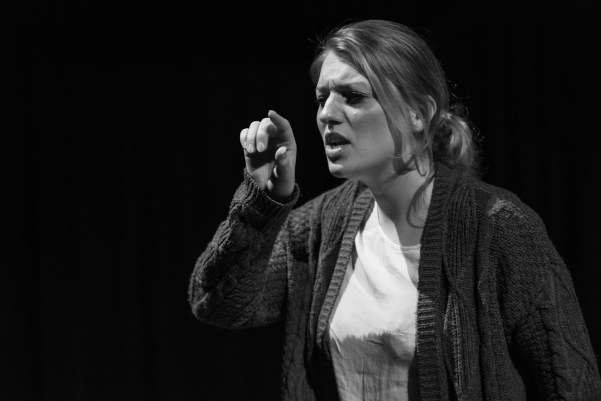
A woman falls asleep in front of the telly waiting for her teenaged son to come home. Instead, the police knocking on her door wake her up at 3 am. Her son’s fine, but he’s done something so horrendous she refuses disclose it.

A woman falls asleep in front of the telly waiting for her teenaged son to come home. Instead, the police knocking on her door wake her up at 3 am. Her son’s fine, but he’s done something so horrendous she refuses disclose it.
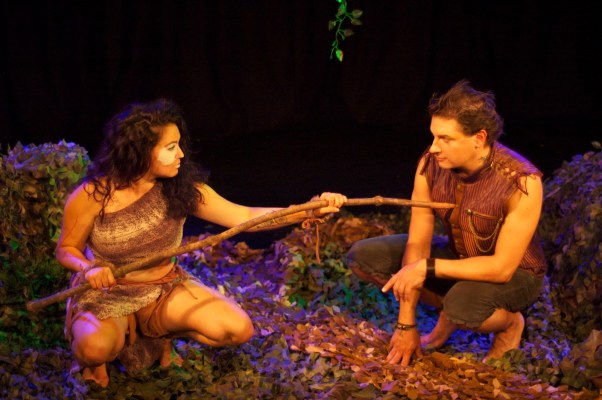
Mowgli, a ferocious boy-child raised by wolves in the jungle, has been kicked out of the pack. He’s trying to figure out what to do next when he meets a mysterious creature from another world – or rather, another story. Puck has been watching Mowgli with unusually keen interest, so the two might be able to help each other out.

by guest critic Simona Negretto
In 1949, George Orwell lived the final months of his life in University College Hospital due to a severe case of tuberculosis. Torn between an uncertain faith in a recovery and the consciousness of the approaching end, hoping to write again, he decided to marry Sonia Brownell, a young and beautiful magazine editor. The marriage, as the play keeps reminding us, was a sort of pragmatic contra-deal conceived more out of interests than of love.

In Duluth, Minnesota, ships, trains and buses come and go under a sweeping midwestern sky heavy with snow. It’s 1934, the height of the Great Depression. A desperate, drifting populace chase the shadows of their debtors and rumours of work in and out of the port city.

A middle-aged, gay Welshman contemplates the English class he teaches in Hong Kong. Amongst the students is Windy, the Chinese woman with whom he shares his bed. Utterly smitten with her, he refers to her as his Pocahontas. He then kisses a barbie doll with long black hair and tanned skin.
Pocahontas was a Native American woman kidnapped by the colonising English in the 1600s, forced to marry, then taken to Britain. The same woman bore her husband a child then died, aged 21, after contracting a European illness.

Women don’t always talk about men.
Women don’t always talk about men.
Women don’t always talk about men.
It bears repeating because it’s often forgotten, ignored or not believed. Popular culture is particularly deaf to the sentiment, and theatre still likes to rely on this inaccurate gender trope. Whilst this has been slowly changing for some time, particularly on the fringe, it’s still a problem.

by guest critic Maeve Campbell
In 2011 Osama Bin Laden was killed, Pope John Paul II was beautified, and Kate and Wills tied the knot. Nearly as many people watched another televised wedding that year as a new reality-TV religion swept the globe. This is where The Marriage of Kim K, a new opera penned by Leoe Mercer and Steven Hyde, begins.

Nearly two years ago, Bj McNeill’s torn apart (dissolution) premiered at Theatre N16. Aussie/Polish company No Offence have since developed the feminist show over subsequent runs. But how much have they improved since their first go?

Hamlet may or may not be Shakespeare’s magnum opus, but the Dane is unquestionably one of the greatest roles in the English language. Theatre’s pop star Robert Icke, what with his reputation for hot takes on the classics, no doubt found the play’s allure irresistible. This Hamlet, freshly transferred to the West End from the Almeida, is a slick, beast of a production surpassing three hours. Undeniably contemporary, it does its best to smash the restrictions of the proscenium arch with a celebrity cast and achingly cool, Scandi/corporate design. His casting of Andrew Scott in the title role and subsequent character choices makes this a Hamlet for cool young people on the hunt for profundity, depth of meaning and instagrammable aesthetics.

I am often impressed with theatre’s ability to transform the most serious of topics into bouncy, chirpy musicals. Tim Rice and Tom Williams looked to the Crusades for their comedic tale of Richard I’s court musician, Blondel, but discarded much of the history. This 1983 show has some great numbers, but its frivolity and insubstantial book focusing on a personal journey rather than the larger political landscape is diminutive rather than powerfully sweeping. This is no Les Mis or Miss Saigon; it is instead an under-developed documentation of a rise to fame – but it still has its moments of fun.
 The Play's The Thing UK