
by Gregory Forrest
The New York Times listed Jennifer Kidwel and Scott R Sheppard’s razor-sharp comedy
as one of the 25 best plays since Angels in America. Like a role-play game that gets
completely out of hand, it’s easy to see why.

by Gregory Forrest
The New York Times listed Jennifer Kidwel and Scott R Sheppard’s razor-sharp comedy
as one of the 25 best plays since Angels in America. Like a role-play game that gets
completely out of hand, it’s easy to see why.

Canada has been taking over over a church behind Summerhall for the last several years with a varied programme showcasing performance from across the country. This year has a distinctly socio-political bent, with controversial Daughter heading the bill.
By Laura Kressly
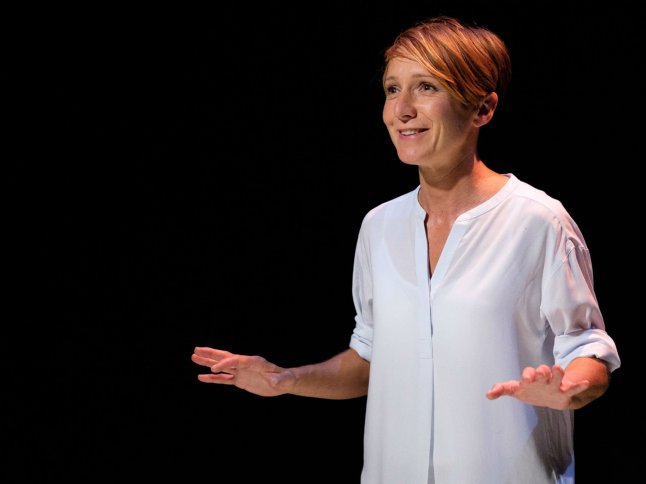
There are guns everywhere in America. Real ones, and pictures of them, hidden and overtly displayed. This constant threat of violence gives the unnamed uni lecturer and mum in this monologue nightmares and anxiety attacks. She awaits the day when a male student takes issue with his grades, or the course content, or anything else that threatens his masculinity and barges into her office or classroom and guns her down.

by Laura Kressly
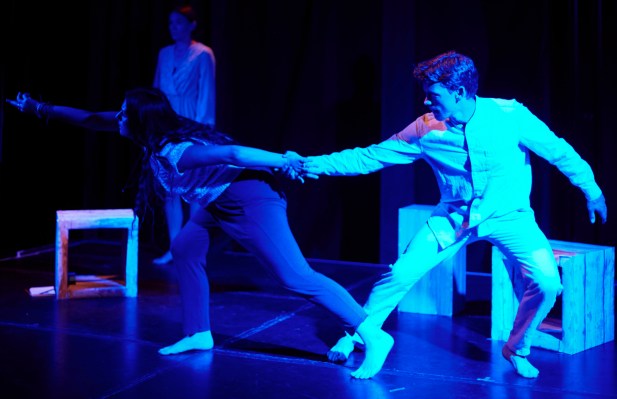
If you were anything other than one of the popular kids, you probably hated school. Matthew’s in the process of coming out as nonbinary so they’re obviously having a bad time of it. Luckily, their best friend Binkie and his fairy godmother RuPaul have their back in this messy, glittery musical ode to being different.
by Laura Kressly
There are many reasons why the classics are still read and performed, with their enduring relevance one of them. Ovid’s Metamorphoses, a narrative poem containing more than 250 different myths, is a wealth of flexible source material that can easily be updated and applied to modern socio-political landscapes. Here, five different myths are updated by five different playwrights to comment on a range of current topics, from #MeToo to the refugee crisis. Ranging in style and quality, the new writing night is largely well-curated and impactful.

by guest critic Meredith Jones Russell
A buoyant cast enters singing their hearts out to “Ireland’s Call”. They are dressed as a variety of Irish stereotypes: a man in a balaclava, a priest, Miss Ireland, an Orangeman, a rugby fan. Caricatures, certainly, but there’s a lot of energy, and the suggestion we might see some of these clichés unpacked and explored.
Then, suddenly, we seem to be in a completely different play. I Am of Ireland, an examination of the complexities and divisions of recent Irish history up to the present day, provides short monologues and scenes focusing on an entirely different set of characters, with a markedly different tone. Continue reading

by guest critic Joanna Trainor
“He wants me to know who I am.”
Sometimes you can question why a theatre has chosen a particular moment to produce a revival of a show. This is not one of those times.

by guest critic Maeve Campbell
On entering a seven-hour long production one might ask the following questions: will I understand the plot, will I be able to sit through it for the duration and will it be worth the plane journey, holiday costs and copious amounts of pilsner consumed over the weekend? The answers are no and no but, to the last question, a resounding yes. Directed by the controversial Frank Castorf, famously ousted as leader of the Volksbühne theatre after nearly fifteen years of service, this production is his swan-song. Castorf’s previous work has been described as ‘deliberately incoherent’, and this Faust does not disappoint.

by guest critic Maeve Campbell
The audience enters the Schaubuhne theatre to voyeuristically inspect the inane musings of two men, protected by the glass of a recording booth at the back of a beautifully brown, wood-panelled studio. This space provides the backdrop for an extended examination of European class politics through reading and discussion of French sociologist Didier Eribon’s memoir, a surprise best-seller in Germany last year.

by guest critic Amy Toledano
Why is the sky blue? What is there to do in Argentina? Why is the sea green? How regularly are young people in the UK and around the world watching pornography? And – more importantly – what affect is it having on their sexual and mental development? These are just some of the questions raised in Abbey Wright’s brand new Why is the Sky Blue?
 The Play's The Thing UK