What I Learned From Johnny Bevan, Soho Theatre; The Caucasian Chalk Circle, Jack Studio Theatre

Is revolution in the air? Or, are we all so broken and defeated by rising costs and a falling quality of life that all we can do is complain bitterly? Perhaps a bit of both? In any case, this is not the first time that I wonder if theatre is responding to the liberal sense of disaffection recently. Shortly before Christmas I questioned Dominic Cavendish’s assertion that theatre isn’t political enough, and my sentiment still stands, particularly after the coincidence of seeing two highly charged political pieces two nights in a row. Fringe theatre, like grassroots politics, is a place of community, a catalyst for change, and the foundations of revolt, as seen in Lazarus Theatre Company’s The Caucasian Chalk Circle and Luke Wright’s What I Learned From Johnny Bevan.

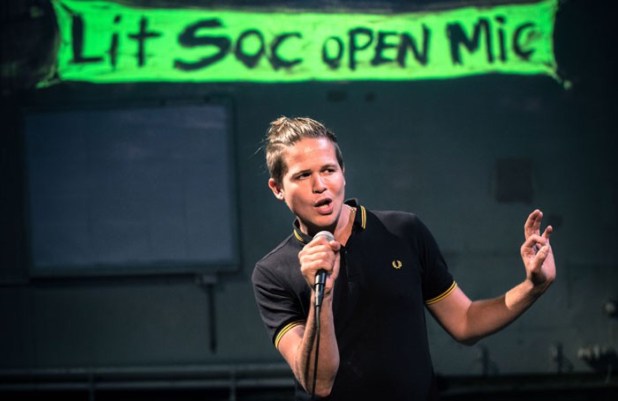
1997. The eve of the general election. Nick, who’s studying English Literature at a nameless uni stays up all night with his best mate, poet Johnny Bevan, to watch Tony Blair win. It’s the dawn of a new era and change is coming for the working class long oppressed by Thatcherite rule.  Fast forward fifteen years and Nick’s a journalist in London, but Johnny’s student aspirations didn’t come to fruition, and neither have Tony Blair’s. The story of these two lads’ friendship, written and performed by Luke Wright in a blaze of fiery spoken word, is an hour long tale of youthful vigour soured by the realities of adult life. Wright’s delivery and writing is fervent, topical and no moment is out of place in the trendy and on-point What I Learned From Johnny Bevan.

South of the river, an older revolution is taking place. In Soviet Russia, a group of peasants stages a play about a servant girl in Georgia raising the governor’s newborn baby that was abandoned during the family’s escape from a war zone. After a perilous journey, sacrifice for the sake of the infant, and a regime change, everything is put right again by a citizen judge. Lazarus Theatre Company, with its trademarks of a large cast and striking visuals, draws parallels between Brecht’s The Caucasian Chalk Circle and the despair of modern life – but “change is hope”. Energetic and in the round, the characters rally the audience to their side like they do in Wright’s monologue.

There’s optimism in both productions as well as despair, and an underlying current of discontent with the state of the UK’s current socio-political trajectory. Both display humanity’s capability for selflessness and selfishness, and the feeling that nothing has changed from Soviet ruled Eastern Europe, to Labour’s late-90’s victory, to present unviable economic conditions and Tory tyranny. We are undeniably flawed with a fickleness vulnerable to power and money, but as a society we are also deeply unhappy and feel that we lack the power to affect change. This sentiment now seems to be emerging in fringe theatre.

Though completely different in form and structure, both What I Learned From Johnny Bevan and The Caucasian Chalk Circle have plenty to say about the contemporary world from similar angles. What I Learned From Johnny Bevan is the better of the two productions, and  the more progressive. A solo performance delivered in spoken word accompanied by charcoal and watercolour landscape projections, most of the imagery in Wright’s language is precise and evocative. Brecht’s well-known play is linguistically stilted and stuffy in contrast, but it’s characters are just as colourful.

Performance poet Luke Wright is a singular tour de force and What I Learned From Johnny Bevan is politically charged and practically flawless. Lazarus Theatre’s performances vary, but of the ten-strong ensemble, no one was particularly strong or weak. Their choreography is well-rehearsed but director Ricky Dukes normally powerful movement sequences  lack impact in the round. The set components take up a lot of space and are used well occasionally, but otherwise clutter the stage with bright, industrial chaos. Neil McKeown’s sound design hints at atmosphere and mood, but is much too quiet to add the impact it could. It’s certainly not a bad production, but neither is it one of Lazarus’ stronger ones.

If theatre is a mirror held up to the world, then evidence is increasing that change is imminent. But what form will it take? Will the people rally as in The Caucasian Chalk Circle or will we either sell out or run away from it all like Nick or Johnny? Only time will tell.

The Play’s the Thing UK is committed to covering fringe and progressive theatre in London and beyond. It is run entirely voluntarily and needs regular support to ensure its survival. For more information and to help The Play’s the Thing UK provide coverage of the theatre that needs reviews the most, visit its patreon.

Mirrors, Rosemary Branch Theatre

rsz_tim_smyth-mirrors-siobhan_mcmillan_54

Photography © Tim Smyth

Maybe the witch in Snow White isn’t that bad. Or, maybe her badness is justified, like she had a traumatic childhood or suffers from a mental illness. Siobhan McMillan proposes just that: Shivvers realizes she’s past her prime and, with insecurity taking over rational thought, she decides to hunt down the young woman who dethroned her from her position as the fairest in the land. This quest takes shape as a solo performance told in the third person, like a fairytale. McMillan regularly interjects with contemporary references and using sarcastic humour to great advantage, makes a strong comment on women’s insecurity about aging.

The use of third person narration is one of the more interesting features of Mirrors; it distances McMillan from the audience and herself. Her physicality and energy cannot be denied as she embodies the characters she simultaneously describes. The audience is told her story but has plenty to watch, and a liberal use of sound and vocal effects create a dynamic aural landscape, even if a touch too loud at times.

The use of an occasional live feed adds another visual layer by which the audience scrutinises Shivvers, but a backlight interferes. The intention shows good instinct by director Jesse Raiment. The set isn’t particularly dyanmic with its black flats and mirrors, save for the ornate frame mounted on a table centre stage – a symbol of modern obsession with female appearance and its dominance in Shivver’s life.

This feminist solo show is an excellent display of performance storytelling and a witty comment on modern life as a woman. Not just about aging, it also looks at female competition, the need to be desired and the perils of dating. With the opportunity of a longer run, Mirrors could upgrade its tech and design to create a more polished production matching its content, creating a piece great for touring small to mid-scale venues.

The Play’s the Thing UK is committed to covering fringe and progressive theatre in London and beyond. It is run entirely voluntarily and needs regular support to ensure its survival. For more information and to help The Play’s the Thing UK provide coverage of the theatre that needs reviews the most, visit its patreon.

Goodnight Polly Jones, Theatre N16

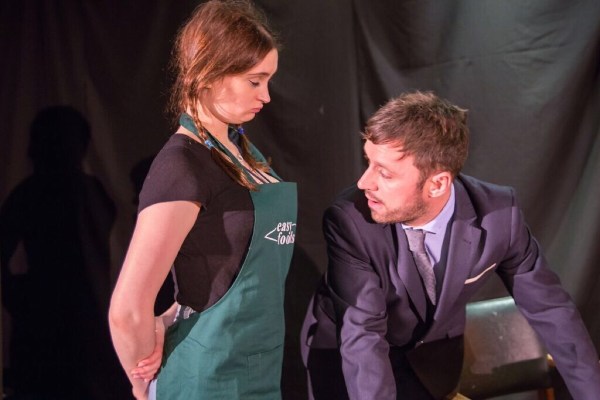
The wonderful thing about new writing is the potential for discovering unknown gems, perfectly formed and ready for a transfer or a tour, or a piece that is still finding its shape but its promise is evident. There’s also the chance of having to endure work that, though trying its hardest, isn’t ready to be put in front of critics. Goodnight Polly Jones is the latter. In its current state, Andrew Sharpe’s script bears more resemblance to a GCSE issue-based devised piece than a play suited to a professional small-scale theatre. Isolated scenes at key plot points and painfully long transitions with busy sound design and terrible voiceovers turn sexual assault and rape into a banal one hour, exacerbated by a performance matching the script’s clunkiness.

Ben Keenan as the jumped up, inappropriately hired Peter provides some redemption. He handles the awkward dialogue and tenuous circumstances extraordinarily well, adding gravitas and emotional truth to the HR manager with a disgustingly flippant disregard for sexual consent. Polly (Victoria Morrison) at her youngest and most immature supermarket clerk manages to match him, but as the older accountant taking that supermarket into administration, she is self-conscious and awkward.

The root problem of this production is the script. Composed solely of four distinct scenes at different times, they show dramatic change in tone and character development, but the story is neglected. This is potentially an important, character-driven play, but there’s no subtlety to the plot – every progression is beaten to death with dialogue rather than shown. The transitions attempt to fill in some gaps, but they too are overt, too long and too cringy, with am dram worthy voice acting. The resolution is half-baked, and Sharpe’s propensity for signposting (that treats the audience as if they were children with ADHD and learning difficulties) misses a glaring, albeit predictable, opportunity to tie up loose ends in the final moments of the play. The scenes as individual units aren’t awful, but the connective thread between them is most thin indeed.

Goodnight Polly Jones doesn’t completely lack potential, but it is in such an early stage of development that it feels wholly inappropriate to stage it in front of a judging audience. A scratch night or a workshop? Absolutely. Though it needs extensive work, it addresses an important issue with some isolated nice moments.

The Play’s the Thing UK is committed to covering fringe and progressive theatre in London and beyond. It is run entirely voluntarily and needs regular support to ensure its survival. For more information and to help The Play’s the Thing UK provide coverage of the theatre that needs reviews the most, visit its patreon.

in/out (a feeling), Hope Theatre

rsz_in_-_out_-_a_feeling-5

Sometimes, simplicity in narrative structure is more effective than twists, heaps of characters and subplots. Storytelling has been a powerful medium for time immemorial. in/out (a feeling) starkly depicts young, Eastern European woman Blue working in a London brothel after promised a cleaning job. Her client Ollie is a coked-up, suburban lad out for his mate’s stag do, but their encounter changes both their lives, at least for a little while. This two-hander is a brutal depiction of sex trafficking and its uncomfortable nearness to us all, but unblinkingly focuses on the delicate humanity of these two characters through interweaving, storytelling monologues. Excellent performances and Andrew Maddock’s sophisticated wordplay and use of rhythm both captivates and horrifies in this outstanding production with few, if any, faults.

Nicholas Clarke and Alex Reynolds are Ollie and Blue. Though rarely addressing each other directly, their chemistry is still tangible. Clarke’s character has a more interesting journey, from lad’s lad to articulate romantic to devoted boyfriend; Reynolds’ is subtler but more devastating. Both have fearless, vulnerable presences and expressive eyes that pierce the audience to the core during extended sequences of direct address. This is a small, intimate play in a similarly sized venue, but these performers fill the room with intensity and then some. The audience feels like they really know them by the end: a remarkable feat.

Director Niall Phillips and lighting designer Çağla Temizsoy put the stage/bed in the round with harsh blue and red lighting. The set design, presumably by Phillips, is similarly harsh and animalistic: white paint slashes the black walls, strips of red fabric hang from the ceiling like intestines. It’s a nightmare to us, but it’s Blue’s reality. Small buckets, like the kind children play with at the beach, dangle at head height. They aren’t filled with sand, though. It’s Ollie’s perpetual supply of cocaine that he lovingly shares with Blue and frantically sniffs during descriptions of his all-night binges. By the end of this 70-minute play, there’s white powder everywhere.

Along with the performances, Maddock’s language is the star of the play. Evocative rhyme hints at spoken word at times, at others his prose dances with colours, imagery and Blue’s memories of a happier life. We meet several other characters through their storytelling: Blue’s pimp, Ollie’s friend Connell, and others. The double meaning and repetition of “in, out” innocuously describes breathing, then the other bodily function that dictates the rhythms of Blue’s existence. Maddock’s ability to wow the audience with his facility of word choice, sentence structure, rhyme and repetition easily tips into the terror that these characters experiences; this is proof of an extraordinary gift with words and evocative storytelling.

Though building awareness of the closeness of human trafficking is clearly the primary purpose of this piece (Do you actually know your neighbours’ isn’t a brothel? I don’t.), in/out (a feeling) could be about anything at all and the language would still have it’s power. This is a production that needs to be seen, but it feels it would lose its intensity in a larger venue. A good portion of the actors’ power hinges on eye contact, which is easily lost in a bigger space. But in/out (a feeling) needs to be seen by more people – by everyone. And it’s a stunning piece of theatre as well as a vital one.

The Play’s the Thing UK is committed to covering fringe and progressive theatre in London and beyond. It is run entirely voluntarily and needs regular support to ensure its survival. For more information and to help The Play’s the Thing UK provide coverage of the theatre that needs reviews the most, visit its patreon.

The Long Road South, King’s Head Theatre

The Civil Rights movement in America was time of turbulence and violence but both black and white activists retaliated with their passion for equality. The issue divided individual families across generations, recreating the conflict on a microcosmic level. Paul Minx’s The Long Road South recreates this excruciating tension through close examination of the dysfunctional Price family in suburban Indiana.

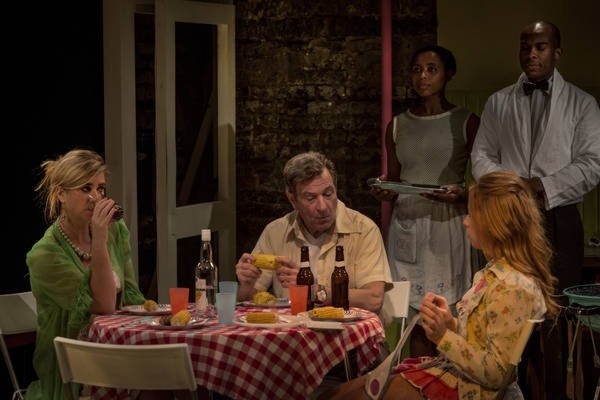
Stay at home Carol Ann (Imogen Stubbs)is mother  to teenager Ivy (Lydea Perkins) and married to supermarket manager Jake (Michael Brandon). They are the only family in their neighbourhood able to afford “help”, black couple Grace (Krissi Bohn) and Andre (Cornelius Macarthy). On the surface, these characters are aspirational and progressive. That American Dream veneer doesn’t hold up for long, though. The characters’ gangrenous innards seep out, creating a kitchen sink drama with excellent moments, dramatic themes  and characterisation akin to Miller and Williams, but lacks the linguistic sophistication of these revolutionary writers and a few too many twists and turns for a one-act play.

The cast is generally strong, with Brandon outshining the rest when he eventually appears in Willy Loman-esque glory. Perkins has a grating vocal quality that, though appropriate to the lying, manipulative character, was nails on a blackboard after a few scenes. Bohn and Macarthy are good foils to each other with a lovely chemistry and sharp edges that sporadically pop out, adding to the dissonance. Stubbs is the tragic heroine, trapped in her house by alcoholism and the memory of an institutionalised child. This lot are a close-knit ensemble, an extended family with all the complexity of a real life one. Unfortunately, the accents spanned the country rather than uniting this family in a common place.

Director Sarah Berger skilfully uses the irregular playing space and space to enhance tension. Rarely touching or even close to each other, this shows the power of religious belief in these characters constantly aware of Satan’s temptations. Adrian Linford’s sunny back garden with its perfectly mowed grass and pastel BBQ juxtaposes the family’s chaos. Minx has an instinct for conflict, but the production’s subtlety comes from the performances rather than the dialogue. There’s no overt moralising or thickly laid Americanisms, just the characters’ genuine need to do what they think is right.

The Long Road South is a quite the good script by a writer with plenty of promise and a great cast. It’s a good reminder of a crucial period of American history, and that monumental change can wreak havoc on the closest of family units. The cast and the characters’ individual stories are certainly the best features here, but the other production elements aren’t far behind.

The Play’s the Thing UK is committed to covering fringe and progressive theatre in London and beyond. It is run entirely voluntarily and needs regular support to ensure its survival. For more information and to help The Play’s the Thing UK provide coverage of the theatre that needs reviews the most, visit its patreon.

Give Me Your Love, Battersea Arts Centre

I’ve grown up always having pet cats and it’s absolutely true that cats love being in cardboard boxes. I stumbled on a Buzzfeed or similar article recently that says cats seek out boxes or other encloses spaces when they’re stressed or in need of comfort. Humans have similar instincts, really. Think about the last time you were upset or stressed: did you want to hide under a duvet, make a pillow fort or crawl into a small, dark space? Or at least curl up into as small of a ball as you could? Observations and life experience indicate we’re pretty similar to our felines in that way. So it would make sense that someone suffering from grief or trauma might hide in a box and never come out.

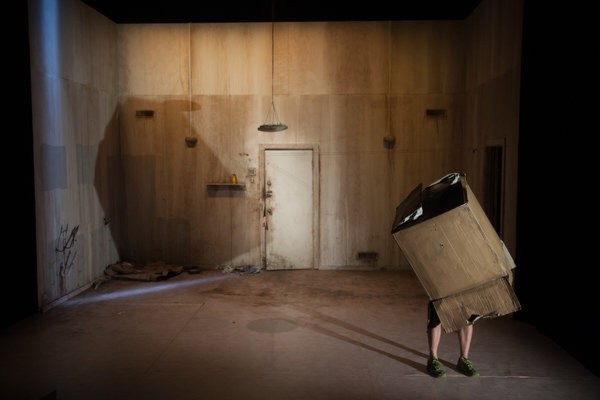
Zach (David Woods) does just that with feline stubbornness and rejection of direct human contact. An Iraq veteran suffering from Post-Traumatic Stress Disorder (PTSD) living with an unsympathetic wife (convincingly voiced offstage by Jon Haynes), we never see Zach’s face, or anyone else’s, in Give Me Your Love. This quiet, tiny show looks empty but brims with feeling in a sophisticated script, discusses cutting edge medical research without boring the audience and shares the horrors of PTSD that many of our vets are left to contend with, unsupported. A talking cardboard box and a patient drug dealer behind a chained door captivate for about an hour with flawless, sensitive performances and detailed dialogue that delicately balances humour and pathos.

Though it’s easy to focus on Woods as the central character, Haynes wonderfully supports and opposes him as wife Carol and friend/drug dealer Ieuan. Carol opposes Zach’s desire to explore MDMA’s potential to cure his PTSD, Ieuan, not unfamiliar with trauma himself, encourages Zach whilst displaying genuine, moving care for him. There’s a brotherly intimacy here that’s lovely to watch, and is perfectly captured by the pair of actors.

Jacob Williams’ set is super-realistic: there are no metaphors here, just the sparse filth that Zach lives in. The detail is in the tiniest things: the way masking tape curls at the edges, the holes in the box for Zach’s arms, the stains on the walls. The lack of people on stage calls for other means of  visual stimulation, and Williams’ work exceeds this tall order very well. Give Me Your Love is never boring, visually or otherwise.  Sound and light by March Cher-Gibard and Richard Vabre match the set’s naturalism, then toy with the audience’s perception of reality through abstract and expressionistic approaches. It’s a jarring transition, but manages to compliment Zach’s turmoil and experimental recovery instead of feeling stuck on and questions what is objective reality and what is in Zach’s head. 

The inclusion of using Ecstasy in PTSD therapy is fascinating research that doesn’t go too much in depth, but can feel extraneous to Zach’s struggle. It’s not about the recovery, but the day-to-day existence and paralysis that can result from action solders experience on the front line. The dialogue still flows, but the research informs the play rather than being the centre of it. This certainly isn’t a bad thing at all because the script could easily end up a lecture; the focus is very much on Zach’s mental and emotional health. The clever use of humour prevents it from becoming a drag, and exquisitely balances the brutality and debilitation of mental health conditions. This is a vital theatrical contribution to the mental health dialogue and de-stigmatisation, and one executed with delicate, detailed skill and a moving emotional journey. A fantastic watch.

The Play’s the Thing UK is committed to covering fringe and progressive theatre in London and beyond. It is run entirely voluntarily and needs regular support to ensure its survival. For more information and to help The Play’s the Thing UK provide coverage of the theatre that needs reviews the most, visit its patreon.

Top Ten Shows of 2015

rsz_top10-620x400

  1. Carmen Disruption 

This Simon Stephens deconstruction bore little resemblance to the opera. Instead, we had a cast of dysfunctional, damaged characters unable to connect with the world around them on any meaningful level. They filled the Almeida with an electric loneliness that grasped the desperate humanity residing deep inside us all before chucking us out, exposed and raw, into the London night.

  1. Pomona

Written by a 27-year-old, Pomona captures the millennial generation in a single play. Frantically set over several levels of dystopian reality and never able to settle, this epitomises those who suffer the consequences of  baby boomers’ past choices.

  1. Light

The first show I ever gave five stars to, after more than a year of criticism. Good intentions and government exploitation address increasing surveillance with stunningly precise physical theatre, object manipulation and light.

  1. Tether 

A two-hander about a blind runner and her guide, this piece is refreshingly unromantic and driven by dialogue and characterisation. This is a simple and powerful piece by a promising young writer set in a world rarely considered by non-disabled people.

  1. Shakespeare & the Alchemy of Gender

A solo performance by veteran Shakespearean, Lisa Wolpe, founder of L.A. Women’s Shakespeare Company. Exquisite extracts of Shakespeare’s most celebrated male roles interspersed with her father’s biography raises important points about performance, gender and family.

  1. Town Hall Cherubs

Theatre Ad Infinitum and Battersea Arts Centre team up to create an immersive, site-specific piece for 2-5 year-olds. Gentle and responsive to the children’s attention spans, this is a bit of a winter treasure hunt around the BAC that stimulates all the senses.

  1. Chef 

Another sharp one-woman show, this one by Sabrina Mahfouz and performed by Jade Anouka. Anouka is a Michelin-star chef who runs the prison kitchen. Part fictional memoir/part foodie homage, this character driven piece cuts an unforgettable character.

  1. This is How We Die

An explosive spoken word/music piece by Canadian Chris Brett Bailey, it defies description and instead must be experienced. A marmite production amongst critics but Bailey’s use of imagery within language is incomparable.

  1. Don Q

A warm and lovely adaptation of Cervantes’ novel, Don Q is an old man’s gleeful adventure story. Four actors multi-role through this story that looks at the way we treat the elderly and the joy of play-acting.

  1. Eclipsed

Set during the Liberian Civil War, the all-woman cast of Danai Gurira’s doesn’t hold back on the experience of women in wartime. This is a brutally raw survival story with the power to leave you shaken, guilty and grateful for the benefits of Western comforts.

Honourable mention: Invisible Treasure

This is an interactive experience that is audience-led, with no actors and no plot. Like a game, the audience is led into a hi-tech room and led through a series of tasks in order to escape. Fun, challenging and frustrating, it makes some powerful points about group dynamics and personal approaches to problem solving.


The Play’s the Thing UK is committed to covering fringe and progressive theatre in London and beyond. It is run entirely voluntarily and needs regular support to ensure its survival. For more information and to help The Play’s the Thing UK provide coverage of the theatre that needs reviews the most, visit its patreon.

The Xmas Carol, Old Red Lion Theatre

rsz_2cc9d33d00000578-3250546-i_ve_never_doubted_that_mr_cameron_like_most_of_his_generation_w-m-2_1443338742165Dominic Cavendish thinks this year’s theatre lacks relevance to current affairs. He’s probably been working under a commercial and subsidized theatre-shaped rock (as mainstream critics are prone to), citing Anders Lustgarten’s Lampedusa as, “number one in a field of one” where, “nothing stood out as ‘the’ play for today.” Matt Trueman defends theatre’s ability to respond at the speed Cavendish would like, and also cites several examples Cavendish neglected: “The Fear of Breathing by Zoe Lafferty and Lucien Bourjeily’s 66 Minutes in Damascus, part of the 2012 LIFT festival, spring to mind, though Cordelia Lynn’s Lela & Co was set in an unnamed country gripped by a similar civil war.” Also springing to mind and not set in Syria but Liberia, Danai Gurira’s Eclipsed starkly presents the victims of another civil war.

The nightmare in Syria driving tens of thousands of people to flee their homeland in search of safety demands global action and aid, of course. But there were numerous other hotbed issues addressed in British theatre over the past year, even the last couple of weeks. Theatre Ad Infinitum’s Light looked at government surveillance, As Is reminded us that AIDS diagnoses are on the rise, Goodstock describes the uncertain life as a young woman with a high risk of breast cancer. Down & Out in Paris and London rallies support for the working poor, The State vs. John Hayes gives us the last night of a schizophrenic woman on death row, and Skyline is a relentless attack on the London housing crisis. There are many others as well, and that’s just in the past year of one critic’s theatregoing.

Within the past week, The Old Red Lion opened Arthur Miller’s first play, No Villain, a love letter to communism and the strikers of 1936 New York City. Accomplished theatre critic and author T L Wiswell also offered her latest work for two nights only, a satirical update of Dickens’ classic Christmas novel to the current 10 Downing Street, The Xmas Carol. That’s just at one venue, not specifically known for political theatre. The Xmas Carol has a dig at pop culture/The X-Factor to frame the consequences of David Cameron’s legislation on everyday, working people after his annual Christmas party, similar to Miller’s use of the strikes to focus on the life of one family out of millions. Both plays need further development (though it’s obviously too late for Miller), but both brashly and fearlessly confront the politics of their day.

In The Xmas Carol, Simon Cowell (Chris Royds) introduces his latest programme that’s sure to be a ratings hit; it’s an interesting meta-theatrical device that works towards justifying Cameron’s (Warren Brooking) travels through his past, present and future. Jason Meininger’s lighting and Keri Danielle Chesser’s sound effectively evoke transitions in time and space. Some more exposition to set up the television show that Cowell is steering would have clarified Cameron’s complicity and aim to improve his ratings, but the device itself is a creative deviation from having Cameron fall asleep and dream the whole thing.

There are some great impressions in the cast, particularly from Luke Theobald as Ghost of Christmas Past Margaret Thatcher. Brooking could have been a louder, bolder Cameron but he captures an element of the man in his gestures and general lack of humanity. Will Bridges is an amusing, though not particularly accurate Jeremy Corbyn but as this is a satire, his punditry can be excused. Jenny Wills as Cameron’s PA Bob Cratchett brings some grounded naturalism to this piece. She’s a lovely character, warm and family focused, with some good dialogue, but her performance style jars with the heightened delivery from the rest of the cast. It works to ground Cameron’s devastating policies in reality, but she could use some backup from other characters. As the play’s currently just under on hour, more down-at-heel, working people could easily be brought in to further emphasise the battle between the ridiculous politicians and celebrities, and the everyday man.

Having gone to a reading of The Xmas Carol about a month ago, the concept has developed quite a bit since then, but the structure could still use additional tightening and detail. More dialogue and exposition will help, particularly in the beginning and end. There are some genuinely funny moments and well-crafted scenes, but a brief resolution. The Tory criticism is relentless and mocking but also pointed and moving. Wiswell is certainly in the process of striking a good balance within the piece, but it needs just a bit more shaping.

Both The Xmas Carol and No Villain are highly political, but in very different ways; the same can be said of many of the aforementioned productions. Sure, they’re not about Syrian civil war and refugees, but they focus on diverse, divisive issues relevant to contemporary life. Perhaps Cavendish needs to visit the fringe more: it’s where angry voices can express their views unfettered, without the burden of corporate sponsors and other such bureaucratic obstacles. These shows don’t have the high production values or years of development and funding that commercial theatre does, but political theatre on the fringe is some of the most raw, honest, relevant theatre I have seen this year.


The Play’s the Thing UK is committed to covering fringe and progressive theatre in London and beyond. It is run entirely voluntarily and needs regular support to ensure its survival. For more information and to help The Play’s the Thing UK provide coverage of the theatre that needs reviews the most, visit its patreon.

No Villain, Old Red Lion Theatre

rsz_no_villain_old_red_lion_theatre_adam_harley_courtesy_of_cameron_harle_5

There’s usually good reason why renowned writers have known but unpublished early works. They hone their craft by writing, usually badly at first, and then have a major breakthrough after they have been writing for some time. Expecting this to be the case with Arthur Miller’s world premiere of the unpublished No Villain, the play proved to be surprisingly good. Miller’s autobiographical one act was written for a playwriting competition when the 20-year-old undergraduate at the University of Michigan was on the verge of leaving due to his family’s losses during the Great Depression. It was in the university’s archives that director Sean Turner found the manuscript mentioned in Miller’s memoirs, dashed off with the desperate hope of saving his Journalism degree. A theatrical and historical relic, the script isn’t a particularly polished affair but brims with youthful enthusiasm, political activism, and familial conflict that hints at the greatness to come in later works like Death of a Salesman and The Crucible.

From beginning to end, tension dominates this story set in 1936 New York City during the strikes that paralysed the garment district and bankrupted businesses barely holding on to their survival. Father Abe Simon (David Bromley) has no sympathy or understanding for the strikers or his sons’ recent discovery and devotion to the new political system taking over the East, Communism. Arnold (Adam Harley) is a thinly veiled Miller who at the beginning of the play returns from Michigan for the holidays. Refusing to help his father (David Bromley) at the shop because it would compromise his principles, older brother Ben (George Turvey) is more practical. The action largely centres around these three men, but the strain of the Depression also shows in their interactions with their mother (Nesba Crenshaw), sister Maxine (Helen Coles) and grandfather (Kenneth Jay).

Focused, emotionally endowed performances in heightened realism and moments of good dialogue generate exquisite set piece scenes, but the overall plot structure and storyline is a bit loose, and the politics are so blatant that it’s agitprop. This is not a subtle play, but it’s certainly not poorly made. The story is a microcosmic representation of Big Issues but it’s clear that this is real life replicated on stage rather than pure fiction. There’s a lot of preaching and arguing and threats, but the actors truthfully capture this almost-constant tension within the family, and these moments are plentiful. Like a baby Death of a Salesman, we see the idealism and father-son relationships that help make Miller one of the greatest dramatists of the 20th century.

Max Dorey’s set and Natalie Pryce’s costumes contribute detail and further authenticity to the production. Stylistically, this is a great example of early 20th century American theatre (but with accents from different parts of the US in one family) made popular by Clurman, Adler, Meisner and the rest of the Group Theatre in the 1920s and 30s. Turner captures this performance style well and in combination with the factual/biographical nature of the script, it feels like the audience is watching a moment of history brought to life.


The Play’s the Thing UK is committed to covering fringe and progressive theatre in London and beyond. It is run entirely voluntarily and needs regular support to ensure its survival. For more information and to help The Play’s the Thing UK provide coverage of the theatre that needs reviews the most, visit its patreon.

Skyline, Ugly Duck

rsz_278df7cf00000578-3032452-image-m-8_1429115791409It’s panto season, and our stages are filled with villains, heroes and dames. Playwright David Bottomley’s new work-in-progress has some passing resemblance to the characters in Britain’s traditional seasonal offerings, but his new play on the London housing crisis is darker, angering fare. Capturing its victims’ lack of power and its perpetuators’ greed, Skyline doesn’t offer a solution but still states a clear opinion on the issue. With a cast of five playing seven characters, the audience sees a microcosmic cross section of social classes who, with poetic and pointed language, are a powerful reminder of the importance of secure housing. There is still some work to be done on the script, but the staged reading in conjunction with a pre-show talk and an exhibition by Alternative Press makes a powerful point that something needs to change to prevent social cleaning through housing policy in London.

Bottomley has a clear gift with words. There’s a subtle poetry that effectively captures his characters’ feelings, laying them exposed and raw for the taking. There could be more differentiation between their rhythms and word choices, though. Drag queen Roxanne’s (Paul L. Martin) closing monologue is similar to that of unemployed single dad and grandfather from Africa, Rex (Kevin Golding). His 28-year-old daughter Tanya occasionally sounds like her Tory MP Francesca (Karen Hill). He does well to go against stereotypes, but there’s a middle ground between them and homogenisation that hasn’t been completely reached yet.

His most complex character is Francesca. Despite being a Tory who’s having an affair with villainous property developer Jasper (Cameron Robertson), the favours she grants him directly conflict with her instinct to do right by her constituents, and values the old London that Jasper desperately wants to demolish. Her dialogue is occasionally overwritten, but she otherwise feels like a real, well-rounded individual. Jasper does as well, though not to the same extent. He could perhaps do with a touch more humanity to make him less cartoonish, even though there must be people out there as horrible as he is. Rex’s inner anguish erupts in balance to the calmer Tanya, who satisfyingly shows her true feelings in Francesca’s surgery. An interesting experiment would be to explore further integration of these characters: what if Rex and Jasper meet? Tanya and Roxanne? There’s space for more scenes without the play feeling too long.

Skyline has plenty of excellent moments, like the only scene between Jasper and Roxanne (a colourful character that’s underused) that shows how truly horrible Jasper is, and Roxanne’s need for a place she can put down roots. Rex’s desperation and Tanya’s resignation come to a head in a climactic final scene, just after Francesca and Jasper do the same. Even though there’s resolution, Bottomley skilfully alludes to the wider landscape and the struggles countless Londoners face due to the housing crisis in these final scenes. Roxanne’s gorgeous monologue that serves as an epilogue underlines the entire play, but dilutes the power in Tanya and Rex’s scene. It would work well earlier, maybe in the scene between her and Jasper.

Though Skyline is still in its development stage, it is remarkably polished and well-structured. A good cast own Bottomley’s rich language and the call for change is clear but not preachy. Some gentle development will whip this story into an even more powerful piece of political theatre.


The Play’s The Thing UK is an independent theatre criticism website maintained voluntarily. Whilst donations are never expected, they are hugely appreciated and will enable more time to be spent reviewing theatre productions of all sizes. Click here to make a donation with PayPal.