Cargo, Arcola Theatre

Cargo at the Arcola Theatre, Milly Thomas, Jack Gouldbourne and Debbie Korley,  Photo by Mark Douet

Civil war is raging in the formerly united, newly named Kingdom. Loyalists and rebels have divided up the charred, frightened remains. Religious fundamentalism and capital punishment are the law of the land. There are furtive rumours of a better life across the channel, and there are regular passages to Calais. Money can buy passports, or if you don’t have any of that, there are people who will help you stow away as Cargo that you can pay later. But safety isn’t a given once you’re on board. The holds of these ships are dark and full of desperate people with shady pasts and their own agendas, and a lot can happen in an 80-minute crossing. Tess Berry-Hart’s script is as much a thriller as it is rousing political theatre, and the diverse cast of four effectively capture a snapshot of the population effected by this tragedy. Though the story is overly convoluted by truths and lies, Cargo provides a timely reminder, like other refugee-themed work at the moment, that we are all human beings in need of a safe and secure life.

Joey (Millie Thomas) is there with her younger brother Iz (Jack Gouldbourne). They’re from the loyalist-controlled docks and have lost everything. Joey’s shrewd and resourceful, Iz is an optimistic innocent who dreams of being a waiter and is the only genuinely nice person on board. Gouldbourne is totally believable as the tween who sees the good in everyone, and is nicely balanced by Thomas’ maternal defensiveness. They meet Sarah (Debbie Korley), an elusive northerner played with brilliant intensity. John Schwab is the slippery American Kayffe, who’s ever-changing biography hides horrific experiences. Berry-Hart never fully reveals the objective truths of the world around them, which is frustrating but leaves plenty to the imagination. The fates of these people are a great unknown in a world where desperation forces people to solely look out for themselves.

Tense from the onset from fear of discovery, anxiety builds quickly though there’s little to do except wait to arrive. These characters have seen so many horrors that relaxing is impossible and anyone could be the enemy. The script is conversational, yet guarded, as the characters attempt to get to know each other. Barry-Hart incorporates believable conflict into the narrative that director David Mercatali approaches with varying pace. The unresolved ending is unsatisfying, but no doubt realistic.

The design team Max Dorey (set), Christopher Nairne (lighting) and Max Pappenheim (sound) create an immersive environment of simple pallets and packaging. The boat is a constant aural presence and the seating, whilst as uncomfortable as the play’s circumstances, is probably pretty accurate. The design exquisitely works together with Mercatali to destabilise the audience; married with the script’s uncertainties it is a most unsettling effect.

Cargo could still use some refining and clarity in order to allow the audience to take in the experience without focusing on following the veracity of the character’s experiences, especially towards the end. Despite this small issue, or really because of it, the experience feels all the more truthful to refugee experience. Even though the concept of re-contextualising it to British people is not new, it is certainly effective. Like other plays on the topic, it humanises displaced people, their need for sanctuary and their vulnerability to exploitation. If theatre repeats these messages enough, the world might start to listen.

Cargo runs through 6 August.

The Play’s the Thing UK is committed to covering fringe and progressive theatre in London and beyond. It is run entirely voluntarily and needs regular support to ensure its survival. For more information and to help The Play’s the Thing UK provide coverage of the theatre that needs reviews the most, visit its patreon.

Unreachable, Royal Court

Anthony Neilson didn’t come into Unreachable rehearsals with a script, but an idea – a director obsessed with finding the perfect light. From this starting point, the cast sculpted a modern satire of the film industry and the people that exist in that world. Over a six-week devising and rehearsal period, six actors worked with Neilson to create the play, a rarity in anything other than small-scale and student theatre. The end result is wickedly funny with on-point performances and, whilst the story isn’t anything remarkable, its execution makes for delicious relief from the chaos of modern Britain.

Maxim (Matt Smith) is Palme d’Or winning writer and director of Child of Ashes, currently filming in an unnamed location. He pushes the self-absorbed, whimsical artist stereotype to the limit with full-on strops, totally inappropriate comments and decisions that blow his producer’s budget. He is camp, temperamental and a fantastic physical comedian. His lead actor Natasha (Tamara Lawrence) is an unfeeling, blunt force of a sociopath who clashes with lead actor Ivan “The Brute” (a sidesplitting Jonjo O’Neill in ridiculous hair extensions). On his production team are the pragmatic producer Amanda Drew, frustrated DOP Richard Pyros, and deaf financial backer Genevieve Barr. Their grounded personalities create plenty of friction (literally, in some cases) by clashing with the flamboyant artists as the shoot goes over budget and over time. Some of the arguments are petty, others deserving, but all just as hilarious. Nielson mocks artists’ egos, but it’s not nasty – anyone working in the arts will have met at least a couple of these personalities in real life.

The comedy lies in the exaggerated characters and brilliant one-liners devised by Nielson and the cast. Even though the scenarios are fairly mundane and the story not particularly interesting in itself, it doesn’t matter one bit. There are some moments of poignancy and genuine intimacy, but Unreachable is really about the laughs. Even without familiarity with working in the arts, even the hardest, most cynical of hearts will find the outstanding performances hilarious. The scenes are often short and episodic, and half an hour could easily be trimmed, though the current two hours doesn’t feel overly long.

Chloe Lamford’s set is the reflectors, flight cases and lights of a film set until the final sequence, when she and lighting designer Chahine Yavroyan can pull out all stops in an impressive display of visual mastery. The only issue with this moment is the fox. Instead of a puppet or forgoing the image all together, an animal that should be in the wild or a sanctuary is paraded about on a lead. It’s a totally unnecessary and cruel device.

In these post-Brexit, unelected Torycore prime minister days where cracking a smile takes immense effort, Unreachable is welcome relief. Even though the play itself is nothing special, experiencing devised theatre in anything more than a tiny fringe venue that doesn’t go more than a couple of minutes without triggering a laugh is a welcome escape from real life.

Unreachable runs through 6 August.

The Play’s the Thing UK is committed to covering fringe and progressive theatre in London and beyond. It is run entirely voluntarily and needs regular support to ensure its survival. For more information and to help The Play’s the Thing UK provide coverage of the theatre that needs reviews the most, visit its patreon.
Fury, Soho Theatre

https://i.guim.co.uk/img/media/c255500e31a395db7d5e99d0e22866efcadc2904/0_0_3907_2727/3907.jpg?w=700&q=55&auto=format&usm=12&fit=max&s=24616b52e71621aa153ffabc5805fe48

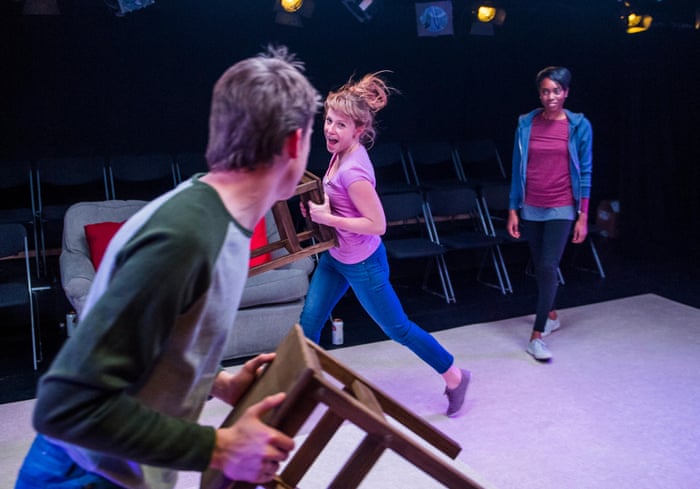
Sam is a young, single mum living in a council flat in Peckham. Having gone through the care system and her boyfriend leaving her after her second son was born, she has no one. When she meets socially inept Tom, an MA student in the flatshare above her, after losing her job as a cleaner, he creates an opportunity for friendship, sex and an escape from her kids. But Sam was born a victim, and a victim she remains. In this discourse on social class, parenting and gaslighting, playwright Phoebe Eclair-Powell incorporates Greek tragedy and a commentating chorus to expose the perils of growing up with no support network.

This is one of the young writer’s first full-length plays, and she’s still finding her feet. Fury has a great concept and characters, and the use of the chorus is a fantastic touch that adds depth and structural variation, but the execution if the ideas isn’t quite there yet. Some sections of the script don’t quite fit the main thread, like her beach outing with an old friend, and others rush the narrative progression. The chorus fills in information left out of the scenes, but this sticking plaster over the gaps is still unsatisfying and overly simplistic. The relationship between Sam (Sarah Ridgeway) and Tom (Alex Austin) escalates a bit too quickly to be plausible, though some slight extending would go far to rectify this.

Ridgeway is excellent as Sam, with a nervous energy and a risk of exploding into violence at any point, making Tom’s manipulation all the more believable to social services. Austin is slimy, awkward and initially seems harmless, but quickly reveals a dark interior. Though he plays the role well, it’s a challenging one because he transforms so quickly. His unlikely behaviour after his initial awkwardness is a powerful reminder that anyone is capable of committing horrendous acts, particularly against vulnerable people. The chorus of three (Naana Agyei-Ampadu, Daniel Kendrick and Anita-Joy Uwajeh) also play additional characters, flipping between them and non-characters with ease and agility.

Director Hannah Hauer-King uses a simple set by Anna Reid to focus on the text. Her in the round staging is a great choice that adds to Sam’s rising paranoia – everyone is indeed watching her every move. The chorus uses seats set into the audience, which although it keeps them ever present, it is unclear why the audience/actor boundary is blurred. She occasionally struggles to clarify space what with the mostly bare stage, but the dialogue usually explains well enough. Hauer-King taps into Eclair-Powell’s poetry with instinctual finesse, making some moments particularly moving.

Though the ended is rather different from the Medea that the show’s marketing compares it to, there is still senseless tragedy brought on by a man’s deliberate actions against a vulnerable woman. Fury shows much potential from the emerging writer and director, and contains some vital messages about growing up poor and female that, with some small adjustments, will be heard loud and clear.

Fury runs through 30 July.

The Play’s the Thing UK is committed to covering fringe and progressive theatre in London and beyond. It is run entirely voluntarily and needs regular support to ensure its survival. For more information and to help The Play’s the Thing UK provide coverage of the theatre that needs reviews the most, visit its patreon.
Ugly Lovely, Old Red Lion

rsz_ffion_jones_and_sophie_hughes_in_ugly_lovely_c_velvet_trumpet_1-1

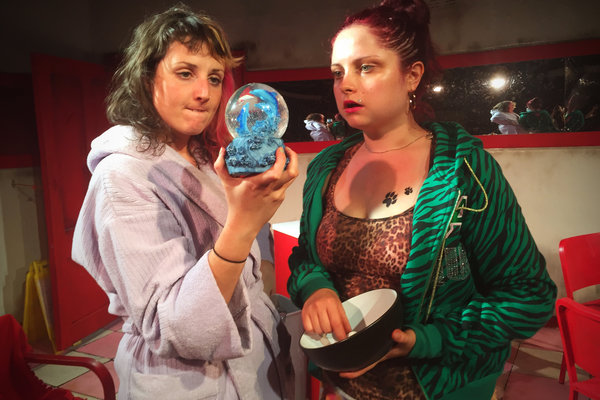
It’s Shell’s 26th birthday and she’s not happy. Her boyfriend Carl is AWOL and probably banging Smelly Kelly, her nan died recently, and she wants to leave Wales for the big city of Liverpool. Her best mate Tash is trying to convince her to stay, but her reasons are far from convincing. Shell is miserable, frustrated and angry. She feels the pull of adventure, but the tug of the sea she knows so well is strong, too. Shell tries to decide what to do as best she can – chatting with the urn that holds her nan’s ashes, going out clubbing and leaving her son Kieran with her mum. Ugly Lovely snapshots down-at-heel but aspirational Swansea with well-rounded characters who are excellently performed within a promising script, but it has a somewhat unsatisfying resolution.

This is writer Ffion Jones’ first play, and as debuts go, it’s a a rather good one. She’s built a sound narrative structure, though some trimming wouldn’t go amiss. The plot isn’t complex enough to warrant the current length or the interval, though too much cutting would rush the climax and dénouement. She has written detailed, nuanced characters with emotional depth that rally the audience’s support, but this leads to disappointment when Shell ignores her ambitions. Jones has an aptitude for sharp dialogue and dark humour, and there are some brilliant comedic moments within the characters’ misery.

Jones plays Shell, endowing the character with emotional truth and lived experience. Sophie Hughes as her best friend Tash is her cheerful sidekick, maintaining a wonderful sense of optimism despite an abusive home life. Oliver Morgan-Thomas rounds out the cast as their laddish schoolmate Robyn who is also doing the best he can to get by, though isn’t the nicest of individuals. His introduction leads to a brutal conflict and adds variation to the individual scenes’ structures, and his rough charm brings a great energy to the dynamic created by the women.

Nikolai Ribnikov’s direction is smooth and instinctive, and Lizzy Leech’s set enhances the gritty naturalism of their day-to-day lives. There is an awkward park bench that doubles as a couch, and the exposed toilet sits unused and exposed in a corner for most of the play, but adds additional dinginess.

This is a great little play that is remarkably polished for a new writer; it shows much promise even though it could use some tweaking. Jones is clearly a skilled theatre maker, and the rest of the creative team serves her script excellently. Production company Velvet Trumpet did exceedingly well in choosing this script, and Jones is certainly one to watch as both an actor and writer.

Ugly Lovely runs through 16 July.

The Play’s the Thing UK is committed to covering fringe and progressive theatre in London and beyond. It is run entirely voluntarily and needs regular support to ensure its survival. For more information and to help The Play’s the Thing UK provide coverage of the theatre that needs reviews the most, visit its patreon.

Savage, Arts Theatre

rsz_gary_fannin_and_bradley_clarkson_in_savage_at_the_arts_theatre_c_roy_tan

Denmark in the mid-1930s was a great place to be if you were gay. Homosexuality was legalized in 1933 and a thriving club scene allowed gay men to meet and socialize publicly. But as the dark cloud of National Socialism swept Europe, safety became more precarious. Dr Carl Vaernet was one of their threats. A practicing GP with an interest in hormone therapy, the Danish Nazi Party member soon captured the attention of party higher ups with his therapies that he claimed cured homosexuality. Hired to cure gay prisoners at Buchenwald late in the war, he experimented on seventeen inmates before the war ended and he escaped to Argentina.

Claudio Macor’s latest play Savage focuses more on the story of Nikolai and his American boyfriend Zack than Dr Vaernet, but the lovers are soon separated and Nik becomes one of the doctor’s victims. The emerging subplot of an SS officer and his secret, gay love slave quickly becomes just as important as Nik and Zack, making Savage more of a play about homosexuality in WWII than specifically about Dr Vaernet and his horrific medical experiments. Spanning several years and multiple narratives, the script, sadly, doesn’t give in-depth attention to any particular character; individual stories are disrupted and incomplete. This would be a much more compelling text if Macor focused attention on one primary character rather than taking a scattergun approach. All of these characters have potential to steer a rich, interesting play that focuses on them, but none of them get the full, individual attention they deserve. There are some great set piece scenes, but the overall structure lacks focus.

Some of the performances are inconsistent and the cast present a range of styles, which distracts from the seriousness of the plot. There are a few good performances, though. Gary Fannin cuts a cold, scientific Dr Vaernet with a clear disgust for gay people; this professional face of homophobia and calm hatred is a most chilling one indeed. Emily Lynne as the doctor’s nurse viciously opposes the Nazis and blatantly defies their rules in a display of ferocious persistence. She’s a great contrast to the doctor’s calm hatred. The two pairs of lovers have moments of genuine care for each other, whereas other times feel forced.

Jamie Attle’s costumes are sharp and detailed, whilst David Shields’ set of rotating panels clarify location but are a bit clumsy. Macor also directs, ensuring his political messages get across but an additional pair of eyes could have developed more intimacy between the couples.

Though the topic is most serious indeed, there’s a distinct lack of joy in the beginning cabaret scene and between Nik and Zack. Macor clearly wants to raise awareness of the horrors of Vaernet’s work, but some lighter moments of exposition would emphasise this further. A dramaturg would not go amiss in order to streamline the script and performance styles in future productions, but this premier still has potential and exposes a historical figure too easily forgotten amidst more prominent Nazi war criminals.

Savage runs through 23 July.

The Play’s the Thing UK is committed to covering fringe and progressive theatre in London and beyond. It is run entirely voluntarily and needs regular support to ensure its survival. For more information and to help The Play’s the Thing UK provide coverage of the theatre that needs reviews the most, visit its patreon.
Karagula, Styx

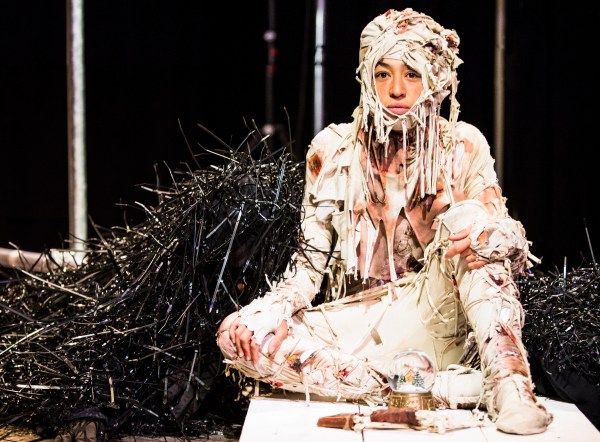
Karagula at The Styx, courtesy of Lara Genovese @ Naiad Photography, Charmaine Wombwell

In a former ambulance depot in Tottenham Hale, Philip Ridley’s latest creation comes to life. This epic parallel world of wholly isolated nation states resembles the worst dystopias imaginable in contemporary fiction. Mareka is a 1950s America with laws enforced to the letter by the Grand Marshall, everyone wears pink, and milkshakes are consumed with religious zeal. Cotna is the future, where people are have numbers instead of names, and watching meteor showers without protective eyewear causes you to hear voices. Then, there’s a community of exiles in the mountains, living in caves, wearing skins, and praying to pre-Christian gods. A storyteller/historian in yet another time and place documents these people and their trials.

These kingdoms have a lot of detail, and a lot of emptiness. The story sprawls over three hours, zipping back and forth across time and place, leaving a swirl of slow understanding, further questions and obvious metaphor in its wake. The text is rich and beautiful, fragmentary and challenging, but it’s only partially reinforced by design. A scaffolding base reveals occasional moments of visual detail, but they generally pale against the language. Karagula is equally marvelous and horrible, an experience for all the senses with stories that enthrall and disturb in equal measure. But Ridley’s Tolkien-esque ambition never reaches its full structural potential.

Individual scenes are just as likely to delight as they are to be forgotten. If Karagula was a tapestry, it would be patchy and moth-eaten in some areas, others would have exquisite embroidery, and still others would be completely plain and ill-fitting. The gaping plot holes leave room for interpretation, but the better scenes feel all the more out of place. Ridley either needs to pare the script right back, or add another couple of hours to join up these worlds more fully. The whole experience is equally delightful and frustrating.

Nine actors play all roles in some exemplary multi-rolling. Producing company PigDog is committed to diversity in casting and audiences, and this cast is admirably so. Obi Abili is a terrifying brutal Grand Marshall in Mareka. Emily Forbes is the fiery leader of the mountain outcasts, initially motherly, then ruthless. Lynette Clarke is similarly versatile, as a flamboyant and vicious Marekan and a cold number in Cotna. None of the ensemble ever let their energy drop; their work is just as fantastic as Ridley’s best scenes.

Director Max Barton approaches the text with clear vision and choices that aid clarity, even in the muddiest sections of text. Designer Shawn Soh has moments of brilliance (beasts with coats of cable ties and a throne of gears and propellers for the narrator are fantastic surprises), but the shoestring budget is noticeable in the inconsistent application of detail.

Despite it’s issues, Karagula packs an emotional punch with social commentary and nihilistic fortune telling. Mareka foreshadows a Trump-led America, and Cotna is a land where technology has ushered in the loss of individualism. There are moments of wonder and horror, and sheer bafflement. Philip Ridley’s vision is commendable, but the execution isn’t quite there, leaving the audience partially sighted. It’s a wondrously alive and human production and like any given human being, it has it its faults and its virtues.

Karagula runs through 9 July.

The Play’s the Thing UK is committed to covering fringe and progressive theatre in London and beyond. It is run entirely voluntarily and needs regular support to ensure its survival. For more information and to help The Play’s the Thing UK provide coverage of the theatre that needs reviews the most, visit its patreon.

Schism, Finborough Theatre

https://i0.wp.com/www.finboroughtheatre.co.uk/assets/images/press-images/schism/pre/Schism-3.jpg

Chicago, 1998. Harrison and Katherine are both struggling. Harrison’s wife recently left him and he gave up a challenging career choice for a safer one as a Math teacher. Fourteen-year-old Katherine’s school cannot see past her cerebral palsy, so she’s not allowed to take “normal” classes. Schism begins when both characters reach breaking point: Harrison is mid-suicide attempt when Katherine breaks into his home to appeal for his help to move into his Math class. This initial meeting spawns a twenty-year long relationship between the two, but not a healthy one. Harrison constantly tries to manipulate and control Katherine, who fights for her independence with progressively underhanded methods. Athena Stevens’ script choppily covers the huge time period in sections, addressing several important issues: autonomy within relationships, abuse, life/work balance, failure and aspiration. A play featuring disability that pushes other topics to the forefront, Schism needs more fleshing out but its messages are loud and clear.

Twenty years is a lot of material to fit into a play and at just over an hour, a lot of the plot is left out. There are about four years between each scene, nicely signposted by a current affairs talk radio show, but pivotal transitions are missing. How does their romantic relationship eventually come about? What are the immediate consequences of his awful behaviour? How does her career develop? How did he manage to keep his job after Katherine, in her final year of high school, hang out at his home regularly? These are unanswered, but easily could be by the addition of more scenes. This wouldn’t effect the episodic nature of the script, but would make the story more satisfying. Despite the clunky narrative arc, Stevens’ dialogue still manages to crackle and easily creates tension. There are some great one-liners that spark belly laughs, and moments that are equally horrifying. As set pieces, the scenes are excellent pieces of writing.

Stevens also plays Katherine and displays a clear sense of ownership over the role. Whether or not there are elements of Katherine in her own life, Stevens performance is emotionally genuine and wholly committed. Tim Beckmann gives a nuanced Harrison who transitions from teacher to lover easily, and maintains an undercurrent of desperation. Alex Marker’s domestic design with the ever-present huge, architectural drawings peeking through the windows is a good reflection of the passion that drives both characters, and director Alex Sims displays a good instinct for portraying the journey of a relationship.

Disability issues are ever present and dictate many of Katherine’s choices, but Schism isn’t about her overcoming adversity. It’s part of who she is, but she has other, more pressing problems – university admissions, bidding for work, whether or not to start a family, and civilian objection to her building projects. Harrison does as well, but they are more psychological and harder to resolve. His inability to cope with Katherine’s success in the field where he failed, his inability to have children with his ex-wife and his inability to let Katherine be an independent woman slowly devour him. It’s compelling to witness. In fact, Schism makes more of a statement about feminism within heterosexual relationships than it does about disability awareness, which is hugely refreshing and shows great progress in theatre equality – Katherine’s disability is a part of her, but only a small one compared to her aspirations.

Schism is a provocative relationship drama that certainly resonates despite the holes in the story. This dysfunctional couple can be both delightful and painful to watch, much like anyone in a modern relationship dealing with the other’s baggage. With some further development, Stevens’ play could pack an even heavier punch.

Schism ran through 14 May.

The Play’s the Thing UK is committed to covering fringe and progressive theatre in London and beyond. It is run entirely voluntarily and needs regular support to ensure its survival. For more information and to help The Play’s the Thing UK provide coverage of the theatre that needs reviews the most, visit its patreon.
Nude, Hope Theatre

Nude- a play by Paul Hewitt - ©HelenMurray-156

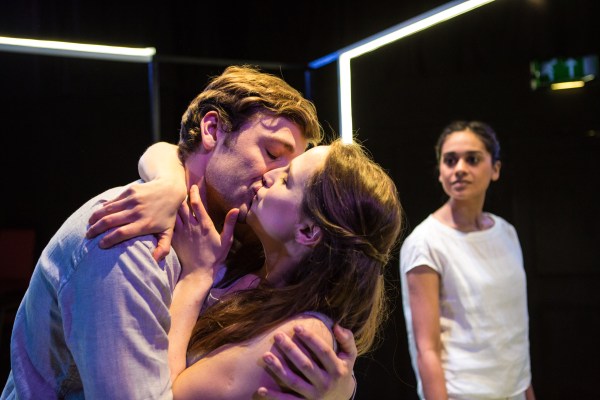
A young couple meet, the relationship blooms, then goes through a rough patch and eventually ends when they are much older. Was it meant to be? Are the events in our lives accidental or controlled by outside forces? Within a standard love story, Nude boldly states that fate has the final word over life, death and love. Playwright Paul Hewitt relies on poetry and narration to tell this tiny, intimate tragedy that feels sadly familiar, like flicking through a dusty photo album of mostly forgotten family members whose memories thrive through stories. Poignant and competently executed, with gaps in the narrative that raise plenty of questions, Hewitt’s script skilfully uses language to depict this couple’s journey and the heavy hand that the personified Fate employs to convince us that we have free will.

Hewitt doesn’t rely on metaphors or overly flowery vocabulary in his rhyming poetry. His language is simple, almost pedestrian, but prettily structured and flows easily from the actors’ mouths. There are a lot of words though, and it’s delivered so quickly that there isn’t much time for in-depth processing. The narrative is a bit chunky with large sections missing and the length of time passing is consequently unclear. His characters are lovely and easy to relate to, though the heteronormative, white, middle class casting of the nameless everyman and woman, that are the focal point of this story, uncomfortably captures the lack of diversity theatre still struggles with. This is countered by a diverse production team and Fate, but romantic leads still lack diversity all to often.

Michelle Fahrenheim and Edward Nash are the charismatic couple controlled by Roshni Rathore as Fate. The three have a relaxed, watchable confidence and natural chemistry, though Fate clearly has the upper hand at all times, even when watching from the peripheral shadows. It creates a great dynamic that’s reminiscent of Prospero or a serious Puck.

Minglu Wang’s minimalist cube that contains the couple in the middle of the space is used well by director Ian Nicholson. Nicholson also incorporates some symbolic black thread, creating a sinister web that further traps the Woman and Man inside their box. This device could have been used more heavily to create a stronger sculptural effect, but was still a nice touch. Creating a space in the round emphasises the idea that the couple are constantly watched and controlled by outside forces – a canny choice.

Though Hewitt’s intention is to focus on a wider philosophical idea, his couple’s story steals the spotlight. Their timeless romance is achingly tragic and well executed textually and through Nicholson’s staging. Nude manages to move the heart even with its small faults, and taps into timeless truths about love, fear and loss.

The Play’s the Thing UK is committed to covering fringe and progressive theatre in London and beyond. It is run entirely voluntarily and needs regular support to ensure its survival. For more information and to help The Play’s the Thing UK provide coverage of the theatre that needs reviews the most, visit its patreon.
 

Gatsby, Union Theatre

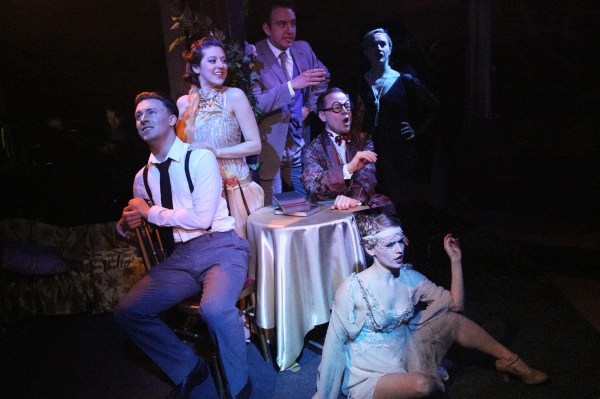
Gatsby (c) Roy Tan (4)

Jay Gatsby’s distinctive yellow car is an iconic image in The Great Gatsby. Power, wealth and charisma emanate from its shimmering, custom paint job as it rolls between Long Island and Manhattan in the decadent 1920s. It’s eye catching and demands attention, like the enigmatic man who owns it. Adaptations of The Great Gatsby are plentiful, but good ones need the same characteristics as Gatsby’s car, along with a generous, heady mix of self-indulgence and extravaganza. Linnie Reedman and Joe Evans’ musical incarnation of F. Scott Fitzgerald’s iconic novel manages to avoid incorporating any these. Bland music, lazy performances and design and a book with numerous shortcomings makes Gatsby a stuttering, third-hand Ford Fiesta rather than a customized, purring Rolls Royce.

Reality TV celeb Ferne McCann makes her theatre debut in this production, bringing a lot of negative publicity with her as consequence. She’s also incredibly surprising – alone in a theatre-trained cast, she is the only one consistently able to be heard over the live actor-musos with her Amy Winehouse-influenced performance. Of the 13-strong cast, most are weak, some terribly so. They are either grotesquely overacted cartoons, or underplayed so much that their performances are flat. There’s no sense of danger or excitement, or EVERYTHING IS EXCITING ALL THE TIME FOR OVER TWO HOURS. It’s exhausting to take in. In either case, the characters are no more than stereotypes; this is more of an issue with Reedman’s book as it certainly doesn’t give the actors much depth to work with. Accents drift around the 50 states and then some, with the only consistent one coming from an actual American.

Reedman also directs, with little comprehension of the narrative arc she constructed from the novel. Other than the Plaza hotel scene late in the play when Daisy and Jay confess all to Tom, there is a pronounced lack of tension. Myrtle’s tragic end is anticlimactic and rushed, as is her husband George’s retaliation. She neglects characterization and seems to focus solely on staging. If that.

There are 21 musical numbers (including a couple of reprises), but none of Joe Evans’ tunes stands out from the rest. Even with a mix of smaller and larger numbers, there is little  musical variation. Transitions from book to song are often abrupt and forced for the sake of fitting in another tune rather than naturally reaching a point in the story where music is necessary to accentuate a plot point or emotion. Nick Pack’s choreography, without much to work with, is similarly unvaried with a bit of a Charleston every now and then.

There are few positives to pull from this production. Reedman and Evans’ interpretation is a choppy hatchet job of Fitzgerald’s work and few, if any, features deem it a worthy adaptation. If Gatsby’s goal is for the audience to “feel…the heat, sweat and life” of the euphoric, post-war American decade, it barely comes close. Tepid, cool and laconic is what actually comes across, in a wheezy motorcar threatening to cut out at any moment.

Gatsby runs through 30th April.

The Play’s the Thing UK is committed to covering fringe and progressive theatre in London and beyond. It is run entirely voluntarily and needs regular support to ensure its survival. For more information and to help The Play’s the Thing UK provide coverage of the theatre that needs reviews the most, visit its patreon.
Russian Dolls, King’s Head Theatre

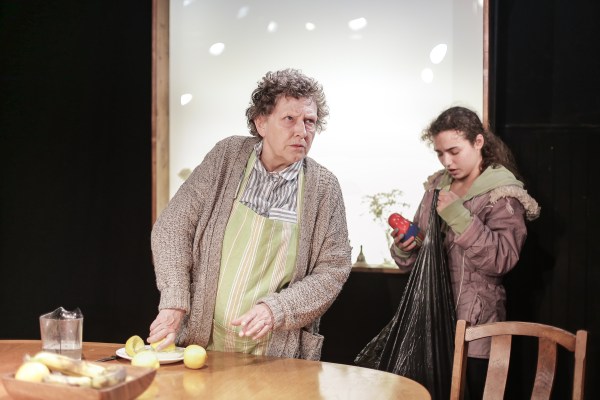
Russian Dolls at King's Head Theatre, Stephanie Fayerman and Mollie Lambert_1 © Andreas Grieger

Camelia’s just got out of young offenders’ but her mum never turned up to collect her, so she’s back to looking after herself. Hilda is a blind elderly woman fending of her goddaughter’s attempts to move her to Basingstoke. When Camelia robs Hilda after tricking into believing she’s covering for her carer, the two end up influencing each other much more than ever expected. Kate Lock’s Russian Dolls tells the fraught story of an unlikely dependency that is doomed to end badly for both women. Lock’s characters are fantastic, and their scenes together are tense and charged with moments of genuine tenderness. In between the scenes are narrative monologues that, whilst providing necessary information, are awkwardly addressed to the ether and disrupt the story’s momentum.

Stephanie Fayerman as Hilda and Mollie Lambert as Camelia are a volatile pair. The energy between them is either stormy or potentially so; the tension makes them wonderfully watchable. Their few scenes of relaxed openness towards the other are fleeting, but hugely rewarding and loaded with tough love. Both performances are excellent, and the dependency on the other is great to watch.

There is no sentimentality towards young people, the care system or aging in Lock’s script. The lack of happy ending is a touch disappointing, but it’s accurate. The stories of young people from broken homes actually managing to turn their lives around are rare considering the 69,540 young people in care as of March last year. Every now and again an “inspiring” case hits the news, but for the majority of these children, their lives are part of an endless cycle of poverty, abuse, drugs and jail time. Well done to Lock for not going the easy route with her narrative.

Structurally, the script is quite simple and there are large, frustrating chronological jumps that skips huge sections of both characters’ emotional journeys. This could easily be a full length, two-act play and would work very well as such. Provided the current ending is kept, a 2 hour or so build up would make it all the more devastating.

Russian Dolls, winner of the Adrian Pagan Award and shortlisted for the Bruntwood Prize, is a bolshy play full of life in all of its glorious imperfections. It’s an honest look at the care system and its flaws, but the actors’ characterization and electric relationship is the highlight of this new play.

Russian Dolls runs through 23 April.

The Play’s the Thing UK is committed to covering fringe and progressive theatre in London and beyond. It is run entirely voluntarily and needs regular support to ensure its survival. For more information and to help The Play’s the Thing UK provide coverage of the theatre that needs reviews the most, visit its patreon.