Father Comes Home From the Wars (Parts 1, 2 & 3), Royal Court

https://i0.wp.com/www.officiallondontheatre.co.uk/servlet/file/store5/item374788/version1/fileservice770/374788_770_preview.jpg

American, Pulitzer Prize-winning playwright Suzan-Lori Parks doesn’t shy away from epic projects. Six years ago, she wrote a play a day to create 365 Days/365 Plays, then went on to write the nine-part Father Comes Home From the Wars. Parts one, two and three centre around Hero, a strapping young slave on a remote Texan farm. Spanning the Civil War, this epic story with influence from Greek myths and contemporary socio-political issues in Parks’ distinctive, poetic language takes its time to develop and has some discordant stylistic choices, but its narrative and historical interpretation is both compelling and important.

Each of the three parts has moments of profound brilliance and devastation, but Parks is in no rush to tell her story. The dialogue-driven script takes its time, meandering around a complex landscape of slavery, loyalty and race within this particular slave family. Though set in war time, there is little action – broader issues drive the conversation more so than current events. This is more of a kitchen sink drama than a wartime adventure story.

Part one solely takes place on the farm as Hero debates whether or not join his master in battle. The rest of the slaves take bets and try to persuade him one way or the other, but in the back of Hero’s mind is a promise from the Boss-Master – but is he likely to keep his end of the deal? Hero’s loyalty is split between his owner and his wife Penny, but the lure of the cast-off but smart uniform proves too much. Though little happens, the domesticity of part one has some of the tension that precedes a huge decision. Seeing a tall, strapping black man in the prime of his life wearing Confederate greys is most unsettling; this paired with the ingrained, accepted attitude that he is the property of his owner is a potent reminder that there has been insufficient progress in America’s attempts at racial equality.

Part two, though set at a particular moment in the midst of the war, has the calm of an eye of a storm and is by far the best of the three parts. Hero and Boss-Master have captured a Yankee prisoner whilst separated from their regiment during a battle. Hero’s loyalty is tested again, this time by his prisoner upon discovery of a secret that’s hidden in plain sight and only skin deep. Racial identity, individuality and freedom intertwine in an intoxicating allure of potential for Hero, who is still doggedly loyal to his owner. The powerful ending devastates in its frank depiction of ingrained attitudes of racial inferiority and liberal frustration with this mentality.

Part three is the more mature sibling to part one. The characters are older, wiser and more world weary in the face of Southern defeat. The pre-war certainty has given way to a chance at the great unknown of freedom, and for the first time they can choose where they live – anywhere in the great, wide world, or on the farm they have known forever. Penny and Hero’s devotion is destabilised in this irrevocably changed world that is now free, but cold and dangerous – and still is for black Americans today. The morality of freedom isn’t black or white here, but the ominous, thought-provoking grey of Hero’s, (now called Ulysses) uniform.

Neil Patel’s unforgiving desert of a set doesn’t have bells and whistles, but it’s sparsity highlights the richness of Park’s language and characterisation. Steve Toussaint is the remarkable Hero, painted with delicate light and shade. The rest of the cast are excellent in their own right, though lack the development of the initially appropriately-named lead.

Parks’ script is almost completely bedded in realism (that’s occasionally heightened), though a talking pet and some contemporary costumes slightly skew reality. Both are used sparingly and without any evident justification across the three parts so their inclusion feels jarring and unnecessary. The onstage musician, though very much a separate commentator, doesn’t clash the way these choices do.

For a play set during a war and a pivotal moment of America’s history, it is oddly detached from violence and conflict. Instead, Parks’ text goes after deeper themes within this transition from slavery to freedom. Though a greater sense of danger and looming dread would add needed further tension in parts one and two, the nuance that flows through the story is undeniably exquisite.

Father Comes Home From the Wars (Parts 1, 2 & 3) run through 22 October.

The Play’s the Thing UK is committed to covering fringe and progressive theatre in London and beyond. It is run entirely voluntarily and needs regular support to ensure its survival. For more information and to help The Play’s the Thing UK provide coverage of the theatre that needs reviews the most, visit its patreon.
Counting Sheep, Edinburgh Festival Fringe

https://i.guim.co.uk/img/media/23913cc392a98f67736cd3cdca806a6774c8940b/0_0_2048_1363/master/2048.jpg?w=620&q=55&auto=format&usm=12&fit=max&s=1feba80ccb7ff150a5842abd1e15ee76

Just over two years ago, a revolution in Kiev ushered in the downfall of the Ukranian government. Protests against the government’s refusal to sign pro-EU legislation lasting months had several violent outbursts that saw hundred of people injured and 780 killed. Toronto-based Ukrainian musician Marichka Kudriavtseva, in Kiev for work at the time, joined the protesters where she met Mark Marczyk, also based in Canada.

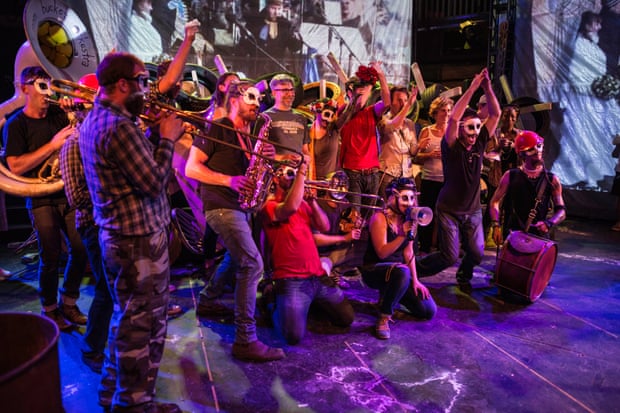
When the two returned from the Ukraine, they teamed up with Marczyk’s Lemon Bucket Orkestra to create Counting Sheep, an immersive “guerrilla folk opera”. A celebration of solidarity and the power of a collective voice, it also mourns those who died in the protests. Told from the perspective of the protesters, little is shared from the other side – but this rallying performance is fitting homage to not just the Ukrainian protesters, but those fighting government tyranny around the world.

Some audience sit around a huge table, whilst others sit on the sides of the space and still others up in a balcony. Klezmer or folk music is playing as the audience enters; there is a convivial atmosphere as the show formally starts. This is a party, or a wedding, or some other huge gathering, until the three screens display news reports of riots and police enter. The tone abruptly shifts, and the world that has been established is dismantled. It’s a wonderful, unsettling surprise.

The space is consistently reformed and redrawn using movement, and the audience is physically moved in the wake of the protesters’ gains and losses. They are willing and unquestioning, the sheep of the title. Though the numbers here obviously pale to those at the actual protest, incorporating the audience in acts such a building barricades and lobbing bricks at police fosters unity from disparate dozens. There is a hint of the solidarity and aggression found in protests, and joy and celebration from the audience who are keen to play. Being served food is also an important enabler that solidifies the unity the show aims to create.

Counting Sheep is hugely effective in its emotional manipulation, and also it’s storytelling through music, movement and projections. Choosing sheep as a metaphor is a curious choice, though. The benign but rather dumb livestock aren’t known for thinking for themselves and are susceptible to herding – otherwise, they wander around unproductively, getting lost and eaten by predators. Whilst the performers are the herders here, they are also in sheep masks, unempowered. Who then are the herders? The government? Unseen forces of political and social unrest? Whatever it is, us human beings are hugely susceptible to it when motivated enough, even if the metaphor isn’t totally clear.

Though sung completely in Ukrainian, there is a clear storyline conveyed through projections and movement. There is little nuance in this piece, but it a playground for the sweeping emotions of popular theatre. It provides at least a hint of the experience that the Ukrainian protesters endured, and powerfully unites the audience through the humanity of collective experience for a common goal. An excellent piece of theatre.

Counting Sheep runs through 29th August.

The Play’s the Thing UK is committed to covering fringe and progressive theatre in London and beyond. It is run entirely voluntarily and needs regular support to ensure its survival. For more information and to help The Play’s the Thing UK provide coverage of the theatre that needs reviews the most, visit its patreon.

Two Man Show, Edinburgh Festival Fringe

https://files.list.co.uk/images/2016/08/19/rashdash-twomanshow-credit-the-other-richard-lst216304.jpg

RashDash are angry. Like, fucking furious level of angry. They’re fed up of patriarchal language and gender stereotypes that limit both men and women from expressing themselves honestly. So they made a show about it. Two Man Show has three women in it, music and dance, nudity and a lot of explosive energy. It’s part science lecture, part role play and part celebration of who we are without others’ judgment and categorisation based on gender expression. It’s a fantastic, “fuck yeah” explosion of pretty skirts, masculinity, tits, cockfighting and nonconformity. It’s also pretty bloody brilliant.

Out of an opening tirade on equality in the dawn of human history, Abbi Greenland and Helen Goalen take on the roles of two brothers, Dan and John. They don’t get on, arguing almost constantly about caring responsibilities for their terminally ill father. Their fighting builds in between movement and dance sequences of surprising intimacy and tenderness.

The culmination to Dan and John’s tension is a fantastic eruption of John’s frustrated masculinity feeling limited by “man things”. His words twists through Abbi’s, the man-woman who is happy in her own skin but doesn’t really suit any of that girly shit. Helen’s feminine contrast powerfully reinforces the importance of choice and freedom and that a woman doesn’t need to be butch to be a feminist and a man can express his feelings and do “feminine things” without his heterosexual maleness being threatened.

Greenland and Goalen’s performances are endowed with conviction and energy, and both are skilled physical performers who can convincingly play men, even with their breasts unveiled. They are accompanied by a musician, who backs them up with unfettered tunes of frustration and celebration.

This is a truly feminist show. Rather than blaming men, Two Man Show looks at the conventions of language that aids female suppression and acknowledges that men are not served by this system, either. Fabulously sequinned and ferociously opinionated, this is not one to miss.

Two Man Show runs through 27th August.

The Play’s the Thing UK is committed to covering fringe and progressive theatre in London and beyond. It is run entirely voluntarily and needs regular support to ensure its survival. For more information and to help The Play’s the Thing UK provide coverage of the theatre that needs reviews the most, visit its patreon.
Macbeth: without words, Edinburgh Festival Fringe

https://i0.wp.com/edinburghfestivalguide.co.uk/wp-content/uploads/2015/11/Macbeth-Without-Words-Ludens-Ensemble-Photo-by-Chrysa-Karagianni.jpg

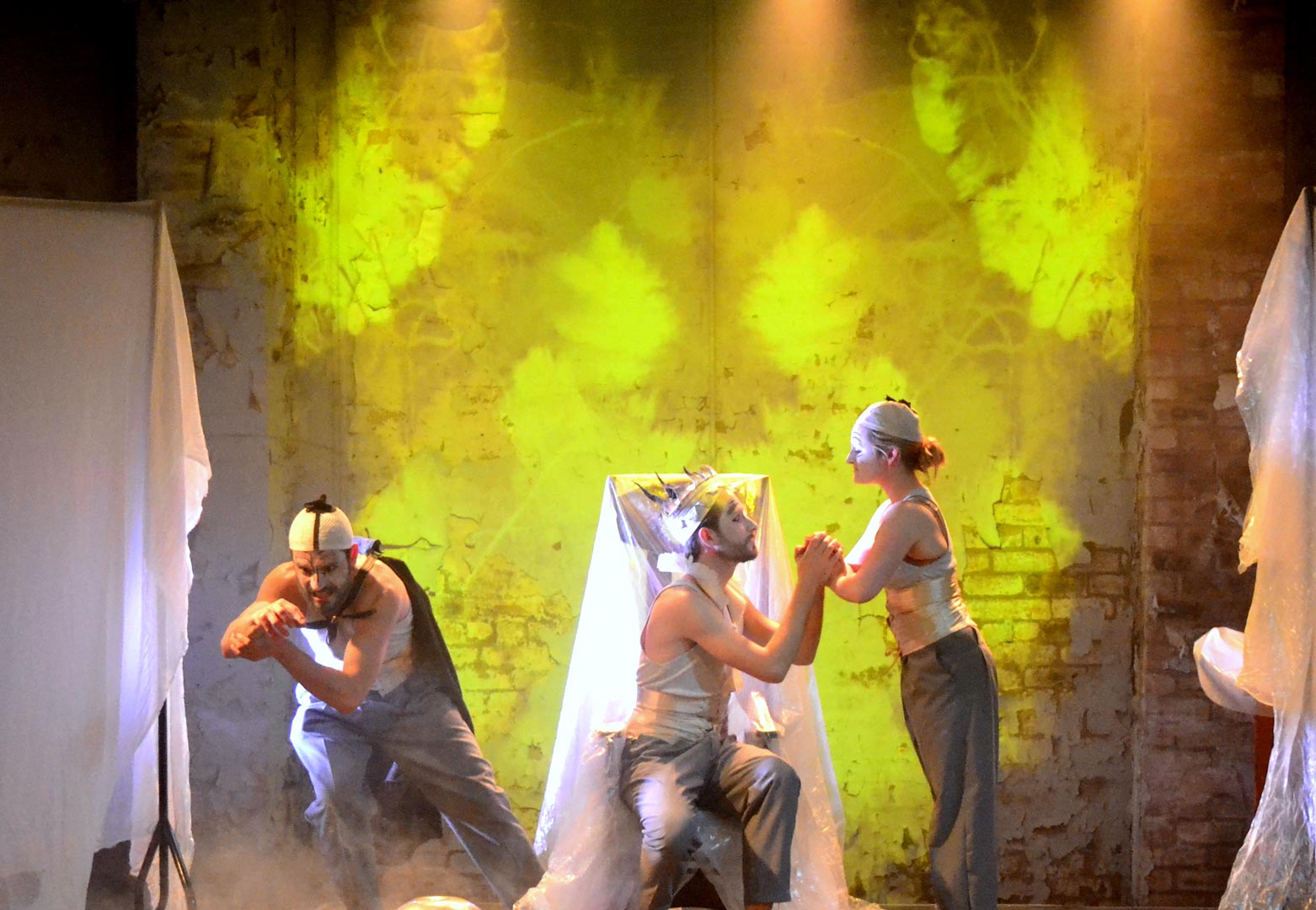
Shakespeare without words. What’s left? In Ludens Ensemble’s Macbeth: without words, plenty. Drawing on the aesthetic of silent films and Victorian gothic with the near-constant use of live sound mixing, a trio of performers playing all roles conveys the story effectively through movement and subtitles. This spooky adaption taps into the heavy darkness and supernatural elements of the story in an easy to follow and visually compelling production.

The design is the most striking element of the show. Greyscale, sexless costumes are the base for elements of victoriana – waspies, a skeletal skirt, capes and papery crowns. Large screens and dust sheets host an array of productions, from silent movie captions to abstract splodges of colour. Haze is used liberally, but it actually feels appropriate to this production to create fog over the heath. The dust sheets are also cleverly used to create ghostly apparitions and shadows, though these could be used more often as a design motif. Two microphones and prerecorded sounds are mixed live to create rich soundscape of suspense and violence, though silence is used to highlight powerful moments of suspense.

The two men and one women are strong physical performers evidently influenced by theatrical clowning and animal work. Their focus and intensity are unwavering, especially as Macbeth’s torment grows. Expressed outwardly, this becomes the centre of the story.

Though there are a few extracts of text, stage directions and summaries projected, Macbeth: without words would be hard to follow without knowing the story already. A freesheet with a plot summary would go a long way to ensure all audience members are catered for. Some of the scenes could use lengthening to reflect their importance to the story, particularly the banquet scene.

This is a visually stunning adaptation of Shakespeare’s play that in no way underserves the original by stripping away the text. Ludens Ensemble create a vocabulary of movement, images and sound that feels just as rich as Shakespeare’s.

Macbeth: without words runs through 29th August.

The Play’s the Thing UK is committed to covering fringe and progressive theatre in London and beyond. It is run entirely voluntarily and needs regular support to ensure its survival. For more information and to help The Play’s the Thing UK provide coverage of the theatre that needs reviews the most, visit its patreon.

Exactly Like You, Edinburgh Festival Fringe

https://i0.wp.com/www.underbellyedinburgh.co.uk/images/made/images/uploads/1000w-x-640h-px_750_500_60_c1.jpg

Things have never been easy for Abby. She doesn’t get on with her mum, she’s didn’t do well in school, she drifts from one shitty job to another without any purpose or goals. She misses her Nana, with whom she would spend long hours writing fantastical stories and listening to music. Nina Simone was their favourite. In Exactly Like You, Lotte Rice tells Abby’s story through a moving, passionate spoken word monologue on losing her way and finding it again.

Rice’s way with words makes Abby funny and relatable, the sort of woman you could sit down with over a pint or a cup of tea and natter about all and sundry going on in the world. She would always have a story or an anecdote to share that would make you laugh or think, or both. Her decision to make Abby a working class, down-at-heel character so expressive and articulate through spoken word is a fantastic choice rather than catering to the stereotype of working class young people as grunting cokeheads who only live for nights out on the piss. The piece is punctuated with soulful renditions of Nina Simone’s songs, effectively breaking up the dense text. Though Abby’s story isn’t remarkable in itself, the mode of telling it is hugely refreshing.

Designer Elouise Farley and lighting designer Zanna Woodgate work together to create a landscape of glowing bookcases, the sort that fit vinyl records. Though simple and subtle, they capture the inner warmth of Abby’s Nana who lived for music of all sorts. They are her memories of her time with Nana, always present and always driving her forward, and a lovely addition that makes the piece feel more polished than a bare stage.

When Abby hits rock bottom after yet another night out drowning her painful memories with too much whiskey, an unexpected helping hand appears. Fortunately, this is not some benevolent, condescending force sent to save her. Abby’s journey is one of reflective self-discovery told in an engaging, lively format with fantastic music to boot.

Exactly Like You runs through 28th August.

The Play’s the Thing UK is committed to covering fringe and progressive theatre in London and beyond. It is run entirely voluntarily and needs regular support to ensure its survival. For more information and to help The Play’s the Thing UK provide coverage of the theatre that needs reviews the most, visit its patreon.

Please Excuse My Dear Aunt Sally, Edinburgh Festival Fringe

https://www.thestage.co.uk/wp-content/uploads/2016/08/please-700x455.jpg

When fourteen-year-old boy Red starts at a new school after his parents’ divorce, his mum anxiously worries about him making friends. Soon, his mobile is constantly buzzing with texts and he’s out most evenings. Mum’s happy but she only sees the life Red constructs especially for her. Someone, or rather something, else has the privilege of an uncensored view – Red’s mobile. As the vulnerable boy is sexually exploited by his unsatisfied maths teacher, his phone sees everything and narrates the story around the characters’ interactions. This slick ensemble piece by NY theatre company One Year Lease seamlessly merges writing styles, design and physical theatre to tell a dream-like story of abuse veiled as love.

When Red’s maths teacher confiscates his mobile and accidentally takes it home with her instead of her own phone, she begins a downward spiral of communication that quickly becomes personal. Red’s parents separation is far from pleasant, and his teacher’s boyfriend is an unemployed layabout, with vague dreams of designing apps. This combination fosters a relationship where the teacher and the student inappropriately confide in each other, and she does nothing to stop it.

Suspicion helps propel the action upwards towards a climactic end, but a lack of consequence in Kevin Armento’s resolution is as disturbing as the story itself. The phone as narrator is a great device – it’s present enough to add context and framing, but is not overused to the point of becoming a gimmick. Abstract movement incorporating versatile set pieces adds a striking, dynamic visual and a disconnect from reality appropriate to a forbidden relationship. A live musical score by Estelle Bajou enhances the surrealism of the staging.

Mathematical equations coldly explain how their illicit affair develops, and minimalist design in black and white juxtaposes the intricacies of the complex lives that collide so inappropriately. Though the script avoids blatant condemnation of the relationship, Please Excuse My Dear Aunt Sally is a striking blend of visual and verbal storytelling.

Please Excuse My Dear Aunt Sally runs through 28th August.

The Play’s the Thing UK is committed to covering fringe and progressive theatre in London and beyond. It is run entirely voluntarily and needs regular support to ensure its survival. For more information and to help The Play’s the Thing UK provide coverage of the theatre that needs reviews the most, visit its patreon.
Bucket List, Edinburgh Festival Fringe

rsz_cpf9rwlwgaagznb

The North American Free Trade Agreement (NAFTA) between Canada, the US and Mexico came into effect on 1 January, 1994. I was eleven years old. The agreement ushered in a degree of national prosperity for all three countries, but Mexico’s low minimum wage, lax environmental regulations and corrupt officials made a perfect storm for sweatshop conditions in the US-owned factories (maquiladoras) taking advantage of the exchange rate and unemployment in Mexican border towns. The maquiladora owners favoured female workers for their diligence and precision and employed girls as young as fourteen, who were better suited for working 12-hour days in harsh environments than older women or clumsy men. These girls, only a few years older than me, were assembling electronics and convenience items out of toxic materials for 39 cents an hour.

I’m American. Though I hide it well with a deliberately constructed accent and uniquely British habits and mannerisms that I’ve developed in the nearly twelve years that I’ve lived here, I still have the passport, the cultural history and the guilt to prove it. Normally that guilt is shaped like guns, healthcare or Trump, but it occasionally takes on other forms. This time it’s privilege. That privilege/guilt pours down my cheeks in hot, angry tears during Theatre Ad Infinitum’s Bucket List. The story of the women and girls’ lives dictated by the maquiladoras, some as young as me, is a horrifying contrast to the suburban middle-class upbringing I had, kept busy with school and music lessons and theatre rehearsals and ambitions. I may have had something that these girls made, some frivolous object bought without thinking in order to make my life easier or better, and I was totally oblivious to their hardship. I did not have to worry about my mother being killed for protesting the maquiladoras’ pollution, or about my auntie being raped by her manager, or getting cancer from the chemicals I encountered on a daily basis.

But for the women and girls in Bucket List, that is their life. The all-female, international cast, directed by Nir Paldi, devised a magical realism story of these desperate factory towns based on an idea from Mexican company member Vicky Araico Casas. Incorporating George Mann’s distinctive choreography and live music, Bucket List tells the story of Milagros (played by Casas), a girl growing up in one of these towns dominated by maquiladoras. Her generation’s experiences and those of her mother’s interweave, creating a landscape of labour, political protests, coming of age and revenge. It is a dense story covering a decade of these women’s lives, but Paldi’s script is easy to follow. Magical realism creeps in stealthily, and only at the end of the performance do certain events seem untenable and raise the question of whether or not they actually happened. Regardless of this fuzzy line between reality and fantasy, Bucket List is an anthem of strength that roars with political agenda and gives voice to the disregarded victims of developed nations.

Initially more of a montage of life experiences, Milagros’ story slowly begins to emerge. This could shift slightly earlier in the piece, but the exposition at the beginning gives wider context and does not feel extraneous. Paldi maintains a careful balance of these women’s lives and a wider, North American political picture that slightly tips in favour of the women, but there is enough of the outside world’s oppression and token assistance to inspire the characters’ rage and passion. Milagros’ tragic end adds fuel to the production’s fury against exploitation that comes out as a roar rather than a whimper.

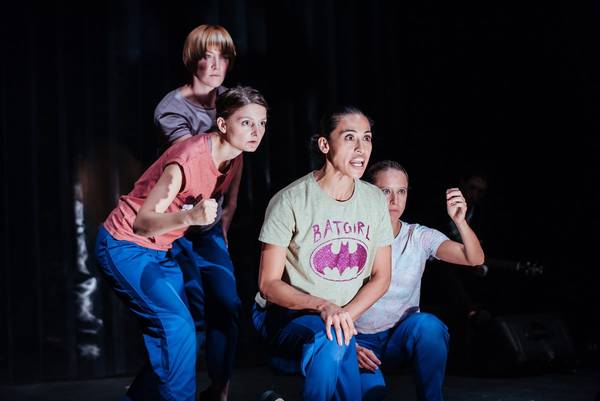
There is hardly any set and technology on display, a dramatic change from their last adult show, Light. Instead, costume plays a bright but subtle role in the story – the five women playing the girls and their family wear coloured t-shirts with cartoon characters often idealised by young girls. Disney princesses, Batgirl and Alice in Wonderland offer them an American-created fantasy that they can strive for but will most certainly never achieve.

Juxtaposed against these pastel tops are quite vicious games demonising the powerful politicians and corporations that shape their lives. They also mock their working conditions, daily violence at the hands of men and threats to their lives. Milagros’ mother (Deborah Pugh) is a vocal political protester, demonstrating a ferocity also contrasting her character’s clothing. The excellent live score by Amy Nostbakken is more of a direct expression of the fighting spirit and sadness within these women.

Though a text-driven piece, Mann uses a series of motifs that soon become recognisable, indicating specific actions and locations. They enhance the understanding and often act as a substitute for words. Though used regularly, Mann’s choreography is one of the company’s trademarks and is unfortunately underused, especially considering the lack of set.

Even though NAFTA is over twenty years old, the maquiladoras are still there, employing women for long hours, polluting local rivers and creating environments ripe for exploitation. Paldi’s script aggressively demands awareness which may be unpalatable to some, but should be required viewing for every American blissfully unaware of their brothers and sisters across the border that are so often looked down upon with racist disgust. Bucket List is truly vital theatre in our age of disposable, thoughtless consumerism.

Bucket List runs through 29th August.

The Play’s the Thing UK is committed to covering fringe and progressive theatre in London and beyond. It is run entirely voluntarily and needs regular support to ensure its survival. For more information and to help The Play’s the Thing UK provide coverage of the theatre that needs reviews the most, visit its patreon.

The Ruff Guide to Shakespeare, Edinburgh Festival Fringe

https://files.list.co.uk/images/2016/07/26/ruffguide_large.jpg

There’s a good amount of Shakespeare-based work for children and young people at the fringe, which is a great way to introduce children to his work as well as give theatre makers a chance to experiment with different styles when approaching the bard’s text. The Ruff Guide to Shakespeare is a mashup of his most popular plays and characters with a biography of his life. There’s a lot packed into an hour, perhaps too much for the primary school middle years that are the target audience age. The show is otherwise well written, well performed and the story line constructed out of Shakespeare’s life gives it a solid grounding on which to sample extracts of his work.

Six Bristol Old Vic students perform Toby Hulse’s script. Though there isn’t a weak link amongst the cast, the strongest by far is Georgia Frost. She has a charisma and stage presence that the others lack, though they all show promise. The company handles their verse well, maintains high energy and warmly encourage the audience of children to join in.

The script is quick and punchy, most valuable for giving the young audience context about Shakespeare as a person in a easily digestible format framed by his “seven ages of man” monologue – a fantastic idea that parallels a short piece of text to a story. There are gags, games and songs that are interactive and playful, though more time could be taken within each activity in order to allow the audience to engage fully. The characters and scenes that are included are some of the most well known, kept short and explained well. There are a lot of them though, and the sheer amount is potentially overwhelming for the younger children in the audience.

Comparable to the Reduced Shakespeare Company’s The Complete Works of William Shakespeare (Abridged), this is a jolly, friendly romp through Shakespeare’s life and works that’s great for a young audience. Some tweaking to either cut some of the characters or pitch it to slightly older children would make this an even stronger piece, but it’s polished, slick and jolly good fun compared to similar shows on offer.

The Ruff Guide to Shakespeare runs through 19th August.

The Play’s the Thing UK is committed to covering fringe and progressive theatre in London and beyond. It is run entirely voluntarily and needs regular support to ensure its survival. For more information and to help The Play’s the Thing UK provide coverage of the theatre that needs reviews the most, visit its patreon.

Lucy McCormick: Triple Threat, Edinburgh Festival Fringe

https://files.list.co.uk/images/2016/08/05/lucy-mccormick-triple-threat-750-500-lst214192.jpg

A cultural relic of its time, the bible is hardly pro-women. Lucy McCormick, here incarnated as one of those vapid pop stars who evangelically (and often inappropriately) rallies for the cause they’re currently backing, wants to turn the spotlight on the new testament’s women. She focuses on their underwritten stories, their emotional involvement in Jesus’ life, and all the fingering and angel snogging that was left out of the text we know so well in Western culture.

Trashy, tasteless, obscene, and absolutely excellent, McCormick’s newest show pushes theatre to to limits of acceptability and beyond – any further and it would be pornographic (arguably it already is), though Lucy McCormick: Triple Threat is still not one for those easily offended. Accompanied by two muscly dancers in Calvins, her three-act play that she dutifully explains scene by scene is the story of Jesus Christ. She plays Mary Magdalene, Jesus’ mother Mary, and Jesus himself, with her backing dancers in the supporting roles. It’s also very funny, though laughter swells from amusement as much as it does from discomfort.

This gig-theatre piece is interspersed with appropriate pop songs at key moments of the story, accompanied by excellent dancing and raw emotional outbursts. Her personal life bleeds into the act as she slowly falls apart in the wake of the pressures of celebrity life. Take all of those public celeb breakdowns and multiply them by hundreds with a lot more nudity and mess, and you get something resembling the whirlwind of in-yer-face chaos that is Lucy’s stage persona in this piece.

Her commitment to her cause is unquestionable, but the fact that her character finds the actions that unfold acceptable is disturbing, yet all too familiar. That we can watch someone fall to bits with no dignity and laugh at their plight, righteously judging them, is a powerful comment on the levels of voyeurism and exhibitionism that are now bombard us through all of media’s incarnations.

Lucy McCormick: Triple Threat, for all its deliberate mess and audience discomfort, is a fantastically considered social commentary executed with precision and high levels of consideration and skill. It’s the epitome of fringe shows, and a great one at that.

Lucy McCormick: Triple Threat runs through 28th August.

The Play’s the Thing UK is committed to covering fringe and progressive theatre in London and beyond. It is run entirely voluntarily and needs regular support to ensure its survival. For more information and to help The Play’s the Thing UK provide coverage of the theatre that needs reviews the most, visit its patreon.

Swansong and Road to Huntsville, Edinburgh Festival Fringe

https://files.list.co.uk/images/2016/08/10/road-to-huntsville-lst207084.jpg

Though climate change has long been a problem, political theatre often ignores it. DugOut’s Swansong faces the issue head on, placing four survivors of a global flood in a swan pedalo. A capella songs and situation comedy bring plenty of joy and laughter to the boat, but the enormity of their survival and uncertain future weighs heavy. Will they find land, or will they kill each other first?

Like the start of a joke, hippy vegan Bobby, posh boy Steven, gym bunny Claire and nihilist Adam are on a boat, and have been for at least a little while now. They’ve already worked out exactly how to wind each other up, which generates the comedy that keeps Sadie Spencer and Tom Black’s script from becoming too heavy. The lightness contrasting the serious of their post-apocalyptic waterworld tips more towards comedy, but the balance mostly works. As they make plans for rebuilding the world to the vision they are creating from scratch in Bobby’s journal (obviously with plenty of arguments), there’s a natural progression towards eventuality – will they find land and survive, or will they all die on the pedalo?

The characters are rather stereotypical for the sake of comedy; despite this there are some poignant moments of understanding and empathy. They are effectively performed but somewhat lacking in depth, though sung interludes between scenes and the resolution help negate this unsatisfaction.

This spirited production is a relief from more sombre approaches to political issues, and a good laugh at that despite its shortcomings. Road to Huntsville is an entirely different beast, though the topic is just as infrequent on British stages. Theatre maker Stephanie Ridings stumbles across a documentary about women who fall in love with prisoners on America’s death rows. Thinking this could be the start of a new play, she latches onto the subject and delves into a world that she doesn’t understand, but doesn’t want to judge. As her research leads her further down the rabbit hole, she emerges in the “death penality capital” of the country, Huntsville, Texas.

Road to Huntsville shares Ridings’ process and turns it into a story of itself. More of a documentary, there are no preconceptions – we are in a theatre to hear about her findings. The curious but emotionally detached beginning takes its time to cave into emotional connection with the people she meets who are at the mercy of a state sanctioned killing machine. This show is a slow burner, but by the end, her passion and rage against the death penalty rally the audience to her side. Her frustrated helplessness hangs heavily in the air as she tries to return to normal life, then she does the same to us, sending us out into the busy joy of Summerhall. Though it makes for melancholy, lingering reflection, Ridings’ reminder that not everyone has the privilege of living in a country where the government won’t kill you if you commit a crime.

Swansong runs through 29th August, Road to Huntsville runs through 28th August.

The Play’s the Thing UK is committed to covering fringe and progressive theatre in London and beyond. It is run entirely voluntarily and needs regular support to ensure its survival. For more information and to help The Play’s the Thing UK provide coverage of the theatre that needs reviews the most, visit its patreon.