by Emma Lamond
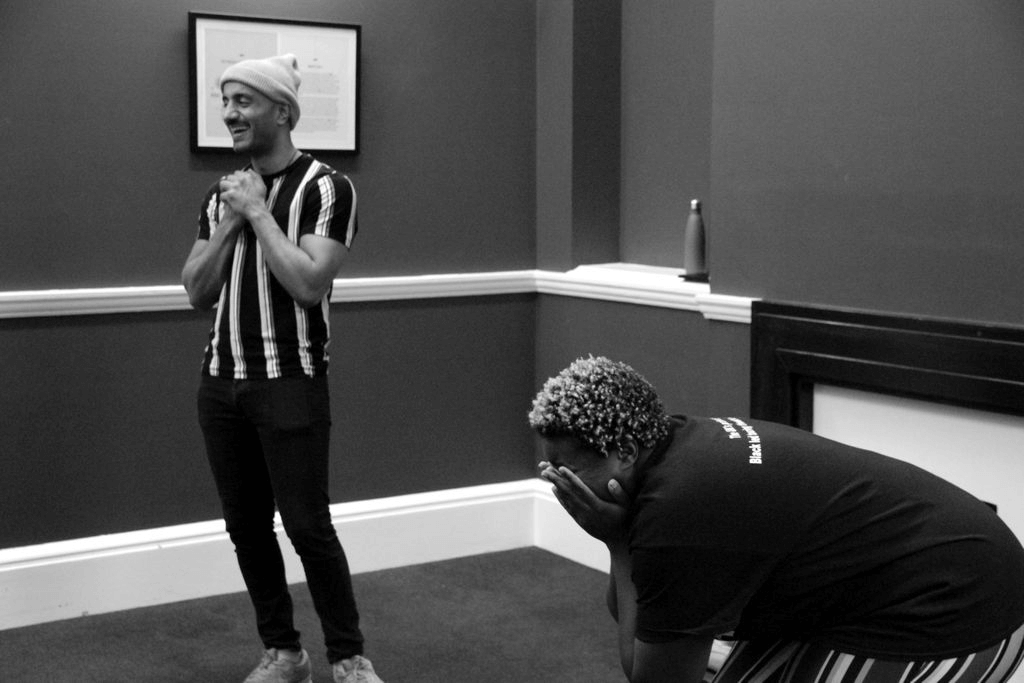
Poor mental health can make us horrible people, and nobody talks enough about it. This play does just that with nuance and painful realism.

by Emma Lamond
Poor mental health can make us horrible people, and nobody talks enough about it. This play does just that with nuance and painful realism.
by Grace Bouchard
As I stand to leave, my foot lands on something soft as it squashes into the ground. I pick up my shoe to see a glistening, pink strawberry, now jam, on the floor. That’s a shame, I think to myself. I could have eaten that.
by Evangeline Cullingworth
Yes, this is my first time in Dingle – no, I’ve not been out on the peninsula yet and yes, I’ll make sure to say hello to Fungie. The next thing I know we’re splitting a bag of Taytos with the row in front and cheering along to a traditional song that has risen up. And the play hasn’t even started yet.

by Laura Kressly
Croydon’s Fairfield Halls re-opened to much fanfare this year, and their traditional pantomime – with all the glitz, glamour and gags that you’d expect – is ramped up with Disney-quality animations, LED screens and special effects. Though all the problematic elements of panto are still there – like heteronormativity, misogyny, and narrow gender roles – this production showcase the capabilities of tech within what is now a conservative form.
By Laura Kressly
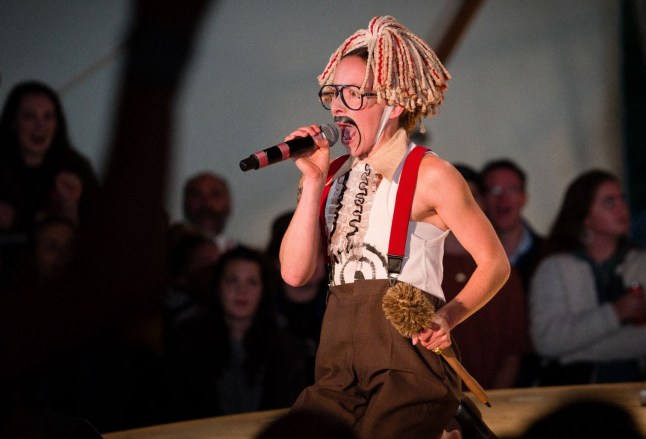
It’s election day in Lovelyville, a place that lives up to its name and is the exact opposite of Britain at the moment. Its citizens are friendly, cheerful and compassionate, and when Nick Dallas is reelected president, things should keep ticking on quietly as usual. Of course, people can’t leave well enough alone and good things never last forever – Mr and Mrs Ubu have just arrived in town with sinister ambitions.
by Laura Kressly
A new Caryl Churchill play is a special occasion, but four at once is a treat. Radically different in tone and theme, this collection ranges from pleasantly surreal to shocking and strange. Though they stand alone as short plays, as a whole they take on an array of society’s ills – but the pronounced concepts that Churchill is known for occasionally stale here, despite regular moments of brilliance.
by Laura Kressly
“Welcome to the glitter zone!”
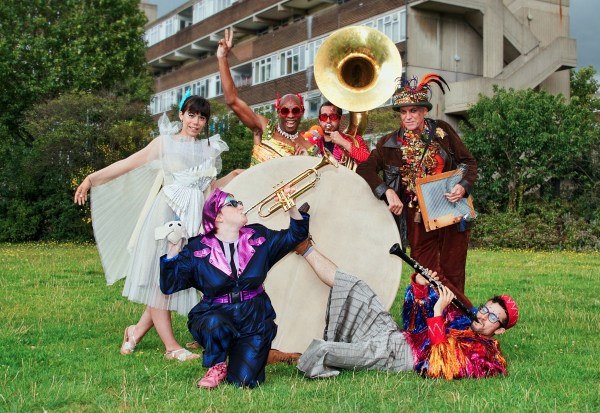
I’m greeted exuberantly by one of the actors, who are mid-yoga warmup when I arrive. Though I try my best to quietly enter their rehearsal space, I’m flustered by a series of train and tube delays that mean I arrived nearly half an hour after I intended and it’s impossible for me to not be noticed. I self-consciously wave, smile, and settle into the chair that’s closest to the door. There are musical instruments, costume, sound equipment and lots of ‘stuff’ everywhere in their Tooting rehearsal room overlooking a school’s playground. And indeed, glitter.

by Laura Kressly
Since 2003, there has been a summer of free, open-air theatre at The Scoop, a sweeping, granite amphitheatre on the Thames next to City Hall. This year’s double-bill is a 90-minute version of Shakespeare’s Twelfth Night and a new children’s musical, The Sea Queen. Performed by one cast doing double-duty, Twelfth Night is the far superior show though there is plenty to appeal to young children in The Sea Queen.

by Nastazja Somers
Casa Festival, London’s largest Latin American arts festival is an annual event that is not
to be missed. Some of the most groundbreaking and refreshing work I’ve seen in my 8 years in London was staged at Casa, including the incredible, heart-stopping 2017 production of Mendoza, a Mexican adaptation of Macbeth. British theatre reflects British society so to say a resistance to staging international work is quite present would be an understatement.

by Laura Kressly
Viewed through a contemporary lens, this can be considered one of Shakespeare’s more problematic plays. A woman prisoner forced to marry her conqueror’s leader, a man trying to force his daughter into an arranged marriage, and fairies forcing teenagers and each other to fall in love, are key aspects of the story that can’t be cut and all are framed by comedy. But at Michelle Terry’s gaff, director Sean Holmes deals with the first admirably and embraces the chaos of the latter two in this psychedelic, fever-dream of an interpretation that is colourful, pacey and full of contemporary jokes.

 The Play's The Thing UK