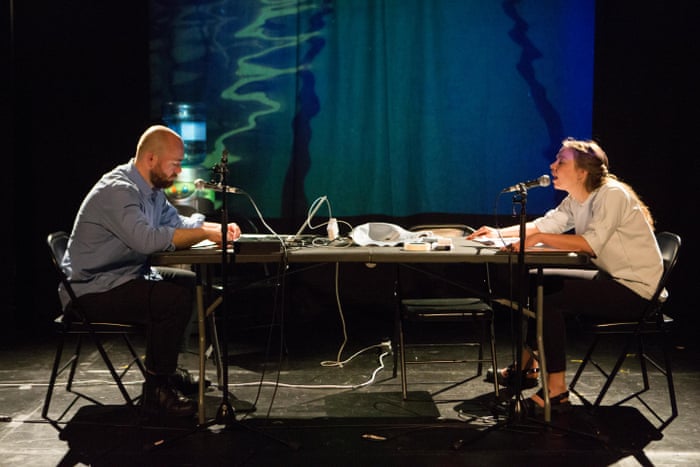
Like their debut production The Beanfield, Breach Theatre’s second show Tank recreates a contentious historical event in a distinctive meta-theatrical mashup of forms and styles.

Like their debut production The Beanfield, Breach Theatre’s second show Tank recreates a contentious historical event in a distinctive meta-theatrical mashup of forms and styles.

RashDash are angry. Like, fucking furious level of angry. They’re fed up of patriarchal language and gender stereotypes that limit both men and women from expressing themselves honestly. So they made a show about it. Two Man Show has three women in it, music and dance, nudity and a lot of explosive energy. It’s part science lecture, part role play and part celebration of who we are without others’ judgment and categorisation based on gender expression. It’s a fantastic, “fuck yeah” explosion of pretty skirts, masculinity, tits, cockfighting and nonconformity. It’s also pretty bloody brilliant.
Out of an opening tirade on equality in the dawn of human history, Abbi Greenland and Helen Goalen take on the roles of two brothers, Dan and John. They don’t get on, arguing almost constantly about caring responsibilities for their terminally ill father. Their fighting builds in between movement and dance sequences of surprising intimacy and tenderness.
The culmination to Dan and John’s tension is a fantastic eruption of John’s frustrated masculinity feeling limited by “man things”. His words twists through Abbi’s, the man-woman who is happy in her own skin but doesn’t really suit any of that girly shit. Helen’s feminine contrast powerfully reinforces the importance of choice and freedom and that a woman doesn’t need to be butch to be a feminist and a man can express his feelings and do “feminine things” without his heterosexual maleness being threatened.
Greenland and Goalen’s performances are endowed with conviction and energy, and both are skilled physical performers who can convincingly play men, even with their breasts unveiled. They are accompanied by a musician, who backs them up with unfettered tunes of frustration and celebration.
This is a truly feminist show. Rather than blaming men, Two Man Show looks at the conventions of language that aids female suppression and acknowledges that men are not served by this system, either. Fabulously sequinned and ferociously opinionated, this is not one to miss.
Two Man Show runs through 27th August.
The Play’s the Thing UK is committed to covering fringe and progressive theatre in London and beyond. It is run entirely voluntarily and needs regular support to ensure its survival. For more information and to help The Play’s the Thing UK provide coverage of the theatre that needs reviews the most, visit its patreon.

Playwright Alice Birch wants to start a revolution. Revolt. She Said. Revolt Again. seeks to challenge the patriarchal language and social structures that hold woman second place to men. Being polite and socially acceptable isn’t going to achieve this, and the marketing material states that this play is not well behaved.The issue is that it is. The collection of scenarios with chaotic climax and resigned footnote of an ending starts out strong, but quickly loses sight of its goals through a lot of talking but few suggestions for effective action.
The first scene between a heterosexual couple is the most effective as he talks about all the things he wants to do to her body, and she corrects his language from one of his ownership to one of hers. The subject matter is provocative, funny and establishes a model that women can actually use. It’s not badly behaved, though – it’s polite, considerate and a bit uncomfortable, but not revolutionary. Subsequent scenes have less of a practical application; this isn’t a problem in and of itself, but these scenarios are much less of a catalyst in a show about taking action. There is some rejection of social convention, but little seen as radical. A culminating babble of voices largely indistinct from each other goes on entirely too long and due to the challenge of deciphering specific lines has little impact.
A cast of four, three women and one man, play a range of characters though disappointingly, the characters are middle class and English. Surely the issues that are presented – the language of sexual domination, consent, reproduction, family, flexible working – effect working class people as well.
Madeleine Girling keeps her set simple and efficient, using only items that are fully functional to each scene. Lighting designer Claire Gerrens creates angular, starkly delineated spaces that support the simple demand for equality and empowerment.
Birch certainly uses language well and constructs dynamic, interesting characters but the lack of much motivating material creates a lot of bluster with little change. The script also avoids any issues of intersectionality, particularly social class and race, even though one of the actors is black. Her goals are certainly admirable, but Revolt. She Said. Revolt Again.? More like have a chat and then carry on with your life.
Revolt. She Said. Revolt Again. runs through 28th August.
The Play’s the Thing UK is committed to covering fringe and progressive theatre in London and beyond. It is run entirely voluntarily and needs regular support to ensure its survival. For more information and to help The Play’s the Thing UK provide coverage of the theatre that needs reviews the most, visit its patreon.
The North American Free Trade Agreement (NAFTA) between Canada, the US and Mexico came into effect on 1 January, 1994. I was eleven years old. The agreement ushered in a degree of national prosperity for all three countries, but Mexico’s low minimum wage, lax environmental regulations and corrupt officials made a perfect storm for sweatshop conditions in the US-owned factories (maquiladoras) taking advantage of the exchange rate and unemployment in Mexican border towns. The maquiladora owners favoured female workers for their diligence and precision and employed girls as young as fourteen, who were better suited for working 12-hour days in harsh environments than older women or clumsy men. These girls, only a few years older than me, were assembling electronics and convenience items out of toxic materials for 39 cents an hour.
I’m American. Though I hide it well with a deliberately constructed accent and uniquely British habits and mannerisms that I’ve developed in the nearly twelve years that I’ve lived here, I still have the passport, the cultural history and the guilt to prove it. Normally that guilt is shaped like guns, healthcare or Trump, but it occasionally takes on other forms. This time it’s privilege. That privilege/guilt pours down my cheeks in hot, angry tears during Theatre Ad Infinitum’s Bucket List. The story of the women and girls’ lives dictated by the maquiladoras, some as young as me, is a horrifying contrast to the suburban middle-class upbringing I had, kept busy with school and music lessons and theatre rehearsals and ambitions. I may have had something that these girls made, some frivolous object bought without thinking in order to make my life easier or better, and I was totally oblivious to their hardship. I did not have to worry about my mother being killed for protesting the maquiladoras’ pollution, or about my auntie being raped by her manager, or getting cancer from the chemicals I encountered on a daily basis.
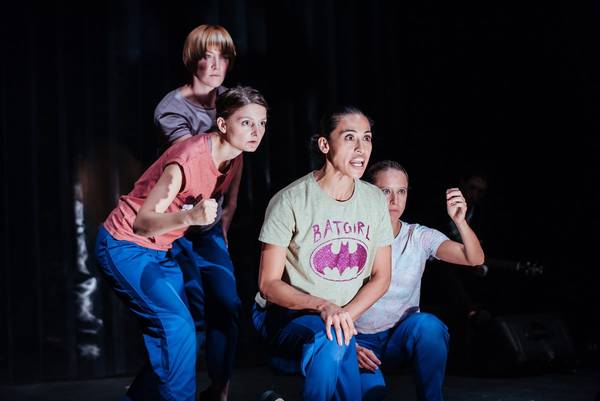
But for the women and girls in Bucket List, that is their life. The all-female, international cast, directed by Nir Paldi, devised a magical realism story of these desperate factory towns based on an idea from Mexican company member Vicky Araico Casas. Incorporating George Mann’s distinctive choreography and live music, Bucket List tells the story of Milagros (played by Casas), a girl growing up in one of these towns dominated by maquiladoras. Her generation’s experiences and those of her mother’s interweave, creating a landscape of labour, political protests, coming of age and revenge. It is a dense story covering a decade of these women’s lives, but Paldi’s script is easy to follow. Magical realism creeps in stealthily, and only at the end of the performance do certain events seem untenable and raise the question of whether or not they actually happened. Regardless of this fuzzy line between reality and fantasy, Bucket List is an anthem of strength that roars with political agenda and gives voice to the disregarded victims of developed nations.
Initially more of a montage of life experiences, Milagros’ story slowly begins to emerge. This could shift slightly earlier in the piece, but the exposition at the beginning gives wider context and does not feel extraneous. Paldi maintains a careful balance of these women’s lives and a wider, North American political picture that slightly tips in favour of the women, but there is enough of the outside world’s oppression and token assistance to inspire the characters’ rage and passion. Milagros’ tragic end adds fuel to the production’s fury against exploitation that comes out as a roar rather than a whimper.
There is hardly any set and technology on display, a dramatic change from their last adult show, Light. Instead, costume plays a bright but subtle role in the story – the five women playing the girls and their family wear coloured t-shirts with cartoon characters often idealised by young girls. Disney princesses, Batgirl and Alice in Wonderland offer them an American-created fantasy that they can strive for but will most certainly never achieve.
Juxtaposed against these pastel tops are quite vicious games demonising the powerful politicians and corporations that shape their lives. They also mock their working conditions, daily violence at the hands of men and threats to their lives. Milagros’ mother (Deborah Pugh) is a vocal political protester, demonstrating a ferocity also contrasting her character’s clothing. The excellent live score by Amy Nostbakken is more of a direct expression of the fighting spirit and sadness within these women.
Though a text-driven piece, Mann uses a series of motifs that soon become recognisable, indicating specific actions and locations. They enhance the understanding and often act as a substitute for words. Though used regularly, Mann’s choreography is one of the company’s trademarks and is unfortunately underused, especially considering the lack of set.
Even though NAFTA is over twenty years old, the maquiladoras are still there, employing women for long hours, polluting local rivers and creating environments ripe for exploitation. Paldi’s script aggressively demands awareness which may be unpalatable to some, but should be required viewing for every American blissfully unaware of their brothers and sisters across the border that are so often looked down upon with racist disgust. Bucket List is truly vital theatre in our age of disposable, thoughtless consumerism.
Bucket List runs through 29th August.
The Play’s the Thing UK is committed to covering fringe and progressive theatre in London and beyond. It is run entirely voluntarily and needs regular support to ensure its survival. For more information and to help The Play’s the Thing UK provide coverage of the theatre that needs reviews the most, visit its patreon.

I was gutted when I found out Janet Adler and Margaret Gibb aren’t real. The portrait Tim Crouch paints of this fictional couple and their anti-capitalist approach to their art, in striking contrast to a deranged Method actor and her coach making a film about Adler’s life, is so well-formed that they feel that that they can’t not be real. Even though the reality of these characters is so detailed through their dialogue, Crouch’s staging and choreography is wholly unrealistic and often absurd, a work of art in itself. This rigid stylisation, though eventually giving way, rebels against convention just as the characters do. These two sets of characters and the staging battle for dominance in a wonderfully compelling and disturbing commentary on the ownership, commodification and nature of art and its creators.
A nameless student begins with a lecture, and intersperses scenes with a discourse on Janet Adler’s life and work, shaping and contextualising the woman that actor Louise discusses with zealous devotion. Despite these strong feelings, Louise is unmoving, staring straight ahead. Her teacher Sam is the same; though their voices have some emotion, their bodies are rigid as they stare through they audience. Adler’s widow, Margaret, assumes the same style when she first appears. A boy moves any necessary props, wearing wireless headphones with instructions whispered to him by a woman sitting upstage with a microphone. Some of the props are appropriate to the action, some totally absurd. The boy’s innocence and movement is powerfully accentuated amongst the stillness; though he is a child, he has control of all physical action rather than the adults. The sculptural staging with juxtaposed power becomes a thoughtful commentary on art’s relationship with its audience, something Adler may have approved of.
Though the performances aren’t wooden in the least, the distance they maintain through roughly half of the play is frustrating, albeit canny. It works as a concept within a play about art and the detailed characters are built through dialogue, but the initial lack of connection between them leaves a gaping void.
Cath Whitefield endows Louise with a fanatical “I will stop at nothing” attitude that’s both satisfying to look down on and be disturbed by. Her and Sam’s visit to the house where Adler and Gibb last lived and their subsequent choices are a potent critique of the Method acting technique, as well as any other justification of awful behaviour for the sake of making art. Her character’s abrasiveness effectively generates empathy for Adler’s widow Margaret, ferociously played by Gina Moxley, who also shows moving tenderness when faced with the memories of her partner.
The richness of the characters and the feeling that they live beyond this play is the strength of Crouch’s writing, but the messages contained therein are important to consider. Who does art belong to once it’s in front of an audience? Where are the boundaries of an homage to the dead? Who do any resulting accolades belong to? It’s certainly thought-provoking stuff to consider the lineage of the cultural products we consume. Despite all the good intentions in the world, what damage may have been caused in the research and making of that book/film/play/artwork/song that we consume so casually?
Adler & Gibb runs through 27th August.
The Play’s the Thing UK is committed to covering fringe and progressive theatre in London and beyond. It is run entirely voluntarily and needs regular support to ensure its survival. For more information and to help The Play’s the Thing UK provide coverage of the theatre that needs reviews the most, visit its patreon.

As great as it is to see Shakespeare inspiring contemporary theatre makers to create derivative work, like any new writing it has the chance of missing the mark by a long shot. Annika Nyman’s Romeo and Juliet Post Scriptum poses the question, “What happens and Romeo and Juliet don’t die?” and the answer isn’t pretty, nor well thought out or well-written. Z Theatre Company’s The Female Question gives us Shakespeare and his female alter-ego bickering over whether or not they shortchanged his female characters, from whom we hear a lot of moaning. MacBain, part of Summerhall’s Big In Belgium season, retells Macbeth through a hybrid of drug-addled Kurt Cobain and Courtney Love and Shakespeare’s text, giving us MacBain.
Romeo and Juliet Post Scriptum is such a lovely premise, but the route Nyman takes is inexplicably far from the characters Shakespeare created. Romeo is the main issue here. Nyman presents him as an indecisive coward who now regrets the whole “feigning death and running away” idea. Deciding that family is more important than love, he wants to go home and make up with his dad. Juliet, unimpressed by this, tries to convince him to stick to the plan and when he is unconvinced, they argue for pretty much the rest of the play. They speak in stilted English that isn’t Elizabethan, but it’s certainly not modern either, preventing the actors from connecting their text. The characters partly make up, then they argue again. Wash. Rinse. Repeat. The rushed ending is disconnected from the all the fighting leading up to the moment, making the overarching effect one of pettiness that doesn’t relate to Shakespeare’s characters and no clear message about their actions.
It’s 400 years since Shakespeare died, and he and his female alter ego meet for their annual discussion in his office. She’s trying to convince him of their legacy, but he doesn’t believe her. Hamlet has been bugging him lately, and he’s feeling like he didn’t do his female characters any justice, hence The Female Question. He talk to the skull on his desk, texts on his phone and has a desk covered in books about himself and papers. Quite what is occupying his time since his death is never revealed, neither is how he got a mobile phone, why there are two of him and why Hamlet keeps giving him grief. Some of his characters come in for a chat, but the through-line (that was never really made clear to begin with) only tenuously connects these characters to Shakespeare’s inner dilemma. This could likely be due the fact that there are two of the same dead person and the rest of the characters aren’t real. Whilst the idea to give Shakespeare’s women another crack at the spotlight is admirable, the execution is muddy, badly performed and has no solid resolution or narrative structure.
MacBain has the most promise due to it’s Summerhall location, but this one-trick pony also disappointed. Despite excellently imposing lighting and sound design, the performances of Kurt and Courtney off their heads playing at talk show interviews that randomly morph into a two-person Macbeth with children’s toys is almost completely pointless. There is no commentary on the Macbeths’ power dynamic, sexuality or guilt. The only thing of any interest is the introduction of “the babe that milks me,” a son that eventually committed suicide. Otherwise, the banter between Kurt and Courtney, a powerful, mythic couple in their own right, comes across as self-indulgent stoners. Watching MacBain is like being the only sober person at a party where everyone else is off their nut, having a great time making in-jokes and reminiscing, only truly coherent to each other. When they are finally pinned and silenced beneath a descending sheet of plexiglass covered in vibrating cutlery, it is sweet relief.
In three unrelated productions that have premises with potential to offer fresh insight into Shakespeare and his work, the lack of dramaturgy and clear concept is painfully apparent. None of them managed to have any meaningful follow-through and most ended with an unspoken question hanging in the air – “what was the point of that?”
The Play’s the Thing UK is committed to covering fringe and progressive theatre in London and beyond. It is run entirely voluntarily and needs regular support to ensure its survival. For more information and to help The Play’s the Thing UK provide coverage of the theatre that needs reviews the most, visit its patreon.

Though climate change has long been a problem, political theatre often ignores it. DugOut’s Swansong faces the issue head on, placing four survivors of a global flood in a swan pedalo. A capella songs and situation comedy bring plenty of joy and laughter to the boat, but the enormity of their survival and uncertain future weighs heavy. Will they find land, or will they kill each other first?
Like the start of a joke, hippy vegan Bobby, posh boy Steven, gym bunny Claire and nihilist Adam are on a boat, and have been for at least a little while now. They’ve already worked out exactly how to wind each other up, which generates the comedy that keeps Sadie Spencer and Tom Black’s script from becoming too heavy. The lightness contrasting the serious of their post-apocalyptic waterworld tips more towards comedy, but the balance mostly works. As they make plans for rebuilding the world to the vision they are creating from scratch in Bobby’s journal (obviously with plenty of arguments), there’s a natural progression towards eventuality – will they find land and survive, or will they all die on the pedalo?
The characters are rather stereotypical for the sake of comedy; despite this there are some poignant moments of understanding and empathy. They are effectively performed but somewhat lacking in depth, though sung interludes between scenes and the resolution help negate this unsatisfaction.
This spirited production is a relief from more sombre approaches to political issues, and a good laugh at that despite its shortcomings. Road to Huntsville is an entirely different beast, though the topic is just as infrequent on British stages. Theatre maker Stephanie Ridings stumbles across a documentary about women who fall in love with prisoners on America’s death rows. Thinking this could be the start of a new play, she latches onto the subject and delves into a world that she doesn’t understand, but doesn’t want to judge. As her research leads her further down the rabbit hole, she emerges in the “death penality capital” of the country, Huntsville, Texas.
Road to Huntsville shares Ridings’ process and turns it into a story of itself. More of a documentary, there are no preconceptions – we are in a theatre to hear about her findings. The curious but emotionally detached beginning takes its time to cave into emotional connection with the people she meets who are at the mercy of a state sanctioned killing machine. This show is a slow burner, but by the end, her passion and rage against the death penalty rally the audience to her side. Her frustrated helplessness hangs heavily in the air as she tries to return to normal life, then she does the same to us, sending us out into the busy joy of Summerhall. Though it makes for melancholy, lingering reflection, Ridings’ reminder that not everyone has the privilege of living in a country where the government won’t kill you if you commit a crime.
Swansong runs through 29th August, Road to Huntsville runs through 28th August.
The Play’s the Thing UK is committed to covering fringe and progressive theatre in London and beyond. It is run entirely voluntarily and needs regular support to ensure its survival. For more information and to help The Play’s the Thing UK provide coverage of the theatre that needs reviews the most, visit its patreon.

A woman sings behind a gauzy white curtain. We cannot see her face, but in her soaring cries we hear her passion. This is Tahirih, born in what is now Iran in the early 1800’s (we don’t know her exact date of birth because authorities burned these documents after her execution). She is a poet, theologist and women’s rights activist, and she has enough followers that the country views her as a national threat to the patriarchal Islam that requires women to be veiled in public.
In the days leading up to her execution, Delia Olam plays people from Tahirih’s life, unfolding her biography, teachings and radical actions. These we see plainly, but Tahirih is always behind the curtain, playing and singing. As the revered and reviled woman is sculpted through the accounts of others whilst her face remains hidden, she becomes mythical and hugely powerful, a revolutionary who’s life is tragically cut short.
Olam’s script and performance meld into a fluid solo performance that is a fitting tribute to such a remarkable woman. Her physical and vocal distinction between the handful of characters she plays is detailed and precise. A servant, Tahirih’s father, an executioner, and a female follower are crafted in detail, and all visited by the audience who go to these people to discover more about this woman who is revolutionary, dangerous, or both. This is excellent clarification of the audience/character relationship in solo performance format – it makes sense with the play’s circumstances and embeds the audience in the action. There is none of the talking out into undefined space or invisible characters that alienates the audience and removes the character from reality, something that often occurs in solo performance. Across these characters in different places and with different relationships to Tahirih, there is still a clear, well-proportioned narrative arc building to an awful end.
The scenes themselves are well-crafted and provide a snapshot of the landscape of attitudes towards women in Iran at the time. They are simply staged and prettily enhanced with candlelight, their simple, calming beauty juxtaposes the inevitable prospect of her death. Transitions are a touch slow; some are smoothed with recorded music whereas others have silent gaps as Olam transforms in and out of Tahirih, who sings and plays between characters. The silences make for a choppy disruption, but this is a minor issue easily forgiven in view of the story’s excellent construction and execution.
To learn about such a remarkable woman through a strong show and performance feels as much of a privilege as it is an education. Olam has fantastic instinct for storytelling and character development, and this detailed show needs hardly any improvement. Do not miss it.
“Just let the wind untie my perfumed hair…” or, Who Is Tahirih? runs through 29th August.
The Play’s the Thing UK is committed to covering fringe and progressive theatre in London and beyond. It is run entirely voluntarily and needs regular support to ensure its survival. For more information and to help The Play’s the Thing UK provide coverage of the theatre that needs reviews the most, visit its patreon.
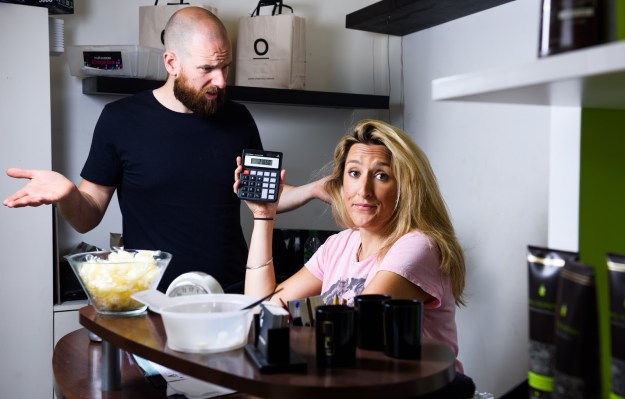
It’s a big day at Bleach for the Stars. The Welsh salon has been nominated salon of the year by Clip Advisor, and dim-but-enthusiastic manageress Sabrina has a lot to do to prepare, like fill out the form to nominate the salon for the award and find money to pay the administration fee. Fed up junior stylist Tanisha does her best to pander to Sabrina’s whims and half-truths, but as the end-of-day deadline for the application looms and a last minute “celebrity” client arrives, Sabrina struggles to keep the business running to the standard that her dad, the owner, expects.
Foiled takes place after hours in a working hair salon, adding a genuine site-specific element to a script that draws on several styles of text-based comedy to entertain its audience. Puns, slapstick, one-liners and Sabrina’s regular misspeaking keep the laughs coming, and two scenarios that raise the stakes drive the action forward. There’s a token sprinkling of musical theatre numbers that feel a bit out of place, but help break up the action nicely.
The intertwining sitcom-esque scenarios hover on the verge of messiness, but writers Beth Granville (who also plays Sabrina) and David Charles keep just enough order in the story for it to not get lost. Staging is a challenge here with the actors racing up and down the narrow salon and sightlines oaccasionally blocked, but the salon is small enough that it’s always easy to hear the dialogue.
Though insubstantial and silly on the surface, Foiled makes pretty powerful comments on social mobility, class and privilege. Tanisha and Sabrina come from very different backgrounds and financial situations which, combined with the two primary plot threads manage to to not feel crowbarred. Foiled is a good laugh, well performed and has a lot to say.
Foiled runs through 29th August.
The Play’s the Thing UK is committed to covering fringe and progressive theatre in London and beyond. It is run entirely voluntarily and needs regular support to ensure its survival. For more information and to help The Play’s the Thing UK provide coverage of the theatre that needs reviews the most, visit its patreon.

Solo performances are popular at the Fringe, and there are some good ones this year. So far, the best production I’ve seen this year is one-woman show Torch, celebrating womenhood in all of its flaws and glory. To portray men from such a perspective is much harder what with society already granting men more privilege than women, but Camilla Whitehill’s powerful Mr Incredible does just that in order to highlight male entitlement.
Adam and Holly have recently split up, and Adam hates it. Men like him aren’t meant to be single. He has a good job, owns a flat in London and desperately wants marriage and children. Whilst he loves Holly’s youth and fighting spirit, he was glad when she started to mellow and come round to the idea of settling down. But she wouldn’t be tamed by his sedate nights in front of the telly watching trashy programmes. She wants to write about important issues and change the world for good.
Though Adam’s account of Holly betrays an obvious, fundamental incompatibility between the two, Adam is blind to it and his desire for Holly to conform, and it’s infuriating. As he details moments from their relationship and its unravelling, he blindly transfers all blame onto her. The script cleverly paints Adam as a generally good guy, making his privilege initially subtle, then growing until their relationship reaches a horrible end. His ingrained entitlement to Holly and the belief that she should conform to his ideal life is a good capture of male immovability around women’s goals and desires, and hopefully framed in a way that triggers male reflection.
Alistair Donegan fleshes out Adam with genuine grief for the loss of his relationship and fully believed justification of the character’s choices. Whitehill’s script paints Adam overly-simplistically at times, but Donegan makes the character three-dimensional.
As a solo performance, it is initially unclear who Adam is talking to, but this is revealed in the play’s final moments when the severity of their breakup is horrifyingly revealed.This moment is subtle and takes some processing, so perhaps a bit more obvious spelling out will make the intended message stronger. Overall, this is a strong, polished production with acute comment on male privilege over women’s bodies and choices.
Deal With the Dragon also looks at male entitlement, but likely not deliberately and with a hefty dose of absurd fantasy. Bren is a gay dragon who finds vulnerable gay men that need looking after and offers to help, but not without signing a contract. The Faustian pact between Bren and artist Hunter looks at artistic temperament and dependency in the arts with both comedy and gravitas, though Kevin Rolston’s piece is lacking in a concise storyline and clear message.
Rolston is an excellent performer who distinguishes between Hunter, another artist Gandy and Bren with physical skill that is delightful to watch. With no costume or props, it’s perfectly clear that Rolston is a dragon. The transformation is simple, but utterly delightful.
The script has a nice premise – What if you had a gay, German dragon to help you get through the unpleasantness of life – but it’s never made clear what the premise is trying to communicate. Are people eventually better off with Bren’s assistance? Worse? What does it say about life’s obstacles as a whole? Should men have someone at their disposal to do their dirty work? These questions go unanswered. Though Rolston’s ability as a performer is undeniable, Deal With the Dragon never makes a definitive statement.
Mr Incredible runs through 28th August, Deal With the Dragon runs through 29th August.
The Play’s the Thing UK is committed to covering fringe and progressive theatre in London and beyond. It is run entirely voluntarily and needs regular support to ensure its survival. For more information and to help The Play’s the Thing UK provide coverage of the theatre that needs reviews the most, visit its patreon.
 The Play's The Thing UK