Politic Man, Ivy House

What with growing up outside of the UK, my knowledge of British history is quite patchy. I can tell you a lot about the late Elizabethan and early Jacobean eras when Shakespeare was alive, but outside of these time periods, I know little. I quite like social history, so learning about new-to-me historical figures through theatre is an event of joyous discovery. What with my leftie sentiments currently battered, encountering someone from the past committed to social justice and equality adds to the excitement even if the play has its shortcomings.

Continue reading

The Collector, Greenwich Theatre

https://i0.wp.com/69-degrees.co.uk/wp-content/uploads/2016/10/The-Collector-at-York-Theatre-Royal.-Anna-Riding-Zoya-Olivia-Beardsley-Foster-William-Reay-Kasprowicz.-Credit-Sheila-Burnett-800x533.jpg

by guest critic Maeve Ryan

When the British army arrived in Northern Ireland, beleaguered Catholics came onto the streets offering them tea, biscuits and cake. How long did it take for the story to change to the one that we know today? In The Collector, Naseer joyfully swaps music CDs with the American soldiers who arrive into Iraq in 2003 because he hopes for democracy and change. He learnt his English by listening to American rap music and soon he becomes a valuable translator for the soldiers. The Collector documents the slow brutalization of the occupiers and the occupied through choices they make; choices that, in Henry Naylor’s play, feel inevitable.


Continue reading

Feature | Barker’s Play Doesn’t Erase Minorities – The Print Room Does

http://www.trbimg.com/img-5296a467/turbine/la-ol-katy-perry-american-music-awards-yellowf-001/600/600x399

by Daniel York

I actually sat down and read In The Depths of Dead Love last night.

If anything, I’m even more angry now. The argument put forth by the Print Room is that, although the play is set in ancient China and the characters have Chinese names, the characters are not “Chinese” and it’s a very “English story”.

Is this true? Well, there are a lot of “deep bows” and talk of emperors but reading the work leaves me wondering just exactly how ethno-specific a play would have to be before the people who programmed and presented this one would consider that, yes, we might just have to cast some actors who aren’t actually Caucasian and middle-class.

The thing that really does disgust me, though, is the Print Room’s argument that they should have the right to cast “the best actors for the roles, independent of ethnic origin”. Leaving aside that being “independent of ethnic origin” appears to be a privilege that only applies to white people, we have the Print Room citing Christopher Hurrell’s defence that, “the characteristics [Barker’s play] seeks in actors are not social, cultural or ethnic—they’re technical, aesthetic and artistic.”

Let’s just pause there. Would it have to be written in pidgin English before the demands were relegated to “social, cultural or ethnic”?

And this is what is utterly despicable about the whole argument I’ve had so many times in the past and, I hope, not too many more in the future: the sheer racial and social snobbery embodied by organisations like the Print Room and the Wrestling School when they assert that they cast “the best actors for the role”. What they’re actually saying is “you little ethnics just aren’t up to the job”.

This would be bad enough but we’re now all pretty much certain that they never met or considered any actors of any other ethnic background other than white Caucasian for this production. This play which was produced on the radio in 2013, which Christopher Hurrell maintains was given a reading at the Print Room in 2013. They’ve had FOUR YEARS to develop this. FOUR YEARS in which it looks as if they never once even considered casting actors who weren’t white. I presume, they never once considered that actors who weren’t white Caucasian were up to the “technical, aesthetic and artistic” demands of the play.

The racial and social snobbery is compounded by the Print Room alleging that the protests have come from “some members of the public” when in fact it’s mainly members of the theatre community. When they argue that the references to China are merely “oblique”. When they give trite lectures about The Great Man being a “fabulist” whose work “is poetic and often difficult to pin down in time or place”.

Yes, we do understand all those things. Because we’ve actually read a few books too. We understand the arguments perfectly because, believe it or not, we’re “artists” as well.
And, as artists, we politely but firmly reject this cultural ethnic elitist high-handedness.

Please join us in in our protest this Thursday Jan 19th. If you can’t physically make it (or even if you can) please partake in the “thunderclap” social media protest.

The Play’s the Thing UK is committed to covering fringe and progressive theatre in London and beyond. It is run entirely voluntarily and needs regular support to ensure its survival. For more information and to help The Play’s the Thing UK provide coverage of the theatre that needs reviews the most, visit its patreon.

Glockenspiel, Tristan Bates Theatre

https://i0.wp.com/www.stevendykesplaywright.com/wp-content/uploads/2015/09/glockenspiel-columbia-1-770x513.jpg

In the programme notes for Steven Dykes’ Glockenspiel, we are told that 40% of current personnel have been deployed more than once, and 27% of those veterans deployed to Iraq and Afghanistan suffer from anxiety disorders and/depression. A fifth of ex-service people are unemployed, and a fifth report cases of domestic violence. Male ex-service members are twice as likely to commit suicide than their non-serving peers. So it’s no secret that the US doesn’t look after its veterans very well. The play tries to look at the effects of service on those now finding their way in the civilian world, but Old Sole Theatre Company’s execution doesn’t deliver the power needed for this slowly-developing script.

Continue reading

Feature: Scenes From A Yellowface Execution

https://girlsdofilm.files.wordpress.com/2014/09/breakfast-at-tiffanys-mickey-rooney-3.jpg?w=800

By Daniel York

Before we go any further, let me lay a couple of things out there:

Howard Barker is a first-rate dramatist.

The Print Room in Notting Hill is a great small-scale theatre.

But they have epically and catastrophically screwed up their casting choices in Barker’s latest offering, In The Depths Of Dead Love. According to the theatre’s website, the play is set in “Ancient China”, concerns an “Emperor” and “Imperial Court” and features characters called “Chin” and “Mrs. Hu”, with an entirely white cast who (without wishing to sound too ironically stereotypical) one would normally expect to see on TV taking tea with Lady Mary Crawley in Downton Abbey.

It’s also doubly ironic that in post-referendum, post-truth Brexit Britain, we’ve spent the last few months being told that you simply cannot call people stupid or racist.

Well, here’s the deal. We don’t actually have to be stupid to do stupid things and we’re all perfectly capable of perpetuating systemic racism without actually being consciously racist. Yes, it’s a subtle one, folks, and interestingly, I can honestly say, hand on heart, I have never once heard the immortal words “I don’t have a racist bone in my body” said by any person of colour. Not one. Because people of colour are ten times as aware of racism as white people. It’s just a fact.

Now, what that hotbed of London fringe theatre that is the Print Room have done, in a play by one of Britain’s most eminent playwrights, is perpetuate the practice of “yellowface,” i.e. when a person who is not of East Asian descent plays a character of East Asian descent. Yellowface, like blackface and brownface, is a remnant of a time when actors of colour were simply not allowed on our stages.

There’s often confusion about a couple of things here. People like to kid themselves that blackface only ever happened in some bygone Edwardian hinterland and only then because there were no black actors around to play Othello. However, this isn’t actually true. The last blacked up Moor of Venice on our stages was as recently as 1990. The practice was only ended by protest from black actors.

Yellowface has lingered on a lot longer, unfortunately. We did however think we’d finally laid the culturally appropriated beast to rest (on British stages at least) in 2012 when, after the Royal Shakespeare Company elected to cast only 3 (out of a cast of 17) East Asian actors in minor roles (including a dog and a maid) in the Chinese classic, The Orphan Of Zhao, a mass social media protest that went viral globally caused considerable embarrassment to both the RSC and the British theatre industry as a whole.

Since then we have seen a whole slew of productions in major theatres: Chimerica, #AiWeiWei, The World Of Extreme Happiness, Yellowface, You For Me For You, P’yongyang, Shangrila, The Sugar-Coated Bullets Of The Bourgeoisie-in major venues, achieving enormous success with casts of real-life East Asian actors, not Caucasians doing an “ethnic turn”. We will also shortly see Snow In Midsummer, at the RSC no less, and Chinglish at the Park Theatre. These are cast with actors who can actually trace their roots to Eastern Asia.

The other confusion that lingers about yellow (and black and brown) face is that if you don’t have the make-up on, the taped eyelids and the dodgy Mickey Rooney in Breakfast At Tiffany’s accent, this somehow ceases to be dodgy theatre practice and magically becomes instead a perfectly valid form of “colour-blind casting”.

But this is the deal. If you take an East Asian character and cast it with a white actor, you’re effectively saying there is no East Asian actor who was good enough/clever enough/talented enough/capable enough to play it.

Or they simply did not exist.

In other words: erasure.

 Daniel York (sometimes known as Daniel York Loh) is a mixed-race British East Asian actor, writer, filmmaker and musician. As an actor he has appeared at the RSC, National Theatre and Royal Court, as well as in the feature films The Beach and Rogue Trader. His short films have been seen in major film festivals where they have been nominated for awards. His first full-length play, The Fu Manchu Complex, ran at Ovalhouse in 2013. Along with composer Craig Adams, he won the 2016 Perfect Pitch award to create an original stage musical, Sinking Water, based on events around the 2004 Morecambe Bay Chinese cockle-picker tragedy, which is currently being developed under commission by Theatre Royal Stratford East. He is one of 21 writers of colour featured in the collection of essays, The Good Immigrant, which won the 2016 Books Are My Bag Reader’s Choice award. He is one-third of the alt-folk trio Wondermare whose self-titled debut album is available to buy on itunes. He has served on the Equity Minority Ethnic Members Committee, is a founder member of British East Asian Artists and has worked with Act For Change to promote diversity in UK media.

Father Comes Home From the Wars (Parts 1, 2 & 3), Royal Court

https://i0.wp.com/www.officiallondontheatre.co.uk/servlet/file/store5/item374788/version1/fileservice770/374788_770_preview.jpg

American, Pulitzer Prize-winning playwright Suzan-Lori Parks doesn’t shy away from epic projects. Six years ago, she wrote a play a day to create 365 Days/365 Plays, then went on to write the nine-part Father Comes Home From the Wars. Parts one, two and three centre around Hero, a strapping young slave on a remote Texan farm. Spanning the Civil War, this epic story with influence from Greek myths and contemporary socio-political issues in Parks’ distinctive, poetic language takes its time to develop and has some discordant stylistic choices, but its narrative and historical interpretation is both compelling and important.

Each of the three parts has moments of profound brilliance and devastation, but Parks is in no rush to tell her story. The dialogue-driven script takes its time, meandering around a complex landscape of slavery, loyalty and race within this particular slave family. Though set in war time, there is little action – broader issues drive the conversation more so than current events. This is more of a kitchen sink drama than a wartime adventure story.

Part one solely takes place on the farm as Hero debates whether or not join his master in battle. The rest of the slaves take bets and try to persuade him one way or the other, but in the back of Hero’s mind is a promise from the Boss-Master – but is he likely to keep his end of the deal? Hero’s loyalty is split between his owner and his wife Penny, but the lure of the cast-off but smart uniform proves too much. Though little happens, the domesticity of part one has some of the tension that precedes a huge decision. Seeing a tall, strapping black man in the prime of his life wearing Confederate greys is most unsettling; this paired with the ingrained, accepted attitude that he is the property of his owner is a potent reminder that there has been insufficient progress in America’s attempts at racial equality.

Part two, though set at a particular moment in the midst of the war, has the calm of an eye of a storm and is by far the best of the three parts. Hero and Boss-Master have captured a Yankee prisoner whilst separated from their regiment during a battle. Hero’s loyalty is tested again, this time by his prisoner upon discovery of a secret that’s hidden in plain sight and only skin deep. Racial identity, individuality and freedom intertwine in an intoxicating allure of potential for Hero, who is still doggedly loyal to his owner. The powerful ending devastates in its frank depiction of ingrained attitudes of racial inferiority and liberal frustration with this mentality.

Part three is the more mature sibling to part one. The characters are older, wiser and more world weary in the face of Southern defeat. The pre-war certainty has given way to a chance at the great unknown of freedom, and for the first time they can choose where they live – anywhere in the great, wide world, or on the farm they have known forever. Penny and Hero’s devotion is destabilised in this irrevocably changed world that is now free, but cold and dangerous – and still is for black Americans today. The morality of freedom isn’t black or white here, but the ominous, thought-provoking grey of Hero’s, (now called Ulysses) uniform.

Neil Patel’s unforgiving desert of a set doesn’t have bells and whistles, but it’s sparsity highlights the richness of Park’s language and characterisation. Steve Toussaint is the remarkable Hero, painted with delicate light and shade. The rest of the cast are excellent in their own right, though lack the development of the initially appropriately-named lead.

Parks’ script is almost completely bedded in realism (that’s occasionally heightened), though a talking pet and some contemporary costumes slightly skew reality. Both are used sparingly and without any evident justification across the three parts so their inclusion feels jarring and unnecessary. The onstage musician, though very much a separate commentator, doesn’t clash the way these choices do.

For a play set during a war and a pivotal moment of America’s history, it is oddly detached from violence and conflict. Instead, Parks’ text goes after deeper themes within this transition from slavery to freedom. Though a greater sense of danger and looming dread would add needed further tension in parts one and two, the nuance that flows through the story is undeniably exquisite.

Father Comes Home From the Wars (Parts 1, 2 & 3) run through 22 October.

The Play’s the Thing UK is committed to covering fringe and progressive theatre in London and beyond. It is run entirely voluntarily and needs regular support to ensure its survival. For more information and to help The Play’s the Thing UK provide coverage of the theatre that needs reviews the most, visit its patreon.

Revolt. She Said. Revolt Again., Edinburgh Festival Fringe

https://cdn2.rsc.org.uk/sitefinity/images/productions/2016-shows/Making-Mischief/revolt-2016-production-photos/revolt-she-said-revolt-again-production-photos_-2016_2016_photo-by-richard-lakos-_c_-rsc_201024.tmb-gal-670.jpg?sfvrsn=1

Playwright Alice Birch wants to start a revolution. Revolt. She Said. Revolt Again. seeks to challenge the patriarchal language and social structures that hold woman second place to men. Being polite and socially acceptable isn’t going to achieve this, and the marketing material states that this play is not well behaved.The issue is that it is. The collection of scenarios with chaotic climax and resigned footnote of an ending starts out strong, but quickly loses sight of its goals through a lot of talking but few suggestions for effective action.

The first scene between a heterosexual couple is the most effective as he talks about all the things he wants to do to her body, and she corrects his language from one of his ownership to one of hers. The subject matter is provocative, funny and establishes a model that women can actually use. It’s not badly behaved, though – it’s polite, considerate and a bit uncomfortable, but not revolutionary. Subsequent scenes have less of a practical application; this isn’t a problem in and of itself, but these scenarios are much less of a catalyst in a show about taking action. There is some rejection of social convention, but little seen as radical. A culminating babble of voices largely indistinct from each other goes on entirely too long and due to the challenge of deciphering specific lines has little impact.

A cast of four, three women and one man, play a range of characters though disappointingly, the characters are middle class and English. Surely the issues that are presented – the language of sexual domination, consent, reproduction, family, flexible working – effect working class people as well.

Madeleine Girling keeps her set simple and efficient, using only items that are fully functional to each scene. Lighting designer Claire Gerrens creates angular, starkly delineated spaces that support the simple demand for equality and empowerment.

Birch certainly uses language well and constructs dynamic, interesting characters but the lack of much motivating material creates a lot of bluster with little change. The script also avoids any issues of intersectionality, particularly social class and race, even though one of the actors is black. Her goals are certainly admirable, but Revolt. She Said. Revolt Again.? More like have a chat and then carry on with your life.

Revolt. She Said. Revolt Again. runs through 28th August.

The Play’s the Thing UK is committed to covering fringe and progressive theatre in London and beyond. It is run entirely voluntarily and needs regular support to ensure its survival. For more information and to help The Play’s the Thing UK provide coverage of the theatre that needs reviews the most, visit its patreon.

“Just let the wind untie my perfumed hair…” or, Who Is Tahirih?, Edinburgh Festival Fringe

https://i0.wp.com/www.ridikulmagazin.hu/cuccok/storages/thumbnails/2014-06-06/153cc8eec7af4dc9e7fe3737d2192f41/680x0.jpg

A woman sings behind a gauzy white curtain. We cannot see her face, but in her soaring cries we hear her passion. This is Tahirih, born in what is now Iran in the early 1800’s (we don’t know her exact date of birth because authorities burned these documents after her execution). She is a poet, theologist and women’s rights activist, and she has enough followers that the country views her as a national threat to the patriarchal Islam that requires women to be veiled in public.

In the days leading up to her execution, Delia Olam plays people from Tahirih’s life, unfolding her biography, teachings and radical actions. These we see plainly, but Tahirih is always behind the curtain, playing and singing. As the revered and reviled woman is sculpted through the accounts of others whilst her face remains hidden, she becomes mythical and hugely powerful, a revolutionary who’s life is tragically cut short.

Olam’s script and performance meld into a fluid solo performance that is a fitting tribute to such a remarkable woman. Her physical and vocal distinction between the handful of characters she plays is detailed and precise. A servant, Tahirih’s father, an executioner, and a female follower are crafted in detail, and all visited by the audience who go to these people to discover more about this woman who is revolutionary, dangerous, or both. This is excellent clarification of the audience/character relationship in solo performance format – it makes sense with the play’s circumstances and embeds the audience in the action. There is none of the talking out into undefined space or invisible characters that alienates the audience and removes the character from reality, something that often occurs in solo performance. Across these characters in different places and with different relationships to Tahirih, there is still a clear, well-proportioned narrative arc building to an awful end.

The scenes themselves are well-crafted and provide a snapshot of the landscape of attitudes towards women in Iran at the time. They are simply staged and prettily enhanced with candlelight, their simple, calming beauty juxtaposes the inevitable prospect of her death. Transitions are a touch slow; some are smoothed with recorded music whereas others have silent gaps as Olam transforms in and out of Tahirih, who sings and plays between characters. The silences make for a choppy disruption, but this is a minor issue easily forgiven in view of the story’s excellent construction and execution.

To learn about such a remarkable woman through a strong show and performance feels as much of a privilege as it is an education. Olam has fantastic instinct for storytelling and character development, and this detailed show needs hardly any improvement. Do not miss it.

“Just let the wind untie my perfumed hair…” or, Who Is Tahirih? runs through 29th August.

The Play’s the Thing UK is committed to covering fringe and progressive theatre in London and beyond. It is run entirely voluntarily and needs regular support to ensure its survival. For more information and to help The Play’s the Thing UK provide coverage of the theatre that needs reviews the most, visit its patreon.

Feature/Review: Children & Shakespeare, Edinburgh Festival Fringe

https://i0.wp.com/unknownmagazine.co.uk/wp-content/uploads/2015/07/York-3-credit-Rob-Freeman-1-1024x683.jpg

Whilst there’s plenty of Shakespeare at the fringe, it doesn’t get much coverage. It’s understandable – the Bard doesn’t count as a potential Next Big Thing, and he’s favoured by student and international groups that usually have short runs and are deemed less worthy of critical attention. It’s obviously necessary to recalibrate expectations and vocabulary when evaluating children and young people’s performances, but directors and teachers can and should be held accountable for the quality of their own creative work and bringing out the best in their students or young cast. They do have the additional pressure of incorporating an educational element and ensuring that their work is suitable for the children and young people they are working with, but that specialism is no more or less different than any other in the performing arts.

To completely ignore young people’s work at the Fringe when sampling the Shakespeare on offer cuts out a large segment of the Shakespeare productions on offer, and considering that these are often international schools as well, the cultural differences can be considered when critiquing. Over one day at the fringe, I watched three distinctly different Shakespeare adaptations – a Scottish stage school including children approximately aged eight through sixteen that looks at Twelfth Night, an American university’s analysis of Shakespeare’s baddies and a Notts young people’s dance-theatre company’s deconstruction of Macbeth.

Admirable Fooling or What You Will by Little Shakespeare School’s Michelle van Rensburg had the most challenging remit in that it is a show suitable for performers over a big age range, but the show she invents is a nonsensical mess. When she sticks to her simplified script with sections of original text more the more able students, it is standard children’s fare – able to be followed, giving the kids a chance to show their skills and including everyone. The random sections from Titanic, though? Inexplicable. None of the children on that stage or in the audience would have even been alive when the film came out, so crowbarring in pop culture references that they wouldn’t understand is gratuitous and self-absorbed. There are also numerous off-text clowning sequences that are unconnected to the story, and a lengthy exposition setting up a storytelling premise that isn’t consistently followed through. The one, shining moment of kitschy, creative inspiration that epitomises fringe Shakespeare is the tiny blond girl who plays the letter Malvolio finds in the garden. She wears a bright yellow sack with felted letters on either side and enthusiastically delivers the text that Malvolio reads from the letter in Shakespeare’s original. She looks about eight years old, maybe nine, certainly no more than ten, and it is an adorable thing of wonder. There are some good actors who are confident and speak well, particularly the eldest girl who plays Olivia, but the show itself is a baffling construction with little through-line or sense.

Bad Shakespeare, by Oklahoma State University drama students, isn’t bad, but it’s just as much of a lecture as it is a performance. Showcasing their intensive summer Shakespeare studies, they work their way though Shakespeare’s development of his villains. The exposition that sets up their five act structure is too long, but the acts’ increasing complexity is a nice touch. Most of the ethnically diverse ensemble are good performers, and all bar one are women – great work towards increasing diversity from the programme director. They handle the language and verse with muscularity and confidence, though there is no evidence of work towards convincingly playing men. Their emotions tend to read more as upset rather than angry or vindictive, and their physicalities are distinctly feminine. The show’s director has chosen faux-period costume; some are in dresses and some in doublet and hose. Neutral, modern dress would suit much better, especially considering the large amount of instructing the audience with contemporary language and pop culture references. Bad Shakespeare is great for learning more about Shakespeare’s characters and some of the scholarship behind them in a relaxed, easy to follow format, but it’s more of a learning experience than a show. However, they wear their confidence and passion for Shakespeare on their sleeves, which is a wonderful thing to see.

Fortitude Dance Theatre’s Macbeth has potential to be the most promising of these three adaptations, and whilst it certainly has some great moments, there are also some misguided creative choices and interpretations, and an inconsistent application of style. The young company demonstrates competence in their dance and verse delivery, though as a whole, they struggle with achieving moments of emotional intensity and staging on a  thrust. The pace was great, but tone consistently conversational. Their opening sequence was a great capture of the 90’s club scene with text and contemporary dance obviously inspired by Frantic Assembly, but the dance element is absent until the discovery of Duncan’s body, about half way through this abrupt edit. There are missed opportunities to incorporate movement into Macbeth and Lady Macbeth’s scenes showing their fluctuating power struggle. This dynamic between characters later between Macbeth and the witches inspires some good tribal, threatening choreography. Macduff’s monologue on hearing of his wife and children’s deaths is a stunning blend of movement and text that the company could to stylistically inspire their future work. They could also do with a stronger director, or dramaturg familiar with Shakespeare pronunciation, to confirm any line interpretations – “Out, damn spot” is not referring to blemishes on her face.

It’s brilliant to see young artists finding their way through making work and discovering styles and forms that work for what they want to communicate in their Shakespeare interpretations. Even though they won’t be up to professional performance standard unless they are extraordinarily gifted, their teachers and directors should be strive for clarity. Though none of these three productions quite reached that point, they each had their merits and watching children and young people discover and explore the joy of performing is a marvelous thing.

The Play’s the Thing UK is committed to covering fringe and progressive theatre in London and beyond. It is run entirely voluntarily and needs regular support to ensure its survival. For more information and to help The Play’s the Thing UK provide coverage of the theatre that needs reviews the most, visit its patreon.


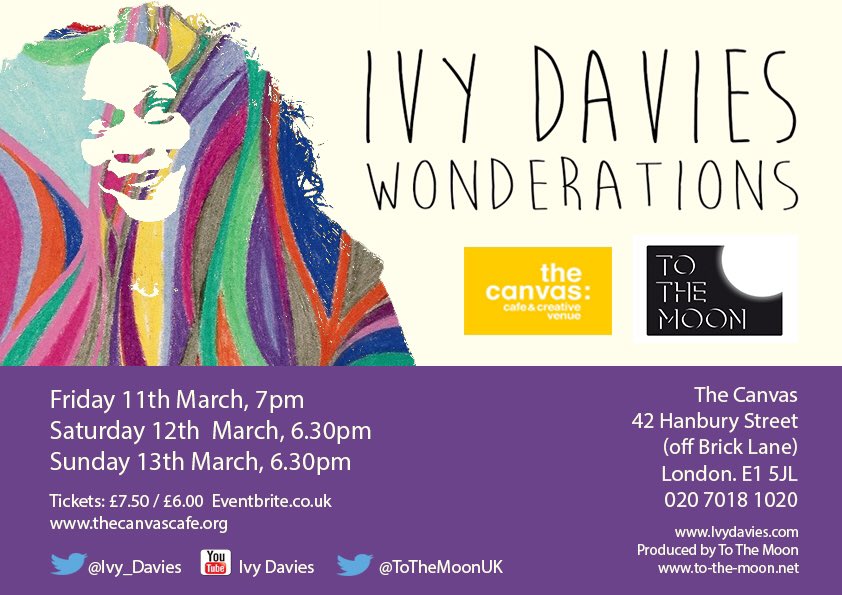
Wonderations, The Canvas Cafe

https://pbs.twimg.com/media/CcvF_vOWEAA7JKp.jpg

Sunday evening was a night of new discoveries. The Canvas Café, just off Brick Lane, serves homemade cakes and prosecco by the glass. It also has walls you can write on and a cosy downstairs performance space. In that space was Ivy Davies and her show Wonderations, a gentle, joyful blend of spoken word, songs from her EP and questioning whether or not Mickey Mouse is actually God. Though lacking in narrative, Davies’ performance shares issues that are particularly personal: aging and her search for identity and faith. With a touch of live art about it, Wonderations is a lovely celebration of self-acceptance akin to reading Davies’ journal.

This isn’t a visual show, but a totally aural one. It could easily be listened to through headphones or with eyes closed, though her soothing melodies and rhythms could lull you to sleep – it’s that relaxing. There are some powerful sentiments in her lyrics and poetry that deserve full attention, however. As Davies struggles to find her pre-marriage and babies self in theatrical songs and rhymes, one can’t help but to relate to her frustration with finding her true identity buried under all the nonsense life throws at us. We all find ourselves wasting hours on social media focused on constructing an image, or immersing ourselves in work and forgetting to just be present in the world for lengthy periods, but Davies exhorts us to let all of it go. She’s like a life coach, but a gentle one who uses cuddles rather than shouting.

This cabaret-esque structure feels conversational, but is precisely and satisfyingly scripted. There’s no plot to speak of, but with Davies wearing the form like her own skin, it works. Her spoken word isn’t the pounding, angry sort I’m accustomed to; it’s full of flowers, sunshine, rain and claiming her own ground. Davies has an immovable strength and presence, but one that overflows with positivity. Less connected from her celebratory songs and spoken word is what feels like an internal monologue where in looking for faith, she wonders if God is actually Mickey Mouse. He’s been seen around the world at the same time, and has plenty of purchasing power. It’s a wonderfully funny, and pointed, argument, though less clear on it’s place in the show’s structure.

Ivy Davies’ Wonderations is a hard show to pin down, but it doesn’t apologise for that. I’m pretty certain that she’s confident enough to not care what anyone thinks of her work, but the themes it contains are universally human presented in an easily digestible format. An excellent event for a quiet Sunday evening, particularly with a slice of cake and a glass of prosecco.

The Play’s the Thing UK is committed to covering fringe and progressive theatre in London and beyond. It is run entirely voluntarily and needs regular support to ensure its survival. For more information and to help The Play’s the Thing UK provide coverage of the theatre that needs reviews the most, visit its patreon.