The Marvellous Adventures of Mary Seacole, Rosemary Branch Theatre

I had never heard of Mary Seacole until I began working in UK schools, several years after my arrival to the UK. What a woman!  No wonder her entrepreneurial, caring Victorian spirit is on the National Curriculum and she has been the subject of several plays, including Rosemary Branch co-artistic director Cleo Sylvestre’s one-woman show, The Marvellous Adventures of Mary Seacole. With a simple narrative structure, Sylvestre’s piece focuses on characterisation and biography. It is well performed, though some adjustments to the script and tech could make this an even better solo show.

We are never told who we are, but Seacole treats us like a society or club she has come to lecture about her life.  She speaks in the past tense shortly after her return from the Crimea; we hear her life story starting with her childhood in Jamaica, helping her mother run their Hotel, Blundell Hall and learnt about her “remedies” from foraging. Continuing onto her London, Central America and finally The Crimean War, Sylvestre endows her with a confident, charismatic warmth – no wonder she was so popular with soldiers and civilians alike. Her performance peaks when recalling her mother first teachings her about plants, and later memories of battlefields heaving with wounded soldiers – her “boys.” These are lovely moments to witness, but some of the more mundane content is delivered on autopilot.

Structurally, the script is a simple, linear narrative. This would be an excellent piece to tour to primary schools, as it’s easy to follow and has plenty of captivating anecdotes. The content is interesting enough to hold an adult audience’s attention for nearly an hour, but it would be a refreshing experiment to see this piece as episodic, with more lighting and sound than is presently used to highlight pivotal moments. This is not a new show, and solo performance has evolved since its inception. Sylvestre’s imagery-laden work would suit regularly used bigger projections, detailed soundscapes stronger lighting changes. Even though this is an important story, it is not an innovative production, but it certainly has the potential to be.

Cleo Sylvestre’s performance is the highlight of The Marvellous Adventures of Mary Seacole, but this long-running solo performance needs some revisiting to give it an extra burst of life worthy of such a vibrant character.

Running at The Rosemary Branch, 9-11 April.

The Play’s the Thing UK is committed to covering fringe and progressive theatre in London and beyond. It is run entirely voluntarily and needs regular support to ensure its survival. For more information and to help The Play’s the Thing UK provide coverage of the theatre that needs reviews the most, visit its patreon.

Beauty & the Beast, Polka Theatre

Beauty and the Beast - Polka Theatre - 20 November 2015 Writer - Charles Way Director - Roman Stefanski Designer - Laura McEwen Music - Julian Butler

Cold, dark days make me want to see feel-good theatre, especially in the run up to the holidays. Bonus points if it’s colourful, has some depth and at least some non-formulaic elements, even in a classic story. Polka Theatre’s Beauty & the Beast for ages 6-12 meets these criteria with a surprisingly complex storyline that keeps adult attention as well as kids’. Despite the target age range, there is some great humour and a touch of innuendo adults will appreciate (kids definitely won’t get it), sumptuous set and lighting and an adapted, relevant script. Some of the performances are wooden from the dated language and there are some dodgy movement-based transitions, but the school group audience was quiet and focused for most of the nearly two hours with interval.

Charles Way’s adaptation of the traditional story gives a much wider context than the Disney film and is more relatable to a modern, young audience. Belle is still the main character, but we get to know her father, Mr Godwin (Simon Holmes) and sister Cassandra (Géhane Strehler) well. Belle and Cassandra are complete opposites: Belle’s bookish, a visionary and frightened by most things; Cassandra loves boys, pretty dresses and adventures. The two bicker regularly and their money-driven merchant father is tired of it, a family dynamic that many children will recognize. Beginning in London and moving to the remote countryside when Mr Godwin loses his fortune, the girls also have to cope with big life changes and overcome adversity.

The women’s performances are consistently stronger than the men’s. Ritu Arya’s Belle is convincingly performed with a wonderfully dry sense of humour and an excellent character arc that isn’t overly saccharine. She carries the story and its energy well without being a stereotypical children’s performer, dealing with the old fashioned language brilliantly. Géhane Strehler is great contrast, giving young girls two opposite ideals to potentially relate to. Both have flaws, virtues and detail. Emma Cater is a sinister housekeeper for Jason Eddy’s Beast, a gentle man with stylized physicality and an imposing presence. Eddy doesn’t quite manage to carry that through after his transformation, but it’s so close to the end that it doesn’t matter much.

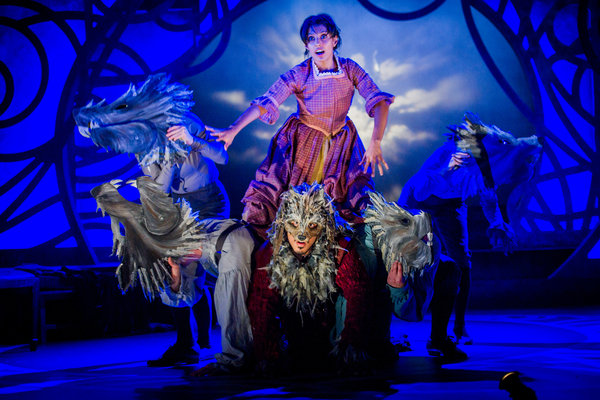
The set is layers of swirling panels that change colour and glow according to location, with the Beast’s castle the richest of them all. Laura McEwen’s set and Ian Scott’s lighting work together in wonderful harmony, with the occasional addition of puppets. Stage combat from RC Annie also adds a visual component, but the fights are slower that fight speed and brief. Some of the transitions lag and have abstract movement to fill the time, but this doesn’t contribute to the story and usually look pretty naff. Costumes, also by McEwen indicate the characters’ circumstances and changes in social class, but the highlight is the headdress and mask for the Beast.

Though there are still age and gender stereotypes, the adapted script empowers the young female characters. The detail and length will occupy adults as well as children and Way’s story is excellently constructed. With wonderfully visual design and a stirring score by Julian Butler, this is a lovely production harking back to the classical story without the glitz of Disney-fication or the panto cheese, and a solid option for a family holiday show.


The Play’s The Thing UK is an independent theatre criticism website maintained voluntarily. Whilst donations are never expected, they are hugely appreciated and will enable more time to be spent reviewing theatre productions of all sizes. Click here to make a donation with PayPal.

First Love is the Revolution, Soho Theatre

https://i0.wp.com/exeuntmagazine.com/wp-content/uploads/love5.jpgRomeo and Juliet gets a modern, interspecies remix by Rita Kalnejais in the south London-set First Love is the Revolution. Awkward, lonely Basti (James Tarpey) is trying to make the best of his teen years in a broken home when he meets Rdeca (Emily Burnett), a sassy fox cub hunting on her own for the first time. With Rdeca’s family not the most functional either, the two black sheep find solace in each other when they discover they understand each other’s speech. Using a bold metaphor for the deliberate choice to alienate or accept of The Other, this urban adventure through back gardens and fox dens is simultaneously funny, brave and disturbing, whilst excellently performed and with writing that keeps the audience on its toes.

The cast of six with a 50/50 gender split is also commendably diverse in age and ethnicity. Hayley Carmichael leads the pack as the fox family’s fierce matriarch. Tarpey and Burnett are the only cast members who do not play multiple roles, though the skill in these young actors is evident in their charming chemistry. Lucy McCormack of performance art acclaim plays a wide array of roles from Rdeca’s hyper but affectionate sister, to the neighbourhood cat that taunts thuggish guard dog Rovis (Samson Kayo) and the prozzie who lives upstairs from Basti. Basti’s dad (Simon Kunz) who wants his meek son to uphold the fighting, womanizing “ideal man” is also Gregor mole and a delightfully gossipy old hen in a cardigan, tweed skirt and wellies on a never ending search for grass seed. Director Steve Marmion’s choice to use animalistic physicalities is just enough of a reminder that not everyone in this play is human, but the movement is not so overpowering that it interferes with the characters’ relationships.

Anthony Lamble’s set design is almost post-apocalyptic; it is certainly grim enough to reinforce the lack of comfort in all of the characters’ lives, human or animal. Human domesticity precariously sits on rolling black slopes that the actors nimbly climb over and tunnels they scurry through. Philip Gladwell’s lighting smoothly morphs through sunsets and sunrises that dictate the wild rhythm of Rdeca and Basti’s all-night adventures.

Kalnejais’ use of the animal/human relationship is a lovely idea, with Basti paralleling the open minds of those willing to see The Other as themselves; he is a citizen opening his home to a refugee rather than labeling her as a pest. The concept harks back to ancient fables and folktales, connecting our often-disconnected present from the rich heritage of our storytelling past. However, whilst I certainly don’t believe she is advocating bestiality, it is the first thing that springs to mind when Basti and Rdeca are caught in a compromising position. It’s not revolutionary, just gross. Maybe it makes me a prude, but I find fox and human sex damages the metaphor rather than reinforces it.

Regardless of acts that would have the RSPCA up in arms, this is a stunning production in Soho Theatre’s main house that brings the emotional scale of Shakespeare to modern day London, with a visceral fervor that celebrates the magic of young love and accepting those that are different from us.


The Play’s The Thing UK is an independent theatre criticism website maintained voluntarily. Whilst donations are never expected, they are hugely appreciated and will enable more time to be spent reviewing theatre productions of all sizes. Click here to make a donation with PayPal.