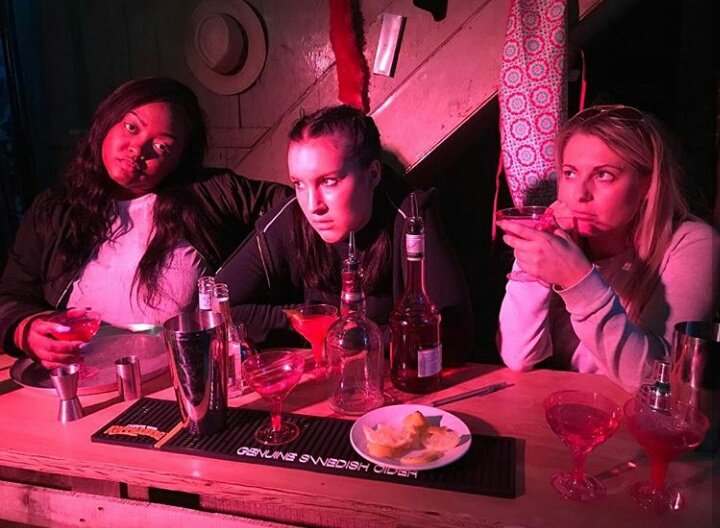
Den, Shoreditch Town Hall

https://pbs.twimg.com/media/C--MVYcXgAA5YFO.jpg

by guest critic Rebecca JS Nice

After working on Tristan Sharps’ Absent at The Shoreditch Town Hall in 2015, I have been given an education in the building’s rich maze of ballrooms and basements, shiny bars and crusty corridors, peeling paint and underground nooks and crannies that both delight and disorientate in equal measure. Dream Think Speak Company did just that, honouring the architecture of the building in a site specific work that set a precedent for work to come. As the evening of May 4th unfolds it seems that Cass Arts are unaware of their sophisticated forbears when they claim to produce “site-specific performances and installations on the themes of secrecy and disguise” in Den. As contemporary immersive theatre expands from the spectacle of Punch Drunk to the intimacy of Sheila Ghelani, Cass Arts have widely missed the context in which they have placed themselves.

Continue reading

Pete ‘n’ Keely, Tristan Bates Theatre

y7uPK2F__-T0J_RF_ggiF5qOpFNRv3Znqa6uI47eseE

by guest critic Alistair Wilkinson

The spectators are cast as the TV studio audience; a flashing sign above our head encourages us to applaud. Unfortunately there isn’t much to celebrate in this production set around two-out-of date performers trying to re-launch their career. The initial impression of the set is one of excitement and exuberance, but Emily Bestow’s design leaves the stage cluttered and incredibly busy. The actors must awkwardly navigate their way through whilst juggling a quick costume change, and avoiding being hit by a colourful disc of some sort. It’s a shame you can’t see the band through this disorientating mess.

Continue reading

Becoming Mohammed, Pleasance Theatre

https://www.londontheatre1.com/wp-content/uploads/2017/05/Becoming-Mohammed1-min.jpg

Director Annamiek van Elst states that, “now more than ever, there is a need to represent narratives around Islam in a positive light”. Too right. Our overly white and insular theatre is trying to diversify, but it still has a long way to go and systemic white, middle class administrations’ unconscious bias to overcome.

Continue reading

All Our Children, Jermyn Street Theatre

As much as I champion innovation in structure and style, sometimes a classic, linear two-act play surprises with its power and relevance. Stephen Unwin’s new script, though occasionally a touch overwritten, uses a historical narrative as potent criticism of current Tory policy of dehumanising budget cuts against society’s most vulnerable.

Victor is a paediatric physician and the head of an institute for disabled people under the age of 25 in 1941 Cologne. The nazis have taken over the facility’s operations and it has been decreed that every fortnight, the most vulnerable residents are to be transferred to a death camp. Victor clearly struggles with the conflict between his pledge to adhere to the Hippocratic Oath, and the potential consequences of not following the regime’s orders. Unwell and plagued by his fanatic head of administration Eric, his devoutly Catholic maid Martha and the mother of one of the patients, Victor just wants to get through the day that will end with a visit from the Bishop, who has heard rumours about the institute’s role in the reported genocide.

Continue reading

Oh Yes Oh No

https://cdn.thestage.co.uk/wp-content/uploads/2017/04/28162116/Louise-Orwin-0416-Oh-Yes-Oh-No-credit-Field-McGlynn1-700x455.jpg

Some questions for women:

Is it ok to want to be fucked?
                                 Does wanting this oppose feminism?
Is it ok to want to be hit in bed?                      Will this man expect that from other women?
Is it ok to fantasise about being raped?               What does this mean if I’ve been raped?

Louise Orwin is asking big questions about female sexuality and desire, but she doesn’t have the answers. There are no definitive answers anyway, just individual experiences. To make Oh Yes Oh No, she interviewed dozens of women around the country and found some disturbing patterns – about 90% of the women she met had been raped. Many of them developed rape fantasies. Women struggled to reconcile their feminism with wanting men to dominate them in bed.

Continue reading

Twelfth Night, Blue Elephant Theatre

Twelfth Night Image small

What with the prominent use of music in Twelfth Night, an actor-muso production is certainly a reasonable concept. Original Impact also sets the play in modern-day summertime, playing up the drunken frivolity at the forefront of the story. The recontextualisation largely works, though combined with some brutal editing, it glosses over the more sombre themes of grief and displacement. The cast demonstrate a range of ability with verse and performance skills, and there are some signs that the director isn’t familiar with Shakespeare. It’s not a terrible production by any means, but some minor adjustments would lend it a more professional feel.

Continue reading

Flights of Fancy, Soho Theatre

Fancy Chance was born in Korea, abandoned as an infant, adopted by a conservative American family, then moved to London. After working as a table dancer and then in a peep show in Seattle, she moved into burlesque, drag, cabaret, live art and circus. Her CV that’s more varied than her cultural make-up, Fancy’s latest endeavour is her first solo performance, Flights of Fancy. Drawing on current politics, cultural clashes and expectations, and her performance history, the show is a collection of sketches that create a quirky autobiography of sorts. Endearing and fun with a biting finale, the piece’s through-line is woolly with loose connections between individual moments.

Continue reading

The Braille Legacy, Charing Cross Theatre

https://i0.wp.com/charingcrosstheatre.co.uk/images/uploaded/Braille_8_gallery.png

Discovery of the evening: Louis Braille was a child when he developed the alphabet of raised dots into the writing still used by blind and visually impaired people around the world today. It’s an especially impressive feat considering the run down and under-resourced institution he attended, Institut National des Jeunes Aveugles in Paris. However, the prevalent hostile attitude towards disabled people was a constant obstacle towards the system’s adoption; even the belief that blind people could be academically educated was radical at the time.

Continue reading

Nuclear War, Royal Court

https://cdn.thestage.co.uk/wp-content/uploads/2017/04/21171628/Nuclear-WarDSC5303Andrew-Sheridan-Beatrice-Scirocchi-Maureen-Beattie-Gerrome-Miller-and-Sharon-Duncan-Brewster-c-Chloe-Lamford-700x455.jpg

In his introduction to the Nuclear War text, Simon Stephens explains that as a playwright, he does not want directors and performers to revere him. Rather, he wants them to see his scripts as a starting point for their own creativity. The third line of the stage directions is, ‘a series of suggestions for a piece of theatre’; from these suggestions, choreographer-director Imogen Knight shapes a haunting landscape of physicalised despair.

Continue reading