Party Trap, Shoreditch Town Hall

https://www.thestage.co.uk/wp-content/uploads/2016/09/Party-Trap-Alex-Brenner-no-use-without-credit-Show-and-Tell-Party-Trap-by-Ross-SutherlandShoreditch-Town-Hall-_DSC5659.jpg

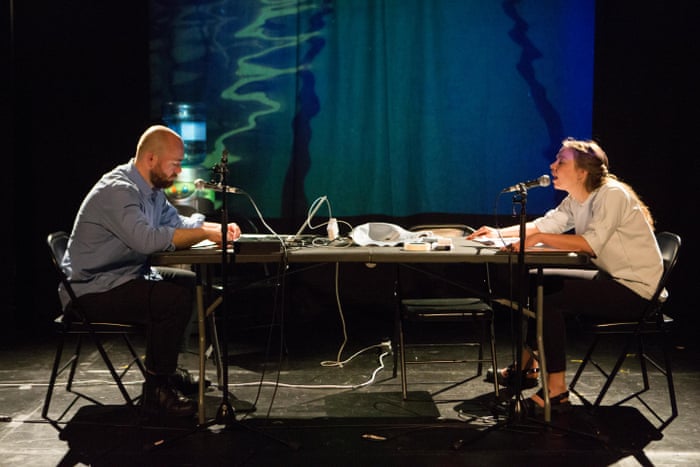
Politicians and members of the press are hardly the best of bedfellows. Unrestrained and violent, Ross Sutherland’s Party Trap explodes this relationship in a dystopian TV interview between journalist Sir David Bradley and MP Amanda Barkham after a landmark decision classifying political criticism as hate speech. Sutherland sets himself the challenge of telling his story through a script that’s an extended palindrome – an impressive feat, were it executed with more of a focus on storytelling rather than showing off a clever concept.

The palindromic writing isn’t particularly pronounced; instead it creates a haunting sense of deja vu once the script passes the halfway point. The shift in power and control from David to Amanda, and the action’s dark turn prevents it from turning stale, but the script structure is still more of a hindrance than a help. The language takes precedence over story clarity, so the plot soon muddies. The slightly futuristic premise becomes less and less tenable, to the point that the entire reality of the piece is called into question. There is little solid ground on which to build a sturdy plot line; language isn’t enough even though this experiment is certainly an interesting one.

The performances are one of the biggest disappointments. Cold and detached, they are couched in venomous sarcasm and violence. Simon Hepworth as Sir David Bradley has some nice moments of vulnerability and depth, but these are too little and too late. Otherwise, he and Zara Plessard are ruthless, calculating and distant. Video performances of other characters are relied on to fill in for news broadcasts and line managers with disturbing agendas; these characters are as self-absorbed as the two on stage.

The design elements are unobtrusive and tie the production together well, with Sutherland’s projections and video being particularly slick.There is no question that Party Trap is well-planned and thought out, but the concept is so prominent that it prevents a story from shining through. It’s a worthy experiment, but one that doesn’t work.

Party Trap runs through 1 October.

The Play’s the Thing UK is committed to covering fringe and progressive theatre in London and beyond. It is run entirely voluntarily and needs regular support to ensure its survival. For more information and to help The Play’s the Thing UK provide coverage of the theatre that needs reviews the most, visit its patreon.

Electric Eden, Edinburgh Festival Fringe

https://www.thestage.co.uk/wp-content/uploads/2016/08/Electric-Eden-700x455.jpg

Tommy Eden, a pensioner with a love for street performing since he retired, is dead. Local entrepreneur Alexander Sheldon’s security guards are responsible. Sheldon didn’t like Tommy performing outside his high end spa and leisure centre, but when the guards manhandled him off his patch, Tommy’s 87-year-old body couldn’t take it. Local young people, angry at the rapid gentrification of their town and the death of a local treasure, organise a protest/party in the abandoned club across the road, and everyone’s invited.

Not Too Tame’s Electric Eden doesn’t manage to deliver much of a party, though. Shouty political slogans and several under-developed subplots give a vague picture of a bigger problem, and staging choices fight against the attempted audience immersion. The concept promises a dynamic execution, but the delivery disappoints.

Seven characters at the party are featured, including organiser Greg (Andrew Butler) and Tommy Eden’s granddaughter, Grace (Louise Haggerty). Their stories, as well as those of the other five characters, are gradually presented through disconnected scenes in between dance numbers and party games. The audience are sometimes invited to join the dancing, other songs are tightly choreographed.

An exposition of protest rhetoric delivered down a mic, petition signing and ordering drinks from the bar is too long. Each of the characters’ individual stories only gets a couple of scenes, so they come across as generic snapshots of character types rather than real people.

The audience are provided with chairs so even though director Jimmy Fairhurst wants to create a party atmosphere, inevitably the majority of the audience end up sitting and watching for the entire performance. Choosing a club as a venue adds little with such a clear distinction between the actors and the audience, and the continuous reiteration that this is a party comes across as forced and false.

The performances are fine and there’s some tight choreography, though this also feels out of place with the attempts to create an anarchic/punk atmosphere. Electric Eden tries to be both a genuine party and a play, but the two aesthetics are so diametrically opposed that neither ends up working within the piece.

The whole experience is frustratingly flat, though it shows such promise on paper. With a script overhaul and a clear vision as to what Electric Eden wants to achieve, it would be a stronger piece. As is, it comes across as a confused and undeveloped piece.

Electric Eden runs through 29th August.

The Play’s the Thing UK is committed to covering fringe and progressive theatre in London and beyond. It is run entirely voluntarily and needs regular support to ensure its survival. For more information and to help The Play’s the Thing UK provide coverage of the theatre that needs reviews the most, visit its patreon.

Counting Sheep, Edinburgh Festival Fringe

https://i.guim.co.uk/img/media/23913cc392a98f67736cd3cdca806a6774c8940b/0_0_2048_1363/master/2048.jpg?w=620&q=55&auto=format&usm=12&fit=max&s=1feba80ccb7ff150a5842abd1e15ee76

Just over two years ago, a revolution in Kiev ushered in the downfall of the Ukranian government. Protests against the government’s refusal to sign pro-EU legislation lasting months had several violent outbursts that saw hundred of people injured and 780 killed. Toronto-based Ukrainian musician Marichka Kudriavtseva, in Kiev for work at the time, joined the protesters where she met Mark Marczyk, also based in Canada.

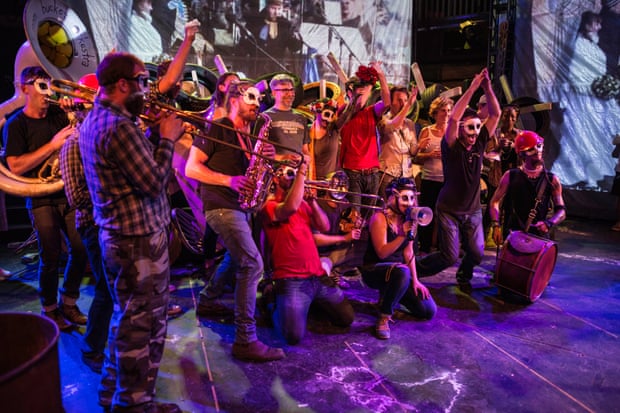
When the two returned from the Ukraine, they teamed up with Marczyk’s Lemon Bucket Orkestra to create Counting Sheep, an immersive “guerrilla folk opera”. A celebration of solidarity and the power of a collective voice, it also mourns those who died in the protests. Told from the perspective of the protesters, little is shared from the other side – but this rallying performance is fitting homage to not just the Ukrainian protesters, but those fighting government tyranny around the world.

Some audience sit around a huge table, whilst others sit on the sides of the space and still others up in a balcony. Klezmer or folk music is playing as the audience enters; there is a convivial atmosphere as the show formally starts. This is a party, or a wedding, or some other huge gathering, until the three screens display news reports of riots and police enter. The tone abruptly shifts, and the world that has been established is dismantled. It’s a wonderful, unsettling surprise.

The space is consistently reformed and redrawn using movement, and the audience is physically moved in the wake of the protesters’ gains and losses. They are willing and unquestioning, the sheep of the title. Though the numbers here obviously pale to those at the actual protest, incorporating the audience in acts such a building barricades and lobbing bricks at police fosters unity from disparate dozens. There is a hint of the solidarity and aggression found in protests, and joy and celebration from the audience who are keen to play. Being served food is also an important enabler that solidifies the unity the show aims to create.

Counting Sheep is hugely effective in its emotional manipulation, and also it’s storytelling through music, movement and projections. Choosing sheep as a metaphor is a curious choice, though. The benign but rather dumb livestock aren’t known for thinking for themselves and are susceptible to herding – otherwise, they wander around unproductively, getting lost and eaten by predators. Whilst the performers are the herders here, they are also in sheep masks, unempowered. Who then are the herders? The government? Unseen forces of political and social unrest? Whatever it is, us human beings are hugely susceptible to it when motivated enough, even if the metaphor isn’t totally clear.

Though sung completely in Ukrainian, there is a clear storyline conveyed through projections and movement. There is little nuance in this piece, but it a playground for the sweeping emotions of popular theatre. It provides at least a hint of the experience that the Ukrainian protesters endured, and powerfully unites the audience through the humanity of collective experience for a common goal. An excellent piece of theatre.

Counting Sheep runs through 29th August.

The Play’s the Thing UK is committed to covering fringe and progressive theatre in London and beyond. It is run entirely voluntarily and needs regular support to ensure its survival. For more information and to help The Play’s the Thing UK provide coverage of the theatre that needs reviews the most, visit its patreon.

Queen Lear, Edinburgh Festival Fringe

https://www.thestage.co.uk/wp-content/uploads/2016/08/Queen-Lear-700x455.jpg

What happened to King Lear’s wife? The woman who birthed the three daughters that he loves so dearly is never mentioned in his title play. Back in the ’80s, the Women’s Theatre Group and Elaine Feinstein created Lear’s Daughters, a flawed, feminist play attempting to reason why Goneril and Regan do what they do by depicting the girls’ upbringing. Their mother is present, but ill and rarely thought upon until her death at the hands of a sex-crazed maniac. Lear and his obsession with having a son cost her her life.

Ronnie Dorsey, perhaps inspired by this version that focused on the daughters rather than their mother, puts the young queen centre stage in Queen Lear. Also a feminist perspective, this script is reflective and revealing, but slow to develop and incorporates a disconnected subplot that results in an unlikely end.

Alice Allemano is the young queen, heavily pregnant with her second child. Goneril and Regan are the daughters of his first wife, a good device that explains the sisters’ disconnect in Shakespeare’s play. Lear’s need for a son translates to her conviction that the child is a boy, but the pregnancy has not gone well. She is overdue, in constant pain, and begs her nurse and the Father overseeing her care to cut the baby from her body. Through her medicated delirium, she reveals her transition from blushing, wide-eyed bride at 16 to an abused incubator. Jane Goddard plays the nurse and Mary McCusker the priest; the trio of women have a warm, maternal chemistry and all are excellent performers.

Dorsey’s script, whilst an interesting premise, has some issues. The dialogue is overwritten and obstructions any natural tension that would arise from the situation. It also slows down narrative progression and often feels clumsy. The secondary plotline, though it has potential to develop into its own story, feels out of place and not fully integrated. The big reveal is barely acknowledged by the other characters, briefly discussed, then forgotten about in light of the queen’s health.

A thorough trimming would do the text a world of good and free up space for more action. The performances are strong and the examination of this forgotten character compelling, but one that could be executed more smoothly.

Queen Lear runs through 29th August.

The Play’s the Thing UK is committed to covering fringe and progressive theatre in London and beyond. It is run entirely voluntarily and needs regular support to ensure its survival. For more information and to help The Play’s the Thing UK provide coverage of the theatre that needs reviews the most, visit its patreon.
Revolt. She Said. Revolt Again., Edinburgh Festival Fringe

https://cdn2.rsc.org.uk/sitefinity/images/productions/2016-shows/Making-Mischief/revolt-2016-production-photos/revolt-she-said-revolt-again-production-photos_-2016_2016_photo-by-richard-lakos-_c_-rsc_201024.tmb-gal-670.jpg?sfvrsn=1

Playwright Alice Birch wants to start a revolution. Revolt. She Said. Revolt Again. seeks to challenge the patriarchal language and social structures that hold woman second place to men. Being polite and socially acceptable isn’t going to achieve this, and the marketing material states that this play is not well behaved.The issue is that it is. The collection of scenarios with chaotic climax and resigned footnote of an ending starts out strong, but quickly loses sight of its goals through a lot of talking but few suggestions for effective action.

The first scene between a heterosexual couple is the most effective as he talks about all the things he wants to do to her body, and she corrects his language from one of his ownership to one of hers. The subject matter is provocative, funny and establishes a model that women can actually use. It’s not badly behaved, though – it’s polite, considerate and a bit uncomfortable, but not revolutionary. Subsequent scenes have less of a practical application; this isn’t a problem in and of itself, but these scenarios are much less of a catalyst in a show about taking action. There is some rejection of social convention, but little seen as radical. A culminating babble of voices largely indistinct from each other goes on entirely too long and due to the challenge of deciphering specific lines has little impact.

A cast of four, three women and one man, play a range of characters though disappointingly, the characters are middle class and English. Surely the issues that are presented – the language of sexual domination, consent, reproduction, family, flexible working – effect working class people as well.

Madeleine Girling keeps her set simple and efficient, using only items that are fully functional to each scene. Lighting designer Claire Gerrens creates angular, starkly delineated spaces that support the simple demand for equality and empowerment.

Birch certainly uses language well and constructs dynamic, interesting characters but the lack of much motivating material creates a lot of bluster with little change. The script also avoids any issues of intersectionality, particularly social class and race, even though one of the actors is black. Her goals are certainly admirable, but Revolt. She Said. Revolt Again.? More like have a chat and then carry on with your life.

Revolt. She Said. Revolt Again. runs through 28th August.

The Play’s the Thing UK is committed to covering fringe and progressive theatre in London and beyond. It is run entirely voluntarily and needs regular support to ensure its survival. For more information and to help The Play’s the Thing UK provide coverage of the theatre that needs reviews the most, visit its patreon.
Us/Them, Edinburgh Festival Fringe

https://www.thestage.co.uk/wp-content/uploads/2016/08/Us-Them_300dpi_PRESS-2_%C2%A9_FKPH-700x455.jpg

On 1 September 2004, a group of terrorists stormed a school in Beslan, holding over a thousand people hostage on the first day back after summer holidays. Most of them were children. When the siege ended three days later, over 300 people were dead. Part history lesson and part dramatherapy storytelling, two actors playing unnamed children who were hostages in the crisis re-enact the events of those three days. The childlike seriousness, quiet bickering and playful staging in Us/Them provides an excellent, contemplative lens through which to view world disasters.

Gytha Parmentier and Roman van Houtven are a soft spoken girl and boy who take pride in their school and their education. They go to the best one in town, and it’s near a wonderful forest. On the other side of the forest is the border, and across the border, children don’t go to school, the men are pedophiles and the women have moustaches. They view the world in black and white, everything is simple and explained in a matter of fact delivery. Whilst they show little fear, as hours stretch into days, the heat and dehydration take a toll on their bodies. Through their tiredness, they try to make sense of the terrorists’ demands and work out what they have to make them let them go. Their naivety is both heart wrenching and warming, rather than condemn they want to please everyone and carry on living their lives in peace.

The script is mostly narration, with some quibbling between the two on how certain moments panned out. More dialogue between the two would be welcome, but the design choices keep the narration from becoming too repetitive. It is description heavy, accented with colourful, abstract staging – childrens’ coats hang on the back wall, a web of unravelled string slows them down so as not to startle the terrorists. Their movements are angular, with leaps, falls and physical play. The bombs they rig around the gymnasium where they are held are balloons. Whilst the imagery and text is childlike, the undercurrent of danger and horror is inescapable, and the quiet honesty is wholly riveting.

Children are so often the faces of global tragedies that rally sympathy and action. Think of the little boy washed up on the beach, the tiny Syrian airstrike victim staring into the middle distance in the back of an ambulance. Whilst their images are splashed across the news and social media, they are rarely heard from. Perhaps if they were given a platform to air their experiences and perspectives, the adults that run the world would be less inclined to mindlessly retaliate against violent acts. Us/Them, rather than having an in-yer-face aggressive, political agenda, intuitively uses text and staging to convey a powerful, lingering request to listen and be kind, no matter how foreign we are to each other.

Us/Them runs through 28th August.

The Play’s the Thing UK is committed to covering fringe and progressive theatre in London and beyond. It is run entirely voluntarily and needs regular support to ensure its survival. For more information and to help The Play’s the Thing UK provide coverage of the theatre that needs reviews the most, visit its patreon.

Bucket List, Edinburgh Festival Fringe

rsz_cpf9rwlwgaagznb

The North American Free Trade Agreement (NAFTA) between Canada, the US and Mexico came into effect on 1 January, 1994. I was eleven years old. The agreement ushered in a degree of national prosperity for all three countries, but Mexico’s low minimum wage, lax environmental regulations and corrupt officials made a perfect storm for sweatshop conditions in the US-owned factories (maquiladoras) taking advantage of the exchange rate and unemployment in Mexican border towns. The maquiladora owners favoured female workers for their diligence and precision and employed girls as young as fourteen, who were better suited for working 12-hour days in harsh environments than older women or clumsy men. These girls, only a few years older than me, were assembling electronics and convenience items out of toxic materials for 39 cents an hour.

I’m American. Though I hide it well with a deliberately constructed accent and uniquely British habits and mannerisms that I’ve developed in the nearly twelve years that I’ve lived here, I still have the passport, the cultural history and the guilt to prove it. Normally that guilt is shaped like guns, healthcare or Trump, but it occasionally takes on other forms. This time it’s privilege. That privilege/guilt pours down my cheeks in hot, angry tears during Theatre Ad Infinitum’s Bucket List. The story of the women and girls’ lives dictated by the maquiladoras, some as young as me, is a horrifying contrast to the suburban middle-class upbringing I had, kept busy with school and music lessons and theatre rehearsals and ambitions. I may have had something that these girls made, some frivolous object bought without thinking in order to make my life easier or better, and I was totally oblivious to their hardship. I did not have to worry about my mother being killed for protesting the maquiladoras’ pollution, or about my auntie being raped by her manager, or getting cancer from the chemicals I encountered on a daily basis.

But for the women and girls in Bucket List, that is their life. The all-female, international cast, directed by Nir Paldi, devised a magical realism story of these desperate factory towns based on an idea from Mexican company member Vicky Araico Casas. Incorporating George Mann’s distinctive choreography and live music, Bucket List tells the story of Milagros (played by Casas), a girl growing up in one of these towns dominated by maquiladoras. Her generation’s experiences and those of her mother’s interweave, creating a landscape of labour, political protests, coming of age and revenge. It is a dense story covering a decade of these women’s lives, but Paldi’s script is easy to follow. Magical realism creeps in stealthily, and only at the end of the performance do certain events seem untenable and raise the question of whether or not they actually happened. Regardless of this fuzzy line between reality and fantasy, Bucket List is an anthem of strength that roars with political agenda and gives voice to the disregarded victims of developed nations.

Initially more of a montage of life experiences, Milagros’ story slowly begins to emerge. This could shift slightly earlier in the piece, but the exposition at the beginning gives wider context and does not feel extraneous. Paldi maintains a careful balance of these women’s lives and a wider, North American political picture that slightly tips in favour of the women, but there is enough of the outside world’s oppression and token assistance to inspire the characters’ rage and passion. Milagros’ tragic end adds fuel to the production’s fury against exploitation that comes out as a roar rather than a whimper.

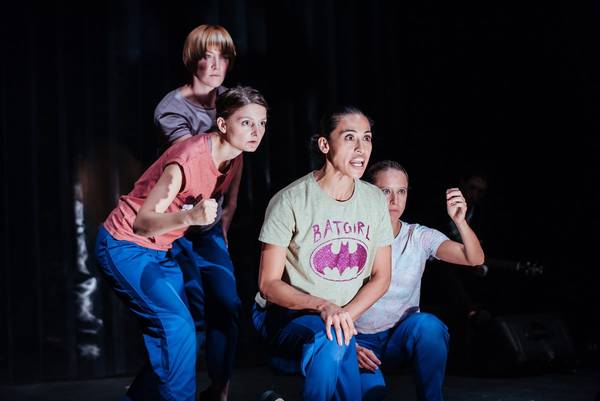
There is hardly any set and technology on display, a dramatic change from their last adult show, Light. Instead, costume plays a bright but subtle role in the story – the five women playing the girls and their family wear coloured t-shirts with cartoon characters often idealised by young girls. Disney princesses, Batgirl and Alice in Wonderland offer them an American-created fantasy that they can strive for but will most certainly never achieve.

Juxtaposed against these pastel tops are quite vicious games demonising the powerful politicians and corporations that shape their lives. They also mock their working conditions, daily violence at the hands of men and threats to their lives. Milagros’ mother (Deborah Pugh) is a vocal political protester, demonstrating a ferocity also contrasting her character’s clothing. The excellent live score by Amy Nostbakken is more of a direct expression of the fighting spirit and sadness within these women.

Though a text-driven piece, Mann uses a series of motifs that soon become recognisable, indicating specific actions and locations. They enhance the understanding and often act as a substitute for words. Though used regularly, Mann’s choreography is one of the company’s trademarks and is unfortunately underused, especially considering the lack of set.

Even though NAFTA is over twenty years old, the maquiladoras are still there, employing women for long hours, polluting local rivers and creating environments ripe for exploitation. Paldi’s script aggressively demands awareness which may be unpalatable to some, but should be required viewing for every American blissfully unaware of their brothers and sisters across the border that are so often looked down upon with racist disgust. Bucket List is truly vital theatre in our age of disposable, thoughtless consumerism.

Bucket List runs through 29th August.

The Play’s the Thing UK is committed to covering fringe and progressive theatre in London and beyond. It is run entirely voluntarily and needs regular support to ensure its survival. For more information and to help The Play’s the Thing UK provide coverage of the theatre that needs reviews the most, visit its patreon.

Lucy McCormick: Triple Threat, Edinburgh Festival Fringe

https://files.list.co.uk/images/2016/08/05/lucy-mccormick-triple-threat-750-500-lst214192.jpg

A cultural relic of its time, the bible is hardly pro-women. Lucy McCormick, here incarnated as one of those vapid pop stars who evangelically (and often inappropriately) rallies for the cause they’re currently backing, wants to turn the spotlight on the new testament’s women. She focuses on their underwritten stories, their emotional involvement in Jesus’ life, and all the fingering and angel snogging that was left out of the text we know so well in Western culture.

Trashy, tasteless, obscene, and absolutely excellent, McCormick’s newest show pushes theatre to to limits of acceptability and beyond – any further and it would be pornographic (arguably it already is), though Lucy McCormick: Triple Threat is still not one for those easily offended. Accompanied by two muscly dancers in Calvins, her three-act play that she dutifully explains scene by scene is the story of Jesus Christ. She plays Mary Magdalene, Jesus’ mother Mary, and Jesus himself, with her backing dancers in the supporting roles. It’s also very funny, though laughter swells from amusement as much as it does from discomfort.

This gig-theatre piece is interspersed with appropriate pop songs at key moments of the story, accompanied by excellent dancing and raw emotional outbursts. Her personal life bleeds into the act as she slowly falls apart in the wake of the pressures of celebrity life. Take all of those public celeb breakdowns and multiply them by hundreds with a lot more nudity and mess, and you get something resembling the whirlwind of in-yer-face chaos that is Lucy’s stage persona in this piece.

Her commitment to her cause is unquestionable, but the fact that her character finds the actions that unfold acceptable is disturbing, yet all too familiar. That we can watch someone fall to bits with no dignity and laugh at their plight, righteously judging them, is a powerful comment on the levels of voyeurism and exhibitionism that are now bombard us through all of media’s incarnations.

Lucy McCormick: Triple Threat, for all its deliberate mess and audience discomfort, is a fantastically considered social commentary executed with precision and high levels of consideration and skill. It’s the epitome of fringe shows, and a great one at that.

Lucy McCormick: Triple Threat runs through 28th August.

The Play’s the Thing UK is committed to covering fringe and progressive theatre in London and beyond. It is run entirely voluntarily and needs regular support to ensure its survival. For more information and to help The Play’s the Thing UK provide coverage of the theatre that needs reviews the most, visit its patreon.

Adler & Gibb, Edinburgh Festival Fringe

https://www.thestage.co.uk/wp-content/uploads/2016/08/Adler-and-Gibb-GIna-Moxley-credit-Richard-Lakos-700x455.jpg

I was gutted when I found out Janet Adler and Margaret Gibb aren’t real. The portrait Tim Crouch paints of this fictional couple and their anti-capitalist approach to their art, in striking contrast to a deranged Method actor and her coach making a film about Adler’s life, is so well-formed that they feel that that they can’t not be real. Even though the reality of these characters is so detailed through their dialogue, Crouch’s staging and choreography is wholly unrealistic and often absurd, a work of art in itself. This rigid stylisation, though eventually giving way, rebels against convention just as the characters do. These two sets of characters and the staging battle for dominance in a wonderfully compelling and disturbing commentary on the ownership, commodification and nature of art and its creators.

A nameless student begins with a lecture, and intersperses scenes with a discourse on Janet Adler’s life and work, shaping and contextualising the woman that actor Louise discusses with zealous devotion. Despite these strong feelings, Louise is unmoving, staring straight ahead. Her teacher Sam is the same; though their voices have some emotion, their bodies are rigid as they stare through they audience. Adler’s widow, Margaret, assumes the same style when she first appears. A boy moves any necessary props, wearing wireless headphones with instructions whispered to him by a woman sitting upstage with a microphone. Some of the props are appropriate to the action, some totally absurd. The boy’s innocence and movement is powerfully accentuated amongst the stillness; though he is a child, he has control of all physical action rather than the adults. The sculptural staging with juxtaposed power becomes a thoughtful commentary on art’s relationship with its audience, something Adler may have approved of.

Though the performances aren’t wooden in the least, the distance they maintain through roughly half of the play is frustrating, albeit canny. It works as a concept within a play about art and the detailed characters are built through dialogue, but the initial lack of connection between them leaves a gaping void.

Cath Whitefield endows Louise with a fanatical “I will stop at nothing” attitude that’s both satisfying to look down on and be disturbed by. Her and Sam’s visit to the house where Adler and Gibb last lived and their subsequent choices are a potent critique of the Method acting technique, as well as any other justification of awful behaviour for the sake of making art. Her character’s abrasiveness effectively generates empathy for Adler’s widow Margaret, ferociously played by Gina Moxley, who also shows moving tenderness when faced with the memories of her partner.

The richness of the characters and the feeling that they live beyond this play is the strength of Crouch’s writing, but the messages contained therein are important to consider. Who does art belong to once it’s in front of an audience? Where are the boundaries of an homage to the dead? Who do any resulting accolades belong to? It’s certainly thought-provoking stuff to consider the lineage of the cultural products we consume. Despite all the good intentions in the world, what damage may have been caused in the research and making of that book/film/play/artwork/song that we consume so casually?

Adler & Gibb runs through 27th August.

The Play’s the Thing UK is committed to covering fringe and progressive theatre in London and beyond. It is run entirely voluntarily and needs regular support to ensure its survival. For more information and to help The Play’s the Thing UK provide coverage of the theatre that needs reviews the most, visit its patreon.