Gatsby, Union Theatre

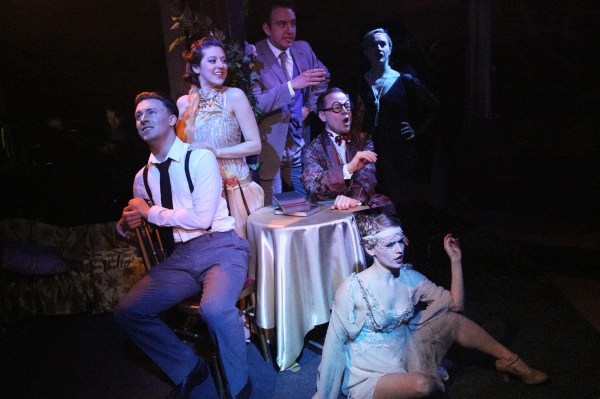
Gatsby (c) Roy Tan (4)

Jay Gatsby’s distinctive yellow car is an iconic image in The Great Gatsby. Power, wealth and charisma emanate from its shimmering, custom paint job as it rolls between Long Island and Manhattan in the decadent 1920s. It’s eye catching and demands attention, like the enigmatic man who owns it. Adaptations of The Great Gatsby are plentiful, but good ones need the same characteristics as Gatsby’s car, along with a generous, heady mix of self-indulgence and extravaganza. Linnie Reedman and Joe Evans’ musical incarnation of F. Scott Fitzgerald’s iconic novel manages to avoid incorporating any these. Bland music, lazy performances and design and a book with numerous shortcomings makes Gatsby a stuttering, third-hand Ford Fiesta rather than a customized, purring Rolls Royce.

Reality TV celeb Ferne McCann makes her theatre debut in this production, bringing a lot of negative publicity with her as consequence. She’s also incredibly surprising – alone in a theatre-trained cast, she is the only one consistently able to be heard over the live actor-musos with her Amy Winehouse-influenced performance. Of the 13-strong cast, most are weak, some terribly so. They are either grotesquely overacted cartoons, or underplayed so much that their performances are flat. There’s no sense of danger or excitement, or EVERYTHING IS EXCITING ALL THE TIME FOR OVER TWO HOURS. It’s exhausting to take in. In either case, the characters are no more than stereotypes; this is more of an issue with Reedman’s book as it certainly doesn’t give the actors much depth to work with. Accents drift around the 50 states and then some, with the only consistent one coming from an actual American.

Reedman also directs, with little comprehension of the narrative arc she constructed from the novel. Other than the Plaza hotel scene late in the play when Daisy and Jay confess all to Tom, there is a pronounced lack of tension. Myrtle’s tragic end is anticlimactic and rushed, as is her husband George’s retaliation. She neglects characterization and seems to focus solely on staging. If that.

There are 21 musical numbers (including a couple of reprises), but none of Joe Evans’ tunes stands out from the rest. Even with a mix of smaller and larger numbers, there is little  musical variation. Transitions from book to song are often abrupt and forced for the sake of fitting in another tune rather than naturally reaching a point in the story where music is necessary to accentuate a plot point or emotion. Nick Pack’s choreography, without much to work with, is similarly unvaried with a bit of a Charleston every now and then.

There are few positives to pull from this production. Reedman and Evans’ interpretation is a choppy hatchet job of Fitzgerald’s work and few, if any, features deem it a worthy adaptation. If Gatsby’s goal is for the audience to “feel…the heat, sweat and life” of the euphoric, post-war American decade, it barely comes close. Tepid, cool and laconic is what actually comes across, in a wheezy motorcar threatening to cut out at any moment.

Gatsby runs through 30th April.

The Play’s the Thing UK is committed to covering fringe and progressive theatre in London and beyond. It is run entirely voluntarily and needs regular support to ensure its survival. For more information and to help The Play’s the Thing UK provide coverage of the theatre that needs reviews the most, visit its patreon.

A Nation’s Theatre: Wail and The Beanfield, Battersea Arts Centre

For two months, theatre makers from across the country are coming to London to celebrate the state of British theatre. One of the A Nation’s Theatre venues is Battersea Arts Centre, currently hosting the double bill of Little Bulb’s Wail and Breach Theatre’s The Beanfield. Wail is an exuberant cabaret about whales and human expression; The Beanfield uses multimedia to examine the impact of police violence on peaceful people and the need to fit in. Though different from each other in content and tone, both Little Bulb and Breach play with performance conventions to create innovative new structures that are at the forefront of theatre performance.

WAIL_Little Bulb Theatre

There’s a lot of science in Wail, and a lot of musical instruments. Actor-musicians Clare Beresford and Dominic Conway, performing as themselves, also have boundless enthusiasm and impressive music repertoires. With material ranging from folk to metal, they share their enthusiasm for whales through songs alternating with monologues of scientific facts. Their charisma and cheer keeps these sections engaging, particularly with the addition of audience interaction. Though the overall energy is light and positive, Beresford’s melancholy for never actually seeing a whale in the flesh provides a bit of contrast to the Male Whale Choir, a hilarious whole-audience exploration of whale songs that males use when on the pull in the coastal waters of Madagascar.

There isn’t as much material on the promised exploration of why humans wail, but a song about why they sing songs is a tender, poignant homage to feeling fragile. This fun, frivolous show is light on the gravitas that a bit more time on this topic could bring, but Wail is still a wonderful, joyful piece as is. The symphonic final number is a fantastic climax wrapping up an excellent contribution to A Nation’s Theatre.

The Beanfield_014_please credit Richard Davenport

The Beanfield by Warwick University’s Breach Theatre wowed audiences at Edinburgh last summer, and understandably so. Drawing on the historic clash between new age travelers heading to Stonehenge and police fresh from the miners’ strikes, they add the framing device of a uni reenactment group researching the event in order to recreate it, and a counter narrative of a group of students going to Solstice. It’s a sophisticated script with plenty of absurdity to lighten the bleak depiction of police violence against unarmed civilians, but still serves as a potent reminder that this happens today in the UK and abroad. Part documentary, interview footage with witnesses on both sides is broadcast liberally; even though the inclusion of police is sympathetic, The Beanfield firmly supports the travelers. Rightly so – pregnant women and children were among the 600 or so attacked with truncheons and projectiles by 1000-odd police.

There is no explicit link between the Beanfield story and that of the contemporary, skeptical students at Solstice, but the inclusion of the latter provides some necessary humour. It’s not a needed subplot though, and detracts from the power behind the political statement of the Beanfield standoff. The script is a great collage of experiences past and present, the sweet naivety of students juxtaposing the atrocities that happened at thirty years previously. The Beanfield, a bit less polished than Wail, is still an excellent piece of theatre with some important thoughts on police brutality.

With multimedia at its forefront, The Beanfield captures the rapid-fire sensory bombardment of present day youth and the desire to instigate change as well as fit in with our peers. Wail, mostly analogue and much less angry, implies the importance of conservation and sympathy for all creatures, human and not. Both shows excellently address concerns of people in this country and experiment with performance, fitting contributions to A Nation’s Theatre.

Wail runs until 23 April, The Beanfield until 21 April then touring.

The Play’s the Thing UK is committed to covering fringe and progressive theatre in London and beyond. It is run entirely voluntarily and needs regular support to ensure its survival. For more information and to help The Play’s the Thing UK provide coverage of the theatre that needs reviews the most, visit its patreon.

The Broke ‘N’ Beat Collective, Battersea Arts Centre

https://i0.wp.com/www.20storieshigh.org.uk/wp-content/uploads/2016/02/Jack-and-Lateefah-1280x853.jpg

Kids have it tough, especially if they’re poor. Decreasing social mobility, higher costs of education and living, and decreasing welfare are trapping our future generations in inescapable cycles of poverty. They are just as aspirational as young people from more privileged backgrounds and aware of the opportunities they don’t have. They are angry, frustrated and lack the opportunity to constructively express their feelings that often go completely disregarded by more comfortable members of society.

Theatre-Rites and 20 Stories High, seeing validity in their voices, worked with numerous young people in this demographic to devise a gig-theatre show that shares experiences of being a poor teenager in Britain today. The Broke ‘N’ Beat Collective is an empowering, important work that uses fantastic puppetry, mask and music to create a gloriously messy collage of young people’s concerns and issues. Structurally mirroring the rough and ready, fractured existence of urban youth culture, it rebels against theatrical and cultural preconceptions without apology for its flaws.

Elisha Howe’s (aka Elektric) soaring rhymes and Jack Hobbs (aka Hobbit) beatboxing energise the audience and establish a defiant, proud tone that carries through the show. They are not backing down, nor are B-boy Ryan Harson (aka LoGisTics) and puppeteer Mohsen Nouri. They literally zoom in on the tiny model tower blocks and street scenes of urban Britain, replicated in cardboard wonderfully extracted from the plain back wall, creating a landscape of alternating songs with monologues. These set pieces and puppets pass on the otherwise unknown life stories of young people they’ve met.

Omar is an insecure, confrontational grey hoodie that takes the whole show to find his voice. Jack’s a wannabe gangsta who knocks up Latifa (both with cartoonish, cardboard heads) and ditches her and the resulting child that reflects on how that’s shaped his life goals. Joanne is the Papergirl who cuts herself because her mum’s boyfriend abused her. There’s also the incredible Speaker Boy, a rotund, playful chap with a boombox for a head. Each puppet is as unique as the young person behind it, and just as inspiring. (Seriously, go look at the puppets’ photos in the gallery part way down the page; they are some of the most emotionally endowed bits of paper and foam I’ve ever encountered. All of these characters unashamedly demand attention with precise, evocative storytelling and a joyfully visualised presence. These stories are broadcast along side an ever-changing soundtrack with interjections of dance, banter and spoken word, simultaneously creating an atmosphere of celebration and seriousness. Though fun, it never loses the sense of the weight behind the work.

Despite the boldness in the work and the importance of its messages, there are some sloppy transitions that cause the piece to lose momentum. Elektric unnecessarily introduces each number by name, and there are some in-jokes between the performers that, whilst sweet, don’t carry energy with their small scale. This gives the whole piece a choppiness that makes it feel unfinished.

All four performers’ exemplary skillsets and vibrance are fantastic vehicles for the young people of this country seeking escape from the poverty that is so limiting to their ambition. Each moment connects to the next through a theme rather than a storyline, but the effect mirrors modern society: a bit messy, emotional and ambitious for a better life. The fun doesn’t override or trivialize the seriousness, and neither is it too weighty. The unpolished feel is very much ingrained in the gig-theatre style, and though it would be great to learn more about the characters presented, The Broke ‘N’ Beat Collective truly holds a mirror up to nature.

The Broke ‘N’ Beat Collective runs through 2 April.

The Play’s the Thing UK is committed to covering fringe and progressive theatre in London and beyond. It is run entirely voluntarily and needs regular support to ensure its survival. For more information and to help The Play’s the Thing UK provide coverage of the theatre that needs reviews the most, visit its patreon.

Leaper: A Fish Tale, Greenwich Theatre

unspecified

Our oceans are dying. Just yesterday, the news reported that 95% of the Great Barrier Reef has been bleached due to temperature rises. There are huge swathes of sea with high concentrations of microplastics that leach toxins into the water and the food chain. We are overfishing our oceans, causing a myriad of problems to human and sea life.

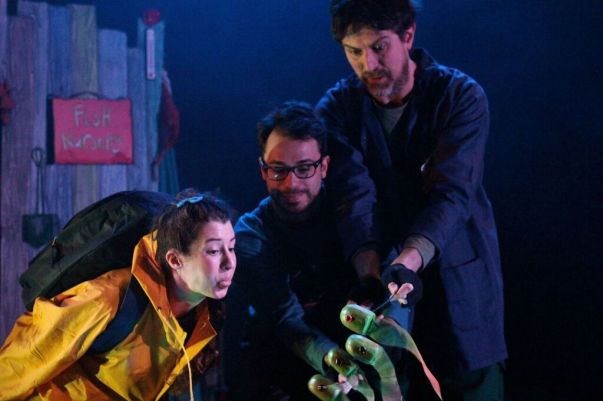
Tucked In is trying to change that through Leaper: A Fish Tale, an adventure story for families about a young girl’s discoveries in the world’s waterways. The unnamed daughter isn’t particularly interested in her dad’s fish farm and wreaks more havoc than anything else. But after falling into the stream in pursuit of a dropped crisp packet, she makes friends with Leaper the salmon on her journey from stream, to river, to ocean and back again. Good puppetry and movement keep younger ones engaged in this surprisingly complex story, though at times it feels a bit too convoluted and the lack of dialogue is unnaturally forced.

With an impressive array of animal puppets by Claire Harvey and Annie Brooks’ transformative set, there’s plenty to look at in the show’s recycled aesthetic. The larger puppets have an excellent range of movements, particularly the duck, seal and big fish. The rubbish monster is the most wonderfully inventive surprise, and the large jellyfish are poetry in motion. The smaller puppets are understandably simpler, but less dynamic with fewer moving parts. The baby fish, though sweet in the way the human characters treat them, are harder to see and not particularly interesting in and of themselves. The design really comes into its own in the middle of the ocean, with atmospheric lighting and sound to match.

Though the show wants to address both overfishing and ocean pollution, the littering is the primary focus. It makes sense as children may struggle with the concept of overfishing, but the plot points on the topic are consequently less engaging. There aren’t many of them though, and the focus is almost solely on the girl’s (Lizzie Franks) journey.

The performances by Franks, Philip Bosworth and Robert Welling are engaging and precise, though the reason for minimising speech is unclear. There are plenty of vocal effects, but character communication and actor impulses feel unnaturally limited. It doesn’t interfere with the story and the children in the audience aren’t bothered, but it doesn’t contribute to the production style.

Leaper: A Fish Tale is visually compelling with some great puppetry and an engaging story for children and adults alike. The performances are good and the story has all the necessary components of a satisfying adventure tale with a clear moral. Though there are some small issues, they don’t interfere with the overall enjoyment of the piece, and this show could play a powerful role in raising engaged, environmentally conscious young people.

Leaper: A Fish Tale is touring schools and theatres in April.

The Play’s the Thing UK is committed to covering fringe and progressive theatre in London and beyond. It is run entirely voluntarily and needs regular support to ensure its survival. For more information and to help The Play’s the Thing UK provide coverage of the theatre that needs reviews the most, visit its patreon.

Rave Space, Camden People’s Theatre

https://www.cptheatre.co.uk/wp-content/uploads/2016/01/Will-Dickie-1-1.jpg

A few hours before the start of the New Year, I found myself alone in a dark room in Battersea Arts Centre with two DJs, Will Dickie and Jeremiah Isaacs. The encounter was intimate, revealing and brief. Twenty minute long The Resolution Studio recorded individual participants’ resolutions for 2016, created a signature dance move, and the two djs and their audience of one had a quick groove session before rejoining the venue’s party. Though I felt self conscious at being the sole centre of these two artists’ attention, it was an event that stuck with me the past few months.

When I received an invitation to Camden People’s Theatre festival Sprint 2016 closing show, Will Dickie’s latest work Rave Space, I jumped at the opportunity to experience more of his work. With The Resolution Studio captivating me with Dickie’s charisma and sensuality for such a short time, I couldn’t resist the offer of an hour-long rave and text hybrid piece in the basement of CPT. I left confused and disappointed, though. There are definitely some wonderful aspects of Rave Space­. Interaction, dance and music meld to make a gig theatre piece with some audience autonomy, but with an actual runtime closer to 90 minutes and lengthy, muddled sequences of text and contemporary dance that only tenuously fit together (if at all), this new piece is much in need of further development.

One-by-one entry, whilst it adds atmosphere and interaction, takes a long time as we each have to ID ourselves and receive a hand stamp. Once we’re in, we can peruse the tiny stations with LED signs, turntables, and random objects assembled like shrines in the corners of the room. Some people are given laser pointers. It’s mysterious, cryptic and exciting, though there isn’t much to actually do or engage with. People are chatting, performers/stewards in hi-vis pepper the space and it feels like a gig is about to start rather than a theatre piece. There are no chairs, and it’s late. The lengthy build-up creates buzz and excitement, but what follows is an anticlimax.

When the music starts, spinning from a pentagonal structure in the middle of the space, a few people get really into it, most others bob heads, some don’t join in at all. That’s ok because there’s no judgement, but watching other people have a great time can be dull. Spoken text over a mic and pre-recorded monologues eventually kick in, but there is a detachment from the music, even though the content is often about music or rave culture. There’s no through-line or any justification for pairing that particular music with those text extracts. Comparing rave culture with the experience of going to church is the most interesting proposal, but it is not investigated further. Also disconnected from any of the topics discussed in the sections of text are sequences of contemporary dance in various styles, including what looks like Butoh. Though a display of adept, emotive physicality akin to a Rodin statue coming to life, these are also detached from everything that has occurred so far.

Though the concept of creating a piece that incorporates rave culture with performance is an excellent one, Will Dickie’s execution leaves much to be desired. There is no denying his charisma and talent, but Rave Space needs to consider its aims and its audience as it grows.

Rave Space was a one-off event at Sprint 2016.

The Play’s the Thing UK is committed to covering fringe and progressive theatre in London and beyond. It is run entirely voluntarily and needs regular support to ensure its survival. For more information and to help The Play’s the Thing UK provide coverage of the theatre that needs reviews the most, visit its patreon.

The Rules of Inflation, Theatre N16

I hate balloons. Well, not balloons themselves, but the noise they make when they burst. After more than three years as a children’s entertainer that does balloon modelling, you’d think I’d be used to them, but no – if anything, it’s worse. When I walked into Theatre N16 to discover a floor covered with balloons and four actors gleefully throwing themselves around the space, I nearly left. I’m glad I didn’t though, despite numerous explosions. Rules of Inflation, a new performance art piece by Balloons Theatre, confronts socio-political issues by setting them at a children’s birthday party, complete with a deranged entertainer who demands his audience of four child characters participate in increasingly disturbing activities. Though my immediate violent revulsion towards the balloons and the job I know all too well intensified as time went on, the messages contained therein are cleverly presented. Even though they are not particularly unique to the stage, the kids’ party framework draws attention to how disturbing these global problems are.

From the start, it is clear this is not a normal children’s party. The creepy music, dark lighting and clown in a ripped, dirty costume (a disturbing Joshua Webb) create a distinctly foreboding, horror film-esque atmosphere, along with all those balloons that could burst at any moment. It’s not a unique landscape but it’s highly unsettling, and relentlessly so. As innocent childhood games become not so innocent, it’s a reminder of how seriously little ones take their play. Getting “out” actually makes them feel like they died, or that they’re gagged and bound. It also calls to mind child’s play in war torn countries, where games in a dangerous environment can result in injury, trauma or death, and the way the world’s politicians play at war without experiencing any direct consequences.

Four actors play four children with varying levels of maturity, who are prone to varying levels of exploitation. Clown targets serious and mature Blue (Nastazja Somers), and finally abandons her in a harrowing, violent end. It’s horrific to witness. Yellow (Bryony Cole) and Green (Emily Sitch) are too similar of characters, and Pink (Bj McNeill) also aligns with them. Whilst this could create an effective gang against Blue, who has a wonderfully defiant presence, this opportunity is missed and she is neither particularly isolated or supported by the kids as Clown abuses her. Instead, their youthfulness draws them to the clown, who eventually proclaims a party  winner even from their indistinctness. The piece is also a bit too long considering the straightforward format, but more abstract moments help add variation and a break from the relentless violence, abuse and manipulation. The actors’ vocal and physical energy was quite adult at times and would be more potent if the actors consistently kept to obvious depictions of children.

Rules of Inflation may not evoke such a visceral reaction in most people, but it’s aggressive displays of sexual abuse and objectification are still incredibly powerful. The piece needs a few tweaks to enhance its potency and theatricality, but not many. The balloons and kids’ party context can play on a fear of clowns as well, but this live art performance is a potent examination of power and child abuse in its own right.

The Rules of Inflation runs until 24th March.

The Play’s the Thing UK is committed to covering fringe and progressive theatre in London and beyond. It is run entirely voluntarily and needs regular support to ensure its survival. For more information and to help The Play’s the Thing UK provide coverage of the theatre that needs reviews the most, visit its patreon.

Wonderations, The Canvas Cafe

https://pbs.twimg.com/media/CcvF_vOWEAA7JKp.jpg

Sunday evening was a night of new discoveries. The Canvas Café, just off Brick Lane, serves homemade cakes and prosecco by the glass. It also has walls you can write on and a cosy downstairs performance space. In that space was Ivy Davies and her show Wonderations, a gentle, joyful blend of spoken word, songs from her EP and questioning whether or not Mickey Mouse is actually God. Though lacking in narrative, Davies’ performance shares issues that are particularly personal: aging and her search for identity and faith. With a touch of live art about it, Wonderations is a lovely celebration of self-acceptance akin to reading Davies’ journal.

This isn’t a visual show, but a totally aural one. It could easily be listened to through headphones or with eyes closed, though her soothing melodies and rhythms could lull you to sleep – it’s that relaxing. There are some powerful sentiments in her lyrics and poetry that deserve full attention, however. As Davies struggles to find her pre-marriage and babies self in theatrical songs and rhymes, one can’t help but to relate to her frustration with finding her true identity buried under all the nonsense life throws at us. We all find ourselves wasting hours on social media focused on constructing an image, or immersing ourselves in work and forgetting to just be present in the world for lengthy periods, but Davies exhorts us to let all of it go. She’s like a life coach, but a gentle one who uses cuddles rather than shouting.

This cabaret-esque structure feels conversational, but is precisely and satisfyingly scripted. There’s no plot to speak of, but with Davies wearing the form like her own skin, it works. Her spoken word isn’t the pounding, angry sort I’m accustomed to; it’s full of flowers, sunshine, rain and claiming her own ground. Davies has an immovable strength and presence, but one that overflows with positivity. Less connected from her celebratory songs and spoken word is what feels like an internal monologue where in looking for faith, she wonders if God is actually Mickey Mouse. He’s been seen around the world at the same time, and has plenty of purchasing power. It’s a wonderfully funny, and pointed, argument, though less clear on it’s place in the show’s structure.

Ivy Davies’ Wonderations is a hard show to pin down, but it doesn’t apologise for that. I’m pretty certain that she’s confident enough to not care what anyone thinks of her work, but the themes it contains are universally human presented in an easily digestible format. An excellent event for a quiet Sunday evening, particularly with a slice of cake and a glass of prosecco.

The Play’s the Thing UK is committed to covering fringe and progressive theatre in London and beyond. It is run entirely voluntarily and needs regular support to ensure its survival. For more information and to help The Play’s the Thing UK provide coverage of the theatre that needs reviews the most, visit its patreon.

Amaluna, Cirque du Soleil at Royal Albert Hall

rsz_bol4

Nearly twenty years ago, I went to my first Cirque du Soleil show in New York. A young teenager and already obsessed with theatre and performance, I was blown away by the colour and spectacle, having never seen anything like it before in the fourteen years that I’d been on this earth. I have no concrete memories of the show, just flashes of light and colour, and feeling impressed. I looked forward to see if Amaluna, inspired by Shakespeare’s The Tempest, would live up to my juvenile memories.

It took a while to find out. First, I had to meet my critic friend, who had invited me as her guest, at door 6 at 7:30. I approached Royal Albert Hall from the side closest to Exhibition Road and found myself at door 3. Not being familiar with the venue, I picked a direction and soon found I was going the wrong way. Considering it’s a circular building and I was early, I carried on and found myself at door 6.

WHAT SHEER HELL IS THIS? At door 6 was Cirque’s version of a red carpet (it was blue), a queue of luxury cars out of which vaguely familiar people emerged in black tie and evening gowns, bright lights and hordes of shouting paparazzi. A few cold looking performers in costume posed for photographs, film crews conducted interviews and vicious looking security guards hovered, ready to move on anyone that looked like they didn’t belong.

I’ve been to a lot of press nights, but this was incomparable. More like a film premiere or awards ceremony, Cirque at some point took the circus outside the venue and into the media and celebrity world. When did this happen? Or more importantly, why? Does Cirque really need the publicity so badly that they pander to the vapid world of Big Brother contestants and paparazzi? And how was I supposed to find my friend in this mess?

Giving wide berth to this bright and shiny, “OK Magazine Live!” shitshow, I carried on to the other side of the large foyer that the blue carpet led to. Fortunately door 6 was duplicated opposite and the nice usher on the door let me wait in the warm. I still managed to be early. The performers across the foyer still looked cold; it dawned on me that they had to be onstage doing acrobatics in less than an hour and that they were either understudies/doubles or Cirque is more interested in photo ops with celebs than the wellbeing of their performers. I desperately hope it’s the former.

Anyway, the show itself. Nearly. We had great seats in a box allocated for press but I didn’t realise at first just how good they were. Or rather, how expensive, until critic friend informed me what they were retailing for. My initial reaction was an inner explosion of flabbergast, “people around us paid HOW MUCH for this show?” Then I realised: press get their tickets free, as does the wafting, gormless army of famous people, so how much is Cirque actually making out of this press gala? Especially considering the post-show reception (we declined our invitation to attend) and the swathes of empty seats in the upper galleries. These are the cheapest seats, but on a press night, why are they empty? Were they marked up so much that they weren’t bought? Are people not interested in Cirque anymore? (In which case, they desperately need the media attention.) Or, did Cirque keep them vacant so plebs didn’t gawp over their famous fellow audience members? Regardless of the reason, none of the prospective answers are positive.

NOW for the show. Really.

I love when theatre and performance makers mess about with Shakespeare. It can prove his work is still relevant and opens the possibility of a new perspective or insight. The programme states that this is a female-driven show: Prospero is now Prospera, and Amaluna is Miranda’s empowering coming-of-age story. The band is entirely female, as is most of the cast. A feminist adaptation of a Shakespeare play for circus? It should be brilliant, and exceed my youthful memories of my last Cirque show.

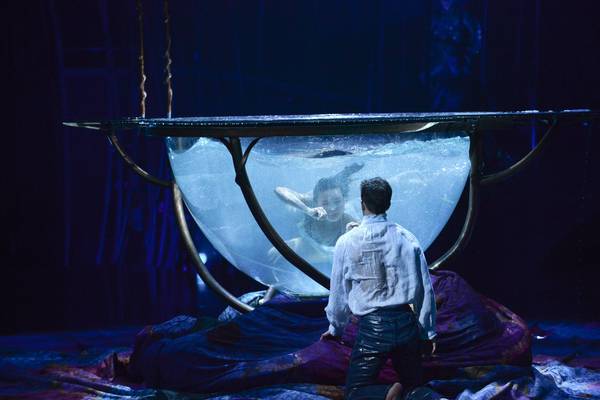
It’s not brilliant. Sure, it’s bright, colourful and a consistent sensory overload. The skill-set of the performers is top notch. There are acrobats, aerialists of all kinds, clowns, Chinese pole performers, and juggling. It’s technically impressive. It’s easy to get swept away by the spectacle of the whole thing.

There’s little substance, though. They story is a vague framework for the circus acts and spectacle. Most importantly, the supposedly empowering female narrative is anything but. Prospera throws a party for her daughter Miranda, who then bathes in the light of the aerial hoop performing Moon Goddess who bestows her with a gift of a glass sphere. It’s an obvious metaphor for Miranda’s  womanhood/menstrual cycle, and a cringy one at that which doesn’t contribute anything to The Tempest aspect story. Miranda also meets a prince who has washed up on their island in a storm. Called Romeo rather than Ferdinand (dear god, why???), Miranda immediately falls in love with his sculpted, often shirtless body. Her best friend Cali, a half-lizard-half-man creature, is jealous of the man who’s taking away Miranda’s attention from him. The two male characters compete for young Miranda’s attention and the pretty, shipwrecked Romeo was always going to win, gifted with a wedding and all. It was like an old school Disney film. Empowering to women? No, no, NO. The narrative presented was about as disempowering as you can get, particularly when you factor in the creepy plot points of an unseen Romeo watching Miranda bathe and hand balance in white shorts that become nearly transparent from the water (You can see EVERYTHING. I’m pretty sure I could see up into her stomach during the splits.), and Cali abducting her into the heavens to keep her to himself. Also consider for a moment that in Shakespeare’s version, Caliban raped Miranda and is enslaved by her father as consequence. Plus, if this is Miranda’s coming-of-age celebration, she’s how old? Sixteen AT THE OLDEST. And she get married at the end of a story that spans no more than a couple of days? This is supposed to be a piece of performance that empowers women.

There’s also plenty of creeping elsewhere in the show. The two clowns, one a nanny to the young Miranda and one a washed up sea captain. Mainha and Papulya are overtly sexual, and as cringy as the Moon Goddess. There’s classical Commedia influence in the pratfalls and lazzi-like sketches full of groping, arse kissing and manipulation. I get that circus performers have to wear tight clothes for their work, but the men are often topless for no apparent reason and there’s more female flesh on display than needs be.

Ignoring the narrative and theme, the individual acts and the show of it is celebratory, fun and a showcase of skill. However, Cirque as a vast, commercial institution raises some concerns, and the perception of female empowerment and celebration by their creative and marketing team when the reality is the opposite is not only highly disturbing, but a sign of endemic patriarchal complacency about what is an acceptable lens to view womanhood through in the performing arts.

The Play’s the Thing UK is committed to covering fringe and progressive theatre in London and beyond. It is run entirely voluntarily and needs regular support to ensure its survival. For more information and to help The Play’s the Thing UK provide coverage of the theatre that needs reviews the most, visit its patreon.

Red Riding Hood, Pleasance Theatre

rsz_red_riding_hood_artwork

As it’s the run up to Christmas, pantos are saturating our stages. There are the traditional ones and plenty that give themselves another label in the hope of getting attention: boutique, adult and gay spring to mind. Then there are other shows that are close to panto in that they’re family friendly and/or based on fairytales, like Polka Theatre’s Beauty & the Beast. New musical Red Riding Hood, by the team that brought audiences the stage adaptation of The Secret Diary of Adrian Mole, Jake Brunger and Pippa Cleary, also falls into this category. The largely excellent, Disney-style songs are this production’s strongest feature, but unfortunately the cheap-looking set, and now-antiquated style of children’s theatre prevent this show from being a stand-out option this holiday season.

Nazarene Williams excels as Little Red. Clever and feisty, she’s a wonderfully pro-active character for young girls to identify with. Her charming sidekick William the Woodcutter (Matthew Jay-Ryan) is dopey and fun, but a good enabler and supports Red on her quest to save her family’s bakery. Matthew Barrow has more character as the wolf; his dad lacks energy in comparison. Mum Holly-Anna Lloyd is a strong singer, but she looks the same age as her daughter and the character lacks maturity. Patsy Blower completes the cast of five as the witty grandma. All of them are strong singers with that powerful, modern American Broadway tone that kids recognize from Disney films.

The book and design are a let down, though. Brunger’s writing is simplistic and not suitable for children in the upper years of primary school, and there are some unnecessary scenes that seem like they were written to add length rather than the main storyline. Three schools were there, and on several occasions the children got bored and started talking amongst themselves: a powerful indicator of this production’s issues. The story has a well-shaped structure and an interesting plot, but the dialogue isn’t far off that in Town Hall Cherubs, which is pitched to 2-5 year olds. This makes the actors perform in that exaggerated style of performance that used to be the signature of all children’s theatre, but many productions have now become much more sophisticated, even for very young children. The design looks great in dim light and the patchwork tree leaves are a particularly lovely idea, but with the lights up, they look like cheap, enlarged photocopies and the flats themselves are flimsy. The birds in the forest are origami paper cranes that the actors fly around, but there is no movement within the birds themselves. The paper rabbit on a stick slid across the floor has the same disappointing lack of impact. Grandma’s pet parrot, an actual puppet, is a much better use of puppetry. There are obvious budget constraints here, but a simpler approach may have been more effective rather than trying to make the set look grand but not having the materials available to do so.

The songs are excellent though, and there are plenty of them. From moving duets to powerful solos and whole-cast numbers, they pull back the attention every time. There are some trite lyrics here and there, but Pippa Cleary’s music is great. The show isn’t beyond rescue, though. With some re-writes and additional invention (like William’s wonderful magic book) to make it more distinctive and develop the characters, this could be an excellent example of modern children’s theatre.


The Play’s the Thing UK is committed to covering fringe and progressive theatre in London and beyond. It is run entirely voluntarily and needs regular support to ensure its survival. For more information and to help The Play’s the Thing UK provide coverage of the theatre that needs reviews the most, visit its patreon.

Mirror Mirror: A Snow White Pantomime, King’s Head Theatre

rsz_tpw3-k1hri_f6bbtm3nyb5zo_ieq3wud5gnorjqw1hmth7eapkugyw_g9qolxtc-nh9sl6jp3piyv_ekam1gf0

They are new to the King’s Head, but Charles Court Opera aren’t new to pantomime. This year’s Mirror Mirror: A Snow White Pantomime is their ninth “boutique” panto. Though an opera company, this show and cast of six are anything but stereotypical opera fare. John Savournin’s script is fresh and witty, the performances are camp and vibrant, and the re-written pop song soundtrack is so well sung that it deserves a cast recording. There’s plenty of typical panto interaction, made easier and more personal in a fringe venue but doesn’t overwhelm the space, either. Though the costumes are detailed and fun, the set is a bit analog and takes up a lot of playing space, restricting movement and choreography. Some of the performances were more genuine than others, but this remains a wonderfully current panto with excellent writing.

Savournin also directs and plays Snow White, the ditzy, ingénue widow of Barry White living with the seven dwarfs, all distinctly and energetically played by Matthew Kellet. Greedy queen Andrea Tweedale uses her mirror (Simon Masterton-Smith) to help her search for a husband, but her plans are thwarted when prince Larry Black (Amy J Payne) and his valet Harry (Nichola Jolly) show up looking for a bride and instead of being impressed by her beauty, Larry falls for Snow. The traditional story veers off in numerous contemporary directions from there, which adds to the audience’s delight and prevents the show from becoming stale or generic. The music is mostly cleverly reworked pop songs, but there’s a bit of musical theatre thrown in and the Act one Finale numbers are fantastic.

No individual performer overshadows the others, instead they are a balanced lot with clear strengths. Payne and Jolly are a charismatic pair, with Kellett’s range of dwarves a hilarious counterpoint to the leads. Savournin’s Snow is shallow but sweet and doesn’t fall short in any of the creative roles he takes on. Tweedale stokes the audiences’ booing and aww-ing brilliantly. The height difference between Savournin and Payne supports the comedy heavily peppering the dialogue, as does the cross-gender casting that goes beyond the dame and principal boy. There is some lovely chemistry between some of the characters but even though it’s a panto, there could be more between Payne and Savournin.

There’s loads of audience interaction and mess, the best being a Great British Bake Off-style competition that results in dough everywhere. Of course, there’s your usual panto call and response but not so much so that the script is otherwise flimsy. The unique visual gags Savournin employs are much more satisfying, anyway (pro tip: look out for Barry). A few give a nod to tradition, but this is definitely a language-focused script. This gives the performance a richness and depth missing from more traditional fare, hence the “boutique” label. Charles Court Opera is certainly onto a winning formula here within London pantomime offerings and is not one panto fans should miss.


The Play’s the Thing UK is committed to covering fringe and progressive theatre in London and beyond. It is run entirely voluntarily and needs regular support to ensure its survival. For more information and to help The Play’s the Thing UK provide coverage of the theatre that needs reviews the most, visit its patreon.