Shifter, Crick Crack Club at Soho Theatre

Going to a Crick Crack Club storytelling event is a bit like joining a private members’ club. This club doesn’t have strict entry criteria, nor is it cold and exclusive – quite the opposite. A welcoming spirit of community and the use of ritual enhance Jan Blake’s and TUUP’s four globe spanning stories. The first half of the two-hour, four-story Shifter has sturdier narratives, but the tales of trickery and metamorphosis interspersed with simple call and response create a magical, engrossing evening despite a few structural shortcomings.

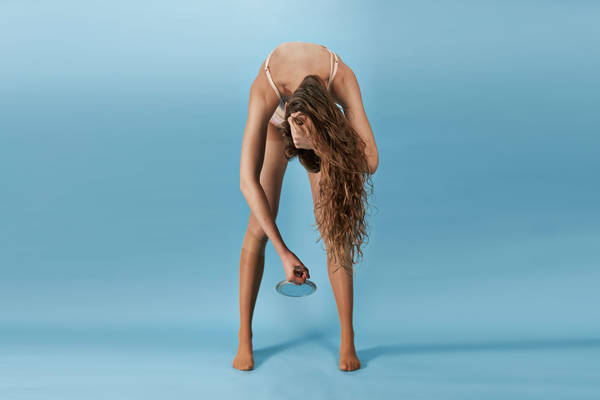
We begin in Scotland, where young prince Raymond on a hunting trip meets a beautiful woman in the depths of the forest. He takes her home and the two soon marry. After many years and the births of their ten children who all have some sort of foreshadowing deformity, the prince makes a surprising discovery after spying on his wife whilst she bathes one evening. After a public reveal, the myth quickly relocates to a chateau in France, where inexplicable marks on a high window ledge are made clear. The prince is very much the victim of his bride’s deceit, but their love is also held up for admiration. Told by TUUP, this story is particularly male focused, demonising the female but also giving her power. It would be an interesting experiment to see what a woman storyteller could bring to this story. The climax and denouement are rushed, but the final line satisfies. TUUP has a relaxed, magnetic presence and his delivery of this warped love story is endowed with empathy and respect.

Blake now takes us to the Gulla Islands off the coast of America, one of the first settlements by African slaves. This is a another love story, again with a man who falls in love with a powerful, shape-shifting woman. Mary is less friendly than Raymond’s wife, and the threat to hew new husband John is tangible in Blake’s telling. This unnamed tale alludes to Rumpelstiltskin and Sleeping Beauty with the prominence of a spinning wheel and mysterious nighttime happenings. The strongest of the four stories in Shifter, its madness and imminent danger give this story a thrill, heightened by the various percussive instruments TUUP uses to accompany.

After the interval, two tribal, pre-Christian tales evoke the savannahs of Africa and the prestige that comes with being a successful hunter. The morals in these stories aren’t about the fear of powerful women in the Christian West; they more broadly apply to all humanity – don’t allow yourself to lose sight of your life goals, and practice rather than magic will bring you success. This half has a more epic sense of coverage, but the narrative arcs are less familiar to Western stories. They are more rounded, with a greater sense of the world outside of the characters; this makes them initially unsatisfying, but more universal.

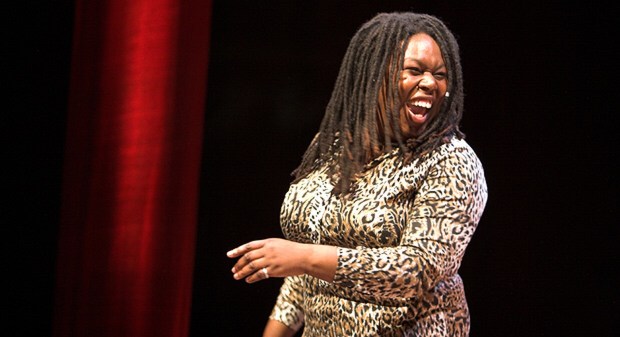
TUUP and Blake both have natural warmth and charisma that draws in the audience like a hug. They are energetic but not ostentatious, simply relying on the rhythms and language of their stories. Much of the pleasure from Shifter comes from their presence, though hearing these stories grants a comfortable sense of inclusiveness despite some rocky moments in the stories themselves.

The Play’s the Thing UK is committed to covering fringe and progressive theatre in London and beyond. It is run entirely voluntarily and needs regular support to ensure its survival. For more information and to help The Play’s the Thing UK provide coverage of the theatre that needs reviews the most, visit its patreon.

Skin A Cat, Vault Festival

rsz_skin-a-cat-main-image-digital

Without question, my best new writing discovery of 2015 was young writer Isley Lynn’s play Tether at Edinburgh Fringe. This surprising, diverse two-hander also made it into the top five of my Top 10 Shows of 2015 so I was excited to receive an invitation to her autobiographical play Skin A Cat at Vault Festival. Having been so blown away by Tether, I worried I would find her other work underwhelming, but Skin A Cat is driven by the same sort of quick-witted, emotionally honest characters on a path of discovery that Tether boasts. Skin A Cat’s not about sport, though. It’s a tale of a stubborn vagina and an epic journey of self-acceptance in a world obsessed with sex. Phenomenal performances and humour tell Alana’s struggle with vaginismus and vaginal penetration with refreshingly frank, honest writing.

Theatre (and Western culture) doesn’t shy away from heteronormative sex, but a main character that hates it due to a psychosexual disorder is most rare indeed. Beginning with her first period on holiday at age nine, we see Alana (Lydia Larson) navigate teenage sexual exploits, several boyfriends, university and her twenties as a heterosexual young woman who finds vaginal penetration excruciating to the point of impossible. Try as she might, it doesn’t happen and the older she gets, the more burdensome and upsetting her virginity becomes. Alana tells her story directly to the audience with support by the excellent Jessica Clark and Jassa Ahluwalia, who play everyone else she encounters along the way, sometimes on mics and sometimes in conventional dialogue scenes, seamlessly switching between the two styles. Larson’s fantastic, perky Alana is genuine, funny and grows up before the audience’s eyes; that and Lynn’s unfettered dialogue cause us to feel like we know her inside and out (#sorrynotsorry) at the end of the 90 minutes.

Lynn’s gift for dialogue and detailed characters within a cleverly framed style shines here, and is generally well supported by director Blythe Stewart. Despite the serious subject matter and the control vaginismus has over Alana’s life, Lynn and Stewart use humour delightfully and liberally in both the writing and staging. Sex, attempted sex and orgasms hilariously abound, along with poignancy, tenderness and dogged desperation. It’s a beautiful balance.

Holly Pigott’s set solely consists of a bed; the pressure of its associated activities dominates Alana’s life. Some of the costume choices puzzle, though. The dungarees that Clark and Ahluwalia wear are androgynous and childlike, and rather old fashioned. Larson wears layers of undergarments that creates a simultaneously sexy and exposing, and completely unsexy and concealing effect – a great manifestation of Alana’s inner conflict.

Skin A Cat evokes belly laughs and empathy, nostalgia and wonder. Though it raises awareness of a psychosexual condition, Lynn manages to not make this an “awareness” play. Instead, it’s a story about growing up, loving yourself and making friends with your body’s quirks. Excellent writing and committed performances in Skin A Cat prove Isley Lynn and the cast are ones to watch.

The Play’s the Thing UK is committed to covering fringe and progressive theatre in London and beyond. It is run entirely voluntarily and needs regular support to ensure its survival. For more information and to help The Play’s the Thing UK provide coverage of the theatre that needs reviews the most, visit its patreon.

You Tweet My Face Space, Theatre N16

rsz_you_tweet_my_face_space_c_boots_&_cats_productions_9

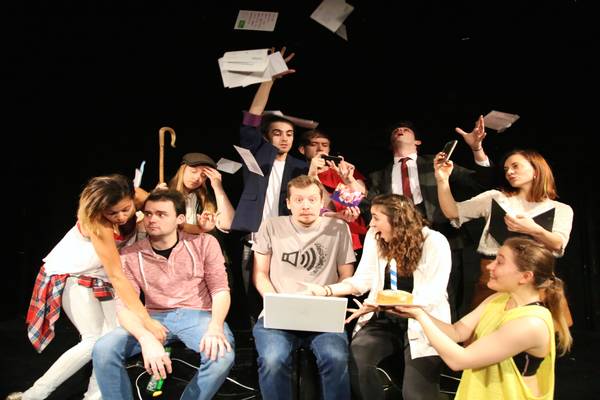
David and Charlotte’s ten-year relationship is on the rocks. He’s struggling with an addiction that’s pushing her out of his busy life, but David’s social media and internet habits aren’t allowing him to give Charlotte the attention she deserves. When an indiscretion on a night out is immediately published and Charlotte leaves him, David vows to quit cold turkey. It’s not so easy though. As the personified apps crash his peace and quiet, this romcom takes a surreal, satirical turn. With bitingly funny moments, good comic timing and some good performances, this surprising one-act is a great giggle for those of us enslaved by technology.

Tom Hartwell is the bookish, quiet David who’s frustration becomes real and relatable. He’s wonderfully foiled by characters such as Hotmail (suave, aloof Hadley Smith), self-obsessed Instagram (girl next door Ellie Goffe with a heart of gold) and Facebook (subtly vicious Evan Rees). Tinder (Kate Okello), Farmville (the wonderfully dour Katie Dalzell) and a couple of others join in to try to persuade David to stay in the internet realm, and some glorious clashes ensue with plenty of digital pop culture in-jokes. Pacing is excellent, as is the energy and ensemble work of the cast.

Hartwell is also the playwright; he has good intuition for the relationship story arc that frames and justifies the chaos, though the moral is a rather obvious one and not particularly profound. His dialogue is punchy and fun, regularly inducing laughs. (It would be interesting to see what his serious material is like.) Director Anne Stoffels has her hands full with a large cast in a small space, but usually manages to keep the action moving without messiness.

For a social media comedy, You Tweet My Face Space is well crafted and even though some of the performances are weaker than others, it reminds us to take a break from our online worlds and interact with people face-to-face more often. It’s a fun, frivolous piece with some excellent moments and a bit of post-holiday season fun.

The Play’s the Thing UK is committed to covering fringe and progressive theatre in London and beyond. It is run entirely voluntarily and needs regular support to ensure its survival. For more information and to help The Play’s the Thing UK provide coverage of the theatre that needs reviews the most, visit its patreon.

in/out (a feeling), Hope Theatre

rsz_in_-_out_-_a_feeling-5

Sometimes, simplicity in narrative structure is more effective than twists, heaps of characters and subplots. Storytelling has been a powerful medium for time immemorial. in/out (a feeling) starkly depicts young, Eastern European woman Blue working in a London brothel after promised a cleaning job. Her client Ollie is a coked-up, suburban lad out for his mate’s stag do, but their encounter changes both their lives, at least for a little while. This two-hander is a brutal depiction of sex trafficking and its uncomfortable nearness to us all, but unblinkingly focuses on the delicate humanity of these two characters through interweaving, storytelling monologues. Excellent performances and Andrew Maddock’s sophisticated wordplay and use of rhythm both captivates and horrifies in this outstanding production with few, if any, faults.

Nicholas Clarke and Alex Reynolds are Ollie and Blue. Though rarely addressing each other directly, their chemistry is still tangible. Clarke’s character has a more interesting journey, from lad’s lad to articulate romantic to devoted boyfriend; Reynolds’ is subtler but more devastating. Both have fearless, vulnerable presences and expressive eyes that pierce the audience to the core during extended sequences of direct address. This is a small, intimate play in a similarly sized venue, but these performers fill the room with intensity and then some. The audience feels like they really know them by the end: a remarkable feat.

Director Niall Phillips and lighting designer Çağla Temizsoy put the stage/bed in the round with harsh blue and red lighting. The set design, presumably by Phillips, is similarly harsh and animalistic: white paint slashes the black walls, strips of red fabric hang from the ceiling like intestines. It’s a nightmare to us, but it’s Blue’s reality. Small buckets, like the kind children play with at the beach, dangle at head height. They aren’t filled with sand, though. It’s Ollie’s perpetual supply of cocaine that he lovingly shares with Blue and frantically sniffs during descriptions of his all-night binges. By the end of this 70-minute play, there’s white powder everywhere.

Along with the performances, Maddock’s language is the star of the play. Evocative rhyme hints at spoken word at times, at others his prose dances with colours, imagery and Blue’s memories of a happier life. We meet several other characters through their storytelling: Blue’s pimp, Ollie’s friend Connell, and others. The double meaning and repetition of “in, out” innocuously describes breathing, then the other bodily function that dictates the rhythms of Blue’s existence. Maddock’s ability to wow the audience with his facility of word choice, sentence structure, rhyme and repetition easily tips into the terror that these characters experiences; this is proof of an extraordinary gift with words and evocative storytelling.

Though building awareness of the closeness of human trafficking is clearly the primary purpose of this piece (Do you actually know your neighbours’ isn’t a brothel? I don’t.), in/out (a feeling) could be about anything at all and the language would still have it’s power. This is a production that needs to be seen, but it feels it would lose its intensity in a larger venue. A good portion of the actors’ power hinges on eye contact, which is easily lost in a bigger space. But in/out (a feeling) needs to be seen by more people – by everyone. And it’s a stunning piece of theatre as well as a vital one.

The Play’s the Thing UK is committed to covering fringe and progressive theatre in London and beyond. It is run entirely voluntarily and needs regular support to ensure its survival. For more information and to help The Play’s the Thing UK provide coverage of the theatre that needs reviews the most, visit its patreon.

Big Brother Blitzkrieg, King’s Head Theatre

Lots of things seem like a great idea at uni. Some of them are genuinely good ideas. A great deal more aren’t. Writing a play about Hitler in the Big Brother House is one of the latter. In 2014, Newcastle University students Hew Rous Eyre and Max Elton founded Bitter Pill Theatre to produce their debut play, Big Brother Blitzkrieg, at Edinburgh Fringe that year. With a couple of other shows now under their belt, they bring their popular first production to London. Meant to somehow satirise Big Brother and Hitler, this stereotype-driven piece doesn’t follow any sort of consistent narrative logic and doesn’t manage to rise to satirical humour. The performances are very good despite the character limitations, but the script comes across as a drunks, nonsensical idea that would have been better off forgotten.

When Hitler fails to kill himself after his final rejection from art school, he wakes up in the garden of the Big Brother House during its final season. True to life, no one watches the programme anymore and the contestants are just in it for the money. Bafflingly, none of them no who Hitler is, even the educated, middle class housemates. Clearly this is a world where WWII never happened, but I’m not sure what point that’s meant to make. Similarly, the plot follows what I imagine to be standard Big Brother events: evictions, competitions, surprises and character clashes that are largely unfunny and offer no new perspective on the show or reality TV format. Though the story defies the laws of Physics through the use of time travel, this element is wholly neglected.

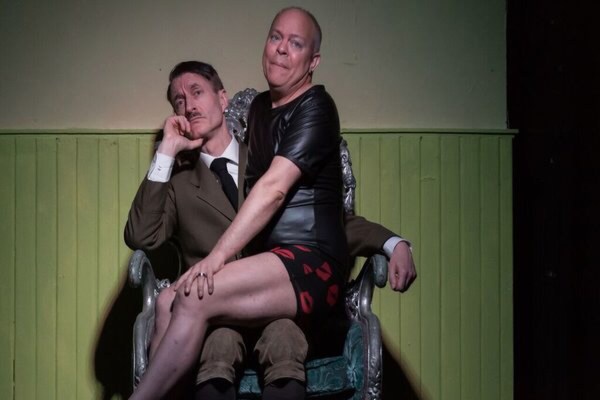
The cast are very good, or at least at playing their respective stereotypes. Stephen Chance is an expressive, quick-witted Hitler with no idea of how to deal with charming, bouncy Essex lad M-Cat (Kit Loyd) and ageing queen Felix (Neil Summerville). He finds kinship in corporate PR and Tory Lucy (Jenny Johns), a delightfully despicable Katie Hopkins homage. The house is completed with femi-gendered Charlie (Hannah Douglas) who has some cracking exchanges with Lucy, and the bland as plain toast housewife Rachel (Tracey Ann Wood), who Hitler immediately distrusts. The combinations invites inevitable situation comedy but again, it’s not sophisticated enough to count as satire, or have any sort of message at all. A shame, as the actors all seem to have great potential but are stuck playing two dimensions.

The show would suit a much smaller format, like a reoccurring sketch as part of a comedy show limiting each slot to ten minutes. About half an hour in, Big Brother Blitzkrieg already feels too long. There were a few good lines, but in 75 minutes, a few isn’t enough to save this play even with the hardworking cast. Despite the commendation these young practitioners deserve for setting up a company whilst still studying and keeping it going for nearly two years, part of artistic development is knowing when to let an idea go. This is a production that needs to retire in favour of more advanced, relevant work.

The Play’s the Thing UK is committed to covering fringe and progressive theatre in London and beyond. It is run entirely voluntarily and needs regular support to ensure its survival. For more information and to help The Play’s the Thing UK provide coverage of the theatre that needs reviews the most, visit its patreon.

The Long Road South, King’s Head Theatre

The Civil Rights movement in America was time of turbulence and violence but both black and white activists retaliated with their passion for equality. The issue divided individual families across generations, recreating the conflict on a microcosmic level. Paul Minx’s The Long Road South recreates this excruciating tension through close examination of the dysfunctional Price family in suburban Indiana.

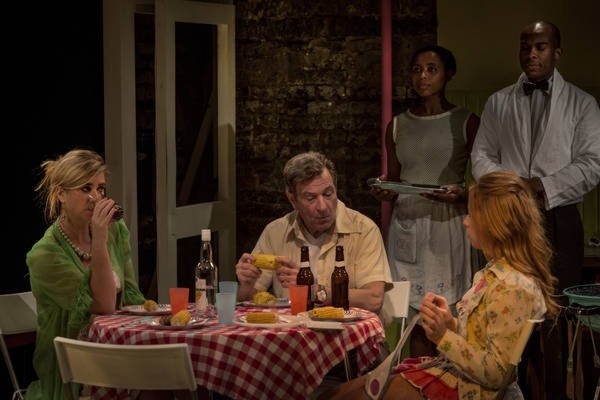
Stay at home Carol Ann (Imogen Stubbs)is mother  to teenager Ivy (Lydea Perkins) and married to supermarket manager Jake (Michael Brandon). They are the only family in their neighbourhood able to afford “help”, black couple Grace (Krissi Bohn) and Andre (Cornelius Macarthy). On the surface, these characters are aspirational and progressive. That American Dream veneer doesn’t hold up for long, though. The characters’ gangrenous innards seep out, creating a kitchen sink drama with excellent moments, dramatic themes  and characterisation akin to Miller and Williams, but lacks the linguistic sophistication of these revolutionary writers and a few too many twists and turns for a one-act play.

The cast is generally strong, with Brandon outshining the rest when he eventually appears in Willy Loman-esque glory. Perkins has a grating vocal quality that, though appropriate to the lying, manipulative character, was nails on a blackboard after a few scenes. Bohn and Macarthy are good foils to each other with a lovely chemistry and sharp edges that sporadically pop out, adding to the dissonance. Stubbs is the tragic heroine, trapped in her house by alcoholism and the memory of an institutionalised child. This lot are a close-knit ensemble, an extended family with all the complexity of a real life one. Unfortunately, the accents spanned the country rather than uniting this family in a common place.

Director Sarah Berger skilfully uses the irregular playing space and space to enhance tension. Rarely touching or even close to each other, this shows the power of religious belief in these characters constantly aware of Satan’s temptations. Adrian Linford’s sunny back garden with its perfectly mowed grass and pastel BBQ juxtaposes the family’s chaos. Minx has an instinct for conflict, but the production’s subtlety comes from the performances rather than the dialogue. There’s no overt moralising or thickly laid Americanisms, just the characters’ genuine need to do what they think is right.

The Long Road South is a quite the good script by a writer with plenty of promise and a great cast. It’s a good reminder of a crucial period of American history, and that monumental change can wreak havoc on the closest of family units. The cast and the characters’ individual stories are certainly the best features here, but the other production elements aren’t far behind.

The Play’s the Thing UK is committed to covering fringe and progressive theatre in London and beyond. It is run entirely voluntarily and needs regular support to ensure its survival. For more information and to help The Play’s the Thing UK provide coverage of the theatre that needs reviews the most, visit its patreon.

Amaluna, Cirque du Soleil at Royal Albert Hall

rsz_bol4

Nearly twenty years ago, I went to my first Cirque du Soleil show in New York. A young teenager and already obsessed with theatre and performance, I was blown away by the colour and spectacle, having never seen anything like it before in the fourteen years that I’d been on this earth. I have no concrete memories of the show, just flashes of light and colour, and feeling impressed. I looked forward to see if Amaluna, inspired by Shakespeare’s The Tempest, would live up to my juvenile memories.

It took a while to find out. First, I had to meet my critic friend, who had invited me as her guest, at door 6 at 7:30. I approached Royal Albert Hall from the side closest to Exhibition Road and found myself at door 3. Not being familiar with the venue, I picked a direction and soon found I was going the wrong way. Considering it’s a circular building and I was early, I carried on and found myself at door 6.

WHAT SHEER HELL IS THIS? At door 6 was Cirque’s version of a red carpet (it was blue), a queue of luxury cars out of which vaguely familiar people emerged in black tie and evening gowns, bright lights and hordes of shouting paparazzi. A few cold looking performers in costume posed for photographs, film crews conducted interviews and vicious looking security guards hovered, ready to move on anyone that looked like they didn’t belong.

I’ve been to a lot of press nights, but this was incomparable. More like a film premiere or awards ceremony, Cirque at some point took the circus outside the venue and into the media and celebrity world. When did this happen? Or more importantly, why? Does Cirque really need the publicity so badly that they pander to the vapid world of Big Brother contestants and paparazzi? And how was I supposed to find my friend in this mess?

Giving wide berth to this bright and shiny, “OK Magazine Live!” shitshow, I carried on to the other side of the large foyer that the blue carpet led to. Fortunately door 6 was duplicated opposite and the nice usher on the door let me wait in the warm. I still managed to be early. The performers across the foyer still looked cold; it dawned on me that they had to be onstage doing acrobatics in less than an hour and that they were either understudies/doubles or Cirque is more interested in photo ops with celebs than the wellbeing of their performers. I desperately hope it’s the former.

Anyway, the show itself. Nearly. We had great seats in a box allocated for press but I didn’t realise at first just how good they were. Or rather, how expensive, until critic friend informed me what they were retailing for. My initial reaction was an inner explosion of flabbergast, “people around us paid HOW MUCH for this show?” Then I realised: press get their tickets free, as does the wafting, gormless army of famous people, so how much is Cirque actually making out of this press gala? Especially considering the post-show reception (we declined our invitation to attend) and the swathes of empty seats in the upper galleries. These are the cheapest seats, but on a press night, why are they empty? Were they marked up so much that they weren’t bought? Are people not interested in Cirque anymore? (In which case, they desperately need the media attention.) Or, did Cirque keep them vacant so plebs didn’t gawp over their famous fellow audience members? Regardless of the reason, none of the prospective answers are positive.

NOW for the show. Really.

I love when theatre and performance makers mess about with Shakespeare. It can prove his work is still relevant and opens the possibility of a new perspective or insight. The programme states that this is a female-driven show: Prospero is now Prospera, and Amaluna is Miranda’s empowering coming-of-age story. The band is entirely female, as is most of the cast. A feminist adaptation of a Shakespeare play for circus? It should be brilliant, and exceed my youthful memories of my last Cirque show.

It’s not brilliant. Sure, it’s bright, colourful and a consistent sensory overload. The skill-set of the performers is top notch. There are acrobats, aerialists of all kinds, clowns, Chinese pole performers, and juggling. It’s technically impressive. It’s easy to get swept away by the spectacle of the whole thing.

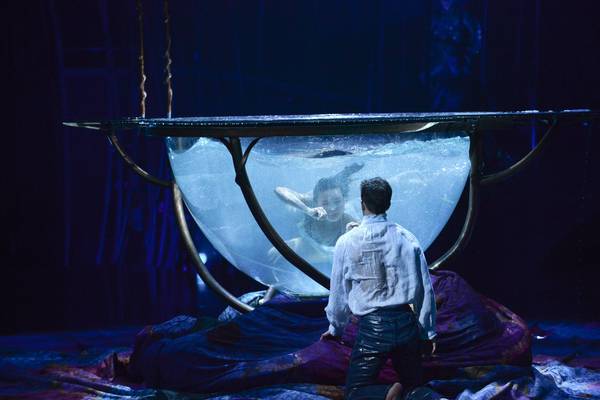
There’s little substance, though. They story is a vague framework for the circus acts and spectacle. Most importantly, the supposedly empowering female narrative is anything but. Prospera throws a party for her daughter Miranda, who then bathes in the light of the aerial hoop performing Moon Goddess who bestows her with a gift of a glass sphere. It’s an obvious metaphor for Miranda’s  womanhood/menstrual cycle, and a cringy one at that which doesn’t contribute anything to The Tempest aspect story. Miranda also meets a prince who has washed up on their island in a storm. Called Romeo rather than Ferdinand (dear god, why???), Miranda immediately falls in love with his sculpted, often shirtless body. Her best friend Cali, a half-lizard-half-man creature, is jealous of the man who’s taking away Miranda’s attention from him. The two male characters compete for young Miranda’s attention and the pretty, shipwrecked Romeo was always going to win, gifted with a wedding and all. It was like an old school Disney film. Empowering to women? No, no, NO. The narrative presented was about as disempowering as you can get, particularly when you factor in the creepy plot points of an unseen Romeo watching Miranda bathe and hand balance in white shorts that become nearly transparent from the water (You can see EVERYTHING. I’m pretty sure I could see up into her stomach during the splits.), and Cali abducting her into the heavens to keep her to himself. Also consider for a moment that in Shakespeare’s version, Caliban raped Miranda and is enslaved by her father as consequence. Plus, if this is Miranda’s coming-of-age celebration, she’s how old? Sixteen AT THE OLDEST. And she get married at the end of a story that spans no more than a couple of days? This is supposed to be a piece of performance that empowers women.

There’s also plenty of creeping elsewhere in the show. The two clowns, one a nanny to the young Miranda and one a washed up sea captain. Mainha and Papulya are overtly sexual, and as cringy as the Moon Goddess. There’s classical Commedia influence in the pratfalls and lazzi-like sketches full of groping, arse kissing and manipulation. I get that circus performers have to wear tight clothes for their work, but the men are often topless for no apparent reason and there’s more female flesh on display than needs be.

Ignoring the narrative and theme, the individual acts and the show of it is celebratory, fun and a showcase of skill. However, Cirque as a vast, commercial institution raises some concerns, and the perception of female empowerment and celebration by their creative and marketing team when the reality is the opposite is not only highly disturbing, but a sign of endemic patriarchal complacency about what is an acceptable lens to view womanhood through in the performing arts.

The Play’s the Thing UK is committed to covering fringe and progressive theatre in London and beyond. It is run entirely voluntarily and needs regular support to ensure its survival. For more information and to help The Play’s the Thing UK provide coverage of the theatre that needs reviews the most, visit its patreon.

Give Me Your Love, Battersea Arts Centre

I’ve grown up always having pet cats and it’s absolutely true that cats love being in cardboard boxes. I stumbled on a Buzzfeed or similar article recently that says cats seek out boxes or other encloses spaces when they’re stressed or in need of comfort. Humans have similar instincts, really. Think about the last time you were upset or stressed: did you want to hide under a duvet, make a pillow fort or crawl into a small, dark space? Or at least curl up into as small of a ball as you could? Observations and life experience indicate we’re pretty similar to our felines in that way. So it would make sense that someone suffering from grief or trauma might hide in a box and never come out.

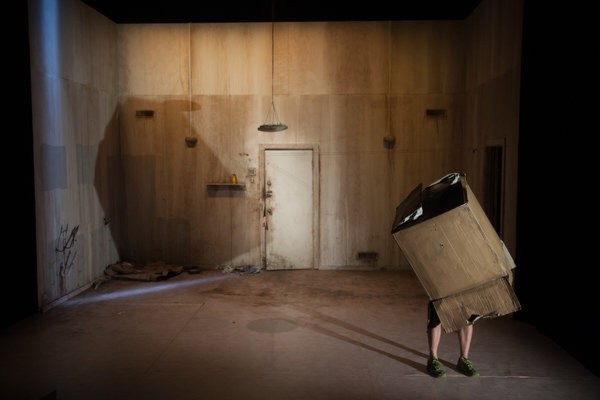
Zach (David Woods) does just that with feline stubbornness and rejection of direct human contact. An Iraq veteran suffering from Post-Traumatic Stress Disorder (PTSD) living with an unsympathetic wife (convincingly voiced offstage by Jon Haynes), we never see Zach’s face, or anyone else’s, in Give Me Your Love. This quiet, tiny show looks empty but brims with feeling in a sophisticated script, discusses cutting edge medical research without boring the audience and shares the horrors of PTSD that many of our vets are left to contend with, unsupported. A talking cardboard box and a patient drug dealer behind a chained door captivate for about an hour with flawless, sensitive performances and detailed dialogue that delicately balances humour and pathos.

Though it’s easy to focus on Woods as the central character, Haynes wonderfully supports and opposes him as wife Carol and friend/drug dealer Ieuan. Carol opposes Zach’s desire to explore MDMA’s potential to cure his PTSD, Ieuan, not unfamiliar with trauma himself, encourages Zach whilst displaying genuine, moving care for him. There’s a brotherly intimacy here that’s lovely to watch, and is perfectly captured by the pair of actors.

Jacob Williams’ set is super-realistic: there are no metaphors here, just the sparse filth that Zach lives in. The detail is in the tiniest things: the way masking tape curls at the edges, the holes in the box for Zach’s arms, the stains on the walls. The lack of people on stage calls for other means of  visual stimulation, and Williams’ work exceeds this tall order very well. Give Me Your Love is never boring, visually or otherwise.  Sound and light by March Cher-Gibard and Richard Vabre match the set’s naturalism, then toy with the audience’s perception of reality through abstract and expressionistic approaches. It’s a jarring transition, but manages to compliment Zach’s turmoil and experimental recovery instead of feeling stuck on and questions what is objective reality and what is in Zach’s head. 

The inclusion of using Ecstasy in PTSD therapy is fascinating research that doesn’t go too much in depth, but can feel extraneous to Zach’s struggle. It’s not about the recovery, but the day-to-day existence and paralysis that can result from action solders experience on the front line. The dialogue still flows, but the research informs the play rather than being the centre of it. This certainly isn’t a bad thing at all because the script could easily end up a lecture; the focus is very much on Zach’s mental and emotional health. The clever use of humour prevents it from becoming a drag, and exquisitely balances the brutality and debilitation of mental health conditions. This is a vital theatrical contribution to the mental health dialogue and de-stigmatisation, and one executed with delicate, detailed skill and a moving emotional journey. A fantastic watch.

The Play’s the Thing UK is committed to covering fringe and progressive theatre in London and beyond. It is run entirely voluntarily and needs regular support to ensure its survival. For more information and to help The Play’s the Thing UK provide coverage of the theatre that needs reviews the most, visit its patreon.

Top Ten Shows of 2015

rsz_top10-620x400

  1. Carmen Disruption 

This Simon Stephens deconstruction bore little resemblance to the opera. Instead, we had a cast of dysfunctional, damaged characters unable to connect with the world around them on any meaningful level. They filled the Almeida with an electric loneliness that grasped the desperate humanity residing deep inside us all before chucking us out, exposed and raw, into the London night.

  1. Pomona

Written by a 27-year-old, Pomona captures the millennial generation in a single play. Frantically set over several levels of dystopian reality and never able to settle, this epitomises those who suffer the consequences of  baby boomers’ past choices.

  1. Light

The first show I ever gave five stars to, after more than a year of criticism. Good intentions and government exploitation address increasing surveillance with stunningly precise physical theatre, object manipulation and light.

  1. Tether 

A two-hander about a blind runner and her guide, this piece is refreshingly unromantic and driven by dialogue and characterisation. This is a simple and powerful piece by a promising young writer set in a world rarely considered by non-disabled people.

  1. Shakespeare & the Alchemy of Gender

A solo performance by veteran Shakespearean, Lisa Wolpe, founder of L.A. Women’s Shakespeare Company. Exquisite extracts of Shakespeare’s most celebrated male roles interspersed with her father’s biography raises important points about performance, gender and family.

  1. Town Hall Cherubs

Theatre Ad Infinitum and Battersea Arts Centre team up to create an immersive, site-specific piece for 2-5 year-olds. Gentle and responsive to the children’s attention spans, this is a bit of a winter treasure hunt around the BAC that stimulates all the senses.

  1. Chef 

Another sharp one-woman show, this one by Sabrina Mahfouz and performed by Jade Anouka. Anouka is a Michelin-star chef who runs the prison kitchen. Part fictional memoir/part foodie homage, this character driven piece cuts an unforgettable character.

  1. This is How We Die

An explosive spoken word/music piece by Canadian Chris Brett Bailey, it defies description and instead must be experienced. A marmite production amongst critics but Bailey’s use of imagery within language is incomparable.

  1. Don Q

A warm and lovely adaptation of Cervantes’ novel, Don Q is an old man’s gleeful adventure story. Four actors multi-role through this story that looks at the way we treat the elderly and the joy of play-acting.

  1. Eclipsed

Set during the Liberian Civil War, the all-woman cast of Danai Gurira’s doesn’t hold back on the experience of women in wartime. This is a brutally raw survival story with the power to leave you shaken, guilty and grateful for the benefits of Western comforts.

Honourable mention: Invisible Treasure

This is an interactive experience that is audience-led, with no actors and no plot. Like a game, the audience is led into a hi-tech room and led through a series of tasks in order to escape. Fun, challenging and frustrating, it makes some powerful points about group dynamics and personal approaches to problem solving.


The Play’s the Thing UK is committed to covering fringe and progressive theatre in London and beyond. It is run entirely voluntarily and needs regular support to ensure its survival. For more information and to help The Play’s the Thing UK provide coverage of the theatre that needs reviews the most, visit its patreon.

The Wasp, Trafalgar Studios

rsz_the_wasp_trafalgar_studios_courtesy_ikin_yum_20

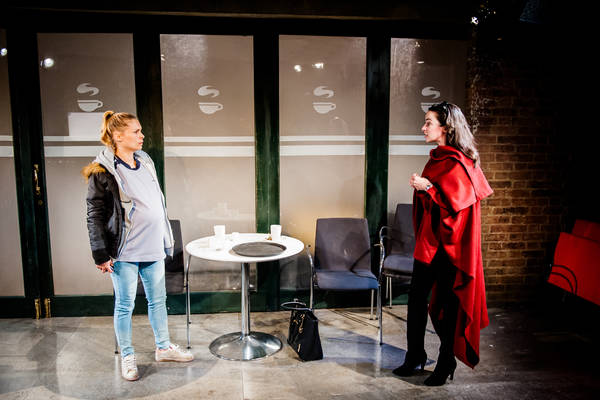
Hampstead Theatre does it again with another powerful, thought-provoking transfer after last month’s Four Minutes Twelve Seconds. Heather and Carla went to secondary school together about 20 years ago, live in the same town, but have little else in common. Heather comes from a stable, middle class family, is now married and lives quite comfortably. Carla is working poor, pregnant with her fifth child, and has a drunkard for a husband. Both had a terrible time in high school: Carla came from an abusive home, and Heather became one of a Carla’s targets after a brief friendship in year 7. They haven’t seen each other since school, but out of the blue, Heather asks Carla for coffee and makes her a surprising offer in Morgan Lloyd Malcolm’s both horrifying and enthralling The Wasp.

Myanna Buring as Carla and Laura Donnelly as Heather are an electric pair, as they should be in this relentless two-hander with sudden plot twists that keep the audience guessing. Their characters’ contrast naturally creates tension anyway, and the story generates even more. Most of the play is a hotbed of tension. The layers of lies and manipulation and abrupt reveals are surprising; there are audible gasps from the audience at certain key moments. The script has a fairly formulaic structure, but it’s the content that surprises. Albee’s Zoo Story, Miller’s The Crucible and most of LaBute’s work appear to influence. The characters’ behaviour is shocking, but the realisation that this could be anyone we know, or ourselves, uncomfortably resonates within.

Though there are a lot of big social and psychological issues presented: revenge, infidelity, class difference, abuse, rape and infertility. It doesn’t feel excessive to conflate them, but aids in creating complex characters that feel like genuine people backed up by Buring and Donnelly’s performances. This toxic cocktail of topics emphasises just how easy it is to cause lasting emotional damage in someone unintentionally, be it a family member, friend, partner or acquaintance. Kids especially: we all had tough times at school and treated each other badly but children are so self-absorbed (the ability to empathise is the last part of the human brain to develop) that they don’t often realize the consequences of their actions. And this is why each and every one of us is the hot mess we are, because of how we were treated by others when we were younger. It doesn’t take much more on top of all the baggage we already carry to send us over the edge, and that message resounds loud and clear through the women’s past and present actions that slowly unravel in the intimate Trafalgar 2.

David Woodhead’s set similarly beds in the horror of the characters’ actions. Benign, commonplace objects become aids for capture in his construction that emulates life. There’s an overly lengthy set change, but the transformation from outside a dingy café to Heather’s sitting room is as big a difference as the two women are to each other. The detail and naturalistic design make the story feel all the more like real life, an effective and powerful choice when simplicity and abstraction are the more common styles.

The Wasp presents the capacity for evil within each of us whilst challenging social stereotypes and making powerful comment on how we treat our fellow human beings. Outstandingly committed performances endowed with energy and high emotion and Lloyd Malcolm’s script create a disturbing landscape, disguised in the routine of day to day life, that can be revealed in a moment.


The Play’s the Thing UK is committed to covering fringe and progressive theatre in London and beyond. It is run entirely voluntarily and needs regular support to ensure its survival. For more information and to help The Play’s the Thing UK provide coverage of the theatre that needs reviews the most, visit its patreon.