King & Country, Barbican Centre/RSC

rsz_king-and-country

Shakespeare’s history plays are some of his best. Epic tales with tragedy and comedy, love and war, politics and history are brought to life on stage, with the storyline of some characters spanning years and multiple plays. The RSC and Barbican have, over the last few years, presented the first four as separate productions but to celebrate the 400th anniversary of Shakespeare’s death this year, unite them as a single ticket. King and Country is Richard II, Henry IV part i, Henry IV part ii and Henry V is a marathon package deal of roughly twelve hours of theatre (plus intervals) spread over several days. A large ensemble cast play all roles across the four plays, with the same actors satisfyingly playing the same parts that stretch across multiple productions. Set and design also carry through; this quartet is slick, engaging and brings together original and contemporary practice.

Big names in the cast are an initial draw and live up to their hype (David Tennant, Antony Sher, Julian Glover), but the thirty-strong ensemble are just as good, if not better. Sam Marks as Aumerle, Poins and the Constable of France is excellent, particularly as Prince Hal’s laddish sidekick with a magnetic energy that bounces around the stage and fills the 1,156-seat theatre with youthful vigour. Matthew Needham comically interprets Hotspur; random, extreme outbursts get laughs, making the character’s tragic flaw the reason for his defeat. He also plays Mowbray and Shadow, the latter being a minor role but played with such commendable contrast that he is unrecognisable. Jennifer Kirby is a feisty Lady Percy and a naughty and nice Katherine, endowing both small roles with heaps of personality. The best comedic performances include Oliver Ford Davies as Shallow (also a fantastic Duke of York and Chorus), Emma King as Doll Tearsheet, Sarah Parks as Mistress Quickly and Joshua Gardner as Fluellen.

Tennant is just as exquisite as Richard II as two years ago, and Jasper Britton’s Bolingbroke/Henry IV is endowed with pathos, guilt and an extraordinary character journey. Alex Hassell is delightful as the devil-may-care Prince Hall, but his quieter, matter of fact Henry V is sensitive but less dynamic. He aims for intimacy rather than bombast and arrogance, a unique interpretation but one that is not overly effective due to a lack of power, particularly in his famous speeches. Antony Sher nails Falstaff’s characterisation, but his even, rhythmic delivery lacks variation and harks back to the old fashioned declamatory RSC stage speech – hugely disappointing.

Stephen Bromson Lewis’ set is the same as it was for Richard II’s performance two years ago and has little variation over the four productions. Paired with Tim Mitchell’s lighting, the audience sees austere courts, earthy battlefields and debauched public houses that don’t interfere with the action. The acrylic floor of under lit ploughed furrows is the surprise of the event, not viewable from the stalls closest to the stage but adds a striking dynamic and atmosphere from the gods: a delight for us peasants with the cheapest seats. Costumes (presumably also by Lewis) hint at a time period, but have a contemporary, minimalist touch that please the eye but not dominating.

There are some odd directorial choices by Gregory Doran in these otherwise stunning productions. Rumour (Antony Byrne) is in contemporary dress, accompanied by a projected digital cascade of hashtags and “rumour”. The Chorus (Oliver Ford Davies) is similarly dressed, which makes sense with the text. The token technology reference? Much less so. These are jarring in their modernity, unneeded and contribute nothing to the meaning and aesthetic of the plays. He misses an opportunity to put Henry V on the elevated walkway heavily used in Richard II; instead he lowers him to a wooden cart and diminishes the gravity of the St. Crispan’s Day speech.

It was an utter joy to see Doran incorporate audience interaction; even though there weren’t many of these moments. They unite the audience and actors in a love for Shakespeare’s work, bringing everyone together in a celebration of living, breathing theatre rather than maintaining a distant reverence for it. Henry V’s adorable insecurity in the presence of French princess Katherine leads to asking the audience for advice, and Hassell’s corpsing during a pub scene as Hal (when an audience member loudly blew his nose and another actor acknowledged it within the action) was a delight. His easy confidence with this style of performance clearly stems from his early work with The Factory and The Globe; Doran should have exploited this more, particularly during the character’s youthful exploits. The audience could have easily been his army or his mates down the pub more often.

Though RSC productions have often missed the mark in the past, these four are almost as on it as they can get. They do not force a modern concept that only tenuously relates to the themes in the script, but they are not stuck in a stilted, stuffy style of yore. Doran’s productions are unified, alive and vibrant with stellar design and performances. Here’s hoping they see life in the UK beyond this Barbican run and their international tour this spring.

The Play’s the Thing UK is committed to covering fringe and progressive theatre in London and beyond. It is run entirely voluntarily and needs regular support to ensure its survival. For more information and to help The Play’s the Thing UK provide coverage of the theatre that needs reviews the most, visit its patreon.

Botallack O’Clock, Old Red Lion Theatre

Roger Hilton was an abstract artist working in Cornwall until his death in 1975. As alcoholism and ill health took hold, he confined himself to a basement bedroom and studio, prolifically churning out work in the middle of the night. Modelling Hilton’s experimental work, playwright Eddie Elks (of Mugs Arrows acclaim) has crafted an unconventional dialogue between an ageing, ill man finding late-night solace in his art, and his radio. Elks begins in naturalism, then surreal expressionism sets in like a lucid dream. The mind of an artist is an unusual, hard to pin down thing inventively captured and well performed in Botallack O’Clock, accompanied by the sadness of approaching death and the need to leave a legacy.

Ken McClymont’s set recreates Hilton’s studio/bedroom with excellent accuracy and detail, and a bit of theatre trickery further enhances the surrealism and absurdity. Photographic projections reinforce the authenticity of the set, complete with drying paintings strung around the periphery and paintbrushes everywhere. A 1960’s radio benignly sits centre stage next to a desk with paper and paints. With Dan Frost as an angular Roger folded on the corner of a mattress and the radio next to him, they become equals. The wardrobe on the back wall is also more than it appears, as are the walls themselves. Particularly bizarre but wonderful moments include the old man struggling to be reborn through the wall and Roger’s energetic bogey with a surprise visitor.

The power in this script is the juxtaposition of the profundity and truth in Roger’s dialogue with his radio, and the veering away from reality that happens soon after insomnia slowly wakes him. It surprises and disarms; Roger’s negotiation of this alteration is charming and confessional, provoking reflection on one’s own mortality. But it’s also deliciously funny and sweet, though begins to feel too long about fifteen minutes before the end.

Dan Frost is not an old man, but endows his physicality with the creaky weight of age. This is simply cast off, like his glasses, when he gleefully reflects on his art school days in Paris. Frost’s vocal rhythm is quick and short, forcing the audience to really listen to and process Elks’ script. Frost is complimented by the dulcet tones of George Haynes as the Radio. 

Botallack O’Clock is, in essence, a simple conversation between a man and his subconscious but Elks’ creativity and skill makes it seem like more than that.  There are some delightful surprises along the way and a range of styles are used to examine our intimate relationships with our work, our possessions and our inevitable deaths – a thoughtful, reflective piece is thinly veiled under the humour and Frost’s abrupt delivery. Though we empathise with Roger throughout, all of us are alone in our twilight years, and we are the sole leading players in our own narratives.

The Play’s the Thing UK is committed to covering fringe and progressive theatre in London and beyond. It is run entirely voluntarily and needs regular support to ensure its survival. For more information and to help The Play’s the Thing UK provide coverage of the theatre that needs reviews the most, visit its patreon.

Give Me Your Love, Battersea Arts Centre

I’ve grown up always having pet cats and it’s absolutely true that cats love being in cardboard boxes. I stumbled on a Buzzfeed or similar article recently that says cats seek out boxes or other encloses spaces when they’re stressed or in need of comfort. Humans have similar instincts, really. Think about the last time you were upset or stressed: did you want to hide under a duvet, make a pillow fort or crawl into a small, dark space? Or at least curl up into as small of a ball as you could? Observations and life experience indicate we’re pretty similar to our felines in that way. So it would make sense that someone suffering from grief or trauma might hide in a box and never come out.

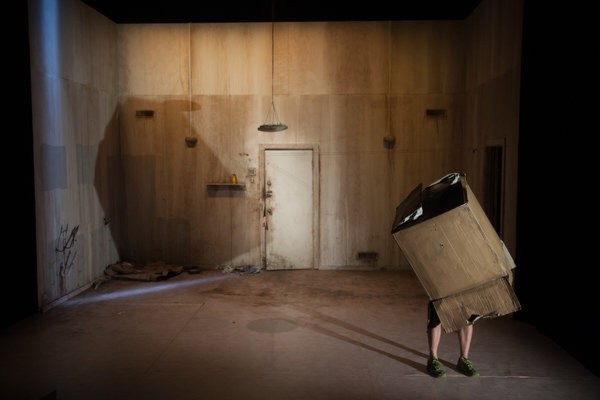
Zach (David Woods) does just that with feline stubbornness and rejection of direct human contact. An Iraq veteran suffering from Post-Traumatic Stress Disorder (PTSD) living with an unsympathetic wife (convincingly voiced offstage by Jon Haynes), we never see Zach’s face, or anyone else’s, in Give Me Your Love. This quiet, tiny show looks empty but brims with feeling in a sophisticated script, discusses cutting edge medical research without boring the audience and shares the horrors of PTSD that many of our vets are left to contend with, unsupported. A talking cardboard box and a patient drug dealer behind a chained door captivate for about an hour with flawless, sensitive performances and detailed dialogue that delicately balances humour and pathos.

Though it’s easy to focus on Woods as the central character, Haynes wonderfully supports and opposes him as wife Carol and friend/drug dealer Ieuan. Carol opposes Zach’s desire to explore MDMA’s potential to cure his PTSD, Ieuan, not unfamiliar with trauma himself, encourages Zach whilst displaying genuine, moving care for him. There’s a brotherly intimacy here that’s lovely to watch, and is perfectly captured by the pair of actors.

Jacob Williams’ set is super-realistic: there are no metaphors here, just the sparse filth that Zach lives in. The detail is in the tiniest things: the way masking tape curls at the edges, the holes in the box for Zach’s arms, the stains on the walls. The lack of people on stage calls for other means of  visual stimulation, and Williams’ work exceeds this tall order very well. Give Me Your Love is never boring, visually or otherwise.  Sound and light by March Cher-Gibard and Richard Vabre match the set’s naturalism, then toy with the audience’s perception of reality through abstract and expressionistic approaches. It’s a jarring transition, but manages to compliment Zach’s turmoil and experimental recovery instead of feeling stuck on and questions what is objective reality and what is in Zach’s head. 

The inclusion of using Ecstasy in PTSD therapy is fascinating research that doesn’t go too much in depth, but can feel extraneous to Zach’s struggle. It’s not about the recovery, but the day-to-day existence and paralysis that can result from action solders experience on the front line. The dialogue still flows, but the research informs the play rather than being the centre of it. This certainly isn’t a bad thing at all because the script could easily end up a lecture; the focus is very much on Zach’s mental and emotional health. The clever use of humour prevents it from becoming a drag, and exquisitely balances the brutality and debilitation of mental health conditions. This is a vital theatrical contribution to the mental health dialogue and de-stigmatisation, and one executed with delicate, detailed skill and a moving emotional journey. A fantastic watch.

The Play’s the Thing UK is committed to covering fringe and progressive theatre in London and beyond. It is run entirely voluntarily and needs regular support to ensure its survival. For more information and to help The Play’s the Thing UK provide coverage of the theatre that needs reviews the most, visit its patreon.

Auld Acquaintance, Bread & Roses Theatre

Imogen and Jake are a trendy, young couple with a new born daughter. It’s nearly Christmas and they are at their mother’s house with Jake’s brother Rob and his wife, Natasha. Everything should be perfect, but it’s far from it: Jake and Rob’s mum is dying in a hospice, Imogen has fallen out of love with Jake whilst struggling with post-natal depression, Rob and Imogen hate each other but Imogen and Natasha are old school friends with an intimate secret.

This one act play by Natalie Audley, newly re-worked for London after a 2014 run at Brighton Fringe, still needs some refining. There are some killer one-liners and painfully spot-on insight on fertility and relationships, but an abrupt ending and wordy lines that uncomfortably stumble from the actors’ mouths give the script a weight that goes against it comedic instincts. The pace varies, but feels slower than it ought to. Audley clearly leans towards poetry and language-driven plays, but some trimming here and there would go a long way.

Performances are mixed and take some time to find their rhythm. Charlie Lees-Massey is by far the best of the cast of four as Natasha. Her moment of surrender to Imogen (Emily Ambler) is sexy as hell, and she maintains a consistent energy and believability throughout. Ambler’s best moments are with Lees-Massey, as are Tom Everatt’s at Rob. Matthew Corbett as Jake seems awkward throughout, though this could be a character choice. Director Courtney Larkin deftly moves her actors around the tiny stage without it feeling crowded or blocking sight lines.

There’s still a clunkiness to the script but further expansion and chiselling will refine the dialogue and turn this into a polished piece of contemporary naturalism. The issues presented are crucial ones to examine on stage, especially as they are told from a female perspective and with a 50/50 gender split cast, but more development is crucial to give them the power they deserve.

The Play’s the Thing UK is committed to covering fringe and progressive theatre in London and beyond. It is run entirely voluntarily and needs regular support to ensure its survival. For more information and to help The Play’s the Thing UK provide coverage of the theatre that needs reviews the most, visit its patreon.

Top Ten Shows of 2015

rsz_top10-620x400

  1. Carmen Disruption 

This Simon Stephens deconstruction bore little resemblance to the opera. Instead, we had a cast of dysfunctional, damaged characters unable to connect with the world around them on any meaningful level. They filled the Almeida with an electric loneliness that grasped the desperate humanity residing deep inside us all before chucking us out, exposed and raw, into the London night.

  1. Pomona

Written by a 27-year-old, Pomona captures the millennial generation in a single play. Frantically set over several levels of dystopian reality and never able to settle, this epitomises those who suffer the consequences of  baby boomers’ past choices.

  1. Light

The first show I ever gave five stars to, after more than a year of criticism. Good intentions and government exploitation address increasing surveillance with stunningly precise physical theatre, object manipulation and light.

  1. Tether 

A two-hander about a blind runner and her guide, this piece is refreshingly unromantic and driven by dialogue and characterisation. This is a simple and powerful piece by a promising young writer set in a world rarely considered by non-disabled people.

  1. Shakespeare & the Alchemy of Gender

A solo performance by veteran Shakespearean, Lisa Wolpe, founder of L.A. Women’s Shakespeare Company. Exquisite extracts of Shakespeare’s most celebrated male roles interspersed with her father’s biography raises important points about performance, gender and family.

  1. Town Hall Cherubs

Theatre Ad Infinitum and Battersea Arts Centre team up to create an immersive, site-specific piece for 2-5 year-olds. Gentle and responsive to the children’s attention spans, this is a bit of a winter treasure hunt around the BAC that stimulates all the senses.

  1. Chef 

Another sharp one-woman show, this one by Sabrina Mahfouz and performed by Jade Anouka. Anouka is a Michelin-star chef who runs the prison kitchen. Part fictional memoir/part foodie homage, this character driven piece cuts an unforgettable character.

  1. This is How We Die

An explosive spoken word/music piece by Canadian Chris Brett Bailey, it defies description and instead must be experienced. A marmite production amongst critics but Bailey’s use of imagery within language is incomparable.

  1. Don Q

A warm and lovely adaptation of Cervantes’ novel, Don Q is an old man’s gleeful adventure story. Four actors multi-role through this story that looks at the way we treat the elderly and the joy of play-acting.

  1. Eclipsed

Set during the Liberian Civil War, the all-woman cast of Danai Gurira’s doesn’t hold back on the experience of women in wartime. This is a brutally raw survival story with the power to leave you shaken, guilty and grateful for the benefits of Western comforts.

Honourable mention: Invisible Treasure

This is an interactive experience that is audience-led, with no actors and no plot. Like a game, the audience is led into a hi-tech room and led through a series of tasks in order to escape. Fun, challenging and frustrating, it makes some powerful points about group dynamics and personal approaches to problem solving.


The Play’s the Thing UK is committed to covering fringe and progressive theatre in London and beyond. It is run entirely voluntarily and needs regular support to ensure its survival. For more information and to help The Play’s the Thing UK provide coverage of the theatre that needs reviews the most, visit its patreon.

Lost, Voyager Business Park

rsz_1map

An invitation to review this different kind of theatrical experience landed in my inbox:

Different Breed Theatre invite you to come down to Gary’s Warehouse in Bermondsey and watch an elf (well…he says he’s an elf, the little shit) talk his way out of a hostage-taking situation. Enjoy Anthony Neilson’s hour-long dark Christmas comedy ‘The Night Before Christmas’ performed by West End actors at bargain prices. There’s food from local market traders. There’s beer from local breweries. There’s questionable secret Santa gifts, rude Christmas cards, music, and of course, an elf. You might even get to sit on Santa’s (mildly pervy) knee.

Sounds like fun, right? This will be my last London production before heading north for the holidays and it sounds like a hell of a finale. Instead, what results is a confusing, audience-led, anti-climax with a profound lack of promised food and entertainment.

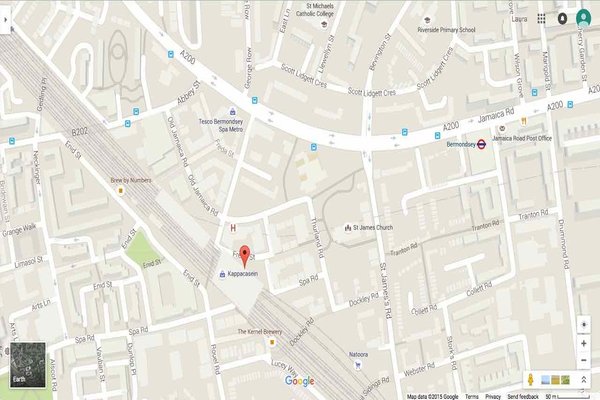
The press release gives a clear, full address: Unit 3, Voyager Business Estate, Spa Road, Bermondsey, London SE16 4RP. I follow normal procedure by using Maps on my phone when I don’t know a venue. Voyager Business Estate! Sounds exciting, like the spaceship. I rush from Bermondsey Station about 20 minutes before curtain. Time is tight so tension is building prematurely. Surrounded by blocks of new-build flats in the Bermondsey Spa regeneration area, I overshoot the small industrial estate. Consulting Maps verifies this instinct, so I turn around. Triumph! There is a lull in the action driven by success. On the corner by the railway arch, high above my head, a sign: Network Rail Voyager Business Park, Units 5-8. The set placement, in conjunction with lighting, deliberately challenges the audience, particularly if they are short with poor night vision.

The lull doesn’t last long. Five – eight! No! I need number three. The street isn’t well lit and I cross over to check the dark warehouses across the road, as I can’t read the signage. No, they were called something else. It’s 10 minutes to blast off. I ring the contact number on the press release, no answer, so I leave a message. Confusion and stress is rapidly increasing in this immersive, site-specific piece.

Then it dawns on me. This is the moment where the penny drops within the slow plot reveal.

There is no hostage elf. The audience of one is the hostage. A hostage of time, a clever invitation and trendy warehouse theatre. Or am I? That seed of doubt is still present, but I now know that it is the product of years of honest, run-of-the-mill press releases that disclose more to press than they do to audiences. This is a progressive, cutting edge approach to marketing and press management, but one not particularly suited to objectivity.

A ha! Units 1-4, on the other side of the railway line. Another sign stoically sits at the top of the fence. No sign of a spaceship, though. The units are small small, set back in the railway arches. The gates are open so I can walk into the car park with a few vans, strategically using the space to block sightlines and further exacerbate audience tension. Low lighting helps generates a sinister environment.

I face Unit 3. It’s shuttered. No lights. It’s 7:27. The shutter is sturdy and dark, an effective aversion to potential trespassers, symbolizing the shutters around cynics’ hearts in the run up to Christmas. I phone again. Still no answer. I leave another message. I like the agency of using our own phones to make contact and the integration of technology, a powerful reminder of our dependency on mobile phones.

It’s at this point that the experience is a let down. There is no signage, no other characters, nothing. Just me, stood in a dark, empty car park. Do I wait? The plot starts to disintegrate. I explore the space. I even knock on the unit 3 shutter. Is this a test? A puzzle? Will I soon be met by someone who’s running late? Whatever this performance has become, it’s effectively evoking anxiety in the audience. A final phone call goes straight to voicemail. The performance started a few minutes ago but it already feels like it’s ended despite the promised hour-long running time. The sound also seems to malfunction, as there is no music. Stomach growls also pointedly comment on the obvious lack of food and drink. I decide to utilize my autonomy and head home.

As hours pass and puzzlement fails to dissipate, I question the message of the piece. It raises more questions than answers, but perhaps that is the entire point: sometimes, communications and events mysteriously malfunction, but it’s up to us to take control of the spaceship that is our life. A powerful thought.


The Play’s the Thing UK is committed to covering fringe and progressive theatre in London and beyond. It is run entirely voluntarily and needs regular support to ensure its survival. For more information and to help The Play’s the Thing UK provide coverage of the theatre that needs reviews the most, visit its patreon.

Goodnight Mister Tom, Duke of York’s Theatre

rsz_5_alex_taylor-mcdowall_william_and_elisa_de_grey_puppeteer_for_sammy_the_dog_in_goodnight_mister_tom_2015_credit_dan_tsantilis

The WWII image of dejected, scrappy children with brown tags around their necks, clutching their most precious belongings as they are re-homed with strangers in the countryside is a powerful one. It’s one that inspired author Michelle Magorian to write Goodnight Mister Tom, adapted by David Wood for the stage, now in London after a successful run at Chichester and before heading off for a national tour. The audience meets little William, who is sent from Deptford to Dorset and assigned to live with the reclusive Tom Oakley. With a focus on Tom more so than the relocated children, this is a story about finding love again after a devastating loss. This part of the production is moving, but the story is slow to develop over a long time period and the flimsy, thin dialogue doesn’t support the large cast of characters, their development and the devastation of wartime.

David Troughton as Tom is a sad and sensitive widower, the complete opposite of the grump that his fellow villagers see. Three Williams, three Zachs (William’s precocious evacuee friend) and a gaggle of children make up half the cast; all are very much child actors. Alex Taylor-McDowall is today’s William, a lanky shy boy poisoned by his fundamentalist Christian single mother, Melle Stewart. We hear a lot about her, but only meet her in one scene. Stewart is unable to show just how evil (and mentally ill) the character is, though she does her best to live up to the previously discussed monster. Most of the other characters have similarly brief stage time, but plenty of multi-rolling and puppetry keeps the generally good ensemble performers busy.

But the first half takes its time to get going. It’s not from a lack of energy in individuals, but the overall pace is languid. It’s lovely and sweet, but flat. The war seems far away from this village, country life is slow, and day-to-day life is filled with routine and little errands. It’s in these small tasks that we see Tom’s affection for William grow: getting “new” clothes for him, teaching him to read and write and fending of bullies who pick on the “townies” and “vaccies” from London.

It’s no wonder the local kids pick on the Londoners. William can’t read or write, sleeps under the bed rather than on it, and his toxic mother skewed his worldview about, well, everything. Zach is well-spoken, attention seeking and flamboyant, the son of actors. It’s interesting that the London children the audience meets are either desperately camp or from the slums in this story; does this reflect Magorian’s preconceptions?

Along with Troughton’s performance, the puppets are outstanding. Tom’s dog, Sammy (Elisa de Grey) is gorgeously constructed, and full of movement and life from de Grey’s work. After the interval, there’s an increase in momentum after an unnecessary subplot involving William’s return to London and the effects of war creep closer, creating more tension and loss. The audience learns more about Tom’s past and the ending is a tearjerker and concise resolution.

For a family show however, the whole thing is too long and convoluted. Tom and William’s story could have easily had more focus with a reduction of other characters, more fleshed out scenes and additional detail about Tom’s life leading up to the point he takes in William. Fortunately, Troughton has enough stage time to keep this otherwise lovely, but flat, production going.

Press ticket for Goodnight Mister Tom is courtesy of theatrebloggers.co.uk.


The Play’s the Thing UK is committed to covering fringe and progressive theatre in London and beyond. It is run entirely voluntarily and needs regular support to ensure its survival. For more information and to help The Play’s the Thing UK provide coverage of the theatre that needs reviews the most, visit its patreon.

The Xmas Carol, Old Red Lion Theatre

rsz_2cc9d33d00000578-3250546-i_ve_never_doubted_that_mr_cameron_like_most_of_his_generation_w-m-2_1443338742165Dominic Cavendish thinks this year’s theatre lacks relevance to current affairs. He’s probably been working under a commercial and subsidized theatre-shaped rock (as mainstream critics are prone to), citing Anders Lustgarten’s Lampedusa as, “number one in a field of one” where, “nothing stood out as ‘the’ play for today.” Matt Trueman defends theatre’s ability to respond at the speed Cavendish would like, and also cites several examples Cavendish neglected: “The Fear of Breathing by Zoe Lafferty and Lucien Bourjeily’s 66 Minutes in Damascus, part of the 2012 LIFT festival, spring to mind, though Cordelia Lynn’s Lela & Co was set in an unnamed country gripped by a similar civil war.” Also springing to mind and not set in Syria but Liberia, Danai Gurira’s Eclipsed starkly presents the victims of another civil war.

The nightmare in Syria driving tens of thousands of people to flee their homeland in search of safety demands global action and aid, of course. But there were numerous other hotbed issues addressed in British theatre over the past year, even the last couple of weeks. Theatre Ad Infinitum’s Light looked at government surveillance, As Is reminded us that AIDS diagnoses are on the rise, Goodstock describes the uncertain life as a young woman with a high risk of breast cancer. Down & Out in Paris and London rallies support for the working poor, The State vs. John Hayes gives us the last night of a schizophrenic woman on death row, and Skyline is a relentless attack on the London housing crisis. There are many others as well, and that’s just in the past year of one critic’s theatregoing.

Within the past week, The Old Red Lion opened Arthur Miller’s first play, No Villain, a love letter to communism and the strikers of 1936 New York City. Accomplished theatre critic and author T L Wiswell also offered her latest work for two nights only, a satirical update of Dickens’ classic Christmas novel to the current 10 Downing Street, The Xmas Carol. That’s just at one venue, not specifically known for political theatre. The Xmas Carol has a dig at pop culture/The X-Factor to frame the consequences of David Cameron’s legislation on everyday, working people after his annual Christmas party, similar to Miller’s use of the strikes to focus on the life of one family out of millions. Both plays need further development (though it’s obviously too late for Miller), but both brashly and fearlessly confront the politics of their day.

In The Xmas Carol, Simon Cowell (Chris Royds) introduces his latest programme that’s sure to be a ratings hit; it’s an interesting meta-theatrical device that works towards justifying Cameron’s (Warren Brooking) travels through his past, present and future. Jason Meininger’s lighting and Keri Danielle Chesser’s sound effectively evoke transitions in time and space. Some more exposition to set up the television show that Cowell is steering would have clarified Cameron’s complicity and aim to improve his ratings, but the device itself is a creative deviation from having Cameron fall asleep and dream the whole thing.

There are some great impressions in the cast, particularly from Luke Theobald as Ghost of Christmas Past Margaret Thatcher. Brooking could have been a louder, bolder Cameron but he captures an element of the man in his gestures and general lack of humanity. Will Bridges is an amusing, though not particularly accurate Jeremy Corbyn but as this is a satire, his punditry can be excused. Jenny Wills as Cameron’s PA Bob Cratchett brings some grounded naturalism to this piece. She’s a lovely character, warm and family focused, with some good dialogue, but her performance style jars with the heightened delivery from the rest of the cast. It works to ground Cameron’s devastating policies in reality, but she could use some backup from other characters. As the play’s currently just under on hour, more down-at-heel, working people could easily be brought in to further emphasise the battle between the ridiculous politicians and celebrities, and the everyday man.

Having gone to a reading of The Xmas Carol about a month ago, the concept has developed quite a bit since then, but the structure could still use additional tightening and detail. More dialogue and exposition will help, particularly in the beginning and end. There are some genuinely funny moments and well-crafted scenes, but a brief resolution. The Tory criticism is relentless and mocking but also pointed and moving. Wiswell is certainly in the process of striking a good balance within the piece, but it needs just a bit more shaping.

Both The Xmas Carol and No Villain are highly political, but in very different ways; the same can be said of many of the aforementioned productions. Sure, they’re not about Syrian civil war and refugees, but they focus on diverse, divisive issues relevant to contemporary life. Perhaps Cavendish needs to visit the fringe more: it’s where angry voices can express their views unfettered, without the burden of corporate sponsors and other such bureaucratic obstacles. These shows don’t have the high production values or years of development and funding that commercial theatre does, but political theatre on the fringe is some of the most raw, honest, relevant theatre I have seen this year.


The Play’s the Thing UK is committed to covering fringe and progressive theatre in London and beyond. It is run entirely voluntarily and needs regular support to ensure its survival. For more information and to help The Play’s the Thing UK provide coverage of the theatre that needs reviews the most, visit its patreon.

The Wasp, Trafalgar Studios

rsz_the_wasp_trafalgar_studios_courtesy_ikin_yum_20

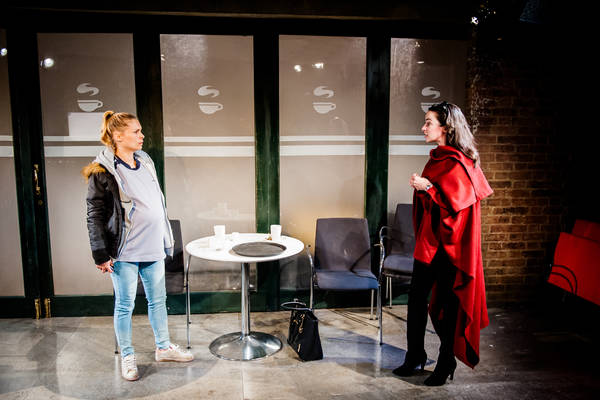
Hampstead Theatre does it again with another powerful, thought-provoking transfer after last month’s Four Minutes Twelve Seconds. Heather and Carla went to secondary school together about 20 years ago, live in the same town, but have little else in common. Heather comes from a stable, middle class family, is now married and lives quite comfortably. Carla is working poor, pregnant with her fifth child, and has a drunkard for a husband. Both had a terrible time in high school: Carla came from an abusive home, and Heather became one of a Carla’s targets after a brief friendship in year 7. They haven’t seen each other since school, but out of the blue, Heather asks Carla for coffee and makes her a surprising offer in Morgan Lloyd Malcolm’s both horrifying and enthralling The Wasp.

Myanna Buring as Carla and Laura Donnelly as Heather are an electric pair, as they should be in this relentless two-hander with sudden plot twists that keep the audience guessing. Their characters’ contrast naturally creates tension anyway, and the story generates even more. Most of the play is a hotbed of tension. The layers of lies and manipulation and abrupt reveals are surprising; there are audible gasps from the audience at certain key moments. The script has a fairly formulaic structure, but it’s the content that surprises. Albee’s Zoo Story, Miller’s The Crucible and most of LaBute’s work appear to influence. The characters’ behaviour is shocking, but the realisation that this could be anyone we know, or ourselves, uncomfortably resonates within.

Though there are a lot of big social and psychological issues presented: revenge, infidelity, class difference, abuse, rape and infertility. It doesn’t feel excessive to conflate them, but aids in creating complex characters that feel like genuine people backed up by Buring and Donnelly’s performances. This toxic cocktail of topics emphasises just how easy it is to cause lasting emotional damage in someone unintentionally, be it a family member, friend, partner or acquaintance. Kids especially: we all had tough times at school and treated each other badly but children are so self-absorbed (the ability to empathise is the last part of the human brain to develop) that they don’t often realize the consequences of their actions. And this is why each and every one of us is the hot mess we are, because of how we were treated by others when we were younger. It doesn’t take much more on top of all the baggage we already carry to send us over the edge, and that message resounds loud and clear through the women’s past and present actions that slowly unravel in the intimate Trafalgar 2.

David Woodhead’s set similarly beds in the horror of the characters’ actions. Benign, commonplace objects become aids for capture in his construction that emulates life. There’s an overly lengthy set change, but the transformation from outside a dingy café to Heather’s sitting room is as big a difference as the two women are to each other. The detail and naturalistic design make the story feel all the more like real life, an effective and powerful choice when simplicity and abstraction are the more common styles.

The Wasp presents the capacity for evil within each of us whilst challenging social stereotypes and making powerful comment on how we treat our fellow human beings. Outstandingly committed performances endowed with energy and high emotion and Lloyd Malcolm’s script create a disturbing landscape, disguised in the routine of day to day life, that can be revealed in a moment.


The Play’s the Thing UK is committed to covering fringe and progressive theatre in London and beyond. It is run entirely voluntarily and needs regular support to ensure its survival. For more information and to help The Play’s the Thing UK provide coverage of the theatre that needs reviews the most, visit its patreon.

No Villain, Old Red Lion Theatre

rsz_no_villain_old_red_lion_theatre_adam_harley_courtesy_of_cameron_harle_5

There’s usually good reason why renowned writers have known but unpublished early works. They hone their craft by writing, usually badly at first, and then have a major breakthrough after they have been writing for some time. Expecting this to be the case with Arthur Miller’s world premiere of the unpublished No Villain, the play proved to be surprisingly good. Miller’s autobiographical one act was written for a playwriting competition when the 20-year-old undergraduate at the University of Michigan was on the verge of leaving due to his family’s losses during the Great Depression. It was in the university’s archives that director Sean Turner found the manuscript mentioned in Miller’s memoirs, dashed off with the desperate hope of saving his Journalism degree. A theatrical and historical relic, the script isn’t a particularly polished affair but brims with youthful enthusiasm, political activism, and familial conflict that hints at the greatness to come in later works like Death of a Salesman and The Crucible.

From beginning to end, tension dominates this story set in 1936 New York City during the strikes that paralysed the garment district and bankrupted businesses barely holding on to their survival. Father Abe Simon (David Bromley) has no sympathy or understanding for the strikers or his sons’ recent discovery and devotion to the new political system taking over the East, Communism. Arnold (Adam Harley) is a thinly veiled Miller who at the beginning of the play returns from Michigan for the holidays. Refusing to help his father (David Bromley) at the shop because it would compromise his principles, older brother Ben (George Turvey) is more practical. The action largely centres around these three men, but the strain of the Depression also shows in their interactions with their mother (Nesba Crenshaw), sister Maxine (Helen Coles) and grandfather (Kenneth Jay).

Focused, emotionally endowed performances in heightened realism and moments of good dialogue generate exquisite set piece scenes, but the overall plot structure and storyline is a bit loose, and the politics are so blatant that it’s agitprop. This is not a subtle play, but it’s certainly not poorly made. The story is a microcosmic representation of Big Issues but it’s clear that this is real life replicated on stage rather than pure fiction. There’s a lot of preaching and arguing and threats, but the actors truthfully capture this almost-constant tension within the family, and these moments are plentiful. Like a baby Death of a Salesman, we see the idealism and father-son relationships that help make Miller one of the greatest dramatists of the 20th century.

Max Dorey’s set and Natalie Pryce’s costumes contribute detail and further authenticity to the production. Stylistically, this is a great example of early 20th century American theatre (but with accents from different parts of the US in one family) made popular by Clurman, Adler, Meisner and the rest of the Group Theatre in the 1920s and 30s. Turner captures this performance style well and in combination with the factual/biographical nature of the script, it feels like the audience is watching a moment of history brought to life.


The Play’s the Thing UK is committed to covering fringe and progressive theatre in London and beyond. It is run entirely voluntarily and needs regular support to ensure its survival. For more information and to help The Play’s the Thing UK provide coverage of the theatre that needs reviews the most, visit its patreon.