Swansong and Road to Huntsville, Edinburgh Festival Fringe

https://files.list.co.uk/images/2016/08/10/road-to-huntsville-lst207084.jpg

Though climate change has long been a problem, political theatre often ignores it. DugOut’s Swansong faces the issue head on, placing four survivors of a global flood in a swan pedalo. A capella songs and situation comedy bring plenty of joy and laughter to the boat, but the enormity of their survival and uncertain future weighs heavy. Will they find land, or will they kill each other first?

Like the start of a joke, hippy vegan Bobby, posh boy Steven, gym bunny Claire and nihilist Adam are on a boat, and have been for at least a little while now. They’ve already worked out exactly how to wind each other up, which generates the comedy that keeps Sadie Spencer and Tom Black’s script from becoming too heavy. The lightness contrasting the serious of their post-apocalyptic waterworld tips more towards comedy, but the balance mostly works. As they make plans for rebuilding the world to the vision they are creating from scratch in Bobby’s journal (obviously with plenty of arguments), there’s a natural progression towards eventuality – will they find land and survive, or will they all die on the pedalo?

The characters are rather stereotypical for the sake of comedy; despite this there are some poignant moments of understanding and empathy. They are effectively performed but somewhat lacking in depth, though sung interludes between scenes and the resolution help negate this unsatisfaction.

This spirited production is a relief from more sombre approaches to political issues, and a good laugh at that despite its shortcomings. Road to Huntsville is an entirely different beast, though the topic is just as infrequent on British stages. Theatre maker Stephanie Ridings stumbles across a documentary about women who fall in love with prisoners on America’s death rows. Thinking this could be the start of a new play, she latches onto the subject and delves into a world that she doesn’t understand, but doesn’t want to judge. As her research leads her further down the rabbit hole, she emerges in the “death penality capital” of the country, Huntsville, Texas.

Road to Huntsville shares Ridings’ process and turns it into a story of itself. More of a documentary, there are no preconceptions – we are in a theatre to hear about her findings. The curious but emotionally detached beginning takes its time to cave into emotional connection with the people she meets who are at the mercy of a state sanctioned killing machine. This show is a slow burner, but by the end, her passion and rage against the death penalty rally the audience to her side. Her frustrated helplessness hangs heavily in the air as she tries to return to normal life, then she does the same to us, sending us out into the busy joy of Summerhall. Though it makes for melancholy, lingering reflection, Ridings’ reminder that not everyone has the privilege of living in a country where the government won’t kill you if you commit a crime.

Swansong runs through 29th August, Road to Huntsville runs through 28th August.

The Play’s the Thing UK is committed to covering fringe and progressive theatre in London and beyond. It is run entirely voluntarily and needs regular support to ensure its survival. For more information and to help The Play’s the Thing UK provide coverage of the theatre that needs reviews the most, visit its patreon.

Agent of Influence: The Secret Life of Pamela More, Edinburgh Festival Fringe

https://i0.wp.com/www.underbellyedinburgh.co.uk/images/made/images/uploads/pamela_more_750_500_60_c1.jpg

Lady Pamela More covers fashion and socialites for The Times and she has no interest in any other topic. As Britain’s involvement in the war becomes certain, her disinterest in politics and international affairs wanes, and her social circles are split into those who support Germany and those who believe the whispered stories coming across the channel. With newfound purpose and contacts, the use of her journalistic skills changes direction to a more practical use – she is recruited to spy on Britain’s elite.

Sarah Sigal reinvents Pamela from her 2014 Park Theatre play World Enough and Time, now making the character the primary subject of a solo performance. Reprised by Rebecca Dunn, Pamela recounts her wartime adventures through past-tense narration and dialogue between herself and impersonated peers. She meets and watches real people from British history, moulding a clear perspective of their wartime activities – this is the most interesting aspect of the narrative. Who the audience is, or why she is telling us her story is never made clear, though. Her tale is interesting enough, but what is it’s point?

The scenes Dunn enacts are more dynamic than the stretches of narration that span the years surrounding the war. She employs accents and an impressive vocal range to differentiate between herself and those she converses with, often with charm and humour. Her storytelling is good enough to maintain attention, but as no moral or message emerges from the text, the ambiguity of the script dwarfs Dunn’s ability.

Agent of Influence: The Secret Life of Pamela More suits a written format much more so than a staged one – it would make a lovely novella what with its detailed description of the setting and characters involved. Though its well performed and a good story in and of itself, theatricality gets in the way, making this solo performance piece fall flat.

Agent of Influence: The Secret Life of Pamela More runs through 28th August.

The Play’s the Thing UK is committed to covering fringe and progressive theatre in London and beyond. It is run entirely voluntarily and needs regular support to ensure its survival. For more information and to help The Play’s the Thing UK provide coverage of the theatre that needs reviews the most, visit its patreon.

Generation Zero, Edinburgh Festival Fringe

https://i0.wp.com/static.progressivemediagroup.com/uploads/imagelibrary/nri/power/projects/Princess.jpg

A nameless couple meet online, fall in love and build a life together. Their lives are comfortably boring, with day jobs, road trips to the beach, holidays in a Yorkshire cottage and lazy weekends snuggling in bed, listening to records. They are almost identical to any contemporary middle class, suburban couple, but something’s not quite right.

Their world is just a bit off. They run out of gas, but they can’t go to the shop to top up their gas meter – they aren’t allowed to exceed their monthly allocation. There’s talk of restrictions on travel in order to cut pollution levels. He’s ambivalent about the environment, but she’s a political activist who devotes more and more of her time to a local group campaigning for change. He wants to spend more time with her, but she’s always out in the evenings, planning actions with the group, so he takes action of his own.

Becky Owen-Fisher’s debut play Generation Zero looks at the battle over the environment through the lens of a young couple in a poetic, episodic script that unsettles through it’s familiarity and the complacency with which (most? some?) people approach political issues. The story doesn’t viciously attack climate change, but takes a gentle, sinister approach that gets into your bones. Owen-Fisher has a good instinct for dialogue and imagery-laden narration that easily flows in and out of naturalism, adding just enough variation in style to keep the audience lightly unsettled.

Director Tom Fox attacks the script with lightening fast transitions; these could be slowed a bit for the sake of keeping up with the actions and the to-ing and fro-ing through time. Without sound and lighting signifiers, they would be totally unclear. Some important moments are also rushed, particularly towards the end, causing the gravitas they should have to be glossed over.More stylised physicality would also be welcome to coordinate with the stylistic changes in text.

The two actors are excellent; Jordan Turk and Francesca Dolan have a gorgeous chemistry that’s lovely to watch, made more romantic by dream-like lighting. The sheets and pillows covering strip lighting on the stage’s edge creates a lovely ethereal effect, destroyed by their reveal at a pivotal moment that also reveals the truth of their relationship’s dynamic – a great choice.

Perhaps some adjustments could be made to the script to transform it into more of a propaganda piece and place a stronger emphasis on the environmental collapse that is merely hinted at, but to do so would cause the piece to lose its delicacy. This is a promising play from an emerging writer with an important message that deserves to be heard.

Generation Zero runs through 29th August.

The Play’s the Thing UK is committed to covering fringe and progressive theatre in London and beyond. It is run entirely voluntarily and needs regular support to ensure its survival. For more information and to help The Play’s the Thing UK provide coverage of the theatre that needs reviews the most, visit its patreon.

Poena 5×1 and No Horizon, Edinburgh Festival Fringe

https://i0.wp.com/www.underbellyedinburgh.co.uk/images/made/images/uploads/POENA-5X1_1_%C2%A9RichardDavenport_750_500_60_c1.jpg

Science and Mathematics. Vaccinations, space travel, electricity. Nuclear weapons, lethal injections, pollution. Poena 5×1 and No Horizon. One is a new play showing the dark potential of science, the other a new musical celebrating overcoming disadvantage through maths. Radically different in style and story, both productions find inspiration in the potential of science, maths and technology, and both need further development.

Scientist Bryony Adams works for the Department of Justice in Poena 5×1. She’s a typical Tory suit who fully believes her horrifying work benefits the greater good – she invented Poena, a drug that reduces prison populations through humane punishment (whatever that is). Named after the minor goddess of punishment, Poena induces a state of despair and hopelessness that can lead to catastrophic mental consequences for the prisoners that are her voluntary test subjects. Bryony becomes emboldened by praise as she further develops the drug, deciding to test it on an unknowing volunteer.

Bryony is a despicable character that Cathy Conneff plays admirably, particularly as she begins to emotionally deteriorate. Considering this is a solo performance with little visual element, her ability to maintain audience focus through compelling embodiment of the character is excellent. The character presents her work to the audience until a twist reveals all is not what it seems. It’s at this point that Abbie Spallen’s script starts to lose its way. As Bryony’s story becomes more personal and less about her work, the narrative becomes knotty and unclear, having a knock-on effect on the script as a whole that until this point, terrifies through the government’s potential to commit heinous acts. Any themes and messages established about the horror of governmental capital punishment are unfortunately diluted. Reworking the ending to maintain character and plot continuity and clarifying the play’s message would take little work but have great effect.

In contrast to Poena 5×1, No Horizon has a solid, consistent script, but this new musical’s shortcomings are its music and the casting of this particular production. The true story of a remarkable young man in the 1680s looks at the power of mathematics to unite people across social class and ability. Nicholas Saunderson, blinded by Smallpox as an infant, learns to read through his friends’ support and tracing letters on gravestones. His envy and frustration grow as his parents enforce limitations on him because of his disability and his best friend in their tiny Yorkshire village goes to Cambridge. Through sheer determination and an innate aptitude for maths and physics, he eventually proves that in a pre-Braille era, disability is still no barrier to success.

It’s a wonderful, uplifting story with a generally good narrative arc, though most of the cast are gifted singers who struggle to match their acting ability to their voices. There is frustratingly little connection between characters, though George Griffiths as Joshua Dunn is a notable exception. The music is rather samey and repetitive without distinction, though there are some standout numbers amongst the Cambridge students. The music is pre-recorded, which makes it even harder to capture any nuance in tone and volume. There is minimal choreography, making the ensemble numbers more choric than musical theatre.

Theatre can be a powerful vehicle for maths and science, but in the cases of No Horizon and Poena 5×1, the subjects are let down a bit. Some tinkering is definitely needed to whip these productions into shape, but there is much potential in these character-driven stories.

Poena 5×1 runs through 29th August, No Horizon runs through 27th August.

The Play’s the Thing UK is committed to covering fringe and progressive theatre in London and beyond. It is run entirely voluntarily and needs regular support to ensure its survival. For more information and to help The Play’s the Thing UK provide coverage of the theatre that needs reviews the most, visit its patreon.

Happy Dave, Edinburgh Festival Fringe

https://theplaysthethinguk.com/wp-content/uploads/2016/08/7e6e8-happy2bdave.png

Dave’s a middle aged advertising executive from Yorkshire, now living and working in London. Amidst his humdrum life, he longs for his youth as a pioneering rave DJ playing to thousands of people, running events up and down the country with his ex, Molly. An invitation by a well-meaning colleague half his age leads Dave back onto the path he abandoned and his transformation into a cultural messiah to a generation focused on careers, property and conforming.

Oli Forsyth has a great script on his hands, despite a hint of judgmental condescension towards millennials. The script states they waste their lives on jobs they hate, have no cultural or creative identity and surround themselves with material possessions to make their empty lives feel full. Dave first aggressively voices this opinion, but his four comrades eventually agree that their generation is distinctly lacking in rebellion. Though this is certainly true of some people, others may find genuine happiness in their high earning, corporate lifestyles.

The opportunity to see Dave as a young man gives the story and character added depth, and there’s good continuity despite Dave being played by two different actors. The dialogue has a natural flow, though a few spoken word monologues feel out of place even though they are well written. There’s room to extend the story after the well-crafted, current climax that shows Dave hasn’t really changed his attitude since he was a young man willing to sacrifice everything for the scene. Lengthening would solve the issue of the abrupt ending by adding a dénouement that answers any questions about the consequences the present Dave has to face.

The ensemble of five is strong; they capture the anger and frustration innate to those trapped in unsatisfying lives. Andy McLeod as the present day Dave is excellent, with clear character choices and constantly bubbling rage that dissolves into bliss when raving or DJing. There’s little genuine warmth between the present day gang, which, although indicative of how self-absorbed millennials are, is unsatisfying to watch. Younger Dave (Forsyth) and Molly (Helen Coles) have some genuinely lovely moments, though a few are a touch overacted.

Happy Dave is remarkably polished for the Fringe, and a dynamic storyline with plenty of emotional rage effectively maintains attention. It’s certainly worth catching.

Happy Dave runs through 29th August.

The Play’s the Thing UK is committed to covering fringe and progressive theatre in London and beyond. It is run entirely voluntarily and needs regular support to ensure its survival. For more information and to help The Play’s the Thing UK provide coverage of the theatre that needs reviews the most, visit its patreon.

Rotterdam, Trafalgar Studios

https://i0.wp.com/johnnyfox.co.uk/wp-content/uploads/2015/11/for-webIMG_2634-700x455.jpg

No one stays long in Rotterdam. Boats, goods and people are always on the move in and out of the Dutch port city. Alice is an exception, an English immigrant whose ship washed ashore seven years ago and never took to sea again. She doesn’t like the city, but neither does she want to leave. Her ex-boyfriend Josh came with her, but after meeting his sister Fiona, Alice realised she was gay and left Josh for Fi. The women set up home in Rotterdam, couched in comfortable, domestic bliss for the last several years. Now a few nights before New Year’s Eve, Alice agonises over a coming out email to her parents back home. As she’s about to click send, Fi has her own coming out – she’s not a gay woman, she’s a man called Adrian trapped in a woman’s body.

Alice’s secure life begins to come loose from its moorings as she tries to support Adrian’s transition. Her brave face can only hold up for so long as she is left in his wake in Jon Brittain’s Rotterdam. The fragility of their relationship is much more moving than any televised exposé for the masses. Even though some scenes are a touch overwritten, the ebb and flow of this delicate situation is exquisitely captured.

Brittain’s use of perfectly balanced perspectives makes it impossible to take sides as Adrian and Alice’s issues become increasingly at odds – a commendable decision that’s difficult to execute in writing. Both are inherently self-absorbed, and both have genuine grievances with the other. The nuance in the storyline lies in their interactions, and two minor characters provide a wider view of their microcosm that feels devastatingly huge. All four characters have quietly powerful speeches and moments where they try to understand each other despite their needs being at odds with someone else’s experience. These characters are wonderfully flawed humans trying their best to navigate an unfamiliar situation; Brittain’s ability to foster audience empathy through their spectrum of emotions and occasional bad behaviour is spot on.

Alice McCarthy and Anna Martine as Alice and Fi/Adrian are phenomenal. Jessica Clark is Lelani, Alice’s much younger, distracting lesbian colleague full of energy, life and good intentions. Ed Eales-White as Josh has a lovely, quiet patience and dogged determination to stick by the couple even though he had been hurt so badly all those years ago.

Though some moments are a bit overly explanatory about family relationships and trans experience, they are easily forgiven in light of the fully believable characters. Though this isn’t an “awareness” piece per say, the humanity and insight into transgender transition Rotterdam provides is hugely important and valuable.

Rotterdam runs through 27th July.

The Play’s the Thing UK is committed to covering fringe and progressive theatre in London and beyond. It is run entirely voluntarily and needs regular support to ensure its survival. For more information and to help The Play’s the Thing UK provide coverage of the theatre that needs reviews the most, visit its patreon.
 

How to Win Against History, Ovalhouse

rsz_copy_of_©rah_petherbridge_photography_-_how_to_win_against_history-_done_3

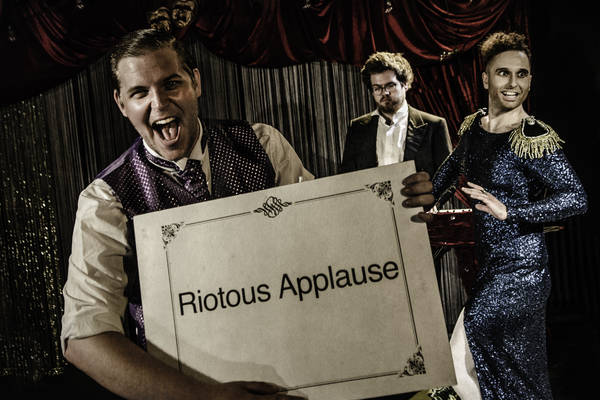
British history is peppered with truly remarkable people. Kings, queens, writers, actors, scientists, athletes and military generals pepper school history books and cultural subconscious. Then there are the people like Henry Paget, fifth Marquis of Anglesey, who are largely forgotten, tucked away in the centuries-old folds of this country’s past. During his brief Victorian life, he became rather infamous for cross-dressing, blowing his family fortune, and turning the chapel of his estate into a 150-seat theatre where he played the leads in his own productions with which he later toured Britain and Europe.

Seiriol Davies’ How to Win Against History chronicles (and fictionalises parts) of Henry’s radical life, focusing on his theatre work and cross dressing, as a fabulous, form-bending cabaret/musical. This little show has a huge heart and needs further script development to smooth out the lumpy narrative, but sequins and silliness, destroying the fourth wall, clowning and contemporary political commentary makes for a powerfully subversive and hilarious production.

The lengthy introduction provides necessary exposition, but as it gives way to a song that focuses on the Marquis’ time at Eton, it becomes too long. The interesting plot points come once the character is of age, and these deserve more attention than they are given. The beginning also sets up the style that’s maintained throughout, of musical theatre songs punctuating scenes that are heavy on the sort of narration and banter that is found in cabaret and drag acts. It’s a wonderful act of genre smashing. Musical theatre, cabaret, vaudeville and pantomime make an engaging, energizing combination that fosters audience participation and celebration. If this is where popular theatre is heading, then bring it on – Seiriol Davies’ script is at the forefront of musical theatre innovation.

Once young Henry finishes school, action starts to pick up. After a mutually beneficial marriage to his cousin (that was reportedly never consummated) and teaming up with a actor Alexander Keith (Matthew Blake), he casts himself in several plays. When no one comes, they take the shows on the road, making hilarious changes as the audience becomes less enamored of his work. More could be made out of his marriage and his increasingly weird theatre productions; they are rushed and little sense of a timescale is provided. Between his awakening as a student to a touring theatre maker, there’s a feeling that a lot of plot is missing. He is suddenly a broken man in Monte Carlo being interviewed by Daily Mail journalist Quentin (a brilliant in-joke!) and whilst this is deliciously funny, there is yet another leap in time and place. More scenes could easily be written to fill in these gaps without disrupting the established style. Even though the cabaret influence comes though in the short sketch-like scenes, as a musical it feels underwritten.

Writer Seiriol Davies plays Henry, the fabulously flamboyant lover of sequined dresses and the theatre. His journey from naïve boy to the ill and impoverished 20-something is lovely and genuine, with songs that in turn capture his enthusiasm and anguish. Energy abounds from the other two performers, making the show feel a lot bigger than it actually is.

Though this new musical needs further development to give it the scale and narrative punch that matches the style, it is fantastically good fun. The political content and deconstructing of style and structure are fly in the face of historical erasure of controversial figures and dramatic conventions. But it evoked engagement and contribution from a willing audience that was eating out of the performers’ hands within the first few minutes and this in and of itself is a huge indicator of excellent work. How to Win Against History could easily have the scale of a West End show, and it deserves the attention that would garner it.

How to Win Against History runs through 28 August in London and Edinburgh.

The Play’s the Thing UK is committed to covering fringe and progressive theatre in London and beyond. It is run entirely voluntarily and needs regular support to ensure its survival. For more information and to help The Play’s the Thing UK provide coverage of the theatre that needs reviews the most, visit its patreon.
 

bare., Courtyard Theatre

rsz_clbw12owyaau3v8

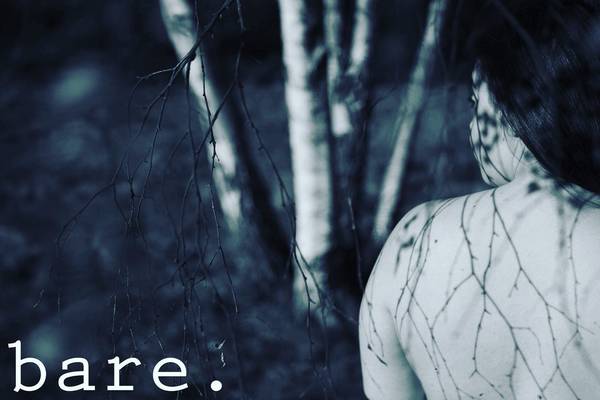
Three young women, three short solo performance pieces, three stories of vulnerability make bare., a thematically linked evening of new writing. Each of the three mini-plays has a distinct style and is performed by the writer. They vary in the quality of writing and inventiveness, and feel very new – more like scratch performances rather than finished pieces. bare. is a lovely concept – short, female solo performances that reveal hopes, fears, aspirations and conflict. It could easily become a regular event, giving women the chance to try out one-person work in front of an audience. As is, these pieces certainly need development but the three writer/performers show much promise and commendable initiative that, with development and experience, will certainly improve their work.

Kat Ronson is first, performing ‘IBZ’. This fragmented work follows a young woman’s journey from singledom into a loving relationship. The wild, drug fueled club nights transform into something more gentle and intimate, but her story does not end happily ever after. The young woman’s transformation is lovely, but the choppy writing makes for an unclear narrative and timeline. Ronson uses comedy punch lines and moments of reflective sincerity effectively, but this doesn’t balance out the vague writing. This piece would benefit from dramaturgical support and a hefty re-write, but the concept and central character are certainly workable.

American Steffanie Freedoff shows that yanks can handle their poetry and spoken word with ‘in the beginning there was Word’, a biographical monologue in verse about hating poetry as a teenager and growing to love it as an adult. This is also a coming-of-age story, but a much more positive one on self-discovery and confidence. It’s a bit cheesy and motivational, but the two stand-alone poems she ends on are angry, provocative and polished. The focus is on these pieces, which feel disconnected from the first part of the performance but add variation in style and tone. This second mini-play also needs development and shaping to find its overarching message, but it feels like it could be lengthened without becoming dull.

Madeleine Dunne brings a strong character piece to the trio with ‘Mind the Gap’, a piece that looks at the struggle of overcoming mental health issues. Lucy is a little girl terrified of breaking the rules and a young adult still limited by these fears. Told in two parts, Dunne’s gift for transformation is revealed in these two naturalistic monologues. It’s not clear who she is talking to and why in either section, but the character is a suitably interesting one. Lucy could also work well as the protagonist in a full play with multiple characters, perhaps even better with others to respond to rather than limited in a solo performance.

A quiet, sung finale wraps up the evening, a nice touch that adds some unity to these unrelated plays. bare. still feels like a scratch or showcase with a range in quality, but as a themed performance event, it is poignant and well curated. All three pieces need refining and/or expansion, though each shows at least some element of promise.

bare. runs through 16 July.

The Play’s the Thing UK is committed to covering fringe and progressive theatre in London and beyond. It is run entirely voluntarily and needs regular support to ensure its survival. For more information and to help The Play’s the Thing UK provide coverage of the theatre that needs reviews the most, visit its patreon.

Cargo, Arcola Theatre

Cargo at the Arcola Theatre, Milly Thomas, Jack Gouldbourne and Debbie Korley,  Photo by Mark Douet

Civil war is raging in the formerly united, newly named Kingdom. Loyalists and rebels have divided up the charred, frightened remains. Religious fundamentalism and capital punishment are the law of the land. There are furtive rumours of a better life across the channel, and there are regular passages to Calais. Money can buy passports, or if you don’t have any of that, there are people who will help you stow away as Cargo that you can pay later. But safety isn’t a given once you’re on board. The holds of these ships are dark and full of desperate people with shady pasts and their own agendas, and a lot can happen in an 80-minute crossing. Tess Berry-Hart’s script is as much a thriller as it is rousing political theatre, and the diverse cast of four effectively capture a snapshot of the population effected by this tragedy. Though the story is overly convoluted by truths and lies, Cargo provides a timely reminder, like other refugee-themed work at the moment, that we are all human beings in need of a safe and secure life.

Joey (Millie Thomas) is there with her younger brother Iz (Jack Gouldbourne). They’re from the loyalist-controlled docks and have lost everything. Joey’s shrewd and resourceful, Iz is an optimistic innocent who dreams of being a waiter and is the only genuinely nice person on board. Gouldbourne is totally believable as the tween who sees the good in everyone, and is nicely balanced by Thomas’ maternal defensiveness. They meet Sarah (Debbie Korley), an elusive northerner played with brilliant intensity. John Schwab is the slippery American Kayffe, who’s ever-changing biography hides horrific experiences. Berry-Hart never fully reveals the objective truths of the world around them, which is frustrating but leaves plenty to the imagination. The fates of these people are a great unknown in a world where desperation forces people to solely look out for themselves.

Tense from the onset from fear of discovery, anxiety builds quickly though there’s little to do except wait to arrive. These characters have seen so many horrors that relaxing is impossible and anyone could be the enemy. The script is conversational, yet guarded, as the characters attempt to get to know each other. Barry-Hart incorporates believable conflict into the narrative that director David Mercatali approaches with varying pace. The unresolved ending is unsatisfying, but no doubt realistic.

The design team Max Dorey (set), Christopher Nairne (lighting) and Max Pappenheim (sound) create an immersive environment of simple pallets and packaging. The boat is a constant aural presence and the seating, whilst as uncomfortable as the play’s circumstances, is probably pretty accurate. The design exquisitely works together with Mercatali to destabilise the audience; married with the script’s uncertainties it is a most unsettling effect.

Cargo could still use some refining and clarity in order to allow the audience to take in the experience without focusing on following the veracity of the character’s experiences, especially towards the end. Despite this small issue, or really because of it, the experience feels all the more truthful to refugee experience. Even though the concept of re-contextualising it to British people is not new, it is certainly effective. Like other plays on the topic, it humanises displaced people, their need for sanctuary and their vulnerability to exploitation. If theatre repeats these messages enough, the world might start to listen.

Cargo runs through 6 August.

The Play’s the Thing UK is committed to covering fringe and progressive theatre in London and beyond. It is run entirely voluntarily and needs regular support to ensure its survival. For more information and to help The Play’s the Thing UK provide coverage of the theatre that needs reviews the most, visit its patreon.
Fury, Soho Theatre

https://i.guim.co.uk/img/media/c255500e31a395db7d5e99d0e22866efcadc2904/0_0_3907_2727/3907.jpg?w=700&q=55&auto=format&usm=12&fit=max&s=24616b52e71621aa153ffabc5805fe48

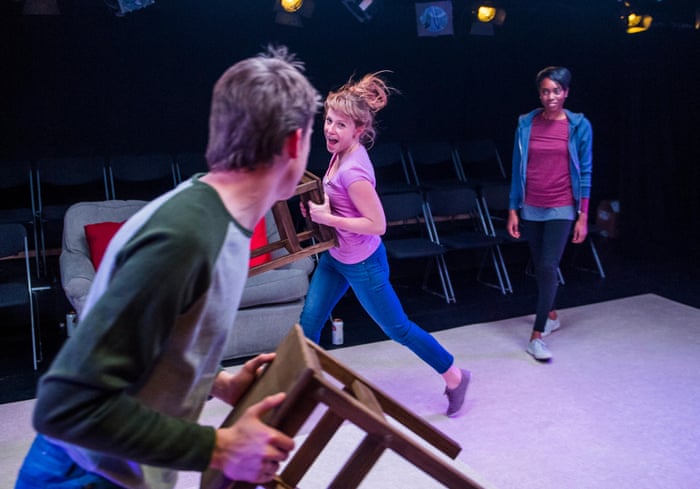
Sam is a young, single mum living in a council flat in Peckham. Having gone through the care system and her boyfriend leaving her after her second son was born, she has no one. When she meets socially inept Tom, an MA student in the flatshare above her, after losing her job as a cleaner, he creates an opportunity for friendship, sex and an escape from her kids. But Sam was born a victim, and a victim she remains. In this discourse on social class, parenting and gaslighting, playwright Phoebe Eclair-Powell incorporates Greek tragedy and a commentating chorus to expose the perils of growing up with no support network.

This is one of the young writer’s first full-length plays, and she’s still finding her feet. Fury has a great concept and characters, and the use of the chorus is a fantastic touch that adds depth and structural variation, but the execution if the ideas isn’t quite there yet. Some sections of the script don’t quite fit the main thread, like her beach outing with an old friend, and others rush the narrative progression. The chorus fills in information left out of the scenes, but this sticking plaster over the gaps is still unsatisfying and overly simplistic. The relationship between Sam (Sarah Ridgeway) and Tom (Alex Austin) escalates a bit too quickly to be plausible, though some slight extending would go far to rectify this.

Ridgeway is excellent as Sam, with a nervous energy and a risk of exploding into violence at any point, making Tom’s manipulation all the more believable to social services. Austin is slimy, awkward and initially seems harmless, but quickly reveals a dark interior. Though he plays the role well, it’s a challenging one because he transforms so quickly. His unlikely behaviour after his initial awkwardness is a powerful reminder that anyone is capable of committing horrendous acts, particularly against vulnerable people. The chorus of three (Naana Agyei-Ampadu, Daniel Kendrick and Anita-Joy Uwajeh) also play additional characters, flipping between them and non-characters with ease and agility.

Director Hannah Hauer-King uses a simple set by Anna Reid to focus on the text. Her in the round staging is a great choice that adds to Sam’s rising paranoia – everyone is indeed watching her every move. The chorus uses seats set into the audience, which although it keeps them ever present, it is unclear why the audience/actor boundary is blurred. She occasionally struggles to clarify space what with the mostly bare stage, but the dialogue usually explains well enough. Hauer-King taps into Eclair-Powell’s poetry with instinctual finesse, making some moments particularly moving.

Though the ended is rather different from the Medea that the show’s marketing compares it to, there is still senseless tragedy brought on by a man’s deliberate actions against a vulnerable woman. Fury shows much potential from the emerging writer and director, and contains some vital messages about growing up poor and female that, with some small adjustments, will be heard loud and clear.

Fury runs through 30 July.

The Play’s the Thing UK is committed to covering fringe and progressive theatre in London and beyond. It is run entirely voluntarily and needs regular support to ensure its survival. For more information and to help The Play’s the Thing UK provide coverage of the theatre that needs reviews the most, visit its patreon.