The Cardinal, Southwark Playhouse

https://newimages.bwwstatic.com/upload11/1593369/tn-500_rosiewyattandnataliesimpsonandsophiacarr-gomm.jpg

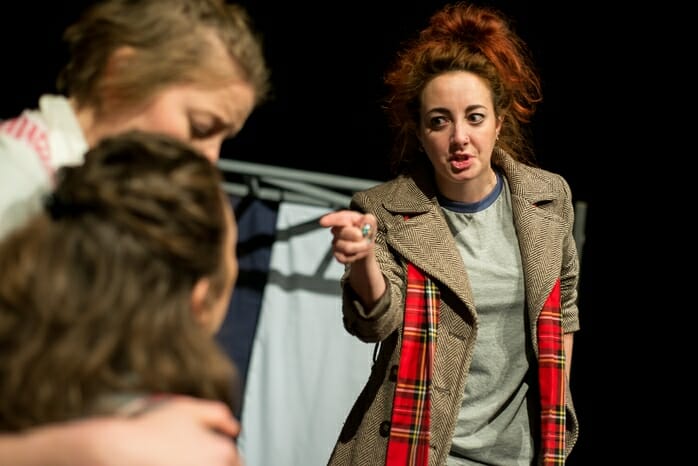
Within 50 years of Shakespeare’s death, playwriting was changing quickly. Less flowery language and more powerful female characters are prominent in James Shirley’s rarely-staged The Cardinal, written in 1641. The plot is more streamlined, but some of the outdoor playhouse performance conventions linger along with the grandness of the king’s court. The story proudly flaunts influence from earlier revenge tragedies and is no less bloody, but easier to follow than some of those on stage a few decades or so earlier. In Southwark Playhouse’s smaller space with historical costumes, Justin Audibert’s production evokes the intimate atmosphere of indoor playhouses that were beginning to take over towards the end of Shakespeare’s career.

Continue reading

Disconnect, Ugly Duck

https://entropymag.org/wp-content/uploads/2014/10/outer-space-wallpaper-pictures.jpg

Imagine a production of Waiting for Godot with more characters, set in space, where the audience chooses the outcome of the story. What you are picturing is probably gloriously weird and kitschy. But now add clumsy dialogue, some poor performances and a loosely applied Brexit analogy, performed on a set that looks like it’s built of cardboard and/or they ran out of paint. If your mind’s eye makes a different picture now, it be more accurate.

Continue reading

Dominoes, Tara Theatre

https://i0.wp.com/farm1.static.flickr.com/133/360046773_f06607e09c_o.jpg

There’s a database where you can look up the size of reparations paid to slave owners after slavery was abolished. In Dominoes, History teacher Leila and her fiancé Andy share the same last name – McKinnon. Andy’s white and Scottish, Leila’s half black-Caribbean. When curiosity gets the better of her in the run up to their half term wedding, she makes a discovery that pits family and friends against each other and threatens to destroy her big day.

Continue reading

Care, Courtyard Theatre

UFKmRtsrO3wmuDLSNSiFJK-uKmbAFnUYhZURRl1jh18

by guest critic Harry McDonald

Time passes and we pass with it, but how do you measure getting older? Do you read wrinkles or responsibilities? Or did you never learn to read?

The Courtyard’s revival of Roy Mitchell’s Care, last produced in 1983 at the Royal Court Upstairs and now presented by the Angus McKay Foundation, interrogates a fraught young couple living in Birmingham in the 1970s. Childlike in their domestic play – bouncing between football, music,  comic books and sex – each lover attempts to survive the other’s presence over a long Easter weekend. And yet there is a third person present. Don’t children always make the scariest ghosts?

Continue reading

The Ferryman, Royal Court

https://cdn.thestage.co.uk/wp-content/uploads/2017/05/03182335/TFMprod2017JP_05101.jpg

Nearly a decade after Jerusalem opened to universal acclaim at The Royal Court, Jez Butterworth finally gives us another masterpiece. A sprawling family/political drama taking place over one day in 1981 rural Armagh, The Ferryman barrels towards a predicable end. But the genius lies in the final scene, where the plot shoots off in a different direction like a rogue firework before exploding. Laden with familial craic, rebel spirit, the complexities of colonialism and rounded off with phenomenal performances, The Ferryman encapsulates the best of contemporary British playwriting.

Continue reading

Becoming Mohammed, Pleasance Theatre

https://www.londontheatre1.com/wp-content/uploads/2017/05/Becoming-Mohammed1-min.jpg

Director Annamiek van Elst states that, “now more than ever, there is a need to represent narratives around Islam in a positive light”. Too right. Our overly white and insular theatre is trying to diversify, but it still has a long way to go and systemic white, middle class administrations’ unconscious bias to overcome.

Continue reading

Twelfth Night, Blue Elephant Theatre

Twelfth Night Image small

What with the prominent use of music in Twelfth Night, an actor-muso production is certainly a reasonable concept. Original Impact also sets the play in modern-day summertime, playing up the drunken frivolity at the forefront of the story. The recontextualisation largely works, though combined with some brutal editing, it glosses over the more sombre themes of grief and displacement. The cast demonstrate a range of ability with verse and performance skills, and there are some signs that the director isn’t familiar with Shakespeare. It’s not a terrible production by any means, but some minor adjustments would lend it a more professional feel.

Continue reading

Romeo and Juliet, Greenwich Theatre

https://theatreweekly.com/wp-content/uploads/2017/04/JSS_8484.jpg

A self-described modern rep company, Merely Theatre is addressing Shakespeare’s  gender problem with 50/50 casting. Five male/female pairs each learn a set of characters in two plays, then on the night it’s decided who will perform. The result is a focus on clear storytelling rather than unimportant details such as the appearance or gender if individual characters. It’s a great device, and partnered with simple staging and a pace that doesn’t hang about, artistic director Scott Ellis has created a distinctive style of performance honouring the historical aesthetics of travelling players, though there’s a lack of nuance dissatisfying to modern audiences.

Continue reading

Day Three at Buzzcut Festival

Image 4

One of the durational works on Saturday afternoon is the six-hour Silent Dinner, where a group of D/deaf and hearing performers prepare a large meal without communicating in their native languages. There isn’t the rush of a professional kitchen, and sunlight streaming through the windows and lighting the rich colours of fresh ingredients is stunning in it’s peaceful simplicity. Watching them is a meditative exercise as they move around the rows of tables, silently and slowly preparing food that they will then eat together. It would be easy to sit with them all day as they take pleasure from the communal experience of cooking and eating.

Continue reading

Sublime, Tristan Bates Theatre

rsz_adele

Sam and Clara live the ordinary, domestic life of a young professional couple, until Sam’s sister Sophie turns up unannounced. The playful, carefree young woman eventually chameleons into someone much more sinister. Caught up in the criminal underworld, she’s back in town with an agenda. As Sophie lures Sam back to the adrenaline-junkie lifestyle of high-end burglary and fraud he’s desperate to leave behind, the siblings’ facade deteriorates further. No one is what they seem in Sublime, though the plodding script that should be thrilling never reaches its potential.

Continue reading