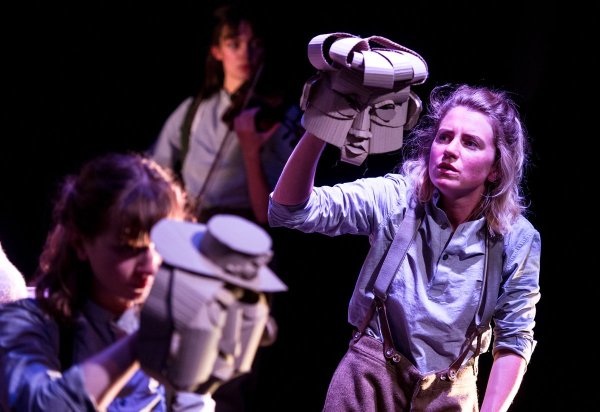
Mule, Edinburgh Festival Fringe

https://www.thestage.co.uk/wp-content/uploads/2016/08/IMG_5602-700x455.jpg

Orla and her sister are close. Even when Orla decided to move from their small Irish town to Ibiza for a summer of working and partying, they still texted everyday. After a sudden cessation in her messages and silence that stretches to ten days, her family starts to worry. A social media campaign turns up a few dead ends and the police are about to launch a full investigation when there’s a phone call.

It’s Orla. She’s in jail with another young woman called Shannon. In Lima.

Based on the real-life Peru Two, Mule fictionalises the pair of young women arrested for drug trafficking in 2013. Using two actors to play all the roles, Mule centres on Orla’s story. A sweet, young woman with little life experience who trusts too easily and struggles to say no, she gets swept up into the Ibiza culture and when she loses her job, she makes some terrible choices. This pacy script by Kat Woods gives a fairly well-rounded picture of the women’s circumstances, but the execution is so rushed that the story is hard to follow.

Scenes are short and snappy, lending an urgency and tension to the story. There are some unexplained gaps in the plot, though – like how they got this job to begin with. Orla and Shannon plan their coverup story early on, but the objective truth is never discussed. Constant character changes give a wide perspective on the story, but the use of voice and physicality as sole signifier of character at the speed and length they maintain isn’t always enough. By the time it becomes clear which character is talking, they have already moved onto another.

Mule is more of a narrative character study than a deeper exploration a chain of events where objective truth is clearly defined. Though the story has a lot packed in – including prison conditions, exploitation, drug use and gender disparity – none of them are fully explored. It has the feel of a documentary, but the character of Orla is the only consistent thread.

It’s a story that has plenty of potential for exploration, but Mule doesn’t go far enough or takes a strong angle, nor does it give enough detail to deem it documentary theatre. The actors’ performances are good and there are some excellent scenes, but Mule feels like it still a work in progress.

Mule runs through 29th August.

The Play’s the Thing UK is committed to covering fringe and progressive theatre in London and beyond. It is run entirely voluntarily and needs regular support to ensure its survival. For more information and to help The Play’s the Thing UK provide coverage of the theatre that needs reviews the most, visit its patreon.

William Shakespeare’s Long Lost First Play (abridged), Edinburgh Festival Fringe

https://i0.wp.com/bloximages.newyork1.vip.townnews.com/southbendtribune.com/content/tncms/assets/v3/editorial/0/fe/0fe0f435-1c5f-5858-af5e-9114b0616351/55c5004c8b770.image.jpg

When I was a teenager, I discovered the Reduced Shakespeare Company’s The Complete Works of William Shakespeare (abridged). My love for Shakespeare had already started to grow, and I thought the script was brilliantly funny and clever. I never saw a professional production of it, or any of the Reduced Shakespeare Company’s subsequent plays, until their newest, William Shakespeare’s Long Lost First Play (Abridged).

I found it hugely disappointing. The humour I found so witty and topical in the mid-90s, though updated, is bound in hackneyed and punny dialogue. The lack of fourth wall is great, but the panto-esque delivery feels cheesy, dated and over long. The script is fine in concept, but its execution is muddy. My tastes have clearly changed over the last twenty years and the Reduced Shakespeare Company’s work is no longer has the impact it once did.

However, the packed house laugh plenty so their style and concept are clearly still popular. Reed Martin and Austin Tichenor’s play is a mashup of most, if not all, of Shakespeare’s plays in one. Found in a Leicester carpark with a pile of bones, this is the never before seen script where Shakespeare tries to fit all his ideas in one in a totally nonsensical story.

Martin, Tichenor and Teddy Spencer are the three performers who play all roles. Their quick changes and timing are most impressive, though they rely on stale stereotypes and basic jokes to generate characters. Ariel from The Tempest becomes the mermaid, a handful of characters are inexplicably gay, and there’s even a joke about Viagra. (Are Viagra jokes even funny anymore?)

The show and the company are still popular after all these years, in spite of shallow, unsophisticated humour. Though the format clearly has staying power and wide appeal, it’s distinctive style in one for those with a penchant for comedy.

William Shakespeare’s Long Lost First Play (abridged) runs through 29th August, then tours.

The Play’s the Thing UK is committed to covering fringe and progressive theatre in London and beyond. It is run entirely voluntarily and needs regular support to ensure its survival. For more information and to help The Play’s the Thing UK provide coverage of the theatre that needs reviews the most, visit its patreon.

Be Prepared, JOAN, Edinburgh Festival Fringe

https://www.thestage.co.uk/wp-content/uploads/2016/05/Joan-Brighton-700x455.jpg

This year, four companies are receiving support from Underbelly to produce and market their latest work. Two of those are Milk Presents and Corner Shop Events, both offering solo performances but radically different in content and style. Each distinctive piece is vibrant and immediate, with moments of power and poignancy. Typical of new work at the fringe, both feel a bit rough and ready but they have a raw, honest emotionality that plucks the heartstrings.

Be Prepared transports the audience to a Quaker funeral for Mr Matthew Chambers, where a man who never actually met him has been invited to speak. Struggling with his own grief, writer/performer Ian Bonar takes on the awkward, unprepared man reduced to a child by his inner turmoil. The character’s biography interweaves with his unconventional encounters with Mr Chambers, spinning a muddled web of good intention that is sweetly moving and honest.

Bonar’s performance is excellent. There’s a simmering anxiety that drives him forward and erupts through the characters ideas that aren’t particularly well-thought through. His underlying focus on his father’s recent death is a constant presence that bubbles through his attempts to talk about Mr Chambers. His pace becomes more frenetic as his stories become increasingly muddled, though this textual choice occasionally interferes with understanding. The script has a seeping rawness that effectively captures the chaos of grief, though there are numerous loose ends that aren’t fully developed.

JOAN addresses rather different themes but has just as much intensity as Be Prepared. This modern Joan of Arc story resonates through it’s father/daughter relationship, and teenaged optimism and arrogance that backfires despite her intentions to save France. Her struggle with gender identity also gets hold of the audience’s empathy and doesn’t release its grip until the curtain call.

Lucy Jane Parkinson’s performance is exquisite. Joan’s hope, determination in the face of adversity and ultimate desperation is skilfully crafted by writer Lucy J Skilbeck. Parkinson fully embodies Joan’s emotional journey and has the audience in the palm of her hand from her initial impersonation of her father, to her final pleas for Saint Catherine’s help.

Though there is an element of drag in the show when Parkinson plays other characters, her depiction of Joan doesn’t come across as drag at all. The character is not sent up, and her struggle with taking on female behaviour and dress is wholly genuine.

Though JOAN is the stronger production of the two, Be Prepared is still a solid production with plenty of merit. Both are moving reflections of aspects of the human condition and powerful pieces of theatre in their own right.

The Play’s the Thing UK is committed to covering fringe and progressive theatre in London and beyond. It is run entirely voluntarily and needs regular support to ensure its survival. For more information and to help The Play’s the Thing UK provide coverage of the theatre that needs reviews the most, visit its patreon.
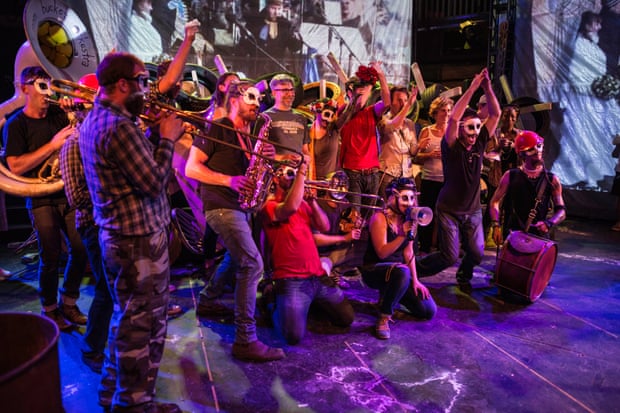
Counting Sheep, Edinburgh Festival Fringe

https://i.guim.co.uk/img/media/23913cc392a98f67736cd3cdca806a6774c8940b/0_0_2048_1363/master/2048.jpg?w=620&q=55&auto=format&usm=12&fit=max&s=1feba80ccb7ff150a5842abd1e15ee76

Just over two years ago, a revolution in Kiev ushered in the downfall of the Ukranian government. Protests against the government’s refusal to sign pro-EU legislation lasting months had several violent outbursts that saw hundred of people injured and 780 killed. Toronto-based Ukrainian musician Marichka Kudriavtseva, in Kiev for work at the time, joined the protesters where she met Mark Marczyk, also based in Canada.

When the two returned from the Ukraine, they teamed up with Marczyk’s Lemon Bucket Orkestra to create Counting Sheep, an immersive “guerrilla folk opera”. A celebration of solidarity and the power of a collective voice, it also mourns those who died in the protests. Told from the perspective of the protesters, little is shared from the other side – but this rallying performance is fitting homage to not just the Ukrainian protesters, but those fighting government tyranny around the world.

Some audience sit around a huge table, whilst others sit on the sides of the space and still others up in a balcony. Klezmer or folk music is playing as the audience enters; there is a convivial atmosphere as the show formally starts. This is a party, or a wedding, or some other huge gathering, until the three screens display news reports of riots and police enter. The tone abruptly shifts, and the world that has been established is dismantled. It’s a wonderful, unsettling surprise.

The space is consistently reformed and redrawn using movement, and the audience is physically moved in the wake of the protesters’ gains and losses. They are willing and unquestioning, the sheep of the title. Though the numbers here obviously pale to those at the actual protest, incorporating the audience in acts such a building barricades and lobbing bricks at police fosters unity from disparate dozens. There is a hint of the solidarity and aggression found in protests, and joy and celebration from the audience who are keen to play. Being served food is also an important enabler that solidifies the unity the show aims to create.

Counting Sheep is hugely effective in its emotional manipulation, and also it’s storytelling through music, movement and projections. Choosing sheep as a metaphor is a curious choice, though. The benign but rather dumb livestock aren’t known for thinking for themselves and are susceptible to herding – otherwise, they wander around unproductively, getting lost and eaten by predators. Whilst the performers are the herders here, they are also in sheep masks, unempowered. Who then are the herders? The government? Unseen forces of political and social unrest? Whatever it is, us human beings are hugely susceptible to it when motivated enough, even if the metaphor isn’t totally clear.

Though sung completely in Ukrainian, there is a clear storyline conveyed through projections and movement. There is little nuance in this piece, but it a playground for the sweeping emotions of popular theatre. It provides at least a hint of the experience that the Ukrainian protesters endured, and powerfully unites the audience through the humanity of collective experience for a common goal. An excellent piece of theatre.

Counting Sheep runs through 29th August.

The Play’s the Thing UK is committed to covering fringe and progressive theatre in London and beyond. It is run entirely voluntarily and needs regular support to ensure its survival. For more information and to help The Play’s the Thing UK provide coverage of the theatre that needs reviews the most, visit its patreon.
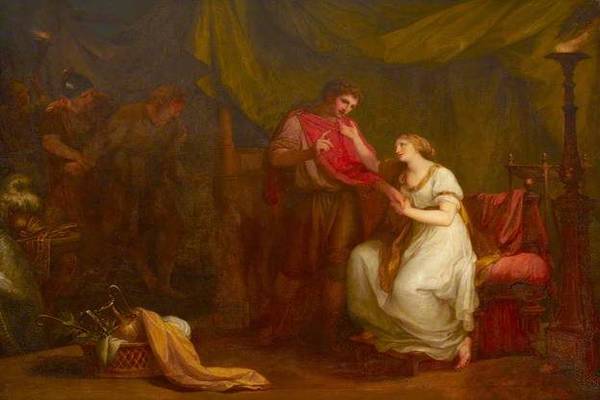
Troilus and Cressida, Edinburgh Festival Fringe

(c) National Trust, Petworth House; Supplied by The Public Catalogue Foundation

There is hardly any Shakespeare at the fringe that isn’t dramatically altered in some way or another. Re-contextualisations abound, as does new work that’s derivative from a story or character. West Country-based Shakespeare on the Level’s Troilus and Cressida is neither of these. It has no gimmicks and no determinedly modern concepts. It is merely the text staged in a clear fashion that serves Shakespeare’s stories, with few divergences. This is not an innovative production and has a few faults, but is remarkably refreshing in its lack of fringe-ness.

Some cross-gendered casting is a welcome choice to improve balance between men and women. There are only three women in the cast of twelve so parity is hardly achieved, but the women in the cast also have the chance to play male roles. Director Kate Littlewood also makes Achilles openly gay, choosing to wile away the days in his tent with his lover, Patroclus. This is a lovely choice that aligns the play with its Greek and Roman roots and doesn’t disrupt the story.

The performances are mixed, with Susie Kimnell’s Helen and Louis Bowen’s Troilus standing out as particularly strong. There are some weak verse speakers who break up the rhythm, others aren’t fully connected to the text and either shout it or approach it too casually.

Littlewood takes a flowing, eastern approach to her costume design, though the Romans and the Greeks are very similar in style. With the multi-rolling necessary to cover the twenty-three characters and varied acting ability, a stronger visual indication of which camp is which would be welcome. She sets Troy in the round, and skilfully uses the diagonals so the audience can always see, and fight director Tom Jordan’s choreography also suits the space.

The story is cut down to a manageable length, maintains clarity and has a clear design concept. Though not a particularly fringe approach to Shakespeare, this is a well-staged production with a cast of emerging talent.

Troilus and Cressida runs through 27th August.

The Play’s the Thing UK is committed to covering fringe and progressive theatre in London and beyond. It is run entirely voluntarily and needs regular support to ensure its survival. For more information and to help The Play’s the Thing UK provide coverage of the theatre that needs reviews the most, visit its patreon.
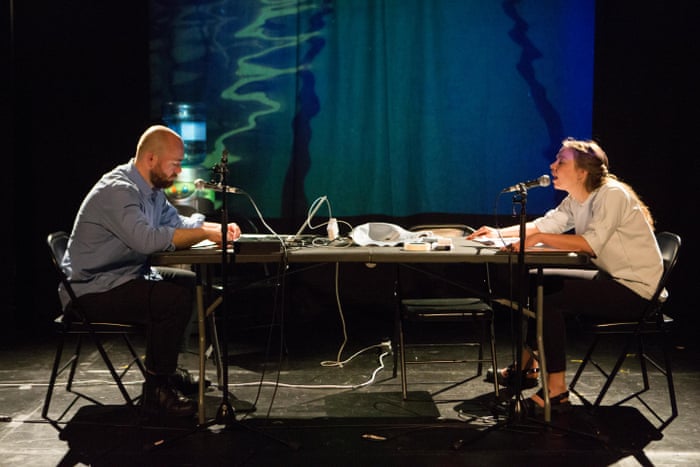
Two Man Show, Edinburgh Festival Fringe

https://files.list.co.uk/images/2016/08/19/rashdash-twomanshow-credit-the-other-richard-lst216304.jpg

RashDash are angry. Like, fucking furious level of angry. They’re fed up of patriarchal language and gender stereotypes that limit both men and women from expressing themselves honestly. So they made a show about it. Two Man Show has three women in it, music and dance, nudity and a lot of explosive energy. It’s part science lecture, part role play and part celebration of who we are without others’ judgment and categorisation based on gender expression. It’s a fantastic, “fuck yeah” explosion of pretty skirts, masculinity, tits, cockfighting and nonconformity. It’s also pretty bloody brilliant.

Out of an opening tirade on equality in the dawn of human history, Abbi Greenland and Helen Goalen take on the roles of two brothers, Dan and John. They don’t get on, arguing almost constantly about caring responsibilities for their terminally ill father. Their fighting builds in between movement and dance sequences of surprising intimacy and tenderness.

The culmination to Dan and John’s tension is a fantastic eruption of John’s frustrated masculinity feeling limited by “man things”. His words twists through Abbi’s, the man-woman who is happy in her own skin but doesn’t really suit any of that girly shit. Helen’s feminine contrast powerfully reinforces the importance of choice and freedom and that a woman doesn’t need to be butch to be a feminist and a man can express his feelings and do “feminine things” without his heterosexual maleness being threatened.

Greenland and Goalen’s performances are endowed with conviction and energy, and both are skilled physical performers who can convincingly play men, even with their breasts unveiled. They are accompanied by a musician, who backs them up with unfettered tunes of frustration and celebration.

This is a truly feminist show. Rather than blaming men, Two Man Show looks at the conventions of language that aids female suppression and acknowledges that men are not served by this system, either. Fabulously sequinned and ferociously opinionated, this is not one to miss.

Two Man Show runs through 27th August.

The Play’s the Thing UK is committed to covering fringe and progressive theatre in London and beyond. It is run entirely voluntarily and needs regular support to ensure its survival. For more information and to help The Play’s the Thing UK provide coverage of the theatre that needs reviews the most, visit its patreon.

Us/Them, Edinburgh Festival Fringe

https://www.thestage.co.uk/wp-content/uploads/2016/08/Us-Them_300dpi_PRESS-2_%C2%A9_FKPH-700x455.jpg

On 1 September 2004, a group of terrorists stormed a school in Beslan, holding over a thousand people hostage on the first day back after summer holidays. Most of them were children. When the siege ended three days later, over 300 people were dead. Part history lesson and part dramatherapy storytelling, two actors playing unnamed children who were hostages in the crisis re-enact the events of those three days. The childlike seriousness, quiet bickering and playful staging in Us/Them provides an excellent, contemplative lens through which to view world disasters.

Gytha Parmentier and Roman van Houtven are a soft spoken girl and boy who take pride in their school and their education. They go to the best one in town, and it’s near a wonderful forest. On the other side of the forest is the border, and across the border, children don’t go to school, the men are pedophiles and the women have moustaches. They view the world in black and white, everything is simple and explained in a matter of fact delivery. Whilst they show little fear, as hours stretch into days, the heat and dehydration take a toll on their bodies. Through their tiredness, they try to make sense of the terrorists’ demands and work out what they have to make them let them go. Their naivety is both heart wrenching and warming, rather than condemn they want to please everyone and carry on living their lives in peace.

The script is mostly narration, with some quibbling between the two on how certain moments panned out. More dialogue between the two would be welcome, but the design choices keep the narration from becoming too repetitive. It is description heavy, accented with colourful, abstract staging – childrens’ coats hang on the back wall, a web of unravelled string slows them down so as not to startle the terrorists. Their movements are angular, with leaps, falls and physical play. The bombs they rig around the gymnasium where they are held are balloons. Whilst the imagery and text is childlike, the undercurrent of danger and horror is inescapable, and the quiet honesty is wholly riveting.

Children are so often the faces of global tragedies that rally sympathy and action. Think of the little boy washed up on the beach, the tiny Syrian airstrike victim staring into the middle distance in the back of an ambulance. Whilst their images are splashed across the news and social media, they are rarely heard from. Perhaps if they were given a platform to air their experiences and perspectives, the adults that run the world would be less inclined to mindlessly retaliate against violent acts. Us/Them, rather than having an in-yer-face aggressive, political agenda, intuitively uses text and staging to convey a powerful, lingering request to listen and be kind, no matter how foreign we are to each other.

Us/Them runs through 28th August.

The Play’s the Thing UK is committed to covering fringe and progressive theatre in London and beyond. It is run entirely voluntarily and needs regular support to ensure its survival. For more information and to help The Play’s the Thing UK provide coverage of the theatre that needs reviews the most, visit its patreon.

A Dream of Dying, Edinburgh Festival Fringe

https://files.list.co.uk/images/2016/08/07/dsc3677-lst214126.jpg

On 16th June 2009, the body of a man was found dead on a beach near Sligo, Ireland. He had given his name as Peter Bergmann at his hotel, but postmortem investigations determined that was an alias. In the days running up to his death, CCTV recorded the man methodically moving around Sligo but taking advantage of cameras’ blind spots, he disposed of all items that could possibly be used to identify him. Monologue A Dream of Dying creates a young man who plans such a death in his future in an attempt to justify why Bergmann might have died the way he did. This quiet, reflective piece may not be the most exciting theatre at the fringe, but its subject matter is a sensitive look at life’s inevitability and the desire to control these final moments.

Lawrence Boothman embodies the fictionalised Bergmann, his friends and family from childhood through to recent graduate on the cusp of the rest of his life. As he contemplates what life will bring him – career, wife, children, grandchildren – he expresses the lingering fear that it could all go wrong. In either case, because life is so unpredictable despite the best laid plans, he is able to plan his death with mechanical precision. The calm rationale is both understandable and unsettling.

Boothman attacks the role with vigour, perhaps too much so in transitions that become rushed. Treasa Nealon’s text follows a natural narrative progression and Boothman tells it with instinct for its rises and falls, lingering over moments of tenderness and celebrating milestones. There’s an anti-theatricality to the piece, but it’s a good story well told.

Peter Bergmann’s true identity was never discovered. His remains evidenced late stage prostate and bone cancer so it is easy to draw conclusions as to why Bergmann chose to end his life. The saddest thing to consider is that whilst he worked hard to make himself unidentifiable, there may have been no one to look for him when he disappeared. A Dream of Dying, though not particularly theatrical, feels like a fitting homage to those that have died unknown and unclaimed the world over.

A Dream of Dying runs through 27th August.

The Play’s the Thing UK is committed to covering fringe and progressive theatre in London and beyond. It is run entirely voluntarily and needs regular support to ensure its survival. For more information and to help The Play’s the Thing UK provide coverage of the theatre that needs reviews the most, visit its patreon.

Life According to Saki, Edinburgh Festival Fringe

CpVFTsMXYAA1jSg

Author Hector Hugh Munro, otherwise known as Saki, is in WWI’s trenches. He and his men been out there for nearly a year, and they are long fed up with life on the front. To entertain his fellow troops, he tells the stories that have already made him a well-known writer. Life According to Saki mixes biography and fiction as Saki tells the audience about his life, interspersed with silly and bizarre anecdotes. The cast of six play both soldiers and the character’s in Saki’s stories with fantastic energy and physical commitment, but the structure of the play and Saki’s pontificating soon grows repetitive. An excessively long ending and too many stories ushers in eventual tedium despite a polished show with high production values.

Anna Lewis’ design is excellent; it clearly indicates the trenches and is flexible for the imagined worlds elsewhere. Costumes are WWI uniforms that fit the cast of women and men smartly – they are not frumpy, unaltered hire costumes. The puppets by Claire Roi Harvey and Suzi Battersby are also very good, with the cock being particularly charming with a great range of realistic movement.

The script is where it begins to fall flat a few stories in. Each one is very short, some only a few minutes long. There are about eight or ten altogether, and the constant shift from tale to tale is exhausting. The are performed with great physical comedy, accents and verge on the fantastical; each one is lovely but there are way too many. Episodes from Saki’s life are bland and dry filler, and the two styles feel forced to miserably cohabit in the same structure. The tacked-on conclusion preaches about how to live one’s life, then drags on even longer into a song and a poem. Though it blatantly states its message of living life to its fullest, the connection to the hour of stories preceding it is tenuous.

Three or four longer stories with depth and detail, and less of Saki’s biography (if any at all) would make this a much more engaging play. The premise of a soldier entertaining his troops is a fine one, but The Life of Saki comes across as self-centred and lecture-y with some silly, disconnected interludes.

Life According to Saki runs through 29th August.

The Play’s the Thing UK is committed to covering fringe and progressive theatre in London and beyond. It is run entirely voluntarily and needs regular support to ensure its survival. For more information and to help The Play’s the Thing UK provide coverage of the theatre that needs reviews the most, visit its patreon.