Two Man Show, Edinburgh Festival Fringe

https://files.list.co.uk/images/2016/08/19/rashdash-twomanshow-credit-the-other-richard-lst216304.jpg

RashDash are angry. Like, fucking furious level of angry. They’re fed up of patriarchal language and gender stereotypes that limit both men and women from expressing themselves honestly. So they made a show about it. Two Man Show has three women in it, music and dance, nudity and a lot of explosive energy. It’s part science lecture, part role play and part celebration of who we are without others’ judgment and categorisation based on gender expression. It’s a fantastic, “fuck yeah” explosion of pretty skirts, masculinity, tits, cockfighting and nonconformity. It’s also pretty bloody brilliant.

Out of an opening tirade on equality in the dawn of human history, Abbi Greenland and Helen Goalen take on the roles of two brothers, Dan and John. They don’t get on, arguing almost constantly about caring responsibilities for their terminally ill father. Their fighting builds in between movement and dance sequences of surprising intimacy and tenderness.

The culmination to Dan and John’s tension is a fantastic eruption of John’s frustrated masculinity feeling limited by “man things”. His words twists through Abbi’s, the man-woman who is happy in her own skin but doesn’t really suit any of that girly shit. Helen’s feminine contrast powerfully reinforces the importance of choice and freedom and that a woman doesn’t need to be butch to be a feminist and a man can express his feelings and do “feminine things” without his heterosexual maleness being threatened.

Greenland and Goalen’s performances are endowed with conviction and energy, and both are skilled physical performers who can convincingly play men, even with their breasts unveiled. They are accompanied by a musician, who backs them up with unfettered tunes of frustration and celebration.

This is a truly feminist show. Rather than blaming men, Two Man Show looks at the conventions of language that aids female suppression and acknowledges that men are not served by this system, either. Fabulously sequinned and ferociously opinionated, this is not one to miss.

Two Man Show runs through 27th August.

The Play’s the Thing UK is committed to covering fringe and progressive theatre in London and beyond. It is run entirely voluntarily and needs regular support to ensure its survival. For more information and to help The Play’s the Thing UK provide coverage of the theatre that needs reviews the most, visit its patreon.

Milk, Edinburgh Festival Fringe

https://i0.wp.com/7210-presscdn-0-59.pagely.netdna-cdn.com/wp-content/uploads/2016/08/milk.jpg

Everyone has a relationship with food. For some its straightforward, for others it’s complex. Food in terms of nourishment isn’t just that which we eat, either. Love, security, and all sorts of other things make us feel full. In Milk, three generations of couples in the same town negotiate what matters most to them and makes their lives feel complete. This is a slowly burning script that comes into its own towards the end when conflict becomes so high that the six characters lives cross outside of their partner’s. There is some good character detail, but writer Ross Dunsmore’s first play shows promise but needs further development.

Steph and Ash are fourteen. Ash is a fairly typical teen boy, but Steph, from a dysfunctional home, has a pathological need to be sexually desired. When Ash doesn’t satisfy, she finds a new, more dangerous target. Danny and Nicole are young marrieds expecting their first child. When the baby arrives, unforeseen complications and postpartum hormones challenge Nicole’s preconceptions about motherhood and open a divide between the couple. Cyril and May are in their 90s and homebound, too scared of the changing landscape of architecture and aggressive young people to go out. As they fantasise about past Sunday roasts, their hermetic existence takes its toll.

The storylines that Dunsmore unfolds are all believable though in their kinship to real life, they take most of the play to reach any level of compelling conflict. Cyril and May’s story has hardly any, rendering it the least interesting and most forced plotline. Whilst the other two are more dynamic, they are underserved in this intertwining format. The two younger couples could each easily have an entire play devoted to them; to force them all into one feels indecisive in the face of several ideas.

Fred Meller’s design is cold and utilitarian, though has some lovely surprises that are gradually unveiled. Director Orla O’Loughlin delineates the three couple’s worlds well and captures the easy rhythm of Dunsmore’s dialogue without adding any forced stylisation.

Without a doubt, Dunsmore’s couples all have compelling stories to tell (though all are heteronormative, white and skew towards female dependency on men), but the format he uses to tell them is not the most effective. Too much exposition interferes with the empathy for the characters and whilst the ending is a satisfying payoff, the build to it is too little and too late.

Milk runs through 28th August.

The Play’s the Thing UK is committed to covering fringe and progressive theatre in London and beyond. It is run entirely voluntarily and needs regular support to ensure its survival. For more information and to help The Play’s the Thing UK provide coverage of the theatre that needs reviews the most, visit its patreon.

Remember to Breathe, Equations for a Moving Body, Edinburgh Festival Fringe

https://s3.amazonaws.com/wos-photos-production/107110.jpg

Two women, in two different shows set on opposite sides of the world, swim as if their lives depend on it. One is training for an ironman-length triathlon, the other never learnt to swim and is doing so to overcome a fear of water. Equations for a Moving Body is Hannah Nicklin’s solo performance telling the story of her decision to complete an ironman and the research she did to discover what would happen to her body as she trains. Remember to Breathe follows fictional Maeve away from the safety of family and a secure job in Ireland, to world travels that eventually find her in New Zealand. Though Hannah and Maeve approach swimming completely differently, the sport shapes who they are and how they deal with obstacles that come their way.

Maeve and her kiwi husband Grant are back in Ireland when the Christchurch earthquake hits. The Celtic Tiger has been and gone, and their business is struggling so they decide to head to the southern hemisphere to help rebuild. It’s here that Maeve discovers a pool in the wreckage, staffed by the relentlessly perky Doreen. In that pool, Maeve gently catalogues her life through her relationship to her father. He and Doreen fade in and out again like memories in this quiet, reflective piece on family and finding your place in the world.

Liz Fitzgibbon as Maeve has a calm strength and enigmatic presence. This everywoman of a character with relatable struggles trying to find peace is a reassuring story to witness, though the lack of outright conflict between characters makes for a sleepy pace.

Julie Sharkey as Doreen and David Heap has Maeve’s earthy, grounded father are great foils constructed by writer Orla Murphy. As well as Maeve’s personal journey that she comes to terms with through swimming, there’s a pointed throughline of the effects of the economy on the common man – a clever inclusion making the script universally relevant.

Maeve swims and came to it in her adult life, but Hannah is a swimmer and has been doing so since she was four. Hannah explains the difference between “I swim” and “I’m a swimmer” and the role goals and life events have in shaping one’s identity. Her decision to complete an ironman in the year she turned 30 becomes a part of who she is and how she lives her life, and Equations for a Moving Body is the moving story of the ups and downs of pushing your body to its limits.

The most engaging focus of Hannah’s story is the people she meets along her training journey. She has a gift for making John, Tom and the various scientists she meets along the way come alive, even if they only feature for brief moments. These encounters provide landmarks that make her story stand out from anyone else’s and excellent focal points of her narrative structure.

The story’s climax is the triathlon, with peaks and troughs that are magnified versions of those in her training. It’s a hugely satisfying and emotional end to a story of struggle, grief and triumph. Those who aren’t much for sport or fitness who find her initial goal baffling are on side at by the finish line.

Nicklin uses live internet use to support her story and add a visual element to the production. Though simple, it’s a great choice. These are almost all accompanied by her narrative, though one section is poignant in its silence and elucidates the source of the show’s name.

Hannah cements her sense of self through her training and its end goal, and Maeve finally finds the peace she is searching for. Both productions are lovely, if very different stories of personal discovery at Summerhall.

The Play’s the Thing UK is committed to covering fringe and progressive theatre in London and beyond. It is run entirely voluntarily and needs regular support to ensure its survival. For more information and to help The Play’s the Thing UK provide coverage of the theatre that needs reviews the most, visit its patreon.
Macbeth: without words, Edinburgh Festival Fringe

https://i0.wp.com/edinburghfestivalguide.co.uk/wp-content/uploads/2015/11/Macbeth-Without-Words-Ludens-Ensemble-Photo-by-Chrysa-Karagianni.jpg

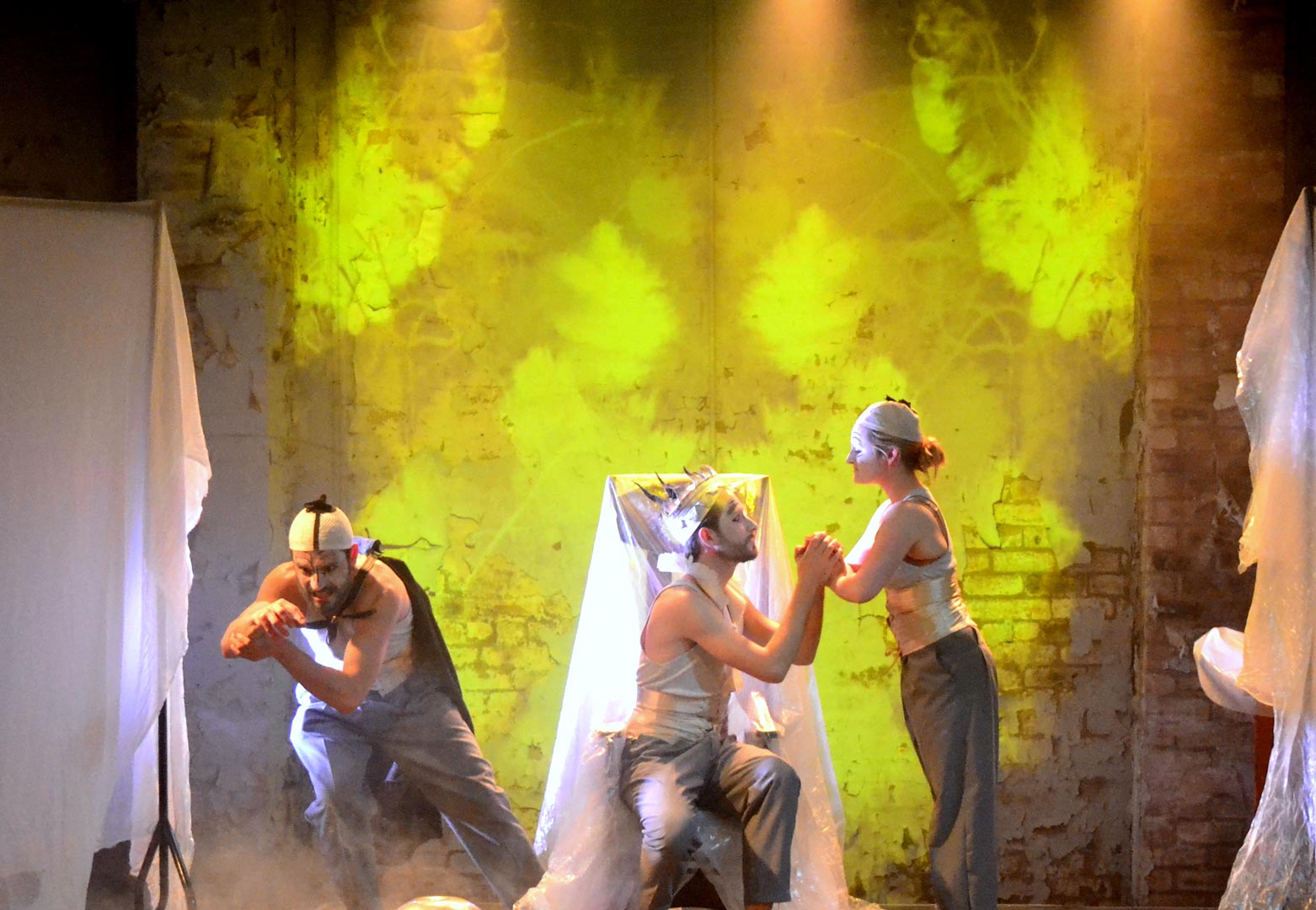
Shakespeare without words. What’s left? In Ludens Ensemble’s Macbeth: without words, plenty. Drawing on the aesthetic of silent films and Victorian gothic with the near-constant use of live sound mixing, a trio of performers playing all roles conveys the story effectively through movement and subtitles. This spooky adaption taps into the heavy darkness and supernatural elements of the story in an easy to follow and visually compelling production.

The design is the most striking element of the show. Greyscale, sexless costumes are the base for elements of victoriana – waspies, a skeletal skirt, capes and papery crowns. Large screens and dust sheets host an array of productions, from silent movie captions to abstract splodges of colour. Haze is used liberally, but it actually feels appropriate to this production to create fog over the heath. The dust sheets are also cleverly used to create ghostly apparitions and shadows, though these could be used more often as a design motif. Two microphones and prerecorded sounds are mixed live to create rich soundscape of suspense and violence, though silence is used to highlight powerful moments of suspense.

The two men and one women are strong physical performers evidently influenced by theatrical clowning and animal work. Their focus and intensity are unwavering, especially as Macbeth’s torment grows. Expressed outwardly, this becomes the centre of the story.

Though there are a few extracts of text, stage directions and summaries projected, Macbeth: without words would be hard to follow without knowing the story already. A freesheet with a plot summary would go a long way to ensure all audience members are catered for. Some of the scenes could use lengthening to reflect their importance to the story, particularly the banquet scene.

This is a visually stunning adaptation of Shakespeare’s play that in no way underserves the original by stripping away the text. Ludens Ensemble create a vocabulary of movement, images and sound that feels just as rich as Shakespeare’s.

Macbeth: without words runs through 29th August.

The Play’s the Thing UK is committed to covering fringe and progressive theatre in London and beyond. It is run entirely voluntarily and needs regular support to ensure its survival. For more information and to help The Play’s the Thing UK provide coverage of the theatre that needs reviews the most, visit its patreon.

Revolt. She Said. Revolt Again., Edinburgh Festival Fringe

https://cdn2.rsc.org.uk/sitefinity/images/productions/2016-shows/Making-Mischief/revolt-2016-production-photos/revolt-she-said-revolt-again-production-photos_-2016_2016_photo-by-richard-lakos-_c_-rsc_201024.tmb-gal-670.jpg?sfvrsn=1

Playwright Alice Birch wants to start a revolution. Revolt. She Said. Revolt Again. seeks to challenge the patriarchal language and social structures that hold woman second place to men. Being polite and socially acceptable isn’t going to achieve this, and the marketing material states that this play is not well behaved.The issue is that it is. The collection of scenarios with chaotic climax and resigned footnote of an ending starts out strong, but quickly loses sight of its goals through a lot of talking but few suggestions for effective action.

The first scene between a heterosexual couple is the most effective as he talks about all the things he wants to do to her body, and she corrects his language from one of his ownership to one of hers. The subject matter is provocative, funny and establishes a model that women can actually use. It’s not badly behaved, though – it’s polite, considerate and a bit uncomfortable, but not revolutionary. Subsequent scenes have less of a practical application; this isn’t a problem in and of itself, but these scenarios are much less of a catalyst in a show about taking action. There is some rejection of social convention, but little seen as radical. A culminating babble of voices largely indistinct from each other goes on entirely too long and due to the challenge of deciphering specific lines has little impact.

A cast of four, three women and one man, play a range of characters though disappointingly, the characters are middle class and English. Surely the issues that are presented – the language of sexual domination, consent, reproduction, family, flexible working – effect working class people as well.

Madeleine Girling keeps her set simple and efficient, using only items that are fully functional to each scene. Lighting designer Claire Gerrens creates angular, starkly delineated spaces that support the simple demand for equality and empowerment.

Birch certainly uses language well and constructs dynamic, interesting characters but the lack of much motivating material creates a lot of bluster with little change. The script also avoids any issues of intersectionality, particularly social class and race, even though one of the actors is black. Her goals are certainly admirable, but Revolt. She Said. Revolt Again.? More like have a chat and then carry on with your life.

Revolt. She Said. Revolt Again. runs through 28th August.

The Play’s the Thing UK is committed to covering fringe and progressive theatre in London and beyond. It is run entirely voluntarily and needs regular support to ensure its survival. For more information and to help The Play’s the Thing UK provide coverage of the theatre that needs reviews the most, visit its patreon.

Exactly Like You, Edinburgh Festival Fringe

https://i0.wp.com/www.underbellyedinburgh.co.uk/images/made/images/uploads/1000w-x-640h-px_750_500_60_c1.jpg

Things have never been easy for Abby. She doesn’t get on with her mum, she’s didn’t do well in school, she drifts from one shitty job to another without any purpose or goals. She misses her Nana, with whom she would spend long hours writing fantastical stories and listening to music. Nina Simone was their favourite. In Exactly Like You, Lotte Rice tells Abby’s story through a moving, passionate spoken word monologue on losing her way and finding it again.

Rice’s way with words makes Abby funny and relatable, the sort of woman you could sit down with over a pint or a cup of tea and natter about all and sundry going on in the world. She would always have a story or an anecdote to share that would make you laugh or think, or both. Her decision to make Abby a working class, down-at-heel character so expressive and articulate through spoken word is a fantastic choice rather than catering to the stereotype of working class young people as grunting cokeheads who only live for nights out on the piss. The piece is punctuated with soulful renditions of Nina Simone’s songs, effectively breaking up the dense text. Though Abby’s story isn’t remarkable in itself, the mode of telling it is hugely refreshing.

Designer Elouise Farley and lighting designer Zanna Woodgate work together to create a landscape of glowing bookcases, the sort that fit vinyl records. Though simple and subtle, they capture the inner warmth of Abby’s Nana who lived for music of all sorts. They are her memories of her time with Nana, always present and always driving her forward, and a lovely addition that makes the piece feel more polished than a bare stage.

When Abby hits rock bottom after yet another night out drowning her painful memories with too much whiskey, an unexpected helping hand appears. Fortunately, this is not some benevolent, condescending force sent to save her. Abby’s journey is one of reflective self-discovery told in an engaging, lively format with fantastic music to boot.

Exactly Like You runs through 28th August.

The Play’s the Thing UK is committed to covering fringe and progressive theatre in London and beyond. It is run entirely voluntarily and needs regular support to ensure its survival. For more information and to help The Play’s the Thing UK provide coverage of the theatre that needs reviews the most, visit its patreon.

Please Excuse My Dear Aunt Sally, Edinburgh Festival Fringe

https://www.thestage.co.uk/wp-content/uploads/2016/08/please-700x455.jpg

When fourteen-year-old boy Red starts at a new school after his parents’ divorce, his mum anxiously worries about him making friends. Soon, his mobile is constantly buzzing with texts and he’s out most evenings. Mum’s happy but she only sees the life Red constructs especially for her. Someone, or rather something, else has the privilege of an uncensored view – Red’s mobile. As the vulnerable boy is sexually exploited by his unsatisfied maths teacher, his phone sees everything and narrates the story around the characters’ interactions. This slick ensemble piece by NY theatre company One Year Lease seamlessly merges writing styles, design and physical theatre to tell a dream-like story of abuse veiled as love.

When Red’s maths teacher confiscates his mobile and accidentally takes it home with her instead of her own phone, she begins a downward spiral of communication that quickly becomes personal. Red’s parents separation is far from pleasant, and his teacher’s boyfriend is an unemployed layabout, with vague dreams of designing apps. This combination fosters a relationship where the teacher and the student inappropriately confide in each other, and she does nothing to stop it.

Suspicion helps propel the action upwards towards a climactic end, but a lack of consequence in Kevin Armento’s resolution is as disturbing as the story itself. The phone as narrator is a great device – it’s present enough to add context and framing, but is not overused to the point of becoming a gimmick. Abstract movement incorporating versatile set pieces adds a striking, dynamic visual and a disconnect from reality appropriate to a forbidden relationship. A live musical score by Estelle Bajou enhances the surrealism of the staging.

Mathematical equations coldly explain how their illicit affair develops, and minimalist design in black and white juxtaposes the intricacies of the complex lives that collide so inappropriately. Though the script avoids blatant condemnation of the relationship, Please Excuse My Dear Aunt Sally is a striking blend of visual and verbal storytelling.

Please Excuse My Dear Aunt Sally runs through 28th August.

The Play’s the Thing UK is committed to covering fringe and progressive theatre in London and beyond. It is run entirely voluntarily and needs regular support to ensure its survival. For more information and to help The Play’s the Thing UK provide coverage of the theatre that needs reviews the most, visit its patreon.

In Fidelity, Edinburgh Festival Fringe

https://www.thestage.co.uk/wp-content/uploads/2016/08/In-Fidelity-Image-10-by-Rob-Drummond-at-Traverse-Photo-Credit-Sally-Jubb.jpg

Rob Drummond and his wife Lucy are celebrating their fifteenth anniversary. As a gift to her, he made a show where two single audience members have the opportunity to go on a first date there and then in the hope of finding the sort of love he has with Lucy. Though the bulk of the production centres around the selected couple on stage, there is plenty of audience interaction as we guide them down the path of getting to know each other. Part TED talk, part talk show, part slumber party, In Fidelity is as informative as it is heartwarming and fun.

Drummond’s extensive research on brain activity, hormones and psychology drives the framework around the first date and is consistently present throughout the show. The pop-science is easy to understand and his presentation style makes this content all the more engaging. After a series of questions he selects the two audience members who will have their first date, the focus becomes on facilitating the introduction of these two people. Each performance will undoubtedly be different and have varying degrees of successful matchmaking, but this makes it all the more exciting.

There’s a gleeful voyeurism that In Fidelity satisfies and even though Drummond gives the audience and the pair on their date quite a lot of freedom, he keeps a tight grip on discussion and interaction so it never feels that he will lose control of the show’s progression. This restriction ensures that everyone in the room feels safe, and its remarkable how quickly people feel comfortable answering very personal questions about their love life. Drummond’s onstage persona is warm and strong, a great balance that encourages the audience to open up. His incorporation of personal anecdotes, adventures in the research process and his own relationship’s journey also help.

The show ends happily the day I see it, with the couple clearly having some degree of chemistry between them. Even if that doesn’t happen, Drummond ends with some fantastic news of his own, leaving the audience with a warm, fuzzy feeling as they leave the theatre. This theatrical experiment is a wonderful exploration of form and its benevolence is a wonderful thing to be a part of.

In Fidelity ends 28th August.

The Play’s the Thing UK is committed to covering fringe and progressive theatre in London and beyond. It is run entirely voluntarily and needs regular support to ensure its survival. For more information and to help The Play’s the Thing UK provide coverage of the theatre that needs reviews the most, visit its patreon.

Us/Them, Edinburgh Festival Fringe

https://www.thestage.co.uk/wp-content/uploads/2016/08/Us-Them_300dpi_PRESS-2_%C2%A9_FKPH-700x455.jpg

On 1 September 2004, a group of terrorists stormed a school in Beslan, holding over a thousand people hostage on the first day back after summer holidays. Most of them were children. When the siege ended three days later, over 300 people were dead. Part history lesson and part dramatherapy storytelling, two actors playing unnamed children who were hostages in the crisis re-enact the events of those three days. The childlike seriousness, quiet bickering and playful staging in Us/Them provides an excellent, contemplative lens through which to view world disasters.

Gytha Parmentier and Roman van Houtven are a soft spoken girl and boy who take pride in their school and their education. They go to the best one in town, and it’s near a wonderful forest. On the other side of the forest is the border, and across the border, children don’t go to school, the men are pedophiles and the women have moustaches. They view the world in black and white, everything is simple and explained in a matter of fact delivery. Whilst they show little fear, as hours stretch into days, the heat and dehydration take a toll on their bodies. Through their tiredness, they try to make sense of the terrorists’ demands and work out what they have to make them let them go. Their naivety is both heart wrenching and warming, rather than condemn they want to please everyone and carry on living their lives in peace.

The script is mostly narration, with some quibbling between the two on how certain moments panned out. More dialogue between the two would be welcome, but the design choices keep the narration from becoming too repetitive. It is description heavy, accented with colourful, abstract staging – childrens’ coats hang on the back wall, a web of unravelled string slows them down so as not to startle the terrorists. Their movements are angular, with leaps, falls and physical play. The bombs they rig around the gymnasium where they are held are balloons. Whilst the imagery and text is childlike, the undercurrent of danger and horror is inescapable, and the quiet honesty is wholly riveting.

Children are so often the faces of global tragedies that rally sympathy and action. Think of the little boy washed up on the beach, the tiny Syrian airstrike victim staring into the middle distance in the back of an ambulance. Whilst their images are splashed across the news and social media, they are rarely heard from. Perhaps if they were given a platform to air their experiences and perspectives, the adults that run the world would be less inclined to mindlessly retaliate against violent acts. Us/Them, rather than having an in-yer-face aggressive, political agenda, intuitively uses text and staging to convey a powerful, lingering request to listen and be kind, no matter how foreign we are to each other.

Us/Them runs through 28th August.

The Play’s the Thing UK is committed to covering fringe and progressive theatre in London and beyond. It is run entirely voluntarily and needs regular support to ensure its survival. For more information and to help The Play’s the Thing UK provide coverage of the theatre that needs reviews the most, visit its patreon.

Fire Burn: The Tragedy of Macbeth, Edinburgh Festival Fringe

https://i0.wp.com/cdn3.historyextra.com/sites/default/files/imagecache/623px_wide/Macbeth%202.jpg

It must be rather dull hanging out on a Scottish Heath with your sisters, waiting for some poor soul to come along to manipulate to the point of ruin. Fire Burn: The Tragedy of Macbeth tries to show the three witches re-enacting the tragedy they catalysed, or perhaps they act it out for the first time and the story Shakespeare depicts is all in their imagination. In either case, the concept of their playacting isn’t clear through their intentions or performance styles.

The three women who play all of the parts are good enough performers, differentiating characters well and endowing the text with energy and purpose. The Macbeth is occasionally a touch flat, but the young trio otherwise make good sense of the story. The witches’ spidery, angular movement and distorted voices contrasts the naturalism of the rest of the characters, and the application and removal of face paint also indicates character changes. This good choice plays up the ritual of the ancient story and adds a dressing-up element to the witches acting out the story.

If the witches are indeed portraying the characters, it is doubtful they would have the interest or ability to employ a contemporary conventional performance style. There is no hint of the witches’ personality or character when taking on the others, and there are no off-text moments to remind the audience that this is the concept. There should be a ruthless brutality and also a sense of play coming through to some extent, either in outbursts or as an undertone to the other roles.

Though not a bad production per se, the intended concept doesn’t read at all. As the show gets underway, there is little to indicate that this is anything more than a three-person version of the play. A three-person Macbeth, whilst a fine incarnation, is less inventive and insightful than the witches’ views on the people’s lives that they toy with.

Fire Burn: The Tragedy of Macbeth runs through 27th August.

The Play’s the Thing UK is committed to covering fringe and progressive theatre in London and beyond. It is run entirely voluntarily and needs regular support to ensure its survival. For more information and to help The Play’s the Thing UK provide coverage of the theatre that needs reviews the most, visit its patreon.