Electric Eden, Edinburgh Festival Fringe

https://www.thestage.co.uk/wp-content/uploads/2016/08/Electric-Eden-700x455.jpg

Tommy Eden, a pensioner with a love for street performing since he retired, is dead. Local entrepreneur Alexander Sheldon’s security guards are responsible. Sheldon didn’t like Tommy performing outside his high end spa and leisure centre, but when the guards manhandled him off his patch, Tommy’s 87-year-old body couldn’t take it. Local young people, angry at the rapid gentrification of their town and the death of a local treasure, organise a protest/party in the abandoned club across the road, and everyone’s invited.

Not Too Tame’s Electric Eden doesn’t manage to deliver much of a party, though. Shouty political slogans and several under-developed subplots give a vague picture of a bigger problem, and staging choices fight against the attempted audience immersion. The concept promises a dynamic execution, but the delivery disappoints.

Seven characters at the party are featured, including organiser Greg (Andrew Butler) and Tommy Eden’s granddaughter, Grace (Louise Haggerty). Their stories, as well as those of the other five characters, are gradually presented through disconnected scenes in between dance numbers and party games. The audience are sometimes invited to join the dancing, other songs are tightly choreographed.

An exposition of protest rhetoric delivered down a mic, petition signing and ordering drinks from the bar is too long. Each of the characters’ individual stories only gets a couple of scenes, so they come across as generic snapshots of character types rather than real people.

The audience are provided with chairs so even though director Jimmy Fairhurst wants to create a party atmosphere, inevitably the majority of the audience end up sitting and watching for the entire performance. Choosing a club as a venue adds little with such a clear distinction between the actors and the audience, and the continuous reiteration that this is a party comes across as forced and false.

The performances are fine and there’s some tight choreography, though this also feels out of place with the attempts to create an anarchic/punk atmosphere. Electric Eden tries to be both a genuine party and a play, but the two aesthetics are so diametrically opposed that neither ends up working within the piece.

The whole experience is frustratingly flat, though it shows such promise on paper. With a script overhaul and a clear vision as to what Electric Eden wants to achieve, it would be a stronger piece. As is, it comes across as a confused and undeveloped piece.

Electric Eden runs through 29th August.

The Play’s the Thing UK is committed to covering fringe and progressive theatre in London and beyond. It is run entirely voluntarily and needs regular support to ensure its survival. For more information and to help The Play’s the Thing UK provide coverage of the theatre that needs reviews the most, visit its patreon.

Mule, Edinburgh Festival Fringe

https://www.thestage.co.uk/wp-content/uploads/2016/08/IMG_5602-700x455.jpg

Orla and her sister are close. Even when Orla decided to move from their small Irish town to Ibiza for a summer of working and partying, they still texted everyday. After a sudden cessation in her messages and silence that stretches to ten days, her family starts to worry. A social media campaign turns up a few dead ends and the police are about to launch a full investigation when there’s a phone call.

It’s Orla. She’s in jail with another young woman called Shannon. In Lima.

Based on the real-life Peru Two, Mule fictionalises the pair of young women arrested for drug trafficking in 2013. Using two actors to play all the roles, Mule centres on Orla’s story. A sweet, young woman with little life experience who trusts too easily and struggles to say no, she gets swept up into the Ibiza culture and when she loses her job, she makes some terrible choices. This pacy script by Kat Woods gives a fairly well-rounded picture of the women’s circumstances, but the execution is so rushed that the story is hard to follow.

Scenes are short and snappy, lending an urgency and tension to the story. There are some unexplained gaps in the plot, though – like how they got this job to begin with. Orla and Shannon plan their coverup story early on, but the objective truth is never discussed. Constant character changes give a wide perspective on the story, but the use of voice and physicality as sole signifier of character at the speed and length they maintain isn’t always enough. By the time it becomes clear which character is talking, they have already moved onto another.

Mule is more of a narrative character study than a deeper exploration a chain of events where objective truth is clearly defined. Though the story has a lot packed in – including prison conditions, exploitation, drug use and gender disparity – none of them are fully explored. It has the feel of a documentary, but the character of Orla is the only consistent thread.

It’s a story that has plenty of potential for exploration, but Mule doesn’t go far enough or takes a strong angle, nor does it give enough detail to deem it documentary theatre. The actors’ performances are good and there are some excellent scenes, but Mule feels like it still a work in progress.

Mule runs through 29th August.

The Play’s the Thing UK is committed to covering fringe and progressive theatre in London and beyond. It is run entirely voluntarily and needs regular support to ensure its survival. For more information and to help The Play’s the Thing UK provide coverage of the theatre that needs reviews the most, visit its patreon.

Be Prepared, JOAN, Edinburgh Festival Fringe

https://www.thestage.co.uk/wp-content/uploads/2016/05/Joan-Brighton-700x455.jpg

This year, four companies are receiving support from Underbelly to produce and market their latest work. Two of those are Milk Presents and Corner Shop Events, both offering solo performances but radically different in content and style. Each distinctive piece is vibrant and immediate, with moments of power and poignancy. Typical of new work at the fringe, both feel a bit rough and ready but they have a raw, honest emotionality that plucks the heartstrings.

Be Prepared transports the audience to a Quaker funeral for Mr Matthew Chambers, where a man who never actually met him has been invited to speak. Struggling with his own grief, writer/performer Ian Bonar takes on the awkward, unprepared man reduced to a child by his inner turmoil. The character’s biography interweaves with his unconventional encounters with Mr Chambers, spinning a muddled web of good intention that is sweetly moving and honest.

Bonar’s performance is excellent. There’s a simmering anxiety that drives him forward and erupts through the characters ideas that aren’t particularly well-thought through. His underlying focus on his father’s recent death is a constant presence that bubbles through his attempts to talk about Mr Chambers. His pace becomes more frenetic as his stories become increasingly muddled, though this textual choice occasionally interferes with understanding. The script has a seeping rawness that effectively captures the chaos of grief, though there are numerous loose ends that aren’t fully developed.

JOAN addresses rather different themes but has just as much intensity as Be Prepared. This modern Joan of Arc story resonates through it’s father/daughter relationship, and teenaged optimism and arrogance that backfires despite her intentions to save France. Her struggle with gender identity also gets hold of the audience’s empathy and doesn’t release its grip until the curtain call.

Lucy Jane Parkinson’s performance is exquisite. Joan’s hope, determination in the face of adversity and ultimate desperation is skilfully crafted by writer Lucy J Skilbeck. Parkinson fully embodies Joan’s emotional journey and has the audience in the palm of her hand from her initial impersonation of her father, to her final pleas for Saint Catherine’s help.

Though there is an element of drag in the show when Parkinson plays other characters, her depiction of Joan doesn’t come across as drag at all. The character is not sent up, and her struggle with taking on female behaviour and dress is wholly genuine.

Though JOAN is the stronger production of the two, Be Prepared is still a solid production with plenty of merit. Both are moving reflections of aspects of the human condition and powerful pieces of theatre in their own right.

The Play’s the Thing UK is committed to covering fringe and progressive theatre in London and beyond. It is run entirely voluntarily and needs regular support to ensure its survival. For more information and to help The Play’s the Thing UK provide coverage of the theatre that needs reviews the most, visit its patreon.

Counting Sheep, Edinburgh Festival Fringe

https://i.guim.co.uk/img/media/23913cc392a98f67736cd3cdca806a6774c8940b/0_0_2048_1363/master/2048.jpg?w=620&q=55&auto=format&usm=12&fit=max&s=1feba80ccb7ff150a5842abd1e15ee76

Just over two years ago, a revolution in Kiev ushered in the downfall of the Ukranian government. Protests against the government’s refusal to sign pro-EU legislation lasting months had several violent outbursts that saw hundred of people injured and 780 killed. Toronto-based Ukrainian musician Marichka Kudriavtseva, in Kiev for work at the time, joined the protesters where she met Mark Marczyk, also based in Canada.

When the two returned from the Ukraine, they teamed up with Marczyk’s Lemon Bucket Orkestra to create Counting Sheep, an immersive “guerrilla folk opera”. A celebration of solidarity and the power of a collective voice, it also mourns those who died in the protests. Told from the perspective of the protesters, little is shared from the other side – but this rallying performance is fitting homage to not just the Ukrainian protesters, but those fighting government tyranny around the world.

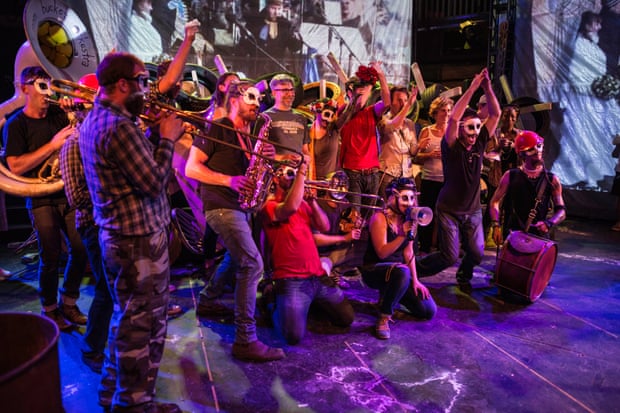
Some audience sit around a huge table, whilst others sit on the sides of the space and still others up in a balcony. Klezmer or folk music is playing as the audience enters; there is a convivial atmosphere as the show formally starts. This is a party, or a wedding, or some other huge gathering, until the three screens display news reports of riots and police enter. The tone abruptly shifts, and the world that has been established is dismantled. It’s a wonderful, unsettling surprise.

The space is consistently reformed and redrawn using movement, and the audience is physically moved in the wake of the protesters’ gains and losses. They are willing and unquestioning, the sheep of the title. Though the numbers here obviously pale to those at the actual protest, incorporating the audience in acts such a building barricades and lobbing bricks at police fosters unity from disparate dozens. There is a hint of the solidarity and aggression found in protests, and joy and celebration from the audience who are keen to play. Being served food is also an important enabler that solidifies the unity the show aims to create.

Counting Sheep is hugely effective in its emotional manipulation, and also it’s storytelling through music, movement and projections. Choosing sheep as a metaphor is a curious choice, though. The benign but rather dumb livestock aren’t known for thinking for themselves and are susceptible to herding – otherwise, they wander around unproductively, getting lost and eaten by predators. Whilst the performers are the herders here, they are also in sheep masks, unempowered. Who then are the herders? The government? Unseen forces of political and social unrest? Whatever it is, us human beings are hugely susceptible to it when motivated enough, even if the metaphor isn’t totally clear.

Though sung completely in Ukrainian, there is a clear storyline conveyed through projections and movement. There is little nuance in this piece, but it a playground for the sweeping emotions of popular theatre. It provides at least a hint of the experience that the Ukrainian protesters endured, and powerfully unites the audience through the humanity of collective experience for a common goal. An excellent piece of theatre.

Counting Sheep runs through 29th August.

The Play’s the Thing UK is committed to covering fringe and progressive theatre in London and beyond. It is run entirely voluntarily and needs regular support to ensure its survival. For more information and to help The Play’s the Thing UK provide coverage of the theatre that needs reviews the most, visit its patreon.

Two Man Show, Edinburgh Festival Fringe

https://files.list.co.uk/images/2016/08/19/rashdash-twomanshow-credit-the-other-richard-lst216304.jpg

RashDash are angry. Like, fucking furious level of angry. They’re fed up of patriarchal language and gender stereotypes that limit both men and women from expressing themselves honestly. So they made a show about it. Two Man Show has three women in it, music and dance, nudity and a lot of explosive energy. It’s part science lecture, part role play and part celebration of who we are without others’ judgment and categorisation based on gender expression. It’s a fantastic, “fuck yeah” explosion of pretty skirts, masculinity, tits, cockfighting and nonconformity. It’s also pretty bloody brilliant.

Out of an opening tirade on equality in the dawn of human history, Abbi Greenland and Helen Goalen take on the roles of two brothers, Dan and John. They don’t get on, arguing almost constantly about caring responsibilities for their terminally ill father. Their fighting builds in between movement and dance sequences of surprising intimacy and tenderness.

The culmination to Dan and John’s tension is a fantastic eruption of John’s frustrated masculinity feeling limited by “man things”. His words twists through Abbi’s, the man-woman who is happy in her own skin but doesn’t really suit any of that girly shit. Helen’s feminine contrast powerfully reinforces the importance of choice and freedom and that a woman doesn’t need to be butch to be a feminist and a man can express his feelings and do “feminine things” without his heterosexual maleness being threatened.

Greenland and Goalen’s performances are endowed with conviction and energy, and both are skilled physical performers who can convincingly play men, even with their breasts unveiled. They are accompanied by a musician, who backs them up with unfettered tunes of frustration and celebration.

This is a truly feminist show. Rather than blaming men, Two Man Show looks at the conventions of language that aids female suppression and acknowledges that men are not served by this system, either. Fabulously sequinned and ferociously opinionated, this is not one to miss.

Two Man Show runs through 27th August.

The Play’s the Thing UK is committed to covering fringe and progressive theatre in London and beyond. It is run entirely voluntarily and needs regular support to ensure its survival. For more information and to help The Play’s the Thing UK provide coverage of the theatre that needs reviews the most, visit its patreon.
Milk, Edinburgh Festival Fringe

https://i0.wp.com/7210-presscdn-0-59.pagely.netdna-cdn.com/wp-content/uploads/2016/08/milk.jpg

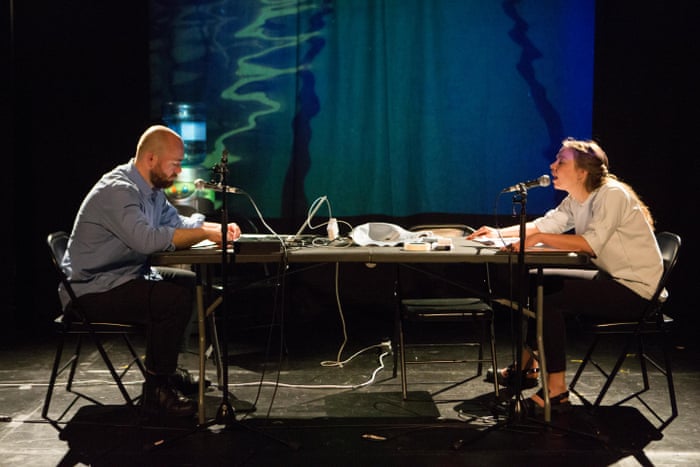
Everyone has a relationship with food. For some its straightforward, for others it’s complex. Food in terms of nourishment isn’t just that which we eat, either. Love, security, and all sorts of other things make us feel full. In Milk, three generations of couples in the same town negotiate what matters most to them and makes their lives feel complete. This is a slowly burning script that comes into its own towards the end when conflict becomes so high that the six characters lives cross outside of their partner’s. There is some good character detail, but writer Ross Dunsmore’s first play shows promise but needs further development.

Steph and Ash are fourteen. Ash is a fairly typical teen boy, but Steph, from a dysfunctional home, has a pathological need to be sexually desired. When Ash doesn’t satisfy, she finds a new, more dangerous target. Danny and Nicole are young marrieds expecting their first child. When the baby arrives, unforeseen complications and postpartum hormones challenge Nicole’s preconceptions about motherhood and open a divide between the couple. Cyril and May are in their 90s and homebound, too scared of the changing landscape of architecture and aggressive young people to go out. As they fantasise about past Sunday roasts, their hermetic existence takes its toll.

The storylines that Dunsmore unfolds are all believable though in their kinship to real life, they take most of the play to reach any level of compelling conflict. Cyril and May’s story has hardly any, rendering it the least interesting and most forced plotline. Whilst the other two are more dynamic, they are underserved in this intertwining format. The two younger couples could each easily have an entire play devoted to them; to force them all into one feels indecisive in the face of several ideas.

Fred Meller’s design is cold and utilitarian, though has some lovely surprises that are gradually unveiled. Director Orla O’Loughlin delineates the three couple’s worlds well and captures the easy rhythm of Dunsmore’s dialogue without adding any forced stylisation.

Without a doubt, Dunsmore’s couples all have compelling stories to tell (though all are heteronormative, white and skew towards female dependency on men), but the format he uses to tell them is not the most effective. Too much exposition interferes with the empathy for the characters and whilst the ending is a satisfying payoff, the build to it is too little and too late.

Milk runs through 28th August.

The Play’s the Thing UK is committed to covering fringe and progressive theatre in London and beyond. It is run entirely voluntarily and needs regular support to ensure its survival. For more information and to help The Play’s the Thing UK provide coverage of the theatre that needs reviews the most, visit its patreon.
Exactly Like You, Edinburgh Festival Fringe

https://i0.wp.com/www.underbellyedinburgh.co.uk/images/made/images/uploads/1000w-x-640h-px_750_500_60_c1.jpg

Things have never been easy for Abby. She doesn’t get on with her mum, she’s didn’t do well in school, she drifts from one shitty job to another without any purpose or goals. She misses her Nana, with whom she would spend long hours writing fantastical stories and listening to music. Nina Simone was their favourite. In Exactly Like You, Lotte Rice tells Abby’s story through a moving, passionate spoken word monologue on losing her way and finding it again.

Rice’s way with words makes Abby funny and relatable, the sort of woman you could sit down with over a pint or a cup of tea and natter about all and sundry going on in the world. She would always have a story or an anecdote to share that would make you laugh or think, or both. Her decision to make Abby a working class, down-at-heel character so expressive and articulate through spoken word is a fantastic choice rather than catering to the stereotype of working class young people as grunting cokeheads who only live for nights out on the piss. The piece is punctuated with soulful renditions of Nina Simone’s songs, effectively breaking up the dense text. Though Abby’s story isn’t remarkable in itself, the mode of telling it is hugely refreshing.

Designer Elouise Farley and lighting designer Zanna Woodgate work together to create a landscape of glowing bookcases, the sort that fit vinyl records. Though simple and subtle, they capture the inner warmth of Abby’s Nana who lived for music of all sorts. They are her memories of her time with Nana, always present and always driving her forward, and a lovely addition that makes the piece feel more polished than a bare stage.

When Abby hits rock bottom after yet another night out drowning her painful memories with too much whiskey, an unexpected helping hand appears. Fortunately, this is not some benevolent, condescending force sent to save her. Abby’s journey is one of reflective self-discovery told in an engaging, lively format with fantastic music to boot.

Exactly Like You runs through 28th August.

The Play’s the Thing UK is committed to covering fringe and progressive theatre in London and beyond. It is run entirely voluntarily and needs regular support to ensure its survival. For more information and to help The Play’s the Thing UK provide coverage of the theatre that needs reviews the most, visit its patreon.

In Fidelity, Edinburgh Festival Fringe

https://www.thestage.co.uk/wp-content/uploads/2016/08/In-Fidelity-Image-10-by-Rob-Drummond-at-Traverse-Photo-Credit-Sally-Jubb.jpg

Rob Drummond and his wife Lucy are celebrating their fifteenth anniversary. As a gift to her, he made a show where two single audience members have the opportunity to go on a first date there and then in the hope of finding the sort of love he has with Lucy. Though the bulk of the production centres around the selected couple on stage, there is plenty of audience interaction as we guide them down the path of getting to know each other. Part TED talk, part talk show, part slumber party, In Fidelity is as informative as it is heartwarming and fun.

Drummond’s extensive research on brain activity, hormones and psychology drives the framework around the first date and is consistently present throughout the show. The pop-science is easy to understand and his presentation style makes this content all the more engaging. After a series of questions he selects the two audience members who will have their first date, the focus becomes on facilitating the introduction of these two people. Each performance will undoubtedly be different and have varying degrees of successful matchmaking, but this makes it all the more exciting.

There’s a gleeful voyeurism that In Fidelity satisfies and even though Drummond gives the audience and the pair on their date quite a lot of freedom, he keeps a tight grip on discussion and interaction so it never feels that he will lose control of the show’s progression. This restriction ensures that everyone in the room feels safe, and its remarkable how quickly people feel comfortable answering very personal questions about their love life. Drummond’s onstage persona is warm and strong, a great balance that encourages the audience to open up. His incorporation of personal anecdotes, adventures in the research process and his own relationship’s journey also help.

The show ends happily the day I see it, with the couple clearly having some degree of chemistry between them. Even if that doesn’t happen, Drummond ends with some fantastic news of his own, leaving the audience with a warm, fuzzy feeling as they leave the theatre. This theatrical experiment is a wonderful exploration of form and its benevolence is a wonderful thing to be a part of.

In Fidelity ends 28th August.

The Play’s the Thing UK is committed to covering fringe and progressive theatre in London and beyond. It is run entirely voluntarily and needs regular support to ensure its survival. For more information and to help The Play’s the Thing UK provide coverage of the theatre that needs reviews the most, visit its patreon.

Bucket List, Edinburgh Festival Fringe

rsz_cpf9rwlwgaagznb

The North American Free Trade Agreement (NAFTA) between Canada, the US and Mexico came into effect on 1 January, 1994. I was eleven years old. The agreement ushered in a degree of national prosperity for all three countries, but Mexico’s low minimum wage, lax environmental regulations and corrupt officials made a perfect storm for sweatshop conditions in the US-owned factories (maquiladoras) taking advantage of the exchange rate and unemployment in Mexican border towns. The maquiladora owners favoured female workers for their diligence and precision and employed girls as young as fourteen, who were better suited for working 12-hour days in harsh environments than older women or clumsy men. These girls, only a few years older than me, were assembling electronics and convenience items out of toxic materials for 39 cents an hour.

I’m American. Though I hide it well with a deliberately constructed accent and uniquely British habits and mannerisms that I’ve developed in the nearly twelve years that I’ve lived here, I still have the passport, the cultural history and the guilt to prove it. Normally that guilt is shaped like guns, healthcare or Trump, but it occasionally takes on other forms. This time it’s privilege. That privilege/guilt pours down my cheeks in hot, angry tears during Theatre Ad Infinitum’s Bucket List. The story of the women and girls’ lives dictated by the maquiladoras, some as young as me, is a horrifying contrast to the suburban middle-class upbringing I had, kept busy with school and music lessons and theatre rehearsals and ambitions. I may have had something that these girls made, some frivolous object bought without thinking in order to make my life easier or better, and I was totally oblivious to their hardship. I did not have to worry about my mother being killed for protesting the maquiladoras’ pollution, or about my auntie being raped by her manager, or getting cancer from the chemicals I encountered on a daily basis.

But for the women and girls in Bucket List, that is their life. The all-female, international cast, directed by Nir Paldi, devised a magical realism story of these desperate factory towns based on an idea from Mexican company member Vicky Araico Casas. Incorporating George Mann’s distinctive choreography and live music, Bucket List tells the story of Milagros (played by Casas), a girl growing up in one of these towns dominated by maquiladoras. Her generation’s experiences and those of her mother’s interweave, creating a landscape of labour, political protests, coming of age and revenge. It is a dense story covering a decade of these women’s lives, but Paldi’s script is easy to follow. Magical realism creeps in stealthily, and only at the end of the performance do certain events seem untenable and raise the question of whether or not they actually happened. Regardless of this fuzzy line between reality and fantasy, Bucket List is an anthem of strength that roars with political agenda and gives voice to the disregarded victims of developed nations.

Initially more of a montage of life experiences, Milagros’ story slowly begins to emerge. This could shift slightly earlier in the piece, but the exposition at the beginning gives wider context and does not feel extraneous. Paldi maintains a careful balance of these women’s lives and a wider, North American political picture that slightly tips in favour of the women, but there is enough of the outside world’s oppression and token assistance to inspire the characters’ rage and passion. Milagros’ tragic end adds fuel to the production’s fury against exploitation that comes out as a roar rather than a whimper.

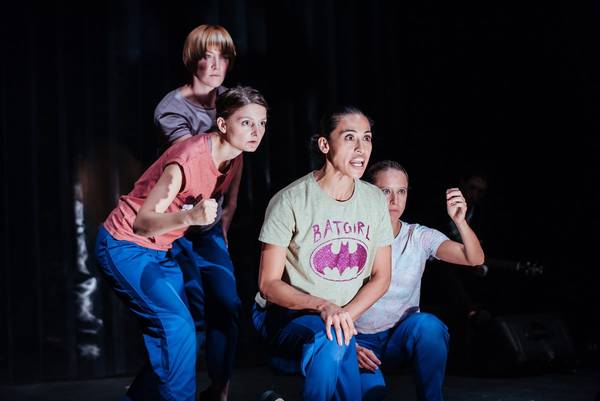
There is hardly any set and technology on display, a dramatic change from their last adult show, Light. Instead, costume plays a bright but subtle role in the story – the five women playing the girls and their family wear coloured t-shirts with cartoon characters often idealised by young girls. Disney princesses, Batgirl and Alice in Wonderland offer them an American-created fantasy that they can strive for but will most certainly never achieve.

Juxtaposed against these pastel tops are quite vicious games demonising the powerful politicians and corporations that shape their lives. They also mock their working conditions, daily violence at the hands of men and threats to their lives. Milagros’ mother (Deborah Pugh) is a vocal political protester, demonstrating a ferocity also contrasting her character’s clothing. The excellent live score by Amy Nostbakken is more of a direct expression of the fighting spirit and sadness within these women.

Though a text-driven piece, Mann uses a series of motifs that soon become recognisable, indicating specific actions and locations. They enhance the understanding and often act as a substitute for words. Though used regularly, Mann’s choreography is one of the company’s trademarks and is unfortunately underused, especially considering the lack of set.

Even though NAFTA is over twenty years old, the maquiladoras are still there, employing women for long hours, polluting local rivers and creating environments ripe for exploitation. Paldi’s script aggressively demands awareness which may be unpalatable to some, but should be required viewing for every American blissfully unaware of their brothers and sisters across the border that are so often looked down upon with racist disgust. Bucket List is truly vital theatre in our age of disposable, thoughtless consumerism.

Bucket List runs through 29th August.

The Play’s the Thing UK is committed to covering fringe and progressive theatre in London and beyond. It is run entirely voluntarily and needs regular support to ensure its survival. For more information and to help The Play’s the Thing UK provide coverage of the theatre that needs reviews the most, visit its patreon.