Schism, Finborough Theatre

https://i0.wp.com/www.finboroughtheatre.co.uk/assets/images/press-images/schism/pre/Schism-3.jpg

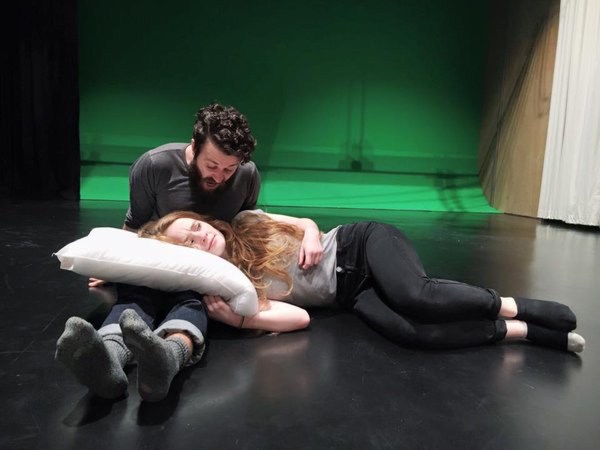
Chicago, 1998. Harrison and Katherine are both struggling. Harrison’s wife recently left him and he gave up a challenging career choice for a safer one as a Math teacher. Fourteen-year-old Katherine’s school cannot see past her cerebral palsy, so she’s not allowed to take “normal” classes. Schism begins when both characters reach breaking point: Harrison is mid-suicide attempt when Katherine breaks into his home to appeal for his help to move into his Math class. This initial meeting spawns a twenty-year long relationship between the two, but not a healthy one. Harrison constantly tries to manipulate and control Katherine, who fights for her independence with progressively underhanded methods. Athena Stevens’ script choppily covers the huge time period in sections, addressing several important issues: autonomy within relationships, abuse, life/work balance, failure and aspiration. A play featuring disability that pushes other topics to the forefront, Schism needs more fleshing out but its messages are loud and clear.

Twenty years is a lot of material to fit into a play and at just over an hour, a lot of the plot is left out. There are about four years between each scene, nicely signposted by a current affairs talk radio show, but pivotal transitions are missing. How does their romantic relationship eventually come about? What are the immediate consequences of his awful behaviour? How does her career develop? How did he manage to keep his job after Katherine, in her final year of high school, hang out at his home regularly? These are unanswered, but easily could be by the addition of more scenes. This wouldn’t effect the episodic nature of the script, but would make the story more satisfying. Despite the clunky narrative arc, Stevens’ dialogue still manages to crackle and easily creates tension. There are some great one-liners that spark belly laughs, and moments that are equally horrifying. As set pieces, the scenes are excellent pieces of writing.

Stevens also plays Katherine and displays a clear sense of ownership over the role. Whether or not there are elements of Katherine in her own life, Stevens performance is emotionally genuine and wholly committed. Tim Beckmann gives a nuanced Harrison who transitions from teacher to lover easily, and maintains an undercurrent of desperation. Alex Marker’s domestic design with the ever-present huge, architectural drawings peeking through the windows is a good reflection of the passion that drives both characters, and director Alex Sims displays a good instinct for portraying the journey of a relationship.

Disability issues are ever present and dictate many of Katherine’s choices, but Schism isn’t about her overcoming adversity. It’s part of who she is, but she has other, more pressing problems – university admissions, bidding for work, whether or not to start a family, and civilian objection to her building projects. Harrison does as well, but they are more psychological and harder to resolve. His inability to cope with Katherine’s success in the field where he failed, his inability to have children with his ex-wife and his inability to let Katherine be an independent woman slowly devour him. It’s compelling to witness. In fact, Schism makes more of a statement about feminism within heterosexual relationships than it does about disability awareness, which is hugely refreshing and shows great progress in theatre equality – Katherine’s disability is a part of her, but only a small one compared to her aspirations.

Schism is a provocative relationship drama that certainly resonates despite the holes in the story. This dysfunctional couple can be both delightful and painful to watch, much like anyone in a modern relationship dealing with the other’s baggage. With some further development, Stevens’ play could pack an even heavier punch.

Schism ran through 14 May.

The Play’s the Thing UK is committed to covering fringe and progressive theatre in London and beyond. It is run entirely voluntarily and needs regular support to ensure its survival. For more information and to help The Play’s the Thing UK provide coverage of the theatre that needs reviews the most, visit its patreon.
Nude, Hope Theatre

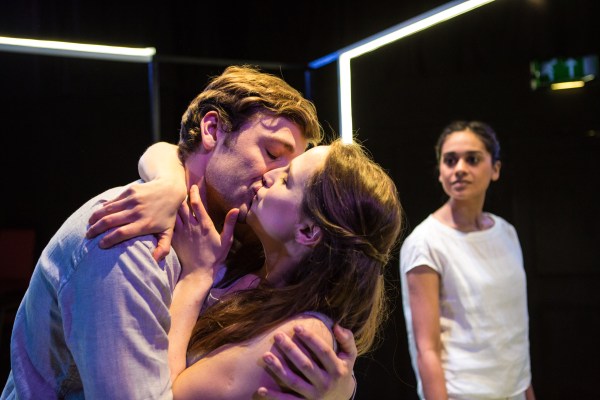
Nude- a play by Paul Hewitt - ©HelenMurray-156

A young couple meet, the relationship blooms, then goes through a rough patch and eventually ends when they are much older. Was it meant to be? Are the events in our lives accidental or controlled by outside forces? Within a standard love story, Nude boldly states that fate has the final word over life, death and love. Playwright Paul Hewitt relies on poetry and narration to tell this tiny, intimate tragedy that feels sadly familiar, like flicking through a dusty photo album of mostly forgotten family members whose memories thrive through stories. Poignant and competently executed, with gaps in the narrative that raise plenty of questions, Hewitt’s script skilfully uses language to depict this couple’s journey and the heavy hand that the personified Fate employs to convince us that we have free will.

Hewitt doesn’t rely on metaphors or overly flowery vocabulary in his rhyming poetry. His language is simple, almost pedestrian, but prettily structured and flows easily from the actors’ mouths. There are a lot of words though, and it’s delivered so quickly that there isn’t much time for in-depth processing. The narrative is a bit chunky with large sections missing and the length of time passing is consequently unclear. His characters are lovely and easy to relate to, though the heteronormative, white, middle class casting of the nameless everyman and woman, that are the focal point of this story, uncomfortably captures the lack of diversity theatre still struggles with. This is countered by a diverse production team and Fate, but romantic leads still lack diversity all to often.

Michelle Fahrenheim and Edward Nash are the charismatic couple controlled by Roshni Rathore as Fate. The three have a relaxed, watchable confidence and natural chemistry, though Fate clearly has the upper hand at all times, even when watching from the peripheral shadows. It creates a great dynamic that’s reminiscent of Prospero or a serious Puck.

Minglu Wang’s minimalist cube that contains the couple in the middle of the space is used well by director Ian Nicholson. Nicholson also incorporates some symbolic black thread, creating a sinister web that further traps the Woman and Man inside their box. This device could have been used more heavily to create a stronger sculptural effect, but was still a nice touch. Creating a space in the round emphasises the idea that the couple are constantly watched and controlled by outside forces – a canny choice.

Though Hewitt’s intention is to focus on a wider philosophical idea, his couple’s story steals the spotlight. Their timeless romance is achingly tragic and well executed textually and through Nicholson’s staging. Nude manages to move the heart even with its small faults, and taps into timeless truths about love, fear and loss.

The Play’s the Thing UK is committed to covering fringe and progressive theatre in London and beyond. It is run entirely voluntarily and needs regular support to ensure its survival. For more information and to help The Play’s the Thing UK provide coverage of the theatre that needs reviews the most, visit its patreon.
 

Russian Dolls, King’s Head Theatre

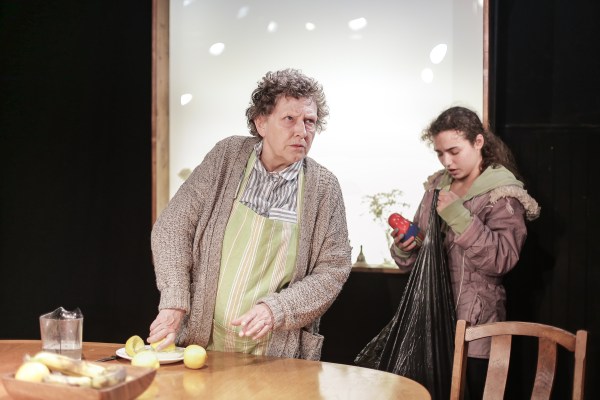
Russian Dolls at King's Head Theatre, Stephanie Fayerman and Mollie Lambert_1 © Andreas Grieger

Camelia’s just got out of young offenders’ but her mum never turned up to collect her, so she’s back to looking after herself. Hilda is a blind elderly woman fending of her goddaughter’s attempts to move her to Basingstoke. When Camelia robs Hilda after tricking into believing she’s covering for her carer, the two end up influencing each other much more than ever expected. Kate Lock’s Russian Dolls tells the fraught story of an unlikely dependency that is doomed to end badly for both women. Lock’s characters are fantastic, and their scenes together are tense and charged with moments of genuine tenderness. In between the scenes are narrative monologues that, whilst providing necessary information, are awkwardly addressed to the ether and disrupt the story’s momentum.

Stephanie Fayerman as Hilda and Mollie Lambert as Camelia are a volatile pair. The energy between them is either stormy or potentially so; the tension makes them wonderfully watchable. Their few scenes of relaxed openness towards the other are fleeting, but hugely rewarding and loaded with tough love. Both performances are excellent, and the dependency on the other is great to watch.

There is no sentimentality towards young people, the care system or aging in Lock’s script. The lack of happy ending is a touch disappointing, but it’s accurate. The stories of young people from broken homes actually managing to turn their lives around are rare considering the 69,540 young people in care as of March last year. Every now and again an “inspiring” case hits the news, but for the majority of these children, their lives are part of an endless cycle of poverty, abuse, drugs and jail time. Well done to Lock for not going the easy route with her narrative.

Structurally, the script is quite simple and there are large, frustrating chronological jumps that skips huge sections of both characters’ emotional journeys. This could easily be a full length, two-act play and would work very well as such. Provided the current ending is kept, a 2 hour or so build up would make it all the more devastating.

Russian Dolls, winner of the Adrian Pagan Award and shortlisted for the Bruntwood Prize, is a bolshy play full of life in all of its glorious imperfections. It’s an honest look at the care system and its flaws, but the actors’ characterization and electric relationship is the highlight of this new play.

Russian Dolls runs through 23 April.

The Play’s the Thing UK is committed to covering fringe and progressive theatre in London and beyond. It is run entirely voluntarily and needs regular support to ensure its survival. For more information and to help The Play’s the Thing UK provide coverage of the theatre that needs reviews the most, visit its patreon.
To Kill a Machine, King’s Head Theatre

To Kill a Machine: Scriptography Productions

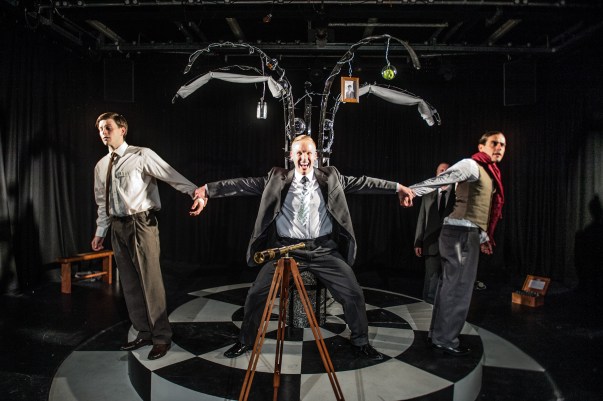
How well can you condense Alan Turing’s life and work into one hour? Considering his technologically groundbreaking career, WWII code breaking and conviction for crimes of gross indecency, that’s a lot of source material for precious little time. Catrin Fflur Huws chooses to focus on the man behind the achievements at various pivotal points in his life for To Kill a Machine. From boarding school days to chemical castration shortly before his death, Huws shows the relationships rather than the events that shaped his life. Scenes of naturalism are interspersed with a surreal, presentational game show indicating the factors outside of Turing’s control that dictate his unfortunate fate at the hands of discrimination. Though stylistically dynamic, they are less compelling than the latter. Together, they make a good whole but with so much missing from Turing’s life, the highlights contained in To Kill a Machine shortchange the story of such an important man.

In the centre of a round platform, a wiry, mechanical tree by designer Cordielia Ashwell sprouts important mementos from Turing’s life: a photograph of Christopher, his first love at school, pages of indecipherable code, and the apple that he may or may not have used to kill himself. Its trunk is also a convenient place to store props and costume, but the visual aspect is the most dominant, and strikingly so. The symbol of life manifested in an everlasting, sculptural form against the items that were his downfall is powerful image.

The tree also dictates circular movements from the cast of four, most prominent in the game show scenes and Turing’s sex with his younger lover, Arnold Murray, who eventually betrays him – the moments where his life spirals irrevocably out of control. Alan’s eventual tethering to the tree via medical equipment during his “treatment” is a horrible,  effective reminder of history’s handing of people discovered to be gay and sapping their life force with discriminatory legislation.

Gwydion Rhys as Alan Turing is the anchor in the cast, with a nuanced and sensitive performance that leaves Benedict Cumberbatch’s generic interpretation in the dust. He is complimented well by intimate scenes with François Pandolfo as his school friend Christopher, and older brother John giving him advice in the run up the trial. This latter scene is by far the best in the play.

Though the script is good, it’s short length is unsatisfying and otherwise dwarfed by the performances and design. The structure works as does the lens with which it views Turing’s life, but surely there is more than an hour’s worth of material on the man behind the life-changing mathematician and inventor.

To Kill A Machine runs through 23 April.

The Play’s the Thing UK is committed to covering fringe and progressive theatre in London and beyond. It is run entirely voluntarily and needs regular support to ensure its survival. For more information and to help The Play’s the Thing UK provide coverage of the theatre that needs reviews the most, visit its patreon.

A Nation’s Theatre: Wail and The Beanfield, Battersea Arts Centre

For two months, theatre makers from across the country are coming to London to celebrate the state of British theatre. One of the A Nation’s Theatre venues is Battersea Arts Centre, currently hosting the double bill of Little Bulb’s Wail and Breach Theatre’s The Beanfield. Wail is an exuberant cabaret about whales and human expression; The Beanfield uses multimedia to examine the impact of police violence on peaceful people and the need to fit in. Though different from each other in content and tone, both Little Bulb and Breach play with performance conventions to create innovative new structures that are at the forefront of theatre performance.

WAIL_Little Bulb Theatre

There’s a lot of science in Wail, and a lot of musical instruments. Actor-musicians Clare Beresford and Dominic Conway, performing as themselves, also have boundless enthusiasm and impressive music repertoires. With material ranging from folk to metal, they share their enthusiasm for whales through songs alternating with monologues of scientific facts. Their charisma and cheer keeps these sections engaging, particularly with the addition of audience interaction. Though the overall energy is light and positive, Beresford’s melancholy for never actually seeing a whale in the flesh provides a bit of contrast to the Male Whale Choir, a hilarious whole-audience exploration of whale songs that males use when on the pull in the coastal waters of Madagascar.

There isn’t as much material on the promised exploration of why humans wail, but a song about why they sing songs is a tender, poignant homage to feeling fragile. This fun, frivolous show is light on the gravitas that a bit more time on this topic could bring, but Wail is still a wonderful, joyful piece as is. The symphonic final number is a fantastic climax wrapping up an excellent contribution to A Nation’s Theatre.

The Beanfield_014_please credit Richard Davenport

The Beanfield by Warwick University’s Breach Theatre wowed audiences at Edinburgh last summer, and understandably so. Drawing on the historic clash between new age travelers heading to Stonehenge and police fresh from the miners’ strikes, they add the framing device of a uni reenactment group researching the event in order to recreate it, and a counter narrative of a group of students going to Solstice. It’s a sophisticated script with plenty of absurdity to lighten the bleak depiction of police violence against unarmed civilians, but still serves as a potent reminder that this happens today in the UK and abroad. Part documentary, interview footage with witnesses on both sides is broadcast liberally; even though the inclusion of police is sympathetic, The Beanfield firmly supports the travelers. Rightly so – pregnant women and children were among the 600 or so attacked with truncheons and projectiles by 1000-odd police.

There is no explicit link between the Beanfield story and that of the contemporary, skeptical students at Solstice, but the inclusion of the latter provides some necessary humour. It’s not a needed subplot though, and detracts from the power behind the political statement of the Beanfield standoff. The script is a great collage of experiences past and present, the sweet naivety of students juxtaposing the atrocities that happened at thirty years previously. The Beanfield, a bit less polished than Wail, is still an excellent piece of theatre with some important thoughts on police brutality.

With multimedia at its forefront, The Beanfield captures the rapid-fire sensory bombardment of present day youth and the desire to instigate change as well as fit in with our peers. Wail, mostly analogue and much less angry, implies the importance of conservation and sympathy for all creatures, human and not. Both shows excellently address concerns of people in this country and experiment with performance, fitting contributions to A Nation’s Theatre.

Wail runs until 23 April, The Beanfield until 21 April then touring.

The Play’s the Thing UK is committed to covering fringe and progressive theatre in London and beyond. It is run entirely voluntarily and needs regular support to ensure its survival. For more information and to help The Play’s the Thing UK provide coverage of the theatre that needs reviews the most, visit its patreon.
The Broke ‘N’ Beat Collective, Battersea Arts Centre

https://i0.wp.com/www.20storieshigh.org.uk/wp-content/uploads/2016/02/Jack-and-Lateefah-1280x853.jpg

Kids have it tough, especially if they’re poor. Decreasing social mobility, higher costs of education and living, and decreasing welfare are trapping our future generations in inescapable cycles of poverty. They are just as aspirational as young people from more privileged backgrounds and aware of the opportunities they don’t have. They are angry, frustrated and lack the opportunity to constructively express their feelings that often go completely disregarded by more comfortable members of society.

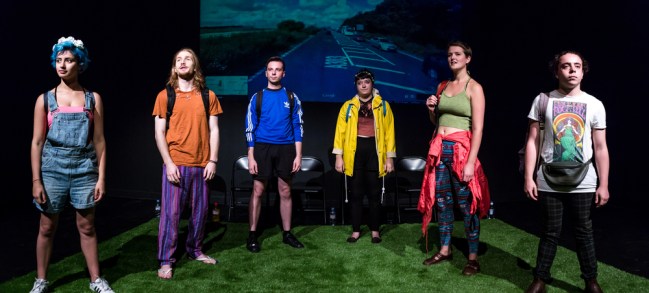
Theatre-Rites and 20 Stories High, seeing validity in their voices, worked with numerous young people in this demographic to devise a gig-theatre show that shares experiences of being a poor teenager in Britain today. The Broke ‘N’ Beat Collective is an empowering, important work that uses fantastic puppetry, mask and music to create a gloriously messy collage of young people’s concerns and issues. Structurally mirroring the rough and ready, fractured existence of urban youth culture, it rebels against theatrical and cultural preconceptions without apology for its flaws.

Elisha Howe’s (aka Elektric) soaring rhymes and Jack Hobbs (aka Hobbit) beatboxing energise the audience and establish a defiant, proud tone that carries through the show. They are not backing down, nor are B-boy Ryan Harson (aka LoGisTics) and puppeteer Mohsen Nouri. They literally zoom in on the tiny model tower blocks and street scenes of urban Britain, replicated in cardboard wonderfully extracted from the plain back wall, creating a landscape of alternating songs with monologues. These set pieces and puppets pass on the otherwise unknown life stories of young people they’ve met.

Omar is an insecure, confrontational grey hoodie that takes the whole show to find his voice. Jack’s a wannabe gangsta who knocks up Latifa (both with cartoonish, cardboard heads) and ditches her and the resulting child that reflects on how that’s shaped his life goals. Joanne is the Papergirl who cuts herself because her mum’s boyfriend abused her. There’s also the incredible Speaker Boy, a rotund, playful chap with a boombox for a head. Each puppet is as unique as the young person behind it, and just as inspiring. (Seriously, go look at the puppets’ photos in the gallery part way down the page; they are some of the most emotionally endowed bits of paper and foam I’ve ever encountered. All of these characters unashamedly demand attention with precise, evocative storytelling and a joyfully visualised presence. These stories are broadcast along side an ever-changing soundtrack with interjections of dance, banter and spoken word, simultaneously creating an atmosphere of celebration and seriousness. Though fun, it never loses the sense of the weight behind the work.

Despite the boldness in the work and the importance of its messages, there are some sloppy transitions that cause the piece to lose momentum. Elektric unnecessarily introduces each number by name, and there are some in-jokes between the performers that, whilst sweet, don’t carry energy with their small scale. This gives the whole piece a choppiness that makes it feel unfinished.

All four performers’ exemplary skillsets and vibrance are fantastic vehicles for the young people of this country seeking escape from the poverty that is so limiting to their ambition. Each moment connects to the next through a theme rather than a storyline, but the effect mirrors modern society: a bit messy, emotional and ambitious for a better life. The fun doesn’t override or trivialize the seriousness, and neither is it too weighty. The unpolished feel is very much ingrained in the gig-theatre style, and though it would be great to learn more about the characters presented, The Broke ‘N’ Beat Collective truly holds a mirror up to nature.

The Broke ‘N’ Beat Collective runs through 2 April.

The Play’s the Thing UK is committed to covering fringe and progressive theatre in London and beyond. It is run entirely voluntarily and needs regular support to ensure its survival. For more information and to help The Play’s the Thing UK provide coverage of the theatre that needs reviews the most, visit its patreon.

Leaper: A Fish Tale, Greenwich Theatre

unspecified

Our oceans are dying. Just yesterday, the news reported that 95% of the Great Barrier Reef has been bleached due to temperature rises. There are huge swathes of sea with high concentrations of microplastics that leach toxins into the water and the food chain. We are overfishing our oceans, causing a myriad of problems to human and sea life.

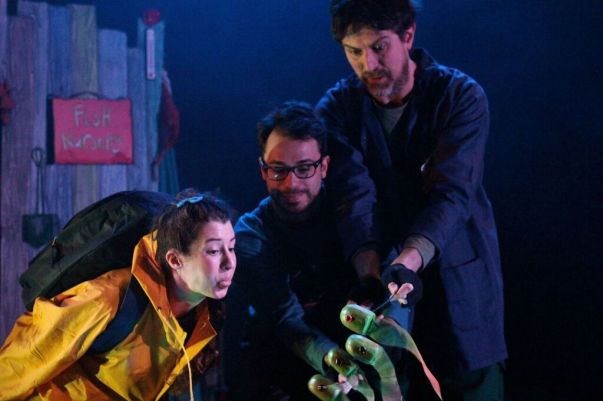
Tucked In is trying to change that through Leaper: A Fish Tale, an adventure story for families about a young girl’s discoveries in the world’s waterways. The unnamed daughter isn’t particularly interested in her dad’s fish farm and wreaks more havoc than anything else. But after falling into the stream in pursuit of a dropped crisp packet, she makes friends with Leaper the salmon on her journey from stream, to river, to ocean and back again. Good puppetry and movement keep younger ones engaged in this surprisingly complex story, though at times it feels a bit too convoluted and the lack of dialogue is unnaturally forced.

With an impressive array of animal puppets by Claire Harvey and Annie Brooks’ transformative set, there’s plenty to look at in the show’s recycled aesthetic. The larger puppets have an excellent range of movements, particularly the duck, seal and big fish. The rubbish monster is the most wonderfully inventive surprise, and the large jellyfish are poetry in motion. The smaller puppets are understandably simpler, but less dynamic with fewer moving parts. The baby fish, though sweet in the way the human characters treat them, are harder to see and not particularly interesting in and of themselves. The design really comes into its own in the middle of the ocean, with atmospheric lighting and sound to match.

Though the show wants to address both overfishing and ocean pollution, the littering is the primary focus. It makes sense as children may struggle with the concept of overfishing, but the plot points on the topic are consequently less engaging. There aren’t many of them though, and the focus is almost solely on the girl’s (Lizzie Franks) journey.

The performances by Franks, Philip Bosworth and Robert Welling are engaging and precise, though the reason for minimising speech is unclear. There are plenty of vocal effects, but character communication and actor impulses feel unnaturally limited. It doesn’t interfere with the story and the children in the audience aren’t bothered, but it doesn’t contribute to the production style.

Leaper: A Fish Tale is visually compelling with some great puppetry and an engaging story for children and adults alike. The performances are good and the story has all the necessary components of a satisfying adventure tale with a clear moral. Though there are some small issues, they don’t interfere with the overall enjoyment of the piece, and this show could play a powerful role in raising engaged, environmentally conscious young people.

Leaper: A Fish Tale is touring schools and theatres in April.

The Play’s the Thing UK is committed to covering fringe and progressive theatre in London and beyond. It is run entirely voluntarily and needs regular support to ensure its survival. For more information and to help The Play’s the Thing UK provide coverage of the theatre that needs reviews the most, visit its patreon.
The Rules of Inflation, Theatre N16

I hate balloons. Well, not balloons themselves, but the noise they make when they burst. After more than three years as a children’s entertainer that does balloon modelling, you’d think I’d be used to them, but no – if anything, it’s worse. When I walked into Theatre N16 to discover a floor covered with balloons and four actors gleefully throwing themselves around the space, I nearly left. I’m glad I didn’t though, despite numerous explosions. Rules of Inflation, a new performance art piece by Balloons Theatre, confronts socio-political issues by setting them at a children’s birthday party, complete with a deranged entertainer who demands his audience of four child characters participate in increasingly disturbing activities. Though my immediate violent revulsion towards the balloons and the job I know all too well intensified as time went on, the messages contained therein are cleverly presented. Even though they are not particularly unique to the stage, the kids’ party framework draws attention to how disturbing these global problems are.

From the start, it is clear this is not a normal children’s party. The creepy music, dark lighting and clown in a ripped, dirty costume (a disturbing Joshua Webb) create a distinctly foreboding, horror film-esque atmosphere, along with all those balloons that could burst at any moment. It’s not a unique landscape but it’s highly unsettling, and relentlessly so. As innocent childhood games become not so innocent, it’s a reminder of how seriously little ones take their play. Getting “out” actually makes them feel like they died, or that they’re gagged and bound. It also calls to mind child’s play in war torn countries, where games in a dangerous environment can result in injury, trauma or death, and the way the world’s politicians play at war without experiencing any direct consequences.

Four actors play four children with varying levels of maturity, who are prone to varying levels of exploitation. Clown targets serious and mature Blue (Nastazja Somers), and finally abandons her in a harrowing, violent end. It’s horrific to witness. Yellow (Bryony Cole) and Green (Emily Sitch) are too similar of characters, and Pink (Bj McNeill) also aligns with them. Whilst this could create an effective gang against Blue, who has a wonderfully defiant presence, this opportunity is missed and she is neither particularly isolated or supported by the kids as Clown abuses her. Instead, their youthfulness draws them to the clown, who eventually proclaims a party  winner even from their indistinctness. The piece is also a bit too long considering the straightforward format, but more abstract moments help add variation and a break from the relentless violence, abuse and manipulation. The actors’ vocal and physical energy was quite adult at times and would be more potent if the actors consistently kept to obvious depictions of children.

Rules of Inflation may not evoke such a visceral reaction in most people, but it’s aggressive displays of sexual abuse and objectification are still incredibly powerful. The piece needs a few tweaks to enhance its potency and theatricality, but not many. The balloons and kids’ party context can play on a fear of clowns as well, but this live art performance is a potent examination of power and child abuse in its own right.

The Rules of Inflation runs until 24th March.

The Play’s the Thing UK is committed to covering fringe and progressive theatre in London and beyond. It is run entirely voluntarily and needs regular support to ensure its survival. For more information and to help The Play’s the Thing UK provide coverage of the theatre that needs reviews the most, visit its patreon.

How To Survive a Swarm of Bees, Bread & Roses Theatre

The heaps of white pillows that cover most of the stage make How To Survive a Swarm of Bees look like a slumber party or a kids’ fort, something with a lot of fun and giggles. But Anna Crace’s short play is far from the happy cuddliness implied by the set. With a Scandi aesthetic in both design and dialogue, this austere piece of new writing gives little away except for the looming apocalypse Of a massive storm and a swarm of bees that threatens the existence of two young couples barricaded into their homes. The minimalist text bears more than a passing resemblance to Beckett, but it’s so sparse that there isn’t much depth or substance despite the interesting premise.

The unnamed hetero couples in their early 20s live separately, but their lives and conflicts parallel each other in the moment. Rather than the somewhat disappointing story, the most interesting feature is the intertwining scenes where the characters occasionally swap partners (not that way, pervert) without acknowledging the change. The device is gently disorientating, aiding the distance from reality that creates a state of reflection in the audience. These four are Every Men in the face of a crisis, with fear, anxiety and need that manifest in four different ways. We can relate to them all, but know they are not of our world.

The lack of action and a threadbare story is frustrating, through. The only thing the four do is talk around the problem and argue, and shift pillows around in their confinement. What exactly is going on in the world? Disappearing news broadcasters and friends choosing to live underground are never fully explained. Why is the world reacting so strongly to a storm? Why are these couples fighting about staying in their homes with the buzzing growing ever louder? They allude to consequences of nature creeping into the house and “the nets” failing, but what are these consequences? It’s never revealed, but easily could be by lengthening this script by another twenty minutes or so.

There is some distinction between the different characters, but other than Laurie Ogden’s agoraphobic young woman, the rest are very similar. Should we stay or go? How long can we realistically eat the soup we’ve stockpiled? How will our relationship hold up with our choice? What do we do if one stays and the other leaves? These questions are debated, but never really answered. The end of the play is abrupt and feels like an interval; some audience hang around for a while and then, confused, head into the night.

The four performances are fine, but tend towards minimalist reflection as well. Though inherently theatrical in structure, elements of this script would be great for telly. The intimacy works well in small fringe theatres, but would most likely come across as flat anywhere larger.

Anna Crace is certainly onto some interesting ideas and design concepts in How To Survive a Swarm of Bees, but the need further development and clearer means of communication.

How To Survive a Swarm of Bees runs until 20th March.

The Play’s the Thing UK is committed to covering fringe and progressive theatre in London and beyond. It is run entirely voluntarily and needs regular support to ensure its survival. For more information and to help The Play’s the Thing UK provide coverage of the theatre that needs reviews the most, visit its patreon.

Wonderations, The Canvas Cafe

https://pbs.twimg.com/media/CcvF_vOWEAA7JKp.jpg

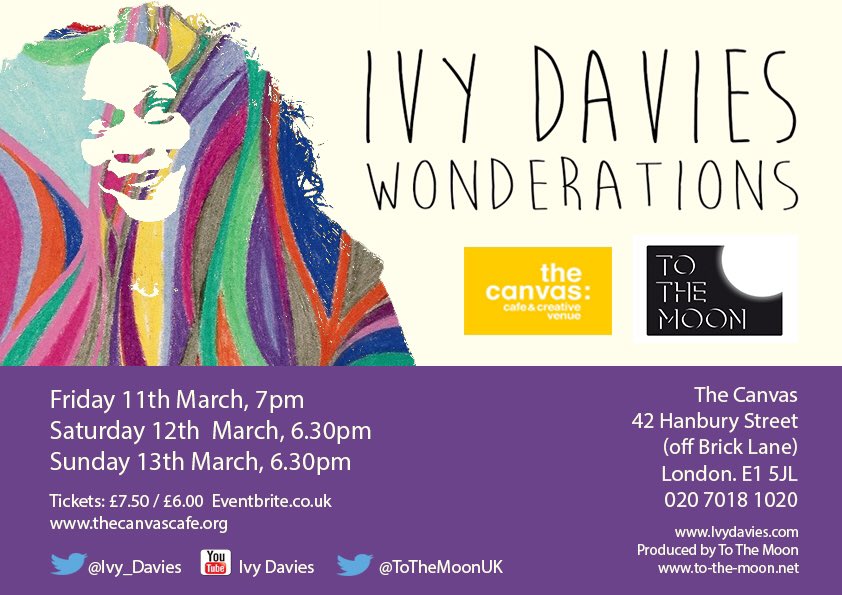
Sunday evening was a night of new discoveries. The Canvas Café, just off Brick Lane, serves homemade cakes and prosecco by the glass. It also has walls you can write on and a cosy downstairs performance space. In that space was Ivy Davies and her show Wonderations, a gentle, joyful blend of spoken word, songs from her EP and questioning whether or not Mickey Mouse is actually God. Though lacking in narrative, Davies’ performance shares issues that are particularly personal: aging and her search for identity and faith. With a touch of live art about it, Wonderations is a lovely celebration of self-acceptance akin to reading Davies’ journal.

This isn’t a visual show, but a totally aural one. It could easily be listened to through headphones or with eyes closed, though her soothing melodies and rhythms could lull you to sleep – it’s that relaxing. There are some powerful sentiments in her lyrics and poetry that deserve full attention, however. As Davies struggles to find her pre-marriage and babies self in theatrical songs and rhymes, one can’t help but to relate to her frustration with finding her true identity buried under all the nonsense life throws at us. We all find ourselves wasting hours on social media focused on constructing an image, or immersing ourselves in work and forgetting to just be present in the world for lengthy periods, but Davies exhorts us to let all of it go. She’s like a life coach, but a gentle one who uses cuddles rather than shouting.

This cabaret-esque structure feels conversational, but is precisely and satisfyingly scripted. There’s no plot to speak of, but with Davies wearing the form like her own skin, it works. Her spoken word isn’t the pounding, angry sort I’m accustomed to; it’s full of flowers, sunshine, rain and claiming her own ground. Davies has an immovable strength and presence, but one that overflows with positivity. Less connected from her celebratory songs and spoken word is what feels like an internal monologue where in looking for faith, she wonders if God is actually Mickey Mouse. He’s been seen around the world at the same time, and has plenty of purchasing power. It’s a wonderfully funny, and pointed, argument, though less clear on it’s place in the show’s structure.

Ivy Davies’ Wonderations is a hard show to pin down, but it doesn’t apologise for that. I’m pretty certain that she’s confident enough to not care what anyone thinks of her work, but the themes it contains are universally human presented in an easily digestible format. An excellent event for a quiet Sunday evening, particularly with a slice of cake and a glass of prosecco.

The Play’s the Thing UK is committed to covering fringe and progressive theatre in London and beyond. It is run entirely voluntarily and needs regular support to ensure its survival. For more information and to help The Play’s the Thing UK provide coverage of the theatre that needs reviews the most, visit its patreon.