Spillikin, Pleasance Theatre

http://www.huntspost.co.uk/polopoly_fs/1.4892837.1487231182!/image/image.jpg_gen/derivatives/landscape_630/image.jpg

by guest critic Alistair Wilkinson

You could easily classify this production as “the one with the robot” but there is more to Spillikin, currently on tour throughout the UK. Despite the high level of artificial intelligence on show, this is a human story depicting the world of a woman going through Alzheimer’s, the struggles she faces and how we as a society care for those who need support. Plays on these themes need to be put on more frequently, however Spillikin could tell this story better.

Continue reading

Celebration, Florida, The Albany

https://i0.wp.com/exeuntmagazine.com/wp-content/uploads/Greg-Wohead-The-Ted-Bundy-Project-c-Alex-Brenner-600x399.jpeg

by guest critic Tom Brocklehurst

Shows incorporating technology have become more and more common recently. This experimental show, Celebration, Florida, features two unrehearsed performers wearing headphones. Greg Wohead, the creator of the show gives them instructions, dictates to them what to say and where to stand, and what accent to speak in. Most of the time they are speaking as him – they have to imitate his American accent (badly) and ask us to picture them as him, standing in his hotel room in his pants, thinking up ideas for this show.

Continue reading

Thought to Flesh, VAULT Festival

https://i0.wp.com/mms.businesswire.com/media/20140820005682/en/428472/5/Granite_Employees_Participating_in_the_Ice_Bucket_Challenge.jpg

The ice bucket challenge did a lot to raise awareness of Motor Neurone Disease. But how many people who froze their tits off because their mates dared them to actually learnt anything about the condition? Probably not many, so other means of educating about the condition are needed. Supported by the Wellcome Trust, Thought to Flesh creators Nathalie Czarnecki and Gareth Mitchell worked with doctors and researchers to develop a work that shares the human side of MND in an episodic montage following a young woman’s life with MND.

Continue reading

Hotel Europe, The Green Rooms

https://cdn.thestage.co.uk/wp-content/uploads/2015/11/Building-exterior-LOW-RES-700x455.png

As populism rises and fascists are tightening national borders with physical walls and stricter immigration regulations, the revolution is gaining speed. Protests and rallies are the most prominent forms of activism, but there is a growing movement in DIY and small actions.

Theatre isn’t standing by, either. In five of the bedrooms at the recently opened hotel for artists The Green Rooms, Isley Lynn and Philipp Ehmann have installed binaural radio drama performances telling stories of migration. With each story by a different writer, solo listeners are treated to intimate, personal accounts of characters impacted by migration. Quietly subversive, each story snapshots a changing world and the vulnerable people affected by the right wing’s knee-jerk, xenophobic reaction.

Continue reading

Space Play, VAULT Festival

https://i0.wp.com/www.vaultfestival.com/wp-content/uploads/2016/12/Space-Play3.jpg

by guest critic Michael Davis

In recent years, tales of space travel have been making more of an appearence in theatre. While the Royal Court showcased Alistair McDowall’s X last year, the Fringe scene has had mature, high-quality productions of its own – including Emily Holyoake’s Stasis and Curious Directive’s Pioneer. Space Play, which has been running at the VAULT Festival, looks at the aftermath of orbital collision with space debris, inspired by the events of the film Gravity.

Continue reading

The People Show 124: Fallout, Toynbee Studios

https://i0.wp.com/cdn.paper4pc.com/images/desert-landscape-pictures-wallpaper-2.jpg
Making devised work for the past 50 years, People Show are nothing less than prolific. Their multidisciplinary works are numbered as part of the title; the company’s works now number 132. To celebrate their anniversary, the company’s taken over Toynbee Studios for three days, filling the venue with performances, films and an exhibition celebrating their half a century of work.

People Show 124: Fallout, first performed in 2013, is resurrected here. The piece deconstructs speeches by public figures and adds light, sound and film; the overall effect is one of provocative absurdity – isolated soundbites lose all meaning, even in a world that’s said to be falling apart. This short piece drives its point home quickly and efficiently and stimulates the senses, but with its message emphasising meaninglessness, it soon becomes repetitive.

Everything in the room is white, even the padded floor is powdered with talc to add an additional layer of frost. Pillows attached to the walls evoke a soothing dreamscape. But soon, pulsing colours disturb the peace as the cast of four fiercely deliver snippets of text. The lights are often so bright they are uncomfortable, even though the colours are childlike and fun. The juxtaposition is clever and sharp, and the switch from austere to saturated is an effective one.

The actors’ tone ranges from gentle to antagonistic, with a decidedly post-apocalyptic bent to the text. Projections of sweeping desert landscapes back up the promises of nuclear fallout, though the dreamy atmosphere from the beginning still lingers – what is real, and what is the product of our subconscious? The disconnect from reality diminishes any potential meaning, making the outcome decidedly absurd, even though the intention seems to want to carry more weight.

This colourful world enhanced with gorgeous projections, bright lights and music is integrated  with the text, though there is a lack of development in the core idea of the piece. If real life is has no purpose and we’re better off in a dream because the world is hellbent on destroying us, that’s fine – but a performance telling us that is not an easy thing to execute and in this case, not done fully effectively.

People Show 124: Fallout is now closed.

The Play’s the Thing UK is committed to covering fringe and progressive theatre in London and beyond. It is run entirely voluntarily and needs regular support to ensure its survival. For more information and to help The Play’s the Thing UK provide coverage of the theatre that needs reviews the most, visit its patreon.

An Inspector Calls, Playhouse Theatre

https://i0.wp.com/www.thegayuk.com/wp-content/uploads/2016/11/An_Inspector_Calls_at_the_Playhouse_Theatre_-Tabitha_Douglas_Ben_Burely_and_James_Hill_-_Photo_by_Mark_Douet-e1479067631695.jpg

Seventy years ago, J B Priestley’s thriller An Inspector Calls was first staged in the UK. Twenty-five years ago, Stephen Daldry’s acclaimed, progressive production opened at the National. His approach shook up the insular, drawing room script in order to highlight the selfish elitism of the middle and upper classes and has been regularly staged since 1992. Now, in a post-Brexit, post-Trump 2016 punctuated by hate crime, polarised political views and gaping social inequality, Daldry’s production about the death of a working class woman known to all members of a posh family still feels relevant. Though there are some clunky moments and miss-matched performance styles, the crusade for accountability and justice that drives the plot keeps this play firmly in the present within a stunning production concept.

Daldry’s interpretation manifests through Ian MacNeil’s design that takes much of the action out of the Birling family home and into the dark, wet street below. Copious fog and treacherous cobbles interfere with their joyous engagement celebrations and ruling class entitlement, endowing the inspector with more power as the Birlings are actually destabilised. The family and their guests are drawn out of the warm comfort of their stilted home that quickly becomes remote and inaccessible, and made to face the dirty secrets that Inspector Goole extracts from each of them in a landscape of damp despair. As their individual facades collapse, so does the home that protects and elevates them from the working classes, the people of the streets. Some of the set transitions are a bit mechanical, but it’s otherwise a powerful visual metaphor and one that’s excellently executed.

The cast’s performances are good, though there are a few different styles. Barbara Marten’s matriarchal Sybil Birling is comedically melodramatic, earning a laugh whenever she speaks. Considering the gravity of the play’s message, this is a strange choice and one that clashes with the largely naturalistic work from the rest. Liam Brennan is an excellent Inspector Goole, earthy and immoveable. Clive Francis is a somewhat frail Arthur Birling, though his vocal power and characterful rage keep him in constant battle with the inspector.

This visually striking production is still relevant what with Priestley’s attacks on the British class system and the casualness with which the upper classes and government treat the lives of the working class and those down at heel. The energy, pace and tension keep it from descending into stale playacting that dances around a real, serious problem and the high production values give it popular appeal and spectacle. With hope, its wide reach will have a big impact and remind audiences that the unseen, working girl in the play is the entire population of impoverished people in this country at the mercy of those with more financial power.

The Inspector Calls runs through 4 February.

The Play’s the Thing UK is committed to covering fringe and progressive theatre in London and beyond. It is run entirely voluntarily and needs regular support to ensure its survival. For more information and to help The Play’s the Thing UK provide coverage of the theatre that needs reviews the most, visit its patreon.

Howl, Rosemary Branch Theatre

https://i0.wp.com/egyptiantheatre.org/wp-content/uploads/2012/08/DSC96451.jpg

With Halloween becoming more and more popular this side of the pond, horror theatre and live events are proliferating. The London Horror Festival is bigger than ever, new scare attractions appear all over the country every year and independent events like Frissonic’s Howl expand the otherworldly and terrifying offers for thrill seekers this time of year. A site specific, immersive performance for an audience of six, Howl is a considered, effective performance that induces plenty of jumps. Though the story of a disappeared sister and mysterious voices is patchy, it is well delivered, and combines audience manipulation with technology to create a delightfully creepy event.

The choice of a small audience generates fear from the beginning – there is less protection with fewer people, particularly when paranormal investigator Rory places us on isolated chairs around a large, long-abandoned storage room. We are there to help Rory look into a something he heard when he was recently alone in the theatre, and we use sound to try evoke it again. Wireless headphones, increasing pace and anxiety, and customised audio content create heavy tension and uncertainly ripe for scares.

The ending in a different room is too rushed and betrayed by the lack of a full blackout. Though there is a clear resolution, the reasoning leading up to that point is never fully explained. How does this voice connect to Rory’s sister who disappeared all those years ago? How did we find him and decide we want to help? Rory is very much a character of the present, but frustratingly little of his past is revealed.

Frissonic nail the scares in Howl with their tech and small-audience approach, but adding flesh to the skeletal story will hugely improve it. Currently running at 40 minutes, another 15 or 20 minutes of text will make this feel more theatrical and less reliant on the scares.

Howl runs through 31 October.

The Play’s the Thing UK is committed to covering fringe and progressive theatre in London and beyond. It is run entirely voluntarily and needs regular support to ensure its survival. For more information and to help The Play’s the Thing UK provide coverage of the theatre that needs reviews the most, visit its patreon.

Songs For the End of the World, Battersea Arts Centre


https://i0.wp.com/www.domcoyote.com/wp-content/uploads/2015/12/millygraphic-2-e1469019899426.jpg

Jim Walters is the first person sent to colonise Mars. But when a global apocalypse occurs, trapping him in the Earth’s orbit and running out of oxygen, he and his guitar are left to broadcast music to the devastation below. Can anyone hear him? Are there any survivors? Will he ever know? Dom Coyote and his band the Bloodmoneys present a post-Brexit apocalypse in the gig-theatre Songs For the End of the World, a piece overly heavy on the ‘gig’ and reliant on a plot constructed of dystopian tropes. Though the story is thin, Dom Coyote’s songs are fantastically varied and plentiful, helping to gloss over any shortcomings in the script.

There’s rockabilly, 90s rock anthems, glam rock, and blues numbers with a touch of connecting story sprinkled in between. Set in Ashley Coombe, the village serves as a window into the attitudes of small, English towns of this dictatorial era – the elderly preacher woman who runs the place condemns foreigners, terrorists and space exploration whilst the rebels put on club nights in an underground bunker. The country is now called New Albion and rather than run by an individual, a corporation dictates all rules and procedures. These plot devices are predictable within a story of a dystopian future, but are simplistic enough to work within the gig-theatre format without needing much explanation. As these two tribes clash, Jim Walters is in space – a symbol of both human progress and arrogant dominion. It’s no surprise which side survives down on Earth, and that the future beyond the end of the show looks particularly bleak.

Though the story is overly familiar, the music is wonderfully varied. David Bowie’s promised influence is clear, but not limiting in style. All of the characters in this Little England kitsch/cold international corporation hybrid are suitably blown out of proportion, but feel eerily familiar in a fundamentalist-driven, isolationist Britain and a world where Donald Trump may become the next leader of its most powerful country. Staging is fairly static as per the usual gig-theatre approach, but there is some variation in movement and costume. The lighting design adds power and hope to the bleak, clinical setting.

A more substantial script and dynamic staging would lend more theatricality to the excellent set of tunes in of Songs For the End of the World; as is, it is overly driven by music and the narrative potential is neglected. That said, it would make a fantastic concept album, and the design is strong – an extra half hour of script would add polish to this fun, vibrant performance piece.

Songs For the End of the World is now closed.

The Play’s the Thing UK is committed to covering fringe and progressive theatre in London and beyond. It is run entirely voluntarily and needs regular support to ensure its survival. For more information and to help The Play’s the Thing UK provide coverage of the theatre that needs reviews the most, visit its patreon.

Kissing the Shotgun Goodnight, Ovalhouse

rsz_kissing_the_shotgun_goodnight_credit_the_other_richard

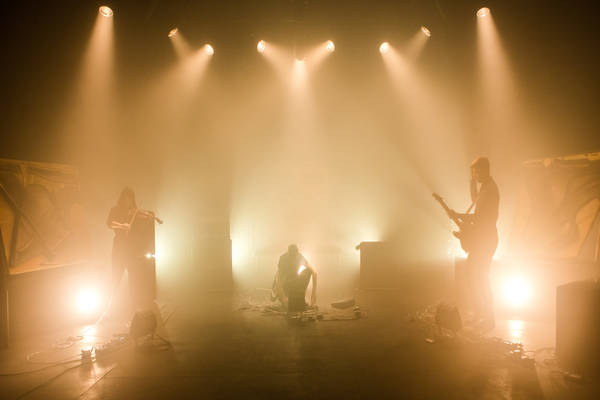
Along with tickets, we are handed earplugs. Considering Christopher Brett Bailey’s first work This Is How We Die, I’m not surprised. A brilliant, relentless barrage of contemporary American myth followed by an encore of noise and light, Bailey isn’t known for doing things by halves, or even singular wholes. The slight, constantly startled-looking Canadian with gravity defying hair attacks performance making with the energy of a supernova. Kissing the Shotgun Goodnight has the same verve, but is otherwise a rather different beast. Whilst This Is How We Die was dominated by language, Kissing the Shotgun Goodnight has very few words – but the earplugs are definitely needed. This anthemic music and light show fills the room with sound, colour and vibration but is the difficult second album to This Is How We Die. Much more of a gig than a piece of theatre, it lacks the satisfaction of characters and narrative, even a hint of one. Bailey’s mind blowing poetry teases with a few tiny fragments, but otherwise leaves us desperately gagging for more of his words.

Though given earplugs, there is the choice of whether or not to use them. Notices state that the sound level is consistently over 100 decibels and that, “if you wear plugs the whole time you might compromise enjoyment of the show. and if you don’t wear them at all you will take home whistling ear canals”. Being one of those people sensitive to loud noises who constantly asks my other half to turn down the telly, I want to play it safe but I don’t want to miss out. So I opt for one plug in, with the other ready. This choice no doubt effects the experience – if I leave them out the whole time and feel discomfort, would I like the show less? Or would I like it more because it’s not actually ‘that’ loud? I use the plugs in response to the volume level – sometimes I have both in, sometimes none. It’s an interesting premise to consider that the experience and quality of the show hinges on these earplugs, adding an additional level of individual, subjective response.

Bailey’s voice, slow and unseen, repeats, “this is a hell dream” in a brief textual introduction. Violinist Alicia Jane Turner uses loop pedals to sculpt a cinematic score reminiscent of mid-90s rock anthems. Her work is wonderfully angry, sweeping and alive. George Percy and Bailey are both on guitar, forming a silhouetted triptych with Bailey soon in the middle – amongst the monolithic speakers and flight cases forming a brutalist, urban landscape, he cuts the figure of a scrappy dystopian overlord. It suits him. If this is what hell is like, it’s fucking glorious.

Behind each performer is a wooden panel of about a metre square made of deconstructed pianos and their strings. These are visually impressive structures in and of themselves; their music evokes the violence and community of tribalism. Combined with excellent sound-responsive lighting (that malfunctioned to the point that the show needing to be stopped briefly), the overall effect is one of epic, soul shaking community.

The title paired with the music evokes the American paradox of a friendly but violent people who love their guns as much as their families. The music’s scale captures the expanse and variation of the North American landscape, and the few words he shares on the experience of waking up from a nightmare to find the world unchanged darkly foreshadow Trump’s America. Whether or not this is an intentional message, it is certainly a powerful one.

Kissing the Shotgun Goodnight is certainly wide open to interpretation and shows Bailey’s ambition and range as a performer of work designed to push the senses to their extremes. His textual dexterity is certainly missed (particularly by the coked up, flailing pair of young women sat next to me commenting on how disappointing this work is compared to his first) and comparatively this piece is somewhat disappointing, but it absolutely has its merits as a visceral, “fuck you/I love you” performance piece.

Kissing the Shotgun Goodnight tours nationally through November.

The Play’s the Thing UK is committed to covering fringe and progressive theatre in London and beyond. It is run entirely voluntarily and needs regular support to ensure its survival. For more information and to help The Play’s the Thing UK provide coverage of the theatre that needs reviews the most, visit its patreon.