Reckless, Rose Playhouse

The pool preserving the remains of The Rose Playhouse is the sea surrounding a nameless, remote island. Fascinating, dangerous, wild or wonderful, all of the island dwellers have lengthy, close relationships with the sea, for better or worse. These intertwining, turbulent histories meet and join each other at the Old Man and his Boy, a story of a new, young love and a past love, long lost. Heady Conduct’s Reckless unfolds a timeless tale of love, truth and community dictated by the sea using narration, site-specific influences and direct address interspersed with conventional performance. The story is both sweet and saddening, but the play’s structure is disjointed and thin, occasionally unclear in time and place, causing the story to lose support and clarity. Fortunately, the scenes between characters are endowed with honesty and intimacy, and the unique performance venue is fantastically utilized by director/actor Rebecca Rogers.

Rogers is the central narrator figure, the Harbour Master. She is the all-seeing and all-knowing, performing with a reserved omniscience. Rogers also plays the Old Man’s dead wife, a quiet enigmatic character often referenced but rarely seen. She’s a wonderful, etherial presence when she does eventually appear. The other living characters have more energy, particularly Alison Tennant as feisty, confident Girl that shy Boy falls in love with, and Blake Kubena as the Old Man, father of Boy. Kubena’s Old Man is a ball of pent up mourning that’s become a threatening obsessive, controlling his son’s every move. Though there is no issue with their performance, Kubena and Simon Rodda’s Boy look like they could be brothers in their late 20s or early 30s, not an elderly man and his teenaged son. The lighthouse keeper, played by Edward Bijl, is a watchful outsider trying to engage with the native islanders though never succeeds, resorting to desperate measures to fit in. Though the character provides some comic relief, he contributes little to the story and provides minimal plot progression.

The general atmosphere is good; atmosphere is vital to make a successful show in such a vast and unusual performance space. It gives productions here specificity of location and time period, otherwise the dark emptiness beyond the stage dwarfs the play. Nautical elements deck the back wall of the site, a hut perches precariously on the water’s edge, seagull puppets and some good sound design add specificity. The lighting isn’t fully utilized to create mood, nor does it do much to counter the sweeping grey ceiling and walls, but this island could be in a location that’s perpetually cloudy.

The use of ritual and tradition gives the story gravitas; the Harbour Master’s Festival of the Lost is a moving tribute to those drowned at sea. It connects the characters to each other and to the island, helping to counteract the loosely fitting scene structure. It also emphasizes the seriousness of the small twist at the end where the audience learns the details of the Wife’s death, and the gradual muddying of the truth with the passage of time. The most moving plot point is Boy giving a ring of his mother’s to Girl, inscribed with a medieval French saying, “pences pour moye du” or “think of me, God willing”. Historically, this ring was found during the Rose’s excavations and now lives in the Museum of London (The Rose sells replicas in its giftshop). This is a delightful nugget of Rose history bonding the theatre to this particular production.

Though Reckless is in the early stages of its expansion into a full production from a one-person show, it still needs more flesh on its skeletal frame. There are great characters and the love story at its core is wonderful, but its dreamlike atmosphere needs more detail to make the world of the play truly believable. It’s most certainly achievable, and this play will develop its sea legs as it continues its development.


The Play’s The Thing UK is an independent theatre criticism website maintained voluntarily. Whilst donations are never expected, they are hugely appreciated and will enable more time to be spent reviewing theatre productions of all sizes. Click here to make a donation with PalPal.
Greywing House, everything theatre

“One-person shows are extremely hard to create and perform effectively. It’s easy for them to be too long, too boring, too bizarre, too indulgent or too lots of other things. Greywing House uses poetic writing and language, puppetry and movement to craft a narrative that gradually exposes the otherworldly realities of coastal Greywing House and its proprietor, Miss Amelia…

“Miss Amelia is the epitome of polite restraint, akin to a 1950’s housewife…Mary Beth Morossa, the creator of the show, plays her with detail and sensitivity.

“The play mostly consists of lengthy monologues where we learn about Miss Amelia’s unfortunate family history…Most captivating are two tales told through puppetry…These are the most visual aspects of the show and excellent examples of storytelling…

“Morossa has an obvious gift for writing. She uses vivid imagery and poetry to draw in the audience. She tells the story clearly and with an effective narrative structure. There are moments of surprise and ambiguity that leave the audience questioning what is real and what is the product of madness. However, it is slow to develop…

“This is a one-person show that is not without potential but still needs development. Having debuted at the London Horror Festival last year, its creepiness works any time of year…”

Read the entire everything theatre review here.

Gorilla, Polka Theatre

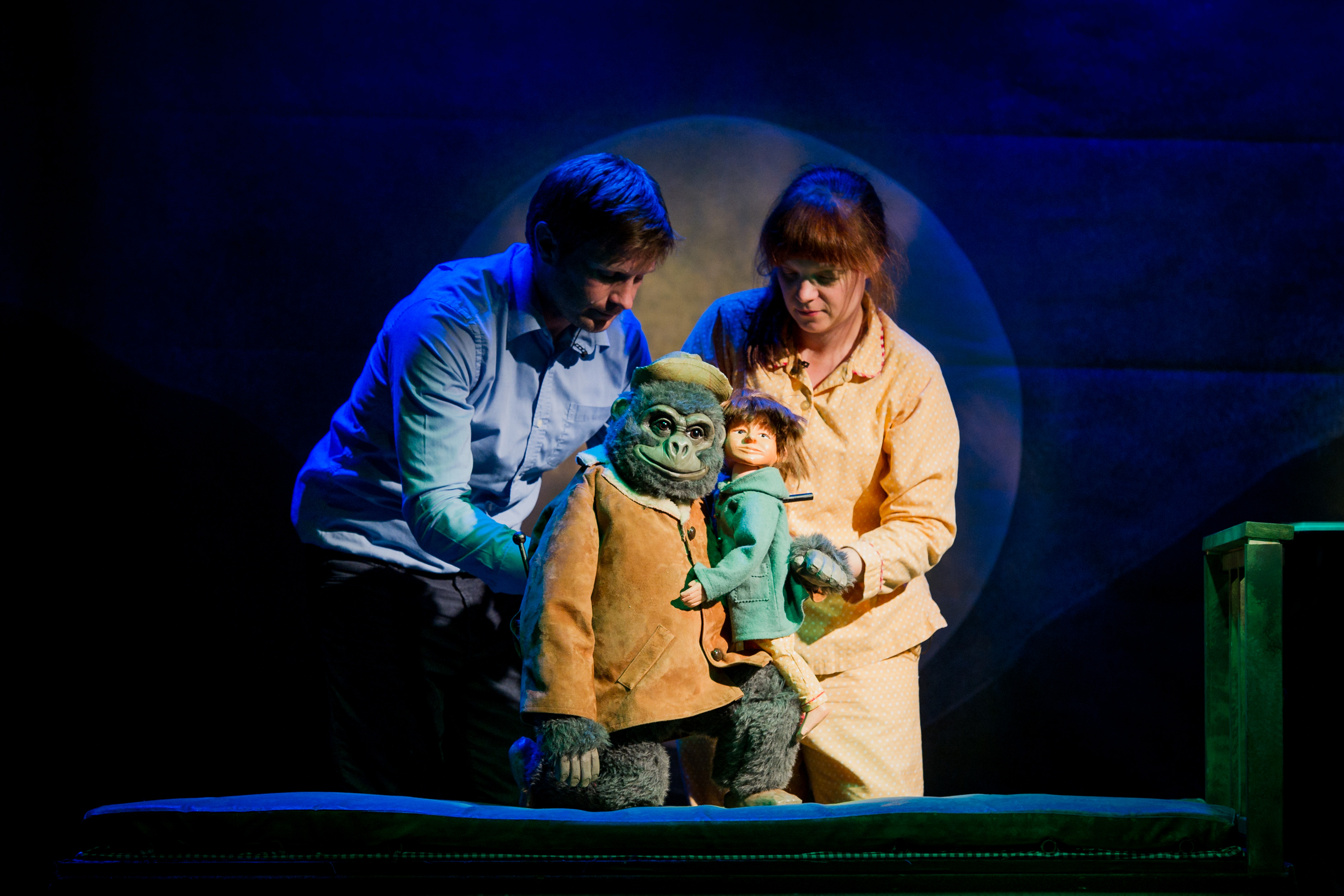
Gorilla Revival - Polka TheatreHannah is a little girl that loves gorillas. She spends all day drawing them, watching programmes about them, and talking about them. She tries to share her love for these wonderful animals with her dad, but he’s too busy. Then, on the night of her birthday she received a small toy gorilla that comes to life and takes her on an adventure, teaching her about kindness and gratitude, and her dad then gives her the best birthday ever. This classic children’s book, Gorilla, is charmingly brought to life with two actors, two puppets and a detailed but lo-tech set for children aged four to eight at Polka Theatre.

The story is a wonderful little adventure, executed quietly and calmly, without special effects and updating to reflect present day. Even the music sounds like it comes from a 1970s lounge bar. Initially I found it all terribly old fashioned, but considering the technology children are bombarded with today, it makes a refreshing change and reminds us that children don’t need an ipad and hi-tech toys to entertain them by the time they’re 3. After Hannah’s introduction, the sequence to establish her day-to-day routine and dad’s busyness is rather repetitive; the children in the audience became a bit fidgety and chatty. Once Hannah’s birthday arrives and the adventure begins through puppet versions of the characters, the audience of little ones becomes quiet and focused. Set changes tend towards the lengthy side, but the reveals that come from the set flips, rope tugs and lighting changes are choreographic in and of themselves.

The puppets suit the design of the set, old fashioned but still detailed and expressive. Actors Ceri Ashcroft and Phil Yarrow are good, with lovely chemistry, though at times it was hard to hear Ashcroft during the songs. The barometer for children’s theatre is the children in the audience though, and these maintained a steady focus once Hannah and her gorilla friend meet. They took some time to settle and weren’t grasped by the beginning exposition, but the rest of the play more than compensated.

There were some lovely staging choices by director Roman Stefanski. Particularly notable are the puppets coming into the audience as it transformed into a cinema and watching the audience as zoo animals from outside the bars of the cage. Transforming the human sized set into a puppet sized one also enchanted the audience, both adult and child. This is particularly praise-worthy as the transitions were quite lengthy and all changes (or most of them) looked operated solely by the performers.

This was my first visit to the Polka. What I found most disappointing was that the house was only half full. The theatre could certainly do with the revenue full houses generate, and this production makes a refreshing change from the fancy bells and whistles of West End family shows. The building emanates a warm sense of community that local families should enjoy more often, and it’s a break from fast and loud modern life. After all, people my age and older thrived in a childhood without the internet and handheld gadgets. Gorilla not only tells a sweet story with a strong female child as a lead, it proves that children today can enjoy live entertainment that quietly focuses on old fashioned adventure storytelling.


The Play’s The Thing UK is an independent theatre criticism website maintained voluntarily. Whilst donations are never expected, they are hugely appreciated and will enable more time to be spent reviewing theatre productions of all sizes. Click here to make a donation with PalPal.
Shakespeare & The Alchemy of Gender, Rose Playhouse

At 19 years old, Lisa Wolpe fell in love with Shakespeare. She’s now performed more of Shakespeare’s male roles than any woman in history after founding Los Angeles Women’s Shakespeare Company twenty years ago. She is currently touring the world with her solo show, Shakespeare & The Alchemy of Gender. Although it sounds like an academic lecture, it contains some of the best Shakespeare performances I have seen. The play pays homage to her father, telling the man’s story and how he affected her life. The man who killed himself when Wolpe was four is brought to life in a deceptively simple show that finds hope in a history of suicide, abuse and war.

Though to say the show is about her father’s life oversimplifies the content. Yes, a large portion is about him, but it also covers her life after he had gone, her relationship to specific Shakespeare characters, gender, performance, religion, Elizabethan society, family and alchemy – the transformation of a base material into something precious. These themes intertwine, with no moment unrelated or superfluous and the 55-minute show amazingly manages to not feel overloaded with messages. As she works through her life and her father’s, she relates Shakespeare’s characters to individual moments in time. As she reflects on her relationship with him now, she becomes Hamlet remembering his father’s ghost, in the best performance of the role I’ve encountered. Her father’s WWII escape and joining up with the Canadian forces as a double agent lead into Henry V. We also meet Richard III, Hermione, Shylock and others in relation to herself and her family’s history. Wolpe is not only adept as any man at embodying the male roles, she excels. She also effortlessly switches between men, women and herself, functioning in an androgynous state when addressing us out of character.

Wolpe is comfortable addressing us with an open honesty about difficult episodes in her life without coming across as confessional or masturbatory, as one-person shows run the risk of being when used to come to terms with the performer’s or writer’s issues, whatever they may be. The show is relaxed and conversational with the audience nodding, laughing, even verbally agreeing. The intimate venue helps, but she certainly has the energy to fill a huge theatre. She had a profound effect on the audience, particularly when sharing moments about her relationship with her family and dressing in boys’ clothes to defend herself against her predatory stepfather.

Her interpretation of the characters she performs seems rooted in physical and vocal distinctions, with her General American accent capturing the visceral-ness of the language that the more recently created RP/Standard English. These characters come from her gut, and she explains how she is able to relate to each one and perform them with truth. This is evidence of Shakespeare’s continuing relevance to modern life. Not only is Shakespeare: An Alchemy of Gender an excellent piece of solo theatre, it is also a lesson in performing the great Shakespearean roles of both genders and an encouragement for all to defy gender boundaries dictated by society.

Because this is a woman that must be experienced, here is an extract from her Iago. Enjoy.


The Play’s The Thing UK is an independent theatre criticism website maintained voluntarily. Whilst donations are never expected, they are hugely appreciated and will enable more time to be spent reviewing theatre productions of all sizes. Click here to make a donation with PalPal.

How Nigeria Became, everything theatre

“It’s 1914. The British government has merged the tribes and kingdoms to create modern Nigeria. King George V has sent Charles (Christian Roe) to visit Herbert Ogunde (Tunji Falana) to ask him and his theatre troupe to perform at the unity celebrations…

“The story the theatre troupe shares with Charles follows young girl Jenrola (Rita Balogun) on her quest to find the spear of Shango…Also looking for the spear are Aguzani (Stephanie Levi-John) and Obaze (Rebecca Omogbehin). The three women engage in a battle of wit and strength to see who can get to the spear first…

“The story of Charles, Herbert and his actors is framed by a Yoruba creation myth that starts and finishes the production…As lovely as this story was, it felt disconnected from the main plotline, even though it provided the background to the spear…

“All of the actors except Roe play multiple roles, and they do so incredibly skillfully. Falana…employs great physical skill to differentiate these characters and shows the inherent misogyny of 1914 Nigeria through comedy rather than nastiness…

“The set is simple but colourful and effective. The stage is a painting of a river delta and coast, forming the natural curve of the stage. There are mats and cushions on the front of the stage for young children, which gives them more of an opportunity to engage with the interactive elements of the production…

“This production is highly polished and engages the young members of the audience as well as the older ones. It was a great experience…seeing numerous young people engage with the action unfolding before them.”

Read the entire everything theatre review here.

So It Goes, Greenwich Theatre

SOITGOES_CMYK_1

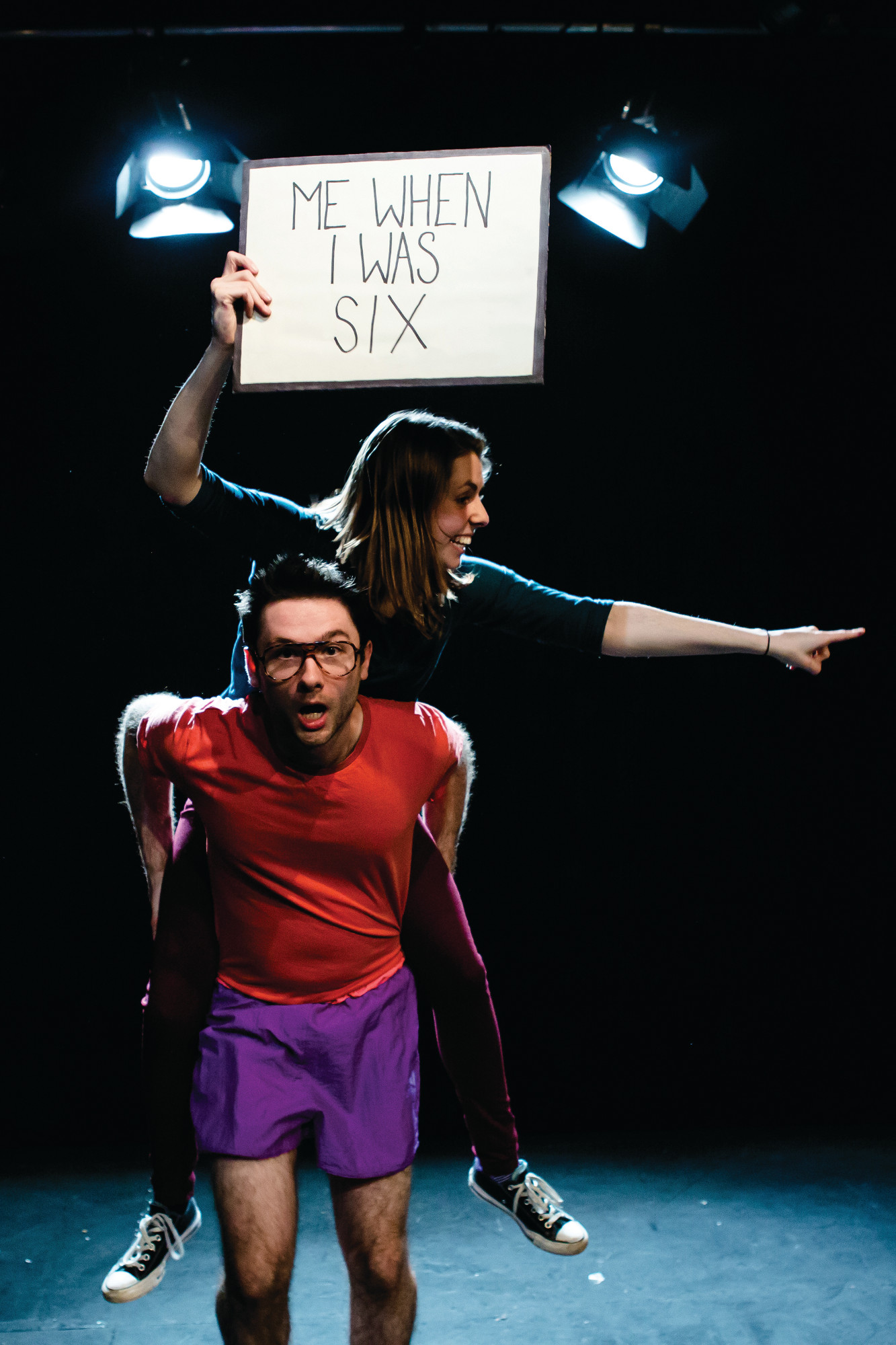
Hannah used to love running with her dad. When she was 17, her dad died and Hannah kept on running, silently and alone. She refused to speak about his death with anyone, including her family. So she decided rather than to navigate the burden of speech, she would create a silent play that tells her dad’s story and her process of dealing with his death. So It Goes is a sweet two-hander that manages to avoid over-sentimentality by focusing on the honest, deeply individual story of navigating life after the death of a parent.

Other than the last line, there is absolutely no speech in this play. All text is written on small whiteboards worn around the actors’ necks or on pre-made signs. This keeps written communication basic; it is rather like watching a comic book or graphic novel being written. This could occasionally feel slow and it was often easy to predict what was coming next on the whiteboard within a scene, but not overly so and not often. The set and props are also simple, with signage and symbolic items representing other characters and jumps in time and place. Most props are drawn outlines of objects, adding humour and a sense of youthful play to the story. The physical performance style matches- it is exaggerated but simplified, physical theatre but not ornate, embellished or for the sole purpose of showing the actors’ physical prowess. So It Goes wants to tell Hannah’s story as clearly and simply as possible, focusing on truthfulness and emotional honesty. The look of the play would certainly appeal to children, but accessing adults’ inner child makes the experience of losing a parent a journey that ends with positive reflection rather than the bitterness of loss.

The performances are equally lovely. Hannah Moss plays herself, and has “help” telling the story from David Ralfe, who plays her Dad and Mum. Ralfe in drag has an initial hit of comedy, but he taps into Mum’s outward expression of hopelessness that soon makes the audience forget that it’s a bloke in a dress. The two actors embody an exaggeration familiar to children’s theatre that is also in keeping with the cartoon aesthetic of the production, but is not crude. If they did not employ the exaggeration or humour in their physical comedy, it would make audiences want to slit their wrists. Instead, there was a lot of sniffling and nose blowing mixed in with laughter.

This is the third play I have seen about death in recent weeks. Each production used a dramatically different approach to convey the same message. Hannah spelled it out for us by writing that her dad “didn’t just die, he lived.” There’s an overabundance of factors in the world that can easily depress us and forget to look for the little moments of daily joy in our own lives, but So It Goes provides a celebratory reminder to do so through a pared down, visual-textual hybrid of physical theatre. Though the tour has now finished of their debut production, On the Run Theatre is certainly a company to watch.

Intention: ☆ ☆ ☆ ☆ ☆

Outcome: ☆ ☆ ☆

Star Rating: ☆ ☆ ☆ ☆


The Play’s The Thing UK is an independent theatre criticism website maintained voluntarily. Whilst donations are never expected, they are hugely appreciated and will enable more time to be spent reviewing theatre productions of all sizes. Click here to make a donation with PalPal.

Shooting With Light, Greenwich Theatre

1930s Paris. Jewish Europeans are moving west to escape the rise of Nazism. Two of them meet: one of them is a Hungarian photographer, the other is a German activist. Both are full of youthful confidence and fearless in pursuit of their goals. Emerging company Idle Motion uses physical theatre, light, sound to tell the story of these young lovers, their legacy and the importance of photography.

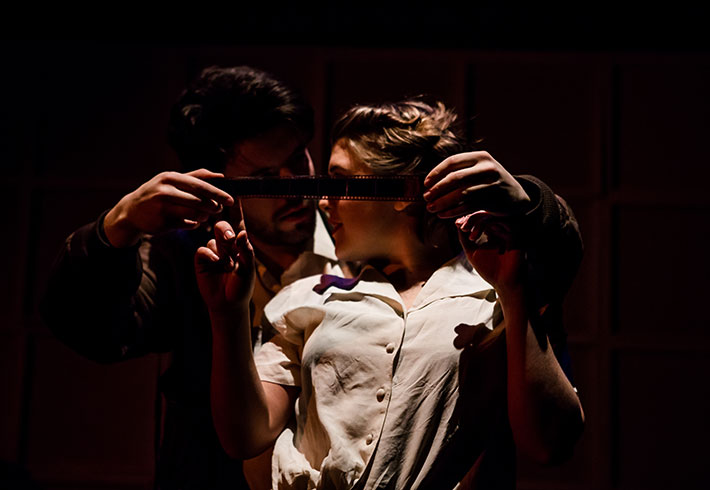
Firstly, Shooting With Light is a loveShooting-With-Light_018 story. Two young people meet, fall in love and take the world by storm before ending in tragedy. These young people are Gerda Taro and partner Robert Capa (after they changed their names), pioneering photojournalists of the Spanish Civil War. Gerda and Robert start working together; Gerda is initially his assistant who supports him in reinventing his persona in order to make the professional contacts he needs to succeed. Her talent overcomes this role however, and she eventually develops an independent reputation for honest, brave documentation. Partly fictionalized but based on Gerta’s brief life, we see Robert teach her to use a camera followed by her passionate rise to renowned photojournalist needing to show the world the reality of life on the front lines. Alternating with this storyline is the time-jumping subplot of Robert’s brother Cornell and his assistant June, seeking to amalgamate Robert’s work after his death. They are frantically searching for a mysterious red suitcase Robert once spoke of in order to complete the archive of Robert’s work.

Interspersing the scenes of historical naturalism are transitions using visual and physical theatre, similar in style to Frantic Assembly. This is an on-trend performance aesthetic, but one that is visually appealing and provides another level of insight into the characters and their struggles. The most effective of these sequences show Taro and Capa falling in love over rolls of negatives towards the beginning, and Taro’s fight to access the front lines with her camera towards the end. The set is simple in appearance as several blocks and a white screen, but they transform using projections, light and a series of doors. Like their narrative, the structure is simple but highly effective and tells an excellent story. Projections of Taro’s work add further historical context and support the world of the play – the audience sees what she sees and experiences.

The company of five twenty-somethings work wonderfully together, and so they should as they met in secondary school. Shooting With Light captures the infectious enthusiasm and ambition of youth, no doubt mirroring their own attitudes that the world is theirs to have and success is a given if they work hard enough. It will be interesting to see how their work develops as they age and experience the challenges and hardships of working in the arts. As visually appealing as their work in now, it needs more depth of human experience. June and Cornell’s quest to locate Capa’s missing work is arguably the more interesting side of the story, but neglected in favour of Taro’s and Capa’s exciting lives and career progression. The ensemble also lacks diversity of age and ethnicity, something that I hope they increase in the future. Idle Motion have an obvious gift for storytelling and integrating various performance styles at this young age, so the world really could be their oyster as they continue to grow.

Intention: ☆ ☆ ☆ ☆

Outcome: ☆ ☆ ☆

Star Rating: ☆ ☆ ☆ 1/2


The Play’s The Thing UK is an independent theatre criticism website maintained voluntarily. Whilst donations are never expected, they are hugely appreciated and will enable more time to be spent reviewing theatre productions of all sizes. Click here to make a donation with PalPal.

Don Q, Greenwich Theatre

Production shot 4 croppedI really struggled to come up with a suitably erudite introduction to this review of Flintlock Theatre’s Don Q. Not because it’s hard to summarize – quite the opposite. The structure works, the message and plot are clear and the performances are excellent in this suitable-for-all-ages appropriation of Cervantes’ Don Quixote. I am chalking my difficulties up to this being such an enchanting and moving play that words aren’t quite capturing that “warm and fuzzy but actually quite sad” feeling I had the entire time. Everything I tried to write came across as cold and clinical. It’s a rare occasion that I go to theatre and nearly forget to take notes because what I am seeing on stage grips me by the proverbials that as a woman, I don’t even have. Seeing Don Q evoked the joy and wonderment I had on my first experience of theatre as a small child.

It’s not a simple show, though. Four actors take on numerous levels of characterization. Like Shakespeare’s A Midsummer Night’s Dream, a group of unrelated characters bookend the play. In this case hapless librarians, frustrated by the council’s efforts to close them down, highlight the importance of storytelling by relating the tale of Norman Vaughan to us. Norman, as we soon find out, is probably their most infamous patron. Norman’s nameless nephew thinks Norman, now 81 years old, has gone mad. You see, Norman loves to read and reenact the stories he reads with his younger friend Sam and anyone else he cajoles into joining him. It is immediately and painfully clear that Norman is completely lucid; he just has a joyful passion for stories and acting them out. The younger generation are so busy being adults that they have forgotten the pleasure of playacting and the power of an absorbing tale. So not only are the audience reminded of the importance of reading and allowing ourselves to be absorbed in a good book, we are also more subtly admonished for not taking the time to listen to our elders and treat them like human beings. So what if Norman (or any other elderly person) loves what he does? As long as no one gets hurt, we are told to leave well enough alone.

Norman’s nephew, having had enough of Norman’s mishaps and convinced he has gone mad, puts him in a nursing home to be looked after properly. He strictly forbids Norman from having access to any books. Sam, on one of his visits, smuggles in a copy of Don Quixote into the nursing home. A comedy chase results in their escape and an adventure imitating a selection of escapades from the original novel. Sam is a begrudging Sancho Panza, a pair of scooters augmented with push brooms and spoons are their trusty steeds and other people they encounter on the way play other characters (some more willingly than others). Their madcap journey is full of whimsy, spontaneity and emotional turmoil but with a potentially tearful ending for the more sentimental of audience members.

Director Robin Colyer skillfully employs physical theatre sequences to add variation and an atmosphere of a touring troupe of players. This is clearly a well-rehearsed, established production; not a breath was out of time. Objects and costume pieces are used liberally and often comically, in a style reminding me of the West End’s 39 Steps. The set and costumes are simple and rustic, but versatile and thought through. Nothing is excessive, nor sparse; the production design is just right.

The performances unite a fantastic script with heaps of audience interaction, and the great design to create a beautifully polished little show. Some call and response would have made more people feel included, as well as giving costume and lines to those in all parts of the auditorium rather than only those sat in the front row. Actors Jeremy Barlow, Francesca Binefa, Kate Colebrook and Samuel Davies are versatile multi-rollers with outstanding chemistry as an ensemble. Whilst I considered that having an older man play the role of Norman would have brought more to the story, the role is incredibly physically demanding and would be difficult to play at a more advanced age.

Don Q is only at Greenwich Theatre for a brief time, but then continues its national tour. This Oxford-based company is worth seeing no matter what your age, where you are or what you do. They use physical theatre, Brecht, storytelling and meta theatre but in an unobtrusive, charming way to create this lovely, warm, gem of a play.

Intention: ☆☆☆☆☆

Outcome: ☆☆☆☆

Star Rating: ☆☆☆☆ 1/2


The Play’s The Thing UK is an independent theatre criticism website maintained voluntarily. Whilst donations are never expected, they are hugely appreciated and will enable more time to be spent reviewing theatre productions of all sizes. Click here to make a donation with PalPal.

Rove, Battersea Arts Centre, for everything theatre

“As the audience enters, a young man with a magnificent beard is asking the violinist on stage with him if she knows “the one about…” several times. She always says yes, and then plays a brief tune. I realized after I settled that all the requests feature a man called Rover Joe involved in numerous exploits or unlikely situations…

“The structure of the performance is relaxed and loose. The subject of the story is a man called Rover Joe, Evans’ grandfather who emigrated from Ireland to Chicago. His tale is told in four sections, in between music, and talking to the audience about the importance of stories, their families, and so on…

“Armstrong’s music is excellent, as is Evans’ storytelling; though opening his eyes whilst giving us the tales would create more of a connection with the audience…

“This is certainly a unique performance: sentimental, quaint and emotionally honest. It raises some thought-provoking points on the nature of families and the tales they harbour. This is certainly a production to see for those interested in storytelling, folk music and folk tales, and quirky performances that don’t easily fit into a genre.”

Intention: ☆☆☆☆☆

Outcome: ☆☆

Star Rating: ☆☆☆ 1/2

Read the entire review on everything theatre here.

Shipwrecked! An Entertainment, for everything theatre

“Based on the true story of Henri Louis Grien, otherwise known as Louis de Rougemont, this is a tale of Victorian high adventure and a lying man’s downfall. It is the Jack Studio Theatre’s Christmas production, and one delightfully unlike other seasonal offerings…

“As a sickly child Louis yearned to experience life outside his bedroom walls, and at the tender age of 16 he decided that it was time to find his way in the world. After arriving in London, he meets a sea captain who invites him to work on an upcoming pearling expedition in the Coral Sea. A storm leads to shipwreck and a new life in Aboriginal Australia until he decides to venture home to London thirty years later. On his return to an unrecognisable city of smoke and industry Louis’ story has turns him into a celebrity, and the audience are surprised by a revelation that something was not what it seemed…

“Written by American playwright Donald Margulies, this is the UK premiere of this wonderful play. With a solid concept by Artistic Director Kate Bannister this is a delightful holiday theatre offering. Tony Taylor convincingly portrays Louis at all ages. Rose and Durbin skilfully employ physical performance to show us characters such as the captain, Louis’ mother, his Aborigine wife and Bruno the dog (the audience’s clear favourite). Performances are excellent throughout…

“The only flaws in the production are minor…The ending critiqued the press and society’s treatment of celebrities, but glorified creativity and imagination at the same time. This left me pondering how to view the principal character, and reminded me that life is not always black and white by any stretch.”

Intention: ☆☆☆☆☆

Outcome: ☆☆☆☆

Star Rating: ☆☆☆☆ 1/2

Read the entire review on everything theatre: http://everything-theatre.co.uk/2014/12/shipwrecked-an-entertainment-brockley-jack-studio-theatre-review.html