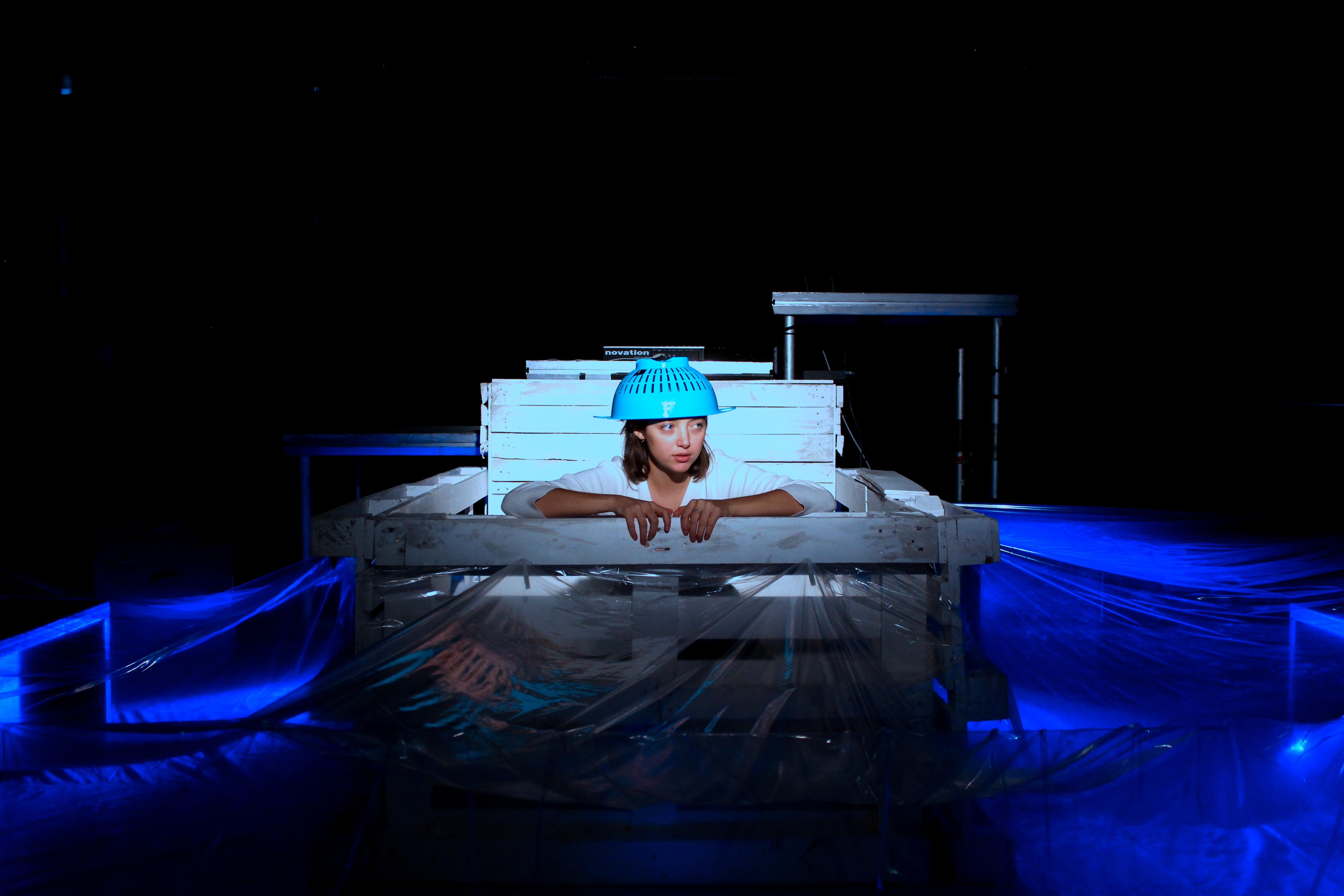
Boat, Theatre N16

BOAT, Theatre N16 (c) Shawn Soh (1)A lot of firsts are happening in Balham theatre at the moment. Theatre N16 has moved from N16 to a new home in SW12, The Bedford Pub. There is little theatre in the immediate area – Tooting Arts Club is further down the Northern line, Clapham and Stockwell both have venues closer to town, BAC is a bit of a trek and there’s a new theatre tentatively in the works in Streatham, but that’s it. Their inaugural production in their new home is first play Boat by poet Kiran Millwood Hargrave; it’s also producer PIGDOG’s debut production. Hargrave’s text uses thickly layered metaphor to tell 14-year-old Girl’s experience of human trafficking. What starts off as an interactive, childlike show soon reveals the sickening underbelly of cities and towns around the world.

“Jellyfish of Sound” Jethro Cooke opens by asking the audience to create some effects that he proceeds to use with others through live mixing. This beginning should indicate that sound is a dominant feature throughout, but it only appears sporadically, and quietly, for the rest of the performance. Instead, the focus is on the story of Girl (Pia Laborde Noguez), on a Beckettian journey with no apparent beginning or end. She is 14, on a small drifting boat. Her Twin (Cristina Catalina) is with her and she keeps herself entertained with visits from the increasingly possessive Turtle (Matthew Coulton) and challenging Gull (Grabriele Lombardo). As Twin’s appearances become more rare, and Girl measures times in the phases of the moon and plans adventures with Gull to find the moon on the seabed, her boat of white pallets and surrounding sea of plastic sheeting abruptly collapses, transforming into a bedroom. Twin, unspeaking and inert, lays draped across the headboard with clay covering her face. Only the clay represents something else, as do Turtle and Gull, and oh god, the realization of her actual reality is horrifying. Girl reminds us that we can pretend none of this happens in the world, as “you believe what you want to believe” and traumatized people will construct an alternative reality in their heads as an escape, but that doesn’t make sex trafficking, child prostitution and refugees cease to exist.

Hargrave’s language is naturally that of a poet’s, but the transitions are abrupt and obvious, announced by the Jellyfish of Sound. The upstairs space in the Bedford is versatile and a good size, but the low ceilings challenge conventional lighting. As potent as the play’s message is, the script imbeds the real story so deeply that it’s easy to take it at face value, or transpose it onto the refugee boats that fill our oceans and our news. But to do so leaves large, logical holes in their world and dilutes its potency. Though a worthy first production, it feels a bit rough around the edges with some moments of vague writing despite good performances. PIGDOG and N16 clearly have great ideas, and this is a wonderful space to explore and develop them in.


The Play’s The Thing UK is an independent theatre criticism website maintained voluntarily. Whilst donations are never expected, they are hugely appreciated and will enable more time to be spent reviewing theatre productions of all sizes. Click here to make a donation with PayPal.
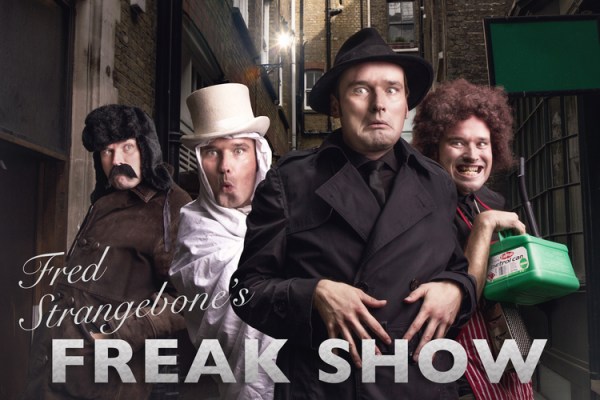
Fred Strangebone’s Freakshow, London Horror Festival

Freak Show by Chris BrockI’m watching Ben Whitehead play a socially inept Victorian playing a half-walrus/half-man creature, indicated by the wearing of a hooded grey sleeping bag, blue swimming flippers on his hands, and paper tusks precariously attached to his face with a false moustache. I’m pondering the life choices I’ve made that led me to this moment as well as whether or not the character-based stand up/absurd solo performance/live art/Victorian freakshow satire/old-fashioned variety show that unfolds before me is one of the greatest pieces of theatre I’ve ever encountered, or the worst. It may possibly be both. I still haven’t decided, and may not ever do so, let alone by the time I finish this review. Fred Strangebone’s Freakshow violently mashes up genres in a bizarre yet often-hilarious piece that manages to be both straightforward and bafflingly random.
Whitehead’s narrator Fred Strangebone cuts an imposing figure in a dinner suit, black shirt, and velvet bowtie. His rigidity and demeanor remind me of Lurch in the original The Addams Family series from the 1960s, but more well spoken and deadpan. Fred tells us exactly what’s going to happen: he will perform some comedy, then tell us a tale of unspeakable horror, and then, time permitting, he’s going to kill himself. His tale of unspeakable horror is more of a speakable mystery (so he says), where Strangebone goes to the freakshow and meets the walrus man and other oddities affiliated with the travelling show. These characters are a fantastic platform for accomplished voice actor Whitehead to get stuck into, and an enjoyably grotesque one at that. After a failed attempt to impress the freakshow to the point that they invite him to join them, he fulfills his initial promise…or does he? The meta-theatre from the stand-up clouds the levels of reality within Fred’s world.

Each of Whitehead’s creations could be a piece in itself, but he connects them through an overarching storyline. This structure could do with some work, as the narration between characters is often thin, with a tenuous link from one character to the next. The dwarfish property developer with pink wellies chewing on a cigar made of chorizo, whilst hilarious, only loosely fits into the established story. A scriptwriter or script consultant could have a positive influence on the story. His comedy is achingly funny, using absurdity and grotesque imagery to generate laughter mixed with disgust. Like when the demon bin-babies vomit all over mute clown cleaner, Sid, after he breast-feeds them to a monstrous soundtrack. (That was another one of those existential moments for me I mentioned earlier.)

Despite the rough structure and the script with predetermined characters crowbarred in, Whitehead has a fantastic sense for the absurdly funny and Fred Strangebone’s Freakshow manages to pay homage to several earlier popular performance forms – including the freakshow (obviously), variety, cabaret and travelling circus. There’s some audience participation, but the piece is more presentational than interactive. The event is a baffling, bizarre and uniquely wonderful one that refuses to be classified into one particular performance genre and certainly a one-of-a-kind contribution to the London Horror Festival this year.


The Play’s The Thing UK is an independent theatre criticism website maintained voluntarily. Whilst donations are never expected, they are hugely appreciated and will enable more time to be spent reviewing theatre productions of all sizes. Click here to make a donation with PayPal.

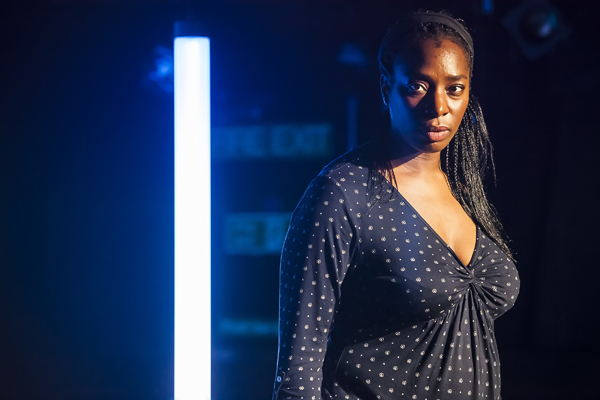
Joanne, Soho Theatre

Joanne2We never meet Joanne. We do however, meet four women who encounter her at different points over a crucial 24-hour period of her life, and one that remembers her as a child. We learn that she cuts a tall, striking figure, makes immediate impact on those she meets and she doesn’t seem to fit in anywhere the world. Joanne is homeless and has just been released from prison. Production company Clean Break, founded by 2 female prisoners in 1979 and still producing, recognizes the importance of sharing stories from vulnerable women prone to falling through society’s cracks. Joanne, written by five female playwrights, has some wonderful writing and is skillfully performed in an intimate space but the brevity of the monologues and talking around Joanne distances rather than fully engages.

Tanya Moodie first plays a key worker, then easily slips into a police officer, an NHS receptionist, a hostel cleaner and a teacher. All were moved by Joanne’s plight and wanted to help her, innately sensing her need for support. These women related to something within Joanne, humanizing her and the thousands of other female prisoners like her. Moodie captures the genuine care these women feel, as well as their conflict – police officer Grace isn’t supposed to get attached to her cases, but alludes to her own struggle with finding a place in the world for her and her daughter. I am particularly touched by Kathleen, on the front line of an NHS hospital for 28 years. She makes some pointed critiques of government legislation’s effects on her workplace and its effects on those most needing care. These stories are much more engrossing than Joanne’s because they’re in front of us, as Joanne herself is a shadowy puzzle that we slowly and satisfyingly piece together.

Through written by five different writers, the monologues seamlessly connect but remain stylistically distinct. Told in the past tense through the sharing of memories, they are fine examples of storytelling that Moodie makes active and varied rather than nostalgic. She owns the distinct characterization of these women, skillfully masking Róisín McBrinn’s direction. Colour changing light-up columns and panels add visual variation, but don’t contribute towards meaning or location. Their presence is unimposing, but unnecessary. The otherwise minimal, black set draws all attention onto Moodie, as it should in this production. Audience focus is on Joanne’s attempted helpers and their capacity to empathise; they are more solid and demanding of immediate attention than the silhouetted subject of their stories who leaves nothing but a memory.


The Play’s The Thing UK is an independent theatre criticism website maintained voluntarily. Whilst donations are never expected, they are hugely appreciated and will enable more time to be spent reviewing theatre productions of all sizes. Click here to make a donation with PayPal.

The Devil Without, London Horror Festival

rsz_1devilHiding in a room above a pub in Camden, John is on the run from an archdemon that he initially believed was the angel Madimi, with whom he did a dodgy deal for his soul. This archdemon is so powerful that being in his presence is enough to kill a mortal. But don’t worry, everyone is safe as long as we follow John’s instructions and don’t go through the door. Arcane symbols and a circle of salt help protect us from harm, as does his wisdom and hundreds of years of life experience. We are there for a workshop of sorts, to learn how to augment our realities through the power of the liminal space that exists between realities and just happen to be caught up in the demon chase, so the audience must sign a waiver before entering the theatre. Part séance, part hypnotism show, part magic and part theatre, The Devil Without seamlessly merges genres and the occult in a frighteningly unpredictable show loaded with audience interaction.

It’s difficult to say much about this show’s details without giving away the elements that generate the near-constant surprise and suspense, but there is a storyline and a structure that definitely makes this a piece of highly effective theatre. Ian Harvey-Stone plays the character of the 500-year-old immortal, performing feats of mind control and magic that rely on audience participation, including four people taken on an out-of-body journey to see if it’s safe to emerge from the room. There are also guided meditations that are meant to reduce phobias and demonstrate the power of our own minds, which are uncomfortably successful. It’s certainly impressive as Harvey-Stone manages to fully convinces and disarms the audience. Logically I believe what he does must be trickery involving audience plants, but he’s so convincing that the seeds of doubts are there, especially with Harvey-Stone’s assurance that they aren’t and the show changes nightly – could it be real? After all, “magic features the power of words…speak something and it exists,” says John. This uncertainty contributes to the scare factor of the show; we are unsettled when logic cannot explain an occurrence.

Smoothly directed by John-David Henshaw, the use of light and sound emphasizes the paranormal with resonant tones and pulsing lights. Henshaw’s direction combined with Harvey-Stone’s performance makes them an impressive pair of suspense masters. As a former scare attraction performer and an aficionado of horror, it takes a lot to rattle me but The Devil Without is hugely unsettling. The fluid genre mash-up and Harvey-Stone’s committed performance combine to create a show that extends the genre of horror theatre in a wonderfully frightening direction.


The Play’s The Thing UK is an independent theatre criticism website maintained voluntarily. Whilst donations are never expected, they are hugely appreciated and will enable more time to be spent reviewing theatre productions of all sizes. Click here to make a donation with PayPal.

The Sandman, London Horror Festival

rsz_sandmanThe sandman doesn’t throw sand in your eyes to help you sleep, oh no. That’s just what parents want children to believe so they aren’t scared of the real sandman. The real sandman is horrible. If you’re still awake, he steals your eyes and puts them into his little bag and takes them up to his little, bald bird-children who live on the moon. Then they eat them.

T. A. Hoffmann, celebrated German gothic horror author, wrote short story “The Sandman” in 1816. Featuring automatons, folklore, love, childhood trauma and obsession, it tells the tragic downfall of Nathaniel, who couldn’t let go of his boyhood fear of the sandman, personified in his father’s malformed colleague, Coppelius. Adie Mueller and Mike Carter adapt and modernise this short story into a one-woman show of the same name that eschews linear narrative in favour of a disturbing, extremely fragmented chaos. Mueller skillfully performs the eight characters that appear in the story, but the show requires a lot of thinking and patience to decipher the truth behind the numerous perspectives.

In the programme, Mueller and Carter state, “The woman knows that this story is too much for her and she needs you, the audience. The story bursts out of her and comes at you in fragments, randomly and out of chronological sequence. You will have to play your part in piecing them together, finding the overarching narrative, and search beyond reason to make meaning from them.” This is a nice idea to draw the audience into a one-person show and make them feel needed, but for the tired and those that want to sit back and be entertained/scared, it’s hard work. It also serves as a distraction from the lack of clarity of the audience’s function and relationship to the performer, a vital element of one-person performance. Requiring us to sift through the pieces of story strewn before us has no benefit to the performance or the piece; it would be delivered identically whether the audience understands or not. Director Carter chooses to keep the house lights on so Meuller can make eye contact, but there is no direct dialogue. What does she want from us? Why are we hearing this story? It is never revealed.

Mueller’s performance draws attention away from these shortcomings, and it’s an excellent one. Her use of physical storytelling and character differentiation comes easily, and shows a high level of skill and training. Clad in white, she cuts a powerful image in the Etcetera’s small black box, adding to the chaos with her violent use of creepy props.

The story modernizes well, with a focus on sexual dysfunction, technology and its grim intersection. The characters evoke empathy, particularly Nathaniel, who we see as a scared child and an adult obsessed with his lecturer’s “daughter” Olympia. Though his behaviour is appalling, he is a victim of his past rather than a calculating psychopath. His attempts to maintain a normal relationship with human being Clara are thwarted by reoccurring psychotic episodes…or are they real? The prospect of an alternative, tormenting reality that haunts Nathaniel is deliciously spooky. The Sandman is creepily unsettling and despite the effort needed to work out what is happening, the performances and characters make up for the jagged structure.


The Play’s The Thing UK is an independent theatre criticism website maintained voluntarily. Whilst donations are never expected, they are hugely appreciated and will enable more time to be spent reviewing theatre productions of all sizes. Click here to make a donation with PayPal.

Rise Up, Theatre Centre

Kimisha Lewis in Rise UpMay, 1961. The American south. Segregation has been ruled unconstitutional, but southern states ignore the legislation and the federal government does nothing to enforce it. Activists of all ages and races, sponsored by civil rights organizations, challenge this non-enforcement on public transport and customer services by sending groups of riders, black and white, on interstate bus journeys from Washington DC to New Orleans.

They never get to New Orleans. Over the next several months, in Alabama and Mississippi one bus after another is brutally attacked. The activists, who believe in passive protest, are terribly injured and eventually arrested. President Kennedy, embarrassed by their actions on an international level, urges them to stop but they continue to fight for equality. Rise Up by Lisa Evans uses spoken word, storytelling and multi-rolling to inspire young people to fight for equality in their everyday lives and pay homage to these brave people fighting for justice. A cast of four actor-storytellers with boundless energy plays all the characters with minimal set and props, inciting enthusiasm from both adults and young people alike.

Three metal panels on wheels are the old silver Greyhound buses. A few matching metal stools cleverly create bus seats, jail cells, shop counters and so on. Actors Emma Dennis-Edwards, Sam Kacher, Kimisha Lewis and Edward Nkom set the scenes with an array of accents and physicalities under their belts, plus a few hats and small props to help. The audience consisting mostly of children from the local girls’ school immediately warm to them, both during the production and the post-show “revolution”.

The script is narration-heavy, perhaps too much so, but these monologues feature sections of poetry delivered with a hint of spoken word, but not so much so that the performance style changes and does a disservice to production style continuity. Though more showing than telling would have been welcome, the incidents described are quite graphic and not appropriate to vividly show to school children. This isn’t a particularly visual show, so the students’ attention is a testament to the script and performers’ strength.

Theatre for young people continues to develop in leaps and bounds, creating rich stories and detailed characterization that can appeal to all ages. Rise Up is an example of this, telling a clear story that although set in another era and country, manages to relate to the lives of contemporary young people in Britain feeling the effects of inequality. The staging is simple as is the design, but this serves to focus the audience’s attention on Evans’ excellent script.


The Play’s The Thing UK is an independent theatre criticism website maintained voluntarily. Whilst donations are never expected, they are hugely appreciated and will enable more time to be spent reviewing theatre productions of all sizes. Click here to make a donation with PalPal.

Empty Vessels, Rosemary Branch

Bethany runs a work-in-progress writers’ retreat on an idyllic Greek island. Her current guests are realty TV star lad’s lad Travis who is paying her to ghostwrite his autobiography, and Eric, a hippie idealist who chucked in his comfortable life to write a fantasy novel set in the present day based in Greek mythology. When mysterious biker chick Athena turns up looking for username Ferryman4 in response to his online advert of souls for sale, Eric’s fantasy starts to look rather like reality.

This dark comedy by Greg Freeman directed by Ken McClymont has an interesting premise and is chocka with witty one-liners. A couple of the characters could use a bit more detail and the dialogue can be a bit clunky, sometimes obviously spelling out plot development unnecessarily. The main thread of the plot is quickly predictable, but doesn’t interfere with enjoyment of the character-driven comedy. With nods to online identity vs. real life, narcissistic selfie culture, and the relevance of ancient history in the modern day, Empty Vessels shares socially relevant messages with a hefty dose of humour and without being preachy.

Travis (Tobias Deacon) is the most entertaining of the four characters, an amusingly abhorrent young man epitomizing the self-obsessed who determine the value of the life by the number of followers they have on social media. He and Eric (Ben Warwick) have some frustratingly funny opening clashes that resemble Christmas dinner with your UKIP voting cousin. Deacon gleefully gets stuck into Travis’s despicable character, but Warwick has less to work with as Eric, who comes across as well-intentioned but confused much of the time, which is less interesting to watch.

The set is simple but not sparse, probably quite cheap, and clearly indicates the setting with a couple of pillars, an army of potted plants, and concrete blocks. Constructed by Jules Darker and presumably designed by McClymont, it immediately evokes Greece. It’s a lesson in how fringe theatre sets don’t have to be sparse to save money, unless there really is no budget for one. Leo Steele’s lighting is warm and inviting, with sharp transitions to show change in time of day and mood. These transitions are wonderfully quick, with no lost momentum.

This one-act also looks at humanity in a positive light despite the mocking of Narcissus’ descendants. The final scene’s revelation is both funny and endearing after the Comedy of Errors-esque soul swapping. It also gives Sophia Hannides (Athena) a chance to showcase her range. Even with the self-obsession of today’s society fostered by the dominance of online presence, there are still gods amongst us who have the power to wake us up and refocus attention onto the real here and now rather than on a smartphone screen.


The Play’s The Thing UK is an independent theatre criticism website maintained voluntarily. Whilst donations are never expected, they are hugely appreciated and will enable more time to be spent reviewing theatre productions of all sizes. Click here to make a donation with PalPal.

Never Ending Night, The Vaults

“Immersive” is a trendy term that’s rather overused in theatre at the moment. But what is it, exactly? The same can be said for “site-specific” and “interactive” theatre. Audiences are seeking out alternative theatre experiences that aren’t just sitting in a dark room and watching actors tell a story, and theatre producers are obliging, using the aforementioned vocabulary often too liberally and consequently diminishing the words’ meaning. Established practitioners of immersive performance include Punchdrunk, probably the most well-known, Secret Cinema’s events that are part cinema and part theatre, and Coney’s use of game design to empower audiences. Many other companies and individual shows also describe their work as immersive; some definitely is whereas others is less concretely categorised. CCSD lecturer Dr. Gareth White says the accepted definition of immersive theatre is a production that contains “installations and expansive environments, which have mobile audiences, and which invite audience participation.” But is that entirely accurate?

Never Ending Night at the Waterloo Vaults is immersive in that the audience is freely mobile in a space fully kitted out as a bunker for the survivors of a global pandemic. The audience is first taken through decontamination, where personal effects are checked and white boiler suits and masks are provided. There is a distinct air of authority that the audience dares not violate. The first part of the performance is set outdoors in one of the two large rooms that contain the show. It’s a desolate street, with bodies of the living, barely living and dead. Lighting guides the audience to individual moments, promenade style. This provides clear, concise exposition to the world created. Narratives overlap, creating snapshot moments of grief and desperation, but it’s not frantic. Soldiers in boiler suits take the last survivors and the audience into the next room, where the rest of the play happens.

The audience can spend as much or as little time with any given character as they chose. There are several options: following a character, staying in one space to see what characters come and go, or move to scenes as they occur; each will create a totally different experience. The survivors have all been in this bunker for quite some time, and a reference to nearby Waterloo Station adds an element of site-specific performance, but doesn’t seem important to any particular narrative. The structure gives the audience autonomy, but with a large cast, individual characters have few scenes so it’s hard to connect to their experiences and learn about the little details of their lives.

There is no interaction between the audience and the actors, which raises the question of whether or not Never Ending Night is fully immersive. Can immersive theatre not be interactive? My initial instinct is to say no, but I don’t know if that’s necessarily correct, showing the issue with the lack of a standard definition. The audience here, even in provided costume, are merely observers with an unclear role. They are not residents of the facility, nor are they government officials. Even if they are there to observe, the reason why is never made clear.

Created by a company of actors trained in the Meisner Technique of character development, this quietly ending piece feels more like an extended acting exercise. It would certainly be possible for the audience and actors to speak to each other without disrupting the main scenes at any given moment, but create a new level of intimacy and depth. There characters are interesting enough to want to engage with them, but the audience was invisible. There are numerous encounters between characters and emotions are often running high, which make for excellent bursts of dramatic tension. These are too brief, within a form that goes on for too long, however. The ensemble cast remains excellent, with immense focus and emotional truth Meisner would commend. The gentle ending is a powerful anti-climax, after which the audience is set free into the night.

It is a well-managed, polished piece of ensemble theatre, but the opportunity to develop a relationship with the characters is not provided. They would continue to function and interact in their world with our without the audience present. Consequently, this is a great production for those looking for an unconventional theatre experience without the pressure of audience participation. The setting is clear, but what isn’t, is what the audience is meant to take from the experience. Still the performances are good, as is the design and it’s a worthy attempt at a form that is still developing, whether or not it really counts as immersive.


The Play’s The Thing UK is an independent theatre criticism website maintained voluntarily. Whilst donations are never expected, they are hugely appreciated and will enable more time to be spent reviewing theatre productions of all sizes. Click here to make a donation with PalPal.

Pomona, National Theatre

There’s an abandoned island in the middle of Manchester. One gated and guarded road goes in and out. Zeppo owns it, like much of the land in Manchester, but he doesn’t like to get involved in the goings on at his properties. Too risky. After Ollie’s twin sister disappears, Zeppo tells her to try looking for her on his abandoned island, Pomona. So she does.

A frenetically spiraling video game of a play, Pomona reminds us “it’s impossible to be a good person now” in our modern world where knowledge is power, but ignorance is bliss. Particularly when it comes to knowing what our fast food is actually made of. And what some people do for money. And that basically, life is really fucking awful and people treat other people appallingly. The characters that inhabit this dystopian world are brutally flawed and painfully alone in their horrible existences. But it’s a hold-your-breath-and-hang-on-for-your-dear-life, wonderful piece of theatre that captures the nature of existence for the Millennial generation.

Originally at the Orange Tree last year and now at The National, 27-year-old playwright Alistair McDowall’s play captures the Millennial generation’s pace of life, attention span, inability to have meaningful interactions with others and hopeless despair as they try to build a life of happiness in a crumbling world. A circular framework and an escapist D&D game quest provide some structure to the plot whilst drawing attention to the futility of the lives of both the misfit characters and an entire generation. The story manages to evade predictability, again mirroring the lives of young and youngish people trying to carve out a career, homeownership and a family from never-ending debt and exponentially increasing costs of living.

All of the characters are likeable in a painfully human sort of way, even if some are rather despicable. Though the play’s set in Manchester, it has a universality that could be anywhere. The minimalist set allows the audience to focus on the language and the story, and the actors to move around at high speed. Short scenes, loud noises and abruptly lit transitions evoke a video game, or comic book film. The ending reveal reminds us that its impossible to ever really know someone, and a person’s life is a many-sided dice of personalities and roles.

As a conventional, “audience sits down and watches actors” piece of theatre it works brilliantly, but there is potential to expand beyond the form. With a game within a play and numerous small choices that dictate the characters’ outcomes, I can’t help but feel there’s scope to develop an alternative, interactive version where the audience is able to follow their own paths within the story’s framework, like a video game/choose your own adventure book. McDowall’s language is highly visual as Ollie (Nadia Clifford) uncovers more and more information in her sister’s story, this could be seen as well as heard.

Pomona encapsulates a generation’s experience but is also a stunningly crafted piece of theatre that skillfully uses language and dynamic characters to tell a fascinating, albeit unpleasant story. As a piece of theatre and a social commentary, it is simply a must-see.


The Play’s The Thing UK is an independent theatre criticism website maintained voluntarily. Whilst donations are never expected, they are hugely appreciated and will enable more time to be spent reviewing theatre productions of all sizes. Click here to make a donation with PalPal.

The White Feather, Union Theatre

During WWI, men considered too afraid to enlist were given white feathers by those disapproving of their cowardice. Also common were boys too young to join up lying about their ages so they could experience the excitement of battle. Then there were the hundreds who were killed for desertion and cowardice in the face of the enemy. These young men suffered from PTSD, an ailment not understood or acknowledged until well after the war was over.

A cast of nine tells the story of 16-year-old Harry Briggs, who cheerfully joins up to escape humdrum village life, and his sister Georgina’s search for the truth of what really happened to her kid brother out on the front. Whilst trying to clear his name, she discovers hidden secrets of her fellow Suffolk villagers, learning more than she bargained for. Spanning several decades and touching on a wide range of issues including homosexuality, shellshock, the class system and the reality of life in the trenches, The White Feather is an intimate, provincial musical with a sturdy first act and excellent music, that reflects the close-knit and often overbearing aspect of life in a small place during wartime. The second act, shorter but covering a much longer period of time, is rather choppy and introduces an interesting subplot but too late to for much development.

Abigail Matthews flawlessly leads as the kind but tenacious Georgina Briggs, supported by wonderfully mouthy best friend, Edith (Katie Brennan). It’s not all about the girls though; David Flynn as the conflicted lord of the manor Adam Davey is the most complex character of the lot and deserves more focus than the script gives him. Edward Brown, played by Zac Hamilton, has a couple of great scenes showcasing his emotional range. This is a great cast size for a musical: enough voices to give the larger numbers a punch, but not so large that some characters are relegated to the ensemble.

A piano, violin and cello trio give the music richness but an acoustic, rural tone that beautifully suits the world of the musical. The book and music are well integrated and transitions from one to the other are mostly smooth. The act finales could stand to be a bit longer, but otherwise the music feels developed, albeit quite gentle. The book follows an evenly paced narrative arc for the first half, but several jumps feel choppy and disruptive after the interval. The programme helps with indicating the time leaps, but more could be added to the script and design to clarify them so the audience doesn’t have to regularly refer to the programme. The Adam Davey subplot could do with more than a single, brief reference in the first half in order to have greater plot integration later, but this could potentially detract from the main thread of Georgina’s quest for justice. Though the title can represent Harry’s perceived cowardice, there is little mention of the feather as a convention of the time. All of the focus points are worthy of presentation and add to the overall story, but perhaps the show is trying to do too much. Without lengthening it quite a lot, some aspects of the plot will remain under-developed.

With an engrossing first act, detailed and complimentary characters, The White Feather writers clearly Ross Clark and Andrew Keates have a gift for telling great stories. New musicals often disappear after their initial run, but this one is a mostly polished affair that deserves more development and larger houses. In the Union Theatre, it’s an emotionally charged, intimate experience not to be missed, even with its shortcomings.


The Play’s The Thing UK is an independent theatre criticism website maintained voluntarily. Whilst donations are never expected, they are hugely appreciated and will enable more time to be spent reviewing theatre productions of all sizes. Click here to make a donation with PalPal.