Mumburger, The Archivist’s Gallery

https://i0.wp.com/livetheatreuk.co.uk/wp-content/uploads/2016/07/image-33.jpeg

Tiffany’s mum just died. Hugh’s wife just died. Together, this father and grown daughter that barely know each other anymore need to arrange a funeral. In the midst of their nonfunctional, chalk and cheese miscommunications, a mysterious delivery of uncooked burger patties arrives on the doorstep of their vegan home. The note on the bag makes them question everything they know about grief, each other and dietary choices.

Sarah Kosar’s Mumburger frames grief within an impossibly absurd scenario but rather than exploiting the potential for comedy, Kosar uses it to bring Tiff and Hugh closer and support their journey through grief and Hugh’s reluctance to let his daughter grow up. Though the episodic structure diffuses the day-to-day struggles, the structure snapshots moments of high tension incredibly well. Good performances support the script’s father/daughter tension that’s as much about a parent learning to let a child go as it is about losing a loved one.

Rosie Wyatt plays Tiffany as a gregarious go-getter with little patience for her non-communicative father (Lindon Alexander). Wearing her heart on her sleeve, her turmoil is completely and believably transparent and an excellent contrast to Alexander’s typically masculine introversion. They both have excellent emotional climaxes endowed with truth and keenly felt by those all too familiar with losing a loved one. Hugh is arguably underwritten for much of the play, though Alexander’s fantastically executed and intimate moment with the tiny slab of his wife’s remains is one the best recent moments on a fringe theatre stage.

Kosar’s script focuses more on the characters and their interactions, but just the right amount of external influence drives the action forward. Some moments feel too brief and the amount of time passing from scene to scene isn’t always clear, but the narrative arc is otherwise strong. The contentious burgers, as disturbing as they are, manage to not tip the entire play into absurdity – great work on the part of Kosar and director Tommo Fowler.

Ruta Irbite’s minimalist design is at odds with the naturalistic dialogue and considering the action solely takes place in one location, comes across as oddly sparse. A chest freezer in the middle of a bare, white stage and a few plain curtains on the back wall keep the budget low, but conflict with the text. Occasional bursts of projected video montages make more sense to the characters’ emotional states, but the lack of domestic furnishings is jarringly surreal.

Kosar’s script is without a doubt a good one, and the performances helped to emphasise its conflict. With clearer staging and transitions this promising one-act could really shine.

Mumburger runs through 24 July.

The Play’s the Thing UK is committed to covering fringe and progressive theatre in London and beyond. It is run entirely voluntarily and needs regular support to ensure its survival. For more information and to help The Play’s the Thing UK provide coverage of the theatre that needs reviews the most, visit its patreon.

Cargo, Arcola Theatre

Cargo at the Arcola Theatre, Milly Thomas, Jack Gouldbourne and Debbie Korley,  Photo by Mark Douet

Civil war is raging in the formerly united, newly named Kingdom. Loyalists and rebels have divided up the charred, frightened remains. Religious fundamentalism and capital punishment are the law of the land. There are furtive rumours of a better life across the channel, and there are regular passages to Calais. Money can buy passports, or if you don’t have any of that, there are people who will help you stow away as Cargo that you can pay later. But safety isn’t a given once you’re on board. The holds of these ships are dark and full of desperate people with shady pasts and their own agendas, and a lot can happen in an 80-minute crossing. Tess Berry-Hart’s script is as much a thriller as it is rousing political theatre, and the diverse cast of four effectively capture a snapshot of the population effected by this tragedy. Though the story is overly convoluted by truths and lies, Cargo provides a timely reminder, like other refugee-themed work at the moment, that we are all human beings in need of a safe and secure life.

Joey (Millie Thomas) is there with her younger brother Iz (Jack Gouldbourne). They’re from the loyalist-controlled docks and have lost everything. Joey’s shrewd and resourceful, Iz is an optimistic innocent who dreams of being a waiter and is the only genuinely nice person on board. Gouldbourne is totally believable as the tween who sees the good in everyone, and is nicely balanced by Thomas’ maternal defensiveness. They meet Sarah (Debbie Korley), an elusive northerner played with brilliant intensity. John Schwab is the slippery American Kayffe, who’s ever-changing biography hides horrific experiences. Berry-Hart never fully reveals the objective truths of the world around them, which is frustrating but leaves plenty to the imagination. The fates of these people are a great unknown in a world where desperation forces people to solely look out for themselves.

Tense from the onset from fear of discovery, anxiety builds quickly though there’s little to do except wait to arrive. These characters have seen so many horrors that relaxing is impossible and anyone could be the enemy. The script is conversational, yet guarded, as the characters attempt to get to know each other. Barry-Hart incorporates believable conflict into the narrative that director David Mercatali approaches with varying pace. The unresolved ending is unsatisfying, but no doubt realistic.

The design team Max Dorey (set), Christopher Nairne (lighting) and Max Pappenheim (sound) create an immersive environment of simple pallets and packaging. The boat is a constant aural presence and the seating, whilst as uncomfortable as the play’s circumstances, is probably pretty accurate. The design exquisitely works together with Mercatali to destabilise the audience; married with the script’s uncertainties it is a most unsettling effect.

Cargo could still use some refining and clarity in order to allow the audience to take in the experience without focusing on following the veracity of the character’s experiences, especially towards the end. Despite this small issue, or really because of it, the experience feels all the more truthful to refugee experience. Even though the concept of re-contextualising it to British people is not new, it is certainly effective. Like other plays on the topic, it humanises displaced people, their need for sanctuary and their vulnerability to exploitation. If theatre repeats these messages enough, the world might start to listen.

Cargo runs through 6 August.

The Play’s the Thing UK is committed to covering fringe and progressive theatre in London and beyond. It is run entirely voluntarily and needs regular support to ensure its survival. For more information and to help The Play’s the Thing UK provide coverage of the theatre that needs reviews the most, visit its patreon.
Fury, Soho Theatre

https://i.guim.co.uk/img/media/c255500e31a395db7d5e99d0e22866efcadc2904/0_0_3907_2727/3907.jpg?w=700&q=55&auto=format&usm=12&fit=max&s=24616b52e71621aa153ffabc5805fe48

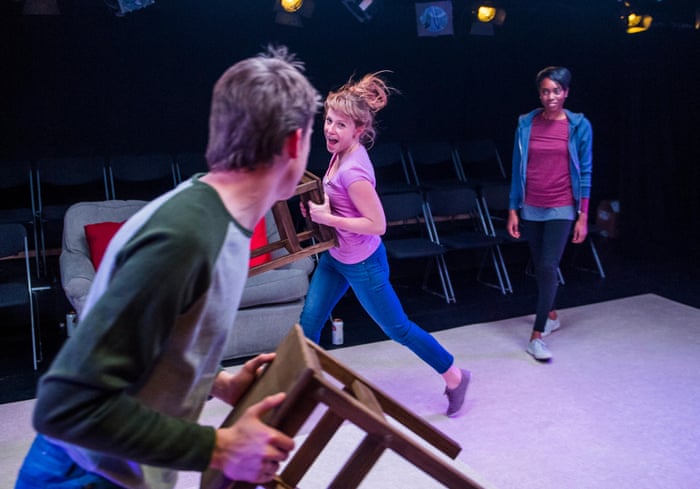
Sam is a young, single mum living in a council flat in Peckham. Having gone through the care system and her boyfriend leaving her after her second son was born, she has no one. When she meets socially inept Tom, an MA student in the flatshare above her, after losing her job as a cleaner, he creates an opportunity for friendship, sex and an escape from her kids. But Sam was born a victim, and a victim she remains. In this discourse on social class, parenting and gaslighting, playwright Phoebe Eclair-Powell incorporates Greek tragedy and a commentating chorus to expose the perils of growing up with no support network.

This is one of the young writer’s first full-length plays, and she’s still finding her feet. Fury has a great concept and characters, and the use of the chorus is a fantastic touch that adds depth and structural variation, but the execution if the ideas isn’t quite there yet. Some sections of the script don’t quite fit the main thread, like her beach outing with an old friend, and others rush the narrative progression. The chorus fills in information left out of the scenes, but this sticking plaster over the gaps is still unsatisfying and overly simplistic. The relationship between Sam (Sarah Ridgeway) and Tom (Alex Austin) escalates a bit too quickly to be plausible, though some slight extending would go far to rectify this.

Ridgeway is excellent as Sam, with a nervous energy and a risk of exploding into violence at any point, making Tom’s manipulation all the more believable to social services. Austin is slimy, awkward and initially seems harmless, but quickly reveals a dark interior. Though he plays the role well, it’s a challenging one because he transforms so quickly. His unlikely behaviour after his initial awkwardness is a powerful reminder that anyone is capable of committing horrendous acts, particularly against vulnerable people. The chorus of three (Naana Agyei-Ampadu, Daniel Kendrick and Anita-Joy Uwajeh) also play additional characters, flipping between them and non-characters with ease and agility.

Director Hannah Hauer-King uses a simple set by Anna Reid to focus on the text. Her in the round staging is a great choice that adds to Sam’s rising paranoia – everyone is indeed watching her every move. The chorus uses seats set into the audience, which although it keeps them ever present, it is unclear why the audience/actor boundary is blurred. She occasionally struggles to clarify space what with the mostly bare stage, but the dialogue usually explains well enough. Hauer-King taps into Eclair-Powell’s poetry with instinctual finesse, making some moments particularly moving.

Though the ended is rather different from the Medea that the show’s marketing compares it to, there is still senseless tragedy brought on by a man’s deliberate actions against a vulnerable woman. Fury shows much potential from the emerging writer and director, and contains some vital messages about growing up poor and female that, with some small adjustments, will be heard loud and clear.

Fury runs through 30 July.

The Play’s the Thing UK is committed to covering fringe and progressive theatre in London and beyond. It is run entirely voluntarily and needs regular support to ensure its survival. For more information and to help The Play’s the Thing UK provide coverage of the theatre that needs reviews the most, visit its patreon.
Ugly Lovely, Old Red Lion

rsz_ffion_jones_and_sophie_hughes_in_ugly_lovely_c_velvet_trumpet_1-1

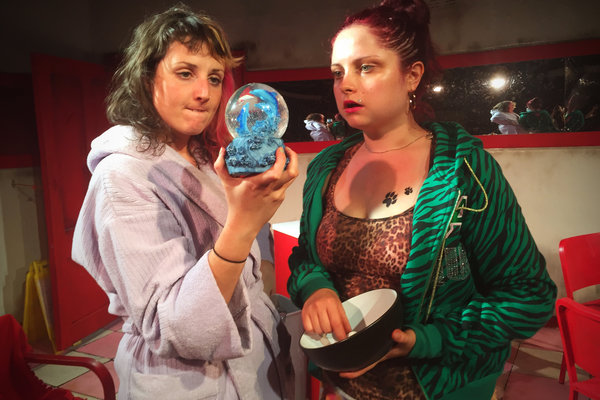
It’s Shell’s 26th birthday and she’s not happy. Her boyfriend Carl is AWOL and probably banging Smelly Kelly, her nan died recently, and she wants to leave Wales for the big city of Liverpool. Her best mate Tash is trying to convince her to stay, but her reasons are far from convincing. Shell is miserable, frustrated and angry. She feels the pull of adventure, but the tug of the sea she knows so well is strong, too. Shell tries to decide what to do as best she can – chatting with the urn that holds her nan’s ashes, going out clubbing and leaving her son Kieran with her mum. Ugly Lovely snapshots down-at-heel but aspirational Swansea with well-rounded characters who are excellently performed within a promising script, but it has a somewhat unsatisfying resolution.

This is writer Ffion Jones’ first play, and as debuts go, it’s a a rather good one. She’s built a sound narrative structure, though some trimming wouldn’t go amiss. The plot isn’t complex enough to warrant the current length or the interval, though too much cutting would rush the climax and dénouement. She has written detailed, nuanced characters with emotional depth that rally the audience’s support, but this leads to disappointment when Shell ignores her ambitions. Jones has an aptitude for sharp dialogue and dark humour, and there are some brilliant comedic moments within the characters’ misery.

Jones plays Shell, endowing the character with emotional truth and lived experience. Sophie Hughes as her best friend Tash is her cheerful sidekick, maintaining a wonderful sense of optimism despite an abusive home life. Oliver Morgan-Thomas rounds out the cast as their laddish schoolmate Robyn who is also doing the best he can to get by, though isn’t the nicest of individuals. His introduction leads to a brutal conflict and adds variation to the individual scenes’ structures, and his rough charm brings a great energy to the dynamic created by the women.

Nikolai Ribnikov’s direction is smooth and instinctive, and Lizzy Leech’s set enhances the gritty naturalism of their day-to-day lives. There is an awkward park bench that doubles as a couch, and the exposed toilet sits unused and exposed in a corner for most of the play, but adds additional dinginess.

This is a great little play that is remarkably polished for a new writer; it shows much promise even though it could use some tweaking. Jones is clearly a skilled theatre maker, and the rest of the creative team serves her script excellently. Production company Velvet Trumpet did exceedingly well in choosing this script, and Jones is certainly one to watch as both an actor and writer.

Ugly Lovely runs through 16 July.

The Play’s the Thing UK is committed to covering fringe and progressive theatre in London and beyond. It is run entirely voluntarily and needs regular support to ensure its survival. For more information and to help The Play’s the Thing UK provide coverage of the theatre that needs reviews the most, visit its patreon.

Maggie and Pierre, Finborough Theatre

https://i0.wp.com/www.theartsdesk.com/sites/default/files/imagecache/mast_image_landscape/mastimages/KellyBurke5_PhotoByAshley%20Carter_REDUCED.jpg

It’s easy to see why Justin Trudeau is one of the darlings of world politics these days. This charming former teacher, actor and advocate, turning to politics after his father’s death, identifies as a feminist, wants to legalise marijuana, is pro-choice, gay friendly and committed to the rights of the First Nations and other minorities. Canada’s liberal prime minister attracts groups of screaming fans wherever he goes both nationally and internationally, like any pop star. But where did these attributes come from?

His parents. Maggie and Pierre Trudeau, who met whilst holidaying in Tahiti in the ‘60s when she was a mere 18 years old, were THE Canadian celebrity couple of the 1970s. Pierre was, like his son after him, the prime minister of Canada. Their relationship was flawed, though. Maggie, young, free-spirited and bipolar, soon felt trapped by family life as her intellectual husband busied himself with work. The press’s constant presence also took its toll on their relationship, which the public then poured over in microscopic detail. In 1979, Linda Griffiths’ and Paul Thompson’s Maggie and Pierre premiers, a solo performance tribute to this enigmatic couple. It runs off and on for many subsequent years, a testament to the pair’s appeal.

The script feels quite contemporary, but other than for the purpose of historical documentary, its purpose isn’t clear all these years later. Though the two meet, fall in love and navigate their relationship, life in the spotlight, and the press, there’s no overriding message. It’s unclear why this story needs to be told. It’s a solid narrative over many years with moving insight into these historical figures, but the social and political commentary are limited to brief reflection on their relationship with the press. Perhaps this play would be more satisfying to Canadians or those that already know of the Trudeaus, but for audiences that have never before heard of this couple, there is little impact. It reads like an autobiography. Outstandingly performed by Kelly Burke and worth seeing for her intricate work alone, there’s the feeling that without her, the play would be disappointing.

Burke plays Pierre, Maggie and journalist Henry whose career has hinged on his reporting of their every move. Even though director Eduard Lewis incorporates numerous costume changes to signify a character change, Burke’s physical and vocal mannerisms completely transform into each respective character. It’s a wholly compelling process, a masterclass in performance. Her energy and commitment never falters and her presence is magnetic.

Designer Sarah Booth’s set is simple, but a confusing mix of abstract and functional elements. A huge, bright red quilt with Pierre’s slogan takes up half the stage and is only referred to once, near the end. Its visual dominance is impossible to ignore but it has hardly any bearing on the story. However, Booth’s creation of a bed that’s revealed from a nondescript cupboard is a great device. Philip Matejtschuk’s composition and sound design adds further depth, emotion and context that the set avoids, giving the show a more rounded, polished feel.

As a documentary artefact, Maggie and Pierre is no doubt a learning experience. The couple’s history is an interesting one and the love story is universally relatable. Kelly Burke’s performance is a wondrous thing to experience though, and more than redeems any of the production’s inadequacies.

Maggie and Pierre runs through 5 July.

The Play’s the Thing UK is committed to covering fringe and progressive theatre in London and beyond. It is run entirely voluntarily and needs regular support to ensure its survival. For more information and to help The Play’s the Thing UK provide coverage of the theatre that needs reviews the most, visit its patreon.
The Doctor in Spite of Himself, Drayton Arms Theatre

The Doctor in Spite of Himself (c) Ulysse Beauvois (3)

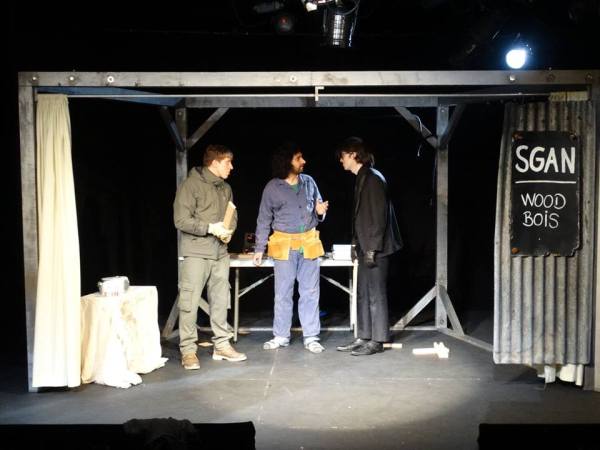
When the abusive, drunken woodcutter Sganarelle beats his wife one time too many, she takes advantage of passing strangers looking for a doctor to cure a young woman’s mysterious illness. Telling them she knows just the man, an eccentric but renowned man of medicine, sets the ball rolling on an absurd adventure of lust, remorse, and blagging it. Exchange Theatre, a French company based in London, have adapted Moliere’s The Doctor In Spite of Himself into a 75-minute contemporary version loaded with metatheatre, energy and good leading performances from a French cast. Plenty of slapstick, detailed design and Shakespearian influence make this a fun, easy to watch adaptation of the French classic.

Actor-director David Furlong plays Sganarelle with a goofy, watchable charm. His undeniable charisma is at odds with the unlikeable character, though his comeuppance and subsequent reform are a somewhat satisfying narrative despite the anti-feminist premise from the 1660s. Furlong is by far the strongest in the cast, but the others are generally good. Anita Adam Gabay as the mostly mute Lucinda exudes a sweet innocence, particularly in the opening montage where she discovers her betrothal to a man she doesn’t love. Matt Mella is the hilariously dumb Lucas, able to evoke laughter with a well-timed pause and a blank look. Some of the actors find it hard to connect to the language in English at times, but these jarring moments are fairly infrequent.

The edited plot occasionally feels rushed and overly compact, though it’s easy to follow and the translation uses relatively modern English. The excused wife beating is uncomfortably old fashioned, but at least it’s ridiculed – along with medicine and the gullibility of the upper classes. These themes translate fairly well to the modern day and English culture, especially considering the Shakespeare-esque comedy sequences that are likely to have drawn on the same commedia del’arte heritage that Shakespeare did. Furlong updates even further by adding in discreetly funny elements of self-reference, even if they don’t always work. The bust of Moliere as a weapon is cute, but characters dictating text to others from an anthology of Moliere plays isn’t as effective and causes energy to drop.

The design, presumably also by Furlong, incorporates an Elizabethan stage-within-a-stage to emphasise the metatheatre and clarify location. It’s clever and looks great, though it causes some difficulties with sightlines and narrows the playing area. Furlong’s overarching concept of using the metatheatre to create distance is a strong one what with its acknowledgment the absurdity of the story and the plot points that don’t work in a present day context.

This production of The Doctor in Spite of Himself is a funny, palatable adaptation of Moliere for London audiences. It’s a good laugh, a good length and has good performances. The company’s talent and vision is highly commendable and deserving of larger production values; their commitment to bringing audiences high quality French theatre in intimate venues makes them one to watch.

The Doctor in Spite of Himself runs through 17 July with performances in both French and English.

The Play’s the Thing UK is committed to covering fringe and progressive theatre in London and beyond. It is run entirely voluntarily and needs regular support to ensure its survival. For more information and to help The Play’s the Thing UK provide coverage of the theatre that needs reviews the most, visit its patreon.

Hardy Animal, Battersea Arts Centre

https://sites.google.com/a/georgetown.edu/mdarts/_/rsrc/1439559537290/units/unit-3/section-2/performance-laura-dannequin-s-hardy-animal/Dannequin.png

What happens when a dancer and performance maker loses the ability to dance due to chronic pain? She makes a solo dance piece with hardly any dance in it. A mix of emotive description, encounters with medical and health practitioners, and her own research tell the story of an injury and the subsequent pain that wouldn’t leave her body. Pointedly still and so quiet that she needs a mic, Laura Dannequin’s resilience makes a compelling piece of solo storytelling that mourns the dances her body wouldn’t allow her to make.

An impassioned monologue about all of the dances she wants to create is followed by a voiceover describing her dancing, whilst Dannequin stands perfectly still. Though her expression gives away nothing, she exudes a sense of loss; the simplicity and contrast between aural and visual imagery are captivating and heavy with grief. A sequence of small flexing movements of her bare back against a litany of treatments and diagnoses she sought from all over the world creates a similar effect, this one with added existentialism and frustration with a medical community that still knows precious little about the human body and its mechanisms. It’s captivating viewing in its simplicity.

Much of the piece examines Dannequin’s relationship with her body and her pain. It becomes a separate entity that she confronts with a range of emotions and dogged research to understand why hers is so persistent. There’s a scientific lecture on types of pain and her own educated theories, but like the rest of her piece’s components, there’s an emotional undercurrent that carries her words. A cathartic climax celebrates her mysterious recovery and the overarching effect is one of beauty and wonder.

Dannequin miraculously withholds the anger she is more than entitled to feel, instead she shares a grounded story of bodily rebellion imbued with emotion and strength. Hardy Animal is a piece of simple, quiet beauty that doesn’t let itself be bogged down with science or negativity.

Hardy Animal ran from 28-29 April and tours regularly.

The Play’s the Thing UK is committed to covering fringe and progressive theatre in London and beyond. It is run entirely voluntarily and needs regular support to ensure its survival. For more information and to help The Play’s the Thing UK provide coverage of the theatre that needs reviews the most, visit its patreon.

This Room, Battersea Arts Centre

https://i0.wp.com/40.media.tumblr.com/0de2b8a4c234adfa06d227487f497f1a/tumblr_nkr4q4aw501r8bp0ao8_1280.jpg

Laura Dean has Obsessive Compulsive Disorder. She’s afraid she’s going to kill herself in her sleep so spends at least two hours before bed checking her house for anything she could use to self-harm. Scarves and tights are hidden away, as are knives and other sharp objects. She can’t sleep without her checking routine and after months of exhaustion, she’s had enough. An NHS diagnosis comes with a round of Cognitive Behaviour Therapy sessions that help her recover, but introduce several ideas that make Dean question the nature of her self. This Room is a gently communal experience where Dean provides insight into the recovery process. There are plenty of clinical reports, forms and questionnaires but Dean’s individuality is never drowned out by these or by the condition she fights.

The audience is in Dean’s bedroom with her as she works through the most commonly held thoughts by people suffering from OCD. She confesses that she wants to know what’s going on inside her head so she can understand what’s really wrong with her, something she still hasn’t quantified after the pages of documented appointments she reads at lightening speed. The clinical nature of her recitations is a lovely juxtaposition to the soft, confession-like anecdotes from her treatment, most notably the session where her therapist (with the perfect bottom) visits her at home to confront her fears, represented by a serpentine tangle of tights, head on. The whole piece is intimate, quiet and deeply personal.

Dean has a soft strength that’s immensely watchable, whether she’s sitting silently on the edge of the stage clutching her water bottle, or reading her medical notes into a stand mic. The audience immediately sides with her, and dutifully responds to her questions. The empathy is tangible, and a group hug would not be out of place after the curtain call.

This Room avoids sentimentality or an overabundance of awareness-raising. Instead, it’s a personal account of a treatment process and an individual response to it. Will Dean ever really be well? If so, does that mean she’s not really herself anymore? These are big questions that don’t have an immediate answer, but are examined in a wonderful format that is a privilege to witness.

This Room runs through 27 April.

The Play’s the Thing UK is committed to covering fringe and progressive theatre in London and beyond. It is run entirely voluntarily and needs regular support to ensure its survival. For more information and to help The Play’s the Thing UK provide coverage of the theatre that needs reviews the most, visit its patreon.
Twelfth Night, Hope Theatre

rsz_web_size-93

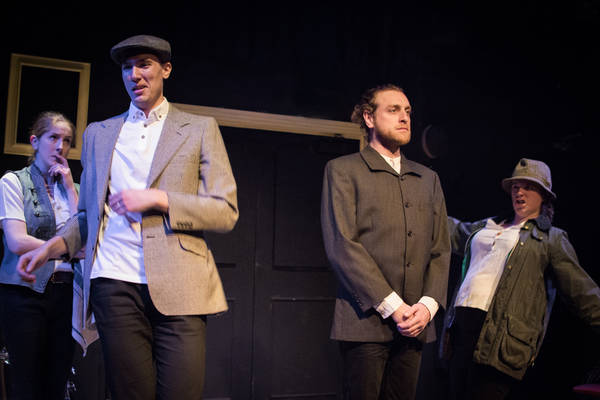
Fringe Shakespeare can be terrible, brilliant and everything in between those two ends of the spectrum. The better productions are vivacious and effortlessly handle Shakespeare’s language whether or not they are updated to a more modern setting, edited heavily or otherwise adapted with a concept. Thick as Thieves’ Twelfth Night is one of these good ones. Four versatile actors play all the parts in this bouncy interpretation that incorporates onstage character changes, plenty of music and audience interaction, and some clever character interpretations. At two hours long with an interval, the text doesn’t feel butchered though the interval isn’t particularly needed. With few faults, this is one of the best Twelfth Nights of recent fringe Shakespeare productions.

Company co-founder Nicky Diss, in an act of insightful  casting, plays Viola and Toby Belch. Her Viola is intense and boyish; her Belch is a gruff, posh older man. Diss’ presence and versatility are things of wonder, but she doesn’t outshine the rest of the cast. Her fellow co-founder Thomas Judd gives a Sir Andrew Aguecheek that is hapless and posh, a delightful interpretation that works very well; he doubles as a townie Orsino. Completing the quad are Oliver Lavery, particularly excelling as a hippy Feste and slimy Malvolio, and Madeliene MacMahon as a wonderfully frivolous Olivia. The four are all exceedingly good at creating clear, contrasting characters and have an energy that goes well beyond the walls of the tiny Hope Theatre.

There no set to speak of, which is fine for this play that changes location every scene. Costume pieces and musical instruments pepper the walls instead, giving easy access for changes. Hats, jackets and waistcoats over a uniform of black trousers and white shirts assist with character differentiation. It’s a simple but effective device to give visual variation and the lack of set reflects original practice. Occasional fiddly changes distract from the action on stage, but these moments are rare.

Some interesting alterations occur to facilitate the four actors, particularly the Sir Topas/Malvolio scene. Rather than Feste duping the prisoner, the lines are split between Sir Andrew, Toby and Maria. It’s believable enough despite vocal differences and makes no difference to the story.

Of the fringe Shakespeare that’s playing at the moment, the performances make this shoestring Twelfth Night a great one. Thick As Thieves are a talented, instinctual bunch certainly worth watching.

Twelfth Night runs through 30th April.

The Play’s the Thing UK is committed to covering fringe and progressive theatre in London and beyond. It is run entirely voluntarily and needs regular support to ensure its survival. For more information and to help The Play’s the Thing UK provide coverage of the theatre that needs reviews the most, visit its patreon.
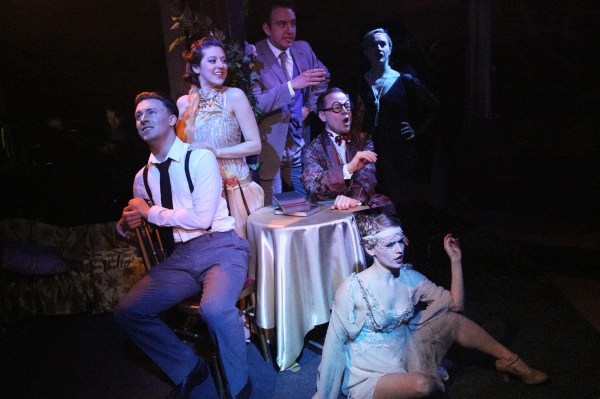
Gatsby, Union Theatre

Gatsby (c) Roy Tan (4)

Jay Gatsby’s distinctive yellow car is an iconic image in The Great Gatsby. Power, wealth and charisma emanate from its shimmering, custom paint job as it rolls between Long Island and Manhattan in the decadent 1920s. It’s eye catching and demands attention, like the enigmatic man who owns it. Adaptations of The Great Gatsby are plentiful, but good ones need the same characteristics as Gatsby’s car, along with a generous, heady mix of self-indulgence and extravaganza. Linnie Reedman and Joe Evans’ musical incarnation of F. Scott Fitzgerald’s iconic novel manages to avoid incorporating any these. Bland music, lazy performances and design and a book with numerous shortcomings makes Gatsby a stuttering, third-hand Ford Fiesta rather than a customized, purring Rolls Royce.

Reality TV celeb Ferne McCann makes her theatre debut in this production, bringing a lot of negative publicity with her as consequence. She’s also incredibly surprising – alone in a theatre-trained cast, she is the only one consistently able to be heard over the live actor-musos with her Amy Winehouse-influenced performance. Of the 13-strong cast, most are weak, some terribly so. They are either grotesquely overacted cartoons, or underplayed so much that their performances are flat. There’s no sense of danger or excitement, or EVERYTHING IS EXCITING ALL THE TIME FOR OVER TWO HOURS. It’s exhausting to take in. In either case, the characters are no more than stereotypes; this is more of an issue with Reedman’s book as it certainly doesn’t give the actors much depth to work with. Accents drift around the 50 states and then some, with the only consistent one coming from an actual American.

Reedman also directs, with little comprehension of the narrative arc she constructed from the novel. Other than the Plaza hotel scene late in the play when Daisy and Jay confess all to Tom, there is a pronounced lack of tension. Myrtle’s tragic end is anticlimactic and rushed, as is her husband George’s retaliation. She neglects characterization and seems to focus solely on staging. If that.

There are 21 musical numbers (including a couple of reprises), but none of Joe Evans’ tunes stands out from the rest. Even with a mix of smaller and larger numbers, there is little  musical variation. Transitions from book to song are often abrupt and forced for the sake of fitting in another tune rather than naturally reaching a point in the story where music is necessary to accentuate a plot point or emotion. Nick Pack’s choreography, without much to work with, is similarly unvaried with a bit of a Charleston every now and then.

There are few positives to pull from this production. Reedman and Evans’ interpretation is a choppy hatchet job of Fitzgerald’s work and few, if any, features deem it a worthy adaptation. If Gatsby’s goal is for the audience to “feel…the heat, sweat and life” of the euphoric, post-war American decade, it barely comes close. Tepid, cool and laconic is what actually comes across, in a wheezy motorcar threatening to cut out at any moment.

Gatsby runs through 30th April.

The Play’s the Thing UK is committed to covering fringe and progressive theatre in London and beyond. It is run entirely voluntarily and needs regular support to ensure its survival. For more information and to help The Play’s the Thing UK provide coverage of the theatre that needs reviews the most, visit its patreon.