Fury, Soho Theatre

https://i.guim.co.uk/img/media/c255500e31a395db7d5e99d0e22866efcadc2904/0_0_3907_2727/3907.jpg?w=700&q=55&auto=format&usm=12&fit=max&s=24616b52e71621aa153ffabc5805fe48

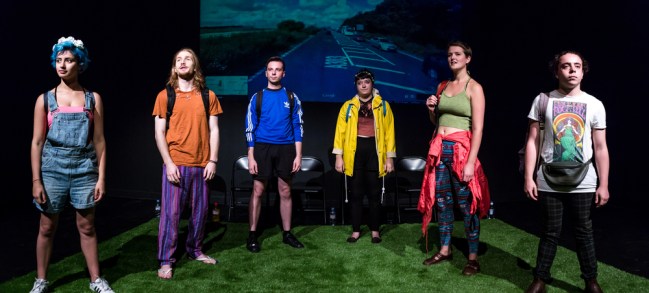
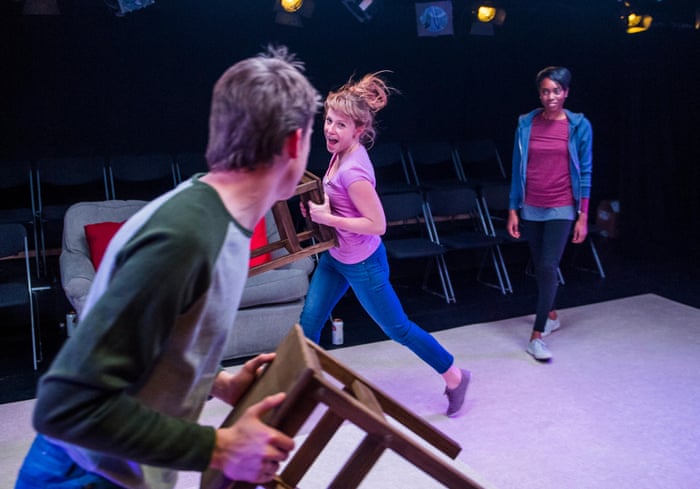
Sam is a young, single mum living in a council flat in Peckham. Having gone through the care system and her boyfriend leaving her after her second son was born, she has no one. When she meets socially inept Tom, an MA student in the flatshare above her, after losing her job as a cleaner, he creates an opportunity for friendship, sex and an escape from her kids. But Sam was born a victim, and a victim she remains. In this discourse on social class, parenting and gaslighting, playwright Phoebe Eclair-Powell incorporates Greek tragedy and a commentating chorus to expose the perils of growing up with no support network.

This is one of the young writer’s first full-length plays, and she’s still finding her feet. Fury has a great concept and characters, and the use of the chorus is a fantastic touch that adds depth and structural variation, but the execution if the ideas isn’t quite there yet. Some sections of the script don’t quite fit the main thread, like her beach outing with an old friend, and others rush the narrative progression. The chorus fills in information left out of the scenes, but this sticking plaster over the gaps is still unsatisfying and overly simplistic. The relationship between Sam (Sarah Ridgeway) and Tom (Alex Austin) escalates a bit too quickly to be plausible, though some slight extending would go far to rectify this.

Ridgeway is excellent as Sam, with a nervous energy and a risk of exploding into violence at any point, making Tom’s manipulation all the more believable to social services. Austin is slimy, awkward and initially seems harmless, but quickly reveals a dark interior. Though he plays the role well, it’s a challenging one because he transforms so quickly. His unlikely behaviour after his initial awkwardness is a powerful reminder that anyone is capable of committing horrendous acts, particularly against vulnerable people. The chorus of three (Naana Agyei-Ampadu, Daniel Kendrick and Anita-Joy Uwajeh) also play additional characters, flipping between them and non-characters with ease and agility.

Director Hannah Hauer-King uses a simple set by Anna Reid to focus on the text. Her in the round staging is a great choice that adds to Sam’s rising paranoia – everyone is indeed watching her every move. The chorus uses seats set into the audience, which although it keeps them ever present, it is unclear why the audience/actor boundary is blurred. She occasionally struggles to clarify space what with the mostly bare stage, but the dialogue usually explains well enough. Hauer-King taps into Eclair-Powell’s poetry with instinctual finesse, making some moments particularly moving.

Though the ended is rather different from the Medea that the show’s marketing compares it to, there is still senseless tragedy brought on by a man’s deliberate actions against a vulnerable woman. Fury shows much potential from the emerging writer and director, and contains some vital messages about growing up poor and female that, with some small adjustments, will be heard loud and clear.

Fury runs through 30 July.

The Play’s the Thing UK is committed to covering fringe and progressive theatre in London and beyond. It is run entirely voluntarily and needs regular support to ensure its survival. For more information and to help The Play’s the Thing UK provide coverage of the theatre that needs reviews the most, visit its patreon.
Ugly Lovely, Old Red Lion

rsz_ffion_jones_and_sophie_hughes_in_ugly_lovely_c_velvet_trumpet_1-1

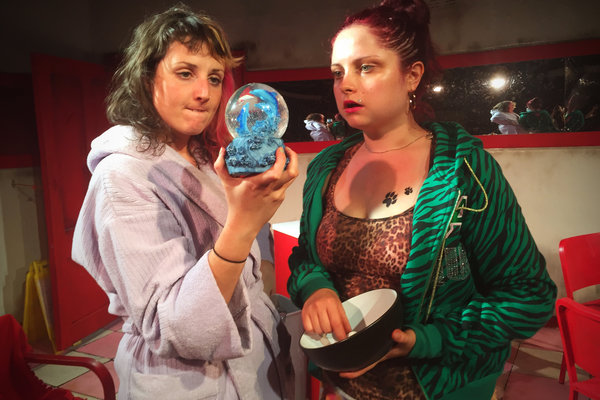
It’s Shell’s 26th birthday and she’s not happy. Her boyfriend Carl is AWOL and probably banging Smelly Kelly, her nan died recently, and she wants to leave Wales for the big city of Liverpool. Her best mate Tash is trying to convince her to stay, but her reasons are far from convincing. Shell is miserable, frustrated and angry. She feels the pull of adventure, but the tug of the sea she knows so well is strong, too. Shell tries to decide what to do as best she can – chatting with the urn that holds her nan’s ashes, going out clubbing and leaving her son Kieran with her mum. Ugly Lovely snapshots down-at-heel but aspirational Swansea with well-rounded characters who are excellently performed within a promising script, but it has a somewhat unsatisfying resolution.

This is writer Ffion Jones’ first play, and as debuts go, it’s a a rather good one. She’s built a sound narrative structure, though some trimming wouldn’t go amiss. The plot isn’t complex enough to warrant the current length or the interval, though too much cutting would rush the climax and dénouement. She has written detailed, nuanced characters with emotional depth that rally the audience’s support, but this leads to disappointment when Shell ignores her ambitions. Jones has an aptitude for sharp dialogue and dark humour, and there are some brilliant comedic moments within the characters’ misery.

Jones plays Shell, endowing the character with emotional truth and lived experience. Sophie Hughes as her best friend Tash is her cheerful sidekick, maintaining a wonderful sense of optimism despite an abusive home life. Oliver Morgan-Thomas rounds out the cast as their laddish schoolmate Robyn who is also doing the best he can to get by, though isn’t the nicest of individuals. His introduction leads to a brutal conflict and adds variation to the individual scenes’ structures, and his rough charm brings a great energy to the dynamic created by the women.

Nikolai Ribnikov’s direction is smooth and instinctive, and Lizzy Leech’s set enhances the gritty naturalism of their day-to-day lives. There is an awkward park bench that doubles as a couch, and the exposed toilet sits unused and exposed in a corner for most of the play, but adds additional dinginess.

This is a great little play that is remarkably polished for a new writer; it shows much promise even though it could use some tweaking. Jones is clearly a skilled theatre maker, and the rest of the creative team serves her script excellently. Production company Velvet Trumpet did exceedingly well in choosing this script, and Jones is certainly one to watch as both an actor and writer.

Ugly Lovely runs through 16 July.

The Play’s the Thing UK is committed to covering fringe and progressive theatre in London and beyond. It is run entirely voluntarily and needs regular support to ensure its survival. For more information and to help The Play’s the Thing UK provide coverage of the theatre that needs reviews the most, visit its patreon.

Savage, Arts Theatre

rsz_gary_fannin_and_bradley_clarkson_in_savage_at_the_arts_theatre_c_roy_tan

Denmark in the mid-1930s was a great place to be if you were gay. Homosexuality was legalized in 1933 and a thriving club scene allowed gay men to meet and socialize publicly. But as the dark cloud of National Socialism swept Europe, safety became more precarious. Dr Carl Vaernet was one of their threats. A practicing GP with an interest in hormone therapy, the Danish Nazi Party member soon captured the attention of party higher ups with his therapies that he claimed cured homosexuality. Hired to cure gay prisoners at Buchenwald late in the war, he experimented on seventeen inmates before the war ended and he escaped to Argentina.

Claudio Macor’s latest play Savage focuses more on the story of Nikolai and his American boyfriend Zack than Dr Vaernet, but the lovers are soon separated and Nik becomes one of the doctor’s victims. The emerging subplot of an SS officer and his secret, gay love slave quickly becomes just as important as Nik and Zack, making Savage more of a play about homosexuality in WWII than specifically about Dr Vaernet and his horrific medical experiments. Spanning several years and multiple narratives, the script, sadly, doesn’t give in-depth attention to any particular character; individual stories are disrupted and incomplete. This would be a much more compelling text if Macor focused attention on one primary character rather than taking a scattergun approach. All of these characters have potential to steer a rich, interesting play that focuses on them, but none of them get the full, individual attention they deserve. There are some great set piece scenes, but the overall structure lacks focus.

Some of the performances are inconsistent and the cast present a range of styles, which distracts from the seriousness of the plot. There are a few good performances, though. Gary Fannin cuts a cold, scientific Dr Vaernet with a clear disgust for gay people; this professional face of homophobia and calm hatred is a most chilling one indeed. Emily Lynne as the doctor’s nurse viciously opposes the Nazis and blatantly defies their rules in a display of ferocious persistence. She’s a great contrast to the doctor’s calm hatred. The two pairs of lovers have moments of genuine care for each other, whereas other times feel forced.

Jamie Attle’s costumes are sharp and detailed, whilst David Shields’ set of rotating panels clarify location but are a bit clumsy. Macor also directs, ensuring his political messages get across but an additional pair of eyes could have developed more intimacy between the couples.

Though the topic is most serious indeed, there’s a distinct lack of joy in the beginning cabaret scene and between Nik and Zack. Macor clearly wants to raise awareness of the horrors of Vaernet’s work, but some lighter moments of exposition would emphasise this further. A dramaturg would not go amiss in order to streamline the script and performance styles in future productions, but this premier still has potential and exposes a historical figure too easily forgotten amidst more prominent Nazi war criminals.

Savage runs through 23 July.

The Play’s the Thing UK is committed to covering fringe and progressive theatre in London and beyond. It is run entirely voluntarily and needs regular support to ensure its survival. For more information and to help The Play’s the Thing UK provide coverage of the theatre that needs reviews the most, visit its patreon.
The Doctor in Spite of Himself, Drayton Arms Theatre

The Doctor in Spite of Himself (c) Ulysse Beauvois (3)

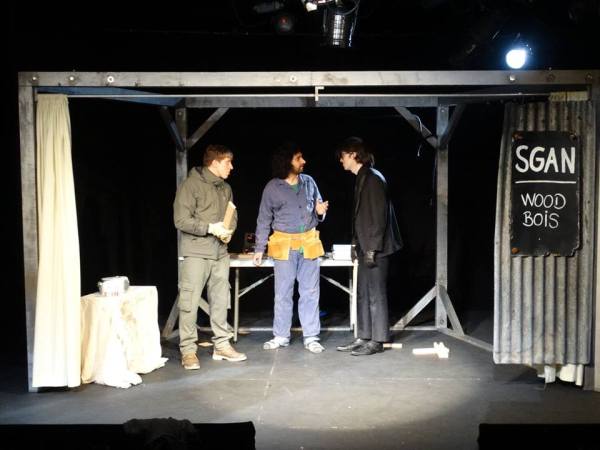
When the abusive, drunken woodcutter Sganarelle beats his wife one time too many, she takes advantage of passing strangers looking for a doctor to cure a young woman’s mysterious illness. Telling them she knows just the man, an eccentric but renowned man of medicine, sets the ball rolling on an absurd adventure of lust, remorse, and blagging it. Exchange Theatre, a French company based in London, have adapted Moliere’s The Doctor In Spite of Himself into a 75-minute contemporary version loaded with metatheatre, energy and good leading performances from a French cast. Plenty of slapstick, detailed design and Shakespearian influence make this a fun, easy to watch adaptation of the French classic.

Actor-director David Furlong plays Sganarelle with a goofy, watchable charm. His undeniable charisma is at odds with the unlikeable character, though his comeuppance and subsequent reform are a somewhat satisfying narrative despite the anti-feminist premise from the 1660s. Furlong is by far the strongest in the cast, but the others are generally good. Anita Adam Gabay as the mostly mute Lucinda exudes a sweet innocence, particularly in the opening montage where she discovers her betrothal to a man she doesn’t love. Matt Mella is the hilariously dumb Lucas, able to evoke laughter with a well-timed pause and a blank look. Some of the actors find it hard to connect to the language in English at times, but these jarring moments are fairly infrequent.

The edited plot occasionally feels rushed and overly compact, though it’s easy to follow and the translation uses relatively modern English. The excused wife beating is uncomfortably old fashioned, but at least it’s ridiculed – along with medicine and the gullibility of the upper classes. These themes translate fairly well to the modern day and English culture, especially considering the Shakespeare-esque comedy sequences that are likely to have drawn on the same commedia del’arte heritage that Shakespeare did. Furlong updates even further by adding in discreetly funny elements of self-reference, even if they don’t always work. The bust of Moliere as a weapon is cute, but characters dictating text to others from an anthology of Moliere plays isn’t as effective and causes energy to drop.

The design, presumably also by Furlong, incorporates an Elizabethan stage-within-a-stage to emphasise the metatheatre and clarify location. It’s clever and looks great, though it causes some difficulties with sightlines and narrows the playing area. Furlong’s overarching concept of using the metatheatre to create distance is a strong one what with its acknowledgment the absurdity of the story and the plot points that don’t work in a present day context.

This production of The Doctor in Spite of Himself is a funny, palatable adaptation of Moliere for London audiences. It’s a good laugh, a good length and has good performances. The company’s talent and vision is highly commendable and deserving of larger production values; their commitment to bringing audiences high quality French theatre in intimate venues makes them one to watch.

The Doctor in Spite of Himself runs through 17 July with performances in both French and English.

The Play’s the Thing UK is committed to covering fringe and progressive theatre in London and beyond. It is run entirely voluntarily and needs regular support to ensure its survival. For more information and to help The Play’s the Thing UK provide coverage of the theatre that needs reviews the most, visit its patreon.
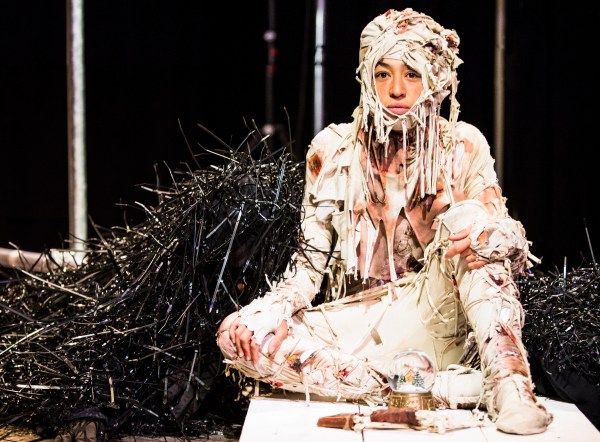
Karagula, Styx

Karagula at The Styx, courtesy of Lara Genovese @ Naiad Photography, Charmaine Wombwell

In a former ambulance depot in Tottenham Hale, Philip Ridley’s latest creation comes to life. This epic parallel world of wholly isolated nation states resembles the worst dystopias imaginable in contemporary fiction. Mareka is a 1950s America with laws enforced to the letter by the Grand Marshall, everyone wears pink, and milkshakes are consumed with religious zeal. Cotna is the future, where people are have numbers instead of names, and watching meteor showers without protective eyewear causes you to hear voices. Then, there’s a community of exiles in the mountains, living in caves, wearing skins, and praying to pre-Christian gods. A storyteller/historian in yet another time and place documents these people and their trials.

These kingdoms have a lot of detail, and a lot of emptiness. The story sprawls over three hours, zipping back and forth across time and place, leaving a swirl of slow understanding, further questions and obvious metaphor in its wake. The text is rich and beautiful, fragmentary and challenging, but it’s only partially reinforced by design. A scaffolding base reveals occasional moments of visual detail, but they generally pale against the language. Karagula is equally marvelous and horrible, an experience for all the senses with stories that enthrall and disturb in equal measure. But Ridley’s Tolkien-esque ambition never reaches its full structural potential.

Individual scenes are just as likely to delight as they are to be forgotten. If Karagula was a tapestry, it would be patchy and moth-eaten in some areas, others would have exquisite embroidery, and still others would be completely plain and ill-fitting. The gaping plot holes leave room for interpretation, but the better scenes feel all the more out of place. Ridley either needs to pare the script right back, or add another couple of hours to join up these worlds more fully. The whole experience is equally delightful and frustrating.

Nine actors play all roles in some exemplary multi-rolling. Producing company PigDog is committed to diversity in casting and audiences, and this cast is admirably so. Obi Abili is a terrifying brutal Grand Marshall in Mareka. Emily Forbes is the fiery leader of the mountain outcasts, initially motherly, then ruthless. Lynette Clarke is similarly versatile, as a flamboyant and vicious Marekan and a cold number in Cotna. None of the ensemble ever let their energy drop; their work is just as fantastic as Ridley’s best scenes.

Director Max Barton approaches the text with clear vision and choices that aid clarity, even in the muddiest sections of text. Designer Shawn Soh has moments of brilliance (beasts with coats of cable ties and a throne of gears and propellers for the narrator are fantastic surprises), but the shoestring budget is noticeable in the inconsistent application of detail.

Despite it’s issues, Karagula packs an emotional punch with social commentary and nihilistic fortune telling. Mareka foreshadows a Trump-led America, and Cotna is a land where technology has ushered in the loss of individualism. There are moments of wonder and horror, and sheer bafflement. Philip Ridley’s vision is commendable, but the execution isn’t quite there, leaving the audience partially sighted. It’s a wondrously alive and human production and like any given human being, it has it its faults and its virtues.

Karagula runs through 9 July.

The Play’s the Thing UK is committed to covering fringe and progressive theatre in London and beyond. It is run entirely voluntarily and needs regular support to ensure its survival. For more information and to help The Play’s the Thing UK provide coverage of the theatre that needs reviews the most, visit its patreon.

Human Animals, Royal Court

https://i0.wp.com/www.officiallondontheatre.co.uk/servlet/file/store5/item365300/version1/fileservice770/365300_770_preview.jpg

I adore animals, certainly more than I like humans, and I think I missed my calling to be a zookeeper or conservationist. I can’t bear any depiction of animals being harmed on stage or film; even mentions of animal abuse is hugely upsetting. So, I found Stef Smith’s Human Animals a pretty horrible ordeal. Smith’s frantic, apocalyptic story captures society’s instinctive, “Must. Destroy. Everything.” response to the natural world threatening contemporary human sovereignty. As the government wreaks havoc on the natural world in the name of security, half a dozen civilians have a range of reactions to the animal population’s invasion of their homes. This visceral, destabilising drama blasts the audience with 75 minutes of shocking, reactive action as the infection spreads across species, but with the fast pace and constant suspense, it’s difficult to relate to any of the characters. Canny design avoids much mess and graphic depictions of the described carnage, but the narrated horror is all too easy enough to imagine from most modern nations, and his highly disturbing on several levels.

Lisa (Lisa McGrills) and Jamie (Ashley Zhangazha) are a young couple supposedly very much in love, though lacking chemistry. Lisa doesn’t like animals much, so isn’t fazed when the government starts killing off the wild ones who are trying to invade people’s homes. She’s had enough of birds smashing into her windows and either dying or injuring themselves. Jamie can’t handle the ruthless killing; his collapse is well written and convincingly performed. Lisa’s boss Si (Sargon Yelda) is one of “them”, a vile, slimy little man profiting from the disaster. Young activist Alex (Natalie Dew) has just returned from travelling abroad, but mum Nancy (Stella Gonet) still tries to treat her as a child. There’s a lot of gorgeous intimacy and tension between them, often diffused by their genial family friend John (Ian Gelder), who clashes with Si regularly in the local boozer. Otherwise, there is little contact between these conflicting personalities, but the reactions from each character to the growing destruction are heartfelt and saddening.

Smith’s best writing is her conflict scenes between the characters. The rest certainly isn’t bad at all, but the storyline requires either depicting the violent extermination of animals or copious narration. Her choice is understandable and, though well incorporated into natural dialogue, there’s a lot of describing. The design team (Camilla Clarke, Lizzie Powell and Mark Melville) work with director Hamish Pirie to break up the text effectively, with sound, lighting, projection and jets of paint constantly interrupting and surprising/startling the audience. Being constantly kept on edge for over an hour is exhausting, with the story causing additional trauma. As horrible as it is, the whole effect is intricately constructed and totes a powerful message.

Also of note is the set design. The cast and audience are inside a zoo-style animal enclosure, disempowering the characters and trivialising their problems because the outside world is dominant and ever watching. Though the set does not literally indicate the characters’ world and gives no hints of the government-ordered extermination and arson that they describe, its tranquillity is calmly sinister.

The production elements and dialogue are excellent, through the relentlessness of Human Animals can alienate – but that’s the point. It’s terrible, clever commentary on contemporary environmentalism, fear of social disorder and individuals’ reactions to what is effectively a civil war and its strong effect will be long remembered by this animal lover.

Human Animals runs through 18 June.

The Play’s the Thing UK is committed to covering fringe and progressive theatre in London and beyond. It is run entirely voluntarily and needs regular support to ensure its survival. For more information and to help The Play’s the Thing UK provide coverage of the theatre that needs reviews the most, visit its patreon.


Interview: Chris Hislop on Barker’s Gertrude

https://i0.wp.com/mytheatremates.com/wp-content/uploads/2016/05/600x425Izabella-Urbanowicz-as-Gertrude-Gertrude-The-Cry-at-Theatre-N16-c-Roy-Tan.jpg

“It is impossible – now, at this point in the long journey of human culture – to avoid the sense that pain is necessity…that it is integral to the human character both in its inflicting and in its suffering…” – Howard Barker

Howard Barker is no stranger to sex and violence. His 2002 reimagining of Shakespeare’s Hamlet places the prince’s mother and her sexuality centre stage in a divisive interpretation of the character who receives little attention in the original story. Rarely staged (most likely due to its relentless, sexually explicit subject matter), theatre PR Chris Hislop returns to directing with this upcoming production of Gertrude: The Cry at Theatre N16 in Balham. The play has fostered a huge range of opinions regarding its depiction of women, feminism and female sexuality and its director has a lot to say on the matter.

Why does this play need to be staged?

It’s a vital, powerful and fascinating piece that tackles feminism and sexuality from a very different angle. It’s also a wonderful dissection of Hamlet – considering the Shakespeare 400 celebrations, now is a great time to be giving the Prince of Denmark an overhaul. It’s also a largely forgotten and underperformed piece by a difficult and complex writer. We need more plays like this and writers like Barker, and if this production inspires anybody to think differently, I’ve done my job well.

Opposing views say Barker presents women in an empowering or negative light. What approach are you taking, and why?

Both – my favourite thing about this play is how it was written to empower an underwritten female character, and yet does such a piss-poor job of doing so. Or maybe it doesn’t – maybe Barker’s aggressive sexualising of Gertrude and blatant female nudity throughout is his attempt at female empowerment. Either way, he’s not a misogynist. Barker’s obsession with women has translated into some wonderful parts in his shows, and he’s always trying to write pieces that celebrate and empower them, just through a rather perverse lens. I don’t want to circumnavigate that entirely, just sand down some of the sharper corners.

What’s so appealing about the character of Gertrude in Shakespeare and Barker’s scripts?

She’s an utter mess. She doesn’t know what she wants, she doesn’t know how she’ll achieve it, and she’s governed by her wants and desires. She’s an incredibly human, rounded character. She’s a mother and a lover, neither of which are mutually exclusive.

Would you say this is a feminist play? Why/why not?

I struggle with the word “feminism”. Our world is defined by our language, and by defining an issue by a specific gender we’re generating responses that hinder as well as help. We talk about “racism” – defining someone by their race – so why don’t we call it “genderism”?

Anyway, I digress: I think this is a play about women, the role of women, and women’s sexuality – not exclusively, I think it has a lot to say about sex in general, but the fact that it does so from a female perspective is important. You could say that it’s not even really from a female perspective; it’s a script by a man, and it’s being directed by a man, but I find such comments painfully genderist. I wouldn’t expect only women to like Carol Churchill, or only men to like books by Ross Kemp.

So – is it a feminist play? Yes. Do I think that’s important? Not really. Do I think it tackles important issues around sex and gender? Yes. Is that important? 100%.

Gertrude: The Cry opens 12 June.

The Play’s the Thing UK is committed to covering fringe and progressive theatre in London and beyond. It is run entirely voluntarily and needs regular support to ensure its survival. For more information and to help The Play’s the Thing UK provide coverage of the theatre that needs reviews the most, visit its patreon.

Schism, Finborough Theatre

https://i0.wp.com/www.finboroughtheatre.co.uk/assets/images/press-images/schism/pre/Schism-3.jpg

Chicago, 1998. Harrison and Katherine are both struggling. Harrison’s wife recently left him and he gave up a challenging career choice for a safer one as a Math teacher. Fourteen-year-old Katherine’s school cannot see past her cerebral palsy, so she’s not allowed to take “normal” classes. Schism begins when both characters reach breaking point: Harrison is mid-suicide attempt when Katherine breaks into his home to appeal for his help to move into his Math class. This initial meeting spawns a twenty-year long relationship between the two, but not a healthy one. Harrison constantly tries to manipulate and control Katherine, who fights for her independence with progressively underhanded methods. Athena Stevens’ script choppily covers the huge time period in sections, addressing several important issues: autonomy within relationships, abuse, life/work balance, failure and aspiration. A play featuring disability that pushes other topics to the forefront, Schism needs more fleshing out but its messages are loud and clear.

Twenty years is a lot of material to fit into a play and at just over an hour, a lot of the plot is left out. There are about four years between each scene, nicely signposted by a current affairs talk radio show, but pivotal transitions are missing. How does their romantic relationship eventually come about? What are the immediate consequences of his awful behaviour? How does her career develop? How did he manage to keep his job after Katherine, in her final year of high school, hang out at his home regularly? These are unanswered, but easily could be by the addition of more scenes. This wouldn’t effect the episodic nature of the script, but would make the story more satisfying. Despite the clunky narrative arc, Stevens’ dialogue still manages to crackle and easily creates tension. There are some great one-liners that spark belly laughs, and moments that are equally horrifying. As set pieces, the scenes are excellent pieces of writing.

Stevens also plays Katherine and displays a clear sense of ownership over the role. Whether or not there are elements of Katherine in her own life, Stevens performance is emotionally genuine and wholly committed. Tim Beckmann gives a nuanced Harrison who transitions from teacher to lover easily, and maintains an undercurrent of desperation. Alex Marker’s domestic design with the ever-present huge, architectural drawings peeking through the windows is a good reflection of the passion that drives both characters, and director Alex Sims displays a good instinct for portraying the journey of a relationship.

Disability issues are ever present and dictate many of Katherine’s choices, but Schism isn’t about her overcoming adversity. It’s part of who she is, but she has other, more pressing problems – university admissions, bidding for work, whether or not to start a family, and civilian objection to her building projects. Harrison does as well, but they are more psychological and harder to resolve. His inability to cope with Katherine’s success in the field where he failed, his inability to have children with his ex-wife and his inability to let Katherine be an independent woman slowly devour him. It’s compelling to witness. In fact, Schism makes more of a statement about feminism within heterosexual relationships than it does about disability awareness, which is hugely refreshing and shows great progress in theatre equality – Katherine’s disability is a part of her, but only a small one compared to her aspirations.

Schism is a provocative relationship drama that certainly resonates despite the holes in the story. This dysfunctional couple can be both delightful and painful to watch, much like anyone in a modern relationship dealing with the other’s baggage. With some further development, Stevens’ play could pack an even heavier punch.

Schism ran through 14 May.

The Play’s the Thing UK is committed to covering fringe and progressive theatre in London and beyond. It is run entirely voluntarily and needs regular support to ensure its survival. For more information and to help The Play’s the Thing UK provide coverage of the theatre that needs reviews the most, visit its patreon.
Russian Dolls, King’s Head Theatre

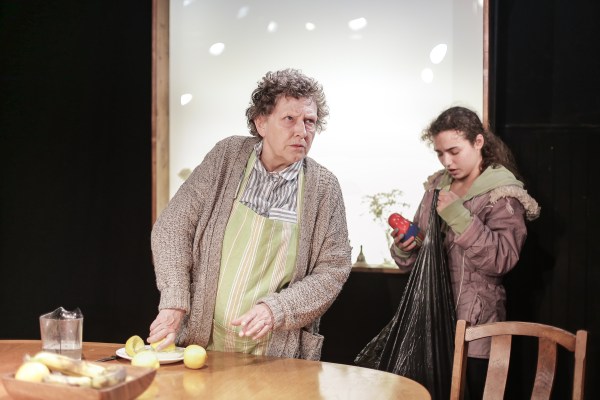
Russian Dolls at King's Head Theatre, Stephanie Fayerman and Mollie Lambert_1 © Andreas Grieger

Camelia’s just got out of young offenders’ but her mum never turned up to collect her, so she’s back to looking after herself. Hilda is a blind elderly woman fending of her goddaughter’s attempts to move her to Basingstoke. When Camelia robs Hilda after tricking into believing she’s covering for her carer, the two end up influencing each other much more than ever expected. Kate Lock’s Russian Dolls tells the fraught story of an unlikely dependency that is doomed to end badly for both women. Lock’s characters are fantastic, and their scenes together are tense and charged with moments of genuine tenderness. In between the scenes are narrative monologues that, whilst providing necessary information, are awkwardly addressed to the ether and disrupt the story’s momentum.

Stephanie Fayerman as Hilda and Mollie Lambert as Camelia are a volatile pair. The energy between them is either stormy or potentially so; the tension makes them wonderfully watchable. Their few scenes of relaxed openness towards the other are fleeting, but hugely rewarding and loaded with tough love. Both performances are excellent, and the dependency on the other is great to watch.

There is no sentimentality towards young people, the care system or aging in Lock’s script. The lack of happy ending is a touch disappointing, but it’s accurate. The stories of young people from broken homes actually managing to turn their lives around are rare considering the 69,540 young people in care as of March last year. Every now and again an “inspiring” case hits the news, but for the majority of these children, their lives are part of an endless cycle of poverty, abuse, drugs and jail time. Well done to Lock for not going the easy route with her narrative.

Structurally, the script is quite simple and there are large, frustrating chronological jumps that skips huge sections of both characters’ emotional journeys. This could easily be a full length, two-act play and would work very well as such. Provided the current ending is kept, a 2 hour or so build up would make it all the more devastating.

Russian Dolls, winner of the Adrian Pagan Award and shortlisted for the Bruntwood Prize, is a bolshy play full of life in all of its glorious imperfections. It’s an honest look at the care system and its flaws, but the actors’ characterization and electric relationship is the highlight of this new play.

Russian Dolls runs through 23 April.

The Play’s the Thing UK is committed to covering fringe and progressive theatre in London and beyond. It is run entirely voluntarily and needs regular support to ensure its survival. For more information and to help The Play’s the Thing UK provide coverage of the theatre that needs reviews the most, visit its patreon.

A Nation’s Theatre: Wail and The Beanfield, Battersea Arts Centre

For two months, theatre makers from across the country are coming to London to celebrate the state of British theatre. One of the A Nation’s Theatre venues is Battersea Arts Centre, currently hosting the double bill of Little Bulb’s Wail and Breach Theatre’s The Beanfield. Wail is an exuberant cabaret about whales and human expression; The Beanfield uses multimedia to examine the impact of police violence on peaceful people and the need to fit in. Though different from each other in content and tone, both Little Bulb and Breach play with performance conventions to create innovative new structures that are at the forefront of theatre performance.

WAIL_Little Bulb Theatre

There’s a lot of science in Wail, and a lot of musical instruments. Actor-musicians Clare Beresford and Dominic Conway, performing as themselves, also have boundless enthusiasm and impressive music repertoires. With material ranging from folk to metal, they share their enthusiasm for whales through songs alternating with monologues of scientific facts. Their charisma and cheer keeps these sections engaging, particularly with the addition of audience interaction. Though the overall energy is light and positive, Beresford’s melancholy for never actually seeing a whale in the flesh provides a bit of contrast to the Male Whale Choir, a hilarious whole-audience exploration of whale songs that males use when on the pull in the coastal waters of Madagascar.

There isn’t as much material on the promised exploration of why humans wail, but a song about why they sing songs is a tender, poignant homage to feeling fragile. This fun, frivolous show is light on the gravitas that a bit more time on this topic could bring, but Wail is still a wonderful, joyful piece as is. The symphonic final number is a fantastic climax wrapping up an excellent contribution to A Nation’s Theatre.

The Beanfield_014_please credit Richard Davenport

The Beanfield by Warwick University’s Breach Theatre wowed audiences at Edinburgh last summer, and understandably so. Drawing on the historic clash between new age travelers heading to Stonehenge and police fresh from the miners’ strikes, they add the framing device of a uni reenactment group researching the event in order to recreate it, and a counter narrative of a group of students going to Solstice. It’s a sophisticated script with plenty of absurdity to lighten the bleak depiction of police violence against unarmed civilians, but still serves as a potent reminder that this happens today in the UK and abroad. Part documentary, interview footage with witnesses on both sides is broadcast liberally; even though the inclusion of police is sympathetic, The Beanfield firmly supports the travelers. Rightly so – pregnant women and children were among the 600 or so attacked with truncheons and projectiles by 1000-odd police.

There is no explicit link between the Beanfield story and that of the contemporary, skeptical students at Solstice, but the inclusion of the latter provides some necessary humour. It’s not a needed subplot though, and detracts from the power behind the political statement of the Beanfield standoff. The script is a great collage of experiences past and present, the sweet naivety of students juxtaposing the atrocities that happened at thirty years previously. The Beanfield, a bit less polished than Wail, is still an excellent piece of theatre with some important thoughts on police brutality.

With multimedia at its forefront, The Beanfield captures the rapid-fire sensory bombardment of present day youth and the desire to instigate change as well as fit in with our peers. Wail, mostly analogue and much less angry, implies the importance of conservation and sympathy for all creatures, human and not. Both shows excellently address concerns of people in this country and experiment with performance, fitting contributions to A Nation’s Theatre.

Wail runs until 23 April, The Beanfield until 21 April then touring.

The Play’s the Thing UK is committed to covering fringe and progressive theatre in London and beyond. It is run entirely voluntarily and needs regular support to ensure its survival. For more information and to help The Play’s the Thing UK provide coverage of the theatre that needs reviews the most, visit its patreon.