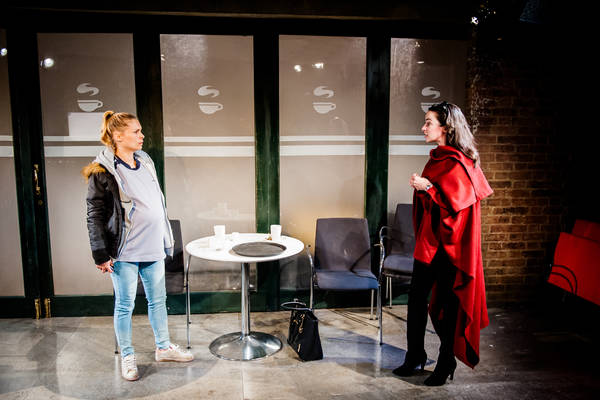
Weald, Finborough Theatre

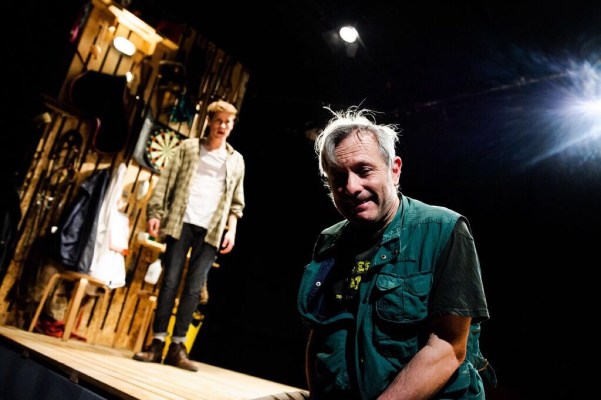
As picturesque as agrarian life may be with it’s rustic farmhouses, sweeping land and livestock, it is not an easy one for older and younger generations who just want to make a decent living. Faded and weather worn, Sam looks after his horses as he’s done his whole life; the younger Jim is all bouncy, boyish banter. The two clearly have much affection for each other in this emotive story of a tragic hero’s fall. But Daniel Foxsmith’s Weald, though full of poetry, passion and the ability to find the audience’s raw nerves, at just over an hour it sells itself short and lacks the sweat and earthiness of farm labour.

Sam (David Crellin) and Jim (Dan Parr) spend most of their time in a barn surrounded by riding tack and looking after horses. Though everything seems well, dramatic revelations are eventually confessed, bringing fiery conflict between the two. Crellin and Parr’s performances are exemplary, with emotional journeys that are the kind actors dream of. They both relish Foxsmith’s rich language and have a wonderfully watchable presence. Their character journeys feel rushed, though; this is wholly down to the script. It’s too short to justify Sam’s final, sudden deterioration that harks of Shakespeare’s Henry V should he have failed at Agincourt.

Bryony Shanahan’s direction taps into the poetic and powerful heart of the script that addresses coming to terms with personal failure, life choices and platonic male relationships that span decades. Her regular use of the audience space shows this is a story that won’t be contained. Though a masculine play, it’s still accessible to female audience members what with the themes that transcend gender. As a failed actor having to adapt to a new and totally unplanned for life, Sam’s struggles particularly resonate and left me feeling exposed and vulnerable, but the grit endemic to farming is glaringly absent. Linguistically heady, Weald lacks a visceral-ness. Even Sam’s final actions when faced with his own ruin are stylised, distancing the audience from the characters’ emotional life.

This is still a beautiful play with fine performances and painfully relevant to present day economic uncertainty, but it’s a sanitised version of real life. Though Sam and Jim mock the wealthy city family that bought the farm house, covering it in solar panels and driving a spotless Range Rover, their daily routine as depicted in the script bears more resemblance to the unseen city man with his shiny wellies than the true life of yard workers.

The Play’s the Thing UK is committed to covering fringe and progressive theatre in London and beyond. It is run entirely voluntarily and needs regular support to ensure its survival. For more information and to help The Play’s the Thing UK provide coverage of the theatre that needs reviews the most, visit its patreon.

The Master Builder, The Old Vic


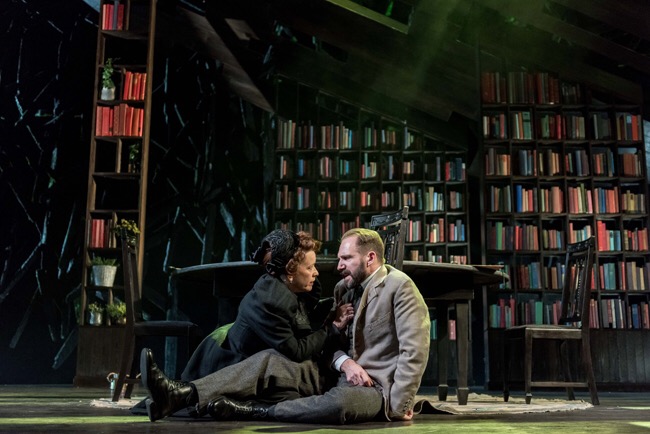
Halvard Solness is afraid. He’s afraid of young people displacing him, and heights. But he is revered as the master builder of his town, a self-made man with luck on his side. The middle aged, unwell Halvard is surrounded by similarly unwell people: a wife who never recovered from past losses, a dying employee and a lovesick clerk. When a young woman he met ten years before arrives on his doorstep and disrupts his routine, the Everyman’s life goes into free fall. This dense, wordy production of Ibsen’s late work is a tightly coiled spring with exquisite design, but David Hare’s adaptation could use a good trim.

Luckily, Ralph Fiennes’ stage presence has been found some time between now and his Prospero at The Haymarket several years ago; Master Builder Halvard Solness flits around the edge of exploding for for nearly three hours and makes for captivating viewing. His tension isn’t alone, though. Linda Emond plays his wife Aline, a woman haunted by traumatic events in her past. Their cold, loveless marriage adds to the despair that hangs over the play. Even with bright spark Hilde Wangel (Sarah Snook), the foreboding and gloom still lurks on the edge of their existence.

Despite the grand performances, the set steals the show. Rob Howell’s design is grand and imposing, with symbolic elements that complement the play’s mood and tone. Curves and lines blend to create contemporary forms, but with a weight and scale that implies the architecture is not of this era. Hugh Vanstone’s lighting adds atmosphere and shadow, further emphasising plot points, but it could be used more often to create more visual variation. Though there are changes in both of the two intervals, the dominant elements remain until the climactic final moments; the sudden disintegration proves more surprising than the characters’ actions in the story itself.

Hare doesn’t skimp on language, but even though the two intervals prevent this production from feeling like its two hours and forty-five minutes, some of the scenes begin to lose momentum. Hare doesn’t attempt to make the language contemporary and maintains the script’s intellect, but neither is it hard to follow. There are just a lot of words, more than are actually needed. Snook uses her physicality most effectively, but the rest of the cast stick to the constraints of the text when extracting characterisation. Fiennes’ Halvard visibly relaxes in the presence of a younger woman, but outside of these infrequent moments, it’s all about the words.

Despite Matthew Warchus’ modern update of the Old Vic’s interior, this production of The Master Builder is firmly rooted in old fashioned realism. It’s a real treat for the senses with wonderful performances and a huge scope for interpretation – a most excellent production of a classic, despite its length.

The Play’s the Thing UK is committed to covering fringe and progressive theatre in London and beyond. It is run entirely voluntarily and needs regular support to ensure its survival. For more information and to help The Play’s the Thing UK provide coverage of the theatre that needs reviews the most, visit its patreon.

Top Ten Shows of 2015

rsz_top10-620x400

  1. Carmen Disruption 

This Simon Stephens deconstruction bore little resemblance to the opera. Instead, we had a cast of dysfunctional, damaged characters unable to connect with the world around them on any meaningful level. They filled the Almeida with an electric loneliness that grasped the desperate humanity residing deep inside us all before chucking us out, exposed and raw, into the London night.

  1. Pomona

Written by a 27-year-old, Pomona captures the millennial generation in a single play. Frantically set over several levels of dystopian reality and never able to settle, this epitomises those who suffer the consequences of  baby boomers’ past choices.

  1. Light

The first show I ever gave five stars to, after more than a year of criticism. Good intentions and government exploitation address increasing surveillance with stunningly precise physical theatre, object manipulation and light.

  1. Tether 

A two-hander about a blind runner and her guide, this piece is refreshingly unromantic and driven by dialogue and characterisation. This is a simple and powerful piece by a promising young writer set in a world rarely considered by non-disabled people.

  1. Shakespeare & the Alchemy of Gender

A solo performance by veteran Shakespearean, Lisa Wolpe, founder of L.A. Women’s Shakespeare Company. Exquisite extracts of Shakespeare’s most celebrated male roles interspersed with her father’s biography raises important points about performance, gender and family.

  1. Town Hall Cherubs

Theatre Ad Infinitum and Battersea Arts Centre team up to create an immersive, site-specific piece for 2-5 year-olds. Gentle and responsive to the children’s attention spans, this is a bit of a winter treasure hunt around the BAC that stimulates all the senses.

  1. Chef 

Another sharp one-woman show, this one by Sabrina Mahfouz and performed by Jade Anouka. Anouka is a Michelin-star chef who runs the prison kitchen. Part fictional memoir/part foodie homage, this character driven piece cuts an unforgettable character.

  1. This is How We Die

An explosive spoken word/music piece by Canadian Chris Brett Bailey, it defies description and instead must be experienced. A marmite production amongst critics but Bailey’s use of imagery within language is incomparable.

  1. Don Q

A warm and lovely adaptation of Cervantes’ novel, Don Q is an old man’s gleeful adventure story. Four actors multi-role through this story that looks at the way we treat the elderly and the joy of play-acting.

  1. Eclipsed

Set during the Liberian Civil War, the all-woman cast of Danai Gurira’s doesn’t hold back on the experience of women in wartime. This is a brutally raw survival story with the power to leave you shaken, guilty and grateful for the benefits of Western comforts.

Honourable mention: Invisible Treasure

This is an interactive experience that is audience-led, with no actors and no plot. Like a game, the audience is led into a hi-tech room and led through a series of tasks in order to escape. Fun, challenging and frustrating, it makes some powerful points about group dynamics and personal approaches to problem solving.


The Play’s the Thing UK is committed to covering fringe and progressive theatre in London and beyond. It is run entirely voluntarily and needs regular support to ensure its survival. For more information and to help The Play’s the Thing UK provide coverage of the theatre that needs reviews the most, visit its patreon.

The Wasp, Trafalgar Studios

rsz_the_wasp_trafalgar_studios_courtesy_ikin_yum_20

Hampstead Theatre does it again with another powerful, thought-provoking transfer after last month’s Four Minutes Twelve Seconds. Heather and Carla went to secondary school together about 20 years ago, live in the same town, but have little else in common. Heather comes from a stable, middle class family, is now married and lives quite comfortably. Carla is working poor, pregnant with her fifth child, and has a drunkard for a husband. Both had a terrible time in high school: Carla came from an abusive home, and Heather became one of a Carla’s targets after a brief friendship in year 7. They haven’t seen each other since school, but out of the blue, Heather asks Carla for coffee and makes her a surprising offer in Morgan Lloyd Malcolm’s both horrifying and enthralling The Wasp.

Myanna Buring as Carla and Laura Donnelly as Heather are an electric pair, as they should be in this relentless two-hander with sudden plot twists that keep the audience guessing. Their characters’ contrast naturally creates tension anyway, and the story generates even more. Most of the play is a hotbed of tension. The layers of lies and manipulation and abrupt reveals are surprising; there are audible gasps from the audience at certain key moments. The script has a fairly formulaic structure, but it’s the content that surprises. Albee’s Zoo Story, Miller’s The Crucible and most of LaBute’s work appear to influence. The characters’ behaviour is shocking, but the realisation that this could be anyone we know, or ourselves, uncomfortably resonates within.

Though there are a lot of big social and psychological issues presented: revenge, infidelity, class difference, abuse, rape and infertility. It doesn’t feel excessive to conflate them, but aids in creating complex characters that feel like genuine people backed up by Buring and Donnelly’s performances. This toxic cocktail of topics emphasises just how easy it is to cause lasting emotional damage in someone unintentionally, be it a family member, friend, partner or acquaintance. Kids especially: we all had tough times at school and treated each other badly but children are so self-absorbed (the ability to empathise is the last part of the human brain to develop) that they don’t often realize the consequences of their actions. And this is why each and every one of us is the hot mess we are, because of how we were treated by others when we were younger. It doesn’t take much more on top of all the baggage we already carry to send us over the edge, and that message resounds loud and clear through the women’s past and present actions that slowly unravel in the intimate Trafalgar 2.

David Woodhead’s set similarly beds in the horror of the characters’ actions. Benign, commonplace objects become aids for capture in his construction that emulates life. There’s an overly lengthy set change, but the transformation from outside a dingy café to Heather’s sitting room is as big a difference as the two women are to each other. The detail and naturalistic design make the story feel all the more like real life, an effective and powerful choice when simplicity and abstraction are the more common styles.

The Wasp presents the capacity for evil within each of us whilst challenging social stereotypes and making powerful comment on how we treat our fellow human beings. Outstandingly committed performances endowed with energy and high emotion and Lloyd Malcolm’s script create a disturbing landscape, disguised in the routine of day to day life, that can be revealed in a moment.


The Play’s the Thing UK is committed to covering fringe and progressive theatre in London and beyond. It is run entirely voluntarily and needs regular support to ensure its survival. For more information and to help The Play’s the Thing UK provide coverage of the theatre that needs reviews the most, visit its patreon.

Song from Far Away, Young Vic Theatre

Willem is 34. He moved from Amsterdam to New York City 12 years ago. After an inconveniently timed phone call from his mother on a cold New York morning, he goes home for his younger brother Pauli’s funeral. He is greeted by his father’s disappointment, his sister’s lectures and the disorientation of not knowing where “home” is anymore. Much has changed, yet so much has remained the same.
I’m 33 years old. Eleven years ago, I moved to the UK from New York City. I use the term “home” fluidly because I don’t know where that place is anymore. So far I haven’t had to suddenly return for a family funeral, but that time will come. I know too well that disarming, unnamed feeling of simultaneous comfort and sadness from remembered places and people, those that have stayed the same and those have changed or disappeared altogether. There are many things that I miss, but much that reinforces my choice not just to leave, but to stay away.

I should have been in tears by the end of Song from Far Away, especially as I saw the 11 September performance, a day indelibly impressed on my memory with an anniversary no easier to bear with each passing year. Willem unexpectedly lost his little brother to an undiagnosed heart condition; I fortunately lost no one in 9/11. I was moved at times, by Simon Stephens’ delicate language, Mark Eizel’s folksy travelling tunes, and Eelco Smits’ honest portrayal of Willem’s understated struggles. Frustratingly, I never received the cathartic cry I sought from this production though, and I should have, considering how keenly I relate to Willem.

The performance and design elements are subtly beautiful, but the production is skeletal. The changing light and shadows of time passing have more connection to the present than the character does, who is more at home in transit than in the arrival at a place. The production seems to want to be minimalist in the extreme in order to draw attention to Willem’s displacement in the world, but in doing so creates an ethereal anti-theatre that doesn’t manage to come close to the audience’s heartstrings. Willem’s extended monologue in the form of letters to Pauli opens his heart to us as he (literally) bares all, but his world is so insular that we are excluded. We can witness, but not engage.

Stephens’ script sounds like it would read better on the page than performed as a theatre piece, at least with Ivo van Hove’s chosen directorial concept. The language is undeniably beautiful and human, and creates a wonderful character, but the production concept distances and isolates him from us, reinforced in the final moments of the play. A Song from Far Away is just that – too distant to hear the details of a faintly mourning cry on cold winter’s day in New York City. We want to comfort the singer, but he is moving further out of our grasp the longer we listen.


The Play’s The Thing UK is an independent theatre criticism website maintained voluntarily. Whilst donations are never expected, they are hugely appreciated and will enable more time to be spent reviewing theatre productions of all sizes. Click here to make a donation with PalPal.

Britannia Fury, Hen & Chickens Theatre

2015-05-07 20.33.52 (2)“Never meet your heroes.”

This stark warning from one character to another foreshadows the absurd, disappointing story about to unfold. Part satire, part pantomime, part superhero spin off, Britannia Fury introduces us to Britain’s only real superhero. He is now an elderly alcoholic living in a council flat after his epic rise and consequential fall into obscurity, but a young reporter has located his address and is determined to share his forgotten story with the world. A mix of performance styles and a story that can’t quite seem to determine what it wants to say prevents the concept from developing into a strong script.

Mr Jameson (Kit Smith) is the exaggerated stereotype of an editor of The Daily London Leader. Loud and abrasive, he provides complete contrast to the nervous Charlie (Ethan Loftus), a young reporter not even on Jameson’s radar. Charlie has the scoop of the year and negotiates with Jameson to let him interview 70s and 80s superhero Britannia Fury, who saved the nation from villainy only to mysteriously retire and disappear. Charlie wants to share the story of this forgotten hero with the nation. Loftus plays Charlie naturalistically, with a quiet, geeky passion for Fury. Whilst both Smith and Loftus embody their characters respective styles well, they clash and cause the production concept to look like it lacks direction. The other characters add to the soupy style mash up rather than siding with one of the earlier, established performance styles. Fury (Geoffrey Kirkness) is a mix of stereotype and naturalism, which adds depth but only further confuses the production’s identity. This is an issue with the script and direction rather than the performers, but one that can be solved by the playwright choosing one approach and sticking with it across all the characters.

The storyline, with its clear premise, becomes convoluted as Charlie and Fury meet and delve into his past. There are some predictable plot twists that lead to a tragic end; again, the initial idea has good potential to explore the human condition through Fury’s story but this is glossed over and made light of with comedy and exaggeration. Charlie’s initial shock of meeting his fallen hero is underplayed, then forgotten, but his emotional journey hits some good points. Their interview occasionally drags, as if the play is trying to buy time rather than following the natural narrative arc and getting to the point. As Charlie delves deeper into Fury’s twisted Tory past, it becomes clear that Jameson’s initial warning rings true.

The idea of the fallen hero in modern times certainly has mileage and Hillcrest Artists begin to solidify interpretations of the theme but they don’t quite come to fruition. Is the play about politics? Is it about society’s short attention span? Or, is it smaller and about the relationship between two people? Is it making fun of superheroes? Is it about Fury’s humanity? Really, it is all of these things and more, but for a play not much longer than an hour, this is too much to try to address. There are some touching moments and witty dialogue but underlying substance doesn’t quite materialise in Britannia Fury.


The Play’s The Thing UK is an independent theatre criticism website maintained voluntarily. Whilst donations are never expected, they are hugely appreciated and will enable more time to be spent reviewing theatre productions of all sizes. Click here to make a donation with PalPal.

Titus Andronicus, Greenwich Theatre

*sAll-male Shakespeare companies justify their existence in the name of historical accuracy and providing audiences with insight into this important aspect of original Shakespearean practice. Whilst I do not negate the educational importance of such companies, the number of female theatre roles compared to male roles hardly makes this practice fair. Smooth Faced Gentlemen is an emerging all-female Shakespeare company that helps redress this imbalance and allow women the opportunity to take on great roles normally only open to male actors. Whilst they are extremely successful in creating masculine performances, capturing the energy of the text, and director Yaz Al-Shaatar has a superb instinct for striking visual theatre, the reasons behind some of their production choices in Titus Andronicus are unclear and casting tends towards younger performers.

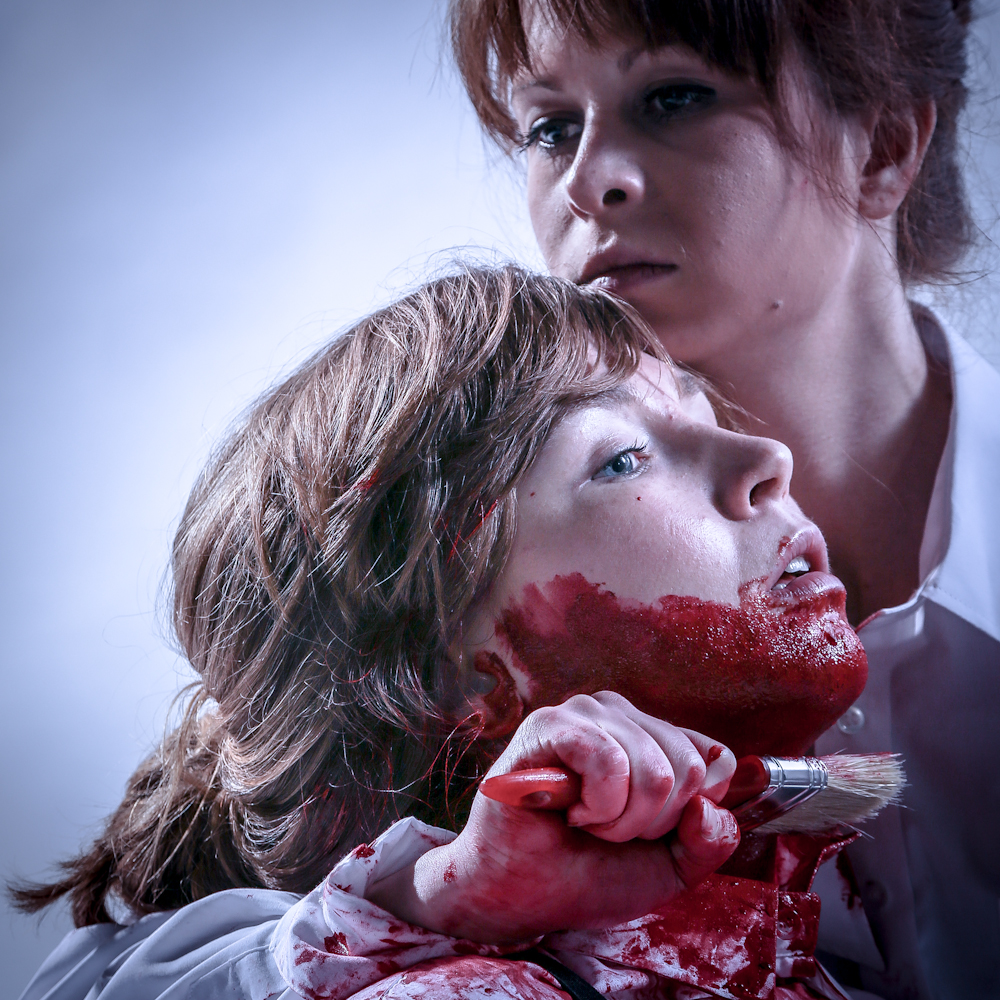
The eight-member cast wears a monochrome uniform of black skinny jeans, ankle boots, white shirts and black braces. Coats, scarves and a wheelchair identify character changes, as do physical and vocal alterations. The set is completely white, but not for long. As Shakespeare’s most gruesome play energetically unfolds and characters are mutilated and killed, the red paint in the tins on the stage edges soon covers the floor, walls and the actors. I’m rather surprised the audience managed to escape any paint splatter. Rather than swords, they have paintbrushes tucked into their waistbands that are dipped in paint before an attack. The paintbrushes were used with the same movements as swords, slicing and stabbing. With such a striking use of weaponry that normally creates rather than kills, it would have been a more unique choice to explore stylized movement rather than emulating real life. As it was, there was a level of absurdity to stabbing someone in the back or slitting a throat with a paintbrush. Perhaps this was a comment on the absurd amount of death and destruction in the play? Perhaps the murders are being compared to art, or even DIY where the old and excess is cleared to make room for new? Or perhaps I am reading too much into it and Al-Shaahtar made this choice simply because it was unique and looked great. White, black and red will always be a powerful colour scheme. The liberal use of red paint highlighted just how brutal this play is.

The performances were on the whole very good. Ashlea Kaye’s Marcus and Demetrius were a highlight of contrast between an ill, old man and scrappy, oversexed young manhood. Kaye is clearly a versatile performer with outstanding stage presence. Ariane Barnes was a formidable Titus, fully believable as the successful general that ruthlessly seeks revenge for his downfall. The ensemble work is excellent with smooth transitions at a fast pace. The ensemble aspect didn’t quite work as the actors remained on stage most of the time, but lounged casually on the periphery, half in the wings, watching the action when not performing. The goal is to enhance the ensemble aspect of the production, but the halfway approach came across as non-committal. Either be present on stage and dynamically contribute to the stage picture, or be out of sight. Otherwise, it lends itself to distractions. I would guess that the oldest cast member is in her early 30s; having a wider range of ages would make their diversity even more commendable.

With a running time of about an hour and 15 minutes, this was a good length to convey the main focal points of the story, but cutting this play can be tough. As one of Shakespeare’s earliest plays and his first attempt at writing a tragedy, it can feel quite clunky. Cutting it cannot overcome this quality and can occasionally exacerbate it. In this case, the tragic downfall of the central characters occasionally felt rushed, but not overly so. An interval wasn’t particularly necessary and felt like it occurred very late in the story. Generally in this version, the editing did a good job at preserving the story and capturing Titus’ life rapidly collapsing around him.

As previously mentioned, the energy was extremely high and well-maintained throughout. Moments of humour lightened the tragedy, particularly good was Tamora and her sons’ portrayal of Revenge, Rape and Murder. Another lovely moment is Aaron (Anita-Joy Uwajeh) meeting his newborn son for the first time and refusing to allow the child to be killed. There were numerous others. Smooth Faced Gentlemen have a clear gift for making Shakespeare accessible and telling a cracking story. They are certainly a company to follow as they grow and develop their performances.


The Play’s The Thing UK is an independent theatre criticism website maintained voluntarily. Whilst donations are never expected, they are hugely appreciated and will enable more time to be spent reviewing theatre productions of all sizes. Click here to make a donation with PalPal.