
 “Immersive” is a trendy term that’s rather overused in theatre at the moment. But what is it, exactly? The same can be said for “site-specific” and “interactive” theatre. Audiences are seeking out alternative theatre experiences that aren’t just sitting in a dark room and watching actors tell a story, and theatre producers are obliging, using the aforementioned vocabulary often too liberally and consequently diminishing the words’ meaning. Established practitioners of immersive performance include Punchdrunk, probably the most well-known, Secret Cinema’s events that are part cinema and part theatre, and Coney’s use of game design to empower audiences. Many other companies and individual shows also describe their work as immersive; some definitely is whereas others is less concretely categorised. CCSD lecturer Dr. Gareth White says the accepted definition of immersive theatre is a production that contains “installations and expansive environments, which have mobile audiences, and which invite audience participation.” But is that entirely accurate?
Never Ending Night at the Waterloo Vaults is immersive in that the audience is freely mobile in a space fully kitted out as a bunker for the survivors of a global pandemic. The audience is first taken through decontamination, where personal effects are checked and white boiler suits and masks are provided. There is a distinct air of authority that the audience dares not violate. The first part of the performance is set outdoors in one of the two large rooms that contain the show. It’s a desolate street, with bodies of the living, barely living and dead. Lighting guides the audience to individual moments, promenade style. This provides clear, concise exposition to the world created. Narratives overlap, creating snapshot moments of grief and desperation, but it’s not frantic. Soldiers in boiler suits take the last survivors and the audience into the next room, where the rest of the play happens.
The audience can spend as much or as little time with any given character as they chose. There are several options: following a character, staying in one space to see what characters come and go, or move to scenes as they occur; each will create a totally different experience. The survivors have all been in this bunker for quite some time, and a reference to nearby Waterloo Station adds an element of site-specific performance, but doesn’t seem important to any particular narrative. The structure gives the audience autonomy, but with a large cast, individual characters have few scenes so it’s hard to connect to their experiences and learn about the little details of their lives.
There is no interaction between the audience and the actors, which raises the question of whether or not Never Ending Night is fully immersive. Can immersive theatre not be interactive? My initial instinct is to say no, but I don’t know if that’s necessarily correct, showing the issue with the lack of a standard definition. The audience here, even in provided costume, are merely observers with an unclear role. They are not residents of the facility, nor are they government officials. Even if they are there to observe, the reason why is never made clear.
Created by a company of actors trained in the Meisner Technique of character development, this quietly ending piece feels more like an extended acting exercise. It would certainly be possible for the audience and actors to speak to each other without disrupting the main scenes at any given moment, but create a new level of intimacy and depth. There characters are interesting enough to want to engage with them, but the audience was invisible. There are numerous encounters between characters and emotions are often running high, which make for excellent bursts of dramatic tension. These are too brief, within a form that goes on for too long, however. The ensemble cast remains excellent, with immense focus and emotional truth Meisner would commend. The gentle ending is a powerful anti-climax, after which the audience is set free into the night.
It is a well-managed, polished piece of ensemble theatre, but the opportunity to develop a relationship with the characters is not provided. They would continue to function and interact in their world with our without the audience present. Consequently, this is a great production for those looking for an unconventional theatre experience without the pressure of audience participation. The setting is clear, but what isn’t, is what the audience is meant to take from the experience. Still the performances are good, as is the design and it’s a worthy attempt at a form that is still developing, whether or not it really counts as immersive.
The Play’s The Thing UK is an independent theatre criticism website maintained voluntarily. Whilst donations are never expected, they are hugely appreciated and will enable more time to be spent reviewing theatre productions of all sizes. Click here to make a donation with PalPal.
 There’s an abandoned island in the middle of Manchester. One gated and guarded road goes in and out. Zeppo owns it, like much of the land in Manchester, but he doesn’t like to get involved in the goings on at his properties. Too risky. After Ollie’s twin sister disappears, Zeppo tells her to try looking for her on his abandoned island, Pomona. So she does.
 During WWI, men considered too afraid to enlist were given white feathers by those disapproving of their cowardice. Also common were boys too young to join up lying about their ages so they could experience the excitement of battle. Then there were the hundreds who were killed for desertion and cowardice in the face of the enemy. These young men suffered from PTSD, an ailment not understood or acknowledged until well after the war was over.
 wo estranged sisters dig through a rubbish tip after their mother’s funeral. Recovering heroin addict Becky, in a moment of anger, had thrown away an unopened letter from their mother containing important information. Older, responsible Diane insisted they recover it, so here they are in their funereal finery, ankle deep in trash, full of hatred, resentment and grief. New company Indigo Iris, founded by actor-producers Emma Shenkman and Georgina Philipps, debut with Arthur M. Jolly’s Trash, a two-hander with potential for absurd situation comedy that instead plays it straight, focusing on the complexity of sisterhood and familial responsibility.
 Willem is 34. He moved from Amsterdam to New York City 12 years ago. After an inconveniently timed phone call from his mother on a cold New York morning, he goes home for his younger brother Pauli’s funeral. He is greeted by his father’s disappointment, his sister’s lectures and the disorientation of not knowing where “home” is anymore. Much has changed, yet so much has remained the same.
 The pool preserving the remains of The Rose Playhouse is the sea surrounding a nameless, remote island. Fascinating, dangerous, wild or wonderful, all of the island dwellers have lengthy, close relationships with the sea, for better or worse. These intertwining, turbulent histories meet and join each other at the Old Man and his Boy, a story of a new, young love and a past love, long lost. Heady Conduct’s Reckless unfolds a timeless tale of love, truth and community dictated by the sea using narration, site-specific influences and direct address interspersed with conventional performance. The story is both sweet and saddening, but the play’s structure is disjointed and thin, occasionally unclear in time and place, causing the story to lose support and clarity. Fortunately, the scenes between characters are endowed with honesty and intimacy, and the unique performance venue is fantastically utilized by director/actor Rebecca Rogers.
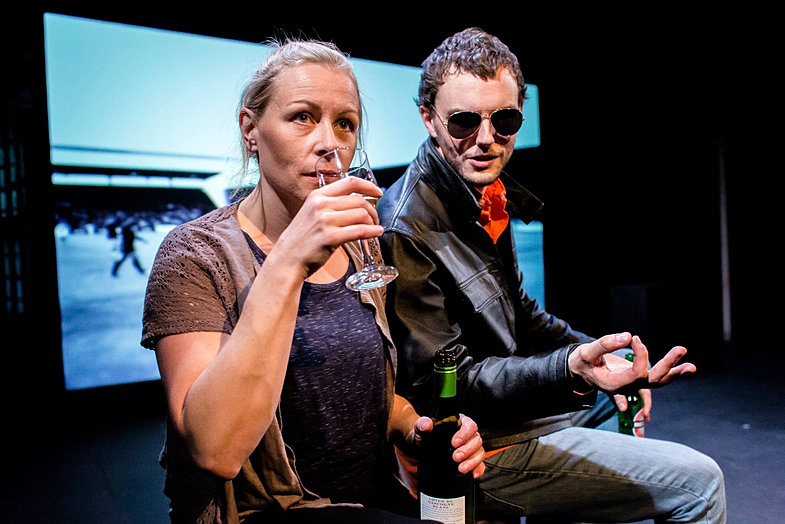 Carol (Holly Joyce) moved to a village in Carcassonne to rebuild her life after a devastating divorce and her son had grown up. She is convinced that in a past life, she was a medieval troubadour called Guy in the time of the Cathars. Raymond (Danny Solomon) is an actor working in the second-rate tourist attraction that Carol stalks, and longs for a life in the more exciting London. With a poetic, reflective script by Nick Wood and direction by Natasha Wood, Consolation has riveting moments between these two damaged, conflicting characters as they travel on parallel journeys of self-discovery, but at two and a half hours with a lengthy, slow-burning beginning, the production could use a trim. The slow development and several sub-plots lend a real-life complexity to the story, though the last to be introduced has insufficient expositional time considering its importance to the play’s conclusion. Despite the script’s need for additional development, this is a moving character piece unsentimentally following two individuals as they come to terms with the insubstantiality of their dreams.
 A walk to a “secret location” ends in a dimly lit warehouse for Volcano’s show about the effects of coal mining. It is a promenade production that literally destabilises the audience, who have to walk over a floor covered with large chunks of the black stuff. Four actors taking on roles both historical and fictitious physically capture miners’ suffering in horrific working conditions. Disappointingly, in a piece with such a focus on introducing the characters at the beginning, their individual stories are neglected in favour of the visual and aural. Some of the metaphors make sense, like the animalistic dining scene showing the reduction of the miners to baser creatures, others are less clear. I still don’t understand the incorporation of Anna Karenina and playing cricket in their pants. Black Stuff is surreal and abstract, but so much so that any message or idea trying to be communicated is almost completely lost.
 Late Night Love is a sweetly nostalgic, and very funny, piece revolving around a phone-in radio show the three members of Eggs Collective listened to as teenagers. Having not grown up in the UK, I missed a lot of the cultural references, but the teenaged idealism about love and relationships is universal. Power ballads and dating conventions are gently mocked, but lovingly remembered. The two-way radios on each table are underused, but an interesting device that places the audience inside the radio show listened to in the dark. Though quite structurally loose at this point, it’s a show that speaks fondly of a specific era and development stage of teenage girls.
 Made in China’s Tonight I’m Gonna Be the New Me blurs the line between truth and fiction through founders Tim Cowbury’s and Jessica Latowicki’s real-life relationship laid bare onstage. The premise is that Tim has written the show that Jess performs as Tim runs the lights and takes notes at the back. Jess dances inside a metal box wearing sequined hotpants and a halter top, an object for our delectation, and presumably Tim’s. She soon hijacks the script that descends into the two picking at each other’s faults, empowering herself as the audience are voyeurs of their argument. What is truth and what is fiction? This blurring is far more interesting to consider than the argument typical of a long-term relationship that unfolds. The made-up story of Tim’s death returns the piece solidly to fiction, again made more interesting in the idea of fantasizing about a partner’s death (we all do it!) than the story itself. I expected the content of Tonight I’m Gonna Be the New Me to be far edgier than it was, though the ideas within the performance are certainly fascinating on several levels.
 Confession: I don’t like Friends. I find the acting two-dimensional, the jokes not funny and it bears no reflection on real life in New York City, where I spent four happy years at drama school. So I was reluctant to see MOTOR’s Ross & Rachel, because I thought it’s about the couple from Friends.
