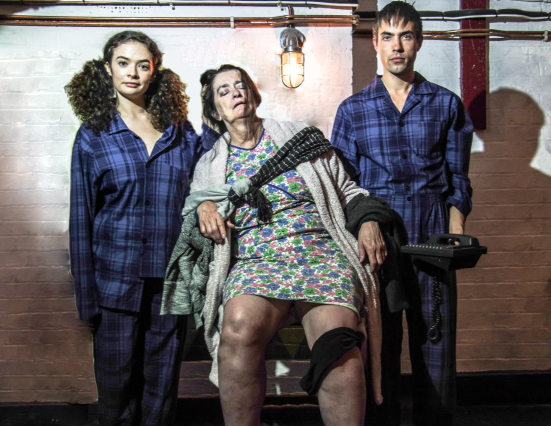
George Orwell’s first full-length book, Down and Out in Paris and London, documents the Eton graduate’s foray into a life of artistic poverty in the 1920’s. About 80 years later, Polly Toynbee spent a period of time living on the minimum wage in London to write her book, Hard Work: Life in Low-Pay Britain. Writer and director David Byrne (not that one), deconstructing and interweaving these two books, creates a hard-hitting new play that confronts contemporary notions of social progress by demonstrating that experiences of a life in poverty have not improved, and “the system” created to support some of society’s most vulnerable people is inherently flawed.
A finely tuned, energetic ensemble of six multi-role a huge range of characters across London and Paris; only Richard Delaney as narrator George Orwell plays one part. His character consistency is the linchpin that holds the Paris story together, countered by Carole Street’s impressively performed Polly Toynbee. Mike Aherne, Andrew Strafford-Baker and Stella Taylor play a diverse array of smaller characters spread across both time periods using accents and costume to distinguish them. There is potential for confusion what with the constantly alternating worlds, but these three actors support clarity and understanding. They are also clearly talented performers; the only downside is that they didn’t have larger roles to really sink their teeth into.
Structurally, Byrne’s script is sound with clear transitions and sufficient exposition. He skillfully avoids audience confusion despite the constant switching between the two different settings. Polly and George embark on similar character journeys, albeit with slightly differing initial aims, but end with the same deeper understanding of society’s invisible working poor. The play is narration-heavy, restricting meaningful character interactions to unsatisfying short scenes. It also can feel more like a lecture than a performance. The fragmentary nature successfully drives the message home, particularly as adjacent scenes in the different settings focus on identical topics, including the bureaucracies of job hunting, flat hunting, and work environments. The play is robust and important enough that it deserves to be lengthened, which would allow for more development of the characters and scenes that are already present. Further emphasis on the individual human lives affected by crushing poverty will also generate further gravitas and audience empathy.
Down & Out In Paris and London returns to London’s New Diorama this spring (where Byrne is artistic director). Hopefully its message will have a wide reach and move people to rally in support of the working poor, particularly in the face of the government’s promised brutal welfare cuts. Its message is a vital one backed by a good script and great performances that deserves more attention.
The Play’s The Thing UK is an independent theatre criticism website maintained voluntarily. Whilst donations are never expected, they are hugely appreciated and will enable more time to be spent reviewing theatre productions of all sizes. Click here to make a donation with PalPal.
 Hailing from LA, Waitless is a semi-autobiographical play about newlyweds Shelly and Trent, from the American south but living in New York. Trent works in finance and Shelly in TV production, but when Trent’s job transfers him to London, Shelly gives up her career to go with him. Told through heightened, contemporary farce with moments of sincerity, Waitless shows that the cultural gap between the UK and US is bigger than you think.
 Current Location is an adaptation of the Japanese play by Toshiki Okada, set in a coastal village, presumably in England, with a minimalist script and design. It feels quite Scandinavian (which suits the simile I will use shortly). Four women anxiously rehearse for a performance, then another arrives who disrupts the natural chemistry of the group. She is soaked from a sudden downpour from the blue, “bad luck cloud” that recently appeared over the village. Its appearance effects the entire population: animals are behaving strangely and people are no longer talking to each other. Rumours abound of a coming disaster; the women we see are split – some believe them, others don’t. As the play progresses, climate change intensifies as does character conflict. Some believe nature will soon cause the village to disappear, others refuse that it’s a possibility.
 script is some of the best new writing I’ve seen in a long time. The characters are intricately detailed and exquisitely sculpted with enough contrasting goals to create natural dramatic conflict without excess. Using Mark’s girlfriend and Becky’s running club mate as a point of reference in their conversation prevents the play from becoming just about Mark and Becky, placing it in the real world even though we only ever see the two of them. The story’s dramatic arc is textbook, but hugely effective with a satisfying resolution. My only issue is the length – this play simply must be lengthened so the story can be continued. I was so engrossed that the abrupt ending was frustrating.
 Camilla Whitehill’s Where Do Little Birds Go? tells the true story of Lisa Prescott, an 18-year-old nightclub hostess kidnapped by the Kray twins in 1966. Re-named Lucy Fuller, Jessica Butcher tells Prescott’s story through this harrowing solo performance. Humour and music are used to break up the horror of Fuller’s imprisonment with an escaped murderer who rapes her for hours on end, but some of the music transitions feel forced. Lucy loves singing; Butcher shares this love with gusto. She also wonderfully and ever so slowly transitions from the bright eyed, bushy tailed girl from Hastings who moved to London with hopes, dreams and £5 in her pocket, to a quietly streetwise, mature young woman.
 My last production of the day is Katharine Rose Williams Radojičić’s Love Letters to the Home Office, which receives a one-off table reading at Summerhall. This is one of the most important plays of contemporary British theatre. Not because of innovation or style, but content: it exposes the consequences of the 2012 Home Office legislation that breaches the human rights of an estimated 50,000 families in the UK.