Tonight With Donny Stixx, The Bunker

https://i0.wp.com/exeuntmagazine.com/wp-content/uploads/Sean-Michael-Verey-in-Tonight-with-Donny-Stixx-at-The-Bunker-photo-by-savannah-photographic-6.jpg

Donny Stixx is a teenaged magician with boundless dedication to his craft and desperation for fame. Rather than doing things that boys his age normally do, he spends hours honing his skills and tweaking the act he performs at kids’ parties, hospices, churches and for anyone else that will watch. The only thing he ever thinks and talks about is his magic. But Donny’s pretty obviously on the autism spectrum; this combined with his unstable upbringing and lack of an appropriate support system is a particularly deadly combination. Philip Ridley’s 2015 Edinburgh award-winning solo show explodes onto a bare, grey stage in a linguistically vivid documentation of fanaticism and social disorder with a phenomenal performance by Sean Michael Verey.

Verey is an unrelenting force with inimitable energy and charisma that shines through a character who has precious little social intuition. Though Donny is awkward and frustrating, Verey’s performance captivates. Having a totally plain stage that is anywhere and everywhere means it’s entirely on the actor to hold attention – but the performance makes it work and is never, ever boring.

Ridley’s text is dense and Verey races through it; it would otherwise be double the length. Though the pace is exhausting to take in, it’s necessary. The language and imagery richly creates a wonderfully detailed believable world. Director David Mercatali coaxes the nuance from Donny’s biographical story incredibly well despite the speed – the sparsely used pauses are devastating. When the pace finally lets up, it’s like cold air hitting a friction burn.

A clearly foreshadowed conclusion results in awed, uncomfortable silence. After a week that saw the broken American political machine elect an orange fascist for its next president, Ridley’s play is far from comforting. Whilst Verey’s depiction of Donny’s passion is delightful and his performance is nothing short of extraordinary, his vulnerability weighs heavily on bruised and helpless liberal consciences. There is no safety net, and fanaticism is the new normal in this dark play from the innocent days of pre-2016. It’s a hard show to sit through, but absolutely worth it.

Tonight With Donny Stixx runs through 3 December.

The Play’s the Thing UK is committed to covering fringe and progressive theatre in London and beyond. It is run entirely voluntarily and needs regular support to ensure its survival. For more information and to help The Play’s the Thing UK provide coverage of the theatre that needs reviews the most, visit its patreon.
The Beggar’s Opera, Brockley Jack

tbo-006

By guest critic Michaela Clement-Hayes, @_mickychaela

London in 1728 was a dark and dangerous place. Highwaymen, hangmen and harlots roamed the streets and life was hard. John Gay’s satirical musical The Beggar’s Opera steps away from the traditional romanticised stories of heroes and villains, unrequited love, choosing instead to tell a tale of rogues and murderers. And a little bit of love, for good measure.

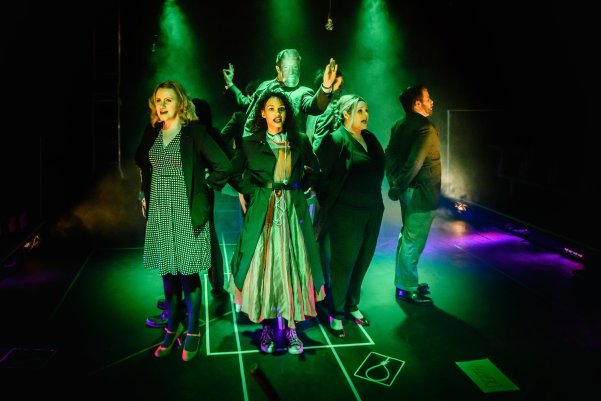
Polly Peachum (Michaela Bennison) has defied her parents and married the notorious highwayman Macheath (Sherwood Alexander) However, he has most certainly not forsaken all others. Wanted for his crimes, he leaves Polly with a promise to return.

Lazarus Theatre have taken David Gay’s story and brought it into the 21st century with a bang. Literally – there are party poppers. It’s a whirlwind of a tale – quirky and fun, transcending the centuries and combining modern day with the past.

Performances are strong from everyone, with the cast acknowledging the audience with intense stares throughout, involving them discreetly yet hardly breaking the fourth wall. The staging is simple yet effective, with ladders, coloured masking tape and a few pieces of furniture whisked on and off, and the cast adopting masks and a few props as they switch from key character to chorus.

Singing is good, but feels a little strained in places. However, this does not detract from the story (adapted and directed by Ricky Dukes), and the new lyrics (penned by Bobby Locke) are both clever and amusing.

It’s fun, fast-paced and funny – a very enjoyable show.

The Play’s the Thing UK is committed to covering fringe and progressive theatre in London and beyond. It is run entirely voluntarily and needs regular support to ensure its survival. For more information and to help The Play’s the Thing UK provide coverage of the theatre that needs reviews the most, visit its patreon.

Possibilities, Theatre N16

https://www.tcmworld.org/wp-content/uploads/2015/12/fork-in-the-road-1.jpg

What if your life has endless parallel possibilities? What if Sliding Doors is true? What if every choice you make leads to your timeline fracturing into endless paths that just keeps multiplying? Possibilities frames this proposal with two people, displaying nearly an hour’s worth of incarnations of their relationship. It’s a nice idea, but one that doesn’t develop any of the individual moments or stories presented. With inconsistent performances and an idea that isn’t fully explored, Possibilities feels like just that – but without the script’s potential coming to fruition.

Jamal Chong and Kate Gwynn take to some scenes better than others. Their intimacy is awkward in some scenes, but their flirtation and sense of play in others is sweetly genuine. The inconsistency is frustrating, as the potential for great performances is there. Chong is also the writer and director – the choice to wear this trio of hats is undoubtedly the root of the issues with this play and production.

The design is minimalistic and functional, with monochromatic chairs and a bench being arranged differently for each scene. Switching on clip-on coloured lights one by one as an introduction is a nice visual touch, but one that doesn’t link to the script in any discernible way.

Other than an interesting question posing as a concept, Possibilities falls short of taking a stance on the impact such a world would have on the individuals that it places under a microscope. The rejection of a narrative arc in favour of a collection of scenes only related through their characters actively prohibits development of this piece, and there is a pronounced absence of dramaturgy. With a bigger creative team and any sort of answer to the concept question, Possibilities would be become a more well-formed reality.

Possibilities runs through 26 October.

The Play’s the Thing UK is committed to covering fringe and progressive theatre in London and beyond. It is run entirely voluntarily and needs regular support to ensure its survival. For more information and to help The Play’s the Thing UK provide coverage of the theatre that needs reviews the most, visit its patreon.

Howl, Rosemary Branch Theatre

https://i0.wp.com/egyptiantheatre.org/wp-content/uploads/2012/08/DSC96451.jpg

With Halloween becoming more and more popular this side of the pond, horror theatre and live events are proliferating. The London Horror Festival is bigger than ever, new scare attractions appear all over the country every year and independent events like Frissonic’s Howl expand the otherworldly and terrifying offers for thrill seekers this time of year. A site specific, immersive performance for an audience of six, Howl is a considered, effective performance that induces plenty of jumps. Though the story of a disappeared sister and mysterious voices is patchy, it is well delivered, and combines audience manipulation with technology to create a delightfully creepy event.

The choice of a small audience generates fear from the beginning – there is less protection with fewer people, particularly when paranormal investigator Rory places us on isolated chairs around a large, long-abandoned storage room. We are there to help Rory look into a something he heard when he was recently alone in the theatre, and we use sound to try evoke it again. Wireless headphones, increasing pace and anxiety, and customised audio content create heavy tension and uncertainly ripe for scares.

The ending in a different room is too rushed and betrayed by the lack of a full blackout. Though there is a clear resolution, the reasoning leading up to that point is never fully explained. How does this voice connect to Rory’s sister who disappeared all those years ago? How did we find him and decide we want to help? Rory is very much a character of the present, but frustratingly little of his past is revealed.

Frissonic nail the scares in Howl with their tech and small-audience approach, but adding flesh to the skeletal story will hugely improve it. Currently running at 40 minutes, another 15 or 20 minutes of text will make this feel more theatrical and less reliant on the scares.

Howl runs through 31 October.

The Play’s the Thing UK is committed to covering fringe and progressive theatre in London and beyond. It is run entirely voluntarily and needs regular support to ensure its survival. For more information and to help The Play’s the Thing UK provide coverage of the theatre that needs reviews the most, visit its patreon.

Songs For the End of the World, Battersea Arts Centre


https://i0.wp.com/www.domcoyote.com/wp-content/uploads/2015/12/millygraphic-2-e1469019899426.jpg

Jim Walters is the first person sent to colonise Mars. But when a global apocalypse occurs, trapping him in the Earth’s orbit and running out of oxygen, he and his guitar are left to broadcast music to the devastation below. Can anyone hear him? Are there any survivors? Will he ever know? Dom Coyote and his band the Bloodmoneys present a post-Brexit apocalypse in the gig-theatre Songs For the End of the World, a piece overly heavy on the ‘gig’ and reliant on a plot constructed of dystopian tropes. Though the story is thin, Dom Coyote’s songs are fantastically varied and plentiful, helping to gloss over any shortcomings in the script.

There’s rockabilly, 90s rock anthems, glam rock, and blues numbers with a touch of connecting story sprinkled in between. Set in Ashley Coombe, the village serves as a window into the attitudes of small, English towns of this dictatorial era – the elderly preacher woman who runs the place condemns foreigners, terrorists and space exploration whilst the rebels put on club nights in an underground bunker. The country is now called New Albion and rather than run by an individual, a corporation dictates all rules and procedures. These plot devices are predictable within a story of a dystopian future, but are simplistic enough to work within the gig-theatre format without needing much explanation. As these two tribes clash, Jim Walters is in space – a symbol of both human progress and arrogant dominion. It’s no surprise which side survives down on Earth, and that the future beyond the end of the show looks particularly bleak.

Though the story is overly familiar, the music is wonderfully varied. David Bowie’s promised influence is clear, but not limiting in style. All of the characters in this Little England kitsch/cold international corporation hybrid are suitably blown out of proportion, but feel eerily familiar in a fundamentalist-driven, isolationist Britain and a world where Donald Trump may become the next leader of its most powerful country. Staging is fairly static as per the usual gig-theatre approach, but there is some variation in movement and costume. The lighting design adds power and hope to the bleak, clinical setting.

A more substantial script and dynamic staging would lend more theatricality to the excellent set of tunes in of Songs For the End of the World; as is, it is overly driven by music and the narrative potential is neglected. That said, it would make a fantastic concept album, and the design is strong – an extra half hour of script would add polish to this fun, vibrant performance piece.

Songs For the End of the World is now closed.

The Play’s the Thing UK is committed to covering fringe and progressive theatre in London and beyond. It is run entirely voluntarily and needs regular support to ensure its survival. For more information and to help The Play’s the Thing UK provide coverage of the theatre that needs reviews the most, visit its patreon.
Kissing the Shotgun Goodnight, Ovalhouse

rsz_kissing_the_shotgun_goodnight_credit_the_other_richard

Along with tickets, we are handed earplugs. Considering Christopher Brett Bailey’s first work This Is How We Die, I’m not surprised. A brilliant, relentless barrage of contemporary American myth followed by an encore of noise and light, Bailey isn’t known for doing things by halves, or even singular wholes. The slight, constantly startled-looking Canadian with gravity defying hair attacks performance making with the energy of a supernova. Kissing the Shotgun Goodnight has the same verve, but is otherwise a rather different beast. Whilst This Is How We Die was dominated by language, Kissing the Shotgun Goodnight has very few words – but the earplugs are definitely needed. This anthemic music and light show fills the room with sound, colour and vibration but is the difficult second album to This Is How We Die. Much more of a gig than a piece of theatre, it lacks the satisfaction of characters and narrative, even a hint of one. Bailey’s mind blowing poetry teases with a few tiny fragments, but otherwise leaves us desperately gagging for more of his words.

Though given earplugs, there is the choice of whether or not to use them. Notices state that the sound level is consistently over 100 decibels and that, “if you wear plugs the whole time you might compromise enjoyment of the show. and if you don’t wear them at all you will take home whistling ear canals”. Being one of those people sensitive to loud noises who constantly asks my other half to turn down the telly, I want to play it safe but I don’t want to miss out. So I opt for one plug in, with the other ready. This choice no doubt effects the experience – if I leave them out the whole time and feel discomfort, would I like the show less? Or would I like it more because it’s not actually ‘that’ loud? I use the plugs in response to the volume level – sometimes I have both in, sometimes none. It’s an interesting premise to consider that the experience and quality of the show hinges on these earplugs, adding an additional level of individual, subjective response.

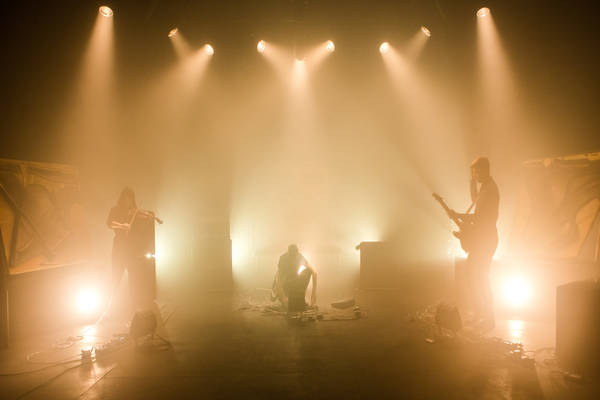
Bailey’s voice, slow and unseen, repeats, “this is a hell dream” in a brief textual introduction. Violinist Alicia Jane Turner uses loop pedals to sculpt a cinematic score reminiscent of mid-90s rock anthems. Her work is wonderfully angry, sweeping and alive. George Percy and Bailey are both on guitar, forming a silhouetted triptych with Bailey soon in the middle – amongst the monolithic speakers and flight cases forming a brutalist, urban landscape, he cuts the figure of a scrappy dystopian overlord. It suits him. If this is what hell is like, it’s fucking glorious.

Behind each performer is a wooden panel of about a metre square made of deconstructed pianos and their strings. These are visually impressive structures in and of themselves; their music evokes the violence and community of tribalism. Combined with excellent sound-responsive lighting (that malfunctioned to the point that the show needing to be stopped briefly), the overall effect is one of epic, soul shaking community.

The title paired with the music evokes the American paradox of a friendly but violent people who love their guns as much as their families. The music’s scale captures the expanse and variation of the North American landscape, and the few words he shares on the experience of waking up from a nightmare to find the world unchanged darkly foreshadow Trump’s America. Whether or not this is an intentional message, it is certainly a powerful one.

Kissing the Shotgun Goodnight is certainly wide open to interpretation and shows Bailey’s ambition and range as a performer of work designed to push the senses to their extremes. His textual dexterity is certainly missed (particularly by the coked up, flailing pair of young women sat next to me commenting on how disappointing this work is compared to his first) and comparatively this piece is somewhat disappointing, but it absolutely has its merits as a visceral, “fuck you/I love you” performance piece.

Kissing the Shotgun Goodnight tours nationally through November.

The Play’s the Thing UK is committed to covering fringe and progressive theatre in London and beyond. It is run entirely voluntarily and needs regular support to ensure its survival. For more information and to help The Play’s the Thing UK provide coverage of the theatre that needs reviews the most, visit its patreon.
Acorn, Courtyard Theatre

acorn-c-hannah-ellis-1

Persephone and Eurydice’s myths are defined by men. What happens when these men are removed and the characters plunged into a modern dreamscape? Maud Dromgoole’s Acorn brings these women and their fates together in a world of fragmented narratives and moments of biting wit, but the worlds that Dromgoole weaves together are so disconnected from each other in this cerebral play that it interferes with its immediacy.

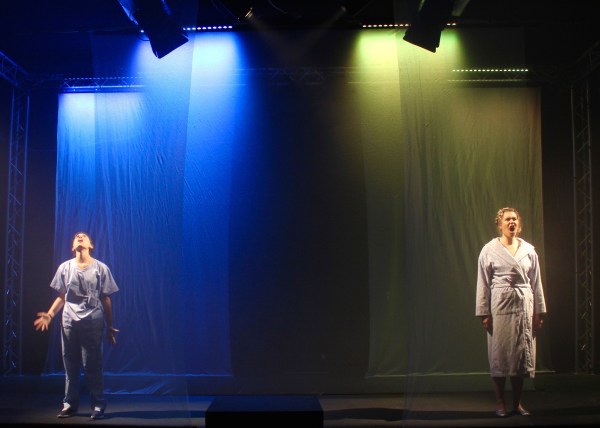
Rather than nurturing plants, this Persephone looks after people – she is a doctor, but one that struggles to connect with her patients. Her opening monologue justifying her disdain for patients’ personal lives is equally hilarious and disturbing, the best scene in the play. Deli Segal brings a simple humanity to this cold character, making her quirky and likeable despite an autistic-like inability to understand others. Lucy Pickles’ Eurydice is a sweet contrast, alternating between a blushing bride and mental health hospital patient. Pickles is no less of a performer, but Persephone has the more dynamic and well-written character.

Dromgoole employs a range of styles, arguably too many for an hour long script. Though this strengthens the ability to relate to the story within individual scenes, the overall effect is one of indecision. An unrelated, recorded dialogue between two men fills transitions unnecessarily and doesn’t link to the women’s stories, then overlapping speech cause dialogue to be missed.

Phil Lindley’s design is simple and precise, allowing for detail and layers to emerge through Jai Morjaria’s lighting and Tom Pearson’s underused projections. The design concepts are most excellently married and add polish to a script that feels under-developed.

Acorn certainly deserves to extending and refining – the characters are excellent, as are the foundations of the stories seen here. Dromgoole uses language well and is clearly confident experimenting with form, style and classical influence, but reinvention with the goal of creating a modern myth doesn’t quite reach the enduring scale of the original material.

Acorn runs through 29 October.

The Play’s the Thing UK is committed to covering fringe and progressive theatre in London and beyond. It is run entirely voluntarily and needs regular support to ensure its survival. For more information and to help The Play’s the Thing UK provide coverage of the theatre that needs reviews the most, visit its patreon.
Undead Bard, Theatre N16

robert-crighton-in-metal-harvest

Professor Ashborn is on a mission to disprove Shakespeare’s existence, but the academics with leather patches on their elbows are trying to stop him. Following Ashborn’s lecture and an interval, Undead Bard creator Robert Crighton summons Shakespeare to talk to him about his life, work and death in an unrelated second half. This two-part show on Shakespeare in the modern world, bardolatry and the authorship debate certainly has some very funny moments of satire, but others are utterly bizarre and the poor execution of an idea. A significantly stronger first act sets up a reasonably enjoyable event, but the second is self-indulgent and anti-climactic in this overly long solo performance.

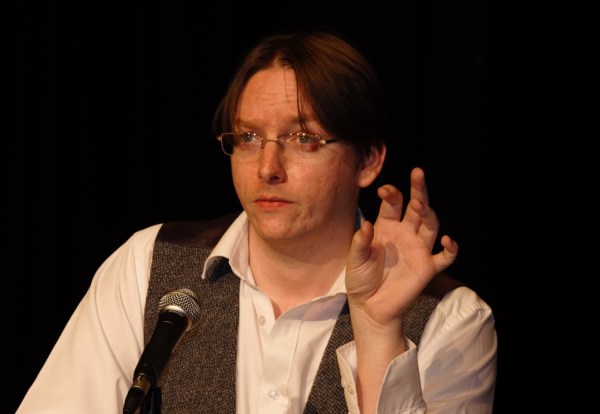
The paranoid Professor Ashborn’s lecture rips the piss out of Shakespeare academics, those that believe Shakespeare wrote Shakespeare’s works, those that believe someone else did under Shakespeare’s name and anyone with a love for Shakespeare’s plays. Crighton as Ashborn talks the audience through his various ridiculous authorship theories with energy and eccentric humour, evoking plenty of laughs. The script follows a natural rhythm of discovery, disappointment and eventual confession; it’s a story carefully crafted with intuition and skill.

Considering the second act, the first would be better served as a stand-alone piece. After what is quite a good piece of character storytelling, this random, rambling seance on the mundanity of Shakespeare’s life and afterlife is, well, mundane. The inclusion of toilet humour and sexual innuendo do not improve the piece. Shakespeare’s confusion at his legacy is cute, but it absolutely doesn’t warrant nearly an hour of discourse and disconnected pop culture references.

Crighton clearly has an aptitude for crafting a story, as evidenced in the first part of the show. Unfortunately, the rest of it is a muddled letdown that needs to be sent back to the drawing board or discarded completely.

Undead Bard runs through 13 October.

The Play’s the Thing UK is committed to covering fringe and progressive theatre in London and beyond. It is run entirely voluntarily and needs regular support to ensure its survival. For more information and to help The Play’s the Thing UK provide coverage of the theatre that needs reviews the most, visit its patreon.

Party Trap, Shoreditch Town Hall

https://www.thestage.co.uk/wp-content/uploads/2016/09/Party-Trap-Alex-Brenner-no-use-without-credit-Show-and-Tell-Party-Trap-by-Ross-SutherlandShoreditch-Town-Hall-_DSC5659.jpg

Politicians and members of the press are hardly the best of bedfellows. Unrestrained and violent, Ross Sutherland’s Party Trap explodes this relationship in a dystopian TV interview between journalist Sir David Bradley and MP Amanda Barkham after a landmark decision classifying political criticism as hate speech. Sutherland sets himself the challenge of telling his story through a script that’s an extended palindrome – an impressive feat, were it executed with more of a focus on storytelling rather than showing off a clever concept.

The palindromic writing isn’t particularly pronounced; instead it creates a haunting sense of deja vu once the script passes the halfway point. The shift in power and control from David to Amanda, and the action’s dark turn prevents it from turning stale, but the script structure is still more of a hindrance than a help. The language takes precedence over story clarity, so the plot soon muddies. The slightly futuristic premise becomes less and less tenable, to the point that the entire reality of the piece is called into question. There is little solid ground on which to build a sturdy plot line; language isn’t enough even though this experiment is certainly an interesting one.

The performances are one of the biggest disappointments. Cold and detached, they are couched in venomous sarcasm and violence. Simon Hepworth as Sir David Bradley has some nice moments of vulnerability and depth, but these are too little and too late. Otherwise, he and Zara Plessard are ruthless, calculating and distant. Video performances of other characters are relied on to fill in for news broadcasts and line managers with disturbing agendas; these characters are as self-absorbed as the two on stage.

The design elements are unobtrusive and tie the production together well, with Sutherland’s projections and video being particularly slick.There is no question that Party Trap is well-planned and thought out, but the concept is so prominent that it prevents a story from shining through. It’s a worthy experiment, but one that doesn’t work.

Party Trap runs through 1 October.

The Play’s the Thing UK is committed to covering fringe and progressive theatre in London and beyond. It is run entirely voluntarily and needs regular support to ensure its survival. For more information and to help The Play’s the Thing UK provide coverage of the theatre that needs reviews the most, visit its patreon.

Team Viking, Edinburgh Festival Fringe

https://i0.wp.com/www.pxleyes.com/images/contests/old-camera/fullsize/Viking-Funeral-4ca7e68bcb25e_hires.jpg

How far would you go for your best mate? Are there any limits, any lines, you wouldn’t cross?

What if your best friend was dying?

What if he asked you to ensure he had a viking funeral?

James Rowland does exactly that for his best friend Tom. He grew up as part of a neighbourhood trio that stayed close well into adulthood. As children, their favourite game was to play Vikings (as in the Kirk Douglas film). When Tom is diagnosed with terminal cancer at age 25 and given only a short time to live, he calls in one final favour from James and Sarah, the other third of their childhood gang. Tom doesn’t care about logistics and legalities, and his magnetic charisma convinces Sarah and James to do this for him, and James is here to tell us the story of their friendship through life and death.

Rowland’s engaging, laddish charm makes you laugh loads, then the tiniest change in pace and inflection turns on the tears. His script approaches death and friendship with respectful levity that does not gloss over the reality of grief, but neither is it too weighty. It’s a perfectly balanced emotional journey, and Rowland’s relaxed delivery draws the audience to him and to each other.

Director Daniel Goldman chooses simple staging – Rowland is on a small, bare stage with few props and tech, and the venue’s lighting is barely existent. The piece would work well in the round to foster it’s warmth and inclusivity. It’s simple, storytelling structure would also suit the intimacy of a circle.

Team Viking is an exemplary solo storytelling piece excelling in its honesty and simplicity. It’s a powerful tribute to his friends, but it’s not insular – it’s the complete opposite, and a truly delightful, heartwarming adventure story for those who have loved and lost.

The Play’s the Thing UK is committed to covering fringe and progressive theatre in London and beyond. It is run entirely voluntarily and needs regular support to ensure its survival. For more information and to help The Play’s the Thing UK provide coverage of the theatre that needs reviews the most, visit its patreon.