Be Prepared, JOAN, Edinburgh Festival Fringe

https://www.thestage.co.uk/wp-content/uploads/2016/05/Joan-Brighton-700x455.jpg

This year, four companies are receiving support from Underbelly to produce and market their latest work. Two of those are Milk Presents and Corner Shop Events, both offering solo performances but radically different in content and style. Each distinctive piece is vibrant and immediate, with moments of power and poignancy. Typical of new work at the fringe, both feel a bit rough and ready but they have a raw, honest emotionality that plucks the heartstrings.

Be Prepared transports the audience to a Quaker funeral for Mr Matthew Chambers, where a man who never actually met him has been invited to speak. Struggling with his own grief, writer/performer Ian Bonar takes on the awkward, unprepared man reduced to a child by his inner turmoil. The character’s biography interweaves with his unconventional encounters with Mr Chambers, spinning a muddled web of good intention that is sweetly moving and honest.

Bonar’s performance is excellent. There’s a simmering anxiety that drives him forward and erupts through the characters ideas that aren’t particularly well-thought through. His underlying focus on his father’s recent death is a constant presence that bubbles through his attempts to talk about Mr Chambers. His pace becomes more frenetic as his stories become increasingly muddled, though this textual choice occasionally interferes with understanding. The script has a seeping rawness that effectively captures the chaos of grief, though there are numerous loose ends that aren’t fully developed.

JOAN addresses rather different themes but has just as much intensity as Be Prepared. This modern Joan of Arc story resonates through it’s father/daughter relationship, and teenaged optimism and arrogance that backfires despite her intentions to save France. Her struggle with gender identity also gets hold of the audience’s empathy and doesn’t release its grip until the curtain call.

Lucy Jane Parkinson’s performance is exquisite. Joan’s hope, determination in the face of adversity and ultimate desperation is skilfully crafted by writer Lucy J Skilbeck. Parkinson fully embodies Joan’s emotional journey and has the audience in the palm of her hand from her initial impersonation of her father, to her final pleas for Saint Catherine’s help.

Though there is an element of drag in the show when Parkinson plays other characters, her depiction of Joan doesn’t come across as drag at all. The character is not sent up, and her struggle with taking on female behaviour and dress is wholly genuine.

Though JOAN is the stronger production of the two, Be Prepared is still a solid production with plenty of merit. Both are moving reflections of aspects of the human condition and powerful pieces of theatre in their own right.

The Play’s the Thing UK is committed to covering fringe and progressive theatre in London and beyond. It is run entirely voluntarily and needs regular support to ensure its survival. For more information and to help The Play’s the Thing UK provide coverage of the theatre that needs reviews the most, visit its patreon.

Lucy, Lucy and Lucy Barfield, Edinburgh Festival Fringe

https://theplaysthethinguk.com/wp-content/uploads/2016/08/e379c-dsc_03212b2528courtesy2bmichelle2bwormleighton2529.jpg

The dedication at the front of The Lion, The Witch and the Wardrobe reads:

My Dear Lucy,

I wrote this story for you, but when I began it I had not realized that girls grow quicker than books. As a result you are already too old for fairy tales, and by the time it is printed and bound you will be older still. But some day you will be old enough to start reading fairy tales again. You can then take it down from some upper shelf, dust it, and tell me what you think of it. I shall probably be too deaf to hear, and too old to understand a word you say but I shall still be, your affectionate Godfather,

C. S. Lewis.

Lucy Grace, long feeling a strong kinship with the book’s protagonist Lucy Pevensie, clung onto the belief in Narnia well into adulthood. When she was 26, the dawning realisation that she would never reach Narnia suddenly hit her. With a sense of crushing loss, she turned to her well-thumbed copy of the book to search for clues that might refresh her once-dependable escape from life’s hardships. Previously skipped pages were poured over for clues, leading to the discovery of the book’s dedication – a revelatory moment for Lucy Grace. There’s a real Lucy! Perhaps she knows more about Narnia and can help her rediscover its wonder as an adult! But who is she?

Lucy, Lucy and Lucy Barfield sweetly documents Grace’s search for the real Lucy, about whom there is little information. This quest leads her down the rabbit hole of contacting Lucy’s father’s estate, researching at the Bodleian Library and interviewing Lucy’s best friend. A research project doesn’t sound like it would make dynamic, compelling theatre, but Grace manages to do so with great success on this solo show.

Grace’s performance is excellent. She has a gleeful charisma and innate sense for storytelling that keeps the audience’s attention. Her childlike wonder at each discovery is infectious. Hints of her background and struggle come through somewhat, though the script is far from self-indulgent.The design, mostly piles of cardboard boxes, lacks the delicacy of the story even though they allude to the archives Grace trawls through searching for details about Lucy’s life.

Lucy Barfield died in 2003 from MS. There is still some mystery around her life, and some of Grace’s findings directly conflict each other. But the creative young woman who danced, wrote poetry and music who inspired one of the country’s greatest writers and academics helps Lucy Grace renew her belief. Lucy, Lucy and Lucy Barfield is a lovely little story of adventure and discovery.

Lucy, Lucy and Lucy Barfield runs through 29th August.

The Play’s the Thing UK is committed to covering fringe and progressive theatre in London and beyond. It is run entirely voluntarily and needs regular support to ensure its survival. For more information and to help The Play’s the Thing UK provide coverage of the theatre that needs reviews the most, visit its patreon.

People of the Eye, Edinburgh Festival Fringe

https://www.thestage.co.uk/wp-content/uploads/2016/08/People-of-the-eye-David-Monteith-Hodge-700x455.jpg

Elizabeth has two daughters. Her youngest is “fine”. Her eldest has profound hearing loss. This diagnosis, in our able-bodied world with all its bias and privilege for those that are “normal”, is a hard one to take. Elizabeth wrestles with guilt, frustration and the never before considered world of adaptation to suit her daughter’s needs.

Theatre maker and actor Erin Siobhan Hutching grew up in a mixed D/deaf and hearing household. Collaborating with the Deaf & Hearing Ensemble, People of the Eye is her story, and those of families everywhere. It tells of parents, siblings, signing and secret languages. Projections and signing facilitates aid accessibility and support storytelling, creating a heartwarming montage of moments. The story is thin, but the message is clear: living in both the D/deaf and hearing world is a blessing.

Emily Howlett performs with Hutching as Elizabeth’s eldest. She signs as well as speaks and takes on several roles: a doctor, a sign language teacher and one of the two central characters. She and Hutching have a lovely chemistry and are generally believable as young siblings. Hutching also switches between Elizabeth and her younger daughter; these transitions are not always clear.

There is an added pedagogic element of Elizabeth taking a sign language class where the audience becomes the rest of the class. Though good fun, it is slightly forced – the story of this family is much more engaging than a lesson.

People of the Eye could certainly do with fleshing out, and its initial premise and structure are robust enough to withstand further development. The performances are engaging and they provide a lovely insight into family life with a disabled family member. The visual structure is a model for other productions seeking to increase their accessibility and can easily be applied to shows where deafness is not specific to the script. It’s a fantastic start with great potential.

People of the Eye runs through 27th August.

The Play’s the Thing UK is committed to covering fringe and progressive theatre in London and beyond. It is run entirely voluntarily and needs regular support to ensure its survival. For more information and to help The Play’s the Thing UK provide coverage of the theatre that needs reviews the most, visit its patreon.
Counting Sheep, Edinburgh Festival Fringe

https://i.guim.co.uk/img/media/23913cc392a98f67736cd3cdca806a6774c8940b/0_0_2048_1363/master/2048.jpg?w=620&q=55&auto=format&usm=12&fit=max&s=1feba80ccb7ff150a5842abd1e15ee76

Just over two years ago, a revolution in Kiev ushered in the downfall of the Ukranian government. Protests against the government’s refusal to sign pro-EU legislation lasting months had several violent outbursts that saw hundred of people injured and 780 killed. Toronto-based Ukrainian musician Marichka Kudriavtseva, in Kiev for work at the time, joined the protesters where she met Mark Marczyk, also based in Canada.

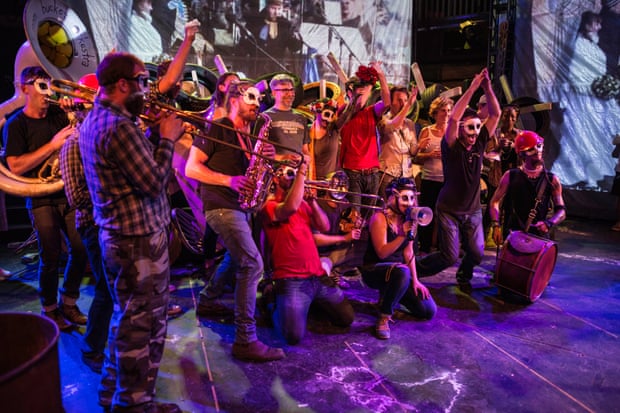
When the two returned from the Ukraine, they teamed up with Marczyk’s Lemon Bucket Orkestra to create Counting Sheep, an immersive “guerrilla folk opera”. A celebration of solidarity and the power of a collective voice, it also mourns those who died in the protests. Told from the perspective of the protesters, little is shared from the other side – but this rallying performance is fitting homage to not just the Ukrainian protesters, but those fighting government tyranny around the world.

Some audience sit around a huge table, whilst others sit on the sides of the space and still others up in a balcony. Klezmer or folk music is playing as the audience enters; there is a convivial atmosphere as the show formally starts. This is a party, or a wedding, or some other huge gathering, until the three screens display news reports of riots and police enter. The tone abruptly shifts, and the world that has been established is dismantled. It’s a wonderful, unsettling surprise.

The space is consistently reformed and redrawn using movement, and the audience is physically moved in the wake of the protesters’ gains and losses. They are willing and unquestioning, the sheep of the title. Though the numbers here obviously pale to those at the actual protest, incorporating the audience in acts such a building barricades and lobbing bricks at police fosters unity from disparate dozens. There is a hint of the solidarity and aggression found in protests, and joy and celebration from the audience who are keen to play. Being served food is also an important enabler that solidifies the unity the show aims to create.

Counting Sheep is hugely effective in its emotional manipulation, and also it’s storytelling through music, movement and projections. Choosing sheep as a metaphor is a curious choice, though. The benign but rather dumb livestock aren’t known for thinking for themselves and are susceptible to herding – otherwise, they wander around unproductively, getting lost and eaten by predators. Whilst the performers are the herders here, they are also in sheep masks, unempowered. Who then are the herders? The government? Unseen forces of political and social unrest? Whatever it is, us human beings are hugely susceptible to it when motivated enough, even if the metaphor isn’t totally clear.

Though sung completely in Ukrainian, there is a clear storyline conveyed through projections and movement. There is little nuance in this piece, but it a playground for the sweeping emotions of popular theatre. It provides at least a hint of the experience that the Ukrainian protesters endured, and powerfully unites the audience through the humanity of collective experience for a common goal. An excellent piece of theatre.

Counting Sheep runs through 29th August.

The Play’s the Thing UK is committed to covering fringe and progressive theatre in London and beyond. It is run entirely voluntarily and needs regular support to ensure its survival. For more information and to help The Play’s the Thing UK provide coverage of the theatre that needs reviews the most, visit its patreon.
Queen Lear, Edinburgh Festival Fringe

https://www.thestage.co.uk/wp-content/uploads/2016/08/Queen-Lear-700x455.jpg

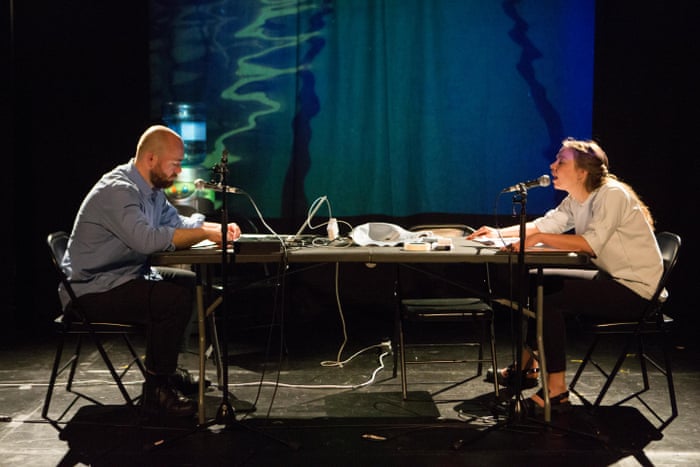
What happened to King Lear’s wife? The woman who birthed the three daughters that he loves so dearly is never mentioned in his title play. Back in the ’80s, the Women’s Theatre Group and Elaine Feinstein created Lear’s Daughters, a flawed, feminist play attempting to reason why Goneril and Regan do what they do by depicting the girls’ upbringing. Their mother is present, but ill and rarely thought upon until her death at the hands of a sex-crazed maniac. Lear and his obsession with having a son cost her her life.

Ronnie Dorsey, perhaps inspired by this version that focused on the daughters rather than their mother, puts the young queen centre stage in Queen Lear. Also a feminist perspective, this script is reflective and revealing, but slow to develop and incorporates a disconnected subplot that results in an unlikely end.

Alice Allemano is the young queen, heavily pregnant with her second child. Goneril and Regan are the daughters of his first wife, a good device that explains the sisters’ disconnect in Shakespeare’s play. Lear’s need for a son translates to her conviction that the child is a boy, but the pregnancy has not gone well. She is overdue, in constant pain, and begs her nurse and the Father overseeing her care to cut the baby from her body. Through her medicated delirium, she reveals her transition from blushing, wide-eyed bride at 16 to an abused incubator. Jane Goddard plays the nurse and Mary McCusker the priest; the trio of women have a warm, maternal chemistry and all are excellent performers.

Dorsey’s script, whilst an interesting premise, has some issues. The dialogue is overwritten and obstructions any natural tension that would arise from the situation. It also slows down narrative progression and often feels clumsy. The secondary plotline, though it has potential to develop into its own story, feels out of place and not fully integrated. The big reveal is barely acknowledged by the other characters, briefly discussed, then forgotten about in light of the queen’s health.

A thorough trimming would do the text a world of good and free up space for more action. The performances are strong and the examination of this forgotten character compelling, but one that could be executed more smoothly.

Queen Lear runs through 29th August.

The Play’s the Thing UK is committed to covering fringe and progressive theatre in London and beyond. It is run entirely voluntarily and needs regular support to ensure its survival. For more information and to help The Play’s the Thing UK provide coverage of the theatre that needs reviews the most, visit its patreon.

Troilus and Cressida, Edinburgh Festival Fringe

(c) National Trust, Petworth House; Supplied by The Public Catalogue Foundation

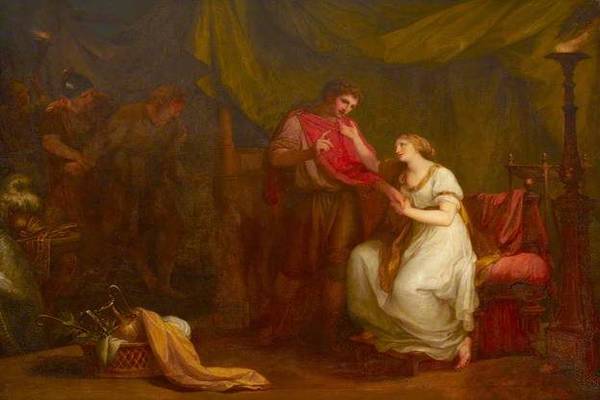
There is hardly any Shakespeare at the fringe that isn’t dramatically altered in some way or another. Re-contextualisations abound, as does new work that’s derivative from a story or character. West Country-based Shakespeare on the Level’s Troilus and Cressida is neither of these. It has no gimmicks and no determinedly modern concepts. It is merely the text staged in a clear fashion that serves Shakespeare’s stories, with few divergences. This is not an innovative production and has a few faults, but is remarkably refreshing in its lack of fringe-ness.

Some cross-gendered casting is a welcome choice to improve balance between men and women. There are only three women in the cast of twelve so parity is hardly achieved, but the women in the cast also have the chance to play male roles. Director Kate Littlewood also makes Achilles openly gay, choosing to wile away the days in his tent with his lover, Patroclus. This is a lovely choice that aligns the play with its Greek and Roman roots and doesn’t disrupt the story.

The performances are mixed, with Susie Kimnell’s Helen and Louis Bowen’s Troilus standing out as particularly strong. There are some weak verse speakers who break up the rhythm, others aren’t fully connected to the text and either shout it or approach it too casually.

Littlewood takes a flowing, eastern approach to her costume design, though the Romans and the Greeks are very similar in style. With the multi-rolling necessary to cover the twenty-three characters and varied acting ability, a stronger visual indication of which camp is which would be welcome. She sets Troy in the round, and skilfully uses the diagonals so the audience can always see, and fight director Tom Jordan’s choreography also suits the space.

The story is cut down to a manageable length, maintains clarity and has a clear design concept. Though not a particularly fringe approach to Shakespeare, this is a well-staged production with a cast of emerging talent.

Troilus and Cressida runs through 27th August.

The Play’s the Thing UK is committed to covering fringe and progressive theatre in London and beyond. It is run entirely voluntarily and needs regular support to ensure its survival. For more information and to help The Play’s the Thing UK provide coverage of the theatre that needs reviews the most, visit its patreon.
Two Man Show, Edinburgh Festival Fringe

https://files.list.co.uk/images/2016/08/19/rashdash-twomanshow-credit-the-other-richard-lst216304.jpg

RashDash are angry. Like, fucking furious level of angry. They’re fed up of patriarchal language and gender stereotypes that limit both men and women from expressing themselves honestly. So they made a show about it. Two Man Show has three women in it, music and dance, nudity and a lot of explosive energy. It’s part science lecture, part role play and part celebration of who we are without others’ judgment and categorisation based on gender expression. It’s a fantastic, “fuck yeah” explosion of pretty skirts, masculinity, tits, cockfighting and nonconformity. It’s also pretty bloody brilliant.

Out of an opening tirade on equality in the dawn of human history, Abbi Greenland and Helen Goalen take on the roles of two brothers, Dan and John. They don’t get on, arguing almost constantly about caring responsibilities for their terminally ill father. Their fighting builds in between movement and dance sequences of surprising intimacy and tenderness.

The culmination to Dan and John’s tension is a fantastic eruption of John’s frustrated masculinity feeling limited by “man things”. His words twists through Abbi’s, the man-woman who is happy in her own skin but doesn’t really suit any of that girly shit. Helen’s feminine contrast powerfully reinforces the importance of choice and freedom and that a woman doesn’t need to be butch to be a feminist and a man can express his feelings and do “feminine things” without his heterosexual maleness being threatened.

Greenland and Goalen’s performances are endowed with conviction and energy, and both are skilled physical performers who can convincingly play men, even with their breasts unveiled. They are accompanied by a musician, who backs them up with unfettered tunes of frustration and celebration.

This is a truly feminist show. Rather than blaming men, Two Man Show looks at the conventions of language that aids female suppression and acknowledges that men are not served by this system, either. Fabulously sequinned and ferociously opinionated, this is not one to miss.

Two Man Show runs through 27th August.

The Play’s the Thing UK is committed to covering fringe and progressive theatre in London and beyond. It is run entirely voluntarily and needs regular support to ensure its survival. For more information and to help The Play’s the Thing UK provide coverage of the theatre that needs reviews the most, visit its patreon.

Milk, Edinburgh Festival Fringe

https://i0.wp.com/7210-presscdn-0-59.pagely.netdna-cdn.com/wp-content/uploads/2016/08/milk.jpg

Everyone has a relationship with food. For some its straightforward, for others it’s complex. Food in terms of nourishment isn’t just that which we eat, either. Love, security, and all sorts of other things make us feel full. In Milk, three generations of couples in the same town negotiate what matters most to them and makes their lives feel complete. This is a slowly burning script that comes into its own towards the end when conflict becomes so high that the six characters lives cross outside of their partner’s. There is some good character detail, but writer Ross Dunsmore’s first play shows promise but needs further development.

Steph and Ash are fourteen. Ash is a fairly typical teen boy, but Steph, from a dysfunctional home, has a pathological need to be sexually desired. When Ash doesn’t satisfy, she finds a new, more dangerous target. Danny and Nicole are young marrieds expecting their first child. When the baby arrives, unforeseen complications and postpartum hormones challenge Nicole’s preconceptions about motherhood and open a divide between the couple. Cyril and May are in their 90s and homebound, too scared of the changing landscape of architecture and aggressive young people to go out. As they fantasise about past Sunday roasts, their hermetic existence takes its toll.

The storylines that Dunsmore unfolds are all believable though in their kinship to real life, they take most of the play to reach any level of compelling conflict. Cyril and May’s story has hardly any, rendering it the least interesting and most forced plotline. Whilst the other two are more dynamic, they are underserved in this intertwining format. The two younger couples could each easily have an entire play devoted to them; to force them all into one feels indecisive in the face of several ideas.

Fred Meller’s design is cold and utilitarian, though has some lovely surprises that are gradually unveiled. Director Orla O’Loughlin delineates the three couple’s worlds well and captures the easy rhythm of Dunsmore’s dialogue without adding any forced stylisation.

Without a doubt, Dunsmore’s couples all have compelling stories to tell (though all are heteronormative, white and skew towards female dependency on men), but the format he uses to tell them is not the most effective. Too much exposition interferes with the empathy for the characters and whilst the ending is a satisfying payoff, the build to it is too little and too late.

Milk runs through 28th August.

The Play’s the Thing UK is committed to covering fringe and progressive theatre in London and beyond. It is run entirely voluntarily and needs regular support to ensure its survival. For more information and to help The Play’s the Thing UK provide coverage of the theatre that needs reviews the most, visit its patreon.

Remember to Breathe, Equations for a Moving Body, Edinburgh Festival Fringe

https://s3.amazonaws.com/wos-photos-production/107110.jpg

Two women, in two different shows set on opposite sides of the world, swim as if their lives depend on it. One is training for an ironman-length triathlon, the other never learnt to swim and is doing so to overcome a fear of water. Equations for a Moving Body is Hannah Nicklin’s solo performance telling the story of her decision to complete an ironman and the research she did to discover what would happen to her body as she trains. Remember to Breathe follows fictional Maeve away from the safety of family and a secure job in Ireland, to world travels that eventually find her in New Zealand. Though Hannah and Maeve approach swimming completely differently, the sport shapes who they are and how they deal with obstacles that come their way.

Maeve and her kiwi husband Grant are back in Ireland when the Christchurch earthquake hits. The Celtic Tiger has been and gone, and their business is struggling so they decide to head to the southern hemisphere to help rebuild. It’s here that Maeve discovers a pool in the wreckage, staffed by the relentlessly perky Doreen. In that pool, Maeve gently catalogues her life through her relationship to her father. He and Doreen fade in and out again like memories in this quiet, reflective piece on family and finding your place in the world.

Liz Fitzgibbon as Maeve has a calm strength and enigmatic presence. This everywoman of a character with relatable struggles trying to find peace is a reassuring story to witness, though the lack of outright conflict between characters makes for a sleepy pace.

Julie Sharkey as Doreen and David Heap has Maeve’s earthy, grounded father are great foils constructed by writer Orla Murphy. As well as Maeve’s personal journey that she comes to terms with through swimming, there’s a pointed throughline of the effects of the economy on the common man – a clever inclusion making the script universally relevant.

Maeve swims and came to it in her adult life, but Hannah is a swimmer and has been doing so since she was four. Hannah explains the difference between “I swim” and “I’m a swimmer” and the role goals and life events have in shaping one’s identity. Her decision to complete an ironman in the year she turned 30 becomes a part of who she is and how she lives her life, and Equations for a Moving Body is the moving story of the ups and downs of pushing your body to its limits.

The most engaging focus of Hannah’s story is the people she meets along her training journey. She has a gift for making John, Tom and the various scientists she meets along the way come alive, even if they only feature for brief moments. These encounters provide landmarks that make her story stand out from anyone else’s and excellent focal points of her narrative structure.

The story’s climax is the triathlon, with peaks and troughs that are magnified versions of those in her training. It’s a hugely satisfying and emotional end to a story of struggle, grief and triumph. Those who aren’t much for sport or fitness who find her initial goal baffling are on side at by the finish line.

Nicklin uses live internet use to support her story and add a visual element to the production. Though simple, it’s a great choice. These are almost all accompanied by her narrative, though one section is poignant in its silence and elucidates the source of the show’s name.

Hannah cements her sense of self through her training and its end goal, and Maeve finally finds the peace she is searching for. Both productions are lovely, if very different stories of personal discovery at Summerhall.

The Play’s the Thing UK is committed to covering fringe and progressive theatre in London and beyond. It is run entirely voluntarily and needs regular support to ensure its survival. For more information and to help The Play’s the Thing UK provide coverage of the theatre that needs reviews the most, visit its patreon.