Missing the Mark: Three Shakespeare Appropriations, Edinburgh Festival Fringe

https://i0.wp.com/cdn.spectator.co.uk/content/uploads/2015/12/iStock_000023304291_Small1.jpg

As great as it is to see Shakespeare inspiring contemporary theatre makers to create derivative work, like any new writing it has the chance of missing the mark by a long shot. Annika Nyman’s Romeo and Juliet Post Scriptum poses the question, “What happens and Romeo and Juliet don’t die?” and the answer isn’t pretty, nor well thought out or well-written. Z Theatre Company’s The Female Question gives us Shakespeare and his female alter-ego bickering over whether or not they shortchanged his female characters, from whom we hear a lot of moaning. MacBain, part of Summerhall’s Big In Belgium season, retells Macbeth through a hybrid of drug-addled Kurt Cobain and Courtney Love and Shakespeare’s text, giving us MacBain.

Romeo and Juliet Post Scriptum is such a lovely premise, but the route Nyman takes is inexplicably far from the characters Shakespeare created. Romeo is the main issue here. Nyman presents him as an indecisive coward who now regrets the whole “feigning death and running away” idea. Deciding that family is more important than love, he wants to go home and make up with his dad. Juliet, unimpressed by this, tries to convince him to stick to the plan and when he is unconvinced, they argue for pretty much the rest of the play. They speak in stilted English that isn’t Elizabethan, but it’s certainly not modern either, preventing the actors from connecting their text. The characters partly make up, then they argue again. Wash. Rinse. Repeat. The rushed ending is disconnected from the all the fighting leading up to the moment, making the overarching effect one of pettiness that doesn’t relate to Shakespeare’s characters and no clear message about their actions.

It’s 400 years since Shakespeare died, and he and his female alter ego meet for their annual discussion in his office. She’s trying to convince him of their legacy, but he doesn’t believe her. Hamlet has been bugging him lately, and he’s feeling like he didn’t do his female characters any justice, hence The Female Question. He talk to the skull on his desk, texts on his phone and has a desk covered in books about himself and papers. Quite what is occupying his time since his death is never revealed, neither is how he got a mobile phone, why there are two of him and why Hamlet keeps giving him grief. Some of his characters come in for a chat, but the through-line (that was never really made clear to begin with) only tenuously connects these characters to Shakespeare’s inner dilemma. This could likely be due the fact that there are two of the same dead person and the rest of the characters aren’t real. Whilst the idea to give Shakespeare’s women another crack at the spotlight is admirable, the execution is muddy, badly performed and has no solid resolution or narrative structure.

MacBain has the most promise due to it’s Summerhall location, but this one-trick pony also disappointed. Despite excellently imposing lighting and sound design, the performances of Kurt and Courtney off their heads playing at talk show interviews that randomly morph into a two-person Macbeth with children’s toys is almost completely pointless. There is no commentary on the Macbeths’ power dynamic, sexuality or guilt. The only thing of any interest is the introduction of “the babe that milks me,” a son that eventually committed suicide. Otherwise, the banter between Kurt and Courtney, a powerful, mythic couple in their own right, comes across as self-indulgent stoners. Watching MacBain is like being the only sober person at a party where everyone else is off their nut, having a great time making in-jokes and reminiscing, only truly coherent to each other. When they are finally pinned and silenced beneath a descending sheet of plexiglass covered in vibrating cutlery, it is sweet relief.

In three unrelated productions that have premises with potential to offer fresh insight into Shakespeare and his work, the lack of dramaturgy and clear concept is painfully apparent. None of them managed to have any meaningful follow-through and most ended with an unspoken question hanging in the air – “what was the point of that?”

The Play’s the Thing UK is committed to covering fringe and progressive theatre in London and beyond. It is run entirely voluntarily and needs regular support to ensure its survival. For more information and to help The Play’s the Thing UK provide coverage of the theatre that needs reviews the most, visit its patreon.

Impromptu Shakespeare, Edinburgh Festival Fringe

https://fruglblog.files.wordpress.com/2015/11/impromptu-shakespeare.jpg

Though there was likely to have been a level of improvisation in Shakespeare, Impromptu Shakespeare creates a whole new, short play every performance inspired by Shakespeare’s style and language. Though quality will vary from show to show, it remains an impressive display of skill in long form improvisation. This is obviously not a polished performance of a play or a script worthy of development, but the source material is evident and consistent comedy ensure plenty of laughs.

To compile a suitable stimulus on which to ground their piece, each audience member is given ping pong balls with thematic words on them. From the barrage of balls that are soon tossed around the room, several are chosen and written down. An audience member provides his/her name and a location, and off they go.

Today, the English are preparing for war against the Welsh and Cornish. King Matthew of England’s beautiful daughter (played by a man) wants to fight the forces of the Welsh bishop, but the Celtic nations are strong and brutal. Who will win? Will the single bishop find a companion? Will the princess be allowed to fight? The play becomes a rough draft of an unpublished Shakespeare history play that is more talk that action, but still delightfully funny.

The main issue with this format is sustaining any sort pace as the performers think on their feet and deliver lines they make up on the spot. There may be a format that the company follows to ensure some sort of story develops, but there are inevitable loose ends and undeveloped subplots.

Even with a slow pace and a story that doesn’t quite live up to the quality of Shakespeare’s writing, laughs are plentiful in this entertaining display of skill.

Impromptu Shakespeare runs through 28th August.

The Play’s the Thing UK is committed to covering fringe and progressive theatre in London and beyond. It is run entirely voluntarily and needs regular support to ensure its survival. For more information and to help The Play’s the Thing UK provide coverage of the theatre that needs reviews the most, visit its patreon.

A Dream of Dying, Edinburgh Festival Fringe

https://files.list.co.uk/images/2016/08/07/dsc3677-lst214126.jpg

On 16th June 2009, the body of a man was found dead on a beach near Sligo, Ireland. He had given his name as Peter Bergmann at his hotel, but postmortem investigations determined that was an alias. In the days running up to his death, CCTV recorded the man methodically moving around Sligo but taking advantage of cameras’ blind spots, he disposed of all items that could possibly be used to identify him. Monologue A Dream of Dying creates a young man who plans such a death in his future in an attempt to justify why Bergmann might have died the way he did. This quiet, reflective piece may not be the most exciting theatre at the fringe, but its subject matter is a sensitive look at life’s inevitability and the desire to control these final moments.

Lawrence Boothman embodies the fictionalised Bergmann, his friends and family from childhood through to recent graduate on the cusp of the rest of his life. As he contemplates what life will bring him – career, wife, children, grandchildren – he expresses the lingering fear that it could all go wrong. In either case, because life is so unpredictable despite the best laid plans, he is able to plan his death with mechanical precision. The calm rationale is both understandable and unsettling.

Boothman attacks the role with vigour, perhaps too much so in transitions that become rushed. Treasa Nealon’s text follows a natural narrative progression and Boothman tells it with instinct for its rises and falls, lingering over moments of tenderness and celebrating milestones. There’s an anti-theatricality to the piece, but it’s a good story well told.

Peter Bergmann’s true identity was never discovered. His remains evidenced late stage prostate and bone cancer so it is easy to draw conclusions as to why Bergmann chose to end his life. The saddest thing to consider is that whilst he worked hard to make himself unidentifiable, there may have been no one to look for him when he disappeared. A Dream of Dying, though not particularly theatrical, feels like a fitting homage to those that have died unknown and unclaimed the world over.

A Dream of Dying runs through 27th August.

The Play’s the Thing UK is committed to covering fringe and progressive theatre in London and beyond. It is run entirely voluntarily and needs regular support to ensure its survival. For more information and to help The Play’s the Thing UK provide coverage of the theatre that needs reviews the most, visit its patreon.
A Tale of Two Cities: Blood for Blood, Edinburgh Festival Fringe

rsz_two_cities

A Tale of Two Cities: Blood for Blood is a rather different beast from Charles Dickens’ A Tale of Two Cities. This choppy, convoluted adaptation lacks the detail and finesse of the novel, though adds a lingering threat and gloom that hangs over this story of revenge and espionage that spans two countries. Though not specifically modernised, the set alludes to greater powers and constant obstacles, but dominates the production and interferes with the action. The script is initially confusing and takes time to settle, but the lost opportunity to capture attention from the start causes the production to never really find its feet.

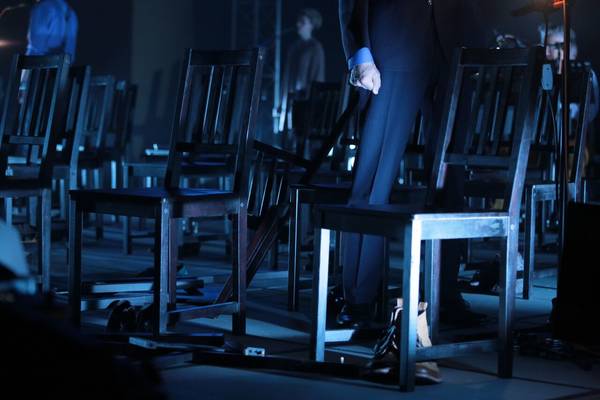
The set is a baffling assemblage of chairs, with a sound desk commanding attention centre stage. There are a lot of chairs; the stage is literally filled with rows of them reminiscent of a large school room, with enough space in between for one person to cautiously pass. This slows movement to a sleepy pace that clashes with the story’s tension, and after the initial visual impact, they are largely unchanging.

Performances are of a good standard across the board with some excellent multi-rolling. The actors do well to keep a high level of vocal energy despite physical limitations caused by the chairs. The selective use of microphones adds distance and authority, though their inconsistent use is more of a muddled hindrance to the performers and themes in the story.

The story naturally has conflict that helps keep it going, but initial exposition doesn’t lay enough groundwork to create solidly increasing tension. With the reliance on text needed to compensate for the staging, its patchiness makes clashes between characters feel sudden and forced.

A Tale of Two Cities: Blood for Blood certainly has some interesting seeds of ideas, but the script needs smoothing and design needs to be re-thought so it helps the action rather than hinders it.

A Tale of Two Cities: Blood for Blood runs through 28th August.

The Play’s the Thing UK is committed to covering fringe and progressive theatre in London and beyond. It is run entirely voluntarily and needs regular support to ensure its survival. For more information and to help The Play’s the Thing UK provide coverage of the theatre that needs reviews the most, visit its patreon.

A Fool’s Paradise, Edinburgh Festival Fringe

rsz_shakespeare-in-ecn

“Americans can’t do Shakespeare,” joke the five women from A Fool’s Paradise.

The self-deprecating, all-female company of players from Baltimore boot that myth out of the theatre with relish. Having learnt 45 scenes, speeches and moments from Shakespeare’s cannon, they promise to perform 30 of them in 60 minutes or else one of the actors gets a pie in the face.

In this delightfully raucous hour, the audience chooses what the actors perform from a bingo card that adds play to their autonomy, and they’re encouraged to take photos as well. The performances are a mix of styles, from emotionally committed and realistic through to outrageous slapstick. Some stick to Shakespeare’s text, some eschew it all together. Some use audience volunteers, some use props. The range is reminiscent of variety, vaudeville and US-style improvisation shows, creating a wonderful mix of theatrical traditions. It’s part-game show and part-celebration of Shakespeare teetering on the edge of total chaos. The atmosphere becomes wonderfully Elizabethan, with the actor/audience and actor/character boundaries heavily blurred.

Kids get involved in order to fill their bingo cards and win sweets, adults are swept away by playful joy. The performers’ response rate is lightening fast and each of them plays about a dozen or so roles. It’s a fantastic display of improvisation, multi-rolling, ensemble and physical skill, and the company are warm and charismatic, sharing enthusiasm rather than alienating through an acrobatic display of Shakespeare knowledge. The material isn’t all from his most popular plays, either – they include histories and the late romances though not all of the scenes include context, which makes it a challenge for even the most Shakespeare-familiar to keep up.

It’s a shame they aren’t here for the whole festival as it promises to be different each night and the exuberance of the company is a delightful celebration of Shakespeare’s greatest moments.

A Fool’s Paradise runs through 12th August.

The Play’s the Thing UK is committed to covering fringe and progressive theatre in London and beyond. It is run entirely voluntarily and needs regular support to ensure its survival. For more information and to help The Play’s the Thing UK provide coverage of the theatre that needs reviews the most, visit its patreon.
Life According to Saki, Edinburgh Festival Fringe

CpVFTsMXYAA1jSg

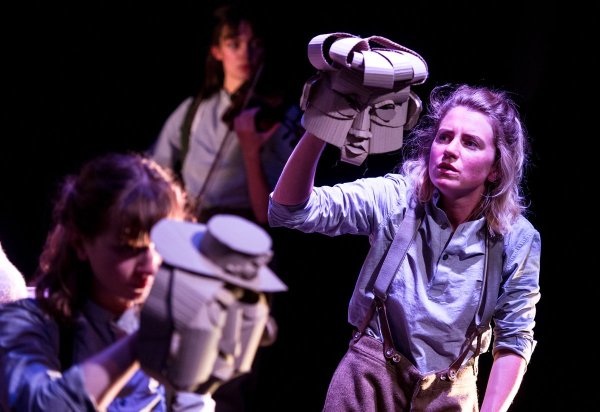
Author Hector Hugh Munro, otherwise known as Saki, is in WWI’s trenches. He and his men been out there for nearly a year, and they are long fed up with life on the front. To entertain his fellow troops, he tells the stories that have already made him a well-known writer. Life According to Saki mixes biography and fiction as Saki tells the audience about his life, interspersed with silly and bizarre anecdotes. The cast of six play both soldiers and the character’s in Saki’s stories with fantastic energy and physical commitment, but the structure of the play and Saki’s pontificating soon grows repetitive. An excessively long ending and too many stories ushers in eventual tedium despite a polished show with high production values.

Anna Lewis’ design is excellent; it clearly indicates the trenches and is flexible for the imagined worlds elsewhere. Costumes are WWI uniforms that fit the cast of women and men smartly – they are not frumpy, unaltered hire costumes. The puppets by Claire Roi Harvey and Suzi Battersby are also very good, with the cock being particularly charming with a great range of realistic movement.

The script is where it begins to fall flat a few stories in. Each one is very short, some only a few minutes long. There are about eight or ten altogether, and the constant shift from tale to tale is exhausting. The are performed with great physical comedy, accents and verge on the fantastical; each one is lovely but there are way too many. Episodes from Saki’s life are bland and dry filler, and the two styles feel forced to miserably cohabit in the same structure. The tacked-on conclusion preaches about how to live one’s life, then drags on even longer into a song and a poem. Though it blatantly states its message of living life to its fullest, the connection to the hour of stories preceding it is tenuous.

Three or four longer stories with depth and detail, and less of Saki’s biography (if any at all) would make this a much more engaging play. The premise of a soldier entertaining his troops is a fine one, but The Life of Saki comes across as self-centred and lecture-y with some silly, disconnected interludes.

Life According to Saki runs through 29th August.

The Play’s the Thing UK is committed to covering fringe and progressive theatre in London and beyond. It is run entirely voluntarily and needs regular support to ensure its survival. For more information and to help The Play’s the Thing UK provide coverage of the theatre that needs reviews the most, visit its patreon.

A Midsummer Night’s Dreaming, Edinburgh Festival Fringe

https://i0.wp.com/www.pci.leeds.ac.uk/files/2016/08/MJ42723_news.jpg

Tang Xianu and Shakespeare were writing about similar themes at the same time, on opposite sides of the world but never met. Teaming up to create a cross cultural performance, Leeds University and International Business and Economics University (UIBE) in China each took a play from each other’s culture and created a new play inspired by the foreign text. Inspired by the Chinese legend of Sophora, a spirit of the woods associated with visions and dreams, UIBE chose A Midsummer Night’s Dream. Adding multiple levels of reinterpretation, they swap the lovers’ genders and who fancies who in order to comment on gender roles in China and the pressures young people face. Performed in English, the students struggle to connect to the emotion behind the words but their adaptation is a complex and clever commentary on relationships and social expectations.

The Sophora Nest Hotel, run by three nameless staff members with otherworldly powers, is an escape from university studies for glamorous young couple Lysander and Hermia. They are followed by their friend Helena, who’s in love with Lysander, and Helena brings along Demetrius, the geeky, shy boy who will do anything for her. Helena is blind to his love, and instead uses him more as servant than a friend. Mostly in contemporary language, the lovers’ plot thread from the original unfolds but rather than the boys being drugged, its the girls, who then both fall in love with Demetrius. Lysander, who orders Hermia around to no end, needs to learn to not take advantage of her. Helena needs to do the same with her devoted sidekick.

All the chopping and changing from the original is wonderfully refreshing, and effectively communicates our need to open our eyes to those right in front of us rather than focusing on our own wants. Other themes emerge as well, particularly the pressure on women that results from being under their father’s thumb, then their husband’s. All four characters also have the drive to be the sexiest, cleverest and have the fanciest gadgets. Though China is so far away, it’s both comforting and disconcerting that young people feel this the world over.

The three hotel staff add a lovely dynamic. One is purely logical and analyses the hotel guests’ behaviour. A second wants to play tricks, and the third tries to maintain harmony between the first two. The emphasis on balance between this trio and the lovers feels distinctly eastern, and one worth worth considering in the west.

Though still maintaining an amount of student-level execution, the insight these Chinese young people provide through their script is provocative, relevant and culturally eye-opening.

A Midsummer Night’s Dreaming runs through 13th August.

The Play’s the Thing UK is committed to covering fringe and progressive theatre in London and beyond. It is run entirely voluntarily and needs regular support to ensure its survival. For more information and to help The Play’s the Thing UK provide coverage of the theatre that needs reviews the most, visit its patreon.

Swansong and Road to Huntsville, Edinburgh Festival Fringe

https://files.list.co.uk/images/2016/08/10/road-to-huntsville-lst207084.jpg

Though climate change has long been a problem, political theatre often ignores it. DugOut’s Swansong faces the issue head on, placing four survivors of a global flood in a swan pedalo. A capella songs and situation comedy bring plenty of joy and laughter to the boat, but the enormity of their survival and uncertain future weighs heavy. Will they find land, or will they kill each other first?

Like the start of a joke, hippy vegan Bobby, posh boy Steven, gym bunny Claire and nihilist Adam are on a boat, and have been for at least a little while now. They’ve already worked out exactly how to wind each other up, which generates the comedy that keeps Sadie Spencer and Tom Black’s script from becoming too heavy. The lightness contrasting the serious of their post-apocalyptic waterworld tips more towards comedy, but the balance mostly works. As they make plans for rebuilding the world to the vision they are creating from scratch in Bobby’s journal (obviously with plenty of arguments), there’s a natural progression towards eventuality – will they find land and survive, or will they all die on the pedalo?

The characters are rather stereotypical for the sake of comedy; despite this there are some poignant moments of understanding and empathy. They are effectively performed but somewhat lacking in depth, though sung interludes between scenes and the resolution help negate this unsatisfaction.

This spirited production is a relief from more sombre approaches to political issues, and a good laugh at that despite its shortcomings. Road to Huntsville is an entirely different beast, though the topic is just as infrequent on British stages. Theatre maker Stephanie Ridings stumbles across a documentary about women who fall in love with prisoners on America’s death rows. Thinking this could be the start of a new play, she latches onto the subject and delves into a world that she doesn’t understand, but doesn’t want to judge. As her research leads her further down the rabbit hole, she emerges in the “death penality capital” of the country, Huntsville, Texas.

Road to Huntsville shares Ridings’ process and turns it into a story of itself. More of a documentary, there are no preconceptions – we are in a theatre to hear about her findings. The curious but emotionally detached beginning takes its time to cave into emotional connection with the people she meets who are at the mercy of a state sanctioned killing machine. This show is a slow burner, but by the end, her passion and rage against the death penalty rally the audience to her side. Her frustrated helplessness hangs heavily in the air as she tries to return to normal life, then she does the same to us, sending us out into the busy joy of Summerhall. Though it makes for melancholy, lingering reflection, Ridings’ reminder that not everyone has the privilege of living in a country where the government won’t kill you if you commit a crime.

Swansong runs through 29th August, Road to Huntsville runs through 28th August.

The Play’s the Thing UK is committed to covering fringe and progressive theatre in London and beyond. It is run entirely voluntarily and needs regular support to ensure its survival. For more information and to help The Play’s the Thing UK provide coverage of the theatre that needs reviews the most, visit its patreon.

“Just let the wind untie my perfumed hair…” or, Who Is Tahirih?, Edinburgh Festival Fringe

https://i0.wp.com/www.ridikulmagazin.hu/cuccok/storages/thumbnails/2014-06-06/153cc8eec7af4dc9e7fe3737d2192f41/680x0.jpg

A woman sings behind a gauzy white curtain. We cannot see her face, but in her soaring cries we hear her passion. This is Tahirih, born in what is now Iran in the early 1800’s (we don’t know her exact date of birth because authorities burned these documents after her execution). She is a poet, theologist and women’s rights activist, and she has enough followers that the country views her as a national threat to the patriarchal Islam that requires women to be veiled in public.

In the days leading up to her execution, Delia Olam plays people from Tahirih’s life, unfolding her biography, teachings and radical actions. These we see plainly, but Tahirih is always behind the curtain, playing and singing. As the revered and reviled woman is sculpted through the accounts of others whilst her face remains hidden, she becomes mythical and hugely powerful, a revolutionary who’s life is tragically cut short.

Olam’s script and performance meld into a fluid solo performance that is a fitting tribute to such a remarkable woman. Her physical and vocal distinction between the handful of characters she plays is detailed and precise. A servant, Tahirih’s father, an executioner, and a female follower are crafted in detail, and all visited by the audience who go to these people to discover more about this woman who is revolutionary, dangerous, or both. This is excellent clarification of the audience/character relationship in solo performance format – it makes sense with the play’s circumstances and embeds the audience in the action. There is none of the talking out into undefined space or invisible characters that alienates the audience and removes the character from reality, something that often occurs in solo performance. Across these characters in different places and with different relationships to Tahirih, there is still a clear, well-proportioned narrative arc building to an awful end.

The scenes themselves are well-crafted and provide a snapshot of the landscape of attitudes towards women in Iran at the time. They are simply staged and prettily enhanced with candlelight, their simple, calming beauty juxtaposes the inevitable prospect of her death. Transitions are a touch slow; some are smoothed with recorded music whereas others have silent gaps as Olam transforms in and out of Tahirih, who sings and plays between characters. The silences make for a choppy disruption, but this is a minor issue easily forgiven in view of the story’s excellent construction and execution.

To learn about such a remarkable woman through a strong show and performance feels as much of a privilege as it is an education. Olam has fantastic instinct for storytelling and character development, and this detailed show needs hardly any improvement. Do not miss it.

“Just let the wind untie my perfumed hair…” or, Who Is Tahirih? runs through 29th August.

The Play’s the Thing UK is committed to covering fringe and progressive theatre in London and beyond. It is run entirely voluntarily and needs regular support to ensure its survival. For more information and to help The Play’s the Thing UK provide coverage of the theatre that needs reviews the most, visit its patreon.

Feature/Review: Children & Shakespeare, Edinburgh Festival Fringe

https://i0.wp.com/unknownmagazine.co.uk/wp-content/uploads/2015/07/York-3-credit-Rob-Freeman-1-1024x683.jpg

Whilst there’s plenty of Shakespeare at the fringe, it doesn’t get much coverage. It’s understandable – the Bard doesn’t count as a potential Next Big Thing, and he’s favoured by student and international groups that usually have short runs and are deemed less worthy of critical attention. It’s obviously necessary to recalibrate expectations and vocabulary when evaluating children and young people’s performances, but directors and teachers can and should be held accountable for the quality of their own creative work and bringing out the best in their students or young cast. They do have the additional pressure of incorporating an educational element and ensuring that their work is suitable for the children and young people they are working with, but that specialism is no more or less different than any other in the performing arts.

To completely ignore young people’s work at the Fringe when sampling the Shakespeare on offer cuts out a large segment of the Shakespeare productions on offer, and considering that these are often international schools as well, the cultural differences can be considered when critiquing. Over one day at the fringe, I watched three distinctly different Shakespeare adaptations – a Scottish stage school including children approximately aged eight through sixteen that looks at Twelfth Night, an American university’s analysis of Shakespeare’s baddies and a Notts young people’s dance-theatre company’s deconstruction of Macbeth.

Admirable Fooling or What You Will by Little Shakespeare School’s Michelle van Rensburg had the most challenging remit in that it is a show suitable for performers over a big age range, but the show she invents is a nonsensical mess. When she sticks to her simplified script with sections of original text more the more able students, it is standard children’s fare – able to be followed, giving the kids a chance to show their skills and including everyone. The random sections from Titanic, though? Inexplicable. None of the children on that stage or in the audience would have even been alive when the film came out, so crowbarring in pop culture references that they wouldn’t understand is gratuitous and self-absorbed. There are also numerous off-text clowning sequences that are unconnected to the story, and a lengthy exposition setting up a storytelling premise that isn’t consistently followed through. The one, shining moment of kitschy, creative inspiration that epitomises fringe Shakespeare is the tiny blond girl who plays the letter Malvolio finds in the garden. She wears a bright yellow sack with felted letters on either side and enthusiastically delivers the text that Malvolio reads from the letter in Shakespeare’s original. She looks about eight years old, maybe nine, certainly no more than ten, and it is an adorable thing of wonder. There are some good actors who are confident and speak well, particularly the eldest girl who plays Olivia, but the show itself is a baffling construction with little through-line or sense.

Bad Shakespeare, by Oklahoma State University drama students, isn’t bad, but it’s just as much of a lecture as it is a performance. Showcasing their intensive summer Shakespeare studies, they work their way though Shakespeare’s development of his villains. The exposition that sets up their five act structure is too long, but the acts’ increasing complexity is a nice touch. Most of the ethnically diverse ensemble are good performers, and all bar one are women – great work towards increasing diversity from the programme director. They handle the language and verse with muscularity and confidence, though there is no evidence of work towards convincingly playing men. Their emotions tend to read more as upset rather than angry or vindictive, and their physicalities are distinctly feminine. The show’s director has chosen faux-period costume; some are in dresses and some in doublet and hose. Neutral, modern dress would suit much better, especially considering the large amount of instructing the audience with contemporary language and pop culture references. Bad Shakespeare is great for learning more about Shakespeare’s characters and some of the scholarship behind them in a relaxed, easy to follow format, but it’s more of a learning experience than a show. However, they wear their confidence and passion for Shakespeare on their sleeves, which is a wonderful thing to see.

Fortitude Dance Theatre’s Macbeth has potential to be the most promising of these three adaptations, and whilst it certainly has some great moments, there are also some misguided creative choices and interpretations, and an inconsistent application of style. The young company demonstrates competence in their dance and verse delivery, though as a whole, they struggle with achieving moments of emotional intensity and staging on a  thrust. The pace was great, but tone consistently conversational. Their opening sequence was a great capture of the 90’s club scene with text and contemporary dance obviously inspired by Frantic Assembly, but the dance element is absent until the discovery of Duncan’s body, about half way through this abrupt edit. There are missed opportunities to incorporate movement into Macbeth and Lady Macbeth’s scenes showing their fluctuating power struggle. This dynamic between characters later between Macbeth and the witches inspires some good tribal, threatening choreography. Macduff’s monologue on hearing of his wife and children’s deaths is a stunning blend of movement and text that the company could to stylistically inspire their future work. They could also do with a stronger director, or dramaturg familiar with Shakespeare pronunciation, to confirm any line interpretations – “Out, damn spot” is not referring to blemishes on her face.

It’s brilliant to see young artists finding their way through making work and discovering styles and forms that work for what they want to communicate in their Shakespeare interpretations. Even though they won’t be up to professional performance standard unless they are extraordinarily gifted, their teachers and directors should be strive for clarity. Though none of these three productions quite reached that point, they each had their merits and watching children and young people discover and explore the joy of performing is a marvelous thing.

The Play’s the Thing UK is committed to covering fringe and progressive theatre in London and beyond. It is run entirely voluntarily and needs regular support to ensure its survival. For more information and to help The Play’s the Thing UK provide coverage of the theatre that needs reviews the most, visit its patreon.