Unreachable, Royal Court

Anthony Neilson didn’t come into Unreachable rehearsals with a script, but an idea – a director obsessed with finding the perfect light. From this starting point, the cast sculpted a modern satire of the film industry and the people that exist in that world. Over a six-week devising and rehearsal period, six actors worked with Neilson to create the play, a rarity in anything other than small-scale and student theatre. The end result is wickedly funny with on-point performances and, whilst the story isn’t anything remarkable, its execution makes for delicious relief from the chaos of modern Britain.

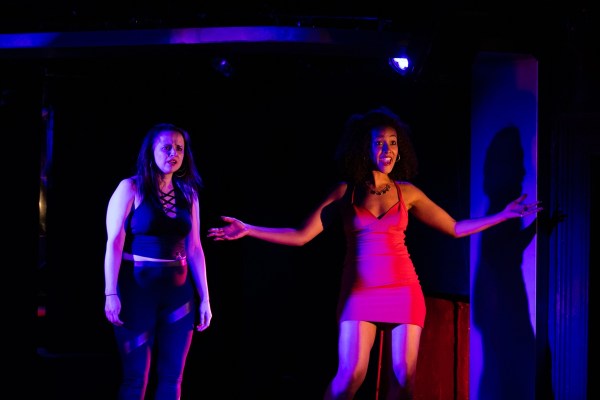
Maxim (Matt Smith) is Palme d’Or winning writer and director of Child of Ashes, currently filming in an unnamed location. He pushes the self-absorbed, whimsical artist stereotype to the limit with full-on strops, totally inappropriate comments and decisions that blow his producer’s budget. He is camp, temperamental and a fantastic physical comedian. His lead actor Natasha (Tamara Lawrence) is an unfeeling, blunt force of a sociopath who clashes with lead actor Ivan “The Brute” (a sidesplitting Jonjo O’Neill in ridiculous hair extensions). On his production team are the pragmatic producer Amanda Drew, frustrated DOP Richard Pyros, and deaf financial backer Genevieve Barr. Their grounded personalities create plenty of friction (literally, in some cases) by clashing with the flamboyant artists as the shoot goes over budget and over time. Some of the arguments are petty, others deserving, but all just as hilarious. Nielson mocks artists’ egos, but it’s not nasty – anyone working in the arts will have met at least a couple of these personalities in real life.

The comedy lies in the exaggerated characters and brilliant one-liners devised by Nielson and the cast. Even though the scenarios are fairly mundane and the story not particularly interesting in itself, it doesn’t matter one bit. There are some moments of poignancy and genuine intimacy, but Unreachable is really about the laughs. Even without familiarity with working in the arts, even the hardest, most cynical of hearts will find the outstanding performances hilarious. The scenes are often short and episodic, and half an hour could easily be trimmed, though the current two hours doesn’t feel overly long.

Chloe Lamford’s set is the reflectors, flight cases and lights of a film set until the final sequence, when she and lighting designer Chahine Yavroyan can pull out all stops in an impressive display of visual mastery. The only issue with this moment is the fox. Instead of a puppet or forgoing the image all together, an animal that should be in the wild or a sanctuary is paraded about on a lead. It’s a totally unnecessary and cruel device.

In these post-Brexit, unelected Torycore prime minister days where cracking a smile takes immense effort, Unreachable is welcome relief. Even though the play itself is nothing special, experiencing devised theatre in anything more than a tiny fringe venue that doesn’t go more than a couple of minutes without triggering a laugh is a welcome escape from real life.

Unreachable runs through 6 August.

The Play’s the Thing UK is committed to covering fringe and progressive theatre in London and beyond. It is run entirely voluntarily and needs regular support to ensure its survival. For more information and to help The Play’s the Thing UK provide coverage of the theatre that needs reviews the most, visit its patreon.
Fury, Soho Theatre

https://i.guim.co.uk/img/media/c255500e31a395db7d5e99d0e22866efcadc2904/0_0_3907_2727/3907.jpg?w=700&q=55&auto=format&usm=12&fit=max&s=24616b52e71621aa153ffabc5805fe48

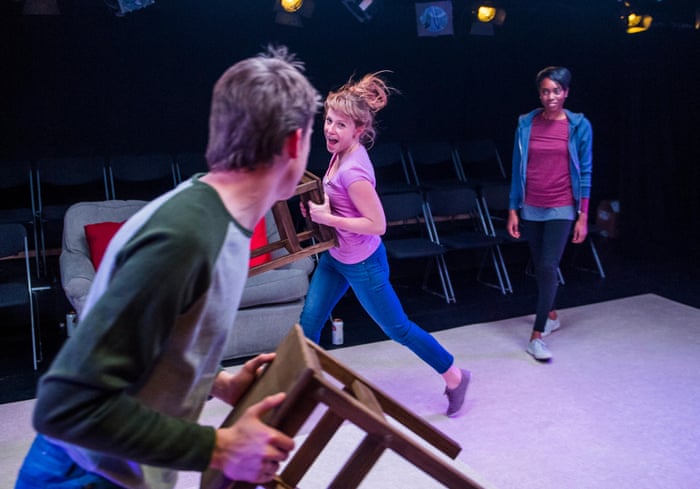
Sam is a young, single mum living in a council flat in Peckham. Having gone through the care system and her boyfriend leaving her after her second son was born, she has no one. When she meets socially inept Tom, an MA student in the flatshare above her, after losing her job as a cleaner, he creates an opportunity for friendship, sex and an escape from her kids. But Sam was born a victim, and a victim she remains. In this discourse on social class, parenting and gaslighting, playwright Phoebe Eclair-Powell incorporates Greek tragedy and a commentating chorus to expose the perils of growing up with no support network.

This is one of the young writer’s first full-length plays, and she’s still finding her feet. Fury has a great concept and characters, and the use of the chorus is a fantastic touch that adds depth and structural variation, but the execution if the ideas isn’t quite there yet. Some sections of the script don’t quite fit the main thread, like her beach outing with an old friend, and others rush the narrative progression. The chorus fills in information left out of the scenes, but this sticking plaster over the gaps is still unsatisfying and overly simplistic. The relationship between Sam (Sarah Ridgeway) and Tom (Alex Austin) escalates a bit too quickly to be plausible, though some slight extending would go far to rectify this.

Ridgeway is excellent as Sam, with a nervous energy and a risk of exploding into violence at any point, making Tom’s manipulation all the more believable to social services. Austin is slimy, awkward and initially seems harmless, but quickly reveals a dark interior. Though he plays the role well, it’s a challenging one because he transforms so quickly. His unlikely behaviour after his initial awkwardness is a powerful reminder that anyone is capable of committing horrendous acts, particularly against vulnerable people. The chorus of three (Naana Agyei-Ampadu, Daniel Kendrick and Anita-Joy Uwajeh) also play additional characters, flipping between them and non-characters with ease and agility.

Director Hannah Hauer-King uses a simple set by Anna Reid to focus on the text. Her in the round staging is a great choice that adds to Sam’s rising paranoia – everyone is indeed watching her every move. The chorus uses seats set into the audience, which although it keeps them ever present, it is unclear why the audience/actor boundary is blurred. She occasionally struggles to clarify space what with the mostly bare stage, but the dialogue usually explains well enough. Hauer-King taps into Eclair-Powell’s poetry with instinctual finesse, making some moments particularly moving.

Though the ended is rather different from the Medea that the show’s marketing compares it to, there is still senseless tragedy brought on by a man’s deliberate actions against a vulnerable woman. Fury shows much potential from the emerging writer and director, and contains some vital messages about growing up poor and female that, with some small adjustments, will be heard loud and clear.

Fury runs through 30 July.

The Play’s the Thing UK is committed to covering fringe and progressive theatre in London and beyond. It is run entirely voluntarily and needs regular support to ensure its survival. For more information and to help The Play’s the Thing UK provide coverage of the theatre that needs reviews the most, visit its patreon.

A Midsummer Night’s Dream, Jack Studio Theatre

Shakespeare often seems to come in cycles, with several productions of the same play on at once in different venues. At the moment, it’s A Midsummer Night’s Dream though it’s a common summer favourite anyway. With so much competition, individual productions need to distinguish themselves from the rest as well as have a distinctive concept, even if that concept is to stick to tradition. New company Wildcard takes a modern approach to the play and adds quite a bit of music, but a range of performance abilities, homogenous delivery and few unique elements make this production feel like a student or recent graduate production. There is a lack of confidence in the direction and the concept is not new or exciting, apart from the use of music. Though it has some good performances, this production isn’t awful, but is largely forgettable.

Amongst the thirteen actors, a few distinguish themselves from the rest of the company. Natasha Killam is a fantastic Hermia, in love, expressive and fully committed to the role. The hipster has an emo best friend in Helena, who plays the character with a dull indifference. Whilst this makes sense to the character stereotype, it’s boring to watch – though this is likely to be a directorial choice. Peter Dewhurst as a townie Demetrius is also very good, eventually matched by Joshua Leese’s hippie Lysander after Puck drugs him in the forest. As representatives from four distinct social tribes, the likelihood of them being in love in real life, let alone friends, is rather implausible, though. A sulking Helena dressed all in black in love with a polo shirted, jumper round the shoulders, Demetrius? Really? This is another of director James Meteyard’s inexperienced and unjustified decisions. 

The most inspired casting is Theseus and Oberon as a woman (both played by Abi McLoughlin), a nice touch but still shows the power imbalance between them and Titania and Hippolyta (Rhiannon Sommers). There are a few female mechanicals (Elly Lowney as Starveling, Christie Peto as Snug and Harriet Ruffer as Quince), which is also great to see. With seven of the thirteen actors women, it goes some way in adding diversity in the entirely white cast of whom nearly all have identical, Home Counties accents and all look to be about the same age. The character types represented are also generally associated with white, middle class people, further showing a blatant lack of diversity in race or social class. Whilst this isn’t an issue in and of itself, it is most definitely a sign of the lack of diversity in theatre.

Some of the lighting design is pretty to look at, though some of the changes are so dramatic that attention is drawn to the lights rather than the performance. There are some pretty strings of fairy lights, but these add to the studenty feel of the piece. There are a couple of retro easy chairs that initially look out of place, but are used well to comedic effect later in the play.

Meteyard tries to further update by adding off-text dialogue and heaps of verbal pauses, Most of which cause the energy and pace to drop. There’s also a lot of slow, even delivery, particularly in the first half, across most of the characters. Fortunately, it picks up up in the lovers’ best scene, which is played well and gets plenty of laughs. He seems to have little experience directing Shakespeare, though he excels with the music. Puck sings most of his monologues, which is really lovely (though why is he in leather trousers, topless and covered in glitter?) and the mechanicals accompany both onstage and off, creating a rich soundscape.

With the music the strongest element of the production, particularly at the end with a delightfully surprising jig, it’s not all pedestrian. But this young company is still very much finding their feet with classical work.

A Midsummer Night’s Dream runs through 23 July.

The Play’s the Thing UK is committed to covering fringe and progressive theatre in London and beyond. It is run entirely voluntarily and needs regular support to ensure its survival. For more information and to help The Play’s the Thing UK provide coverage of the theatre that needs reviews the most, visit its patreon.

CUT, The Vaults

We don’t often see Antipodean theatre on the London fringe, but when we do, it’s certainly a bit different from British progressive performance. CUT, a cinematic, fragmented solo performance with elements of interactive theatre and immersive installation, effectively evokes a constant sense of unease but the range of styles and influences create a convoluted message. Technology is used effectively to maintain audience tension, with light and sound breaking up the narrative creating an extreme environment. But despite CUT‘s slickness and a fractured story that holds viewers’ focus, there is no clear reason why the story of an anonymous female flight attendant pursued by a male stranger is told. There is no predominant theme or message, just a story that, though it is told well, isn’t particularly dynamic or interesting.

Hannah Norris, an Australian actor based in London, is the only performer but the audience is a vital contributor to the piece so it’s easy to forget this is a solo performance. We are boarded onto a plane and accompany her throughout her shift and her subsequent journey home, with regular interruptions of nightmarish flashbacks, surreal characters, blackouts and loud noises. Norris’ character constantly narrates the journey, but it is never made clear what this episode from her life is meant to say. They man following her perhaps comments on male objectification of women, but it’s not particularly clear if this is an actual message of the piece – if that is the piece’s intention, it lacks conviction. The focus could just as easily be the possibilities of contemporary narrative structure influenced by pop culture and technology. The programme notes by writer/director Duncan Graham fail to elucidate despite an explanation of influences.

Regardless of the lack of clarity behind the piece, Norris is an excellent performer. She morphs and changes within the blackouts, always surprising and maintaining attention. Her timing and characterisation are impeccable within the often third-person text. Sam Hopkins and Russell Goldsmith’s design almost becomes characters within their prominence, but they do not overwhelm. The nerve wracking harmony between Norris, sound and light is exquisite.

With production elements that are much more impressive than the piece as a whole, CUT still has plenty of positives, but the story behind the suspense it creates is unsatisfying and anticlimactic. The narration and tech creates emotional distance, but perhaps the favouring of style over substance is too blunt for a British audience.

CUT runs through 31 July.

The Play’s the Thing UK is committed to covering fringe and progressive theatre in London and beyond. It is run entirely voluntarily and needs regular support to ensure its survival. For more information and to help The Play’s the Thing UK provide coverage of the theatre that needs reviews the most, visit its patreon.
Ugly Lovely, Old Red Lion

rsz_ffion_jones_and_sophie_hughes_in_ugly_lovely_c_velvet_trumpet_1-1

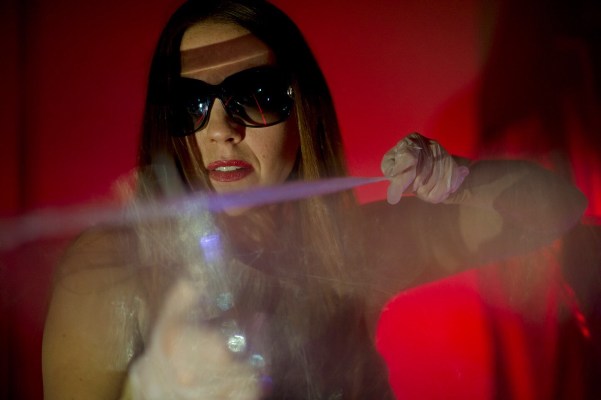
It’s Shell’s 26th birthday and she’s not happy. Her boyfriend Carl is AWOL and probably banging Smelly Kelly, her nan died recently, and she wants to leave Wales for the big city of Liverpool. Her best mate Tash is trying to convince her to stay, but her reasons are far from convincing. Shell is miserable, frustrated and angry. She feels the pull of adventure, but the tug of the sea she knows so well is strong, too. Shell tries to decide what to do as best she can – chatting with the urn that holds her nan’s ashes, going out clubbing and leaving her son Kieran with her mum. Ugly Lovely snapshots down-at-heel but aspirational Swansea with well-rounded characters who are excellently performed within a promising script, but it has a somewhat unsatisfying resolution.

This is writer Ffion Jones’ first play, and as debuts go, it’s a a rather good one. She’s built a sound narrative structure, though some trimming wouldn’t go amiss. The plot isn’t complex enough to warrant the current length or the interval, though too much cutting would rush the climax and dénouement. She has written detailed, nuanced characters with emotional depth that rally the audience’s support, but this leads to disappointment when Shell ignores her ambitions. Jones has an aptitude for sharp dialogue and dark humour, and there are some brilliant comedic moments within the characters’ misery.

Jones plays Shell, endowing the character with emotional truth and lived experience. Sophie Hughes as her best friend Tash is her cheerful sidekick, maintaining a wonderful sense of optimism despite an abusive home life. Oliver Morgan-Thomas rounds out the cast as their laddish schoolmate Robyn who is also doing the best he can to get by, though isn’t the nicest of individuals. His introduction leads to a brutal conflict and adds variation to the individual scenes’ structures, and his rough charm brings a great energy to the dynamic created by the women.

Nikolai Ribnikov’s direction is smooth and instinctive, and Lizzy Leech’s set enhances the gritty naturalism of their day-to-day lives. There is an awkward park bench that doubles as a couch, and the exposed toilet sits unused and exposed in a corner for most of the play, but adds additional dinginess.

This is a great little play that is remarkably polished for a new writer; it shows much promise even though it could use some tweaking. Jones is clearly a skilled theatre maker, and the rest of the creative team serves her script excellently. Production company Velvet Trumpet did exceedingly well in choosing this script, and Jones is certainly one to watch as both an actor and writer.

Ugly Lovely runs through 16 July.

The Play’s the Thing UK is committed to covering fringe and progressive theatre in London and beyond. It is run entirely voluntarily and needs regular support to ensure its survival. For more information and to help The Play’s the Thing UK provide coverage of the theatre that needs reviews the most, visit its patreon.
Savage, Arts Theatre

rsz_gary_fannin_and_bradley_clarkson_in_savage_at_the_arts_theatre_c_roy_tan

Denmark in the mid-1930s was a great place to be if you were gay. Homosexuality was legalized in 1933 and a thriving club scene allowed gay men to meet and socialize publicly. But as the dark cloud of National Socialism swept Europe, safety became more precarious. Dr Carl Vaernet was one of their threats. A practicing GP with an interest in hormone therapy, the Danish Nazi Party member soon captured the attention of party higher ups with his therapies that he claimed cured homosexuality. Hired to cure gay prisoners at Buchenwald late in the war, he experimented on seventeen inmates before the war ended and he escaped to Argentina.

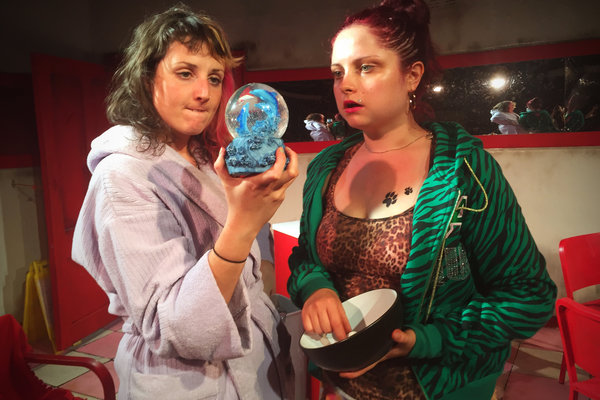
Claudio Macor’s latest play Savage focuses more on the story of Nikolai and his American boyfriend Zack than Dr Vaernet, but the lovers are soon separated and Nik becomes one of the doctor’s victims. The emerging subplot of an SS officer and his secret, gay love slave quickly becomes just as important as Nik and Zack, making Savage more of a play about homosexuality in WWII than specifically about Dr Vaernet and his horrific medical experiments. Spanning several years and multiple narratives, the script, sadly, doesn’t give in-depth attention to any particular character; individual stories are disrupted and incomplete. This would be a much more compelling text if Macor focused attention on one primary character rather than taking a scattergun approach. All of these characters have potential to steer a rich, interesting play that focuses on them, but none of them get the full, individual attention they deserve. There are some great set piece scenes, but the overall structure lacks focus.

Some of the performances are inconsistent and the cast present a range of styles, which distracts from the seriousness of the plot. There are a few good performances, though. Gary Fannin cuts a cold, scientific Dr Vaernet with a clear disgust for gay people; this professional face of homophobia and calm hatred is a most chilling one indeed. Emily Lynne as the doctor’s nurse viciously opposes the Nazis and blatantly defies their rules in a display of ferocious persistence. She’s a great contrast to the doctor’s calm hatred. The two pairs of lovers have moments of genuine care for each other, whereas other times feel forced.

Jamie Attle’s costumes are sharp and detailed, whilst David Shields’ set of rotating panels clarify location but are a bit clumsy. Macor also directs, ensuring his political messages get across but an additional pair of eyes could have developed more intimacy between the couples.

Though the topic is most serious indeed, there’s a distinct lack of joy in the beginning cabaret scene and between Nik and Zack. Macor clearly wants to raise awareness of the horrors of Vaernet’s work, but some lighter moments of exposition would emphasise this further. A dramaturg would not go amiss in order to streamline the script and performance styles in future productions, but this premier still has potential and exposes a historical figure too easily forgotten amidst more prominent Nazi war criminals.

Savage runs through 23 July.

The Play’s the Thing UK is committed to covering fringe and progressive theatre in London and beyond. It is run entirely voluntarily and needs regular support to ensure its survival. For more information and to help The Play’s the Thing UK provide coverage of the theatre that needs reviews the most, visit its patreon.

Screwed, Theatre503

Char and Luce are free spirits who live their lives totally in the moment, but not in a happy, hippie sort of way. These inseparable 30-somethings work in a factory in Little England and spend their spare time clubbing, drinking and fucking. They have no life plans, just the immediate goals of getting pissed and getting off with blokes in toilets. Their line manager Paulo and Luce’s transgender mum Doris try their best to save them, but the self-absorbed duo don’t want to know. Kathryn O’Reilly’s debut play Screwed admirably endows women with stereotypically laddish behaviours, but there’s an uncomfortably judgemental tone taken on the lack of goodness within these women. The wonderfully biting dialogue and excellent performances from the cast of four easily seduce the audience, but the script’s message evokes troubling questions.

The two women are verbally abusive, physically violent and without a care for anyone else. Instant gratification is all that matters and they stop at nothing to get it. Their behaviour predictably catches up with them, but there’s little reform after disaster strikes. In contrast, the men in the story are as virtuous as the women are abhorrent. Why? What is this juxtaposition meant to say? Is it to prove that women can be just as bad a men? That male sensitivity is real and should be respected? That women should behave like this in order to feel empowered? Their working class background is obvious, though so is Paulo’s – but his ambition contrasts their lack of it. Is this a comment on social class as well as gender? There is clear reference to the  cycle of poverty, but it’s certainly not viewed with sympathy. All of these themes are raised, but none are particularly positive by the limited emotional range endowed on the duo. The harsh spotlight may be brutal and honest representation of working class, small town Britain but its sweeping generalisations about women and social class are unclear at best, and worrying at the worst.

Samantha Robinson and Eloise Joseph are Char and Luce. Their attack on the roles is positively electric, as is their chemistry and threat to anyone that crosses their path. Stephen Myott-Meadows  as Paulo is a quiet romantic with a biblical capacity for forgiveness. He’s the Nice Guy that always gets friendzoned, taken advantage of, and keeps coming back for more in the hope that things have changed. They never do, and his hurt is inevitable. In this case, it’s horrific. Derek Elroy is Luce’s saintly mother, unappreciated by her daughter, who still lives with her despite being in her third decade, on a daily basis. Elroy’s calm is a fantastic foil to Luce’s viciousness. 

Catherine Morgan’s simple set is a remarkable continuous line that forms the landscape Char and Luce barrel through on a day-to-day basis. As soothing to look at as Elroy’s voice is to hear, it’s metallic smoothness is a reminder of the connection between all things in the world. The girls’ behaviour might seem trivial on a small scale, but it deeply effects those closest to them.

Screwed is a difficult play to pin down. On the surface, it’s fantastic. But upon pondering what O’Reilly wants to communicate, it becomes more troubling, a judgment of male and female behaviour within working class suburbia. There is clear moralising, but the moral of this story is not a comfortable one to take in.

Screwed runs through 23 July.

The Play’s the Thing UK is committed to covering fringe and progressive theatre in London and beyond. It is run entirely voluntarily and needs regular support to ensure its survival. For more information and to help The Play’s the Thing UK provide coverage of the theatre that needs reviews the most, visit its patreon.