The Toll, Half Moon

https://cdn.onthewight.com/wp-content/2017/03/luke-wright.jpg

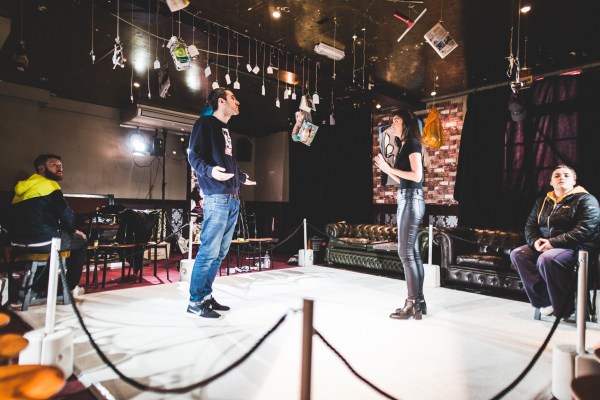
Luke Wright’s jovial demeanour and impressive word hoard sit at odds with his smudged eyeliner and black leather jacket. The unassuming performance poet skulks to the mic, breathes, then unleashes a torrent of verbal acrobatics snapshotting British everymen and women. From a Georgian dine and dasher, to a bloke from Essex who swears he saw a lion roaming a campground, Wright’s depictions bring these characters to life. His dexterity and character-driven performance has a theatricality missing from most performance poetry, but the polished story present in What I Learned From Johnny Bevan is notably absent in The Toll.

Continue reading

Made in India, Soho Theatre

https://files.list.co.uk/images/2017/02/14/made-in-india-LST233293_large.jpg

@hannahnicklin: Since reading this I keep on thinking in quiet moments ‘women are raped nightly so I can have tomatoes in winter’

We know we exploit foreign workers for cheap goods, because we’re liberal and aware. But does that stop us? Largely, no – because we can’t afford to. I buy my clothes from Primark and my fruit and veg from the stalls that line Peckham Rye because I work in the arts and I’m poor. I don’t give any thought to where they come from in the transactional moment, but am righteously moved by articles like the one above that Hannah Nicklin tweeted. Sure, this makes me a hypocrite. But I need only to look at the other people also shopping on Sunday mornings to reinforce that I am far from alone. Most of my fellow “liberal elites” (educated, urban and left leaning) are the same, and centuries of imperialism (obviously white, male and western-led) have established the systems that the whole of society (including the liberal factions) implicitly condones through consumerism.

Continue reading

The Monkey, Theatre 503

The Monkey - Theatre 503, George Whitehead and Morgan Watkins, photos by Simon Annand 2

Tel and Dal are two Sarf London geezas who grew up together on a Bermondsey estate. Dapper and ambitious Tel has moved up in the criminal underworld, away from Dal’s small-scale thieving so they don’t see each other much. Dal’s less aspirational, still robbing people on the street with his mate Becks. When they’re not out working, Dal and Becks get their drugs from young dealer Al, who lives upstairs. Life’s ticking along as normal until Tel shows up unannounced looking for the money he leant to Al a month ago. Tel’s volatile temperament, sharp intelligence and vanity mean the other three are no match for the increasing danger.

Continue reading

The Long Trick, VAULT Festival

https://i0.wp.com/www.vaultfestival.com/wp-content/uploads/2016/11/Marietta-Kirkbride-The-Long-Trick-main-image.jpg

Tristan is the stuff of Cornish legends. The Robin Hood-esque figure who lives along the Helford River gives much needed gifts to local people the moment they reach utter despair – or so people believe. The reality is rather different. Tristan does live on the Helford, on a boat with his teenaged daughter Kelsey. He can’t find a job so steals electronics from second homes and sells them on to make a living. He occasionally helps out locals when he’s feeling flush, but his virtue is up for debate. When Tristan meets Gale, a vegan activist who suddenly appears in Cornwall after years of drifting around Europe, his world is transformed, but not quite in the manner he expects.

Continue reading

He(art), Theatre N16

jack-gogarty-alex-reynolds-by-jesse-night

Chalk and cheese Alice and Rhys debate whether to purchase a painting in an art gallery. Simultaneously, siblings Kev and Sam hatch a plan to fund a life-saving procedure for their ill mum that the NHS won’t cover. Running at just over an hour, writer Andrew Maddock fits in the nature of art and its criticism, public health, social class, poverty and loyalty across two very different sets of characters in the same neighbourhood. It’s a lot for 65 minutes and whilst it’s not enough time to fully explore these themes, the play doesn’t feel crowded. Though the direction and performances are intuitive and finely tuned, Maddock’s outstanding verse poetry and use of non-naturalism is sorely missed in this surprising diversion from his trademark style.

Continue reading

Three Sisters, Union Theatre

https://i0.wp.com/www.jetsetreport.com/admin2/photos/Moscow_Ritz.jpg

“Nothing turns out the way we planned.”

Though 2016 has been riddled with despair, 2017 looks worse. With the fascist post-truth movement on the rise and Trump taking office in a matter of days, there is little to look forward to. Far-off lands look like alluring utopias, and it’s easy to fall prey to the lingering question of what the point is of carrying on in the face of all this societal disintegration. With existentialism one of the cruxes of the story, this Three Sisters is a bleak echo of present day narcissism and hopelessness. Phil Willmott’s staging of a new, pared back translation doesn’t stagnate, though. Combined with a strong cast, this is production uncannily suits our times.

Continue reading

The Trackers of Oxyrhynchus, Finborough Theatre

trackers

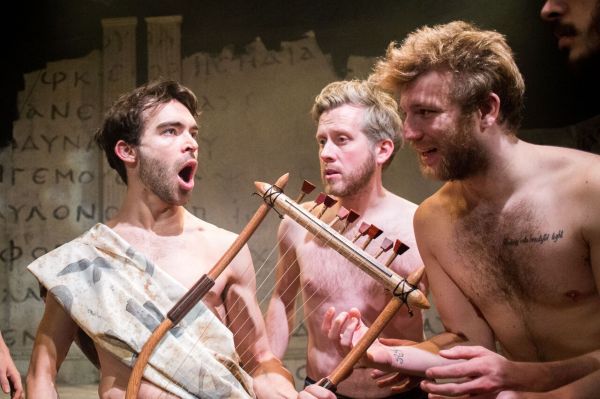
In the first part of Tony Harrison’s The Trackers of Oxyrhynchus, Victorian archaeologist Grenfell struts and frets around a group of silent Egyptians sifting through scraps of papyrus. He maniacally monologues on his quest to find Sophocles’ lost plays and works himself into such a frenzy that he begins to hallucinate. This triggers an inexplicable leap to ancient Greece where a satyr play is acted out and cloth phalluses abound, then another transition to a modern day street populated by homeless men.

Though there is some thematic consistency, the three stories are otherwise unrelated by plot and style. What initially appears to be a play-within-a-play turns out to be a disjointed and disappointing triptych, much like the fragments of papyrus that litter the stage.

Continue reading

Tonight With Donny Stixx, The Bunker

https://i0.wp.com/exeuntmagazine.com/wp-content/uploads/Sean-Michael-Verey-in-Tonight-with-Donny-Stixx-at-The-Bunker-photo-by-savannah-photographic-6.jpg

Donny Stixx is a teenaged magician with boundless dedication to his craft and desperation for fame. Rather than doing things that boys his age normally do, he spends hours honing his skills and tweaking the act he performs at kids’ parties, hospices, churches and for anyone else that will watch. The only thing he ever thinks and talks about is his magic. But Donny’s pretty obviously on the autism spectrum; this combined with his unstable upbringing and lack of an appropriate support system is a particularly deadly combination. Philip Ridley’s 2015 Edinburgh award-winning solo show explodes onto a bare, grey stage in a linguistically vivid documentation of fanaticism and social disorder with a phenomenal performance by Sean Michael Verey.

Verey is an unrelenting force with inimitable energy and charisma that shines through a character who has precious little social intuition. Though Donny is awkward and frustrating, Verey’s performance captivates. Having a totally plain stage that is anywhere and everywhere means it’s entirely on the actor to hold attention – but the performance makes it work and is never, ever boring.

Ridley’s text is dense and Verey races through it; it would otherwise be double the length. Though the pace is exhausting to take in, it’s necessary. The language and imagery richly creates a wonderfully detailed believable world. Director David Mercatali coaxes the nuance from Donny’s biographical story incredibly well despite the speed – the sparsely used pauses are devastating. When the pace finally lets up, it’s like cold air hitting a friction burn.

A clearly foreshadowed conclusion results in awed, uncomfortable silence. After a week that saw the broken American political machine elect an orange fascist for its next president, Ridley’s play is far from comforting. Whilst Verey’s depiction of Donny’s passion is delightful and his performance is nothing short of extraordinary, his vulnerability weighs heavily on bruised and helpless liberal consciences. There is no safety net, and fanaticism is the new normal in this dark play from the innocent days of pre-2016. It’s a hard show to sit through, but absolutely worth it.

Tonight With Donny Stixx runs through 3 December.

The Play’s the Thing UK is committed to covering fringe and progressive theatre in London and beyond. It is run entirely voluntarily and needs regular support to ensure its survival. For more information and to help The Play’s the Thing UK provide coverage of the theatre that needs reviews the most, visit its patreon.

An Inspector Calls, Playhouse Theatre

https://i0.wp.com/www.thegayuk.com/wp-content/uploads/2016/11/An_Inspector_Calls_at_the_Playhouse_Theatre_-Tabitha_Douglas_Ben_Burely_and_James_Hill_-_Photo_by_Mark_Douet-e1479067631695.jpg

Seventy years ago, J B Priestley’s thriller An Inspector Calls was first staged in the UK. Twenty-five years ago, Stephen Daldry’s acclaimed, progressive production opened at the National. His approach shook up the insular, drawing room script in order to highlight the selfish elitism of the middle and upper classes and has been regularly staged since 1992. Now, in a post-Brexit, post-Trump 2016 punctuated by hate crime, polarised political views and gaping social inequality, Daldry’s production about the death of a working class woman known to all members of a posh family still feels relevant. Though there are some clunky moments and miss-matched performance styles, the crusade for accountability and justice that drives the plot keeps this play firmly in the present within a stunning production concept.

Daldry’s interpretation manifests through Ian MacNeil’s design that takes much of the action out of the Birling family home and into the dark, wet street below. Copious fog and treacherous cobbles interfere with their joyous engagement celebrations and ruling class entitlement, endowing the inspector with more power as the Birlings are actually destabilised. The family and their guests are drawn out of the warm comfort of their stilted home that quickly becomes remote and inaccessible, and made to face the dirty secrets that Inspector Goole extracts from each of them in a landscape of damp despair. As their individual facades collapse, so does the home that protects and elevates them from the working classes, the people of the streets. Some of the set transitions are a bit mechanical, but it’s otherwise a powerful visual metaphor and one that’s excellently executed.

The cast’s performances are good, though there are a few different styles. Barbara Marten’s matriarchal Sybil Birling is comedically melodramatic, earning a laugh whenever she speaks. Considering the gravity of the play’s message, this is a strange choice and one that clashes with the largely naturalistic work from the rest. Liam Brennan is an excellent Inspector Goole, earthy and immoveable. Clive Francis is a somewhat frail Arthur Birling, though his vocal power and characterful rage keep him in constant battle with the inspector.

This visually striking production is still relevant what with Priestley’s attacks on the British class system and the casualness with which the upper classes and government treat the lives of the working class and those down at heel. The energy, pace and tension keep it from descending into stale playacting that dances around a real, serious problem and the high production values give it popular appeal and spectacle. With hope, its wide reach will have a big impact and remind audiences that the unseen, working girl in the play is the entire population of impoverished people in this country at the mercy of those with more financial power.

The Inspector Calls runs through 4 February.

The Play’s the Thing UK is committed to covering fringe and progressive theatre in London and beyond. It is run entirely voluntarily and needs regular support to ensure its survival. For more information and to help The Play’s the Thing UK provide coverage of the theatre that needs reviews the most, visit its patreon.

Feature: Silent Snacks

https://i0.wp.com/munchies-images.vice.com/wp_upload/Silent-Snacks-theatre-cinema-food.jpg

Rejoice! If you are the sort of theatregoer who has signed the Theatre Charter, and is regularly outraged by the appalling behaviour from other audience members who may not have the same high standard of culture or upbringing as yourself, you will adore Today Tix’ latest initiative, Silent Snacks. No longer will you have to endure the incessant rustling of sweet wrappers, the crunch of crisps, the post-coke burps, the mobile phone lights, the whispers, the fidgeting, the breathing, the poor and the young wreaking utter havoc on your evening of cultural consumption in the proper Victorian fashion (I say, what did those Elizabethans know about theatre!). The selection of sophisticated, upper-middle class, white people snacks come delivered in red cloth pouches so at no point in the consumption process will they make a sound that could offend surrounding ears. They also contain enough elite ingredients to satisfy Whole Food shoppers, and are bland enough to not offend Home Counties and Middle England palates.

Available through the Today Tix app, savvy audience members can pre-order this etiquette cure-all that enables guilt free theatre snacking. It’s only too big of a shame that these snacks cannot be forced onto all audience members that dare to eat during a performance, especially the group of urban teenagers who never attended the theatre before.

First on offer are Quiet Pop(corn) bites. A base of ground popcorn and dates creates a truffle-y texture, but with the dates and coconut blossom nectar, they are more sweet than savoury. They don’t particularly taste of popcorn, but neither does any other flavour dominate. They lack a satisfying crunch, but are indeed silent. The crushed popcorn does tend to get in between the teeth, so there is potential for some discomfort until you are able to pick out the offending particles in private – we can’t have teeth picking in the stalls, obviously!

The flawless, leading lady of Silent Snacks are the Muffled Truffles: rich, dark chocolate indulgence. Instead of popcorn, smooth cocoa powder is blended with chewy dates. They are not one for commoners who prefer sweet, milk chocolate and are more substantial than conventional truffles due to the presence of the dates.Very classy and adult, like theatre audiences should be.

Silent Slices are dainty, soft slices of dried pear. Chewy and subtle, these tiny nibbles have no added ingredients and pear is such a delicate flavour that drying greatly diminishes it. Apple with a sprinkle of cinnamon would have a stronger taste, but the pear is less offensive to those with delicate constitutions and aversion to anything stronger than the blandest of foods.

These snacks would not be complete without a suitably refined beverage. The Anti-Gas Lime and Mint drink is a questionably lurid green concoction of grapefruit, lime, mint and water. Oral and anal gas expulsion is banished, as is the risk of noise in opening the container. A branded silicon cup is a smart vehicle through which to show off your culinary choices, despite terrible mouth feel and the bitter flavour of the drink.

Silent Snacks are available for a limited time only though Today Tix, so we can only hope that the entire theatregoing populace uses the app to procure their theatre tickets and sees the error of their noisily munching ways. Though we will mourn their eventual disappearance, we can hope their legacy lives on by serving to return theatre to it’s rightful, middle class audiences.

The Play’s the Thing UK is committed to covering fringe and progressive theatre in London and beyond. It is run entirely voluntarily and needs regular support to ensure its survival. For more information and to help The Play’s the Thing UK provide coverage of the theatre that needs reviews the most, visit its patreon.