Bucket List, Edinburgh Festival Fringe

rsz_cpf9rwlwgaagznb

The North American Free Trade Agreement (NAFTA) between Canada, the US and Mexico came into effect on 1 January, 1994. I was eleven years old. The agreement ushered in a degree of national prosperity for all three countries, but Mexico’s low minimum wage, lax environmental regulations and corrupt officials made a perfect storm for sweatshop conditions in the US-owned factories (maquiladoras) taking advantage of the exchange rate and unemployment in Mexican border towns. The maquiladora owners favoured female workers for their diligence and precision and employed girls as young as fourteen, who were better suited for working 12-hour days in harsh environments than older women or clumsy men. These girls, only a few years older than me, were assembling electronics and convenience items out of toxic materials for 39 cents an hour.

I’m American. Though I hide it well with a deliberately constructed accent and uniquely British habits and mannerisms that I’ve developed in the nearly twelve years that I’ve lived here, I still have the passport, the cultural history and the guilt to prove it. Normally that guilt is shaped like guns, healthcare or Trump, but it occasionally takes on other forms. This time it’s privilege. That privilege/guilt pours down my cheeks in hot, angry tears during Theatre Ad Infinitum’s Bucket List. The story of the women and girls’ lives dictated by the maquiladoras, some as young as me, is a horrifying contrast to the suburban middle-class upbringing I had, kept busy with school and music lessons and theatre rehearsals and ambitions. I may have had something that these girls made, some frivolous object bought without thinking in order to make my life easier or better, and I was totally oblivious to their hardship. I did not have to worry about my mother being killed for protesting the maquiladoras’ pollution, or about my auntie being raped by her manager, or getting cancer from the chemicals I encountered on a daily basis.

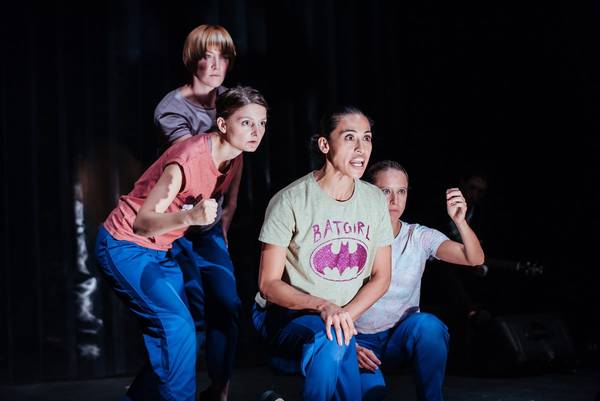
But for the women and girls in Bucket List, that is their life. The all-female, international cast, directed by Nir Paldi, devised a magical realism story of these desperate factory towns based on an idea from Mexican company member Vicky Araico Casas. Incorporating George Mann’s distinctive choreography and live music, Bucket List tells the story of Milagros (played by Casas), a girl growing up in one of these towns dominated by maquiladoras. Her generation’s experiences and those of her mother’s interweave, creating a landscape of labour, political protests, coming of age and revenge. It is a dense story covering a decade of these women’s lives, but Paldi’s script is easy to follow. Magical realism creeps in stealthily, and only at the end of the performance do certain events seem untenable and raise the question of whether or not they actually happened. Regardless of this fuzzy line between reality and fantasy, Bucket List is an anthem of strength that roars with political agenda and gives voice to the disregarded victims of developed nations.

Initially more of a montage of life experiences, Milagros’ story slowly begins to emerge. This could shift slightly earlier in the piece, but the exposition at the beginning gives wider context and does not feel extraneous. Paldi maintains a careful balance of these women’s lives and a wider, North American political picture that slightly tips in favour of the women, but there is enough of the outside world’s oppression and token assistance to inspire the characters’ rage and passion. Milagros’ tragic end adds fuel to the production’s fury against exploitation that comes out as a roar rather than a whimper.

There is hardly any set and technology on display, a dramatic change from their last adult show, Light. Instead, costume plays a bright but subtle role in the story – the five women playing the girls and their family wear coloured t-shirts with cartoon characters often idealised by young girls. Disney princesses, Batgirl and Alice in Wonderland offer them an American-created fantasy that they can strive for but will most certainly never achieve.

Juxtaposed against these pastel tops are quite vicious games demonising the powerful politicians and corporations that shape their lives. They also mock their working conditions, daily violence at the hands of men and threats to their lives. Milagros’ mother (Deborah Pugh) is a vocal political protester, demonstrating a ferocity also contrasting her character’s clothing. The excellent live score by Amy Nostbakken is more of a direct expression of the fighting spirit and sadness within these women.

Though a text-driven piece, Mann uses a series of motifs that soon become recognisable, indicating specific actions and locations. They enhance the understanding and often act as a substitute for words. Though used regularly, Mann’s choreography is one of the company’s trademarks and is unfortunately underused, especially considering the lack of set.

Even though NAFTA is over twenty years old, the maquiladoras are still there, employing women for long hours, polluting local rivers and creating environments ripe for exploitation. Paldi’s script aggressively demands awareness which may be unpalatable to some, but should be required viewing for every American blissfully unaware of their brothers and sisters across the border that are so often looked down upon with racist disgust. Bucket List is truly vital theatre in our age of disposable, thoughtless consumerism.

Bucket List runs through 29th August.

The Play’s the Thing UK is committed to covering fringe and progressive theatre in London and beyond. It is run entirely voluntarily and needs regular support to ensure its survival. For more information and to help The Play’s the Thing UK provide coverage of the theatre that needs reviews the most, visit its patreon.

Feature/Review: Children & Shakespeare, Edinburgh Festival Fringe

https://i0.wp.com/unknownmagazine.co.uk/wp-content/uploads/2015/07/York-3-credit-Rob-Freeman-1-1024x683.jpg

Whilst there’s plenty of Shakespeare at the fringe, it doesn’t get much coverage. It’s understandable – the Bard doesn’t count as a potential Next Big Thing, and he’s favoured by student and international groups that usually have short runs and are deemed less worthy of critical attention. It’s obviously necessary to recalibrate expectations and vocabulary when evaluating children and young people’s performances, but directors and teachers can and should be held accountable for the quality of their own creative work and bringing out the best in their students or young cast. They do have the additional pressure of incorporating an educational element and ensuring that their work is suitable for the children and young people they are working with, but that specialism is no more or less different than any other in the performing arts.

To completely ignore young people’s work at the Fringe when sampling the Shakespeare on offer cuts out a large segment of the Shakespeare productions on offer, and considering that these are often international schools as well, the cultural differences can be considered when critiquing. Over one day at the fringe, I watched three distinctly different Shakespeare adaptations – a Scottish stage school including children approximately aged eight through sixteen that looks at Twelfth Night, an American university’s analysis of Shakespeare’s baddies and a Notts young people’s dance-theatre company’s deconstruction of Macbeth.

Admirable Fooling or What You Will by Little Shakespeare School’s Michelle van Rensburg had the most challenging remit in that it is a show suitable for performers over a big age range, but the show she invents is a nonsensical mess. When she sticks to her simplified script with sections of original text more the more able students, it is standard children’s fare – able to be followed, giving the kids a chance to show their skills and including everyone. The random sections from Titanic, though? Inexplicable. None of the children on that stage or in the audience would have even been alive when the film came out, so crowbarring in pop culture references that they wouldn’t understand is gratuitous and self-absorbed. There are also numerous off-text clowning sequences that are unconnected to the story, and a lengthy exposition setting up a storytelling premise that isn’t consistently followed through. The one, shining moment of kitschy, creative inspiration that epitomises fringe Shakespeare is the tiny blond girl who plays the letter Malvolio finds in the garden. She wears a bright yellow sack with felted letters on either side and enthusiastically delivers the text that Malvolio reads from the letter in Shakespeare’s original. She looks about eight years old, maybe nine, certainly no more than ten, and it is an adorable thing of wonder. There are some good actors who are confident and speak well, particularly the eldest girl who plays Olivia, but the show itself is a baffling construction with little through-line or sense.

Bad Shakespeare, by Oklahoma State University drama students, isn’t bad, but it’s just as much of a lecture as it is a performance. Showcasing their intensive summer Shakespeare studies, they work their way though Shakespeare’s development of his villains. The exposition that sets up their five act structure is too long, but the acts’ increasing complexity is a nice touch. Most of the ethnically diverse ensemble are good performers, and all bar one are women – great work towards increasing diversity from the programme director. They handle the language and verse with muscularity and confidence, though there is no evidence of work towards convincingly playing men. Their emotions tend to read more as upset rather than angry or vindictive, and their physicalities are distinctly feminine. The show’s director has chosen faux-period costume; some are in dresses and some in doublet and hose. Neutral, modern dress would suit much better, especially considering the large amount of instructing the audience with contemporary language and pop culture references. Bad Shakespeare is great for learning more about Shakespeare’s characters and some of the scholarship behind them in a relaxed, easy to follow format, but it’s more of a learning experience than a show. However, they wear their confidence and passion for Shakespeare on their sleeves, which is a wonderful thing to see.

Fortitude Dance Theatre’s Macbeth has potential to be the most promising of these three adaptations, and whilst it certainly has some great moments, there are also some misguided creative choices and interpretations, and an inconsistent application of style. The young company demonstrates competence in their dance and verse delivery, though as a whole, they struggle with achieving moments of emotional intensity and staging on a  thrust. The pace was great, but tone consistently conversational. Their opening sequence was a great capture of the 90’s club scene with text and contemporary dance obviously inspired by Frantic Assembly, but the dance element is absent until the discovery of Duncan’s body, about half way through this abrupt edit. There are missed opportunities to incorporate movement into Macbeth and Lady Macbeth’s scenes showing their fluctuating power struggle. This dynamic between characters later between Macbeth and the witches inspires some good tribal, threatening choreography. Macduff’s monologue on hearing of his wife and children’s deaths is a stunning blend of movement and text that the company could to stylistically inspire their future work. They could also do with a stronger director, or dramaturg familiar with Shakespeare pronunciation, to confirm any line interpretations – “Out, damn spot” is not referring to blemishes on her face.

It’s brilliant to see young artists finding their way through making work and discovering styles and forms that work for what they want to communicate in their Shakespeare interpretations. Even though they won’t be up to professional performance standard unless they are extraordinarily gifted, their teachers and directors should be strive for clarity. Though none of these three productions quite reached that point, they each had their merits and watching children and young people discover and explore the joy of performing is a marvelous thing.

The Play’s the Thing UK is committed to covering fringe and progressive theatre in London and beyond. It is run entirely voluntarily and needs regular support to ensure its survival. For more information and to help The Play’s the Thing UK provide coverage of the theatre that needs reviews the most, visit its patreon.


Cargo, Arcola Theatre

Cargo at the Arcola Theatre, Milly Thomas, Jack Gouldbourne and Debbie Korley,  Photo by Mark Douet

Civil war is raging in the formerly united, newly named Kingdom. Loyalists and rebels have divided up the charred, frightened remains. Religious fundamentalism and capital punishment are the law of the land. There are furtive rumours of a better life across the channel, and there are regular passages to Calais. Money can buy passports, or if you don’t have any of that, there are people who will help you stow away as Cargo that you can pay later. But safety isn’t a given once you’re on board. The holds of these ships are dark and full of desperate people with shady pasts and their own agendas, and a lot can happen in an 80-minute crossing. Tess Berry-Hart’s script is as much a thriller as it is rousing political theatre, and the diverse cast of four effectively capture a snapshot of the population effected by this tragedy. Though the story is overly convoluted by truths and lies, Cargo provides a timely reminder, like other refugee-themed work at the moment, that we are all human beings in need of a safe and secure life.

Joey (Millie Thomas) is there with her younger brother Iz (Jack Gouldbourne). They’re from the loyalist-controlled docks and have lost everything. Joey’s shrewd and resourceful, Iz is an optimistic innocent who dreams of being a waiter and is the only genuinely nice person on board. Gouldbourne is totally believable as the tween who sees the good in everyone, and is nicely balanced by Thomas’ maternal defensiveness. They meet Sarah (Debbie Korley), an elusive northerner played with brilliant intensity. John Schwab is the slippery American Kayffe, who’s ever-changing biography hides horrific experiences. Berry-Hart never fully reveals the objective truths of the world around them, which is frustrating but leaves plenty to the imagination. The fates of these people are a great unknown in a world where desperation forces people to solely look out for themselves.

Tense from the onset from fear of discovery, anxiety builds quickly though there’s little to do except wait to arrive. These characters have seen so many horrors that relaxing is impossible and anyone could be the enemy. The script is conversational, yet guarded, as the characters attempt to get to know each other. Barry-Hart incorporates believable conflict into the narrative that director David Mercatali approaches with varying pace. The unresolved ending is unsatisfying, but no doubt realistic.

The design team Max Dorey (set), Christopher Nairne (lighting) and Max Pappenheim (sound) create an immersive environment of simple pallets and packaging. The boat is a constant aural presence and the seating, whilst as uncomfortable as the play’s circumstances, is probably pretty accurate. The design exquisitely works together with Mercatali to destabilise the audience; married with the script’s uncertainties it is a most unsettling effect.

Cargo could still use some refining and clarity in order to allow the audience to take in the experience without focusing on following the veracity of the character’s experiences, especially towards the end. Despite this small issue, or really because of it, the experience feels all the more truthful to refugee experience. Even though the concept of re-contextualising it to British people is not new, it is certainly effective. Like other plays on the topic, it humanises displaced people, their need for sanctuary and their vulnerability to exploitation. If theatre repeats these messages enough, the world might start to listen.

Cargo runs through 6 August.

The Play’s the Thing UK is committed to covering fringe and progressive theatre in London and beyond. It is run entirely voluntarily and needs regular support to ensure its survival. For more information and to help The Play’s the Thing UK provide coverage of the theatre that needs reviews the most, visit its patreon.
Karagula, Styx

Karagula at The Styx, courtesy of Lara Genovese @ Naiad Photography, Charmaine Wombwell

In a former ambulance depot in Tottenham Hale, Philip Ridley’s latest creation comes to life. This epic parallel world of wholly isolated nation states resembles the worst dystopias imaginable in contemporary fiction. Mareka is a 1950s America with laws enforced to the letter by the Grand Marshall, everyone wears pink, and milkshakes are consumed with religious zeal. Cotna is the future, where people are have numbers instead of names, and watching meteor showers without protective eyewear causes you to hear voices. Then, there’s a community of exiles in the mountains, living in caves, wearing skins, and praying to pre-Christian gods. A storyteller/historian in yet another time and place documents these people and their trials.

These kingdoms have a lot of detail, and a lot of emptiness. The story sprawls over three hours, zipping back and forth across time and place, leaving a swirl of slow understanding, further questions and obvious metaphor in its wake. The text is rich and beautiful, fragmentary and challenging, but it’s only partially reinforced by design. A scaffolding base reveals occasional moments of visual detail, but they generally pale against the language. Karagula is equally marvelous and horrible, an experience for all the senses with stories that enthrall and disturb in equal measure. But Ridley’s Tolkien-esque ambition never reaches its full structural potential.

Individual scenes are just as likely to delight as they are to be forgotten. If Karagula was a tapestry, it would be patchy and moth-eaten in some areas, others would have exquisite embroidery, and still others would be completely plain and ill-fitting. The gaping plot holes leave room for interpretation, but the better scenes feel all the more out of place. Ridley either needs to pare the script right back, or add another couple of hours to join up these worlds more fully. The whole experience is equally delightful and frustrating.

Nine actors play all roles in some exemplary multi-rolling. Producing company PigDog is committed to diversity in casting and audiences, and this cast is admirably so. Obi Abili is a terrifying brutal Grand Marshall in Mareka. Emily Forbes is the fiery leader of the mountain outcasts, initially motherly, then ruthless. Lynette Clarke is similarly versatile, as a flamboyant and vicious Marekan and a cold number in Cotna. None of the ensemble ever let their energy drop; their work is just as fantastic as Ridley’s best scenes.

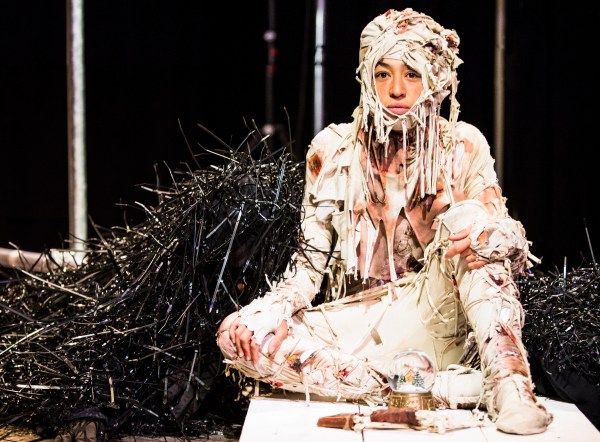
Director Max Barton approaches the text with clear vision and choices that aid clarity, even in the muddiest sections of text. Designer Shawn Soh has moments of brilliance (beasts with coats of cable ties and a throne of gears and propellers for the narrator are fantastic surprises), but the shoestring budget is noticeable in the inconsistent application of detail.

Despite it’s issues, Karagula packs an emotional punch with social commentary and nihilistic fortune telling. Mareka foreshadows a Trump-led America, and Cotna is a land where technology has ushered in the loss of individualism. There are moments of wonder and horror, and sheer bafflement. Philip Ridley’s vision is commendable, but the execution isn’t quite there, leaving the audience partially sighted. It’s a wondrously alive and human production and like any given human being, it has it its faults and its virtues.

Karagula runs through 9 July.

The Play’s the Thing UK is committed to covering fringe and progressive theatre in London and beyond. It is run entirely voluntarily and needs regular support to ensure its survival. For more information and to help The Play’s the Thing UK provide coverage of the theatre that needs reviews the most, visit its patreon.

The Broke ‘N’ Beat Collective, Battersea Arts Centre

https://i0.wp.com/www.20storieshigh.org.uk/wp-content/uploads/2016/02/Jack-and-Lateefah-1280x853.jpg

Kids have it tough, especially if they’re poor. Decreasing social mobility, higher costs of education and living, and decreasing welfare are trapping our future generations in inescapable cycles of poverty. They are just as aspirational as young people from more privileged backgrounds and aware of the opportunities they don’t have. They are angry, frustrated and lack the opportunity to constructively express their feelings that often go completely disregarded by more comfortable members of society.

Theatre-Rites and 20 Stories High, seeing validity in their voices, worked with numerous young people in this demographic to devise a gig-theatre show that shares experiences of being a poor teenager in Britain today. The Broke ‘N’ Beat Collective is an empowering, important work that uses fantastic puppetry, mask and music to create a gloriously messy collage of young people’s concerns and issues. Structurally mirroring the rough and ready, fractured existence of urban youth culture, it rebels against theatrical and cultural preconceptions without apology for its flaws.

Elisha Howe’s (aka Elektric) soaring rhymes and Jack Hobbs (aka Hobbit) beatboxing energise the audience and establish a defiant, proud tone that carries through the show. They are not backing down, nor are B-boy Ryan Harson (aka LoGisTics) and puppeteer Mohsen Nouri. They literally zoom in on the tiny model tower blocks and street scenes of urban Britain, replicated in cardboard wonderfully extracted from the plain back wall, creating a landscape of alternating songs with monologues. These set pieces and puppets pass on the otherwise unknown life stories of young people they’ve met.

Omar is an insecure, confrontational grey hoodie that takes the whole show to find his voice. Jack’s a wannabe gangsta who knocks up Latifa (both with cartoonish, cardboard heads) and ditches her and the resulting child that reflects on how that’s shaped his life goals. Joanne is the Papergirl who cuts herself because her mum’s boyfriend abused her. There’s also the incredible Speaker Boy, a rotund, playful chap with a boombox for a head. Each puppet is as unique as the young person behind it, and just as inspiring. (Seriously, go look at the puppets’ photos in the gallery part way down the page; they are some of the most emotionally endowed bits of paper and foam I’ve ever encountered. All of these characters unashamedly demand attention with precise, evocative storytelling and a joyfully visualised presence. These stories are broadcast along side an ever-changing soundtrack with interjections of dance, banter and spoken word, simultaneously creating an atmosphere of celebration and seriousness. Though fun, it never loses the sense of the weight behind the work.

Despite the boldness in the work and the importance of its messages, there are some sloppy transitions that cause the piece to lose momentum. Elektric unnecessarily introduces each number by name, and there are some in-jokes between the performers that, whilst sweet, don’t carry energy with their small scale. This gives the whole piece a choppiness that makes it feel unfinished.

All four performers’ exemplary skillsets and vibrance are fantastic vehicles for the young people of this country seeking escape from the poverty that is so limiting to their ambition. Each moment connects to the next through a theme rather than a storyline, but the effect mirrors modern society: a bit messy, emotional and ambitious for a better life. The fun doesn’t override or trivialize the seriousness, and neither is it too weighty. The unpolished feel is very much ingrained in the gig-theatre style, and though it would be great to learn more about the characters presented, The Broke ‘N’ Beat Collective truly holds a mirror up to nature.

The Broke ‘N’ Beat Collective runs through 2 April.

The Play’s the Thing UK is committed to covering fringe and progressive theatre in London and beyond. It is run entirely voluntarily and needs regular support to ensure its survival. For more information and to help The Play’s the Thing UK provide coverage of the theatre that needs reviews the most, visit its patreon.

RED Women’s Theatre Awards, Greenwich Theatre

red women logo

This year sees the launch of a new playwriting competition, RED Women’s Theatre Awards. Co- produced by Edinburgh-based academic and playwright Effie Samara, Greenwich Theatre and Female Arts, the awards are “aimed at anyone who identifies as female who has an inspirational, questioning and challenging social and political voice.” There are three regional heats in the competition; the first was at Greenwich Theatre with staged readings of four plays. Completely differing in tone and style and at various stages of development, this heat showcases the huge variety of female voices in English playwriting.

I spoke to founder Effie Samara about the awards and her reason for founding them.

What do you hope to achieve with these awards?

When I first spoke about RED to James Haddrell, Artistic Director of Greenwich Theatre, I must admit, I was dreading that it was going to achieve absolutely nothing. As a theatre artist, he engages with that female-led theatre aesthetic by producing Broken Leg, Smooth-Faced Gents and now RED. Is he a revolutionary? I think he is. Is he an exception? He is a valiant exception but we are actually witnessing the beginning of an epoch in politics and in theatre. They follow each other. My view is that the State, its governance, its justice, its policing, its education and its performativity are about to undergo a female-authored revolution. RED positions itself at the forefront of this development.

What criteria did you use when selecting plays for the heat?

The award is for political theatre. Our first concern was to ensure the writer’s engagement with the notions of justice, resistance and her ability to problematise those dramatically.

RED Theatre Awards currently cover the south of England, Wales and Scotland. What are your plans for expansion in the rest of England? Is N. Ireland a goal as well?

Northern Ireland is absolutely a goal. In the first instance, we’re including N. Ireland in the Scottish round. We can’t wait to hear some loud Irish voices! Scotland is also underrepresented on a national level.      

What can theatre makers do now to counteract the gender disparity?

The solution is very simple and I’m afraid it begins with us women. Us, being able to handle our own freedom: express it in the ownership of our person, define it in politics, and dramatise it in our consciousness and on stage. Women who robotically follow institutional missions fuel that gender disparity through their own complicity with these structures. Numbers are on our side in this argument: There are a lot of us. Over 3 billion. If we meant business, if we did this together, actioning solidarity within our cause, this injustice could be culled in no time.

What message do you want to communicate with the RED awards?

Words are loaded pistols. And we, women, can cock a gun way better than any establishment pointing one at us. Throughout the history of humankind we have been told we’re not allowed to fathom our own course, to govern our own person, our own body, its production and reproduction. RED is here to provide a platform for women.

The four plays selected for this heat are Under My Thumb by Cassiah Joski-Jethi, Spurn the Dust by Sian Rowland, Dissonance by Isabella Javor and Gone by Kate Webster. Some are more blatantly topical that others, some look at broader female issues and group dynamics. All are short plays with potential for development and by female voices that have a lot to say.

The Play’s the Thing UK is committed to covering fringe and progressive theatre in London and beyond. It is run entirely voluntarily and needs regular support to ensure its survival. For more information and to help The Play’s the Thing UK provide coverage of the theatre that needs reviews the most, visit its patreon.

The Marvellous Adventures of Mary Seacole, Rosemary Branch Theatre

I had never heard of Mary Seacole until I began working in UK schools, several years after my arrival to the UK. What a woman!  No wonder her entrepreneurial, caring Victorian spirit is on the National Curriculum and she has been the subject of several plays, including Rosemary Branch co-artistic director Cleo Sylvestre’s one-woman show, The Marvellous Adventures of Mary Seacole. With a simple narrative structure, Sylvestre’s piece focuses on characterisation and biography. It is well performed, though some adjustments to the script and tech could make this an even better solo show.

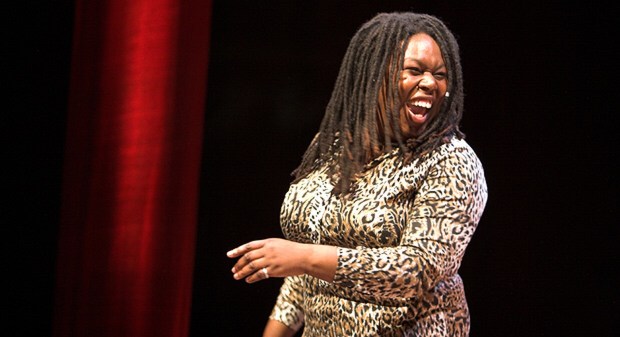
We are never told who we are, but Seacole treats us like a society or club she has come to lecture about her life.  She speaks in the past tense shortly after her return from the Crimea; we hear her life story starting with her childhood in Jamaica, helping her mother run their Hotel, Blundell Hall and learnt about her “remedies” from foraging. Continuing onto her London, Central America and finally The Crimean War, Sylvestre endows her with a confident, charismatic warmth – no wonder she was so popular with soldiers and civilians alike. Her performance peaks when recalling her mother first teachings her about plants, and later memories of battlefields heaving with wounded soldiers – her “boys.” These are lovely moments to witness, but some of the more mundane content is delivered on autopilot.

Structurally, the script is a simple, linear narrative. This would be an excellent piece to tour to primary schools, as it’s easy to follow and has plenty of captivating anecdotes. The content is interesting enough to hold an adult audience’s attention for nearly an hour, but it would be a refreshing experiment to see this piece as episodic, with more lighting and sound than is presently used to highlight pivotal moments. This is not a new show, and solo performance has evolved since its inception. Sylvestre’s imagery-laden work would suit regularly used bigger projections, detailed soundscapes stronger lighting changes. Even though this is an important story, it is not an innovative production, but it certainly has the potential to be.

Cleo Sylvestre’s performance is the highlight of The Marvellous Adventures of Mary Seacole, but this long-running solo performance needs some revisiting to give it an extra burst of life worthy of such a vibrant character.

Running at The Rosemary Branch, 9-11 April.

The Play’s the Thing UK is committed to covering fringe and progressive theatre in London and beyond. It is run entirely voluntarily and needs regular support to ensure its survival. For more information and to help The Play’s the Thing UK provide coverage of the theatre that needs reviews the most, visit its patreon.

Hamlet Peckham, Bussey Building

What happens when a director completely disregards age, gender and nationality in a Shakespeare production, then stages it in a former cricket bat factory with a stripped-back aesthetic and fantastic performers? Shakespeare Peckham. Founded by actor/director/producer Anthony Green, Hamlet Peckham bears more resemblance to the vibrancy and gender bending of Shakespeare’s original productions than most modern conceptual interpretations. Green incorporates several aspects of original practice, which prove that embracing the conventions of Shakespeare’s theatre with a fearless cast is a winning combination.

There are a few concepts that Green adds, such as casting three actors as Hamlet to highlight “the problem, the plan and the solution” of Hamlet’s narrative. He also empowers Polonius, making the father of Laertes and Ophelia the strongest character in the play. There’s loads of direct address and audience interaction, as there was in Elizabethan and Jacobean theatre and as there should always be. The ghost is just a man rather than ethereal or otherworldly, and when Hamlet is played by a woman, he changes all gender pronouns to “she” and “her.” These choices, proving Green’s instinct for excellent theatre and Shakespeare performance, either work well or, at the very least, don’t not work. The only one of these approaches that jars is the textual changes according to gender, but it will have little impact on a viewer who doesn’t know the play well.

The Bussey Building, here configured with the audience on three sides, also has three slender poles along the front of the stage. Though their position prohibits the curving movement that the Globe’s pillars creates, the actors use them – as supports, to hide behind and to propel them. Sight lines are occasionally blocked, but never for long. There is no backstage, so the actors hang out in the dark behind the audience. No feature of this space goes unused, though there are no specific adaptations that warrant the addition of “Peckham” to the show title. This isn’t a site-specific production, but it is certainly wonderfully site-responsive as well as being sensitive to the audience’s energy. Set designer Michael Leopold and lighting designer Adam King create a subtle, harmonising impact on the space with wooden crates, white curtains and colour. The actors’ black and white contemporary costumes looks like their own clothing, but rather than appearing cheap, it comes across as relaxed and accessible.

The cast is phenomenal. Nine of them take on all roles, with only a few not doubling, tripling or more. It’s impossible to chose a few standout performances, but the three Hamlets (Sharon Singh, Max Calandrew and Izabella Urbanowicz) seamlessly blend their interpretations whilst making each moment their own. Gil Sutherland as Polonius is the driving force behind manipulative Claudius (Pete Collis), Daniel Rusteau is a warm, grounded Horatio. Eva Savage is half a dozen characters, particularly excelling as the joyful singing gravedigger. As a whole, they are a well-oiled, energetic and charismatic bunch who have the talent for the world’s biggest stages. Working with Green, each moment is crafted with care and detail, but the effort only shows in the performers’ ease.

Both progressive and ancient, Hamlet Peckham is what contemporary Shakespeare should be – striving for equality in cast and crew, respecting core performance techniques from original Shakespearian theatre practice, and a relaxed, flexible concept that focuses on telling the story with passion and muscularity. This production creates opportunities, showcases great talent and tells Shakespeare’s story with all the energy and life of new play. Don’t miss it.

The Play’s the Thing UK is committed to covering fringe and progressive theatre in London and beyond. It is run entirely voluntarily and needs regular support to ensure its survival. For more information and to help The Play’s the Thing UK provide coverage of the theatre that needs reviews the most, visit its patreon.

Shifter, Crick Crack Club at Soho Theatre

Going to a Crick Crack Club storytelling event is a bit like joining a private members’ club. This club doesn’t have strict entry criteria, nor is it cold and exclusive – quite the opposite. A welcoming spirit of community and the use of ritual enhance Jan Blake’s and TUUP’s four globe spanning stories. The first half of the two-hour, four-story Shifter has sturdier narratives, but the tales of trickery and metamorphosis interspersed with simple call and response create a magical, engrossing evening despite a few structural shortcomings.

We begin in Scotland, where young prince Raymond on a hunting trip meets a beautiful woman in the depths of the forest. He takes her home and the two soon marry. After many years and the births of their ten children who all have some sort of foreshadowing deformity, the prince makes a surprising discovery after spying on his wife whilst she bathes one evening. After a public reveal, the myth quickly relocates to a chateau in France, where inexplicable marks on a high window ledge are made clear. The prince is very much the victim of his bride’s deceit, but their love is also held up for admiration. Told by TUUP, this story is particularly male focused, demonising the female but also giving her power. It would be an interesting experiment to see what a woman storyteller could bring to this story. The climax and denouement are rushed, but the final line satisfies. TUUP has a relaxed, magnetic presence and his delivery of this warped love story is endowed with empathy and respect.

Blake now takes us to the Gulla Islands off the coast of America, one of the first settlements by African slaves. This is a another love story, again with a man who falls in love with a powerful, shape-shifting woman. Mary is less friendly than Raymond’s wife, and the threat to hew new husband John is tangible in Blake’s telling. This unnamed tale alludes to Rumpelstiltskin and Sleeping Beauty with the prominence of a spinning wheel and mysterious nighttime happenings. The strongest of the four stories in Shifter, its madness and imminent danger give this story a thrill, heightened by the various percussive instruments TUUP uses to accompany.

After the interval, two tribal, pre-Christian tales evoke the savannahs of Africa and the prestige that comes with being a successful hunter. The morals in these stories aren’t about the fear of powerful women in the Christian West; they more broadly apply to all humanity – don’t allow yourself to lose sight of your life goals, and practice rather than magic will bring you success. This half has a more epic sense of coverage, but the narrative arcs are less familiar to Western stories. They are more rounded, with a greater sense of the world outside of the characters; this makes them initially unsatisfying, but more universal.

TUUP and Blake both have natural warmth and charisma that draws in the audience like a hug. They are energetic but not ostentatious, simply relying on the rhythms and language of their stories. Much of the pleasure from Shifter comes from their presence, though hearing these stories grants a comfortable sense of inclusiveness despite some rocky moments in the stories themselves.

The Play’s the Thing UK is committed to covering fringe and progressive theatre in London and beyond. It is run entirely voluntarily and needs regular support to ensure its survival. For more information and to help The Play’s the Thing UK provide coverage of the theatre that needs reviews the most, visit its patreon.

The Long Road South, King’s Head Theatre

The Civil Rights movement in America was time of turbulence and violence but both black and white activists retaliated with their passion for equality. The issue divided individual families across generations, recreating the conflict on a microcosmic level. Paul Minx’s The Long Road South recreates this excruciating tension through close examination of the dysfunctional Price family in suburban Indiana.

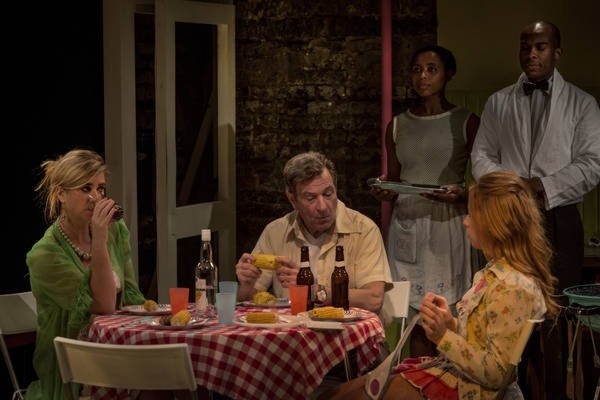
Stay at home Carol Ann (Imogen Stubbs)is mother  to teenager Ivy (Lydea Perkins) and married to supermarket manager Jake (Michael Brandon). They are the only family in their neighbourhood able to afford “help”, black couple Grace (Krissi Bohn) and Andre (Cornelius Macarthy). On the surface, these characters are aspirational and progressive. That American Dream veneer doesn’t hold up for long, though. The characters’ gangrenous innards seep out, creating a kitchen sink drama with excellent moments, dramatic themes  and characterisation akin to Miller and Williams, but lacks the linguistic sophistication of these revolutionary writers and a few too many twists and turns for a one-act play.

The cast is generally strong, with Brandon outshining the rest when he eventually appears in Willy Loman-esque glory. Perkins has a grating vocal quality that, though appropriate to the lying, manipulative character, was nails on a blackboard after a few scenes. Bohn and Macarthy are good foils to each other with a lovely chemistry and sharp edges that sporadically pop out, adding to the dissonance. Stubbs is the tragic heroine, trapped in her house by alcoholism and the memory of an institutionalised child. This lot are a close-knit ensemble, an extended family with all the complexity of a real life one. Unfortunately, the accents spanned the country rather than uniting this family in a common place.

Director Sarah Berger skilfully uses the irregular playing space and space to enhance tension. Rarely touching or even close to each other, this shows the power of religious belief in these characters constantly aware of Satan’s temptations. Adrian Linford’s sunny back garden with its perfectly mowed grass and pastel BBQ juxtaposes the family’s chaos. Minx has an instinct for conflict, but the production’s subtlety comes from the performances rather than the dialogue. There’s no overt moralising or thickly laid Americanisms, just the characters’ genuine need to do what they think is right.

The Long Road South is a quite the good script by a writer with plenty of promise and a great cast. It’s a good reminder of a crucial period of American history, and that monumental change can wreak havoc on the closest of family units. The cast and the characters’ individual stories are certainly the best features here, but the other production elements aren’t far behind.

The Play’s the Thing UK is committed to covering fringe and progressive theatre in London and beyond. It is run entirely voluntarily and needs regular support to ensure its survival. For more information and to help The Play’s the Thing UK provide coverage of the theatre that needs reviews the most, visit its patreon.