Mirrors, Rosemary Branch Theatre

rsz_tim_smyth-mirrors-siobhan_mcmillan_54

Photography © Tim Smyth

Maybe the witch in Snow White isn’t that bad. Or, maybe her badness is justified, like she had a traumatic childhood or suffers from a mental illness. Siobhan McMillan proposes just that: Shivvers realizes she’s past her prime and, with insecurity taking over rational thought, she decides to hunt down the young woman who dethroned her from her position as the fairest in the land. This quest takes shape as a solo performance told in the third person, like a fairytale. McMillan regularly interjects with contemporary references and using sarcastic humour to great advantage, makes a strong comment on women’s insecurity about aging.

The use of third person narration is one of the more interesting features of Mirrors; it distances McMillan from the audience and herself. Her physicality and energy cannot be denied as she embodies the characters she simultaneously describes. The audience is told her story but has plenty to watch, and a liberal use of sound and vocal effects create a dynamic aural landscape, even if a touch too loud at times.

The use of an occasional live feed adds another visual layer by which the audience scrutinises Shivvers, but a backlight interferes. The intention shows good instinct by director Jesse Raiment. The set isn’t particularly dyanmic with its black flats and mirrors, save for the ornate frame mounted on a table centre stage – a symbol of modern obsession with female appearance and its dominance in Shivver’s life.

This feminist solo show is an excellent display of performance storytelling and a witty comment on modern life as a woman. Not just about aging, it also looks at female competition, the need to be desired and the perils of dating. With the opportunity of a longer run, Mirrors could upgrade its tech and design to create a more polished production matching its content, creating a piece great for touring small to mid-scale venues.

The Play’s the Thing UK is committed to covering fringe and progressive theatre in London and beyond. It is run entirely voluntarily and needs regular support to ensure its survival. For more information and to help The Play’s the Thing UK provide coverage of the theatre that needs reviews the most, visit its patreon.

Macbeth, Young Vic Theatre

Though drastic re-imaginings of Shakespeare’s plays can show the contemporary relevance of his workgroups the use of a clear, justifiable concept, randomly slapping on cool ideas has the opposite effect. Alienating and confusing, the audience can go away with no more understanding of the story than they came in with, and the director’s decisions look masturbatory and self-indulgent. If a new perspective or insight isn’t provided on a play that the audience is likely to already know or have seen, then there is absolutely no point to adding a concept at all. Such is the case with Carrie Cracknell and Lucy Guerin’s Macbeth. With a text cut to ribbons, lengthy contemporary dance sequences inserted, generically quirky witches and inexplicable doubling, this production is a fine example of how contemporary Shakespeare concepts for the sake of edginess fails to communicate anything to the audience.

An optical illusion of a set by Lizzie Clachan and Neil Austin’s lighting ensures every moment could make a stunning photograph with stark shadows and forced perspective. This isn’t an art exhibition, though. The cold, industrial feel supports the mood of the play but lacks the sumptuousness that the Macbeths kill for. The rarely changing set doesn’t delineate space or place well, merging this world with the next. In some scenes this works, but it’s hard to follow where the characters are, particularly with the liberal cuts to the text. A home or a Heath? Scotland or England? Bedroom or banquet? It’s easy to lose track, even knowing the play well.

The witches, wearing beige dance wear, twitch and spasm around the space, sometimes with other characters joining in to create a repetitive, robotic movement machine. Why? I genuinely don’t know. There’s a hint of a lack of self-control but the repetition counters that effect. They also double for the child characters, which causes them to lose their power and inhuman-ness. Their movement sequences are entirely too long and lack any support for the narrative, though they are distinct from the other characters.

Fortunately, some of the performances are quite good. John Heffernan as Macbeth is a flawed man we see unravel, though this process is forced due to the cuts in the first half of the play. Anna Maxwell Martin on the other hand is rushed and deadpan, completely disregarding the verse and therefore flattening it. Prasanna Puwanarajah is a good Banquo, though the choice to have his ghost narrate the “out, damn spot” monologue was completely ineffective and nonsensical. Despite a disempowerment of the smaller roles due to the textual edits, the rest of the cast perform with energy and commitment.

There is a litany of further poor choices that show a value of style over substance in this production, and despite the directors’ need for weirdness, the whole thing comes across as generic and pointless. The stylised, lengthy movement sequences make no comment on the world of the play or its inhabitants, and with so much of the text removed, this Macbeth is very much “a tale…full of sound a fury, signifying nothing”.

The Play’s the Thing UK is committed to covering fringe and progressive theatre in London and beyond. It is run entirely voluntarily and needs regular support to ensure its survival. For more information and to help The Play’s the Thing UK provide coverage of the theatre that needs reviews the most, visit its patreon.

Red Riding Hood, Preston Continental

rsz_12299318_10153680692062789_6332526754861081608_n

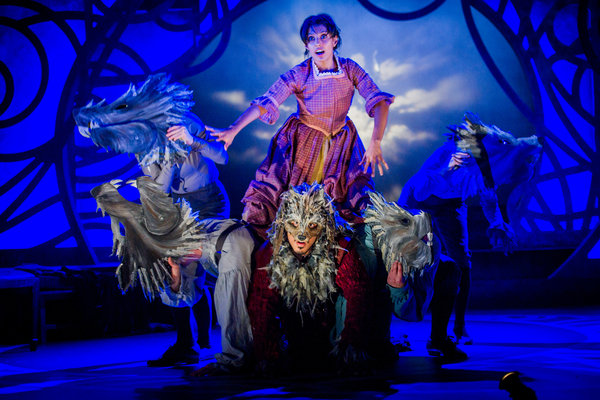
What makes the story of Red Riding Hood so enduring? Is it the clever heroine? Is it the metaphor for growing up? Is it the violence and gore? Horse & Bamboo choose to focus on the colour red and its symbolism in their touring Red Riding Hood. Two actors, Nix Wood and Alex Kanefsky, are actor-storytellers-puppeteers who endow the story with a richness and life that appeals to their young audience as well as their families. The company’s lo-fi touring aesthetic uses a surprising amount of puppets at different sizes, masks and costume to keep the kids’ attention. It’s a bit hodgepodge on the surface but there’s a good amount of layers to this piece: meta theatre, storytelling, playing at the characters, and embodying them. Wood and Kanefsky fluidly switch between the styles that initially feel excessive in their quantity, but the children are so absorbed in the story that cannot be deemed as anything but highly effective and engaging.

The main focus of the story is the dynamic between Red and the Wolf. Mum and Grandma make appearances, but they don’t waste any time getting to the woods. The deeper Red gets, the larger the characters become – a great device. Initially, a tiny Red and mum are reading bedtime stories in a dolls’ house, eventually Wood plays Red in a full mask and the wolf is a nearly life-sized puppet with excellent movement and expression in the head and neck. Music and animated projections add additional detail to Wood’s controlled, emotional physicality communicating the unspeaking Red’s inner life. The wolf and Red focus results in a reinforcement of the “don’t trust strangers particularly if they seem nice” moral, which works for a children’s show but is quite a shallow interpretation in a production that has such depths of performance technique and style.

Red’s cloak is a dark, rich red that stands out beautifully against the rest of the set. Wood sets up red as her favourite colour as she chats with the entering audience pre-show; it’s lovely to watch. Kanefsky is goofy and warm, and loves cakes. This trait follows his characters through the rest of the story. The set is made of abstract blues and greens, inspired by Paul Klee’s art (my initial association was with Kandinsky’s work). Though the idea of starting with visual art for a way into a concept is a common one, the abstract set design clashes with the concrete realism of the puppets and mask, and the animation style was the starkness of shadow puppetry.

As children’s theatre goes, Horse & Bamboo’s Red Riding Hood is more sophisticated than it appears. Despite the moralizing, the craftsmanship and performance skill can be appreciated and enjoyed by all ages. Knowing that Horse & Bamboo are a touring company with just two actors makes their work all the more impressive. An excellent production for families at any time of year, too.


The Play’s the Thing UK is committed to covering fringe and progressive theatre in London and beyond. It is run entirely voluntarily and needs regular support to ensure its survival. For more information and to help The Play’s the Thing UK provide coverage of the theatre that needs reviews the most, visit its patreon.
Top Ten Shows of 2015

rsz_top10-620x400

  1. Carmen Disruption 

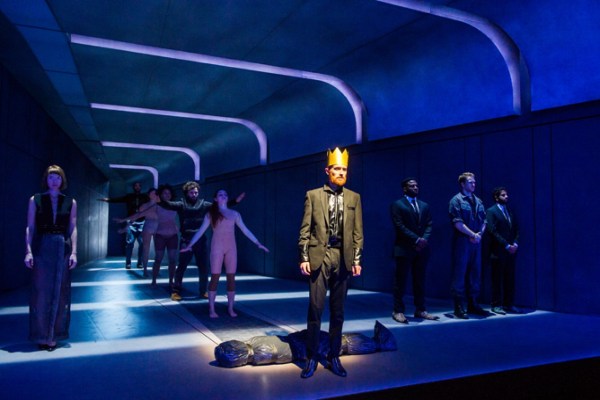
This Simon Stephens deconstruction bore little resemblance to the opera. Instead, we had a cast of dysfunctional, damaged characters unable to connect with the world around them on any meaningful level. They filled the Almeida with an electric loneliness that grasped the desperate humanity residing deep inside us all before chucking us out, exposed and raw, into the London night.

  1. Pomona

Written by a 27-year-old, Pomona captures the millennial generation in a single play. Frantically set over several levels of dystopian reality and never able to settle, this epitomises those who suffer the consequences of  baby boomers’ past choices.

  1. Light

The first show I ever gave five stars to, after more than a year of criticism. Good intentions and government exploitation address increasing surveillance with stunningly precise physical theatre, object manipulation and light.

  1. Tether 

A two-hander about a blind runner and her guide, this piece is refreshingly unromantic and driven by dialogue and characterisation. This is a simple and powerful piece by a promising young writer set in a world rarely considered by non-disabled people.

  1. Shakespeare & the Alchemy of Gender

A solo performance by veteran Shakespearean, Lisa Wolpe, founder of L.A. Women’s Shakespeare Company. Exquisite extracts of Shakespeare’s most celebrated male roles interspersed with her father’s biography raises important points about performance, gender and family.

  1. Town Hall Cherubs

Theatre Ad Infinitum and Battersea Arts Centre team up to create an immersive, site-specific piece for 2-5 year-olds. Gentle and responsive to the children’s attention spans, this is a bit of a winter treasure hunt around the BAC that stimulates all the senses.

  1. Chef 

Another sharp one-woman show, this one by Sabrina Mahfouz and performed by Jade Anouka. Anouka is a Michelin-star chef who runs the prison kitchen. Part fictional memoir/part foodie homage, this character driven piece cuts an unforgettable character.

  1. This is How We Die

An explosive spoken word/music piece by Canadian Chris Brett Bailey, it defies description and instead must be experienced. A marmite production amongst critics but Bailey’s use of imagery within language is incomparable.

  1. Don Q

A warm and lovely adaptation of Cervantes’ novel, Don Q is an old man’s gleeful adventure story. Four actors multi-role through this story that looks at the way we treat the elderly and the joy of play-acting.

  1. Eclipsed

Set during the Liberian Civil War, the all-woman cast of Danai Gurira’s doesn’t hold back on the experience of women in wartime. This is a brutally raw survival story with the power to leave you shaken, guilty and grateful for the benefits of Western comforts.

Honourable mention: Invisible Treasure

This is an interactive experience that is audience-led, with no actors and no plot. Like a game, the audience is led into a hi-tech room and led through a series of tasks in order to escape. Fun, challenging and frustrating, it makes some powerful points about group dynamics and personal approaches to problem solving.


The Play’s the Thing UK is committed to covering fringe and progressive theatre in London and beyond. It is run entirely voluntarily and needs regular support to ensure its survival. For more information and to help The Play’s the Thing UK provide coverage of the theatre that needs reviews the most, visit its patreon.

Beauty & the Beast, Polka Theatre

Beauty and the Beast - Polka Theatre - 20 November 2015 Writer - Charles Way Director - Roman Stefanski Designer - Laura McEwen Music - Julian Butler

Cold, dark days make me want to see feel-good theatre, especially in the run up to the holidays. Bonus points if it’s colourful, has some depth and at least some non-formulaic elements, even in a classic story. Polka Theatre’s Beauty & the Beast for ages 6-12 meets these criteria with a surprisingly complex storyline that keeps adult attention as well as kids’. Despite the target age range, there is some great humour and a touch of innuendo adults will appreciate (kids definitely won’t get it), sumptuous set and lighting and an adapted, relevant script. Some of the performances are wooden from the dated language and there are some dodgy movement-based transitions, but the school group audience was quiet and focused for most of the nearly two hours with interval.

Charles Way’s adaptation of the traditional story gives a much wider context than the Disney film and is more relatable to a modern, young audience. Belle is still the main character, but we get to know her father, Mr Godwin (Simon Holmes) and sister Cassandra (Géhane Strehler) well. Belle and Cassandra are complete opposites: Belle’s bookish, a visionary and frightened by most things; Cassandra loves boys, pretty dresses and adventures. The two bicker regularly and their money-driven merchant father is tired of it, a family dynamic that many children will recognize. Beginning in London and moving to the remote countryside when Mr Godwin loses his fortune, the girls also have to cope with big life changes and overcome adversity.

The women’s performances are consistently stronger than the men’s. Ritu Arya’s Belle is convincingly performed with a wonderfully dry sense of humour and an excellent character arc that isn’t overly saccharine. She carries the story and its energy well without being a stereotypical children’s performer, dealing with the old fashioned language brilliantly. Géhane Strehler is great contrast, giving young girls two opposite ideals to potentially relate to. Both have flaws, virtues and detail. Emma Cater is a sinister housekeeper for Jason Eddy’s Beast, a gentle man with stylized physicality and an imposing presence. Eddy doesn’t quite manage to carry that through after his transformation, but it’s so close to the end that it doesn’t matter much.

The set is layers of swirling panels that change colour and glow according to location, with the Beast’s castle the richest of them all. Laura McEwen’s set and Ian Scott’s lighting work together in wonderful harmony, with the occasional addition of puppets. Stage combat from RC Annie also adds a visual component, but the fights are slower that fight speed and brief. Some of the transitions lag and have abstract movement to fill the time, but this doesn’t contribute to the story and usually look pretty naff. Costumes, also by McEwen indicate the characters’ circumstances and changes in social class, but the highlight is the headdress and mask for the Beast.

Though there are still age and gender stereotypes, the adapted script empowers the young female characters. The detail and length will occupy adults as well as children and Way’s story is excellently constructed. With wonderfully visual design and a stirring score by Julian Butler, this is a lovely production harking back to the classical story without the glitz of Disney-fication or the panto cheese, and a solid option for a family holiday show.


The Play’s The Thing UK is an independent theatre criticism website maintained voluntarily. Whilst donations are never expected, they are hugely appreciated and will enable more time to be spent reviewing theatre productions of all sizes. Click here to make a donation with PayPal.

Live from Television Centre

On Sunday night, theatre people ( and hopefully others) up and down the country tuned in to BBC Four to watch Battersea Arts Centre and Arts Council England take over the former Television Centre, now a building site for luxury flats. Over two hours, four theatre companies streamed their work for live audiences in the comfort of their homes, to push the boundaries of theatre’s adaptability to the popular small screen and to challenge typical TV programming. I watched in bed and with twitter open so I could keep half an eye on #livefromTVC; it was a gloriously anarchic experiment that I hope ushers in a new era for telly and theatre even though not every element worked as well as it could have – but that’s the point of experimentation.

Gecko’s The Time of Your Life celebrates life cycles in a circular swirling movement with a “Truman Show”-style storyline of meta-television. The close-up nature of telly supports the characters’ intimacy and expressiveness well, but the narrow framing reduced their normally expansive work to a much smaller scale. I didn’t mind the spinning camera work, but twitter buzzed with complaints of dizziness. It was rough and ready, with limbs often out of the frame and movements ahead of the action, but that supports the “liveness”. Their piece wasn’t the most accessible and most suitable to open the evening either; Richard DeDomenici’s Redux Project would have been a more appealing start to non-theatre goers.

The long running Redux Project is adapted for the evening with joyfully irreverent recreations of classic moments from BBC television history. DeDomenici has a friendly, laid-back persona thinly veiling biting political commentary just as sharp as “The Revolution Will Be Televised”, but less blatant and without personal attacks. The live artist aims, “to disrupt the cinema industry by making counterfeit sections of popular films”; he satisfies with powerful alternative perspectives that are funny on the surface, but pose bigger challenges to cinematic convention underneath.

Common Wealth’s No Guts, No Heart, No Glory is a verbatim piece sharing the experiences of young women from Bradford who are Muslim boxers. It’s a powerful piece challenging stereotypes and giving voice to a demographic often ignored at best or stigmatized at worst. This worked brilliantly on telly, capturing the intensity and passion of the characters despite some strange camera angles.

Backstage in Biscuit Land by Touretteshero (Jess Thom) becomes Broadcast from Biscuit Land, the wonderful show that’s inclusive, informative, and contains plenty of biscuits and cats. Thom has a noticeable form of Tourettes that manifests in physical and verbal tics used for comedic effect in her show, and a reminder that understanding for people with disabilities is still lacking. In a more surreal moment, Thom reminisces about a particularly funny tic about Keith Chegwin in a quiet theatre; cameras then reveal Cheggers there in the live studio audience.

The variety of the evening reminds audiences of the power of live performance and its relevance to everyone. I’m certain that anyone who watched would be able to find something appealing in the evening, and hopefully discovered a company or artist previously unknown to them. Even if it was mainly theatre makers and goers that watched, TV can still reach audiences that are otherwise unable to travel to an individual performance. At best, those who don’t consider themselves theatre people will have found pleasure in the event, and there’s hope that the powers that be discover there is room for dancing biscuits, physical theatre and political performance on our small screens as well as our big stages.


The Play’s The Thing UK is an independent theatre criticism website maintained voluntarily. Whilst donations are never expected, they are hugely appreciated and will enable more time to be spent reviewing theatre productions of all sizes. Click here to make a donation with PayPal.

The Sandman, London Horror Festival

rsz_sandmanThe sandman doesn’t throw sand in your eyes to help you sleep, oh no. That’s just what parents want children to believe so they aren’t scared of the real sandman. The real sandman is horrible. If you’re still awake, he steals your eyes and puts them into his little bag and takes them up to his little, bald bird-children who live on the moon. Then they eat them.

T. A. Hoffmann, celebrated German gothic horror author, wrote short story “The Sandman” in 1816. Featuring automatons, folklore, love, childhood trauma and obsession, it tells the tragic downfall of Nathaniel, who couldn’t let go of his boyhood fear of the sandman, personified in his father’s malformed colleague, Coppelius. Adie Mueller and Mike Carter adapt and modernise this short story into a one-woman show of the same name that eschews linear narrative in favour of a disturbing, extremely fragmented chaos. Mueller skillfully performs the eight characters that appear in the story, but the show requires a lot of thinking and patience to decipher the truth behind the numerous perspectives.

In the programme, Mueller and Carter state, “The woman knows that this story is too much for her and she needs you, the audience. The story bursts out of her and comes at you in fragments, randomly and out of chronological sequence. You will have to play your part in piecing them together, finding the overarching narrative, and search beyond reason to make meaning from them.” This is a nice idea to draw the audience into a one-person show and make them feel needed, but for the tired and those that want to sit back and be entertained/scared, it’s hard work. It also serves as a distraction from the lack of clarity of the audience’s function and relationship to the performer, a vital element of one-person performance. Requiring us to sift through the pieces of story strewn before us has no benefit to the performance or the piece; it would be delivered identically whether the audience understands or not. Director Carter chooses to keep the house lights on so Meuller can make eye contact, but there is no direct dialogue. What does she want from us? Why are we hearing this story? It is never revealed.

Mueller’s performance draws attention away from these shortcomings, and it’s an excellent one. Her use of physical storytelling and character differentiation comes easily, and shows a high level of skill and training. Clad in white, she cuts a powerful image in the Etcetera’s small black box, adding to the chaos with her violent use of creepy props.

The story modernizes well, with a focus on sexual dysfunction, technology and its grim intersection. The characters evoke empathy, particularly Nathaniel, who we see as a scared child and an adult obsessed with his lecturer’s “daughter” Olympia. Though his behaviour is appalling, he is a victim of his past rather than a calculating psychopath. His attempts to maintain a normal relationship with human being Clara are thwarted by reoccurring psychotic episodes…or are they real? The prospect of an alternative, tormenting reality that haunts Nathaniel is deliciously spooky. The Sandman is creepily unsettling and despite the effort needed to work out what is happening, the performances and characters make up for the jagged structure.


The Play’s The Thing UK is an independent theatre criticism website maintained voluntarily. Whilst donations are never expected, they are hugely appreciated and will enable more time to be spent reviewing theatre productions of all sizes. Click here to make a donation with PayPal.

Twelfth Night: A Gender Experiment (opposite gender cast), The Rose Playhouse

Most Shakespeare I see is performed with the actors’ genders matching that of the characters they play. Sometimes I see token cross-gender or gender-blind casting within an own-gender cast, sometimes all-male productions and less often, all-female productions (I wrote about the scarcity of all-female Shakespeare companies in the UK for The Shakespeare Standard last month). What I hadn’t seen however, was a completely cross-gendered production. As part of a gender experiment, actor/director Natasha Rickman stages Twelfth Night: A Gender Experiment four ways: all-female, all-male, same gendered and cross-gendered. Rather than seeing all four, I went for the most rare of the options out of curiosity, which was satisfied by excellent performances and a 90-minute edit with plenty of fun and energy. I’m now tempted to see the remaining three as I can’t decipher quite what Rickman seeks to prove or disprove with her experiment, but the questions surrounding the nature of the experiment did not dampen the enjoyment of the evening.

A cast of seven, three men, three women and a sock puppet, play all parts. There are the same number of men and women in all four versions, supporting Equity’s goal for 50/50 gender representation in theatre. Rickman is a RADA grad, as are most of her cast so handle Shakespeare’s text easily. Julia Goulding is an outstanding, versatile Orsino, Sir Andrew and Feste, using accents to clearly differentiate her characters. Shauna Snow is, hands down, the best Malvolio I have ever seen – serpentine and androgynous, but utterly buffoonish upon discovery of Maria’s planted letter and vulnerable after her release from prison. Henry Gilbert is a lovely Olivia, feminine but not helpless. Christopher Logan’s Viola has a hard, threatening edge when fending off Olivia’s advances, rare in a female playing the role. There is a notable lack of racial diversity, though. This cast is all white and the actors that make up the rest of the company appear to be as well, or at least look like it in the small, black & white photographs in the copied programme.

Sorcha Corcoran clothes the women in costumes inspired by Smooth Faced Gentlemen’s skinny jeans, shirts and braces, showing masculinity without hiding feminine features. The men wear dresses, but don’t hide their short hair with wigs. Though they still play the gender of the characters, Rickman doesn’t strive for realism in design or performance, which works well for this play that has such a heavy focus on gender. She indicates gender with the costume rather than playing it, creating a self-referential style more in keeping with Shakespeare’s original performance practice than contemporary productions that seek total naturalism. Also, she draws on stereotypes to create the roles; there is a heavy dose of Commedia dell’arte in the characters’ movements, which would have been a large influence on Shakespeare’s comedic characters in both writing and performance. The overall feel is light, funny and camp from both the men and women, with any references to the characters’ genders heightened due to the reversed casting. Combined with a good sense for pace and timing, the 90 minutes feel more like a relaxed hour filled with laughter and music.

Rickman uses diagonals well on the small stage, but doesn’t place much action around the rest of the Rose’s site despite the tea lights scattered around the pool and back wall. Sir Andrew and Viola’s almost-fight is oddly conducted with tree branches, which feel out of place. There’s a good dose of music and a jig during Feste’s final song, ending the evening with a flourish and reinforcing the sheer joy of Shakespeare’s comedies. This is one of The Rose Playhouse’s stronger offerings, and a rare opportunity to see a cast with impressive credits perform Shakespeare in an intimate space, regardless of any gender “experiments” the production seeks to conduct.


The Play’s The Thing UK is an independent theatre criticism website maintained voluntarily. Whilst donations are never expected, they are hugely appreciated and will enable more time to be spent reviewing theatre productions of all sizes. Click here to make a donation with PayPal.

Tamburlaine the Great, Tristan Bates Theatre

That which goes up must eventually fall. Christopher Marlowe’s Tamburlaine the Great tells of the title role’s rise from common thug to emperor of Persia and Africa. A precursor to, and probable influence of, Shakespeare’s ruthless Richard III, the man is needlessly brutal: he orders rivals’ remains displayed on city walls, women and children killed, manipulates others to join his cause and then betrays them. Fate eventually catches up with Tamburlaine after he sets fire to books, including the Qu’ran, and proclaims himself more powerful than God.

Lazarus Theatre Company returns to form after a disappointing Henry V with a modern, concise presentation of Marlowe’s play depicting Tamburlaine as a violent, string vest wearing hood rat transformed into a suited and booted world ruler. Social mobility is the dominant theme, emphasized through Rachel Dingle’s costume design in this rags to riches tale. With visually arresting movement sequences, skillful use of light, and pointed similarities with Middle Eastern politics, immigration and Western meddling in the region, this is a relevant, well-crafted adaptation of the Elizabethan original.

The defining feature of this Lazarus’ adaptation is the extended movement sequences, with a powerfully striking one opening the show. A large cast use militaristic stylization and East Asian performance techniques to slowly travel across the stage, setting the tone for Tamburlaine’s merciless and unfeeling crusade. The choreography is precisely angular and even though the actors are well-rehearsed and the effect is visually stunning, there are hints of restrained self-consciousness from some of the company. Accompanied by deep, tonal sound design by Neil McKeown with the actors smartly dressed in modern suits, it reflects the contemporary Western political machine that coldly invades other countries. These sequences are used throughout, enough to be effective but not so much that they lose their power. No choreographer is credited, so they are assumed to be a product of co-directors Ricky Dukes and Gavin Marrington-Odedra.

Performances from the company of 15 are good, with delivery occasionally broken and overindulgent. These moments are rare and don’t affect the pace or energy of the cast as a whole. Particular highlights are Kate Austen as the aggressive, trackie-bottomed Techelles who is Tamburlaine’s number two. She never loses her fierceness, even when Tamburlaine’s success means she has to wear a fitted dress. Robert Gosling is the simpering, camp Mycetes, Emperor of Persia. He’s a great contrast to Prince Plockey’s earthy Tamburlaine. Alex Reynolds is the captured prisoner Zenocrates that Tamburlaine woos and makes his bride. Her transition from victim to doting wife is a disturbingly good example of Stockholm Syndrome, reinforcing Tamburlaine’s power and manipulation. Lorna Reed plays three smaller roles, with a calm strength and subtly powerful voice. She would make an excellent Hermione or Lady Anne. The bombastic Bajozeth, Emperor of the Turks, is played by Alex Maude and is a joy to watch, particularly when imprisoned and force fed by Tamburlaine.

There are few weaknesses in this Lazarus production, but those that are present are minor. Tamburlaine’s final speech has too many pauses and the use of five identical crowns can cause confusion as to which character is the most important at any given moment. There was also an unsatisfying lack of blood considering the play’s violence. However, fringe productions tend to not have a dry cleaning budget; having the Mads Mikkelsen-as-Hannibal Lector suits cleaned daily would cost a small fortune. Artistic director Dukes’ flair for updating classical theatre with contemporary relevance and visual staging is at its finest in Tamburlaine the Great and is certainly worth a watch, particularly as it’s a play rarely staged.


The Play’s The Thing UK is an independent theatre criticism website maintained voluntarily. Whilst donations are never expected, they are hugely appreciated and will enable more time to be spent reviewing theatre productions of all sizes. Click here to make a donation with PalPal.

Edinburgh Festival Fringe, 21 August

Two radically different solo performances make up my day: a joyful, music-based reimagining of A Midsummer Night’s Dream at Summerhall entitled Titania, and Total Theatre Award shortlisted physical/visual theatre piece, Oog at dancebase. Oog is the more polished and complete of the two, a non-verbal expressionist work depicting a broken soldier at the end of some unknown war, alone in a cellar. Titania is a sexy, celebratory, aural experience with audience participation that focuses on the fairies’ story.

Anna-Helena McLean uses live mixing, voice and cello performance in an impressive display of vocal dexterity to evoke the fairy kingdom. She often uses Shakespeare’s text, with spoken-word style delivery, and simultaneously creates atmosphere through sound. The effect is a rich, aural bath that can easily be absorbed with eyes closed. Rather than ethereal, this forest is earthy and sensual. McLean takes on a range of characters through fluid transitions and vocal differentiation, disregarding a narrative. More physical distinction between characters would have been welcome and in a piece entitled Titania, there isn’t as strong a focus on the fairy queen as expected.

At points McLean has the audience singing, snapping their fingers and joining her on stage. The scene where Titania seduces Bottom involves four audience members, one as Bottom and the others as fairy attendants; this scene is so sexually charged as she undoes Bottom’s shirt and strokes his chest that my rapidly-repeating inner monologue consists of, “OMG THEY’RE ALL GONNA START FUCKING”. As well as the sexual overtones, there is celebration and laughter. This piece could easily develop into a larger, club-style performance with additional actors, that seeks to create the forest through participation rather than the audience passively watching for much of the show.

Though using Shakespeare’s work as a launch pad for new styles of work is brilliant, to make a fully effective reimagining of the original, the artist must provide a clear, specific comment or interpretation on an aspect of the text. I’m not sure what McLean seeks to say about Shakespeare’s A Midsummer Night’s Dream; there is no evident overriding message in this piece. The grounded, sexual aspect of the fairies is a starting point, but it isn’t enough. That said, Titania is a piece I wholly enjoyed, even though it needs additional development.

Oog is an entirely different beast, using fast, twitchy movements to exhibit the trauma of war experienced by soldiers. There is no speech, but the character replays happy moments from civilian life mouthing conversation, memories of battle, and intermittently gazes up the ladder leading to his freedom that he cannot bear to climb.

Like a video sped up, performer Al Seed is relentless and tense. Oog is captivating to watch with a range of movements and styles; the expressionism lends itself to a range of interpretations. His Beckettian struggle feels like he has endured it forever, and will continue to do so for time eternal. There is little that signposts him as a soldier, though. Without the programme notes, I don’t know that I would have determined the production concept.

The design is stunning. Side lighting and smoke create strong visual angles and the electronic soundtrack enhances the tension in Seed’s body and mind. His coat is huge and sculptural, a presence in and of itself. Even though the performance is only 40 minutes, it could have been shorter and still conveyed the same intensity, particularly with the cyclical nature of the piece.

These radically different one-person shows experiment with form and style, showing the possibility of character-driven, non-narrative live performance. Both have their merits and both have their flaws, and both are worth seeing for their interpretations of timeless stories.


The Play’s The Thing UK is an independent theatre criticism website maintained voluntarily. Whilst donations are never expected, they are hugely appreciated and will enable more time to be spent reviewing theatre productions of all sizes. Click here to make a donation with PalPal.