Inkheart, HOME

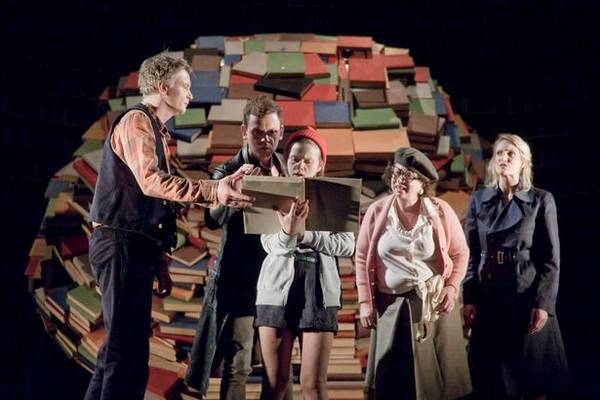
rsz_js78563653Meggie (Katherine Carlton) and her bookbinder father Mo (Paul McEwan) love books. They also share a fantastical gift that’s causing them to be chased all over the world (or Europe, at least) by fictional characters that aren’t very nice at all. Cornelia Funke’s young adult novel Inkheart is adapted for the stage by director Walter Meierjohann in a high-spirited production with inventive staging. The mountain of books and projections that make the set effectively reinforce the importance of the stories that drive the action. The plot is rushed and over-complicated though, particularly for a family show. Books generally have way more content than will fit into a reasonable timeframe, and Inkheart feels like Meierjohann tries to fit the entire novel into two hours on stage.

This is a great play for villains: Will Irvine is Capricorn, a ruthless, Dr Evil-like pursuer who needs Mo to help him bring his assassin, The Shadow, into this world. His stooges Basta (Darryl Clark) and Flatnose (Griffin Stevens) provide excellent comic relief with a dash of audience interaction. Rachel Atkins is the intimidating, book collecting Great Aunt Elinor and the nonspeaking figure draped in black, Mortola. They all provide an excellent foil to the protagonists, even though Meggie is feisty and temperamental (a fantastic role model for young girls struggling to assert themselves). Mo is gentle and kind, with a warm heart and an inner secret – a complex, developed character that adults can relate to.

The pace in the first act ticks along nicely but after the interval, there seem to be leaps in time and space caused by huge chunks cut from the original novel. There are several twists and reveals, making the second act crowded with information. The character development from the first act is neglected in favour of chucking plot points at us, one after the other. Though, this is a story about a long love affair with books and their power, as well as the power we have to write the stories of our own lives. It’s an adventure, a love story and a coming of age tale with great performances, and a flawed, unexpected narrative. Much like our own lives.


The Play’s the Thing UK is committed to covering fringe and progressive theatre in London and beyond. It is run entirely voluntarily and needs regular support to ensure its survival. For more information and to help The Play’s the Thing UK provide coverage of the theatre that needs reviews the most, visit its patreon.

Top Ten Shows of 2015

rsz_top10-620x400

  1. Carmen Disruption 

This Simon Stephens deconstruction bore little resemblance to the opera. Instead, we had a cast of dysfunctional, damaged characters unable to connect with the world around them on any meaningful level. They filled the Almeida with an electric loneliness that grasped the desperate humanity residing deep inside us all before chucking us out, exposed and raw, into the London night.

  1. Pomona

Written by a 27-year-old, Pomona captures the millennial generation in a single play. Frantically set over several levels of dystopian reality and never able to settle, this epitomises those who suffer the consequences of  baby boomers’ past choices.

  1. Light

The first show I ever gave five stars to, after more than a year of criticism. Good intentions and government exploitation address increasing surveillance with stunningly precise physical theatre, object manipulation and light.

  1. Tether 

A two-hander about a blind runner and her guide, this piece is refreshingly unromantic and driven by dialogue and characterisation. This is a simple and powerful piece by a promising young writer set in a world rarely considered by non-disabled people.

  1. Shakespeare & the Alchemy of Gender

A solo performance by veteran Shakespearean, Lisa Wolpe, founder of L.A. Women’s Shakespeare Company. Exquisite extracts of Shakespeare’s most celebrated male roles interspersed with her father’s biography raises important points about performance, gender and family.

  1. Town Hall Cherubs

Theatre Ad Infinitum and Battersea Arts Centre team up to create an immersive, site-specific piece for 2-5 year-olds. Gentle and responsive to the children’s attention spans, this is a bit of a winter treasure hunt around the BAC that stimulates all the senses.

  1. Chef 

Another sharp one-woman show, this one by Sabrina Mahfouz and performed by Jade Anouka. Anouka is a Michelin-star chef who runs the prison kitchen. Part fictional memoir/part foodie homage, this character driven piece cuts an unforgettable character.

  1. This is How We Die

An explosive spoken word/music piece by Canadian Chris Brett Bailey, it defies description and instead must be experienced. A marmite production amongst critics but Bailey’s use of imagery within language is incomparable.

  1. Don Q

A warm and lovely adaptation of Cervantes’ novel, Don Q is an old man’s gleeful adventure story. Four actors multi-role through this story that looks at the way we treat the elderly and the joy of play-acting.

  1. Eclipsed

Set during the Liberian Civil War, the all-woman cast of Danai Gurira’s doesn’t hold back on the experience of women in wartime. This is a brutally raw survival story with the power to leave you shaken, guilty and grateful for the benefits of Western comforts.

Honourable mention: Invisible Treasure

This is an interactive experience that is audience-led, with no actors and no plot. Like a game, the audience is led into a hi-tech room and led through a series of tasks in order to escape. Fun, challenging and frustrating, it makes some powerful points about group dynamics and personal approaches to problem solving.


The Play’s the Thing UK is committed to covering fringe and progressive theatre in London and beyond. It is run entirely voluntarily and needs regular support to ensure its survival. For more information and to help The Play’s the Thing UK provide coverage of the theatre that needs reviews the most, visit its patreon.

The Xmas Carol, Old Red Lion Theatre

rsz_2cc9d33d00000578-3250546-i_ve_never_doubted_that_mr_cameron_like_most_of_his_generation_w-m-2_1443338742165Dominic Cavendish thinks this year’s theatre lacks relevance to current affairs. He’s probably been working under a commercial and subsidized theatre-shaped rock (as mainstream critics are prone to), citing Anders Lustgarten’s Lampedusa as, “number one in a field of one” where, “nothing stood out as ‘the’ play for today.” Matt Trueman defends theatre’s ability to respond at the speed Cavendish would like, and also cites several examples Cavendish neglected: “The Fear of Breathing by Zoe Lafferty and Lucien Bourjeily’s 66 Minutes in Damascus, part of the 2012 LIFT festival, spring to mind, though Cordelia Lynn’s Lela & Co was set in an unnamed country gripped by a similar civil war.” Also springing to mind and not set in Syria but Liberia, Danai Gurira’s Eclipsed starkly presents the victims of another civil war.

The nightmare in Syria driving tens of thousands of people to flee their homeland in search of safety demands global action and aid, of course. But there were numerous other hotbed issues addressed in British theatre over the past year, even the last couple of weeks. Theatre Ad Infinitum’s Light looked at government surveillance, As Is reminded us that AIDS diagnoses are on the rise, Goodstock describes the uncertain life as a young woman with a high risk of breast cancer. Down & Out in Paris and London rallies support for the working poor, The State vs. John Hayes gives us the last night of a schizophrenic woman on death row, and Skyline is a relentless attack on the London housing crisis. There are many others as well, and that’s just in the past year of one critic’s theatregoing.

Within the past week, The Old Red Lion opened Arthur Miller’s first play, No Villain, a love letter to communism and the strikers of 1936 New York City. Accomplished theatre critic and author T L Wiswell also offered her latest work for two nights only, a satirical update of Dickens’ classic Christmas novel to the current 10 Downing Street, The Xmas Carol. That’s just at one venue, not specifically known for political theatre. The Xmas Carol has a dig at pop culture/The X-Factor to frame the consequences of David Cameron’s legislation on everyday, working people after his annual Christmas party, similar to Miller’s use of the strikes to focus on the life of one family out of millions. Both plays need further development (though it’s obviously too late for Miller), but both brashly and fearlessly confront the politics of their day.

In The Xmas Carol, Simon Cowell (Chris Royds) introduces his latest programme that’s sure to be a ratings hit; it’s an interesting meta-theatrical device that works towards justifying Cameron’s (Warren Brooking) travels through his past, present and future. Jason Meininger’s lighting and Keri Danielle Chesser’s sound effectively evoke transitions in time and space. Some more exposition to set up the television show that Cowell is steering would have clarified Cameron’s complicity and aim to improve his ratings, but the device itself is a creative deviation from having Cameron fall asleep and dream the whole thing.

There are some great impressions in the cast, particularly from Luke Theobald as Ghost of Christmas Past Margaret Thatcher. Brooking could have been a louder, bolder Cameron but he captures an element of the man in his gestures and general lack of humanity. Will Bridges is an amusing, though not particularly accurate Jeremy Corbyn but as this is a satire, his punditry can be excused. Jenny Wills as Cameron’s PA Bob Cratchett brings some grounded naturalism to this piece. She’s a lovely character, warm and family focused, with some good dialogue, but her performance style jars with the heightened delivery from the rest of the cast. It works to ground Cameron’s devastating policies in reality, but she could use some backup from other characters. As the play’s currently just under on hour, more down-at-heel, working people could easily be brought in to further emphasise the battle between the ridiculous politicians and celebrities, and the everyday man.

Having gone to a reading of The Xmas Carol about a month ago, the concept has developed quite a bit since then, but the structure could still use additional tightening and detail. More dialogue and exposition will help, particularly in the beginning and end. There are some genuinely funny moments and well-crafted scenes, but a brief resolution. The Tory criticism is relentless and mocking but also pointed and moving. Wiswell is certainly in the process of striking a good balance within the piece, but it needs just a bit more shaping.

Both The Xmas Carol and No Villain are highly political, but in very different ways; the same can be said of many of the aforementioned productions. Sure, they’re not about Syrian civil war and refugees, but they focus on diverse, divisive issues relevant to contemporary life. Perhaps Cavendish needs to visit the fringe more: it’s where angry voices can express their views unfettered, without the burden of corporate sponsors and other such bureaucratic obstacles. These shows don’t have the high production values or years of development and funding that commercial theatre does, but political theatre on the fringe is some of the most raw, honest, relevant theatre I have seen this year.


The Play’s the Thing UK is committed to covering fringe and progressive theatre in London and beyond. It is run entirely voluntarily and needs regular support to ensure its survival. For more information and to help The Play’s the Thing UK provide coverage of the theatre that needs reviews the most, visit its patreon.

The Wasp, Trafalgar Studios

rsz_the_wasp_trafalgar_studios_courtesy_ikin_yum_20

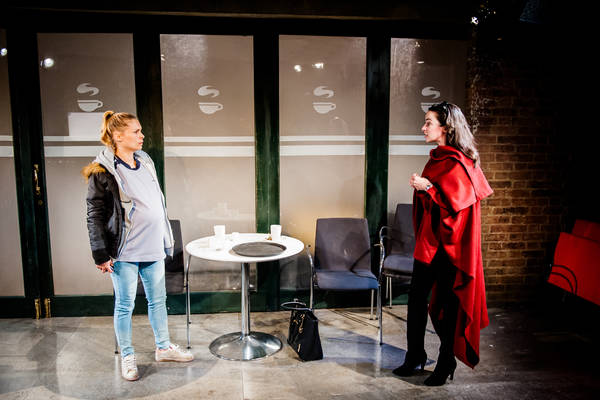
Hampstead Theatre does it again with another powerful, thought-provoking transfer after last month’s Four Minutes Twelve Seconds. Heather and Carla went to secondary school together about 20 years ago, live in the same town, but have little else in common. Heather comes from a stable, middle class family, is now married and lives quite comfortably. Carla is working poor, pregnant with her fifth child, and has a drunkard for a husband. Both had a terrible time in high school: Carla came from an abusive home, and Heather became one of a Carla’s targets after a brief friendship in year 7. They haven’t seen each other since school, but out of the blue, Heather asks Carla for coffee and makes her a surprising offer in Morgan Lloyd Malcolm’s both horrifying and enthralling The Wasp.

Myanna Buring as Carla and Laura Donnelly as Heather are an electric pair, as they should be in this relentless two-hander with sudden plot twists that keep the audience guessing. Their characters’ contrast naturally creates tension anyway, and the story generates even more. Most of the play is a hotbed of tension. The layers of lies and manipulation and abrupt reveals are surprising; there are audible gasps from the audience at certain key moments. The script has a fairly formulaic structure, but it’s the content that surprises. Albee’s Zoo Story, Miller’s The Crucible and most of LaBute’s work appear to influence. The characters’ behaviour is shocking, but the realisation that this could be anyone we know, or ourselves, uncomfortably resonates within.

Though there are a lot of big social and psychological issues presented: revenge, infidelity, class difference, abuse, rape and infertility. It doesn’t feel excessive to conflate them, but aids in creating complex characters that feel like genuine people backed up by Buring and Donnelly’s performances. This toxic cocktail of topics emphasises just how easy it is to cause lasting emotional damage in someone unintentionally, be it a family member, friend, partner or acquaintance. Kids especially: we all had tough times at school and treated each other badly but children are so self-absorbed (the ability to empathise is the last part of the human brain to develop) that they don’t often realize the consequences of their actions. And this is why each and every one of us is the hot mess we are, because of how we were treated by others when we were younger. It doesn’t take much more on top of all the baggage we already carry to send us over the edge, and that message resounds loud and clear through the women’s past and present actions that slowly unravel in the intimate Trafalgar 2.

David Woodhead’s set similarly beds in the horror of the characters’ actions. Benign, commonplace objects become aids for capture in his construction that emulates life. There’s an overly lengthy set change, but the transformation from outside a dingy café to Heather’s sitting room is as big a difference as the two women are to each other. The detail and naturalistic design make the story feel all the more like real life, an effective and powerful choice when simplicity and abstraction are the more common styles.

The Wasp presents the capacity for evil within each of us whilst challenging social stereotypes and making powerful comment on how we treat our fellow human beings. Outstandingly committed performances endowed with energy and high emotion and Lloyd Malcolm’s script create a disturbing landscape, disguised in the routine of day to day life, that can be revealed in a moment.


The Play’s the Thing UK is committed to covering fringe and progressive theatre in London and beyond. It is run entirely voluntarily and needs regular support to ensure its survival. For more information and to help The Play’s the Thing UK provide coverage of the theatre that needs reviews the most, visit its patreon.

Red Riding Hood, Pleasance Theatre

rsz_red_riding_hood_artwork

As it’s the run up to Christmas, pantos are saturating our stages. There are the traditional ones and plenty that give themselves another label in the hope of getting attention: boutique, adult and gay spring to mind. Then there are other shows that are close to panto in that they’re family friendly and/or based on fairytales, like Polka Theatre’s Beauty & the Beast. New musical Red Riding Hood, by the team that brought audiences the stage adaptation of The Secret Diary of Adrian Mole, Jake Brunger and Pippa Cleary, also falls into this category. The largely excellent, Disney-style songs are this production’s strongest feature, but unfortunately the cheap-looking set, and now-antiquated style of children’s theatre prevent this show from being a stand-out option this holiday season.

Nazarene Williams excels as Little Red. Clever and feisty, she’s a wonderfully pro-active character for young girls to identify with. Her charming sidekick William the Woodcutter (Matthew Jay-Ryan) is dopey and fun, but a good enabler and supports Red on her quest to save her family’s bakery. Matthew Barrow has more character as the wolf; his dad lacks energy in comparison. Mum Holly-Anna Lloyd is a strong singer, but she looks the same age as her daughter and the character lacks maturity. Patsy Blower completes the cast of five as the witty grandma. All of them are strong singers with that powerful, modern American Broadway tone that kids recognize from Disney films.

The book and design are a let down, though. Brunger’s writing is simplistic and not suitable for children in the upper years of primary school, and there are some unnecessary scenes that seem like they were written to add length rather than the main storyline. Three schools were there, and on several occasions the children got bored and started talking amongst themselves: a powerful indicator of this production’s issues. The story has a well-shaped structure and an interesting plot, but the dialogue isn’t far off that in Town Hall Cherubs, which is pitched to 2-5 year olds. This makes the actors perform in that exaggerated style of performance that used to be the signature of all children’s theatre, but many productions have now become much more sophisticated, even for very young children. The design looks great in dim light and the patchwork tree leaves are a particularly lovely idea, but with the lights up, they look like cheap, enlarged photocopies and the flats themselves are flimsy. The birds in the forest are origami paper cranes that the actors fly around, but there is no movement within the birds themselves. The paper rabbit on a stick slid across the floor has the same disappointing lack of impact. Grandma’s pet parrot, an actual puppet, is a much better use of puppetry. There are obvious budget constraints here, but a simpler approach may have been more effective rather than trying to make the set look grand but not having the materials available to do so.

The songs are excellent though, and there are plenty of them. From moving duets to powerful solos and whole-cast numbers, they pull back the attention every time. There are some trite lyrics here and there, but Pippa Cleary’s music is great. The show isn’t beyond rescue, though. With some re-writes and additional invention (like William’s wonderful magic book) to make it more distinctive and develop the characters, this could be an excellent example of modern children’s theatre.


The Play’s the Thing UK is committed to covering fringe and progressive theatre in London and beyond. It is run entirely voluntarily and needs regular support to ensure its survival. For more information and to help The Play’s the Thing UK provide coverage of the theatre that needs reviews the most, visit its patreon.

Mirror Mirror: A Snow White Pantomime, King’s Head Theatre

rsz_tpw3-k1hri_f6bbtm3nyb5zo_ieq3wud5gnorjqw1hmth7eapkugyw_g9qolxtc-nh9sl6jp3piyv_ekam1gf0

They are new to the King’s Head, but Charles Court Opera aren’t new to pantomime. This year’s Mirror Mirror: A Snow White Pantomime is their ninth “boutique” panto. Though an opera company, this show and cast of six are anything but stereotypical opera fare. John Savournin’s script is fresh and witty, the performances are camp and vibrant, and the re-written pop song soundtrack is so well sung that it deserves a cast recording. There’s plenty of typical panto interaction, made easier and more personal in a fringe venue but doesn’t overwhelm the space, either. Though the costumes are detailed and fun, the set is a bit analog and takes up a lot of playing space, restricting movement and choreography. Some of the performances were more genuine than others, but this remains a wonderfully current panto with excellent writing.

Savournin also directs and plays Snow White, the ditzy, ingénue widow of Barry White living with the seven dwarfs, all distinctly and energetically played by Matthew Kellet. Greedy queen Andrea Tweedale uses her mirror (Simon Masterton-Smith) to help her search for a husband, but her plans are thwarted when prince Larry Black (Amy J Payne) and his valet Harry (Nichola Jolly) show up looking for a bride and instead of being impressed by her beauty, Larry falls for Snow. The traditional story veers off in numerous contemporary directions from there, which adds to the audience’s delight and prevents the show from becoming stale or generic. The music is mostly cleverly reworked pop songs, but there’s a bit of musical theatre thrown in and the Act one Finale numbers are fantastic.

No individual performer overshadows the others, instead they are a balanced lot with clear strengths. Payne and Jolly are a charismatic pair, with Kellett’s range of dwarves a hilarious counterpoint to the leads. Savournin’s Snow is shallow but sweet and doesn’t fall short in any of the creative roles he takes on. Tweedale stokes the audiences’ booing and aww-ing brilliantly. The height difference between Savournin and Payne supports the comedy heavily peppering the dialogue, as does the cross-gender casting that goes beyond the dame and principal boy. There is some lovely chemistry between some of the characters but even though it’s a panto, there could be more between Payne and Savournin.

There’s loads of audience interaction and mess, the best being a Great British Bake Off-style competition that results in dough everywhere. Of course, there’s your usual panto call and response but not so much so that the script is otherwise flimsy. The unique visual gags Savournin employs are much more satisfying, anyway (pro tip: look out for Barry). A few give a nod to tradition, but this is definitely a language-focused script. This gives the performance a richness and depth missing from more traditional fare, hence the “boutique” label. Charles Court Opera is certainly onto a winning formula here within London pantomime offerings and is not one panto fans should miss.


The Play’s the Thing UK is committed to covering fringe and progressive theatre in London and beyond. It is run entirely voluntarily and needs regular support to ensure its survival. For more information and to help The Play’s the Thing UK provide coverage of the theatre that needs reviews the most, visit its patreon.

Torn Apart (Dissolution), Theatre N16

rsz_1broken_heart_by_chain_saw

Love is one of the best things in the world, or the worst. It feels like floating, butterflies, warmth and fuzziness, or being trapped in a cage with no way out. Everyone wants to love and be loved, but when it backfires, the effects are devastating. For life, sometimes. Torn Apart (Dissolution) presents three interconnected relationships across generations and international borders. These people are broken at worst or dysfunctional at best, which makes for some good dramatic tension but the playwright BJ McNeill’s structure, style and storyline deteriorates towards the end. Some lovely set-piece scenes, a few good performances and a powerful set design help offset these issues, but new company No Offence Theatre need to continue developing their ideas in order to better showcase them.

The international company founded by two actors, Australian Hannah Kerin and Polish Natazja Somers is admirably diverse, and the play suits their strengths well. Complimented by Simon Donohue and Elliott Rogers, they form two couples that are related but never met. Rogers, at only twenty years old, possesses a presence and rich emotional range rare in a performer so young. He is excellent contrast to his carefree girlfriend Casey (Kerin) and the two fill the intimate Theatre N16 wonderfully. Somers and Donohue as Alina and an unnamed soldier have a more mature, world-weary energy that add another layer of contrast. Less developed are scenes with lesbian couple Holly (Katherine Eskenazi) and Erica (Monty Leigh), but they create a rare and commendable female-strong cast. The action flips between these three couples’ stories, revealing their connection at a good pace.

Szymon Ruszczewski’s set is simple but evocative. A bed with white linens sits in the middle of the stage, inside a white cube with threads creating walls the audience can see through – or thin bars, trapping the unhappy couples inside a generic, characterless bedroom. Ruszczewski has also designed the lighting, which is the most successful plot I’ve seen in this low-ceilinged theatre with several nooks and crannies that tend to cast stark shadows.

McNeill also directs. There’s a good use of diagonal lines so all sides can see, but some odd choices as well. Gratuitous female toplessness doesn’t add anything to the story. If the point is that the audience is witnessing private, intimate moments, why isn’t everyone naked when they’re having sex? He also doesn’t include a curtain call; this is incongruent with the naturalistic style of the piece that has a literal fourth wall. Several of the characters toy with the strings that make up the set walls, which makes their meaning jarringly ambiguous – are they walls, or are they bars, or are they just strings? Structurally, the last couple of scenes change style, and neither develops the plot. Ending with the last soldier/Alina scene would be abrupt, but a reinforcement of the horror that lurks in some relationships.

There is definite potential in this new company and their creatives, as well as scope to continue developing and refining their work. Their goal to create truly international work not limited by where their artists are from is a wonderful one that will garner them more attention with the overall increase in quality of their work.


The Play’s The Thing UK is an independent theatre criticism website maintained voluntarily. Whilst donations are never expected, they are hugely appreciated and will enable more time to be spent reviewing theatre productions of all sizes. Click here to make a donation with PayPal.

Skyline, Ugly Duck

rsz_278df7cf00000578-3032452-image-m-8_1429115791409It’s panto season, and our stages are filled with villains, heroes and dames. Playwright David Bottomley’s new work-in-progress has some passing resemblance to the characters in Britain’s traditional seasonal offerings, but his new play on the London housing crisis is darker, angering fare. Capturing its victims’ lack of power and its perpetuators’ greed, Skyline doesn’t offer a solution but still states a clear opinion on the issue. With a cast of five playing seven characters, the audience sees a microcosmic cross section of social classes who, with poetic and pointed language, are a powerful reminder of the importance of secure housing. There is still some work to be done on the script, but the staged reading in conjunction with a pre-show talk and an exhibition by Alternative Press makes a powerful point that something needs to change to prevent social cleaning through housing policy in London.

Bottomley has a clear gift with words. There’s a subtle poetry that effectively captures his characters’ feelings, laying them exposed and raw for the taking. There could be more differentiation between their rhythms and word choices, though. Drag queen Roxanne’s (Paul L. Martin) closing monologue is similar to that of unemployed single dad and grandfather from Africa, Rex (Kevin Golding). His 28-year-old daughter Tanya occasionally sounds like her Tory MP Francesca (Karen Hill). He does well to go against stereotypes, but there’s a middle ground between them and homogenisation that hasn’t been completely reached yet.

His most complex character is Francesca. Despite being a Tory who’s having an affair with villainous property developer Jasper (Cameron Robertson), the favours she grants him directly conflict with her instinct to do right by her constituents, and values the old London that Jasper desperately wants to demolish. Her dialogue is occasionally overwritten, but she otherwise feels like a real, well-rounded individual. Jasper does as well, though not to the same extent. He could perhaps do with a touch more humanity to make him less cartoonish, even though there must be people out there as horrible as he is. Rex’s inner anguish erupts in balance to the calmer Tanya, who satisfyingly shows her true feelings in Francesca’s surgery. An interesting experiment would be to explore further integration of these characters: what if Rex and Jasper meet? Tanya and Roxanne? There’s space for more scenes without the play feeling too long.

Skyline has plenty of excellent moments, like the only scene between Jasper and Roxanne (a colourful character that’s underused) that shows how truly horrible Jasper is, and Roxanne’s need for a place she can put down roots. Rex’s desperation and Tanya’s resignation come to a head in a climactic final scene, just after Francesca and Jasper do the same. Even though there’s resolution, Bottomley skilfully alludes to the wider landscape and the struggles countless Londoners face due to the housing crisis in these final scenes. Roxanne’s gorgeous monologue that serves as an epilogue underlines the entire play, but dilutes the power in Tanya and Rex’s scene. It would work well earlier, maybe in the scene between her and Jasper.

Though Skyline is still in its development stage, it is remarkably polished and well-structured. A good cast own Bottomley’s rich language and the call for change is clear but not preachy. Some gentle development will whip this story into an even more powerful piece of political theatre.


The Play’s The Thing UK is an independent theatre criticism website maintained voluntarily. Whilst donations are never expected, they are hugely appreciated and will enable more time to be spent reviewing theatre productions of all sizes. Click here to make a donation with PayPal.

Lemons Lemons Lemons Lemons Lemons, Camden People’s Theatre

rsz_8ba7e0f9-eb48-4cc6-a4fa-d91796add7eb-2060x1236

(c) Giulia Delprato

Austerity sucks. People all over the country have had their benefits cut, work opportunities reduced and wages frozen. Austerity has badly affected young people at the onset of their careers, inhibiting the making of an independent, adult life. Young couples don’t have it any easier, even if one of the pair has a great job. For Bernadette and Oliver, life’s about to get even harder. They live in a Britain where the government isn’t just limiting welfare, arts council grants and junior doctors’ salaries. The newest austerity measure is on their speech – not what they say, but how much. Every individual is limited to 140 words a day in Sam Steiner’s Lemons Lemons Lemons Lemons Lemons.

Steiner uses the word limit to frame Bernadette and Oliver’s journey as a couple and their efforts to overcome obstacles within their relationship. The audience sees them meet at a cat funeral, wake up together for the first time, make up coded abbreviations to use when the Hush Law comes into effect. They fight, they fuck, they count their words, and it’s lovely despite the dark premise. Euan Kitson (Oliver) and Beth Holmes (Bernadette) are charmingly intimate with each other, as they should be after their runs at Latitude, Edinburgh and Warwick Arts Centre. Fundamentally a love story, these two do their best to get by and stay together even though they’re chalk and cheese. Despite stylized blocking and choreography, and no physical contact for the entire play, these young actors are sweetly genuine.

The short scenes alternate between their pre- and post- speech limited relationship, with transitions well marked with movement and the use of microphones by director Ed Franklin. Steiner’s slow plot reveal keeps the audience keen, as do his conflicting characters trying to make it work one day at a time. The amount of time passing isn’t clear though, and there are logistical points that are ignored. Has the government installed internal speech limiters in everyone? If not, why don’t they ignore the law in the privacy of their homes? How does Bernadette go to work as a courtroom lawyer with a mere 140 words? How do they remember their word count? So many questions go unanswered which make the situation implausible, particularly with naturalistic performances.

Also jarring with the performance style is the abstract movement direction/choreography. With real-life dialogue and performance, the angular, distant movements provide visual variation that are pleasing to look at, but interfere with the actors’ connection to each other. In a world where words can’t be the sole means of communicating between a couple, there’s a blatant lack of contact even though they are often physically close. It makes sense to use movement to indicate scene changes, but the unfaltering style Franklin chooses is coldly repetitive. There’s a sense of showing off his cleverness or wanting to veer away from naturalism just for the sake of it. However, his sense of timing and interpretation of a script with little more than the dialogue and scene delineations is poignant and intuitive.

Considering production company Walrus are fresh out of Warwick uni and Lemons Lemons Lemons Lemons Lemons is the creative team’s first professional endeavor, this slightly dystopian two-hander is an excellent piece of theatre. With no set and a focus on the words that the government brutally restricts, this tale of young love is wonderfully performed and an easy, touching watch.


The Play’s The Thing UK is an independent theatre criticism website maintained voluntarily. Whilst donations are never expected, they are hugely appreciated and will enable more time to be spent reviewing theatre productions of all sizes. Click here to make a donation with PayPal.

Claustrophobia, Hope Theatre

rsz_claustrophobia_at_hope_theatre__lgpr

I imagine getting stuck in a lift is pretty high on the list of “Worst Things Ever.” Well, it’s obviously not as horrible as the death of a loved one, terrorism, cancer and a host of other things, but in terms of scary experiences that can ruin your day, it’s definitely up there. And, the longer you’re trapped, the worse it gets. In Claustrophobia, Aidan and Rachel are on their way home when the lift their in stops moving. As minutes turn into hours, their phones run out of battery and they run out of food and water. Mental and emotional deterioration sets in.

Playwright Jason Hewitt cleverly breaks down the play’s structure as the characters do the same, and employs an ending device that creates ambiguity and questions about what is and isn’t real. Though the script addresses the crisis effectively through its structure, the characters lack development and some of the scene transitions are clunky. Director Sharon Burrell does an admirable job with this well-performed two hander in an intimate space, but elements of the script let it down.

Michael Cusick and Natasha Pring play defensive, closed characters that don’t give much away about themselves for most of the show. They’re damaged people and often quite rude to each other, but their language conceals the inner workings of their minds. Their vulnerability comes through in abstract moments later in the play. Both attack the roles with commitment and energy that is amplified on the small, in-the-round stage and are a pleasure to watch.

Lighting by Tom Burgess and his projections (co-designed with Burrell) are rich and visceral during the character’s expressionist and dreaming moments. The projected video is abstract and wonderfully evokes specific moods that the lighting matches. This tech augments the language and adds clarity to sections of the script that veer from the previously established naturalism, but the transitions between these two styles are abrupt, and never fully explained; there is an unsatisfying lack of connection to the characters’ real life.

This is Hewitt’s first full-length play and even though it needs work, it shows his capacity for creative thought and a confidence to play with form. Burrell’s use of the space and staging is excellent and supports the script’s ideas, as do Cusick and Pring’s great performances. Though there are some issues, this is a polished production that shows promise.


The Play’s The Thing UK is an independent theatre criticism website maintained voluntarily. Whilst donations are never expected, they are hugely appreciated and will enable more time to be spent reviewing theatre productions of all sizes. Click here to make a donation with PayPal.