Feature: Scenes From A Yellowface Execution

https://girlsdofilm.files.wordpress.com/2014/09/breakfast-at-tiffanys-mickey-rooney-3.jpg?w=800

By Daniel York

Before we go any further, let me lay a couple of things out there:

Howard Barker is a first-rate dramatist.

The Print Room in Notting Hill is a great small-scale theatre.

But they have epically and catastrophically screwed up their casting choices in Barker’s latest offering, In The Depths Of Dead Love. According to the theatre’s website, the play is set in “Ancient China”, concerns an “Emperor” and “Imperial Court” and features characters called “Chin” and “Mrs. Hu”, with an entirely white cast who (without wishing to sound too ironically stereotypical) one would normally expect to see on TV taking tea with Lady Mary Crawley in Downton Abbey.

It’s also doubly ironic that in post-referendum, post-truth Brexit Britain, we’ve spent the last few months being told that you simply cannot call people stupid or racist.

Well, here’s the deal. We don’t actually have to be stupid to do stupid things and we’re all perfectly capable of perpetuating systemic racism without actually being consciously racist. Yes, it’s a subtle one, folks, and interestingly, I can honestly say, hand on heart, I have never once heard the immortal words “I don’t have a racist bone in my body” said by any person of colour. Not one. Because people of colour are ten times as aware of racism as white people. It’s just a fact.

Now, what that hotbed of London fringe theatre that is the Print Room have done, in a play by one of Britain’s most eminent playwrights, is perpetuate the practice of “yellowface,” i.e. when a person who is not of East Asian descent plays a character of East Asian descent. Yellowface, like blackface and brownface, is a remnant of a time when actors of colour were simply not allowed on our stages.

There’s often confusion about a couple of things here. People like to kid themselves that blackface only ever happened in some bygone Edwardian hinterland and only then because there were no black actors around to play Othello. However, this isn’t actually true. The last blacked up Moor of Venice on our stages was as recently as 1990. The practice was only ended by protest from black actors.

Yellowface has lingered on a lot longer, unfortunately. We did however think we’d finally laid the culturally appropriated beast to rest (on British stages at least) in 2012 when, after the Royal Shakespeare Company elected to cast only 3 (out of a cast of 17) East Asian actors in minor roles (including a dog and a maid) in the Chinese classic, The Orphan Of Zhao, a mass social media protest that went viral globally caused considerable embarrassment to both the RSC and the British theatre industry as a whole.

Since then we have seen a whole slew of productions in major theatres: Chimerica, #AiWeiWei, The World Of Extreme Happiness, Yellowface, You For Me For You, P’yongyang, Shangrila, The Sugar-Coated Bullets Of The Bourgeoisie-in major venues, achieving enormous success with casts of real-life East Asian actors, not Caucasians doing an “ethnic turn”. We will also shortly see Snow In Midsummer, at the RSC no less, and Chinglish at the Park Theatre. These are cast with actors who can actually trace their roots to Eastern Asia.

The other confusion that lingers about yellow (and black and brown) face is that if you don’t have the make-up on, the taped eyelids and the dodgy Mickey Rooney in Breakfast At Tiffany’s accent, this somehow ceases to be dodgy theatre practice and magically becomes instead a perfectly valid form of “colour-blind casting”.

But this is the deal. If you take an East Asian character and cast it with a white actor, you’re effectively saying there is no East Asian actor who was good enough/clever enough/talented enough/capable enough to play it.

Or they simply did not exist.

In other words: erasure.

 Daniel York (sometimes known as Daniel York Loh) is a mixed-race British East Asian actor, writer, filmmaker and musician. As an actor he has appeared at the RSC, National Theatre and Royal Court, as well as in the feature films The Beach and Rogue Trader. His short films have been seen in major film festivals where they have been nominated for awards. His first full-length play, The Fu Manchu Complex, ran at Ovalhouse in 2013. Along with composer Craig Adams, he won the 2016 Perfect Pitch award to create an original stage musical, Sinking Water, based on events around the 2004 Morecambe Bay Chinese cockle-picker tragedy, which is currently being developed under commission by Theatre Royal Stratford East. He is one of 21 writers of colour featured in the collection of essays, The Good Immigrant, which won the 2016 Books Are My Bag Reader’s Choice award. He is one-third of the alt-folk trio Wondermare whose self-titled debut album is available to buy on itunes. He has served on the Equity Minority Ethnic Members Committee, is a founder member of British East Asian Artists and has worked with Act For Change to promote diversity in UK media.

Monorogue: Elf Off, Old Red Lion Theatre

https://i0.wp.com/northpoleexperience.com/wp-content/uploads/2014/09/slide-1.jpg

The Salon:Collective’s Monorogue is back again, this time with a Christmas edition. The monologue showcase is now in Santa’s workshop, where perky elf Gingersparkles is interviewing human candidates for a vacancy in the Lapland workshop. Seven lacklustre individuals who can’t otherwise find seasonal employment are created and performed by Salon:Collective actors in this spunky, lighthearted show where the audience gets to vote for the best performer/character. Distinctive characters and good performances are the trademark of this regular event, and the framework around the monologues makes for more palatable viewing.

The set is a simple construction of heaps of brightly wrapped presents, Christmas decorations and toys. It’s easy, cheap and hugely effective in the intimate blackbox theatre. Though perhaps unintended, it is also a lovely juxtaposition to some of the more down-at-heel characters.

The performances are generally good, though some of the characters tend towards stereotypical and miss opportunities for nuance. The standouts are Lucy Gallagher and Louise Devlin’s intense Scottish tomboy Mae, and Angela Harvey’s struggling mum of five Hayley. Rachel Stoneley’s confused but sweet stripper, Jade, is a great way to wrap up the candidates. Laurie Stevens is the adorable Gingersparkles, but she surprises with a ferocious climax that wraps up the evening well.

The scripts have a strong lean towards comedy, which suits the time of year, but some of them lack depth and choose to mock personality traits rather than empathise. Whilst there is nothing overtly offensive and the stereotypes created are identifiable and relatable, there is room for more variation.

Monorogue proves again that they offer an entertaining event that allows actors and playwrights to showcase their talents without taking the more common, in your face approach to self-marketing usually found in showcases. The theme sets the actor/writers a challenge and gives the audiences a needed framing device, and the performances are usually good.

Monorogue: Elf Off is now closed.

The Play’s the Thing UK is committed to covering fringe and progressive theatre in London and beyond. It is run entirely voluntarily and needs regular support to ensure its survival. For more information and to help The Play’s the Thing UK provide coverage of the theatre that needs reviews the most, visit its patreon.

Tonight With Donny Stixx, The Bunker

https://i0.wp.com/exeuntmagazine.com/wp-content/uploads/Sean-Michael-Verey-in-Tonight-with-Donny-Stixx-at-The-Bunker-photo-by-savannah-photographic-6.jpg

Donny Stixx is a teenaged magician with boundless dedication to his craft and desperation for fame. Rather than doing things that boys his age normally do, he spends hours honing his skills and tweaking the act he performs at kids’ parties, hospices, churches and for anyone else that will watch. The only thing he ever thinks and talks about is his magic. But Donny’s pretty obviously on the autism spectrum; this combined with his unstable upbringing and lack of an appropriate support system is a particularly deadly combination. Philip Ridley’s 2015 Edinburgh award-winning solo show explodes onto a bare, grey stage in a linguistically vivid documentation of fanaticism and social disorder with a phenomenal performance by Sean Michael Verey.

Verey is an unrelenting force with inimitable energy and charisma that shines through a character who has precious little social intuition. Though Donny is awkward and frustrating, Verey’s performance captivates. Having a totally plain stage that is anywhere and everywhere means it’s entirely on the actor to hold attention – but the performance makes it work and is never, ever boring.

Ridley’s text is dense and Verey races through it; it would otherwise be double the length. Though the pace is exhausting to take in, it’s necessary. The language and imagery richly creates a wonderfully detailed believable world. Director David Mercatali coaxes the nuance from Donny’s biographical story incredibly well despite the speed – the sparsely used pauses are devastating. When the pace finally lets up, it’s like cold air hitting a friction burn.

A clearly foreshadowed conclusion results in awed, uncomfortable silence. After a week that saw the broken American political machine elect an orange fascist for its next president, Ridley’s play is far from comforting. Whilst Verey’s depiction of Donny’s passion is delightful and his performance is nothing short of extraordinary, his vulnerability weighs heavily on bruised and helpless liberal consciences. There is no safety net, and fanaticism is the new normal in this dark play from the innocent days of pre-2016. It’s a hard show to sit through, but absolutely worth it.

Tonight With Donny Stixx runs through 3 December.

The Play’s the Thing UK is committed to covering fringe and progressive theatre in London and beyond. It is run entirely voluntarily and needs regular support to ensure its survival. For more information and to help The Play’s the Thing UK provide coverage of the theatre that needs reviews the most, visit its patreon.

Possibilities, Theatre N16

https://www.tcmworld.org/wp-content/uploads/2015/12/fork-in-the-road-1.jpg

What if your life has endless parallel possibilities? What if Sliding Doors is true? What if every choice you make leads to your timeline fracturing into endless paths that just keeps multiplying? Possibilities frames this proposal with two people, displaying nearly an hour’s worth of incarnations of their relationship. It’s a nice idea, but one that doesn’t develop any of the individual moments or stories presented. With inconsistent performances and an idea that isn’t fully explored, Possibilities feels like just that – but without the script’s potential coming to fruition.

Jamal Chong and Kate Gwynn take to some scenes better than others. Their intimacy is awkward in some scenes, but their flirtation and sense of play in others is sweetly genuine. The inconsistency is frustrating, as the potential for great performances is there. Chong is also the writer and director – the choice to wear this trio of hats is undoubtedly the root of the issues with this play and production.

The design is minimalistic and functional, with monochromatic chairs and a bench being arranged differently for each scene. Switching on clip-on coloured lights one by one as an introduction is a nice visual touch, but one that doesn’t link to the script in any discernible way.

Other than an interesting question posing as a concept, Possibilities falls short of taking a stance on the impact such a world would have on the individuals that it places under a microscope. The rejection of a narrative arc in favour of a collection of scenes only related through their characters actively prohibits development of this piece, and there is a pronounced absence of dramaturgy. With a bigger creative team and any sort of answer to the concept question, Possibilities would be become a more well-formed reality.

Possibilities runs through 26 October.

The Play’s the Thing UK is committed to covering fringe and progressive theatre in London and beyond. It is run entirely voluntarily and needs regular support to ensure its survival. For more information and to help The Play’s the Thing UK provide coverage of the theatre that needs reviews the most, visit its patreon.

Kissing the Shotgun Goodnight, Ovalhouse

rsz_kissing_the_shotgun_goodnight_credit_the_other_richard

Along with tickets, we are handed earplugs. Considering Christopher Brett Bailey’s first work This Is How We Die, I’m not surprised. A brilliant, relentless barrage of contemporary American myth followed by an encore of noise and light, Bailey isn’t known for doing things by halves, or even singular wholes. The slight, constantly startled-looking Canadian with gravity defying hair attacks performance making with the energy of a supernova. Kissing the Shotgun Goodnight has the same verve, but is otherwise a rather different beast. Whilst This Is How We Die was dominated by language, Kissing the Shotgun Goodnight has very few words – but the earplugs are definitely needed. This anthemic music and light show fills the room with sound, colour and vibration but is the difficult second album to This Is How We Die. Much more of a gig than a piece of theatre, it lacks the satisfaction of characters and narrative, even a hint of one. Bailey’s mind blowing poetry teases with a few tiny fragments, but otherwise leaves us desperately gagging for more of his words.

Though given earplugs, there is the choice of whether or not to use them. Notices state that the sound level is consistently over 100 decibels and that, “if you wear plugs the whole time you might compromise enjoyment of the show. and if you don’t wear them at all you will take home whistling ear canals”. Being one of those people sensitive to loud noises who constantly asks my other half to turn down the telly, I want to play it safe but I don’t want to miss out. So I opt for one plug in, with the other ready. This choice no doubt effects the experience – if I leave them out the whole time and feel discomfort, would I like the show less? Or would I like it more because it’s not actually ‘that’ loud? I use the plugs in response to the volume level – sometimes I have both in, sometimes none. It’s an interesting premise to consider that the experience and quality of the show hinges on these earplugs, adding an additional level of individual, subjective response.

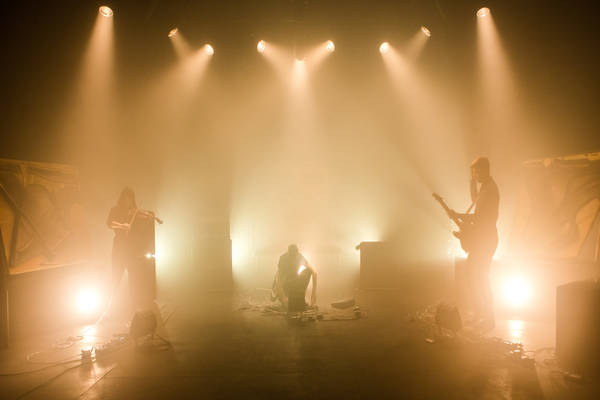
Bailey’s voice, slow and unseen, repeats, “this is a hell dream” in a brief textual introduction. Violinist Alicia Jane Turner uses loop pedals to sculpt a cinematic score reminiscent of mid-90s rock anthems. Her work is wonderfully angry, sweeping and alive. George Percy and Bailey are both on guitar, forming a silhouetted triptych with Bailey soon in the middle – amongst the monolithic speakers and flight cases forming a brutalist, urban landscape, he cuts the figure of a scrappy dystopian overlord. It suits him. If this is what hell is like, it’s fucking glorious.

Behind each performer is a wooden panel of about a metre square made of deconstructed pianos and their strings. These are visually impressive structures in and of themselves; their music evokes the violence and community of tribalism. Combined with excellent sound-responsive lighting (that malfunctioned to the point that the show needing to be stopped briefly), the overall effect is one of epic, soul shaking community.

The title paired with the music evokes the American paradox of a friendly but violent people who love their guns as much as their families. The music’s scale captures the expanse and variation of the North American landscape, and the few words he shares on the experience of waking up from a nightmare to find the world unchanged darkly foreshadow Trump’s America. Whether or not this is an intentional message, it is certainly a powerful one.

Kissing the Shotgun Goodnight is certainly wide open to interpretation and shows Bailey’s ambition and range as a performer of work designed to push the senses to their extremes. His textual dexterity is certainly missed (particularly by the coked up, flailing pair of young women sat next to me commenting on how disappointing this work is compared to his first) and comparatively this piece is somewhat disappointing, but it absolutely has its merits as a visceral, “fuck you/I love you” performance piece.

Kissing the Shotgun Goodnight tours nationally through November.

The Play’s the Thing UK is committed to covering fringe and progressive theatre in London and beyond. It is run entirely voluntarily and needs regular support to ensure its survival. For more information and to help The Play’s the Thing UK provide coverage of the theatre that needs reviews the most, visit its patreon.

Acorn, Courtyard Theatre

acorn-c-hannah-ellis-1

Persephone and Eurydice’s myths are defined by men. What happens when these men are removed and the characters plunged into a modern dreamscape? Maud Dromgoole’s Acorn brings these women and their fates together in a world of fragmented narratives and moments of biting wit, but the worlds that Dromgoole weaves together are so disconnected from each other in this cerebral play that it interferes with its immediacy.

Rather than nurturing plants, this Persephone looks after people – she is a doctor, but one that struggles to connect with her patients. Her opening monologue justifying her disdain for patients’ personal lives is equally hilarious and disturbing, the best scene in the play. Deli Segal brings a simple humanity to this cold character, making her quirky and likeable despite an autistic-like inability to understand others. Lucy Pickles’ Eurydice is a sweet contrast, alternating between a blushing bride and mental health hospital patient. Pickles is no less of a performer, but Persephone has the more dynamic and well-written character.

Dromgoole employs a range of styles, arguably too many for an hour long script. Though this strengthens the ability to relate to the story within individual scenes, the overall effect is one of indecision. An unrelated, recorded dialogue between two men fills transitions unnecessarily and doesn’t link to the women’s stories, then overlapping speech cause dialogue to be missed.

Phil Lindley’s design is simple and precise, allowing for detail and layers to emerge through Jai Morjaria’s lighting and Tom Pearson’s underused projections. The design concepts are most excellently married and add polish to a script that feels under-developed.

Acorn certainly deserves to extending and refining – the characters are excellent, as are the foundations of the stories seen here. Dromgoole uses language well and is clearly confident experimenting with form, style and classical influence, but reinvention with the goal of creating a modern myth doesn’t quite reach the enduring scale of the original material.

Acorn runs through 29 October.

The Play’s the Thing UK is committed to covering fringe and progressive theatre in London and beyond. It is run entirely voluntarily and needs regular support to ensure its survival. For more information and to help The Play’s the Thing UK provide coverage of the theatre that needs reviews the most, visit its patreon.

Undead Bard, Theatre N16

robert-crighton-in-metal-harvest

Professor Ashborn is on a mission to disprove Shakespeare’s existence, but the academics with leather patches on their elbows are trying to stop him. Following Ashborn’s lecture and an interval, Undead Bard creator Robert Crighton summons Shakespeare to talk to him about his life, work and death in an unrelated second half. This two-part show on Shakespeare in the modern world, bardolatry and the authorship debate certainly has some very funny moments of satire, but others are utterly bizarre and the poor execution of an idea. A significantly stronger first act sets up a reasonably enjoyable event, but the second is self-indulgent and anti-climactic in this overly long solo performance.

The paranoid Professor Ashborn’s lecture rips the piss out of Shakespeare academics, those that believe Shakespeare wrote Shakespeare’s works, those that believe someone else did under Shakespeare’s name and anyone with a love for Shakespeare’s plays. Crighton as Ashborn talks the audience through his various ridiculous authorship theories with energy and eccentric humour, evoking plenty of laughs. The script follows a natural rhythm of discovery, disappointment and eventual confession; it’s a story carefully crafted with intuition and skill.

Considering the second act, the first would be better served as a stand-alone piece. After what is quite a good piece of character storytelling, this random, rambling seance on the mundanity of Shakespeare’s life and afterlife is, well, mundane. The inclusion of toilet humour and sexual innuendo do not improve the piece. Shakespeare’s confusion at his legacy is cute, but it absolutely doesn’t warrant nearly an hour of discourse and disconnected pop culture references.

Crighton clearly has an aptitude for crafting a story, as evidenced in the first part of the show. Unfortunately, the rest of it is a muddled letdown that needs to be sent back to the drawing board or discarded completely.

Undead Bard runs through 13 October.

The Play’s the Thing UK is committed to covering fringe and progressive theatre in London and beyond. It is run entirely voluntarily and needs regular support to ensure its survival. For more information and to help The Play’s the Thing UK provide coverage of the theatre that needs reviews the most, visit its patreon.

Father Comes Home From the Wars (Parts 1, 2 & 3), Royal Court

https://i0.wp.com/www.officiallondontheatre.co.uk/servlet/file/store5/item374788/version1/fileservice770/374788_770_preview.jpg

American, Pulitzer Prize-winning playwright Suzan-Lori Parks doesn’t shy away from epic projects. Six years ago, she wrote a play a day to create 365 Days/365 Plays, then went on to write the nine-part Father Comes Home From the Wars. Parts one, two and three centre around Hero, a strapping young slave on a remote Texan farm. Spanning the Civil War, this epic story with influence from Greek myths and contemporary socio-political issues in Parks’ distinctive, poetic language takes its time to develop and has some discordant stylistic choices, but its narrative and historical interpretation is both compelling and important.

Each of the three parts has moments of profound brilliance and devastation, but Parks is in no rush to tell her story. The dialogue-driven script takes its time, meandering around a complex landscape of slavery, loyalty and race within this particular slave family. Though set in war time, there is little action – broader issues drive the conversation more so than current events. This is more of a kitchen sink drama than a wartime adventure story.

Part one solely takes place on the farm as Hero debates whether or not join his master in battle. The rest of the slaves take bets and try to persuade him one way or the other, but in the back of Hero’s mind is a promise from the Boss-Master – but is he likely to keep his end of the deal? Hero’s loyalty is split between his owner and his wife Penny, but the lure of the cast-off but smart uniform proves too much. Though little happens, the domesticity of part one has some of the tension that precedes a huge decision. Seeing a tall, strapping black man in the prime of his life wearing Confederate greys is most unsettling; this paired with the ingrained, accepted attitude that he is the property of his owner is a potent reminder that there has been insufficient progress in America’s attempts at racial equality.

Part two, though set at a particular moment in the midst of the war, has the calm of an eye of a storm and is by far the best of the three parts. Hero and Boss-Master have captured a Yankee prisoner whilst separated from their regiment during a battle. Hero’s loyalty is tested again, this time by his prisoner upon discovery of a secret that’s hidden in plain sight and only skin deep. Racial identity, individuality and freedom intertwine in an intoxicating allure of potential for Hero, who is still doggedly loyal to his owner. The powerful ending devastates in its frank depiction of ingrained attitudes of racial inferiority and liberal frustration with this mentality.

Part three is the more mature sibling to part one. The characters are older, wiser and more world weary in the face of Southern defeat. The pre-war certainty has given way to a chance at the great unknown of freedom, and for the first time they can choose where they live – anywhere in the great, wide world, or on the farm they have known forever. Penny and Hero’s devotion is destabilised in this irrevocably changed world that is now free, but cold and dangerous – and still is for black Americans today. The morality of freedom isn’t black or white here, but the ominous, thought-provoking grey of Hero’s, (now called Ulysses) uniform.

Neil Patel’s unforgiving desert of a set doesn’t have bells and whistles, but it’s sparsity highlights the richness of Park’s language and characterisation. Steve Toussaint is the remarkable Hero, painted with delicate light and shade. The rest of the cast are excellent in their own right, though lack the development of the initially appropriately-named lead.

Parks’ script is almost completely bedded in realism (that’s occasionally heightened), though a talking pet and some contemporary costumes slightly skew reality. Both are used sparingly and without any evident justification across the three parts so their inclusion feels jarring and unnecessary. The onstage musician, though very much a separate commentator, doesn’t clash the way these choices do.

For a play set during a war and a pivotal moment of America’s history, it is oddly detached from violence and conflict. Instead, Parks’ text goes after deeper themes within this transition from slavery to freedom. Though a greater sense of danger and looming dread would add needed further tension in parts one and two, the nuance that flows through the story is undeniably exquisite.

Father Comes Home From the Wars (Parts 1, 2 & 3) run through 22 October.

The Play’s the Thing UK is committed to covering fringe and progressive theatre in London and beyond. It is run entirely voluntarily and needs regular support to ensure its survival. For more information and to help The Play’s the Thing UK provide coverage of the theatre that needs reviews the most, visit its patreon.

Party Trap, Shoreditch Town Hall

https://www.thestage.co.uk/wp-content/uploads/2016/09/Party-Trap-Alex-Brenner-no-use-without-credit-Show-and-Tell-Party-Trap-by-Ross-SutherlandShoreditch-Town-Hall-_DSC5659.jpg

Politicians and members of the press are hardly the best of bedfellows. Unrestrained and violent, Ross Sutherland’s Party Trap explodes this relationship in a dystopian TV interview between journalist Sir David Bradley and MP Amanda Barkham after a landmark decision classifying political criticism as hate speech. Sutherland sets himself the challenge of telling his story through a script that’s an extended palindrome – an impressive feat, were it executed with more of a focus on storytelling rather than showing off a clever concept.

The palindromic writing isn’t particularly pronounced; instead it creates a haunting sense of deja vu once the script passes the halfway point. The shift in power and control from David to Amanda, and the action’s dark turn prevents it from turning stale, but the script structure is still more of a hindrance than a help. The language takes precedence over story clarity, so the plot soon muddies. The slightly futuristic premise becomes less and less tenable, to the point that the entire reality of the piece is called into question. There is little solid ground on which to build a sturdy plot line; language isn’t enough even though this experiment is certainly an interesting one.

The performances are one of the biggest disappointments. Cold and detached, they are couched in venomous sarcasm and violence. Simon Hepworth as Sir David Bradley has some nice moments of vulnerability and depth, but these are too little and too late. Otherwise, he and Zara Plessard are ruthless, calculating and distant. Video performances of other characters are relied on to fill in for news broadcasts and line managers with disturbing agendas; these characters are as self-absorbed as the two on stage.

The design elements are unobtrusive and tie the production together well, with Sutherland’s projections and video being particularly slick.There is no question that Party Trap is well-planned and thought out, but the concept is so prominent that it prevents a story from shining through. It’s a worthy experiment, but one that doesn’t work.

Party Trap runs through 1 October.

The Play’s the Thing UK is committed to covering fringe and progressive theatre in London and beyond. It is run entirely voluntarily and needs regular support to ensure its survival. For more information and to help The Play’s the Thing UK provide coverage of the theatre that needs reviews the most, visit its patreon.

Interview: Isley Lynn on Skin a Cat

rsz_skin-a-cat-main-image-digital

The upcoming opening of new venue The Bunker has certainly generated plenty of buzz, but what has excited me most about their debut season is that Rive Productions is bringing back Isley Lynn’s Skin a Cat for a three-week run. Hugely deserving winner of Vault Festival’s Pick of the Year, Skin a Cat is the coming-of-age story of Alana, a young woman who, like most young people, just wants to lose her virginity – but there’s something in the way. I spoke with writer Isley Lynn about the importance of Alana’s story, why stories like hers need to be told and how Lynn is working for more diversity in British theatre.

TPTTUK: Why does Alana’s story need telling?

IL: I’ve always been most interested in telling stories I haven’t heard before. I get so bored and frustrated when I see a show that’s beautifully produced/designed/directed/written/performed but tells me nothing I didn’t already know, or shows me nothing I haven’t seen so many times over. The bar really is so low for new stories – stories about differently abled people, women-centred stories, unconventional stories of anyone non-white, I could go on. Stories that give us new perspective are so important and exciting that I want to spend my time telling them. And the stories about sex – especially first sex – never matched up with my own experiences, so I figured I should tell mine. It really was as simple as that, but that’s also why it’s important.

TPTTUK: You use several dramatic forms and styles in Skin a Cat. Tell me a bit about these choices and the reasons behind them.

IL: To be honest, the play was so easy to write that it came out without too much thought. The stylistic qualities were organic to the material – and I had plenty of lived material to work with! I felt the direct address was important because it allows Alana to be honest and open with the audience in a way she isn’t able to be with the characters onstage with her. In a play about the pressures of how others see you and what effort it is to please, it felt crucial to keep this [play focused on] her story, her testimony, her voice.

So much of the action happens mid-coitus, and I had no idea how to put sex on stage. All credit to our wickedly brilliant director Blythe Stewart for its staging (this was definitely the most fun I’ve ever had in rehearsals, and I’m still impressed with how she managed to create a representational, physical language without resorting to silly hip thrusts).

TPTTUK: What would you like audiences to take away from Skin a Cat?

IL: We only had six performances at the Vault Festival, but after every one I had someone approach me and share their own embarrassing story, or their own experience of sexual shame or difference. That’s exactly the reaction I hope for at the Bunker – I want people to be able to see themselves in Alana’s story, and feel emboldened to talk about their experiences with strangers and friends and loved ones, because that’s the only way we can start to realise how we all “fall short” of the expectations placed on us – and not just with sex, but in so many other areas of our lives – and how unimportant and unhealthy those expectations can be.

TPTTUK: What are the biggest issues in the theatre industry today? Is your work combating them?

IL: I hope I am – I’m trying to. So many of the issues in our industry have their roots in the lack of representation. I’ve already talked about how important it is to have a diversity of stories and that’s a big part of it, but the responsibility for that is at the feet of everyone, not just writers – It’s important to create opportunities for underrepresented people on the stage, but it’s worthless if those individuals are not in a position to take opportunities available to them because they can’t afford to work for low or no pay, for example, or if they couldn’t afford the outrageous drama school audition [fee] in the first place. I have no idea how to fix that with unpaid work being the foundation for any career (certainly mine) and so much the norm.

Often, only people with strong financial support behind them can take full advantage of what’s out there. There are great one-off schemes, and great venues doing their part (like the Hope Theatre with their Equity house agreement on pay), but until the entire industry is a viable career option [for anyone], we won’t have a community that reflects the world we live in, and that’s the primary job of the arts.

TPTTUK: Isley Lynn fans are dying to know: what’s coming up next?

IL: I’ve been working with one of my absolute favourite actors on a one woman show that, if all goes well, should have a life at the 2017 Edinburgh Fringe and hopefully beyond. It’s about a English-Egyptian woman who takes up pole dancing when her husband leaves her for the revolution in Cairo. It’s going to be a unique perspective on the battle over women’s bodies and what that means when you have to navigate two very different worlds, when you’re not fully on one side or the other.

Skin a Cat runs 12 October – 5 November.

The Play’s the Thing UK is committed to covering fringe and progressive theatre in London and beyond. It is run entirely voluntarily and needs regular support to ensure its survival. For more information and to help The Play’s the Thing UK provide coverage of the theatre that needs reviews the most, visit its patreon.