One Last Thing (For Now), Old Red Lion

https://theblogoftheatrethings.files.wordpress.com/2017/02/one-last-thing-for-now-credit-of-laurie-field-14.jpg

Families separated by war and conflict have kept in touch one way or another for time immemorial. Recently giving way to skype, texts and emails, letter writing is now largely neglected – but surviving relics betray heartache, fear and longing. International theatre company Althea Theatre draw on choral physical theatre and the intimate communications between family members from a range of global conflicts to create a moving tribute to love and patriotism.

Continue reading

Celebration, Florida, The Albany

https://i0.wp.com/exeuntmagazine.com/wp-content/uploads/Greg-Wohead-The-Ted-Bundy-Project-c-Alex-Brenner-600x399.jpeg

by guest critic Tom Brocklehurst

Shows incorporating technology have become more and more common recently. This experimental show, Celebration, Florida, features two unrehearsed performers wearing headphones. Greg Wohead, the creator of the show gives them instructions, dictates to them what to say and where to stand, and what accent to speak in. Most of the time they are speaking as him – they have to imitate his American accent (badly) and ask us to picture them as him, standing in his hotel room in his pants, thinking up ideas for this show.

Continue reading

World Without Us, Edinburgh Festival Fringe

https://www.thestage.co.uk/wp-content/uploads/2016/08/World-Without-Us-700x455.jpg

Imagine the world if the entire human population disappeared suddenly, without a trace. What would it look like after a day, a month, a century, an era? A lone performer from Belgian company Ontroerend Goed methodically describes how the theatre space we sit in would change as a focal point within the wider world’s transformation. Delivered in a near monotone on a stage bare except for a grey obelisk, World Without Us is a meditative account of our solar system’s lifespan, and humanity’s inconsequence in the great scheme of planetary existence.

Karolien De Bleser quietly narrates this epoch-spanning journey of our planet with matter of fact coolness. What she describes really is remarkable in its compressed state, but the almost total lack of inflection makes the text pedestrian even in its most dramatic moments. Her movement around the space is relaxed and random, to look for meaning in it feels silly what with the story she tells.

With the ability to focus on the story without the mind drifting to topics such as what to have for lunch, the overall effect is a sense of calm acceptance that our lives, whilst impacting the planet immediately, really don’t matter. Our absence has little effect other than the gradual decay and burial of the artefacts we leave behind. Even in periods of environmental turmoil such as we see in the planet’s history, the impact is meaningless.

Even though the sun eventually swells and engulfs the Earth before it dies, all is not lost. Lightyears away, a single human artefact remains with a friendly but assumptive purpose. Its contents are, depending on one’s world view, absurd or incredibly beautiful. Perhaps they are both.The whimsy of human invention is particularly poignant at this moment.

World Without Us is a lovely, contemplative piece of performance and would work particularly well as an audio recording. As theatre, it could come across as flat, or upsetting or remarkable, depending each individual’s world view. Calmly provocative, it is wonderfully wide open to interpretation and effect.

World Without Us is now closed.

The Play’s the Thing UK is committed to covering fringe and progressive theatre in London and beyond. It is run entirely voluntarily and needs regular support to ensure its survival. For more information and to help The Play’s the Thing UK provide coverage of the theatre that needs reviews the most, visit its patreon.


Mule, Edinburgh Festival Fringe

https://www.thestage.co.uk/wp-content/uploads/2016/08/IMG_5602-700x455.jpg

Orla and her sister are close. Even when Orla decided to move from their small Irish town to Ibiza for a summer of working and partying, they still texted everyday. After a sudden cessation in her messages and silence that stretches to ten days, her family starts to worry. A social media campaign turns up a few dead ends and the police are about to launch a full investigation when there’s a phone call.

It’s Orla. She’s in jail with another young woman called Shannon. In Lima.

Based on the real-life Peru Two, Mule fictionalises the pair of young women arrested for drug trafficking in 2013. Using two actors to play all the roles, Mule centres on Orla’s story. A sweet, young woman with little life experience who trusts too easily and struggles to say no, she gets swept up into the Ibiza culture and when she loses her job, she makes some terrible choices. This pacy script by Kat Woods gives a fairly well-rounded picture of the women’s circumstances, but the execution is so rushed that the story is hard to follow.

Scenes are short and snappy, lending an urgency and tension to the story. There are some unexplained gaps in the plot, though – like how they got this job to begin with. Orla and Shannon plan their coverup story early on, but the objective truth is never discussed. Constant character changes give a wide perspective on the story, but the use of voice and physicality as sole signifier of character at the speed and length they maintain isn’t always enough. By the time it becomes clear which character is talking, they have already moved onto another.

Mule is more of a narrative character study than a deeper exploration a chain of events where objective truth is clearly defined. Though the story has a lot packed in – including prison conditions, exploitation, drug use and gender disparity – none of them are fully explored. It has the feel of a documentary, but the character of Orla is the only consistent thread.

It’s a story that has plenty of potential for exploration, but Mule doesn’t go far enough or takes a strong angle, nor does it give enough detail to deem it documentary theatre. The actors’ performances are good and there are some excellent scenes, but Mule feels like it still a work in progress.

Mule runs through 29th August.

The Play’s the Thing UK is committed to covering fringe and progressive theatre in London and beyond. It is run entirely voluntarily and needs regular support to ensure its survival. For more information and to help The Play’s the Thing UK provide coverage of the theatre that needs reviews the most, visit its patreon.

William Shakespeare’s Long Lost First Play (abridged), Edinburgh Festival Fringe

https://i0.wp.com/bloximages.newyork1.vip.townnews.com/southbendtribune.com/content/tncms/assets/v3/editorial/0/fe/0fe0f435-1c5f-5858-af5e-9114b0616351/55c5004c8b770.image.jpg

When I was a teenager, I discovered the Reduced Shakespeare Company’s The Complete Works of William Shakespeare (abridged). My love for Shakespeare had already started to grow, and I thought the script was brilliantly funny and clever. I never saw a professional production of it, or any of the Reduced Shakespeare Company’s subsequent plays, until their newest, William Shakespeare’s Long Lost First Play (Abridged).

I found it hugely disappointing. The humour I found so witty and topical in the mid-90s, though updated, is bound in hackneyed and punny dialogue. The lack of fourth wall is great, but the panto-esque delivery feels cheesy, dated and over long. The script is fine in concept, but its execution is muddy. My tastes have clearly changed over the last twenty years and the Reduced Shakespeare Company’s work is no longer has the impact it once did.

However, the packed house laugh plenty so their style and concept are clearly still popular. Reed Martin and Austin Tichenor’s play is a mashup of most, if not all, of Shakespeare’s plays in one. Found in a Leicester carpark with a pile of bones, this is the never before seen script where Shakespeare tries to fit all his ideas in one in a totally nonsensical story.

Martin, Tichenor and Teddy Spencer are the three performers who play all roles. Their quick changes and timing are most impressive, though they rely on stale stereotypes and basic jokes to generate characters. Ariel from The Tempest becomes the mermaid, a handful of characters are inexplicably gay, and there’s even a joke about Viagra. (Are Viagra jokes even funny anymore?)

The show and the company are still popular after all these years, in spite of shallow, unsophisticated humour. Though the format clearly has staying power and wide appeal, it’s distinctive style in one for those with a penchant for comedy.

William Shakespeare’s Long Lost First Play (abridged) runs through 29th August, then tours.

The Play’s the Thing UK is committed to covering fringe and progressive theatre in London and beyond. It is run entirely voluntarily and needs regular support to ensure its survival. For more information and to help The Play’s the Thing UK provide coverage of the theatre that needs reviews the most, visit its patreon.

Counting Sheep, Edinburgh Festival Fringe

https://i.guim.co.uk/img/media/23913cc392a98f67736cd3cdca806a6774c8940b/0_0_2048_1363/master/2048.jpg?w=620&q=55&auto=format&usm=12&fit=max&s=1feba80ccb7ff150a5842abd1e15ee76

Just over two years ago, a revolution in Kiev ushered in the downfall of the Ukranian government. Protests against the government’s refusal to sign pro-EU legislation lasting months had several violent outbursts that saw hundred of people injured and 780 killed. Toronto-based Ukrainian musician Marichka Kudriavtseva, in Kiev for work at the time, joined the protesters where she met Mark Marczyk, also based in Canada.

When the two returned from the Ukraine, they teamed up with Marczyk’s Lemon Bucket Orkestra to create Counting Sheep, an immersive “guerrilla folk opera”. A celebration of solidarity and the power of a collective voice, it also mourns those who died in the protests. Told from the perspective of the protesters, little is shared from the other side – but this rallying performance is fitting homage to not just the Ukrainian protesters, but those fighting government tyranny around the world.

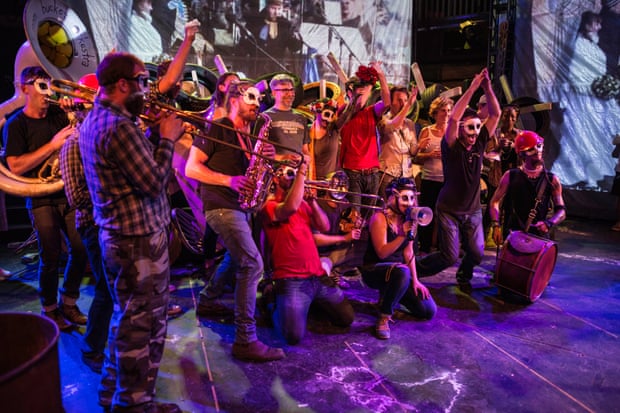
Some audience sit around a huge table, whilst others sit on the sides of the space and still others up in a balcony. Klezmer or folk music is playing as the audience enters; there is a convivial atmosphere as the show formally starts. This is a party, or a wedding, or some other huge gathering, until the three screens display news reports of riots and police enter. The tone abruptly shifts, and the world that has been established is dismantled. It’s a wonderful, unsettling surprise.

The space is consistently reformed and redrawn using movement, and the audience is physically moved in the wake of the protesters’ gains and losses. They are willing and unquestioning, the sheep of the title. Though the numbers here obviously pale to those at the actual protest, incorporating the audience in acts such a building barricades and lobbing bricks at police fosters unity from disparate dozens. There is a hint of the solidarity and aggression found in protests, and joy and celebration from the audience who are keen to play. Being served food is also an important enabler that solidifies the unity the show aims to create.

Counting Sheep is hugely effective in its emotional manipulation, and also it’s storytelling through music, movement and projections. Choosing sheep as a metaphor is a curious choice, though. The benign but rather dumb livestock aren’t known for thinking for themselves and are susceptible to herding – otherwise, they wander around unproductively, getting lost and eaten by predators. Whilst the performers are the herders here, they are also in sheep masks, unempowered. Who then are the herders? The government? Unseen forces of political and social unrest? Whatever it is, us human beings are hugely susceptible to it when motivated enough, even if the metaphor isn’t totally clear.

Though sung completely in Ukrainian, there is a clear storyline conveyed through projections and movement. There is little nuance in this piece, but it a playground for the sweeping emotions of popular theatre. It provides at least a hint of the experience that the Ukrainian protesters endured, and powerfully unites the audience through the humanity of collective experience for a common goal. An excellent piece of theatre.

Counting Sheep runs through 29th August.

The Play’s the Thing UK is committed to covering fringe and progressive theatre in London and beyond. It is run entirely voluntarily and needs regular support to ensure its survival. For more information and to help The Play’s the Thing UK provide coverage of the theatre that needs reviews the most, visit its patreon.

Please Excuse My Dear Aunt Sally, Edinburgh Festival Fringe

https://www.thestage.co.uk/wp-content/uploads/2016/08/please-700x455.jpg

When fourteen-year-old boy Red starts at a new school after his parents’ divorce, his mum anxiously worries about him making friends. Soon, his mobile is constantly buzzing with texts and he’s out most evenings. Mum’s happy but she only sees the life Red constructs especially for her. Someone, or rather something, else has the privilege of an uncensored view – Red’s mobile. As the vulnerable boy is sexually exploited by his unsatisfied maths teacher, his phone sees everything and narrates the story around the characters’ interactions. This slick ensemble piece by NY theatre company One Year Lease seamlessly merges writing styles, design and physical theatre to tell a dream-like story of abuse veiled as love.

When Red’s maths teacher confiscates his mobile and accidentally takes it home with her instead of her own phone, she begins a downward spiral of communication that quickly becomes personal. Red’s parents separation is far from pleasant, and his teacher’s boyfriend is an unemployed layabout, with vague dreams of designing apps. This combination fosters a relationship where the teacher and the student inappropriately confide in each other, and she does nothing to stop it.

Suspicion helps propel the action upwards towards a climactic end, but a lack of consequence in Kevin Armento’s resolution is as disturbing as the story itself. The phone as narrator is a great device – it’s present enough to add context and framing, but is not overused to the point of becoming a gimmick. Abstract movement incorporating versatile set pieces adds a striking, dynamic visual and a disconnect from reality appropriate to a forbidden relationship. A live musical score by Estelle Bajou enhances the surrealism of the staging.

Mathematical equations coldly explain how their illicit affair develops, and minimalist design in black and white juxtaposes the intricacies of the complex lives that collide so inappropriately. Though the script avoids blatant condemnation of the relationship, Please Excuse My Dear Aunt Sally is a striking blend of visual and verbal storytelling.

Please Excuse My Dear Aunt Sally runs through 28th August.

The Play’s the Thing UK is committed to covering fringe and progressive theatre in London and beyond. It is run entirely voluntarily and needs regular support to ensure its survival. For more information and to help The Play’s the Thing UK provide coverage of the theatre that needs reviews the most, visit its patreon.

Us/Them, Edinburgh Festival Fringe

https://www.thestage.co.uk/wp-content/uploads/2016/08/Us-Them_300dpi_PRESS-2_%C2%A9_FKPH-700x455.jpg

On 1 September 2004, a group of terrorists stormed a school in Beslan, holding over a thousand people hostage on the first day back after summer holidays. Most of them were children. When the siege ended three days later, over 300 people were dead. Part history lesson and part dramatherapy storytelling, two actors playing unnamed children who were hostages in the crisis re-enact the events of those three days. The childlike seriousness, quiet bickering and playful staging in Us/Them provides an excellent, contemplative lens through which to view world disasters.

Gytha Parmentier and Roman van Houtven are a soft spoken girl and boy who take pride in their school and their education. They go to the best one in town, and it’s near a wonderful forest. On the other side of the forest is the border, and across the border, children don’t go to school, the men are pedophiles and the women have moustaches. They view the world in black and white, everything is simple and explained in a matter of fact delivery. Whilst they show little fear, as hours stretch into days, the heat and dehydration take a toll on their bodies. Through their tiredness, they try to make sense of the terrorists’ demands and work out what they have to make them let them go. Their naivety is both heart wrenching and warming, rather than condemn they want to please everyone and carry on living their lives in peace.

The script is mostly narration, with some quibbling between the two on how certain moments panned out. More dialogue between the two would be welcome, but the design choices keep the narration from becoming too repetitive. It is description heavy, accented with colourful, abstract staging – childrens’ coats hang on the back wall, a web of unravelled string slows them down so as not to startle the terrorists. Their movements are angular, with leaps, falls and physical play. The bombs they rig around the gymnasium where they are held are balloons. Whilst the imagery and text is childlike, the undercurrent of danger and horror is inescapable, and the quiet honesty is wholly riveting.

Children are so often the faces of global tragedies that rally sympathy and action. Think of the little boy washed up on the beach, the tiny Syrian airstrike victim staring into the middle distance in the back of an ambulance. Whilst their images are splashed across the news and social media, they are rarely heard from. Perhaps if they were given a platform to air their experiences and perspectives, the adults that run the world would be less inclined to mindlessly retaliate against violent acts. Us/Them, rather than having an in-yer-face aggressive, political agenda, intuitively uses text and staging to convey a powerful, lingering request to listen and be kind, no matter how foreign we are to each other.

Us/Them runs through 28th August.

The Play’s the Thing UK is committed to covering fringe and progressive theatre in London and beyond. It is run entirely voluntarily and needs regular support to ensure its survival. For more information and to help The Play’s the Thing UK provide coverage of the theatre that needs reviews the most, visit its patreon.

Bucket List, Edinburgh Festival Fringe

rsz_cpf9rwlwgaagznb

The North American Free Trade Agreement (NAFTA) between Canada, the US and Mexico came into effect on 1 January, 1994. I was eleven years old. The agreement ushered in a degree of national prosperity for all three countries, but Mexico’s low minimum wage, lax environmental regulations and corrupt officials made a perfect storm for sweatshop conditions in the US-owned factories (maquiladoras) taking advantage of the exchange rate and unemployment in Mexican border towns. The maquiladora owners favoured female workers for their diligence and precision and employed girls as young as fourteen, who were better suited for working 12-hour days in harsh environments than older women or clumsy men. These girls, only a few years older than me, were assembling electronics and convenience items out of toxic materials for 39 cents an hour.

I’m American. Though I hide it well with a deliberately constructed accent and uniquely British habits and mannerisms that I’ve developed in the nearly twelve years that I’ve lived here, I still have the passport, the cultural history and the guilt to prove it. Normally that guilt is shaped like guns, healthcare or Trump, but it occasionally takes on other forms. This time it’s privilege. That privilege/guilt pours down my cheeks in hot, angry tears during Theatre Ad Infinitum’s Bucket List. The story of the women and girls’ lives dictated by the maquiladoras, some as young as me, is a horrifying contrast to the suburban middle-class upbringing I had, kept busy with school and music lessons and theatre rehearsals and ambitions. I may have had something that these girls made, some frivolous object bought without thinking in order to make my life easier or better, and I was totally oblivious to their hardship. I did not have to worry about my mother being killed for protesting the maquiladoras’ pollution, or about my auntie being raped by her manager, or getting cancer from the chemicals I encountered on a daily basis.

But for the women and girls in Bucket List, that is their life. The all-female, international cast, directed by Nir Paldi, devised a magical realism story of these desperate factory towns based on an idea from Mexican company member Vicky Araico Casas. Incorporating George Mann’s distinctive choreography and live music, Bucket List tells the story of Milagros (played by Casas), a girl growing up in one of these towns dominated by maquiladoras. Her generation’s experiences and those of her mother’s interweave, creating a landscape of labour, political protests, coming of age and revenge. It is a dense story covering a decade of these women’s lives, but Paldi’s script is easy to follow. Magical realism creeps in stealthily, and only at the end of the performance do certain events seem untenable and raise the question of whether or not they actually happened. Regardless of this fuzzy line between reality and fantasy, Bucket List is an anthem of strength that roars with political agenda and gives voice to the disregarded victims of developed nations.

Initially more of a montage of life experiences, Milagros’ story slowly begins to emerge. This could shift slightly earlier in the piece, but the exposition at the beginning gives wider context and does not feel extraneous. Paldi maintains a careful balance of these women’s lives and a wider, North American political picture that slightly tips in favour of the women, but there is enough of the outside world’s oppression and token assistance to inspire the characters’ rage and passion. Milagros’ tragic end adds fuel to the production’s fury against exploitation that comes out as a roar rather than a whimper.

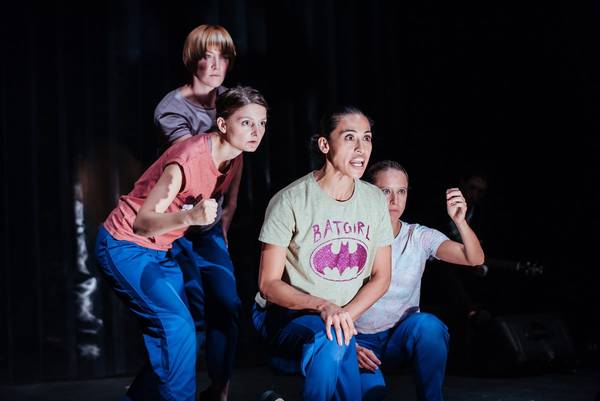
There is hardly any set and technology on display, a dramatic change from their last adult show, Light. Instead, costume plays a bright but subtle role in the story – the five women playing the girls and their family wear coloured t-shirts with cartoon characters often idealised by young girls. Disney princesses, Batgirl and Alice in Wonderland offer them an American-created fantasy that they can strive for but will most certainly never achieve.

Juxtaposed against these pastel tops are quite vicious games demonising the powerful politicians and corporations that shape their lives. They also mock their working conditions, daily violence at the hands of men and threats to their lives. Milagros’ mother (Deborah Pugh) is a vocal political protester, demonstrating a ferocity also contrasting her character’s clothing. The excellent live score by Amy Nostbakken is more of a direct expression of the fighting spirit and sadness within these women.

Though a text-driven piece, Mann uses a series of motifs that soon become recognisable, indicating specific actions and locations. They enhance the understanding and often act as a substitute for words. Though used regularly, Mann’s choreography is one of the company’s trademarks and is unfortunately underused, especially considering the lack of set.

Even though NAFTA is over twenty years old, the maquiladoras are still there, employing women for long hours, polluting local rivers and creating environments ripe for exploitation. Paldi’s script aggressively demands awareness which may be unpalatable to some, but should be required viewing for every American blissfully unaware of their brothers and sisters across the border that are so often looked down upon with racist disgust. Bucket List is truly vital theatre in our age of disposable, thoughtless consumerism.

Bucket List runs through 29th August.

The Play’s the Thing UK is committed to covering fringe and progressive theatre in London and beyond. It is run entirely voluntarily and needs regular support to ensure its survival. For more information and to help The Play’s the Thing UK provide coverage of the theatre that needs reviews the most, visit its patreon.
Hamlet in Bed, Edinburgh Festival Fringe

https://i0.wp.com/www.rattlestick.org/wp-content/uploads/2015/09/hib-2.jpg

Michael, a typical New York City lost soul, is obsessed with Hamlet. He knows the play inside out and pours over every bit of scholarship he can find on it. His neighbourhood secondhand bookseller puts anything aside that he might be interested in and this time, he’s struck gold. A diary from forgotten ex-actor Anna May Miller details her rehearsals for Hamlet, a failed relationship and a child she put up for adoption on the day Michael was born. The orphaned man, desperate for a mother and to enact his perfect version of Hamlet, creates an elaborate scheme to cover both bases in Hamlet in Bed.

What is more of a treatise on Shakespeare’s play than a journey of personal discovery is also a creepy, misogynistic story of stalking and entitlement. The two interweaving storylines are given equal measure by writer Michael Laurence, resulting in neither reaching full potential, though Annette O’Toole gives an electric performance as Anna May.

The imagery-laden beginning of the script is a feast for the ears. Though the start makes for a great aural experience, the best scene is an extended rehearsal for Michael’s Hamlet where a debate on the characters’ intentions becomes a thinly veiled filter for their own issues and insecurities. Also, the scholarship on display in this scene is in-depth and spot-on. An anti-climactic end is a lost opportunity for Anna May to condemn his self-centred exploitation of her weaknesses, which creates an uneasy feeling that his actions are deemed acceptable. There are also entirely too many coincidences to make the story believable, and a few occasions where choices aren’t fully explained or justified.

Though the story revolves around Michael, played by Laurence, O’Toole’s performance completely dominates his. It’s not at all to do with any shortcomings on his part, but a total mastery of craft on hers. The privilege of seeing a stage and screen legend in an intimate venue at least partially alleviates the problems in the script.

With questionable themes and a script that can’t decide what it wants to be about, Hamlet in Bed has several glaring flaws that a re-write would be able to solve. Despite these, O’Toole’s performance is fantastic, and great to watch.

Hamlet in Bed runs through 29th August.

The Play’s the Thing UK is committed to covering fringe and progressive theatre in London and beyond. It is run entirely voluntarily and needs regular support to ensure its survival. For more information and to help The Play’s the Thing UK provide coverage of the theatre that needs reviews the most, visit its patreon.