The Marvellous Adventures of Mary Seacole, Rosemary Branch Theatre

I had never heard of Mary Seacole until I began working in UK schools, several years after my arrival to the UK. What a woman!  No wonder her entrepreneurial, caring Victorian spirit is on the National Curriculum and she has been the subject of several plays, including Rosemary Branch co-artistic director Cleo Sylvestre’s one-woman show, The Marvellous Adventures of Mary Seacole. With a simple narrative structure, Sylvestre’s piece focuses on characterisation and biography. It is well performed, though some adjustments to the script and tech could make this an even better solo show.

We are never told who we are, but Seacole treats us like a society or club she has come to lecture about her life.  She speaks in the past tense shortly after her return from the Crimea; we hear her life story starting with her childhood in Jamaica, helping her mother run their Hotel, Blundell Hall and learnt about her “remedies” from foraging. Continuing onto her London, Central America and finally The Crimean War, Sylvestre endows her with a confident, charismatic warmth – no wonder she was so popular with soldiers and civilians alike. Her performance peaks when recalling her mother first teachings her about plants, and later memories of battlefields heaving with wounded soldiers – her “boys.” These are lovely moments to witness, but some of the more mundane content is delivered on autopilot.

Structurally, the script is a simple, linear narrative. This would be an excellent piece to tour to primary schools, as it’s easy to follow and has plenty of captivating anecdotes. The content is interesting enough to hold an adult audience’s attention for nearly an hour, but it would be a refreshing experiment to see this piece as episodic, with more lighting and sound than is presently used to highlight pivotal moments. This is not a new show, and solo performance has evolved since its inception. Sylvestre’s imagery-laden work would suit regularly used bigger projections, detailed soundscapes stronger lighting changes. Even though this is an important story, it is not an innovative production, but it certainly has the potential to be.

Cleo Sylvestre’s performance is the highlight of The Marvellous Adventures of Mary Seacole, but this long-running solo performance needs some revisiting to give it an extra burst of life worthy of such a vibrant character.

Running at The Rosemary Branch, 9-11 April.

The Play’s the Thing UK is committed to covering fringe and progressive theatre in London and beyond. It is run entirely voluntarily and needs regular support to ensure its survival. For more information and to help The Play’s the Thing UK provide coverage of the theatre that needs reviews the most, visit its patreon.

Shakespeare as You (Might) Like It, Rosemary Branch Theatre

rsz_b551c7178d1c33dd1b480aca6c14387c3b89b05f2301913df15fd10fc38737bf

Four hundred years ago this April, Shakespeare died. A bunch of academics decided to take advantage of this bizarre anniversary and launched Shakespeare 400. It’s a great excuse for a nationwide Shakespeare celebration, but few of the involved events appear to acknowledge that the celebration is of his death and that he most definitely would write no more. Shook Up Shakespeare hasn’t let this fact bypass them, though. Their 45-minute Shakespearian cabaret mash up, Shakespeare As You (Might) Like It, is a quad centenary wake celebrating some of the Bard’s best female roles and the chaotic spirit of Elizabethan and Jacobean performance conventions.

Performer/creators Roseanna Morris and Helen Watkinson energetically and easily flip from Shakespeare’s verse to contemporary audience banter. Their show doesn’t have a plot, but involves party games, cakes, wine, singing and audience interaction as well as some cracking excerpts. In the intimate Rosemary Branch Theatre, it’s hard to hide but after the initial refreshments, party bags and taking a register, it feels more like a group of friends out for a laugh so people willingly volunteer. There’s a hint of The Complete Works of William Shakespeare (abridged) but with less structure, though it doesn’t feel like it needs it at such a short length.

Morris and Watkinson, as well as being friendly, charismatic and unintimidating, are excellent performers. They perform three scenes and at a push, the Desdemona/Emilia scene is the best but the other two are still fantastically endowed with a seemingly-easy commitment. Though not the best of singers, they confidently carry the Willow song. They switch their tone on a pin, which is truly lovely to watch.

Shakespeare As You (Might) Like It is their debut show as a company and as fun as it is, it could use some developing. With more material it will probably need more shaping and a more clearly outlined purpose/message, but Morris and Watkinson are natural talents with clear passion for sharing Shakespeare’s work with joy rather than quiet reverence.

The Play’s the Thing UK is committed to covering fringe and progressive theatre in London and beyond. It is run entirely voluntarily and needs regular support to ensure its survival. For more information and to help The Play’s the Thing UK provide coverage of the theatre that needs reviews the most, visit its patreon.

Big Brother Blitzkrieg, King’s Head Theatre

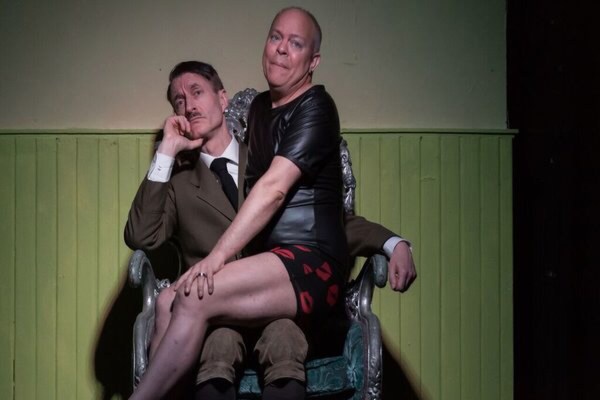
Lots of things seem like a great idea at uni. Some of them are genuinely good ideas. A great deal more aren’t. Writing a play about Hitler in the Big Brother House is one of the latter. In 2014, Newcastle University students Hew Rous Eyre and Max Elton founded Bitter Pill Theatre to produce their debut play, Big Brother Blitzkrieg, at Edinburgh Fringe that year. With a couple of other shows now under their belt, they bring their popular first production to London. Meant to somehow satirise Big Brother and Hitler, this stereotype-driven piece doesn’t follow any sort of consistent narrative logic and doesn’t manage to rise to satirical humour. The performances are very good despite the character limitations, but the script comes across as a drunks, nonsensical idea that would have been better off forgotten.

When Hitler fails to kill himself after his final rejection from art school, he wakes up in the garden of the Big Brother House during its final season. True to life, no one watches the programme anymore and the contestants are just in it for the money. Bafflingly, none of them no who Hitler is, even the educated, middle class housemates. Clearly this is a world where WWII never happened, but I’m not sure what point that’s meant to make. Similarly, the plot follows what I imagine to be standard Big Brother events: evictions, competitions, surprises and character clashes that are largely unfunny and offer no new perspective on the show or reality TV format. Though the story defies the laws of Physics through the use of time travel, this element is wholly neglected.

The cast are very good, or at least at playing their respective stereotypes. Stephen Chance is an expressive, quick-witted Hitler with no idea of how to deal with charming, bouncy Essex lad M-Cat (Kit Loyd) and ageing queen Felix (Neil Summerville). He finds kinship in corporate PR and Tory Lucy (Jenny Johns), a delightfully despicable Katie Hopkins homage. The house is completed with femi-gendered Charlie (Hannah Douglas) who has some cracking exchanges with Lucy, and the bland as plain toast housewife Rachel (Tracey Ann Wood), who Hitler immediately distrusts. The combinations invites inevitable situation comedy but again, it’s not sophisticated enough to count as satire, or have any sort of message at all. A shame, as the actors all seem to have great potential but are stuck playing two dimensions.

The show would suit a much smaller format, like a reoccurring sketch as part of a comedy show limiting each slot to ten minutes. About half an hour in, Big Brother Blitzkrieg already feels too long. There were a few good lines, but in 75 minutes, a few isn’t enough to save this play even with the hardworking cast. Despite the commendation these young practitioners deserve for setting up a company whilst still studying and keeping it going for nearly two years, part of artistic development is knowing when to let an idea go. This is a production that needs to retire in favour of more advanced, relevant work.

The Play’s the Thing UK is committed to covering fringe and progressive theatre in London and beyond. It is run entirely voluntarily and needs regular support to ensure its survival. For more information and to help The Play’s the Thing UK provide coverage of the theatre that needs reviews the most, visit its patreon.

The Long Road South, King’s Head Theatre

The Civil Rights movement in America was time of turbulence and violence but both black and white activists retaliated with their passion for equality. The issue divided individual families across generations, recreating the conflict on a microcosmic level. Paul Minx’s The Long Road South recreates this excruciating tension through close examination of the dysfunctional Price family in suburban Indiana.

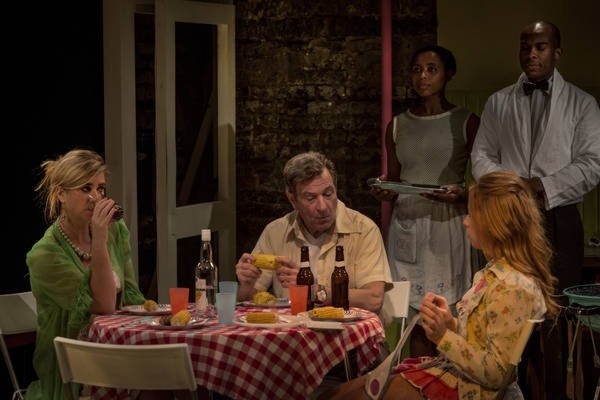
Stay at home Carol Ann (Imogen Stubbs)is mother  to teenager Ivy (Lydea Perkins) and married to supermarket manager Jake (Michael Brandon). They are the only family in their neighbourhood able to afford “help”, black couple Grace (Krissi Bohn) and Andre (Cornelius Macarthy). On the surface, these characters are aspirational and progressive. That American Dream veneer doesn’t hold up for long, though. The characters’ gangrenous innards seep out, creating a kitchen sink drama with excellent moments, dramatic themes  and characterisation akin to Miller and Williams, but lacks the linguistic sophistication of these revolutionary writers and a few too many twists and turns for a one-act play.

The cast is generally strong, with Brandon outshining the rest when he eventually appears in Willy Loman-esque glory. Perkins has a grating vocal quality that, though appropriate to the lying, manipulative character, was nails on a blackboard after a few scenes. Bohn and Macarthy are good foils to each other with a lovely chemistry and sharp edges that sporadically pop out, adding to the dissonance. Stubbs is the tragic heroine, trapped in her house by alcoholism and the memory of an institutionalised child. This lot are a close-knit ensemble, an extended family with all the complexity of a real life one. Unfortunately, the accents spanned the country rather than uniting this family in a common place.

Director Sarah Berger skilfully uses the irregular playing space and space to enhance tension. Rarely touching or even close to each other, this shows the power of religious belief in these characters constantly aware of Satan’s temptations. Adrian Linford’s sunny back garden with its perfectly mowed grass and pastel BBQ juxtaposes the family’s chaos. Minx has an instinct for conflict, but the production’s subtlety comes from the performances rather than the dialogue. There’s no overt moralising or thickly laid Americanisms, just the characters’ genuine need to do what they think is right.

The Long Road South is a quite the good script by a writer with plenty of promise and a great cast. It’s a good reminder of a crucial period of American history, and that monumental change can wreak havoc on the closest of family units. The cast and the characters’ individual stories are certainly the best features here, but the other production elements aren’t far behind.

The Play’s the Thing UK is committed to covering fringe and progressive theatre in London and beyond. It is run entirely voluntarily and needs regular support to ensure its survival. For more information and to help The Play’s the Thing UK provide coverage of the theatre that needs reviews the most, visit its patreon.

King & Country, Barbican Centre/RSC

rsz_king-and-country

Shakespeare’s history plays are some of his best. Epic tales with tragedy and comedy, love and war, politics and history are brought to life on stage, with the storyline of some characters spanning years and multiple plays. The RSC and Barbican have, over the last few years, presented the first four as separate productions but to celebrate the 400th anniversary of Shakespeare’s death this year, unite them as a single ticket. King and Country is Richard II, Henry IV part i, Henry IV part ii and Henry V is a marathon package deal of roughly twelve hours of theatre (plus intervals) spread over several days. A large ensemble cast play all roles across the four plays, with the same actors satisfyingly playing the same parts that stretch across multiple productions. Set and design also carry through; this quartet is slick, engaging and brings together original and contemporary practice.

Big names in the cast are an initial draw and live up to their hype (David Tennant, Antony Sher, Julian Glover), but the thirty-strong ensemble are just as good, if not better. Sam Marks as Aumerle, Poins and the Constable of France is excellent, particularly as Prince Hal’s laddish sidekick with a magnetic energy that bounces around the stage and fills the 1,156-seat theatre with youthful vigour. Matthew Needham comically interprets Hotspur; random, extreme outbursts get laughs, making the character’s tragic flaw the reason for his defeat. He also plays Mowbray and Shadow, the latter being a minor role but played with such commendable contrast that he is unrecognisable. Jennifer Kirby is a feisty Lady Percy and a naughty and nice Katherine, endowing both small roles with heaps of personality. The best comedic performances include Oliver Ford Davies as Shallow (also a fantastic Duke of York and Chorus), Emma King as Doll Tearsheet, Sarah Parks as Mistress Quickly and Joshua Gardner as Fluellen.

Tennant is just as exquisite as Richard II as two years ago, and Jasper Britton’s Bolingbroke/Henry IV is endowed with pathos, guilt and an extraordinary character journey. Alex Hassell is delightful as the devil-may-care Prince Hall, but his quieter, matter of fact Henry V is sensitive but less dynamic. He aims for intimacy rather than bombast and arrogance, a unique interpretation but one that is not overly effective due to a lack of power, particularly in his famous speeches. Antony Sher nails Falstaff’s characterisation, but his even, rhythmic delivery lacks variation and harks back to the old fashioned declamatory RSC stage speech – hugely disappointing.

Stephen Bromson Lewis’ set is the same as it was for Richard II’s performance two years ago and has little variation over the four productions. Paired with Tim Mitchell’s lighting, the audience sees austere courts, earthy battlefields and debauched public houses that don’t interfere with the action. The acrylic floor of under lit ploughed furrows is the surprise of the event, not viewable from the stalls closest to the stage but adds a striking dynamic and atmosphere from the gods: a delight for us peasants with the cheapest seats. Costumes (presumably also by Lewis) hint at a time period, but have a contemporary, minimalist touch that please the eye but not dominating.

There are some odd directorial choices by Gregory Doran in these otherwise stunning productions. Rumour (Antony Byrne) is in contemporary dress, accompanied by a projected digital cascade of hashtags and “rumour”. The Chorus (Oliver Ford Davies) is similarly dressed, which makes sense with the text. The token technology reference? Much less so. These are jarring in their modernity, unneeded and contribute nothing to the meaning and aesthetic of the plays. He misses an opportunity to put Henry V on the elevated walkway heavily used in Richard II; instead he lowers him to a wooden cart and diminishes the gravity of the St. Crispan’s Day speech.

It was an utter joy to see Doran incorporate audience interaction; even though there weren’t many of these moments. They unite the audience and actors in a love for Shakespeare’s work, bringing everyone together in a celebration of living, breathing theatre rather than maintaining a distant reverence for it. Henry V’s adorable insecurity in the presence of French princess Katherine leads to asking the audience for advice, and Hassell’s corpsing during a pub scene as Hal (when an audience member loudly blew his nose and another actor acknowledged it within the action) was a delight. His easy confidence with this style of performance clearly stems from his early work with The Factory and The Globe; Doran should have exploited this more, particularly during the character’s youthful exploits. The audience could have easily been his army or his mates down the pub more often.

Though RSC productions have often missed the mark in the past, these four are almost as on it as they can get. They do not force a modern concept that only tenuously relates to the themes in the script, but they are not stuck in a stilted, stuffy style of yore. Doran’s productions are unified, alive and vibrant with stellar design and performances. Here’s hoping they see life in the UK beyond this Barbican run and their international tour this spring.

The Play’s the Thing UK is committed to covering fringe and progressive theatre in London and beyond. It is run entirely voluntarily and needs regular support to ensure its survival. For more information and to help The Play’s the Thing UK provide coverage of the theatre that needs reviews the most, visit its patreon.

No Villain, Old Red Lion Theatre

rsz_no_villain_old_red_lion_theatre_adam_harley_courtesy_of_cameron_harle_5

There’s usually good reason why renowned writers have known but unpublished early works. They hone their craft by writing, usually badly at first, and then have a major breakthrough after they have been writing for some time. Expecting this to be the case with Arthur Miller’s world premiere of the unpublished No Villain, the play proved to be surprisingly good. Miller’s autobiographical one act was written for a playwriting competition when the 20-year-old undergraduate at the University of Michigan was on the verge of leaving due to his family’s losses during the Great Depression. It was in the university’s archives that director Sean Turner found the manuscript mentioned in Miller’s memoirs, dashed off with the desperate hope of saving his Journalism degree. A theatrical and historical relic, the script isn’t a particularly polished affair but brims with youthful enthusiasm, political activism, and familial conflict that hints at the greatness to come in later works like Death of a Salesman and The Crucible.

From beginning to end, tension dominates this story set in 1936 New York City during the strikes that paralysed the garment district and bankrupted businesses barely holding on to their survival. Father Abe Simon (David Bromley) has no sympathy or understanding for the strikers or his sons’ recent discovery and devotion to the new political system taking over the East, Communism. Arnold (Adam Harley) is a thinly veiled Miller who at the beginning of the play returns from Michigan for the holidays. Refusing to help his father (David Bromley) at the shop because it would compromise his principles, older brother Ben (George Turvey) is more practical. The action largely centres around these three men, but the strain of the Depression also shows in their interactions with their mother (Nesba Crenshaw), sister Maxine (Helen Coles) and grandfather (Kenneth Jay).

Focused, emotionally endowed performances in heightened realism and moments of good dialogue generate exquisite set piece scenes, but the overall plot structure and storyline is a bit loose, and the politics are so blatant that it’s agitprop. This is not a subtle play, but it’s certainly not poorly made. The story is a microcosmic representation of Big Issues but it’s clear that this is real life replicated on stage rather than pure fiction. There’s a lot of preaching and arguing and threats, but the actors truthfully capture this almost-constant tension within the family, and these moments are plentiful. Like a baby Death of a Salesman, we see the idealism and father-son relationships that help make Miller one of the greatest dramatists of the 20th century.

Max Dorey’s set and Natalie Pryce’s costumes contribute detail and further authenticity to the production. Stylistically, this is a great example of early 20th century American theatre (but with accents from different parts of the US in one family) made popular by Clurman, Adler, Meisner and the rest of the Group Theatre in the 1920s and 30s. Turner captures this performance style well and in combination with the factual/biographical nature of the script, it feels like the audience is watching a moment of history brought to life.


The Play’s the Thing UK is committed to covering fringe and progressive theatre in London and beyond. It is run entirely voluntarily and needs regular support to ensure its survival. For more information and to help The Play’s the Thing UK provide coverage of the theatre that needs reviews the most, visit its patreon.

Wilde Without the Boy/The Ballad of Reading Gaol, Rose Playhouse

rsz_wilde-without-the-boy-publicity-shot

Near the end of his two-year imprisonment for gross indecency, Oscar Wilde was a man broken from hard labour, isolation and social disgrace. Until a sympathetic warden at Reading Gaol allowed him restricted writing privileges, he hadn’t been able to write at all. Provided with a single sheet of paper that would be collected and replaced when that one was filled, Wilde penned an 80-page letter of 50,000 words to the selfish lover who was his downfall, Lord Alfred ‘Bosie’ Douglas. Heavily edited and published posthumously by Wilde’s friend and former lover Robbie Ross, the chatty letter was titled “De Profundis”. After Wilde’s release, he wrote poem “The Ballad of Reading Gaol” whilst exiled in Paris; this work details the execution of a fellow inmate.

In Wilde Without the Boy/The Ballad of Reading Gaol, actor Gerard Logan and director/writer Gareth Armstrong team up to create a staged version of these two narratives as a one-man show in two acts. Dramatic in structure and reasonably well performed, this is a text-heavy piece that suits the intimate Rose Playhouse. However, the consistent, even tone and pace that Logan employs has a lulling effect and the verbosity overwhelms with details. There is little to watch; though Wilde Without the Boy gives insight into Wilde’s state of mind at this challenging point in his life, it would make more sense as an audio recording and I cannot discern why it was put on the stage. The Ballad of Reading Gaol is performed with more vocal and physical variation so even though it is the shorter part of the event, it is the more compelling piece.

The set is simple: a bare table and two chairs for the first act, with a stack of documents that are occasionally referenced as letters. The red rope lighting that outlines the Rose’s archaeological remains casts a faint red glow on the walls reminiscent of the passion and anger that constantly burns in Wilde’s heart. Whether or not this was intentional, it effectively contributes to the heavy mood of both pieces. In the second piece, the table is covered with summer linen and a sole green carnation rests there. It is another powerful symbol of Wilde’s homosexuality that is repeatedly denied in Wilde Without the Boy. This show completely ignores the vast space beyond the stage, a decision that suits the script, but it’s still a shame to neglect such a unique feature. The musical score, intermittent in Wilde Without the Boy but a constant presence in The Ballad of Reading Gaol, is latterly a character in itself and Logan’s delivery is impeccably timed to its rise and fall. No programme was supplied, but whoever designed or composed this score deserves acknowledgement.

Though both are interesting pieces of text in that they aren’t normally performed or read by anyone other that Wilde enthusiasts or students, their theatrical potential is limited. Even with Armstrong’s adaptation and edit of the letter, as a one-person show it’s still more of a recitation with a thin story arc detailing Wilde’s views of Bosie and his experiences in prison. Logan has some lovely emotional moments, but it’s not enough to keep the mind from drifting. The Ballad of Reading Gaol has an actual storyline, which is an immense boost to Logan’s performance. He has a compelling stage present and vocal agility, but Wilde Without the Boy is not the best showcase of his abilities, the Rose as a venue or theatre itself.


The Play’s the Thing UK is committed to covering fringe and progressive theatre in London and beyond. It is run entirely voluntarily and needs regular support to ensure its survival. For more information and to help The Play’s the Thing UK provide coverage of the theatre that needs reviews the most, visit its patreon.

Piaf, Charing Cross Theatre

rsz_eventgallery-7928

Icon Edith Piaf inspired numerous films and plays, including 1978 play with music, Piaf. The four foot, 8 inches tall chanteuse from a broken home died at just 47, but left a songbook often heard in popular culture. These songs, which feature heavily, epitomize the defiant spirit of a France under attack, painfully relevant today. Addicted to drink and painkillers, the little sparrow must have struggled immensely with her inner demons but Pam Gems’ script avoids such nuance, for her or any of the other characters. Cameron Leigh’s belter of a voice reveals Piaf’s passion and turmoil through her songs, and the rest of the cast provide good vocal support, but Gems’ diabolically awful book manages to be rushed, tedious and two-dimensional all at once.

Portrayed as a selfish, junkie nymphomaniac who treats people as commodities, there is little room for audience sympathy in the first half. The scenes are short and delivered with an even, speedy pace; it’s as if director Jari Laakso feels uncomfortable with Piaf’s poor characterization and the gaping jumps in time that leave even the most important of events glossed over, and he wants to get to the interval ASAP. The second half marginally improves as Piaf’s health declines and she is seen as frail, vulnerable and poor. A few of the lines get laughs, as the humour is less distasteful than earlier in the play.

Cameron Leigh is an explosive barrage of rudeness as Edith Piaf and clearly struggles to find any decency in the script’s portrayal. Instead, she wisely focuses on revealing the character’s emotional life in her songs, the best feature of this play. Backed up by her best friend Toine (Samantha Spurgin), Marlene Dietrich (the imposingly glam Valerie Cutko) and an array of multi-rolling men and actor-musos, their vocal prowess makes this production bearable. It’s a small cast for the number of characters, but there is some good physical multi-rolling and costume indications help make up for scarcity in the dialogue.

Laakso and the cast energetically do their best, but the overwhelming issue in Piaf is Gems’ atrocious script. Otherwise, the songs are well sung, the production suits the theatre well and the set (Phillipa Batt) and lighting (Chris Randall) are well considered and often striking. It’s just a shame Gems isn’t alive to re-write it.


The Play’s The Thing UK is an independent theatre criticism website maintained voluntarily. Whilst donations are never expected, they are hugely appreciated and will enable more time to be spent reviewing theatre productions of all sizes. Click here to make a donation with PayPal.

The Notebook, Battersea Arts Centre

https://i0.wp.com/www.forcedentertainment.com/wp-content/uploads/2014/10/The-Notebook-Forced-Entertainment-Rehearsal-Image-April-2014-photo-Tim-Etchells-DSC04935.jpgNearly everyday we see news of refugees fleeing war torn lands in search of safety abroad. No matter how the press spins objective facts to suit their own agenda and their readers’ opinions, the perspective of these events unfailingly separates “them” from “us”. These people running for their lives are The Other that we must either keep out or allow in. It’s all very black and white, heavily doused with an air of superiority; we either look down on them as vermin that need controlling or as victims that need handling with kid gloves. We never really hear from these refugees, though. It’s all, “me, me, me” and a flamboyant display of either virtue or condemnation.
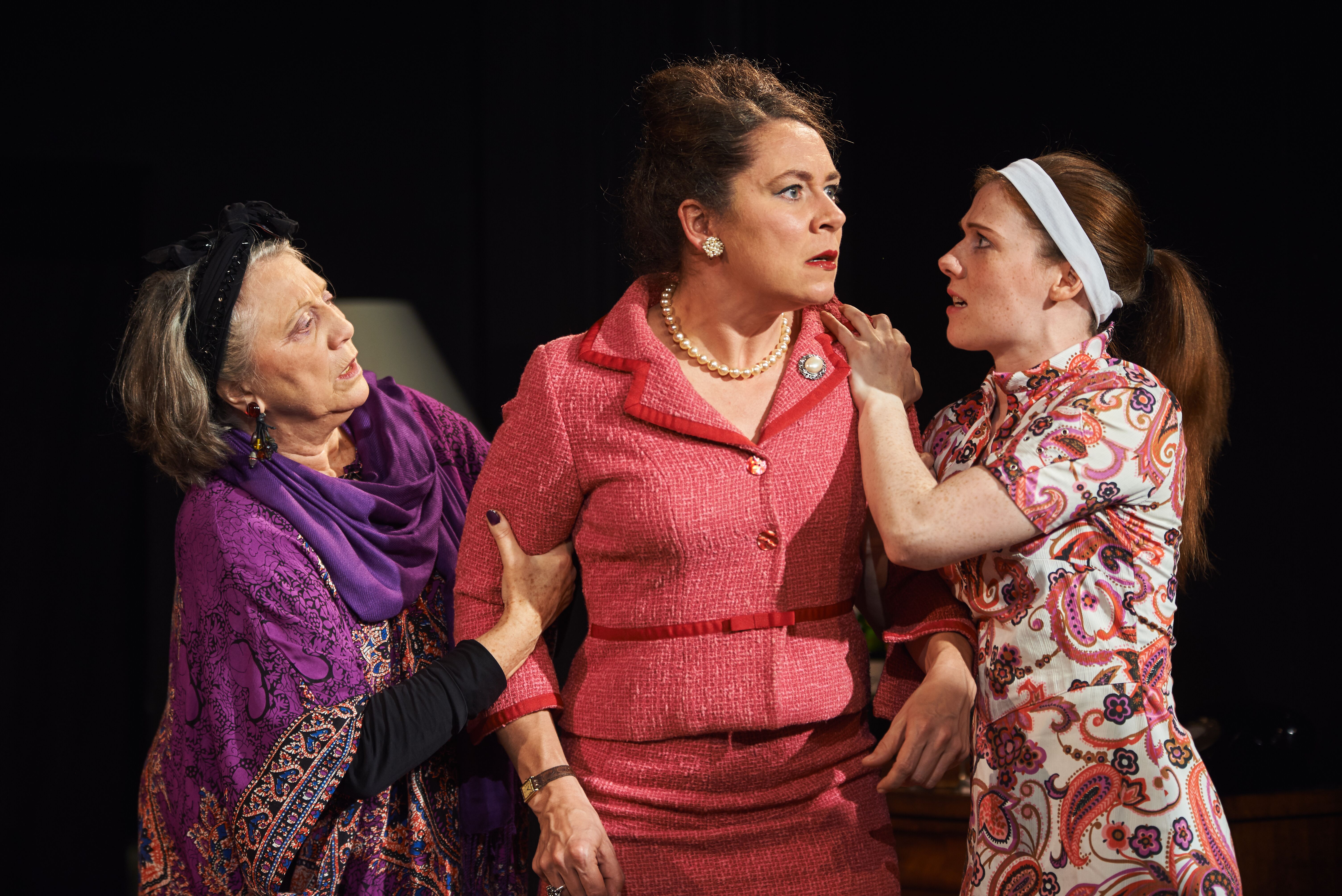
The Notebook, with a stark simplicity that forces the audience to sit and listen for two unrelenting hours, slowly unpacks the horrors of war that drives people to flee from a first person perspective. It makes us take the focus off ourselves for once and genuinely listen to the stories of those in need. Told by nameless twin boys moved to their grandmother’s home in the Hungarian countryside, they come of age during World War II, the subsequent Russian occupation and descent of the Iron Curtain. Adapted from Agota Kristóf’s novel of the same name, Forced Entertainment strips the story down to a text that’s read from thick notebooks by two identically dressed actors (Robin Arthur and Richard Lowdon) who represent the boys. This is storytelling in its most raw, boiled down form, with language being almost the sole vehicle of communication.

The set is two wooden chairs and the lighting rarely changes. There isn’t much to look at, which makes this show a tough one for those used to constant visual stimulation in both real and theatrical worlds. There were times I internally railed against the form, like a kid with ADD in a lesson that lasts more than three seconds. One woman walked out part way through. Others fidgeted and checked their watches. We just aren’t used to sitting down and just listening for a couple of hours anymore. The story is unquestionably riveting, though. Through use of precisely timed delivery, often in unison, childhood innocence breaks down and is eventually destroyed, despite their mother’s attempts to protect it. Their grandmother’s house is hardly a haven, and they must resort to deplorable behaviour to eek out a sub-par existence even though the bombs are a distant threat. It’s understandable though, considering the abuse they endure from their grandmother, the general public and those in positions of trust. The people in this story are rarely kind; even though it’s unsaid it’s given that it’s not their fault. The human spirit can endure only so much.

The language doesn’t hold anything back. It is often explicitly graphic with appalling acts emphasised by unemotional delivery. The audience inevitably uses their imagination to make up for the lack of visuals; these images are far worse than anything that could be presented on stage. Though the performance could use shortening, it’s soaked with detail and condenses years into hours. Shaving off half an hour would still maintain impact, but it’s not Forced Entertainment’s job to make us comfortable. Director Tim Etchells wants us to think, empathise and listen, really listen, even if the process isn’t easy. The Notebook is a hard production to watch, but the message of acceptance and universal humanity is a vital one.


The Play’s The Thing UK is an independent theatre criticism website maintained voluntarily. Whilst donations are never expected, they are hugely appreciated and will enable more time to be spent reviewing theatre productions of all sizes. Click here to make a donation with PayPal.

The Killing of Sister George, London Theatre Workshop

JHDTHmHNUC5s8ahQ6vv0FnjNF0ywJmSNOl7h0gT9Ch8,hFmORSc8H8GW1FxpEpv8GOdBhVvJqoliuWLo_jZszeU,PCCZDB9Yh7LIfBnwbk-dicJH55Con_eOwl7icS3jyXYIf a play includes the BBC, lesbians and emotional instability within the arts, it would be fair to assume it’s a contemporary text. The Killing of Sister George, written in 1964 by Frank Marcus, is refreshingly ahead of its time and despite its age, doesn’t feel particularly dated. In an excellent production by Artful Theatre, this all-female four hander kills off a beloved radio drama character to look at the difference between public perception and actual reality.

The cast of characters is a vibrantly coloured one. June Buckridge (Sioned Jones) has played Sister George on the popular radio drama “Applehurst” for over six years. Over that time, she’s lived with her “flatmate,” Alice “Childie” McNaught (Bryony Rawle) who she emotionally manipulates and abuses. Sister George is lovely and virtuous, June is anything but. Jones captures the blur between actor and long-embodied character exquisitely, embodying June’s aggression that covers her fragility. Sarah Shelton is Mrs. Mercy Croft, the BBC’s assistant executive head who is tasked with breaking bad news to June. Initially cold and businesslike, she warms to Rawle’s vulnerable Childie. Rounding off the cast is Janet Amsden as the eccentric clairvoyant Madame Xenia who lives upstairs, a woman who adds some much needed levity and stability. Marcus would have done well to include more of Madame Xenia, as even though there is plenty of comedy written into the script, the story is a dark one indeed. The four women fill the intimate venue with energy so it’s fit to burst.

Despite mentions of telegrams and conspicuously absent mobile phones and computers now vital to working professionals, the play feels modern due to themes that are still relevant. June and Sister George could not be more different, and the public adore Sister George; June doesn’t cope well under the immense pressure of living up to the ideals belonging to someone imaginary. June’s work-life balance is disturbed when Mrs Croft visits her home for meetings, a feeling actors know all to well what with the amount of admin and line learning that happen at home. There is also the implication that these women have no one else in the world that’s a friend or family. Of course there are work colleagues, clients, and fellow cast members, but there’s a desperation and heavy loneliness that hangs over these four.

I hadn’t been to London Theatre Workshop before, or seen a production of the quintessentially English The Killing of Sister George, and was impressed by both. A well-looked after gastro pub theatre space and a new-to-me play that could easily come across as stuffy and old fashioned is instead filled with life.


The Play’s The Thing UK is an independent theatre criticism website maintained voluntarily. Whilst donations are never expected, they are hugely appreciated and will enable more time to be spent reviewing theatre productions of all sizes. Click here to make a donation with PayPal.