Feature | Addiction and the Audience in People, Places & Things

https://i0.wp.com/thestagereview.net/wp-content/uploads/2017/10/Denise-Hough-and-company-in-People-Places-Things.-Photo-by-Johan-Persson..png?fit=1234%2C819&ssl=1

by guest critic Steven Strauss

Heaps of deserved praise has been showered on Jeremy Herrin’s production of Duncan Macmillan’s People, Places & Things, with much directed at Denise Gough’s thrillingly committed performance of a struggling actor in rehab. Yet after seeing it at Wyndham’s Theatre in mid-2016 then its New York City run this year, it’s easy to see there’s more to it than Gough. A second, transatlantic viewing proves just how thoroughly the production theatricalises addicts’ experiences in order to generate audience empathy with the struggle to overcome addiction.

Continue reading

The Red Lion, Trafalgar Studios

https://newimages.bwwstatic.com/upload11/1735034/tn-500_theredlion,trafalgarstudios-deanboneandstephentompkinson(courtesyofmarkdouet).jpg

I have no interest in football, or any other sports for that matter. It’s not for lack of trying, what with growing up in a middle America that reveres sporting ability above all else. So I approach plays about football with caution, wary that my prejudices could sway my judgement. Fortunately, the tempestuous story of two ideologically opposed, minor league football men and the young player caught between them has little to do with the actual game and has a compelling, emotional narrative.

Continue reading

Submission and Sarah, Sky and Seven Other Guys, Edinburgh Festival Fringe

https://files.list.co.uk/images/2017/08/14/submission-liver-and-lung-productions-1-1-LST259072-(1).jpg

A British Pakistani Muslim tries to reconcile his faith and family with his love of men and clubbing.

A gay guy and his straight female bff share a flat, a mutual adoration for classic films and the occasional man.

Liver & Lung Productions’ two new plays, whilst needing further development, look at two issues that queer men of colour face. Submission is the stronger of the two works, though Sarah, Sky and Seven Other Guys includes a mix of serious and light-hearted material.

Continue reading

Custody, Ovalhouse

https://cdn.thestage.co.uk/wp-content/uploads/2017/03/30165602/Custody-7-Kike-Brimah-Urbain-Hayo-Sacharissa-Claxton-Photo-Lidia-Crisafulli1-700x455.jpg

By guest critic Alistair Wilkinson

HOPE: A feeling of expectation and desire for something to happen.

How do we cope when we don’t get what we want? How do we beat a system that is set up to make you fail? Custody asks just these questions, as we are taken on a two-year journey of a family’s struggle for justice for their loved one, twenty-nine year old Brian, who died whilst in police custody. Through this eighty-minute narrative, we see four different individuals cope/hope, whilst their questions are left unanswered.

Continue reading

The Monkey, Theatre 503

The Monkey - Theatre 503, George Whitehead and Morgan Watkins, photos by Simon Annand 2

Tel and Dal are two Sarf London geezas who grew up together on a Bermondsey estate. Dapper and ambitious Tel has moved up in the criminal underworld, away from Dal’s small-scale thieving so they don’t see each other much. Dal’s less aspirational, still robbing people on the street with his mate Becks. When they’re not out working, Dal and Becks get their drugs from young dealer Al, who lives upstairs. Life’s ticking along as normal until Tel shows up unannounced looking for the money he leant to Al a month ago. Tel’s volatile temperament, sharp intelligence and vanity mean the other three are no match for the increasing danger.

Continue reading

Living A Little, VAULT Festival

https://i0.wp.com/www.ayoungertheatre.com/wp-content/uploads/2017/02/Living-a-Little-600x350.jpg

Rob and Paul are best mates, albeit total polar opposites. They share a cozy bachelor pad where they engage in typical mid-20s, male behaviour – drinking, weight lifting, discussing women in graphic detail and fighting off zombies. Well into the zombie apocalypse, the lads lucked out – solar panels and generators keep them in heat and electricity, and they secured their block of flats so the undead can’t get in. But when a masked intruder turns up, their groove is properly disrupted. Dark comedy Living A Little is a post-apocalyptic genre mashup that’s polished and unexpectedly poignant.

Continue reading

The Wild Party, The Other Palace

https://i0.wp.com/7210-presscdn-0-59.pagely.netdna-cdn.com/wp-content/uploads/2017/02/Frances-Ruffelle-as-Queenie-and-the-cast-of-The-Wild-Party.-Photo-Credit-Scott-Rylander.jpg

Newly rebranded as The Other Palace and now part of Andrew Lloyd Webber’s empire, the former St Jame’s Theatre aims to focus on new British musical theatre. With Paul Taylor-Mills at the creative helm and two spaces in which to develop and showcase new work from the UK, their debut production is…(drumroll)…an American musical from 2000. An odd choice considering the Broadway production nearly two decades ago left critics unimpressed.

Continue reading

Mule, Edinburgh Festival Fringe

https://www.thestage.co.uk/wp-content/uploads/2016/08/IMG_5602-700x455.jpg

Orla and her sister are close. Even when Orla decided to move from their small Irish town to Ibiza for a summer of working and partying, they still texted everyday. After a sudden cessation in her messages and silence that stretches to ten days, her family starts to worry. A social media campaign turns up a few dead ends and the police are about to launch a full investigation when there’s a phone call.

It’s Orla. She’s in jail with another young woman called Shannon. In Lima.

Based on the real-life Peru Two, Mule fictionalises the pair of young women arrested for drug trafficking in 2013. Using two actors to play all the roles, Mule centres on Orla’s story. A sweet, young woman with little life experience who trusts too easily and struggles to say no, she gets swept up into the Ibiza culture and when she loses her job, she makes some terrible choices. This pacy script by Kat Woods gives a fairly well-rounded picture of the women’s circumstances, but the execution is so rushed that the story is hard to follow.

Scenes are short and snappy, lending an urgency and tension to the story. There are some unexplained gaps in the plot, though – like how they got this job to begin with. Orla and Shannon plan their coverup story early on, but the objective truth is never discussed. Constant character changes give a wide perspective on the story, but the use of voice and physicality as sole signifier of character at the speed and length they maintain isn’t always enough. By the time it becomes clear which character is talking, they have already moved onto another.

Mule is more of a narrative character study than a deeper exploration a chain of events where objective truth is clearly defined. Though the story has a lot packed in – including prison conditions, exploitation, drug use and gender disparity – none of them are fully explored. It has the feel of a documentary, but the character of Orla is the only consistent thread.

It’s a story that has plenty of potential for exploration, but Mule doesn’t go far enough or takes a strong angle, nor does it give enough detail to deem it documentary theatre. The actors’ performances are good and there are some excellent scenes, but Mule feels like it still a work in progress.

Mule runs through 29th August.

The Play’s the Thing UK is committed to covering fringe and progressive theatre in London and beyond. It is run entirely voluntarily and needs regular support to ensure its survival. For more information and to help The Play’s the Thing UK provide coverage of the theatre that needs reviews the most, visit its patreon.

Give Me Your Love, Battersea Arts Centre

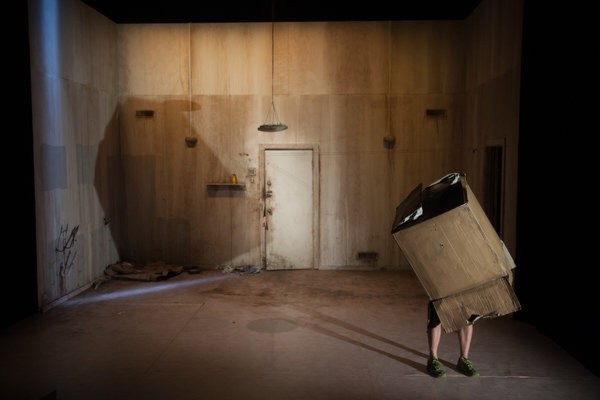
I’ve grown up always having pet cats and it’s absolutely true that cats love being in cardboard boxes. I stumbled on a Buzzfeed or similar article recently that says cats seek out boxes or other encloses spaces when they’re stressed or in need of comfort. Humans have similar instincts, really. Think about the last time you were upset or stressed: did you want to hide under a duvet, make a pillow fort or crawl into a small, dark space? Or at least curl up into as small of a ball as you could? Observations and life experience indicate we’re pretty similar to our felines in that way. So it would make sense that someone suffering from grief or trauma might hide in a box and never come out.

Zach (David Woods) does just that with feline stubbornness and rejection of direct human contact. An Iraq veteran suffering from Post-Traumatic Stress Disorder (PTSD) living with an unsympathetic wife (convincingly voiced offstage by Jon Haynes), we never see Zach’s face, or anyone else’s, in Give Me Your Love. This quiet, tiny show looks empty but brims with feeling in a sophisticated script, discusses cutting edge medical research without boring the audience and shares the horrors of PTSD that many of our vets are left to contend with, unsupported. A talking cardboard box and a patient drug dealer behind a chained door captivate for about an hour with flawless, sensitive performances and detailed dialogue that delicately balances humour and pathos.

Though it’s easy to focus on Woods as the central character, Haynes wonderfully supports and opposes him as wife Carol and friend/drug dealer Ieuan. Carol opposes Zach’s desire to explore MDMA’s potential to cure his PTSD, Ieuan, not unfamiliar with trauma himself, encourages Zach whilst displaying genuine, moving care for him. There’s a brotherly intimacy here that’s lovely to watch, and is perfectly captured by the pair of actors.

Jacob Williams’ set is super-realistic: there are no metaphors here, just the sparse filth that Zach lives in. The detail is in the tiniest things: the way masking tape curls at the edges, the holes in the box for Zach’s arms, the stains on the walls. The lack of people on stage calls for other means of  visual stimulation, and Williams’ work exceeds this tall order very well. Give Me Your Love is never boring, visually or otherwise.  Sound and light by March Cher-Gibard and Richard Vabre match the set’s naturalism, then toy with the audience’s perception of reality through abstract and expressionistic approaches. It’s a jarring transition, but manages to compliment Zach’s turmoil and experimental recovery instead of feeling stuck on and questions what is objective reality and what is in Zach’s head. 

The inclusion of using Ecstasy in PTSD therapy is fascinating research that doesn’t go too much in depth, but can feel extraneous to Zach’s struggle. It’s not about the recovery, but the day-to-day existence and paralysis that can result from action solders experience on the front line. The dialogue still flows, but the research informs the play rather than being the centre of it. This certainly isn’t a bad thing at all because the script could easily end up a lecture; the focus is very much on Zach’s mental and emotional health. The clever use of humour prevents it from becoming a drag, and exquisitely balances the brutality and debilitation of mental health conditions. This is a vital theatrical contribution to the mental health dialogue and de-stigmatisation, and one executed with delicate, detailed skill and a moving emotional journey. A fantastic watch.

The Play’s the Thing UK is committed to covering fringe and progressive theatre in London and beyond. It is run entirely voluntarily and needs regular support to ensure its survival. For more information and to help The Play’s the Thing UK provide coverage of the theatre that needs reviews the most, visit its patreon.