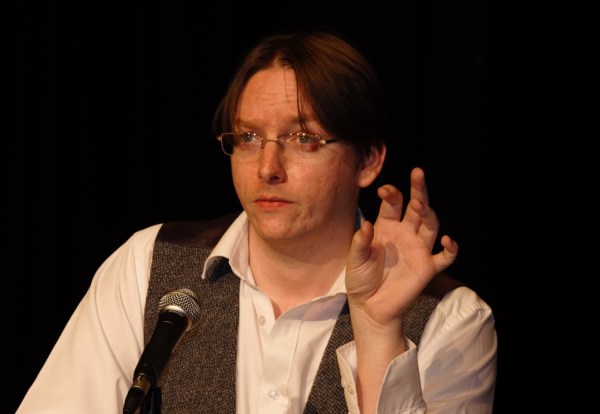
Confessional, Southwark Playhouse

How does it feel to have never had something beautiful in your life?

In this reimagining of the Tennessee Williams’ one-act that later becomes the more fully-formed Small Craft Warnings, the flotsam and jetsam of a remote Californian coastal town are relocated to the Thames estuary. The ‘immersive’ staging spreads the actors amongst sections of the audience in Monk’s Bar, making the characters’ volatility all the more threatening to those in the midst of their fighting and fucking. But not a lot happens in this extended character study at a forgotten edge of the world. Tense, emotive performances and pretty language help hide the existential-ish script, but Williams’ lonely poetry leaves a lingering emptiness. 

Lizzie Stanton as the attention seeking, volatile Leona leads the cast of disparate and desperate characters. Stanton has a ferocious, watchable energy that dictates a sensitive and varied pace. It’s a shame Williams doesn’t grant her a role with more depth than poetic monologuing on her transient existence searching for the world’s elusive beauty. She is ably foiled by her lazy, townie live-in lover (Gavin Brocker) and weepy, nymphomaniac Violet (Simone Somers-Yeates). 

Though the characters translate rather well despite the decades and distance that separate them from the original, the vocabulary sits uncomfortably in their mouths. There are numerous giveaways that the text is American, and a dated one at that. It’s great that the concept grants this contemporary Essex seaside town the words to honestly and thoroughly express themselves, but the choice is unrealistic and initially confusing to the ear.

Director Jack Silver essentially stages in the round, with the audience tightly packed in. This disappointingly limits the actors’ use of space to designated paths – a shame what with their vivacity and heightened emotion. Justin Williams’ set is every inch the working men’s club or grotty housing estate pub to the point I instinctively check I’m not going to sit in any suspicious crumbs or liquids.

Williams’ characters are, without question, wonderful creations. But this one-act doesn’t live up to his masterpieces that balance characterisation with story. Watching someone drift through their life without purpose is only interesting for so long; watching half a dozen people carry on as such for over an hour pushes the limits of human sympathy.

Confessional runs through 29 October.

The Play’s the Thing UK is committed to covering fringe and progressive theatre in London and beyond. It is run entirely voluntarily and needs regular support to ensure its survival. For more information and to help The Play’s the Thing UK provide coverage of the theatre that needs reviews the most, visit its patreon.

Possibilities, Theatre N16

https://www.tcmworld.org/wp-content/uploads/2015/12/fork-in-the-road-1.jpg

What if your life has endless parallel possibilities? What if Sliding Doors is true? What if every choice you make leads to your timeline fracturing into endless paths that just keeps multiplying? Possibilities frames this proposal with two people, displaying nearly an hour’s worth of incarnations of their relationship. It’s a nice idea, but one that doesn’t develop any of the individual moments or stories presented. With inconsistent performances and an idea that isn’t fully explored, Possibilities feels like just that – but without the script’s potential coming to fruition.

Jamal Chong and Kate Gwynn take to some scenes better than others. Their intimacy is awkward in some scenes, but their flirtation and sense of play in others is sweetly genuine. The inconsistency is frustrating, as the potential for great performances is there. Chong is also the writer and director – the choice to wear this trio of hats is undoubtedly the root of the issues with this play and production.

The design is minimalistic and functional, with monochromatic chairs and a bench being arranged differently for each scene. Switching on clip-on coloured lights one by one as an introduction is a nice visual touch, but one that doesn’t link to the script in any discernible way.

Other than an interesting question posing as a concept, Possibilities falls short of taking a stance on the impact such a world would have on the individuals that it places under a microscope. The rejection of a narrative arc in favour of a collection of scenes only related through their characters actively prohibits development of this piece, and there is a pronounced absence of dramaturgy. With a bigger creative team and any sort of answer to the concept question, Possibilities would be become a more well-formed reality.

Possibilities runs through 26 October.

The Play’s the Thing UK is committed to covering fringe and progressive theatre in London and beyond. It is run entirely voluntarily and needs regular support to ensure its survival. For more information and to help The Play’s the Thing UK provide coverage of the theatre that needs reviews the most, visit its patreon.

Interview: Mark Brailsford on Staging Shakespeare’s Stories

https://i0.wp.com/www.brightonandhovenews.org/wp-content/uploads/2016/04/DSC01425.jpeg

When Brighton Shakespeare Company’s press release for their Macbeth tour of historical churches in Brighton and Sussex landed in my inbox, I was sorry I couldn’t make it. Shakespeare productions in churches and cathedrals wonderfully hark back to the grandeur of private performances for noblemen and royalty in the 16th century. Shakespeare’s epic stories sit well in the sweeping architecture of these ancient buildings, and on a practical level it’s a great way for companies to save money on sets and reach audiences in rural locations.

Used to the plethora of venues that showcase small-scale, fringe and progressive approaches to Shakespeare in London, I was curious about BSC’s unusually traditional approach. I spoke to artistic director and founder of this new regional company, Mark Brailsford, about the company’s work.

Tell me a bit about Brighton Shakespeare Company and its mission.

The BSC’s ethos takes a character-led approach inspired by Ron Moody and Stephen Berkoff. The company’s aims are to bring individual, characterful actors to the classics in the style of the time the plays were written.

How do you approach Shakespeare? What concepts to you employ?

We are apparently called radical because we set our productions in the period, something not many companies seem to do these days and we’re happy with this label. Many companies, but not all, like to have directors impose their directorial vision onto the plays whereas my approach is to be true to the story and genius of the Bard himself. [I aim] to bring them to life by allowing the story to stand on its own terms. After all, it seems to have worked for 400 years.

Why stage Shakespeare for audiences today?

[The] story. The themes and narratives are as relevant today as they have ever been. Love and loss, pain and laughter, war and peace and the slings and arrows of outrageous fortune. These exist in day-to-day lives all over the world.

What are some of the obstacles you and the company face?

Lack of money! We’re unfunded and back our shows via crowdfunding and box office.

Shakespeare is known for not supporting diversity. What steps are you taking to redress the balance?

This is a myth as there was more diversity in Shakespeare than commonly thought, especially for his time. His women are very strong characters, Othello was black and one of the best take-downs of antisemitism was Shylock’s speech in Merchant of Venice. He also gave prominent parts to working class characters, not a theme of Elizabethan life at the time.*

What do you hope audiences take away from your productions?

Joy, a tingling spine and a thrilling comprehension of the play.

*These views are not representative of those held by The Play’s the Thing UK or its writers.

The Play’s the Thing UK is committed to covering fringe and progressive theatre in London and beyond. It is run entirely voluntarily and needs regular support to ensure its survival. For more information and to help The Play’s the Thing UK provide coverage of the theatre that needs reviews the most, visit its patreon.

Howl, Rosemary Branch Theatre

https://i0.wp.com/egyptiantheatre.org/wp-content/uploads/2012/08/DSC96451.jpg

With Halloween becoming more and more popular this side of the pond, horror theatre and live events are proliferating. The London Horror Festival is bigger than ever, new scare attractions appear all over the country every year and independent events like Frissonic’s Howl expand the otherworldly and terrifying offers for thrill seekers this time of year. A site specific, immersive performance for an audience of six, Howl is a considered, effective performance that induces plenty of jumps. Though the story of a disappeared sister and mysterious voices is patchy, it is well delivered, and combines audience manipulation with technology to create a delightfully creepy event.

The choice of a small audience generates fear from the beginning – there is less protection with fewer people, particularly when paranormal investigator Rory places us on isolated chairs around a large, long-abandoned storage room. We are there to help Rory look into a something he heard when he was recently alone in the theatre, and we use sound to try evoke it again. Wireless headphones, increasing pace and anxiety, and customised audio content create heavy tension and uncertainly ripe for scares.

The ending in a different room is too rushed and betrayed by the lack of a full blackout. Though there is a clear resolution, the reasoning leading up to that point is never fully explained. How does this voice connect to Rory’s sister who disappeared all those years ago? How did we find him and decide we want to help? Rory is very much a character of the present, but frustratingly little of his past is revealed.

Frissonic nail the scares in Howl with their tech and small-audience approach, but adding flesh to the skeletal story will hugely improve it. Currently running at 40 minutes, another 15 or 20 minutes of text will make this feel more theatrical and less reliant on the scares.

Howl runs through 31 October.

The Play’s the Thing UK is committed to covering fringe and progressive theatre in London and beyond. It is run entirely voluntarily and needs regular support to ensure its survival. For more information and to help The Play’s the Thing UK provide coverage of the theatre that needs reviews the most, visit its patreon.

Songs For the End of the World, Battersea Arts Centre


https://i0.wp.com/www.domcoyote.com/wp-content/uploads/2015/12/millygraphic-2-e1469019899426.jpg

Jim Walters is the first person sent to colonise Mars. But when a global apocalypse occurs, trapping him in the Earth’s orbit and running out of oxygen, he and his guitar are left to broadcast music to the devastation below. Can anyone hear him? Are there any survivors? Will he ever know? Dom Coyote and his band the Bloodmoneys present a post-Brexit apocalypse in the gig-theatre Songs For the End of the World, a piece overly heavy on the ‘gig’ and reliant on a plot constructed of dystopian tropes. Though the story is thin, Dom Coyote’s songs are fantastically varied and plentiful, helping to gloss over any shortcomings in the script.

There’s rockabilly, 90s rock anthems, glam rock, and blues numbers with a touch of connecting story sprinkled in between. Set in Ashley Coombe, the village serves as a window into the attitudes of small, English towns of this dictatorial era – the elderly preacher woman who runs the place condemns foreigners, terrorists and space exploration whilst the rebels put on club nights in an underground bunker. The country is now called New Albion and rather than run by an individual, a corporation dictates all rules and procedures. These plot devices are predictable within a story of a dystopian future, but are simplistic enough to work within the gig-theatre format without needing much explanation. As these two tribes clash, Jim Walters is in space – a symbol of both human progress and arrogant dominion. It’s no surprise which side survives down on Earth, and that the future beyond the end of the show looks particularly bleak.

Though the story is overly familiar, the music is wonderfully varied. David Bowie’s promised influence is clear, but not limiting in style. All of the characters in this Little England kitsch/cold international corporation hybrid are suitably blown out of proportion, but feel eerily familiar in a fundamentalist-driven, isolationist Britain and a world where Donald Trump may become the next leader of its most powerful country. Staging is fairly static as per the usual gig-theatre approach, but there is some variation in movement and costume. The lighting design adds power and hope to the bleak, clinical setting.

A more substantial script and dynamic staging would lend more theatricality to the excellent set of tunes in of Songs For the End of the World; as is, it is overly driven by music and the narrative potential is neglected. That said, it would make a fantastic concept album, and the design is strong – an extra half hour of script would add polish to this fun, vibrant performance piece.

Songs For the End of the World is now closed.

The Play’s the Thing UK is committed to covering fringe and progressive theatre in London and beyond. It is run entirely voluntarily and needs regular support to ensure its survival. For more information and to help The Play’s the Thing UK provide coverage of the theatre that needs reviews the most, visit its patreon.

The Right Ballerina, Hen & Chickens Theatre

Theatre is well and truly a product of the left, with mainstream and commercial work often comfortably centrist at the most. It’s rare to come across right wing work, particularly something as extreme as Billy Cowan’s The Right Ballerina. His depiction of the ruination of a naive prima ballerina (discovered to be a member of a far right political party by an international human rights charity) brutally demonises the so-called ‘PC Brigade’ and champions the individual’s right to quietly choose their affiliations and get on with their life as long as they aren’t causing anyone direct harm. 

Watching the play is a deeply uncomfortable experience, particularly when the charity’s spokesman behaves so despicably towards a young woman who just wants to dance and start a family. Though there is a copious amount of this discomfort that comes from an emotional response clashing with one’s belief systems, The Right Ballerina voices a perspective rarely seen on stage and has the potential for fostering reflection on the easy dismissal of right wing points of view and the feelings of the people that hold them.

Cowan’s script is well-formed and detailed, giving plenty of time for dancer Penny’s fall from a great height to feel believable and tragic. There’s an element of stereotyping in camp company director Trevor and suited, multinational representative Mr X. But Penny and the company’s artistic director Jack are intricate, humanly flawed and alive. Dialogue-heavy and a touch too long, it could do with a bit of trimming but too much would force the narrative. The only letdown is the highly unlikely ending, but the rest of the script is generally sound.

Filip Krenus as Mr X, representative of an organisation protesting the ballet company’s performances due to Penny’s party membership, is of panto villain proportions and easy to hate in the face of his cold, relentless bullying. Gregory A Smith’s Trevor is more than a bit of a young Nathan Lane, though he deserves more stage time and development. Adam Grayson and Genevieve Berkeley-Steele as Jack and Penny have excellent emotional range and chemistry. Berkeley-Steele’s fighting strength in the face of her victimisation generates plenty of empathy, even though she’s anti-immigration/racist. 

Boaz Torfstein’s design is Jack’s office, crafted with lots of little details down to the pointe shoes on a bookcase and stunning costume displays from past productions. Matthew Gould’s direction is suitably subtle and works well in the slightly irregularly-shaped venue, though his fight choreography is clumsy.

In spite of a few issues with the script and production, the perspective unapologetically presented here certainly deserves stage time even though it flies in the face of left wing sentiment that fuels our theatre. Though The Right Ballerina is angering and provocative, its story is certainly a thought-provoking one.

The Right Ballerina runs through 22 October.

The Play’s the Thing UK is committed to covering fringe and progressive theatre in London and beyond. It is run entirely voluntarily and needs regular support to ensure its survival. For more information and to help The Play’s the Thing UK provide coverage of the theatre that needs reviews the most, visit its patreon.

Kissing the Shotgun Goodnight, Ovalhouse

rsz_kissing_the_shotgun_goodnight_credit_the_other_richard

Along with tickets, we are handed earplugs. Considering Christopher Brett Bailey’s first work This Is How We Die, I’m not surprised. A brilliant, relentless barrage of contemporary American myth followed by an encore of noise and light, Bailey isn’t known for doing things by halves, or even singular wholes. The slight, constantly startled-looking Canadian with gravity defying hair attacks performance making with the energy of a supernova. Kissing the Shotgun Goodnight has the same verve, but is otherwise a rather different beast. Whilst This Is How We Die was dominated by language, Kissing the Shotgun Goodnight has very few words – but the earplugs are definitely needed. This anthemic music and light show fills the room with sound, colour and vibration but is the difficult second album to This Is How We Die. Much more of a gig than a piece of theatre, it lacks the satisfaction of characters and narrative, even a hint of one. Bailey’s mind blowing poetry teases with a few tiny fragments, but otherwise leaves us desperately gagging for more of his words.

Though given earplugs, there is the choice of whether or not to use them. Notices state that the sound level is consistently over 100 decibels and that, “if you wear plugs the whole time you might compromise enjoyment of the show. and if you don’t wear them at all you will take home whistling ear canals”. Being one of those people sensitive to loud noises who constantly asks my other half to turn down the telly, I want to play it safe but I don’t want to miss out. So I opt for one plug in, with the other ready. This choice no doubt effects the experience – if I leave them out the whole time and feel discomfort, would I like the show less? Or would I like it more because it’s not actually ‘that’ loud? I use the plugs in response to the volume level – sometimes I have both in, sometimes none. It’s an interesting premise to consider that the experience and quality of the show hinges on these earplugs, adding an additional level of individual, subjective response.

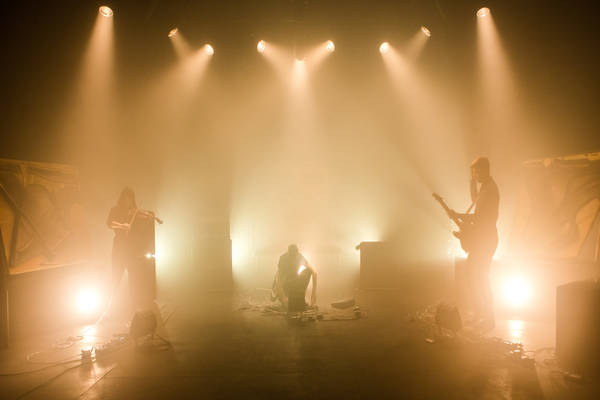
Bailey’s voice, slow and unseen, repeats, “this is a hell dream” in a brief textual introduction. Violinist Alicia Jane Turner uses loop pedals to sculpt a cinematic score reminiscent of mid-90s rock anthems. Her work is wonderfully angry, sweeping and alive. George Percy and Bailey are both on guitar, forming a silhouetted triptych with Bailey soon in the middle – amongst the monolithic speakers and flight cases forming a brutalist, urban landscape, he cuts the figure of a scrappy dystopian overlord. It suits him. If this is what hell is like, it’s fucking glorious.

Behind each performer is a wooden panel of about a metre square made of deconstructed pianos and their strings. These are visually impressive structures in and of themselves; their music evokes the violence and community of tribalism. Combined with excellent sound-responsive lighting (that malfunctioned to the point that the show needing to be stopped briefly), the overall effect is one of epic, soul shaking community.

The title paired with the music evokes the American paradox of a friendly but violent people who love their guns as much as their families. The music’s scale captures the expanse and variation of the North American landscape, and the few words he shares on the experience of waking up from a nightmare to find the world unchanged darkly foreshadow Trump’s America. Whether or not this is an intentional message, it is certainly a powerful one.

Kissing the Shotgun Goodnight is certainly wide open to interpretation and shows Bailey’s ambition and range as a performer of work designed to push the senses to their extremes. His textual dexterity is certainly missed (particularly by the coked up, flailing pair of young women sat next to me commenting on how disappointing this work is compared to his first) and comparatively this piece is somewhat disappointing, but it absolutely has its merits as a visceral, “fuck you/I love you” performance piece.

Kissing the Shotgun Goodnight tours nationally through November.

The Play’s the Thing UK is committed to covering fringe and progressive theatre in London and beyond. It is run entirely voluntarily and needs regular support to ensure its survival. For more information and to help The Play’s the Thing UK provide coverage of the theatre that needs reviews the most, visit its patreon.
Acorn, Courtyard Theatre

acorn-c-hannah-ellis-1

Persephone and Eurydice’s myths are defined by men. What happens when these men are removed and the characters plunged into a modern dreamscape? Maud Dromgoole’s Acorn brings these women and their fates together in a world of fragmented narratives and moments of biting wit, but the worlds that Dromgoole weaves together are so disconnected from each other in this cerebral play that it interferes with its immediacy.

Rather than nurturing plants, this Persephone looks after people – she is a doctor, but one that struggles to connect with her patients. Her opening monologue justifying her disdain for patients’ personal lives is equally hilarious and disturbing, the best scene in the play. Deli Segal brings a simple humanity to this cold character, making her quirky and likeable despite an autistic-like inability to understand others. Lucy Pickles’ Eurydice is a sweet contrast, alternating between a blushing bride and mental health hospital patient. Pickles is no less of a performer, but Persephone has the more dynamic and well-written character.

Dromgoole employs a range of styles, arguably too many for an hour long script. Though this strengthens the ability to relate to the story within individual scenes, the overall effect is one of indecision. An unrelated, recorded dialogue between two men fills transitions unnecessarily and doesn’t link to the women’s stories, then overlapping speech cause dialogue to be missed.

Phil Lindley’s design is simple and precise, allowing for detail and layers to emerge through Jai Morjaria’s lighting and Tom Pearson’s underused projections. The design concepts are most excellently married and add polish to a script that feels under-developed.

Acorn certainly deserves to extending and refining – the characters are excellent, as are the foundations of the stories seen here. Dromgoole uses language well and is clearly confident experimenting with form, style and classical influence, but reinvention with the goal of creating a modern myth doesn’t quite reach the enduring scale of the original material.

Acorn runs through 29 October.

The Play’s the Thing UK is committed to covering fringe and progressive theatre in London and beyond. It is run entirely voluntarily and needs regular support to ensure its survival. For more information and to help The Play’s the Thing UK provide coverage of the theatre that needs reviews the most, visit its patreon.
Can You Hear Me Running?, Pleasance Theatre

Louise is a successful actor and singer with numerous, impressive credits to her name, a gorgeous family, and a plenty of auditions. But when a cold turns out to be a sign of something worse, Louise is sent into an existential spin. Now looking back on this life changing encounter, Can You Hear Me Running? follows her journey through illness, diagnosis and recovery. This solo performance uses an episodic approach to document Louise’s journey, with a secondary thread of self-discovery by running. Gorgeous projections and a live piano score add layers to this intimate performance piece, but the two intertwining narratives are too loosely connected to have a truly moving impact.

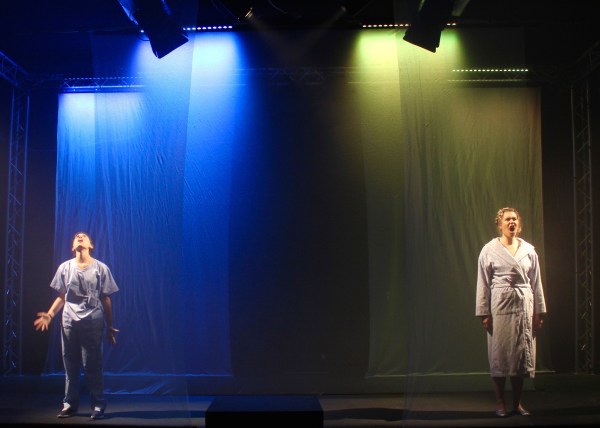
It’s devastating when your body rebels against you to the point that you can no longer do what you love or trained to do. When Louise has to stop singing and is warned that she may never sing professionally again, performer and co-creator Louise Breckon-Richards captures this emotional abyss with perfect agony. As co-creator it is presumed this is an autobiographical work, but that in no way diminishes the uncontainable passion and energy clambering over a mountainous landscape of white boxes.

Designer Adrian Gee and projection designer Eve Auster work in tandem to treat the senses with rich visual accompaniment. We see Louise’s childhood in rural Wales, the streets and parks she runs in and her vocal folds in all their alien glory across the entire width and depth of the stagehands . As Louise embodies the various medical practitioners she meets along the way, we see their credentials spelt out in clinical precision, a good contrast to a world so beautiful it compels Louise to sing.

Though it’s clear that Louise eventually finds solace in running, it is never explained how she got to that point. A throwaway line that she hadn’t run since she was at school makes her sudden choice to do so disconnected from any motivation to escape her health issues. Whilst she can’t sing or speak, why run? Why not knit, or write, or garden or cook? The disconnect is so pronounced that her running journey is almost a totally separate play from the story of her health, making both storylines a bit patchy.

Despite this, Breckon-Richards and Jo Harper’s script has the bones of a lovely story full of hardship and hope. With further development and unifying the plot threads, it will be a very powerful piece indeed.

Can You Hear Me Running? runs through 23 October.

The Play’s the Thing UK is committed to covering fringe and progressive theatre in London and beyond. It is run entirely voluntarily and needs regular support to ensure its survival. For more information and to help The Play’s the Thing UK provide coverage of the theatre that needs reviews the most, visit its patreon.

Undead Bard, Theatre N16

robert-crighton-in-metal-harvest

Professor Ashborn is on a mission to disprove Shakespeare’s existence, but the academics with leather patches on their elbows are trying to stop him. Following Ashborn’s lecture and an interval, Undead Bard creator Robert Crighton summons Shakespeare to talk to him about his life, work and death in an unrelated second half. This two-part show on Shakespeare in the modern world, bardolatry and the authorship debate certainly has some very funny moments of satire, but others are utterly bizarre and the poor execution of an idea. A significantly stronger first act sets up a reasonably enjoyable event, but the second is self-indulgent and anti-climactic in this overly long solo performance.

The paranoid Professor Ashborn’s lecture rips the piss out of Shakespeare academics, those that believe Shakespeare wrote Shakespeare’s works, those that believe someone else did under Shakespeare’s name and anyone with a love for Shakespeare’s plays. Crighton as Ashborn talks the audience through his various ridiculous authorship theories with energy and eccentric humour, evoking plenty of laughs. The script follows a natural rhythm of discovery, disappointment and eventual confession; it’s a story carefully crafted with intuition and skill.

Considering the second act, the first would be better served as a stand-alone piece. After what is quite a good piece of character storytelling, this random, rambling seance on the mundanity of Shakespeare’s life and afterlife is, well, mundane. The inclusion of toilet humour and sexual innuendo do not improve the piece. Shakespeare’s confusion at his legacy is cute, but it absolutely doesn’t warrant nearly an hour of discourse and disconnected pop culture references.

Crighton clearly has an aptitude for crafting a story, as evidenced in the first part of the show. Unfortunately, the rest of it is a muddled letdown that needs to be sent back to the drawing board or discarded completely.

Undead Bard runs through 13 October.

The Play’s the Thing UK is committed to covering fringe and progressive theatre in London and beyond. It is run entirely voluntarily and needs regular support to ensure its survival. For more information and to help The Play’s the Thing UK provide coverage of the theatre that needs reviews the most, visit its patreon.