Familie Flӧz, Peacock Theatre

https://i0.wp.com/www.festivalcomic.cat/2015/style/images/hotel_paradiso.jpg
by guest reviewer Rebecca Nice

German physical theatre company Teatro Delusio perform a silent comedy accompanied by an array of canonical scores from ballet to opera to a bit of pop. The international show that crosses language barriers through visual tableaus and expressive physicality of character is formed by a series of vignettes starring stock characters. Three performers play stage technicians and alternate to appear as stereotypical theatricals who they encounter backstage. There’s the one who always wants to sit and eat, the one who doesn’t want to be there and the one who’s always flexing his muscles can always be found in a technical team and this trio run the show, set entirely backstage, with haphazard efficiency and human agenda.

Continue reading

The Wild Party, Hope Theatre

rsz_wildparty_afphotography-529-1000x600

By guest reviewer Martin Pettitt

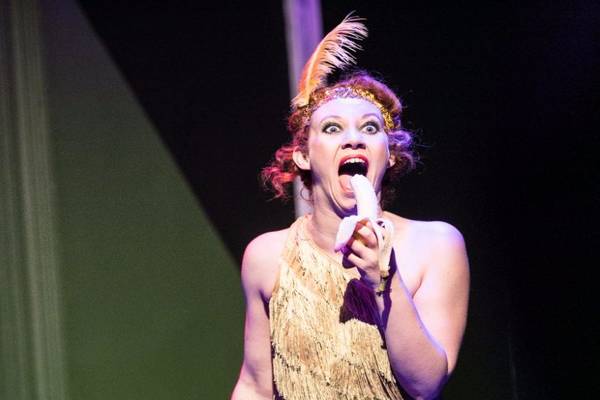
The Wild Party, a simple and to-the-point title, perfectly describes the show as well as the evening I experienced. There was so much to like about this performance. Adapted into a performance piece here by Mingled Yarn Theatre Company, The Wild Party was originally a book-length narrative poem by Joseph Moncure March in the roaring twenties. Initially deemed too racy to publish, it has since become a seminal work finding ever more relevance as we venture further into the 2000s.

Continue reading

Bianco, Southbank Centre

https://i0.wp.com/caramellattekiss.com/wp-content/uploads/2014/06/6T9T8237e1.jpg

By guest critic Rebecca Nice @rebeccajsnice

NoFit State Circus takes London by storm with a big show in a big top with grand ideas and huge audiences. A must-see on the London tourist and art scene, the slightly ominous looking grey tent is nestled into a winter wonderland of overpriced bars with a ticket price to match but the raucous, everyone-welcome, ‘roll up roll up’ nature of circus emanates from the tent in boundless quantities. Programmed by the Southbank Centre in a key Christmas location, Bianco will undoubtedly reach new audiences – which brings a certain responsibility to the oeuvre. The show not only introduces circus to new and well-seasoned theatregoers, but it sits within a concentration of productions in Southbank’s multiple venues that all want to be the cream of the crop. Based on a series of short acts that each display a specific circus skill, Bianco is accessibly fast paced but disappointingly repetitive in its lack of dramaturgy.

The main attraction of Bianco is a set made of scaffold ladders and truss that are separated, wheeled about and reset between acts. Audiences can move at their will, see things close up, from behind or directly underneath. The crew happily holler ‘mind ya backs’ as they restage and point you in new directions. This makes for constantly changing viewpoints; you always have the best seat in the house as you watch from wherever you want to be. Four towers form a central square area where truss cross bars support trapeze acts and tightrope walkers accompanied by live music. The greater sense of agency makes for a work that is almost promenade and immersive in terms of the sensory landscape. This culminates in a final snow scene where glowing white (foam) snowflakes descend upon our shoulders.

The original music ranges from folk to lyrical, acapella to rock and pop, as singer-musicians Andy Moore, Annette Loose, Doug Kemp and Matt Collins swap microphone for guitars, saxophone to accordion and double bass to drums. The strong musical score sets the tone and atmosphere for each piece and holds the work together during down moments where scenery is being set.

No Fit State travels and lives together, erecting and dismantling the big top and their lives to pack them away for the next place. This traditional circus lifestyle is evident in the precision, communication and identity of the cast and this connection feeds through into performance both in terms of the mechanics of the show and the performative camaraderie between characters.

Artistic Director Tom Rack and Director Firenza Guidi work here with a cast of seventeen, each with their own act, and it is the stringing of these together like a never-ending list of circus skills that is a downfall for the work. Bianco is long and relentless with one person after another selling their wares. Any loose plot or theme to mesh these phrases together are lost and the sheer volume of content begins to hinder the success of the piece as each new act blurs into another and recalling previous ones becomes impossible.

Out of a whopping number of acts (over eighteen), from solos to full ensembles, few stand out in either creating striking visual compositions or containing themes and characters that allow the circus skills to be fully shown off. The female juggling solo may not throw the highest club or make the most complex siteswaps but the throws and catches between the legs, behind the body and into the audience make a vivacious, flirty and clumsy character fully realised and incredibly funny, firmly rooted in her choreography and clowning. The sheer volume of this company in numbers of performers and size of the performance space provides tableaus not seen before. Five ropes in line, each with an individual aerial performer who turn and ascend in unison are a feast for the eyes. The entire cast emerging from the dark, lit by flaming torches or a man spinning inside his cyr wheel flanked by four figures dangling from aerial hoops make for striking compositions. A solo female performer hangs upside down from a rope with her legs bent and toes facing the ceiling. As the loose end of the rope drapes on top of her feet in a perfect curve, she lets herself slowly down as if magically walking upside down along this arc. Gems like this unexpected delicacy in a fresh take on an old trick appear sporadically in Bianco, but are in danger of being lost with the acts being so short and so many. Hula hoops are spun and aerial hoops rotate, performers swing from swags of loose hanging rope or shimmy along a tightrope. Jugglers swing on a trapeze, two aerial silks support solo and duet. A trampoline is rolled out, there is a handstand act and a contortionist with a wine glass balancing act. Box frames spin on high with strings of beads creating sparkling halos and another trapeze act appears, this time with a dress embellished with fluorescent lights. Many acts like these are cut short before they reach their true potential.

I delight in the seaside swim scene with up to nine performers diving from the heights of the big top onto a central trampoline. Dressed in old fashioned striped bathing suits with arm bands or goggles, this scene is visually wonderful but could be stronger if the choreography and swimming motifs were tighter and crisper. Compositions of performers diving one after the other can be more tightly woven into mini sketches. What if someone wearing a shark fin dived in, or someone belly-flopped and bounced everyone out of the sea? What if someone was scared of the water and got stuck on the high hanging rubber ring? Scenes like these don’t quite reach a climax in humour and pacing of skills.

After two hours and twenty minutes of high energy, constant tricks and emotive portraits of people laughing, shouting, twisting and turning on high, both audience and cast are exhausted and elated. A sinuous male aerial act returns to close the show on a rope as his curly locks and chiaroscuro muscles form a Christ-like visage. The lyrical piece is an unapologetic show of human beauty as the Vitruvian man soars in circular flight as artificial snow falls from the darkness. It is this image that leaves an imprint in my mind, of hundreds of tiny people looking up to the dark depths of the tent top, dancing in the snow.

Bianco runs through 22 January.

Tickets arranged by Theatre Bloggers.

The Play’s the Thing UK is committed to covering fringe and progressive theatre in London and beyond. It is run entirely voluntarily and needs regular support to ensure its survival. For more information and to help The Play’s the Thing UK provide coverage of the theatre that needs reviews the most, visit its patreon.

The Beggar’s Opera, Brockley Jack

tbo-006

By guest critic Michaela Clement-Hayes, @_mickychaela

London in 1728 was a dark and dangerous place. Highwaymen, hangmen and harlots roamed the streets and life was hard. John Gay’s satirical musical The Beggar’s Opera steps away from the traditional romanticised stories of heroes and villains, unrequited love, choosing instead to tell a tale of rogues and murderers. And a little bit of love, for good measure.

Polly Peachum (Michaela Bennison) has defied her parents and married the notorious highwayman Macheath (Sherwood Alexander) However, he has most certainly not forsaken all others. Wanted for his crimes, he leaves Polly with a promise to return.

Lazarus Theatre have taken David Gay’s story and brought it into the 21st century with a bang. Literally – there are party poppers. It’s a whirlwind of a tale – quirky and fun, transcending the centuries and combining modern day with the past.

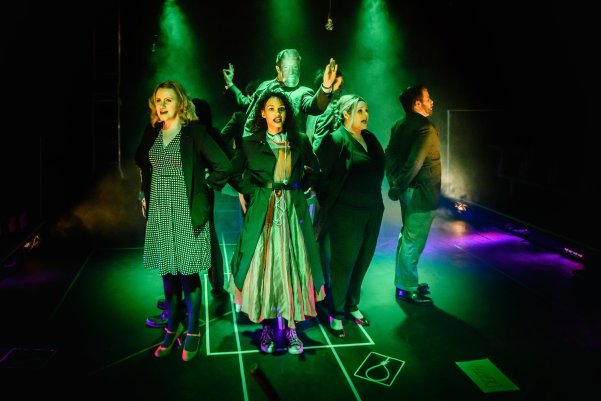
Performances are strong from everyone, with the cast acknowledging the audience with intense stares throughout, involving them discreetly yet hardly breaking the fourth wall. The staging is simple yet effective, with ladders, coloured masking tape and a few pieces of furniture whisked on and off, and the cast adopting masks and a few props as they switch from key character to chorus.

Singing is good, but feels a little strained in places. However, this does not detract from the story (adapted and directed by Ricky Dukes), and the new lyrics (penned by Bobby Locke) are both clever and amusing.

It’s fun, fast-paced and funny – a very enjoyable show.

The Play’s the Thing UK is committed to covering fringe and progressive theatre in London and beyond. It is run entirely voluntarily and needs regular support to ensure its survival. For more information and to help The Play’s the Thing UK provide coverage of the theatre that needs reviews the most, visit its patreon.

The Last Five Years, St James Theatre

https://www.thestage.co.uk/wp-content/uploads/2016/11/Samantha-Barks-as-Cathy-in-THE-LAST-FIVE-YEARS-at-St-James-Theatre.jpg

The most moving performances are often largely removed from our day-to-day lives. But every so often you come across a piece of theatre that, whilst it may not be the objective best thing you’ve seen, encapsulates your life so well that you can’t not fall in love with it.

The Last Five Years is good though, even if it’s been a favourite of mine since I discovered it as a student back in 2002. The Jason Robert Brown musical, now 15 years old, is a wonderfully simple (albeit heteronormative) tale of boy and girl meeting, falling in love and falling apart. Framed by the late 90s NYC arts world (that I watched as a teenager in the suburbs and later joined as a drama school student), his story is told in chronological order and hers in reverse. There are two performers; the only time they interact directly is at their wedding, making the songs function more like reflective monologues. Though there is hardly any book, Brown’s lyrics tell the story clearly and sensitively. Dynamic staging and committed performances, like those in this anniversary production that Brown directs, are necessary to keep this quirky little musical from falling flat. It’s a powerful, disarming show when executed effectively, and this production may well be its new definitive.

Jamie is a writer and Cathy is an actor. They are 23 when they meet; neither has had any success yet but both are wide-eyed, bushy tailed, and ready to fall in love. Jamie quickly becomes a bestselling novelist whilst Cathy is left in his wake, waitressing and doing summer theatre in the depths of the Midwest. It’s within this career disparity that their relationship deteriorates, and I find Cathy painfully echoes my own life as a failed actor. The isolation and jealousy that Brown fosters in his songs is wholly believable and all too familiar.

Both characters are flawed but generally likeable and despite reservoirs of love, it’s not enough to save their marriage. Though both characters can be irritating in their own way, their good intentions and fundamental incompatibility also ring true to anyone that’s endured the heartbreak of an ended relationship or marriage. Here is yet another parallel to my past, but this time I’m more like Jamie – I married young and naive and was divorced by 30 as a result of my own mistakes.

Samantha Barks and Jonathan Bailey are Cathy and Jamie. Barks is a stronger singer, but Bailey’s full of charisma and confidently flirts with the audience – it’s a lovely touch. Both have great emotional range and their chemistry is undeniable. Their performances, layered with Brown’s storytelling, reduces many to tears. Sniffling and eye wiping is plentiful in this intimate house.

The small scale of the show is fleshed out with some delightful video design by Jeff Sugg and Derek McLane’s set. These provide the context that’s missing from the script and grounds their story in a real time and place, though its Gabriella Slade’s costumes that indicate the 1990s setting. The videos are simple and cartoon-like, a sweet and charming addition that Brown underuses.

Though more of a song cycle with hardly any spoken dialogue (if you were to listen to the soundtrack you would hear almost the entire show) and arguably rather insubstantial, this one-act show has the ability to burrow into the depths of your guts. It’s a heartfelt love letter to the countless New York City artists doing their best to get by and find meaning in each other, and to everyone that’s every fallen in and out of love. The poignant, timeless story of youthful love and loss has the sorts of songs that you play on loop whilst crying in bed with a heart broken by your own failures (I’ve done this more than I care to admit), and those you can dance to after a brilliant first date or a career win. With the excellent performances and slick design of this production, it’s not one to miss – even if you cry through it.

The Last Five Years runs through 3 December.

The Play’s the Thing UK is committed to covering fringe and progressive theatre in London and beyond. It is run entirely voluntarily and needs regular support to ensure its survival. For more information and to help The Play’s the Thing UK provide coverage of the theatre that needs reviews the most, visit its patreon.
Kissing the Shotgun Goodnight, Ovalhouse

rsz_kissing_the_shotgun_goodnight_credit_the_other_richard

Along with tickets, we are handed earplugs. Considering Christopher Brett Bailey’s first work This Is How We Die, I’m not surprised. A brilliant, relentless barrage of contemporary American myth followed by an encore of noise and light, Bailey isn’t known for doing things by halves, or even singular wholes. The slight, constantly startled-looking Canadian with gravity defying hair attacks performance making with the energy of a supernova. Kissing the Shotgun Goodnight has the same verve, but is otherwise a rather different beast. Whilst This Is How We Die was dominated by language, Kissing the Shotgun Goodnight has very few words – but the earplugs are definitely needed. This anthemic music and light show fills the room with sound, colour and vibration but is the difficult second album to This Is How We Die. Much more of a gig than a piece of theatre, it lacks the satisfaction of characters and narrative, even a hint of one. Bailey’s mind blowing poetry teases with a few tiny fragments, but otherwise leaves us desperately gagging for more of his words.

Though given earplugs, there is the choice of whether or not to use them. Notices state that the sound level is consistently over 100 decibels and that, “if you wear plugs the whole time you might compromise enjoyment of the show. and if you don’t wear them at all you will take home whistling ear canals”. Being one of those people sensitive to loud noises who constantly asks my other half to turn down the telly, I want to play it safe but I don’t want to miss out. So I opt for one plug in, with the other ready. This choice no doubt effects the experience – if I leave them out the whole time and feel discomfort, would I like the show less? Or would I like it more because it’s not actually ‘that’ loud? I use the plugs in response to the volume level – sometimes I have both in, sometimes none. It’s an interesting premise to consider that the experience and quality of the show hinges on these earplugs, adding an additional level of individual, subjective response.

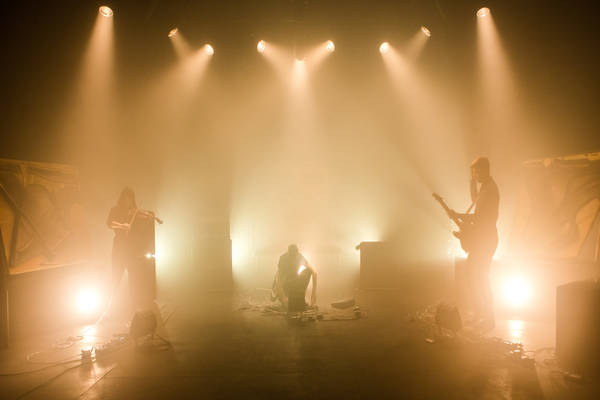
Bailey’s voice, slow and unseen, repeats, “this is a hell dream” in a brief textual introduction. Violinist Alicia Jane Turner uses loop pedals to sculpt a cinematic score reminiscent of mid-90s rock anthems. Her work is wonderfully angry, sweeping and alive. George Percy and Bailey are both on guitar, forming a silhouetted triptych with Bailey soon in the middle – amongst the monolithic speakers and flight cases forming a brutalist, urban landscape, he cuts the figure of a scrappy dystopian overlord. It suits him. If this is what hell is like, it’s fucking glorious.

Behind each performer is a wooden panel of about a metre square made of deconstructed pianos and their strings. These are visually impressive structures in and of themselves; their music evokes the violence and community of tribalism. Combined with excellent sound-responsive lighting (that malfunctioned to the point that the show needing to be stopped briefly), the overall effect is one of epic, soul shaking community.

The title paired with the music evokes the American paradox of a friendly but violent people who love their guns as much as their families. The music’s scale captures the expanse and variation of the North American landscape, and the few words he shares on the experience of waking up from a nightmare to find the world unchanged darkly foreshadow Trump’s America. Whether or not this is an intentional message, it is certainly a powerful one.

Kissing the Shotgun Goodnight is certainly wide open to interpretation and shows Bailey’s ambition and range as a performer of work designed to push the senses to their extremes. His textual dexterity is certainly missed (particularly by the coked up, flailing pair of young women sat next to me commenting on how disappointing this work is compared to his first) and comparatively this piece is somewhat disappointing, but it absolutely has its merits as a visceral, “fuck you/I love you” performance piece.

Kissing the Shotgun Goodnight tours nationally through November.

The Play’s the Thing UK is committed to covering fringe and progressive theatre in London and beyond. It is run entirely voluntarily and needs regular support to ensure its survival. For more information and to help The Play’s the Thing UK provide coverage of the theatre that needs reviews the most, visit its patreon.
Father Comes Home From the Wars (Parts 1, 2 & 3), Royal Court

https://i0.wp.com/www.officiallondontheatre.co.uk/servlet/file/store5/item374788/version1/fileservice770/374788_770_preview.jpg

American, Pulitzer Prize-winning playwright Suzan-Lori Parks doesn’t shy away from epic projects. Six years ago, she wrote a play a day to create 365 Days/365 Plays, then went on to write the nine-part Father Comes Home From the Wars. Parts one, two and three centre around Hero, a strapping young slave on a remote Texan farm. Spanning the Civil War, this epic story with influence from Greek myths and contemporary socio-political issues in Parks’ distinctive, poetic language takes its time to develop and has some discordant stylistic choices, but its narrative and historical interpretation is both compelling and important.

Each of the three parts has moments of profound brilliance and devastation, but Parks is in no rush to tell her story. The dialogue-driven script takes its time, meandering around a complex landscape of slavery, loyalty and race within this particular slave family. Though set in war time, there is little action – broader issues drive the conversation more so than current events. This is more of a kitchen sink drama than a wartime adventure story.

Part one solely takes place on the farm as Hero debates whether or not join his master in battle. The rest of the slaves take bets and try to persuade him one way or the other, but in the back of Hero’s mind is a promise from the Boss-Master – but is he likely to keep his end of the deal? Hero’s loyalty is split between his owner and his wife Penny, but the lure of the cast-off but smart uniform proves too much. Though little happens, the domesticity of part one has some of the tension that precedes a huge decision. Seeing a tall, strapping black man in the prime of his life wearing Confederate greys is most unsettling; this paired with the ingrained, accepted attitude that he is the property of his owner is a potent reminder that there has been insufficient progress in America’s attempts at racial equality.

Part two, though set at a particular moment in the midst of the war, has the calm of an eye of a storm and is by far the best of the three parts. Hero and Boss-Master have captured a Yankee prisoner whilst separated from their regiment during a battle. Hero’s loyalty is tested again, this time by his prisoner upon discovery of a secret that’s hidden in plain sight and only skin deep. Racial identity, individuality and freedom intertwine in an intoxicating allure of potential for Hero, who is still doggedly loyal to his owner. The powerful ending devastates in its frank depiction of ingrained attitudes of racial inferiority and liberal frustration with this mentality.

Part three is the more mature sibling to part one. The characters are older, wiser and more world weary in the face of Southern defeat. The pre-war certainty has given way to a chance at the great unknown of freedom, and for the first time they can choose where they live – anywhere in the great, wide world, or on the farm they have known forever. Penny and Hero’s devotion is destabilised in this irrevocably changed world that is now free, but cold and dangerous – and still is for black Americans today. The morality of freedom isn’t black or white here, but the ominous, thought-provoking grey of Hero’s, (now called Ulysses) uniform.

Neil Patel’s unforgiving desert of a set doesn’t have bells and whistles, but it’s sparsity highlights the richness of Park’s language and characterisation. Steve Toussaint is the remarkable Hero, painted with delicate light and shade. The rest of the cast are excellent in their own right, though lack the development of the initially appropriately-named lead.

Parks’ script is almost completely bedded in realism (that’s occasionally heightened), though a talking pet and some contemporary costumes slightly skew reality. Both are used sparingly and without any evident justification across the three parts so their inclusion feels jarring and unnecessary. The onstage musician, though very much a separate commentator, doesn’t clash the way these choices do.

For a play set during a war and a pivotal moment of America’s history, it is oddly detached from violence and conflict. Instead, Parks’ text goes after deeper themes within this transition from slavery to freedom. Though a greater sense of danger and looming dread would add needed further tension in parts one and two, the nuance that flows through the story is undeniably exquisite.

Father Comes Home From the Wars (Parts 1, 2 & 3) run through 22 October.

The Play’s the Thing UK is committed to covering fringe and progressive theatre in London and beyond. It is run entirely voluntarily and needs regular support to ensure its survival. For more information and to help The Play’s the Thing UK provide coverage of the theatre that needs reviews the most, visit its patreon.

Electric Eden, Edinburgh Festival Fringe

https://www.thestage.co.uk/wp-content/uploads/2016/08/Electric-Eden-700x455.jpg

Tommy Eden, a pensioner with a love for street performing since he retired, is dead. Local entrepreneur Alexander Sheldon’s security guards are responsible. Sheldon didn’t like Tommy performing outside his high end spa and leisure centre, but when the guards manhandled him off his patch, Tommy’s 87-year-old body couldn’t take it. Local young people, angry at the rapid gentrification of their town and the death of a local treasure, organise a protest/party in the abandoned club across the road, and everyone’s invited.

Not Too Tame’s Electric Eden doesn’t manage to deliver much of a party, though. Shouty political slogans and several under-developed subplots give a vague picture of a bigger problem, and staging choices fight against the attempted audience immersion. The concept promises a dynamic execution, but the delivery disappoints.

Seven characters at the party are featured, including organiser Greg (Andrew Butler) and Tommy Eden’s granddaughter, Grace (Louise Haggerty). Their stories, as well as those of the other five characters, are gradually presented through disconnected scenes in between dance numbers and party games. The audience are sometimes invited to join the dancing, other songs are tightly choreographed.

An exposition of protest rhetoric delivered down a mic, petition signing and ordering drinks from the bar is too long. Each of the characters’ individual stories only gets a couple of scenes, so they come across as generic snapshots of character types rather than real people.

The audience are provided with chairs so even though director Jimmy Fairhurst wants to create a party atmosphere, inevitably the majority of the audience end up sitting and watching for the entire performance. Choosing a club as a venue adds little with such a clear distinction between the actors and the audience, and the continuous reiteration that this is a party comes across as forced and false.

The performances are fine and there’s some tight choreography, though this also feels out of place with the attempts to create an anarchic/punk atmosphere. Electric Eden tries to be both a genuine party and a play, but the two aesthetics are so diametrically opposed that neither ends up working within the piece.

The whole experience is frustratingly flat, though it shows such promise on paper. With a script overhaul and a clear vision as to what Electric Eden wants to achieve, it would be a stronger piece. As is, it comes across as a confused and undeveloped piece.

Electric Eden runs through 29th August.

The Play’s the Thing UK is committed to covering fringe and progressive theatre in London and beyond. It is run entirely voluntarily and needs regular support to ensure its survival. For more information and to help The Play’s the Thing UK provide coverage of the theatre that needs reviews the most, visit its patreon.
Counting Sheep, Edinburgh Festival Fringe

https://i.guim.co.uk/img/media/23913cc392a98f67736cd3cdca806a6774c8940b/0_0_2048_1363/master/2048.jpg?w=620&q=55&auto=format&usm=12&fit=max&s=1feba80ccb7ff150a5842abd1e15ee76

Just over two years ago, a revolution in Kiev ushered in the downfall of the Ukranian government. Protests against the government’s refusal to sign pro-EU legislation lasting months had several violent outbursts that saw hundred of people injured and 780 killed. Toronto-based Ukrainian musician Marichka Kudriavtseva, in Kiev for work at the time, joined the protesters where she met Mark Marczyk, also based in Canada.

When the two returned from the Ukraine, they teamed up with Marczyk’s Lemon Bucket Orkestra to create Counting Sheep, an immersive “guerrilla folk opera”. A celebration of solidarity and the power of a collective voice, it also mourns those who died in the protests. Told from the perspective of the protesters, little is shared from the other side – but this rallying performance is fitting homage to not just the Ukrainian protesters, but those fighting government tyranny around the world.

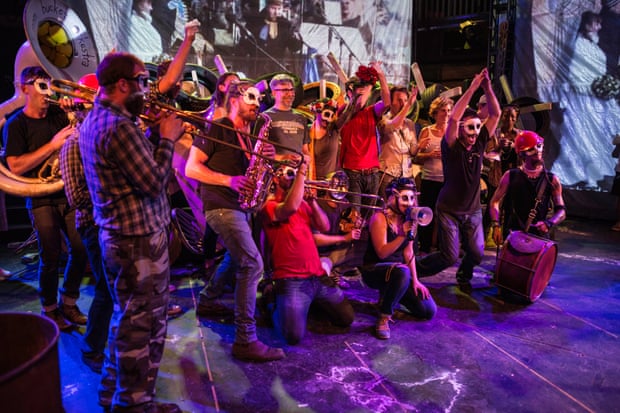
Some audience sit around a huge table, whilst others sit on the sides of the space and still others up in a balcony. Klezmer or folk music is playing as the audience enters; there is a convivial atmosphere as the show formally starts. This is a party, or a wedding, or some other huge gathering, until the three screens display news reports of riots and police enter. The tone abruptly shifts, and the world that has been established is dismantled. It’s a wonderful, unsettling surprise.

The space is consistently reformed and redrawn using movement, and the audience is physically moved in the wake of the protesters’ gains and losses. They are willing and unquestioning, the sheep of the title. Though the numbers here obviously pale to those at the actual protest, incorporating the audience in acts such a building barricades and lobbing bricks at police fosters unity from disparate dozens. There is a hint of the solidarity and aggression found in protests, and joy and celebration from the audience who are keen to play. Being served food is also an important enabler that solidifies the unity the show aims to create.

Counting Sheep is hugely effective in its emotional manipulation, and also it’s storytelling through music, movement and projections. Choosing sheep as a metaphor is a curious choice, though. The benign but rather dumb livestock aren’t known for thinking for themselves and are susceptible to herding – otherwise, they wander around unproductively, getting lost and eaten by predators. Whilst the performers are the herders here, they are also in sheep masks, unempowered. Who then are the herders? The government? Unseen forces of political and social unrest? Whatever it is, us human beings are hugely susceptible to it when motivated enough, even if the metaphor isn’t totally clear.

Though sung completely in Ukrainian, there is a clear storyline conveyed through projections and movement. There is little nuance in this piece, but it a playground for the sweeping emotions of popular theatre. It provides at least a hint of the experience that the Ukrainian protesters endured, and powerfully unites the audience through the humanity of collective experience for a common goal. An excellent piece of theatre.

Counting Sheep runs through 29th August.

The Play’s the Thing UK is committed to covering fringe and progressive theatre in London and beyond. It is run entirely voluntarily and needs regular support to ensure its survival. For more information and to help The Play’s the Thing UK provide coverage of the theatre that needs reviews the most, visit its patreon.

Please Excuse My Dear Aunt Sally, Edinburgh Festival Fringe

https://www.thestage.co.uk/wp-content/uploads/2016/08/please-700x455.jpg

When fourteen-year-old boy Red starts at a new school after his parents’ divorce, his mum anxiously worries about him making friends. Soon, his mobile is constantly buzzing with texts and he’s out most evenings. Mum’s happy but she only sees the life Red constructs especially for her. Someone, or rather something, else has the privilege of an uncensored view – Red’s mobile. As the vulnerable boy is sexually exploited by his unsatisfied maths teacher, his phone sees everything and narrates the story around the characters’ interactions. This slick ensemble piece by NY theatre company One Year Lease seamlessly merges writing styles, design and physical theatre to tell a dream-like story of abuse veiled as love.

When Red’s maths teacher confiscates his mobile and accidentally takes it home with her instead of her own phone, she begins a downward spiral of communication that quickly becomes personal. Red’s parents separation is far from pleasant, and his teacher’s boyfriend is an unemployed layabout, with vague dreams of designing apps. This combination fosters a relationship where the teacher and the student inappropriately confide in each other, and she does nothing to stop it.

Suspicion helps propel the action upwards towards a climactic end, but a lack of consequence in Kevin Armento’s resolution is as disturbing as the story itself. The phone as narrator is a great device – it’s present enough to add context and framing, but is not overused to the point of becoming a gimmick. Abstract movement incorporating versatile set pieces adds a striking, dynamic visual and a disconnect from reality appropriate to a forbidden relationship. A live musical score by Estelle Bajou enhances the surrealism of the staging.

Mathematical equations coldly explain how their illicit affair develops, and minimalist design in black and white juxtaposes the intricacies of the complex lives that collide so inappropriately. Though the script avoids blatant condemnation of the relationship, Please Excuse My Dear Aunt Sally is a striking blend of visual and verbal storytelling.

Please Excuse My Dear Aunt Sally runs through 28th August.

The Play’s the Thing UK is committed to covering fringe and progressive theatre in London and beyond. It is run entirely voluntarily and needs regular support to ensure its survival. For more information and to help The Play’s the Thing UK provide coverage of the theatre that needs reviews the most, visit its patreon.