35 Amici Drive, Lyric Hammersmith

https://lyric.co.uk/wp-content/uploads/2017/03/35-Amici-Drive-by-Lily-Owen-001.jpg

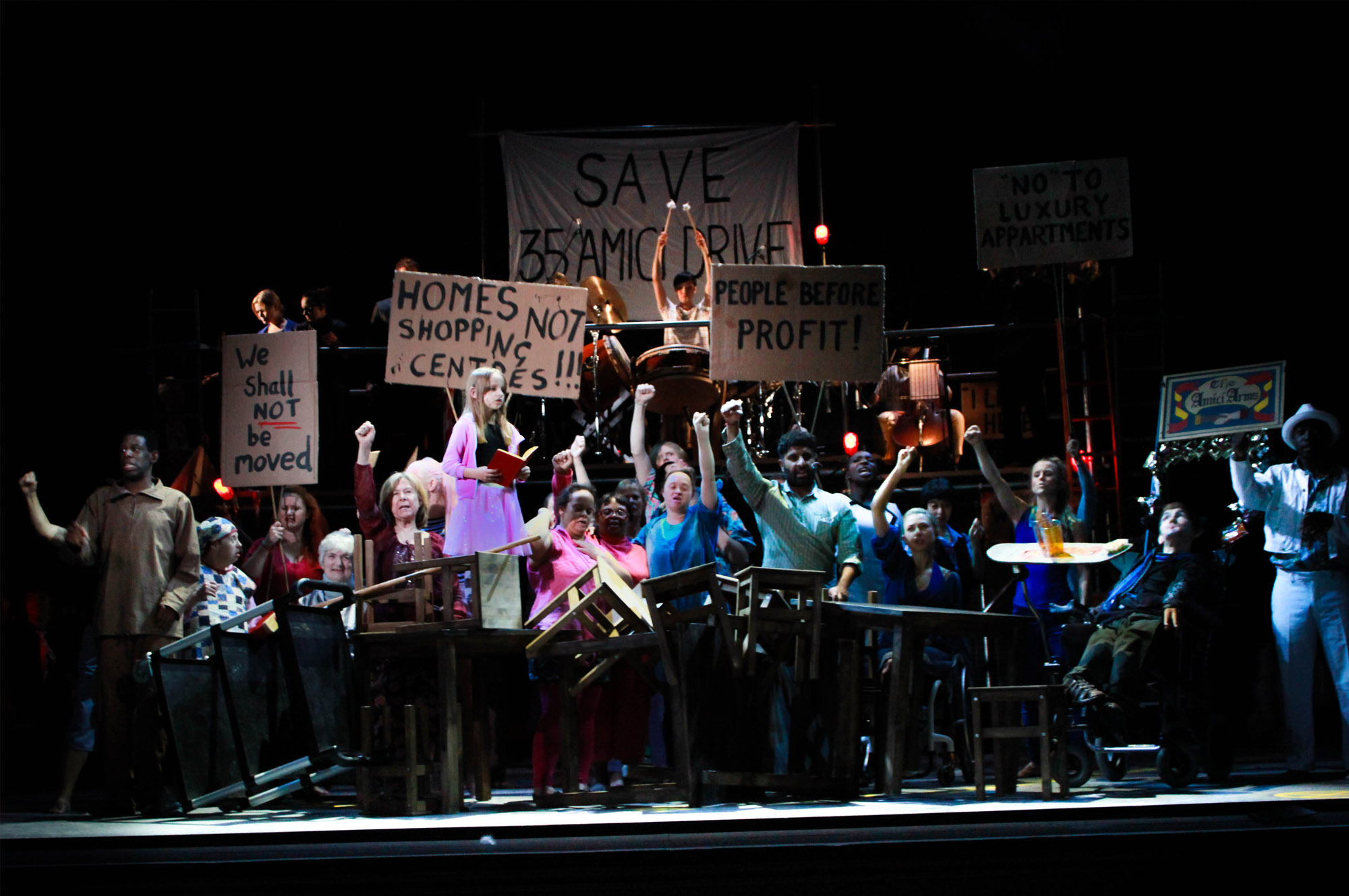
Council block 35 Amici Drive and the pub attached to it are earmarked for demolition. Luxury flats and commercial retail units will replace it, and plans to rehouse current residents are vague. Money-grubbing developers and local counsellors push for “positive change” but those who live there are having none of it.

Continue reading

Miss Nightingale, The Vaults

https://i0.wp.com/www.gaytimes.co.uk/wp-content/uploads/2017/04/1st-kiss-Nicholas-Coutu-Langmead-Conor-OKane-in-Miss-Nightingale-Photo-Robert-Workman.jpg

By guest critic Alistair Wilkinson

Fly to the front line. Sing some songs. Win the war. Live happily ever after. Sounds easy, right? That’s the idyllic goal that two queers, an unmarried mother and an unborn child feel in Matthew Bugg’s dreamy production of Miss Nightingale. This gorgeous depiction of 1940’s Britain hits you right in the feels and pulls on all heartstrings. The set provides an intimate cabaret club vibe, decorated with posters stating memorable lines from the wonderful songs that are performed throughout.

Continue reading

The Mutant Man, Space Arts Centre

315_The Mutant Man @ The Space. Photo by Greg Goodale

By guest reviewer Maeve Campbell

Contemporary pop culture is awash with true crime stories: NPR’s Serial, HBO’s The Jinx and Netflix’s Making of a Murder are just a few titles that have recently gripped public imagination. It is therefore not surprising that two plays about the life of Harry Crawford, born Eugenia Falleni in 1875, have been dramatised in the last few years. The Trouble with Harry by Lachlan Philpot played in Melbourne in 2014 and now Christopher Bryant’s The Mutant Man comes to the Space Arts Centre.
Continue reading

Assisted Suicide: The Musical, Royal Festival Hall

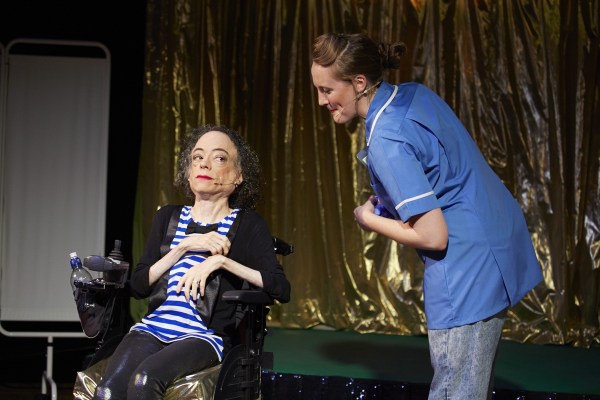
It’s uncomfortable to watch a play that conflicts with your politics or world view, and Liz Carr’s Assisted Suicide: The Musical does just that. The gay actor and comedian aligns with cuddly liberal ideology other than her avowed opposition to legalising assisted suicide in the UK. As a disabled woman, she worries that disabled people will consequently feel pressured to end their lives so they are no longer burdens on their loved ones, especially as many non-disabled people flippantly comment how hard their lives must be. After all, if you’re told the same thing over and over again, it’s too easy to start believing it.

Continue reading

Dr Carnesky’s Incredible Bleeding Woman, Soho Theatre

https://cdn0.vox-cdn.com/thumbor/08BLiZi0k-g-w2TYXY9nOkQTz_4=/800x0/filters:no_upscale()/cdn0.vox-cdn.com/uploads/chorus_asset/file/2316126/shutterstock_132379235.0.jpg

From a lectern in the corner of the stage, Dr Marisa Carnesky fights the social taboo of periods. Resembling a character from a Tim Burton film, the PhD holder in menstrual rituals and synchronicity shares her collective research with a group of performance artists she assembled, the Menstruants. Sideshow/cabaret Dr Carnesky’s Incredible Bleeding Woman is a wonderfully quirky manifestation of sisterhood, womanhood and the wonders of the female body.

Every month on the new moon, Dr Carnesky and the Menstruants met on a beach in Southend to develop and performed rituals around their menstrual cycle. The Menstruants come from an array of backgrounds and sexualities, and their rituals are as unique and individual as they are. Through their performances, every woman’s personal experiences with their bodies is validated and celebrated.

The performances on show are distinctive and compelling. There is some spectacle: sword swallower MisSa Blue has a customised set of swords that suit her oesophagus shape each day of her cycle. Some of the work is more reflective and otherwordly, like Nao Nagal’s use of traditional Japanese masked performance. Molly Beth Morossa provides a creepy sideshow element with her twitchy, Victorian high tea. H Plewis performs a visceral movement piece with her menstrual jelly. Rhyannon Styles simply speaks to us directly about her experience of cycles as a trans woman. Fancy Chance, with the rest of the company, performs a phenomenal circus act as a finale, after an empowering, proud sequence of feminine reclamation. All of the acts celebrate female abilities and bodies without aggression.

In between the vulnerable, performative manifestations of female cycles, Dr Carnesky talks to the audience through an array of historical and cultural mores surrounding menstruation. She particularly focuses on myth and symbolism – death and rebirth, shedding of skin and female unity. Her tone is gentle and matter-of-fact; the the content may be revolutionary but she comes across as warm and supportive.

In a show that has the potential to come across as alienating, it is instead welcoming – no one in the audience (men included) seem uncomfortable, and the stories shared on the stage are supported from the house. Instead,this diverse, inclusive variety show is a divine honouring of the feminine mystery and a reclamation of one of the features that defines women, and a showcase of some excellent live artists.

Dr Carnesky’s Incredible Bleeding Woman runs through 7 January.

The Play’s the Thing UK is committed to covering fringe and progressive theatre in London and beyond. It is run entirely voluntarily and needs regular support to ensure its survival. For more information and to help The Play’s the Thing UK provide coverage of the theatre that needs reviews the most, visit its patreon.

Love, Lies and Taxidermy and Scorch, Edinburgh Festival Fringe

First loves: awkward, hormonal milestones of young adulthood that make you feel like you’re on top of the world in a bubble that’s just the two of you. That is, unless you’re a trans or gender fluid teen who is still exploring gender identity, or someone with extensive family problems. But issues like these, when married with a youthful story of falling in love, make for some powerful and moving theatre.

Love, Lies and Taxidermy compares falling in love for the first time to living in a film. With narration incorporating stage directions, short scenes reminiscent of quick cuts and a wonderfully ridiculous conclusion, the play feels like a teen romcom, but has enough substance to ensure it isn’t total frivolity. It’s fluffy, sweet and addresses how social class can effect young love.

Set in Myrthyr Tydfil where all road lead to Tesco, Ash and Valentine meet at hospital when they’re both waiting to see if they qualify for paid medical trials. Ash’s dad is on the verge of bankruptcy, and Val’s parents are separated so he wants to send them on a cruise in hope they will fall in love again. The tentatively begin dating, but life has a way of interfering with their time together. Ash has other ideas to earn some quick cash courtesy of an aspiring filmmaker college mate, but devoted Val vehemently opposes them. Cue a mad dash adventure to rescue Ash from her poor choices and live happily ever after.

There are a few lose ends in the narrative that get forgotten in favour of the “boy rescues girl” plot line, like Val’s quest for money for his parents. They could easily be trimmed to get to the point faster, or developed further to make a more fully-formed story.

The cast of three display remarkable energy as they play all the roles. Remy Beasley and Andy Rush are Ash and Val, the young couple who clearly fancy the pants off each other. Rush, though the hero, goes against the stereotypical popular lad who wins the girl through violence and strength. Awkward and geeky, his devotion to the bold and brassy Beasley is utterly adorable. Beasley’s confidence also goes against the romcom trope; she most definitely does not want to be rescued even though she doesn’t want to make the money in the way she has chosen.

The ending, however unrealistic, charms and delights. Though there is no set to portray the described splendour, the text more than makes up for its absence. The intimacy of the Roundabout suits this play well, though a larger venue would give more scope for design.

Scorch takes a different tone from Love, Lies and Taxidermy, though it also has a generous helping of youthful optimism about love. Kez, a bio-girl who dresses as a boy when not at school Orr home, has met Jules online and is smitten despite the “cool dude” exterior. This story has a darker outcome what with the complexities of gender identity and disclosure as it reinterprets the classic coming-of-age tale.

Kez is perky, accepting and generally at peace with her discomfort in a female body. Amy McAllister embodies the role with verve and charisma, making the audience sympathetic to consequences that arise from not telling Jules that she has a female, strap-on wearing body. The character’s good intentions are sweet, but not enough to save her.

Kez grows up quickly over the course of the story, and the Internet gives her a wealth of information to help her explore her gender identity and legal options. Her social media accounts facilitate meeting girls, and it’s all too easy to set up alternative profiles that portray her as a boy. It also helps her find a local support group, so the sword that is growing up in the digital age is well and truly double-sided.

This is a well-formed script with several layers. Whilst it is a powerful piece of storytelling as a solo performance, introducing additional actors to take on other roles would add depth to Kez’s experiences. McAllister uses the space well, though the opportunity to fully engage with the audience is missed.

Both productions are generally excellent examples of storytelling. The differing perspectives on teenage love are delightfully nostalgic and provocative without becoming twee or trite. The Roundabout enhances their intimacy, but limits scope for design and staging. These two plays would be served just as well, if not better, in a larger space that enables them to extend their production values.

The Play’s the Thing UK is committed to covering fringe and progressive theatre in London and beyond. It is run entirely voluntarily and needs regular support to ensure its survival. For more information and to help The Play’s the Thing UK provide coverage of the theatre that needs reviews the most, visit its patreon.

Be Prepared, JOAN, Edinburgh Festival Fringe

https://www.thestage.co.uk/wp-content/uploads/2016/05/Joan-Brighton-700x455.jpg

This year, four companies are receiving support from Underbelly to produce and market their latest work. Two of those are Milk Presents and Corner Shop Events, both offering solo performances but radically different in content and style. Each distinctive piece is vibrant and immediate, with moments of power and poignancy. Typical of new work at the fringe, both feel a bit rough and ready but they have a raw, honest emotionality that plucks the heartstrings.

Be Prepared transports the audience to a Quaker funeral for Mr Matthew Chambers, where a man who never actually met him has been invited to speak. Struggling with his own grief, writer/performer Ian Bonar takes on the awkward, unprepared man reduced to a child by his inner turmoil. The character’s biography interweaves with his unconventional encounters with Mr Chambers, spinning a muddled web of good intention that is sweetly moving and honest.

Bonar’s performance is excellent. There’s a simmering anxiety that drives him forward and erupts through the characters ideas that aren’t particularly well-thought through. His underlying focus on his father’s recent death is a constant presence that bubbles through his attempts to talk about Mr Chambers. His pace becomes more frenetic as his stories become increasingly muddled, though this textual choice occasionally interferes with understanding. The script has a seeping rawness that effectively captures the chaos of grief, though there are numerous loose ends that aren’t fully developed.

JOAN addresses rather different themes but has just as much intensity as Be Prepared. This modern Joan of Arc story resonates through it’s father/daughter relationship, and teenaged optimism and arrogance that backfires despite her intentions to save France. Her struggle with gender identity also gets hold of the audience’s empathy and doesn’t release its grip until the curtain call.

Lucy Jane Parkinson’s performance is exquisite. Joan’s hope, determination in the face of adversity and ultimate desperation is skilfully crafted by writer Lucy J Skilbeck. Parkinson fully embodies Joan’s emotional journey and has the audience in the palm of her hand from her initial impersonation of her father, to her final pleas for Saint Catherine’s help.

Though there is an element of drag in the show when Parkinson plays other characters, her depiction of Joan doesn’t come across as drag at all. The character is not sent up, and her struggle with taking on female behaviour and dress is wholly genuine.

Though JOAN is the stronger production of the two, Be Prepared is still a solid production with plenty of merit. Both are moving reflections of aspects of the human condition and powerful pieces of theatre in their own right.

The Play’s the Thing UK is committed to covering fringe and progressive theatre in London and beyond. It is run entirely voluntarily and needs regular support to ensure its survival. For more information and to help The Play’s the Thing UK provide coverage of the theatre that needs reviews the most, visit its patreon.

Mr Incredible and Deal With a Dragon, Edinburgh Festival Fringe

https://files.list.co.uk/images/m/mr-incredible-main-image-print-LST209719.jpg

Solo performances are popular at the Fringe, and there are some good ones this year. So far, the best production I’ve seen this year is one-woman show Torch, celebrating womenhood in all of its flaws and glory. To portray men from such a perspective is much harder what with society already granting men more privilege than women, but Camilla Whitehill’s powerful Mr Incredible does just that in order to highlight male entitlement.

Adam and Holly have recently split up, and Adam hates it. Men like him aren’t meant to be single. He has a good job, owns a flat in London and desperately wants marriage and children. Whilst he loves Holly’s youth and fighting spirit, he was glad when she started to mellow and come round to the idea of settling down. But she wouldn’t be tamed by his sedate nights in front of the telly watching trashy programmes. She wants to write about important issues and change the world for good.

Though Adam’s account of Holly betrays an obvious, fundamental incompatibility between the two, Adam is blind to it and his desire for Holly to conform, and it’s infuriating. As he details moments from their relationship and its unravelling, he blindly transfers all blame onto her. The script cleverly paints Adam as a generally good guy, making his privilege initially subtle, then growing until their relationship reaches a horrible end. His ingrained entitlement to Holly and the belief that she should conform to his ideal life is a good capture of male immovability around women’s goals and desires, and hopefully framed in a way that triggers male reflection.

Alistair Donegan fleshes out Adam with genuine grief for the loss of his relationship and fully believed justification of the character’s choices. Whitehill’s script paints Adam overly-simplistically at times, but Donegan makes the character three-dimensional.

As a solo performance, it is initially unclear who Adam is talking to, but this is revealed in the play’s final moments when the severity of their breakup is horrifyingly revealed.This moment is subtle and takes some processing, so perhaps a bit more obvious spelling out will make the intended message stronger. Overall, this is a strong, polished production with acute comment on male privilege over women’s bodies and choices.

Deal With the Dragon also looks at male entitlement, but likely not deliberately and with a hefty dose of absurd fantasy. Bren is a gay dragon who finds vulnerable gay men that need looking after and offers to help, but not without signing a contract. The Faustian pact between Bren and artist Hunter looks at artistic temperament and dependency in the arts with both comedy and gravitas, though Kevin Rolston’s piece is lacking in a concise storyline and clear message.

Rolston is an excellent performer who distinguishes between Hunter, another artist Gandy and Bren with physical skill that is delightful to watch. With no costume or props, it’s perfectly clear that Rolston is a dragon. The transformation is simple, but utterly delightful.

The script has a nice premise – What if you had a gay, German dragon to help you get through the unpleasantness of life – but it’s never made clear what the premise is trying to communicate. Are people eventually better off with Bren’s assistance? Worse? What does it say about life’s obstacles as a whole? Should men have someone at their disposal to do their dirty work? These questions go unanswered. Though Rolston’s ability as a performer is undeniable, Deal With the Dragon never makes a definitive statement.

Mr Incredible runs through 28th August, Deal With the Dragon runs through 29th August.

The Play’s the Thing UK is committed to covering fringe and progressive theatre in London and beyond. It is run entirely voluntarily and needs regular support to ensure its survival. For more information and to help The Play’s the Thing UK provide coverage of the theatre that needs reviews the most, visit its patreon.

Rotterdam, Trafalgar Studios

https://i0.wp.com/johnnyfox.co.uk/wp-content/uploads/2015/11/for-webIMG_2634-700x455.jpg

No one stays long in Rotterdam. Boats, goods and people are always on the move in and out of the Dutch port city. Alice is an exception, an English immigrant whose ship washed ashore seven years ago and never took to sea again. She doesn’t like the city, but neither does she want to leave. Her ex-boyfriend Josh came with her, but after meeting his sister Fiona, Alice realised she was gay and left Josh for Fi. The women set up home in Rotterdam, couched in comfortable, domestic bliss for the last several years. Now a few nights before New Year’s Eve, Alice agonises over a coming out email to her parents back home. As she’s about to click send, Fi has her own coming out – she’s not a gay woman, she’s a man called Adrian trapped in a woman’s body.

Alice’s secure life begins to come loose from its moorings as she tries to support Adrian’s transition. Her brave face can only hold up for so long as she is left in his wake in Jon Brittain’s Rotterdam. The fragility of their relationship is much more moving than any televised exposé for the masses. Even though some scenes are a touch overwritten, the ebb and flow of this delicate situation is exquisitely captured.

Brittain’s use of perfectly balanced perspectives makes it impossible to take sides as Adrian and Alice’s issues become increasingly at odds – a commendable decision that’s difficult to execute in writing. Both are inherently self-absorbed, and both have genuine grievances with the other. The nuance in the storyline lies in their interactions, and two minor characters provide a wider view of their microcosm that feels devastatingly huge. All four characters have quietly powerful speeches and moments where they try to understand each other despite their needs being at odds with someone else’s experience. These characters are wonderfully flawed humans trying their best to navigate an unfamiliar situation; Brittain’s ability to foster audience empathy through their spectrum of emotions and occasional bad behaviour is spot on.

Alice McCarthy and Anna Martine as Alice and Fi/Adrian are phenomenal. Jessica Clark is Lelani, Alice’s much younger, distracting lesbian colleague full of energy, life and good intentions. Ed Eales-White as Josh has a lovely, quiet patience and dogged determination to stick by the couple even though he had been hurt so badly all those years ago.

Though some moments are a bit overly explanatory about family relationships and trans experience, they are easily forgiven in light of the fully believable characters. Though this isn’t an “awareness” piece per say, the humanity and insight into transgender transition Rotterdam provides is hugely important and valuable.

Rotterdam runs through 27th July.

The Play’s the Thing UK is committed to covering fringe and progressive theatre in London and beyond. It is run entirely voluntarily and needs regular support to ensure its survival. For more information and to help The Play’s the Thing UK provide coverage of the theatre that needs reviews the most, visit its patreon.
 

Savage, Arts Theatre

rsz_gary_fannin_and_bradley_clarkson_in_savage_at_the_arts_theatre_c_roy_tan

Denmark in the mid-1930s was a great place to be if you were gay. Homosexuality was legalized in 1933 and a thriving club scene allowed gay men to meet and socialize publicly. But as the dark cloud of National Socialism swept Europe, safety became more precarious. Dr Carl Vaernet was one of their threats. A practicing GP with an interest in hormone therapy, the Danish Nazi Party member soon captured the attention of party higher ups with his therapies that he claimed cured homosexuality. Hired to cure gay prisoners at Buchenwald late in the war, he experimented on seventeen inmates before the war ended and he escaped to Argentina.

Claudio Macor’s latest play Savage focuses more on the story of Nikolai and his American boyfriend Zack than Dr Vaernet, but the lovers are soon separated and Nik becomes one of the doctor’s victims. The emerging subplot of an SS officer and his secret, gay love slave quickly becomes just as important as Nik and Zack, making Savage more of a play about homosexuality in WWII than specifically about Dr Vaernet and his horrific medical experiments. Spanning several years and multiple narratives, the script, sadly, doesn’t give in-depth attention to any particular character; individual stories are disrupted and incomplete. This would be a much more compelling text if Macor focused attention on one primary character rather than taking a scattergun approach. All of these characters have potential to steer a rich, interesting play that focuses on them, but none of them get the full, individual attention they deserve. There are some great set piece scenes, but the overall structure lacks focus.

Some of the performances are inconsistent and the cast present a range of styles, which distracts from the seriousness of the plot. There are a few good performances, though. Gary Fannin cuts a cold, scientific Dr Vaernet with a clear disgust for gay people; this professional face of homophobia and calm hatred is a most chilling one indeed. Emily Lynne as the doctor’s nurse viciously opposes the Nazis and blatantly defies their rules in a display of ferocious persistence. She’s a great contrast to the doctor’s calm hatred. The two pairs of lovers have moments of genuine care for each other, whereas other times feel forced.

Jamie Attle’s costumes are sharp and detailed, whilst David Shields’ set of rotating panels clarify location but are a bit clumsy. Macor also directs, ensuring his political messages get across but an additional pair of eyes could have developed more intimacy between the couples.

Though the topic is most serious indeed, there’s a distinct lack of joy in the beginning cabaret scene and between Nik and Zack. Macor clearly wants to raise awareness of the horrors of Vaernet’s work, but some lighter moments of exposition would emphasise this further. A dramaturg would not go amiss in order to streamline the script and performance styles in future productions, but this premier still has potential and exposes a historical figure too easily forgotten amidst more prominent Nazi war criminals.

Savage runs through 23 July.

The Play’s the Thing UK is committed to covering fringe and progressive theatre in London and beyond. It is run entirely voluntarily and needs regular support to ensure its survival. For more information and to help The Play’s the Thing UK provide coverage of the theatre that needs reviews the most, visit its patreon.