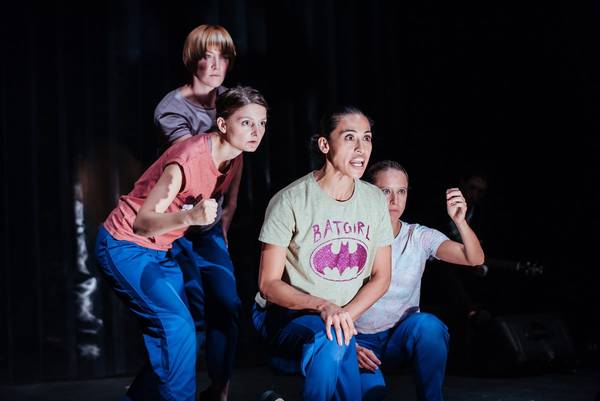
Mule, Edinburgh Festival Fringe

https://www.thestage.co.uk/wp-content/uploads/2016/08/IMG_5602-700x455.jpg

Orla and her sister are close. Even when Orla decided to move from their small Irish town to Ibiza for a summer of working and partying, they still texted everyday. After a sudden cessation in her messages and silence that stretches to ten days, her family starts to worry. A social media campaign turns up a few dead ends and the police are about to launch a full investigation when there’s a phone call.

It’s Orla. She’s in jail with another young woman called Shannon. In Lima.

Based on the real-life Peru Two, Mule fictionalises the pair of young women arrested for drug trafficking in 2013. Using two actors to play all the roles, Mule centres on Orla’s story. A sweet, young woman with little life experience who trusts too easily and struggles to say no, she gets swept up into the Ibiza culture and when she loses her job, she makes some terrible choices. This pacy script by Kat Woods gives a fairly well-rounded picture of the women’s circumstances, but the execution is so rushed that the story is hard to follow.

Scenes are short and snappy, lending an urgency and tension to the story. There are some unexplained gaps in the plot, though – like how they got this job to begin with. Orla and Shannon plan their coverup story early on, but the objective truth is never discussed. Constant character changes give a wide perspective on the story, but the use of voice and physicality as sole signifier of character at the speed and length they maintain isn’t always enough. By the time it becomes clear which character is talking, they have already moved onto another.

Mule is more of a narrative character study than a deeper exploration a chain of events where objective truth is clearly defined. Though the story has a lot packed in – including prison conditions, exploitation, drug use and gender disparity – none of them are fully explored. It has the feel of a documentary, but the character of Orla is the only consistent thread.

It’s a story that has plenty of potential for exploration, but Mule doesn’t go far enough or takes a strong angle, nor does it give enough detail to deem it documentary theatre. The actors’ performances are good and there are some excellent scenes, but Mule feels like it still a work in progress.

Mule runs through 29th August.

The Play’s the Thing UK is committed to covering fringe and progressive theatre in London and beyond. It is run entirely voluntarily and needs regular support to ensure its survival. For more information and to help The Play’s the Thing UK provide coverage of the theatre that needs reviews the most, visit its patreon.

Us/Them, Edinburgh Festival Fringe

https://www.thestage.co.uk/wp-content/uploads/2016/08/Us-Them_300dpi_PRESS-2_%C2%A9_FKPH-700x455.jpg

On 1 September 2004, a group of terrorists stormed a school in Beslan, holding over a thousand people hostage on the first day back after summer holidays. Most of them were children. When the siege ended three days later, over 300 people were dead. Part history lesson and part dramatherapy storytelling, two actors playing unnamed children who were hostages in the crisis re-enact the events of those three days. The childlike seriousness, quiet bickering and playful staging in Us/Them provides an excellent, contemplative lens through which to view world disasters.

Gytha Parmentier and Roman van Houtven are a soft spoken girl and boy who take pride in their school and their education. They go to the best one in town, and it’s near a wonderful forest. On the other side of the forest is the border, and across the border, children don’t go to school, the men are pedophiles and the women have moustaches. They view the world in black and white, everything is simple and explained in a matter of fact delivery. Whilst they show little fear, as hours stretch into days, the heat and dehydration take a toll on their bodies. Through their tiredness, they try to make sense of the terrorists’ demands and work out what they have to make them let them go. Their naivety is both heart wrenching and warming, rather than condemn they want to please everyone and carry on living their lives in peace.

The script is mostly narration, with some quibbling between the two on how certain moments panned out. More dialogue between the two would be welcome, but the design choices keep the narration from becoming too repetitive. It is description heavy, accented with colourful, abstract staging – childrens’ coats hang on the back wall, a web of unravelled string slows them down so as not to startle the terrorists. Their movements are angular, with leaps, falls and physical play. The bombs they rig around the gymnasium where they are held are balloons. Whilst the imagery and text is childlike, the undercurrent of danger and horror is inescapable, and the quiet honesty is wholly riveting.

Children are so often the faces of global tragedies that rally sympathy and action. Think of the little boy washed up on the beach, the tiny Syrian airstrike victim staring into the middle distance in the back of an ambulance. Whilst their images are splashed across the news and social media, they are rarely heard from. Perhaps if they were given a platform to air their experiences and perspectives, the adults that run the world would be less inclined to mindlessly retaliate against violent acts. Us/Them, rather than having an in-yer-face aggressive, political agenda, intuitively uses text and staging to convey a powerful, lingering request to listen and be kind, no matter how foreign we are to each other.

Us/Them runs through 28th August.

The Play’s the Thing UK is committed to covering fringe and progressive theatre in London and beyond. It is run entirely voluntarily and needs regular support to ensure its survival. For more information and to help The Play’s the Thing UK provide coverage of the theatre that needs reviews the most, visit its patreon.

Bucket List, Edinburgh Festival Fringe

rsz_cpf9rwlwgaagznb

The North American Free Trade Agreement (NAFTA) between Canada, the US and Mexico came into effect on 1 January, 1994. I was eleven years old. The agreement ushered in a degree of national prosperity for all three countries, but Mexico’s low minimum wage, lax environmental regulations and corrupt officials made a perfect storm for sweatshop conditions in the US-owned factories (maquiladoras) taking advantage of the exchange rate and unemployment in Mexican border towns. The maquiladora owners favoured female workers for their diligence and precision and employed girls as young as fourteen, who were better suited for working 12-hour days in harsh environments than older women or clumsy men. These girls, only a few years older than me, were assembling electronics and convenience items out of toxic materials for 39 cents an hour.

I’m American. Though I hide it well with a deliberately constructed accent and uniquely British habits and mannerisms that I’ve developed in the nearly twelve years that I’ve lived here, I still have the passport, the cultural history and the guilt to prove it. Normally that guilt is shaped like guns, healthcare or Trump, but it occasionally takes on other forms. This time it’s privilege. That privilege/guilt pours down my cheeks in hot, angry tears during Theatre Ad Infinitum’s Bucket List. The story of the women and girls’ lives dictated by the maquiladoras, some as young as me, is a horrifying contrast to the suburban middle-class upbringing I had, kept busy with school and music lessons and theatre rehearsals and ambitions. I may have had something that these girls made, some frivolous object bought without thinking in order to make my life easier or better, and I was totally oblivious to their hardship. I did not have to worry about my mother being killed for protesting the maquiladoras’ pollution, or about my auntie being raped by her manager, or getting cancer from the chemicals I encountered on a daily basis.

But for the women and girls in Bucket List, that is their life. The all-female, international cast, directed by Nir Paldi, devised a magical realism story of these desperate factory towns based on an idea from Mexican company member Vicky Araico Casas. Incorporating George Mann’s distinctive choreography and live music, Bucket List tells the story of Milagros (played by Casas), a girl growing up in one of these towns dominated by maquiladoras. Her generation’s experiences and those of her mother’s interweave, creating a landscape of labour, political protests, coming of age and revenge. It is a dense story covering a decade of these women’s lives, but Paldi’s script is easy to follow. Magical realism creeps in stealthily, and only at the end of the performance do certain events seem untenable and raise the question of whether or not they actually happened. Regardless of this fuzzy line between reality and fantasy, Bucket List is an anthem of strength that roars with political agenda and gives voice to the disregarded victims of developed nations.

Initially more of a montage of life experiences, Milagros’ story slowly begins to emerge. This could shift slightly earlier in the piece, but the exposition at the beginning gives wider context and does not feel extraneous. Paldi maintains a careful balance of these women’s lives and a wider, North American political picture that slightly tips in favour of the women, but there is enough of the outside world’s oppression and token assistance to inspire the characters’ rage and passion. Milagros’ tragic end adds fuel to the production’s fury against exploitation that comes out as a roar rather than a whimper.

There is hardly any set and technology on display, a dramatic change from their last adult show, Light. Instead, costume plays a bright but subtle role in the story – the five women playing the girls and their family wear coloured t-shirts with cartoon characters often idealised by young girls. Disney princesses, Batgirl and Alice in Wonderland offer them an American-created fantasy that they can strive for but will most certainly never achieve.

Juxtaposed against these pastel tops are quite vicious games demonising the powerful politicians and corporations that shape their lives. They also mock their working conditions, daily violence at the hands of men and threats to their lives. Milagros’ mother (Deborah Pugh) is a vocal political protester, demonstrating a ferocity also contrasting her character’s clothing. The excellent live score by Amy Nostbakken is more of a direct expression of the fighting spirit and sadness within these women.

Though a text-driven piece, Mann uses a series of motifs that soon become recognisable, indicating specific actions and locations. They enhance the understanding and often act as a substitute for words. Though used regularly, Mann’s choreography is one of the company’s trademarks and is unfortunately underused, especially considering the lack of set.

Even though NAFTA is over twenty years old, the maquiladoras are still there, employing women for long hours, polluting local rivers and creating environments ripe for exploitation. Paldi’s script aggressively demands awareness which may be unpalatable to some, but should be required viewing for every American blissfully unaware of their brothers and sisters across the border that are so often looked down upon with racist disgust. Bucket List is truly vital theatre in our age of disposable, thoughtless consumerism.

Bucket List runs through 29th August.

The Play’s the Thing UK is committed to covering fringe and progressive theatre in London and beyond. It is run entirely voluntarily and needs regular support to ensure its survival. For more information and to help The Play’s the Thing UK provide coverage of the theatre that needs reviews the most, visit its patreon.

Hamlet, Ophelia – Part One, Edinburgh Festival Fringe

rsz_121

What would Hamlet have been like as a child? Ophelia? Were they close? Did they squabble or were they the best of friends? Shakespearian Lovers, a new female-led company from Italy, attempt to answer these questions in Hamlet, Ophelia – Part One. In this version Hamlet is played by a woman, bringing a quiet, feminine sensitivity to the role considered one of Shakespeare’s greatest. Despite performing in their second language, the two women have a sound connection with the contemporary English text that shows the two grow from playful children to adults at Gertrude’s wedding to her second husband. There are some major issues with staging and the ending needs work, but this gentle, little play stays true to Hamlet’s personality as reflected in Shakespeare’s text and has the strong foundations of a good script.

Of the two performers, the perky Ophelia is the stronger. She has a natural curiosity and handles the English script comfortably. Hamlet is much more reserved and often too quiet to easily hear, but she has an intellectual intensity that suits the character. Though Hamlet’s femininity is not disguised, masculine pronouns are used throughout – the relationship in this piece wouldn’t differ from one gender to the other, Ophelia is clearly female but Hamlet’s ambiguity interferes with any potential statement about his gender.

The script has a sensible progression through childhood and into adulthood. They play as equals but as they grow, the difference between the son of a king and the daughter of a minister informs their interactions. The affection they have for each other is genuine and heartwarming, though the circumstances life deals them requires formal restraint, even through teenage hormones. The ending needs development and resolution in order to emphasise why the it is where it is, and the reason why this story is being told needs clarification, but the characterisation is sound.

The staging is the primary issue with this production. The venue is too small to allow space to be clearly differentiated through either distance or lighting and there is no backstage. Private moments lose their intimacy and physical expression is restricted, particularly when they are playing, and Hamlet tries to express his grief for his father’s death.

This is some promising work from a new international company. Even though a native English speaker’s advice would be useful to sort out a few minor mispronunciations, the confidence and ability both actors display in performing in a foreign language is impressive. With additional work on the script and fully realised staging, this has potential to be a great two-hander.

Hamlet, Ophelia – Part One runs through 28th August.

The Play’s the Thing UK is committed to covering fringe and progressive theatre in London and beyond. It is run entirely voluntarily and needs regular support to ensure its survival. For more information and to help The Play’s the Thing UK provide coverage of the theatre that needs reviews the most, visit its patreon.

A Fool’s Paradise, Edinburgh Festival Fringe

rsz_shakespeare-in-ecn

“Americans can’t do Shakespeare,” joke the five women from A Fool’s Paradise.

The self-deprecating, all-female company of players from Baltimore boot that myth out of the theatre with relish. Having learnt 45 scenes, speeches and moments from Shakespeare’s cannon, they promise to perform 30 of them in 60 minutes or else one of the actors gets a pie in the face.

In this delightfully raucous hour, the audience chooses what the actors perform from a bingo card that adds play to their autonomy, and they’re encouraged to take photos as well. The performances are a mix of styles, from emotionally committed and realistic through to outrageous slapstick. Some stick to Shakespeare’s text, some eschew it all together. Some use audience volunteers, some use props. The range is reminiscent of variety, vaudeville and US-style improvisation shows, creating a wonderful mix of theatrical traditions. It’s part-game show and part-celebration of Shakespeare teetering on the edge of total chaos. The atmosphere becomes wonderfully Elizabethan, with the actor/audience and actor/character boundaries heavily blurred.

Kids get involved in order to fill their bingo cards and win sweets, adults are swept away by playful joy. The performers’ response rate is lightening fast and each of them plays about a dozen or so roles. It’s a fantastic display of improvisation, multi-rolling, ensemble and physical skill, and the company are warm and charismatic, sharing enthusiasm rather than alienating through an acrobatic display of Shakespeare knowledge. The material isn’t all from his most popular plays, either – they include histories and the late romances though not all of the scenes include context, which makes it a challenge for even the most Shakespeare-familiar to keep up.

It’s a shame they aren’t here for the whole festival as it promises to be different each night and the exuberance of the company is a delightful celebration of Shakespeare’s greatest moments.

A Fool’s Paradise runs through 12th August.

The Play’s the Thing UK is committed to covering fringe and progressive theatre in London and beyond. It is run entirely voluntarily and needs regular support to ensure its survival. For more information and to help The Play’s the Thing UK provide coverage of the theatre that needs reviews the most, visit its patreon.

A Midsummer Night’s Dreaming, Edinburgh Festival Fringe

https://i0.wp.com/www.pci.leeds.ac.uk/files/2016/08/MJ42723_news.jpg

Tang Xianu and Shakespeare were writing about similar themes at the same time, on opposite sides of the world but never met. Teaming up to create a cross cultural performance, Leeds University and International Business and Economics University (UIBE) in China each took a play from each other’s culture and created a new play inspired by the foreign text. Inspired by the Chinese legend of Sophora, a spirit of the woods associated with visions and dreams, UIBE chose A Midsummer Night’s Dream. Adding multiple levels of reinterpretation, they swap the lovers’ genders and who fancies who in order to comment on gender roles in China and the pressures young people face. Performed in English, the students struggle to connect to the emotion behind the words but their adaptation is a complex and clever commentary on relationships and social expectations.

The Sophora Nest Hotel, run by three nameless staff members with otherworldly powers, is an escape from university studies for glamorous young couple Lysander and Hermia. They are followed by their friend Helena, who’s in love with Lysander, and Helena brings along Demetrius, the geeky, shy boy who will do anything for her. Helena is blind to his love, and instead uses him more as servant than a friend. Mostly in contemporary language, the lovers’ plot thread from the original unfolds but rather than the boys being drugged, its the girls, who then both fall in love with Demetrius. Lysander, who orders Hermia around to no end, needs to learn to not take advantage of her. Helena needs to do the same with her devoted sidekick.

All the chopping and changing from the original is wonderfully refreshing, and effectively communicates our need to open our eyes to those right in front of us rather than focusing on our own wants. Other themes emerge as well, particularly the pressure on women that results from being under their father’s thumb, then their husband’s. All four characters also have the drive to be the sexiest, cleverest and have the fanciest gadgets. Though China is so far away, it’s both comforting and disconcerting that young people feel this the world over.

The three hotel staff add a lovely dynamic. One is purely logical and analyses the hotel guests’ behaviour. A second wants to play tricks, and the third tries to maintain harmony between the first two. The emphasis on balance between this trio and the lovers feels distinctly eastern, and one worth worth considering in the west.

Though still maintaining an amount of student-level execution, the insight these Chinese young people provide through their script is provocative, relevant and culturally eye-opening.

A Midsummer Night’s Dreaming runs through 13th August.

The Play’s the Thing UK is committed to covering fringe and progressive theatre in London and beyond. It is run entirely voluntarily and needs regular support to ensure its survival. For more information and to help The Play’s the Thing UK provide coverage of the theatre that needs reviews the most, visit its patreon.

“Just let the wind untie my perfumed hair…” or, Who Is Tahirih?, Edinburgh Festival Fringe

https://i0.wp.com/www.ridikulmagazin.hu/cuccok/storages/thumbnails/2014-06-06/153cc8eec7af4dc9e7fe3737d2192f41/680x0.jpg

A woman sings behind a gauzy white curtain. We cannot see her face, but in her soaring cries we hear her passion. This is Tahirih, born in what is now Iran in the early 1800’s (we don’t know her exact date of birth because authorities burned these documents after her execution). She is a poet, theologist and women’s rights activist, and she has enough followers that the country views her as a national threat to the patriarchal Islam that requires women to be veiled in public.

In the days leading up to her execution, Delia Olam plays people from Tahirih’s life, unfolding her biography, teachings and radical actions. These we see plainly, but Tahirih is always behind the curtain, playing and singing. As the revered and reviled woman is sculpted through the accounts of others whilst her face remains hidden, she becomes mythical and hugely powerful, a revolutionary who’s life is tragically cut short.

Olam’s script and performance meld into a fluid solo performance that is a fitting tribute to such a remarkable woman. Her physical and vocal distinction between the handful of characters she plays is detailed and precise. A servant, Tahirih’s father, an executioner, and a female follower are crafted in detail, and all visited by the audience who go to these people to discover more about this woman who is revolutionary, dangerous, or both. This is excellent clarification of the audience/character relationship in solo performance format – it makes sense with the play’s circumstances and embeds the audience in the action. There is none of the talking out into undefined space or invisible characters that alienates the audience and removes the character from reality, something that often occurs in solo performance. Across these characters in different places and with different relationships to Tahirih, there is still a clear, well-proportioned narrative arc building to an awful end.

The scenes themselves are well-crafted and provide a snapshot of the landscape of attitudes towards women in Iran at the time. They are simply staged and prettily enhanced with candlelight, their simple, calming beauty juxtaposes the inevitable prospect of her death. Transitions are a touch slow; some are smoothed with recorded music whereas others have silent gaps as Olam transforms in and out of Tahirih, who sings and plays between characters. The silences make for a choppy disruption, but this is a minor issue easily forgiven in view of the story’s excellent construction and execution.

To learn about such a remarkable woman through a strong show and performance feels as much of a privilege as it is an education. Olam has fantastic instinct for storytelling and character development, and this detailed show needs hardly any improvement. Do not miss it.

“Just let the wind untie my perfumed hair…” or, Who Is Tahirih? runs through 29th August.

The Play’s the Thing UK is committed to covering fringe and progressive theatre in London and beyond. It is run entirely voluntarily and needs regular support to ensure its survival. For more information and to help The Play’s the Thing UK provide coverage of the theatre that needs reviews the most, visit its patreon.

Feature/Review: Children & Shakespeare, Edinburgh Festival Fringe

https://i0.wp.com/unknownmagazine.co.uk/wp-content/uploads/2015/07/York-3-credit-Rob-Freeman-1-1024x683.jpg

Whilst there’s plenty of Shakespeare at the fringe, it doesn’t get much coverage. It’s understandable – the Bard doesn’t count as a potential Next Big Thing, and he’s favoured by student and international groups that usually have short runs and are deemed less worthy of critical attention. It’s obviously necessary to recalibrate expectations and vocabulary when evaluating children and young people’s performances, but directors and teachers can and should be held accountable for the quality of their own creative work and bringing out the best in their students or young cast. They do have the additional pressure of incorporating an educational element and ensuring that their work is suitable for the children and young people they are working with, but that specialism is no more or less different than any other in the performing arts.

To completely ignore young people’s work at the Fringe when sampling the Shakespeare on offer cuts out a large segment of the Shakespeare productions on offer, and considering that these are often international schools as well, the cultural differences can be considered when critiquing. Over one day at the fringe, I watched three distinctly different Shakespeare adaptations – a Scottish stage school including children approximately aged eight through sixteen that looks at Twelfth Night, an American university’s analysis of Shakespeare’s baddies and a Notts young people’s dance-theatre company’s deconstruction of Macbeth.

Admirable Fooling or What You Will by Little Shakespeare School’s Michelle van Rensburg had the most challenging remit in that it is a show suitable for performers over a big age range, but the show she invents is a nonsensical mess. When she sticks to her simplified script with sections of original text more the more able students, it is standard children’s fare – able to be followed, giving the kids a chance to show their skills and including everyone. The random sections from Titanic, though? Inexplicable. None of the children on that stage or in the audience would have even been alive when the film came out, so crowbarring in pop culture references that they wouldn’t understand is gratuitous and self-absorbed. There are also numerous off-text clowning sequences that are unconnected to the story, and a lengthy exposition setting up a storytelling premise that isn’t consistently followed through. The one, shining moment of kitschy, creative inspiration that epitomises fringe Shakespeare is the tiny blond girl who plays the letter Malvolio finds in the garden. She wears a bright yellow sack with felted letters on either side and enthusiastically delivers the text that Malvolio reads from the letter in Shakespeare’s original. She looks about eight years old, maybe nine, certainly no more than ten, and it is an adorable thing of wonder. There are some good actors who are confident and speak well, particularly the eldest girl who plays Olivia, but the show itself is a baffling construction with little through-line or sense.

Bad Shakespeare, by Oklahoma State University drama students, isn’t bad, but it’s just as much of a lecture as it is a performance. Showcasing their intensive summer Shakespeare studies, they work their way though Shakespeare’s development of his villains. The exposition that sets up their five act structure is too long, but the acts’ increasing complexity is a nice touch. Most of the ethnically diverse ensemble are good performers, and all bar one are women – great work towards increasing diversity from the programme director. They handle the language and verse with muscularity and confidence, though there is no evidence of work towards convincingly playing men. Their emotions tend to read more as upset rather than angry or vindictive, and their physicalities are distinctly feminine. The show’s director has chosen faux-period costume; some are in dresses and some in doublet and hose. Neutral, modern dress would suit much better, especially considering the large amount of instructing the audience with contemporary language and pop culture references. Bad Shakespeare is great for learning more about Shakespeare’s characters and some of the scholarship behind them in a relaxed, easy to follow format, but it’s more of a learning experience than a show. However, they wear their confidence and passion for Shakespeare on their sleeves, which is a wonderful thing to see.

Fortitude Dance Theatre’s Macbeth has potential to be the most promising of these three adaptations, and whilst it certainly has some great moments, there are also some misguided creative choices and interpretations, and an inconsistent application of style. The young company demonstrates competence in their dance and verse delivery, though as a whole, they struggle with achieving moments of emotional intensity and staging on a  thrust. The pace was great, but tone consistently conversational. Their opening sequence was a great capture of the 90’s club scene with text and contemporary dance obviously inspired by Frantic Assembly, but the dance element is absent until the discovery of Duncan’s body, about half way through this abrupt edit. There are missed opportunities to incorporate movement into Macbeth and Lady Macbeth’s scenes showing their fluctuating power struggle. This dynamic between characters later between Macbeth and the witches inspires some good tribal, threatening choreography. Macduff’s monologue on hearing of his wife and children’s deaths is a stunning blend of movement and text that the company could to stylistically inspire their future work. They could also do with a stronger director, or dramaturg familiar with Shakespeare pronunciation, to confirm any line interpretations – “Out, damn spot” is not referring to blemishes on her face.

It’s brilliant to see young artists finding their way through making work and discovering styles and forms that work for what they want to communicate in their Shakespeare interpretations. Even though they won’t be up to professional performance standard unless they are extraordinarily gifted, their teachers and directors should be strive for clarity. Though none of these three productions quite reached that point, they each had their merits and watching children and young people discover and explore the joy of performing is a marvelous thing.

The Play’s the Thing UK is committed to covering fringe and progressive theatre in London and beyond. It is run entirely voluntarily and needs regular support to ensure its survival. For more information and to help The Play’s the Thing UK provide coverage of the theatre that needs reviews the most, visit its patreon.


Mr Incredible and Deal With a Dragon, Edinburgh Festival Fringe

https://files.list.co.uk/images/m/mr-incredible-main-image-print-LST209719.jpg

Solo performances are popular at the Fringe, and there are some good ones this year. So far, the best production I’ve seen this year is one-woman show Torch, celebrating womenhood in all of its flaws and glory. To portray men from such a perspective is much harder what with society already granting men more privilege than women, but Camilla Whitehill’s powerful Mr Incredible does just that in order to highlight male entitlement.

Adam and Holly have recently split up, and Adam hates it. Men like him aren’t meant to be single. He has a good job, owns a flat in London and desperately wants marriage and children. Whilst he loves Holly’s youth and fighting spirit, he was glad when she started to mellow and come round to the idea of settling down. But she wouldn’t be tamed by his sedate nights in front of the telly watching trashy programmes. She wants to write about important issues and change the world for good.

Though Adam’s account of Holly betrays an obvious, fundamental incompatibility between the two, Adam is blind to it and his desire for Holly to conform, and it’s infuriating. As he details moments from their relationship and its unravelling, he blindly transfers all blame onto her. The script cleverly paints Adam as a generally good guy, making his privilege initially subtle, then growing until their relationship reaches a horrible end. His ingrained entitlement to Holly and the belief that she should conform to his ideal life is a good capture of male immovability around women’s goals and desires, and hopefully framed in a way that triggers male reflection.

Alistair Donegan fleshes out Adam with genuine grief for the loss of his relationship and fully believed justification of the character’s choices. Whitehill’s script paints Adam overly-simplistically at times, but Donegan makes the character three-dimensional.

As a solo performance, it is initially unclear who Adam is talking to, but this is revealed in the play’s final moments when the severity of their breakup is horrifyingly revealed.This moment is subtle and takes some processing, so perhaps a bit more obvious spelling out will make the intended message stronger. Overall, this is a strong, polished production with acute comment on male privilege over women’s bodies and choices.

Deal With the Dragon also looks at male entitlement, but likely not deliberately and with a hefty dose of absurd fantasy. Bren is a gay dragon who finds vulnerable gay men that need looking after and offers to help, but not without signing a contract. The Faustian pact between Bren and artist Hunter looks at artistic temperament and dependency in the arts with both comedy and gravitas, though Kevin Rolston’s piece is lacking in a concise storyline and clear message.

Rolston is an excellent performer who distinguishes between Hunter, another artist Gandy and Bren with physical skill that is delightful to watch. With no costume or props, it’s perfectly clear that Rolston is a dragon. The transformation is simple, but utterly delightful.

The script has a nice premise – What if you had a gay, German dragon to help you get through the unpleasantness of life – but it’s never made clear what the premise is trying to communicate. Are people eventually better off with Bren’s assistance? Worse? What does it say about life’s obstacles as a whole? Should men have someone at their disposal to do their dirty work? These questions go unanswered. Though Rolston’s ability as a performer is undeniable, Deal With the Dragon never makes a definitive statement.

Mr Incredible runs through 28th August, Deal With the Dragon runs through 29th August.

The Play’s the Thing UK is committed to covering fringe and progressive theatre in London and beyond. It is run entirely voluntarily and needs regular support to ensure its survival. For more information and to help The Play’s the Thing UK provide coverage of the theatre that needs reviews the most, visit its patreon.

A Midsummer Night’s Dream in Gotham, Edinburgh Festival Fringe

https://i0.wp.com/www.gannett-cdn.com/-mm-/fc7f555cbf52fb26543e971d5e28e773dc747515/c%3D428-0-4784-3275%26amp%3Br%3Dx408%26amp%3Bc%3D540x405/local/-/media/2016/07/26/LAGroup/Shreveport/636051373770747955-SHR-caddo-magnet-01.JPG

The American High School Theatre Festival is wonderful. It gives school students from the US and Canada the opportunity to perform at the fringe as well as travel abroad, and is often the first chance participants have to travel outside their home country. Teacher-directors also have a platform for showcasing their skills in front of an international audience, so it’s sad that these student productions are often ignored by press. Shakespeare is regularly produced along with a fairly standard programme of musicals and plays for young people, though the bard gives directors more o to be flexible with the text. Whilst these show are far from the standard you’d expect from professionals, they are enthusiastically executed and sheer joy in performing is evident throughout.

A Midsummer Night’s Dream in Gotham by Caddo Parish Magnet High School in Louisiana is one of the festival’s offerings, and whilst it certainly has its issues, it has plenty of merits. A comic book world could certainly work for the action-driven, over-the-top fights and comedy, but director Patti Reeves only consistently applies it to the fairy world. She changes names and locations from Shakespeare’s original which is hard on the ear to begin with, but soon becomes less so. Adapting pronunciation so syllables fit Shakespeare’s verse would minimise this. The lovers remain unadapted – a lost opportunity for an added layer of humour and clashing with the gritty caped crusaders.

Reeves has innate instinct for physical comedy and a clear skill in developing that in her students. There are plenty of chuckles to be had in the mechanicals’ scenes that steal the show. The performances are hammy and over-the-top, but that’s the sort that works best for these characters who are rooted in Commedia stock characters and slapstick. She has some wonderfully confident pupils in her cast, with Echo Patriquin as Helena and Scott Martin as Flute/Thisby the most consistent examples.

Though most of the performances are typically pedestrian school fare and the concept has potential to be developed with further time and resources (something teachers generally lack), the dedication these young people show for Shakespeare is truly inspiring and a great trip down memory lane for anyone who found their love of theatre whilst at school.

A Midsummer Night’s Dream in Gotham runs through 10th August.

The Play’s the Thing UK is committed to covering fringe and progressive theatre in London and beyond. It is run entirely voluntarily and needs regular support to ensure its survival. For more information and to help The Play’s the Thing UK provide coverage of the theatre that needs reviews the most, visit its patreon.