CUT, The Vaults

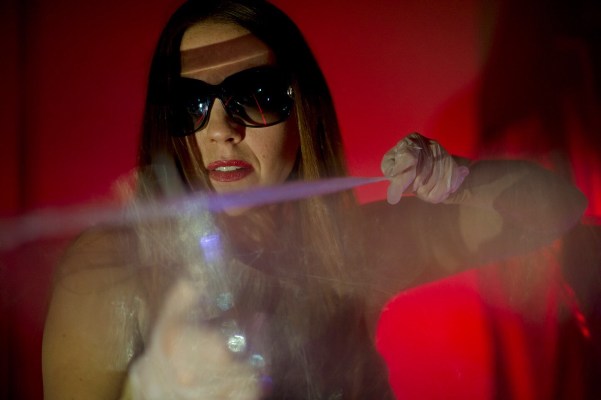
We don’t often see Antipodean theatre on the London fringe, but when we do, it’s certainly a bit different from British progressive performance. CUT, a cinematic, fragmented solo performance with elements of interactive theatre and immersive installation, effectively evokes a constant sense of unease but the range of styles and influences create a convoluted message. Technology is used effectively to maintain audience tension, with light and sound breaking up the narrative creating an extreme environment. But despite CUT‘s slickness and a fractured story that holds viewers’ focus, there is no clear reason why the story of an anonymous female flight attendant pursued by a male stranger is told. There is no predominant theme or message, just a story that, though it is told well, isn’t particularly dynamic or interesting.

Hannah Norris, an Australian actor based in London, is the only performer but the audience is a vital contributor to the piece so it’s easy to forget this is a solo performance. We are boarded onto a plane and accompany her throughout her shift and her subsequent journey home, with regular interruptions of nightmarish flashbacks, surreal characters, blackouts and loud noises. Norris’ character constantly narrates the journey, but it is never made clear what this episode from her life is meant to say. They man following her perhaps comments on male objectification of women, but it’s not particularly clear if this is an actual message of the piece – if that is the piece’s intention, it lacks conviction. The focus could just as easily be the possibilities of contemporary narrative structure influenced by pop culture and technology. The programme notes by writer/director Duncan Graham fail to elucidate despite an explanation of influences.

Regardless of the lack of clarity behind the piece, Norris is an excellent performer. She morphs and changes within the blackouts, always surprising and maintaining attention. Her timing and characterisation are impeccable within the often third-person text. Sam Hopkins and Russell Goldsmith’s design almost becomes characters within their prominence, but they do not overwhelm. The nerve wracking harmony between Norris, sound and light is exquisite.

With production elements that are much more impressive than the piece as a whole, CUT still has plenty of positives, but the story behind the suspense it creates is unsatisfying and anticlimactic. The narration and tech creates emotional distance, but perhaps the favouring of style over substance is too blunt for a British audience.

CUT runs through 31 July.

The Play’s the Thing UK is committed to covering fringe and progressive theatre in London and beyond. It is run entirely voluntarily and needs regular support to ensure its survival. For more information and to help The Play’s the Thing UK provide coverage of the theatre that needs reviews the most, visit its patreon.

Ugly Lovely, Old Red Lion

rsz_ffion_jones_and_sophie_hughes_in_ugly_lovely_c_velvet_trumpet_1-1

It’s Shell’s 26th birthday and she’s not happy. Her boyfriend Carl is AWOL and probably banging Smelly Kelly, her nan died recently, and she wants to leave Wales for the big city of Liverpool. Her best mate Tash is trying to convince her to stay, but her reasons are far from convincing. Shell is miserable, frustrated and angry. She feels the pull of adventure, but the tug of the sea she knows so well is strong, too. Shell tries to decide what to do as best she can – chatting with the urn that holds her nan’s ashes, going out clubbing and leaving her son Kieran with her mum. Ugly Lovely snapshots down-at-heel but aspirational Swansea with well-rounded characters who are excellently performed within a promising script, but it has a somewhat unsatisfying resolution.

This is writer Ffion Jones’ first play, and as debuts go, it’s a a rather good one. She’s built a sound narrative structure, though some trimming wouldn’t go amiss. The plot isn’t complex enough to warrant the current length or the interval, though too much cutting would rush the climax and dénouement. She has written detailed, nuanced characters with emotional depth that rally the audience’s support, but this leads to disappointment when Shell ignores her ambitions. Jones has an aptitude for sharp dialogue and dark humour, and there are some brilliant comedic moments within the characters’ misery.

Jones plays Shell, endowing the character with emotional truth and lived experience. Sophie Hughes as her best friend Tash is her cheerful sidekick, maintaining a wonderful sense of optimism despite an abusive home life. Oliver Morgan-Thomas rounds out the cast as their laddish schoolmate Robyn who is also doing the best he can to get by, though isn’t the nicest of individuals. His introduction leads to a brutal conflict and adds variation to the individual scenes’ structures, and his rough charm brings a great energy to the dynamic created by the women.

Nikolai Ribnikov’s direction is smooth and instinctive, and Lizzy Leech’s set enhances the gritty naturalism of their day-to-day lives. There is an awkward park bench that doubles as a couch, and the exposed toilet sits unused and exposed in a corner for most of the play, but adds additional dinginess.

This is a great little play that is remarkably polished for a new writer; it shows much promise even though it could use some tweaking. Jones is clearly a skilled theatre maker, and the rest of the creative team serves her script excellently. Production company Velvet Trumpet did exceedingly well in choosing this script, and Jones is certainly one to watch as both an actor and writer.

Ugly Lovely runs through 16 July.

The Play’s the Thing UK is committed to covering fringe and progressive theatre in London and beyond. It is run entirely voluntarily and needs regular support to ensure its survival. For more information and to help The Play’s the Thing UK provide coverage of the theatre that needs reviews the most, visit its patreon.
Savage, Arts Theatre

rsz_gary_fannin_and_bradley_clarkson_in_savage_at_the_arts_theatre_c_roy_tan

Denmark in the mid-1930s was a great place to be if you were gay. Homosexuality was legalized in 1933 and a thriving club scene allowed gay men to meet and socialize publicly. But as the dark cloud of National Socialism swept Europe, safety became more precarious. Dr Carl Vaernet was one of their threats. A practicing GP with an interest in hormone therapy, the Danish Nazi Party member soon captured the attention of party higher ups with his therapies that he claimed cured homosexuality. Hired to cure gay prisoners at Buchenwald late in the war, he experimented on seventeen inmates before the war ended and he escaped to Argentina.

Claudio Macor’s latest play Savage focuses more on the story of Nikolai and his American boyfriend Zack than Dr Vaernet, but the lovers are soon separated and Nik becomes one of the doctor’s victims. The emerging subplot of an SS officer and his secret, gay love slave quickly becomes just as important as Nik and Zack, making Savage more of a play about homosexuality in WWII than specifically about Dr Vaernet and his horrific medical experiments. Spanning several years and multiple narratives, the script, sadly, doesn’t give in-depth attention to any particular character; individual stories are disrupted and incomplete. This would be a much more compelling text if Macor focused attention on one primary character rather than taking a scattergun approach. All of these characters have potential to steer a rich, interesting play that focuses on them, but none of them get the full, individual attention they deserve. There are some great set piece scenes, but the overall structure lacks focus.

Some of the performances are inconsistent and the cast present a range of styles, which distracts from the seriousness of the plot. There are a few good performances, though. Gary Fannin cuts a cold, scientific Dr Vaernet with a clear disgust for gay people; this professional face of homophobia and calm hatred is a most chilling one indeed. Emily Lynne as the doctor’s nurse viciously opposes the Nazis and blatantly defies their rules in a display of ferocious persistence. She’s a great contrast to the doctor’s calm hatred. The two pairs of lovers have moments of genuine care for each other, whereas other times feel forced.

Jamie Attle’s costumes are sharp and detailed, whilst David Shields’ set of rotating panels clarify location but are a bit clumsy. Macor also directs, ensuring his political messages get across but an additional pair of eyes could have developed more intimacy between the couples.

Though the topic is most serious indeed, there’s a distinct lack of joy in the beginning cabaret scene and between Nik and Zack. Macor clearly wants to raise awareness of the horrors of Vaernet’s work, but some lighter moments of exposition would emphasise this further. A dramaturg would not go amiss in order to streamline the script and performance styles in future productions, but this premier still has potential and exposes a historical figure too easily forgotten amidst more prominent Nazi war criminals.

Savage runs through 23 July.

The Play’s the Thing UK is committed to covering fringe and progressive theatre in London and beyond. It is run entirely voluntarily and needs regular support to ensure its survival. For more information and to help The Play’s the Thing UK provide coverage of the theatre that needs reviews the most, visit its patreon.

Screwed, Theatre503

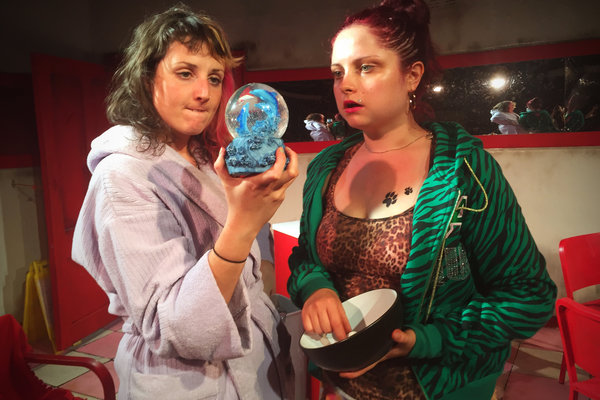
Char and Luce are free spirits who live their lives totally in the moment, but not in a happy, hippie sort of way. These inseparable 30-somethings work in a factory in Little England and spend their spare time clubbing, drinking and fucking. They have no life plans, just the immediate goals of getting pissed and getting off with blokes in toilets. Their line manager Paulo and Luce’s transgender mum Doris try their best to save them, but the self-absorbed duo don’t want to know. Kathryn O’Reilly’s debut play Screwed admirably endows women with stereotypically laddish behaviours, but there’s an uncomfortably judgemental tone taken on the lack of goodness within these women. The wonderfully biting dialogue and excellent performances from the cast of four easily seduce the audience, but the script’s message evokes troubling questions.

The two women are verbally abusive, physically violent and without a care for anyone else. Instant gratification is all that matters and they stop at nothing to get it. Their behaviour predictably catches up with them, but there’s little reform after disaster strikes. In contrast, the men in the story are as virtuous as the women are abhorrent. Why? What is this juxtaposition meant to say? Is it to prove that women can be just as bad a men? That male sensitivity is real and should be respected? That women should behave like this in order to feel empowered? Their working class background is obvious, though so is Paulo’s – but his ambition contrasts their lack of it. Is this a comment on social class as well as gender? There is clear reference to the  cycle of poverty, but it’s certainly not viewed with sympathy. All of these themes are raised, but none are particularly positive by the limited emotional range endowed on the duo. The harsh spotlight may be brutal and honest representation of working class, small town Britain but its sweeping generalisations about women and social class are unclear at best, and worrying at the worst.

Samantha Robinson and Eloise Joseph are Char and Luce. Their attack on the roles is positively electric, as is their chemistry and threat to anyone that crosses their path. Stephen Myott-Meadows  as Paulo is a quiet romantic with a biblical capacity for forgiveness. He’s the Nice Guy that always gets friendzoned, taken advantage of, and keeps coming back for more in the hope that things have changed. They never do, and his hurt is inevitable. In this case, it’s horrific. Derek Elroy is Luce’s saintly mother, unappreciated by her daughter, who still lives with her despite being in her third decade, on a daily basis. Elroy’s calm is a fantastic foil to Luce’s viciousness. 

Catherine Morgan’s simple set is a remarkable continuous line that forms the landscape Char and Luce barrel through on a day-to-day basis. As soothing to look at as Elroy’s voice is to hear, it’s metallic smoothness is a reminder of the connection between all things in the world. The girls’ behaviour might seem trivial on a small scale, but it deeply effects those closest to them.

Screwed is a difficult play to pin down. On the surface, it’s fantastic. But upon pondering what O’Reilly wants to communicate, it becomes more troubling, a judgment of male and female behaviour within working class suburbia. There is clear moralising, but the moral of this story is not a comfortable one to take in.

Screwed runs through 23 July.

The Play’s the Thing UK is committed to covering fringe and progressive theatre in London and beyond. It is run entirely voluntarily and needs regular support to ensure its survival. For more information and to help The Play’s the Thing UK provide coverage of the theatre that needs reviews the most, visit its patreon.
Maggie and Pierre, Finborough Theatre

https://i0.wp.com/www.theartsdesk.com/sites/default/files/imagecache/mast_image_landscape/mastimages/KellyBurke5_PhotoByAshley%20Carter_REDUCED.jpg

It’s easy to see why Justin Trudeau is one of the darlings of world politics these days. This charming former teacher, actor and advocate, turning to politics after his father’s death, identifies as a feminist, wants to legalise marijuana, is pro-choice, gay friendly and committed to the rights of the First Nations and other minorities. Canada’s liberal prime minister attracts groups of screaming fans wherever he goes both nationally and internationally, like any pop star. But where did these attributes come from?

His parents. Maggie and Pierre Trudeau, who met whilst holidaying in Tahiti in the ‘60s when she was a mere 18 years old, were THE Canadian celebrity couple of the 1970s. Pierre was, like his son after him, the prime minister of Canada. Their relationship was flawed, though. Maggie, young, free-spirited and bipolar, soon felt trapped by family life as her intellectual husband busied himself with work. The press’s constant presence also took its toll on their relationship, which the public then poured over in microscopic detail. In 1979, Linda Griffiths’ and Paul Thompson’s Maggie and Pierre premiers, a solo performance tribute to this enigmatic couple. It runs off and on for many subsequent years, a testament to the pair’s appeal.

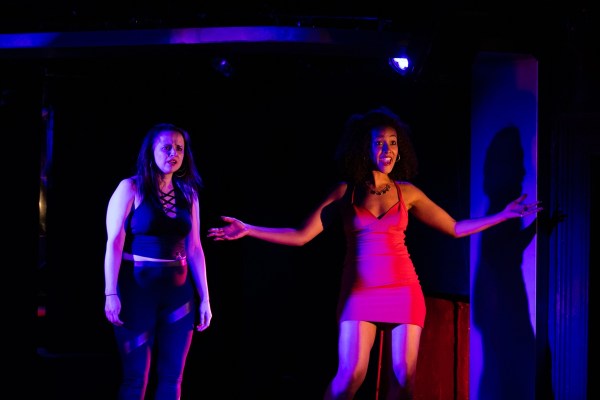
The script feels quite contemporary, but other than for the purpose of historical documentary, its purpose isn’t clear all these years later. Though the two meet, fall in love and navigate their relationship, life in the spotlight, and the press, there’s no overriding message. It’s unclear why this story needs to be told. It’s a solid narrative over many years with moving insight into these historical figures, but the social and political commentary are limited to brief reflection on their relationship with the press. Perhaps this play would be more satisfying to Canadians or those that already know of the Trudeaus, but for audiences that have never before heard of this couple, there is little impact. It reads like an autobiography. Outstandingly performed by Kelly Burke and worth seeing for her intricate work alone, there’s the feeling that without her, the play would be disappointing.

Burke plays Pierre, Maggie and journalist Henry whose career has hinged on his reporting of their every move. Even though director Eduard Lewis incorporates numerous costume changes to signify a character change, Burke’s physical and vocal mannerisms completely transform into each respective character. It’s a wholly compelling process, a masterclass in performance. Her energy and commitment never falters and her presence is magnetic.

Designer Sarah Booth’s set is simple, but a confusing mix of abstract and functional elements. A huge, bright red quilt with Pierre’s slogan takes up half the stage and is only referred to once, near the end. Its visual dominance is impossible to ignore but it has hardly any bearing on the story. However, Booth’s creation of a bed that’s revealed from a nondescript cupboard is a great device. Philip Matejtschuk’s composition and sound design adds further depth, emotion and context that the set avoids, giving the show a more rounded, polished feel.

As a documentary artefact, Maggie and Pierre is no doubt a learning experience. The couple’s history is an interesting one and the love story is universally relatable. Kelly Burke’s performance is a wondrous thing to experience though, and more than redeems any of the production’s inadequacies.

Maggie and Pierre runs through 5 July.

The Play’s the Thing UK is committed to covering fringe and progressive theatre in London and beyond. It is run entirely voluntarily and needs regular support to ensure its survival. For more information and to help The Play’s the Thing UK provide coverage of the theatre that needs reviews the most, visit its patreon.

The Doctor in Spite of Himself, Drayton Arms Theatre

The Doctor in Spite of Himself (c) Ulysse Beauvois (3)

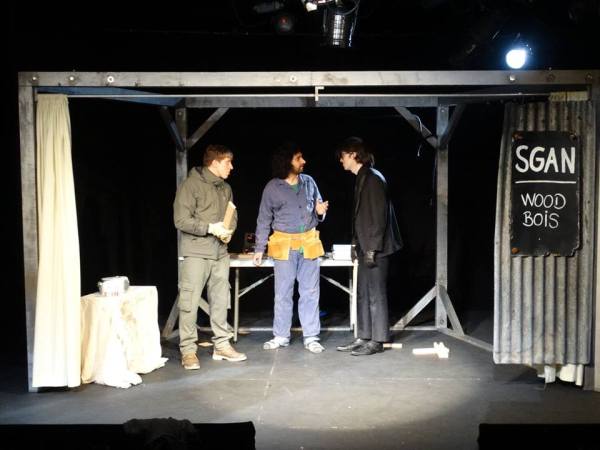
When the abusive, drunken woodcutter Sganarelle beats his wife one time too many, she takes advantage of passing strangers looking for a doctor to cure a young woman’s mysterious illness. Telling them she knows just the man, an eccentric but renowned man of medicine, sets the ball rolling on an absurd adventure of lust, remorse, and blagging it. Exchange Theatre, a French company based in London, have adapted Moliere’s The Doctor In Spite of Himself into a 75-minute contemporary version loaded with metatheatre, energy and good leading performances from a French cast. Plenty of slapstick, detailed design and Shakespearian influence make this a fun, easy to watch adaptation of the French classic.

Actor-director David Furlong plays Sganarelle with a goofy, watchable charm. His undeniable charisma is at odds with the unlikeable character, though his comeuppance and subsequent reform are a somewhat satisfying narrative despite the anti-feminist premise from the 1660s. Furlong is by far the strongest in the cast, but the others are generally good. Anita Adam Gabay as the mostly mute Lucinda exudes a sweet innocence, particularly in the opening montage where she discovers her betrothal to a man she doesn’t love. Matt Mella is the hilariously dumb Lucas, able to evoke laughter with a well-timed pause and a blank look. Some of the actors find it hard to connect to the language in English at times, but these jarring moments are fairly infrequent.

The edited plot occasionally feels rushed and overly compact, though it’s easy to follow and the translation uses relatively modern English. The excused wife beating is uncomfortably old fashioned, but at least it’s ridiculed – along with medicine and the gullibility of the upper classes. These themes translate fairly well to the modern day and English culture, especially considering the Shakespeare-esque comedy sequences that are likely to have drawn on the same commedia del’arte heritage that Shakespeare did. Furlong updates even further by adding in discreetly funny elements of self-reference, even if they don’t always work. The bust of Moliere as a weapon is cute, but characters dictating text to others from an anthology of Moliere plays isn’t as effective and causes energy to drop.

The design, presumably also by Furlong, incorporates an Elizabethan stage-within-a-stage to emphasise the metatheatre and clarify location. It’s clever and looks great, though it causes some difficulties with sightlines and narrows the playing area. Furlong’s overarching concept of using the metatheatre to create distance is a strong one what with its acknowledgment the absurdity of the story and the plot points that don’t work in a present day context.

This production of The Doctor in Spite of Himself is a funny, palatable adaptation of Moliere for London audiences. It’s a good laugh, a good length and has good performances. The company’s talent and vision is highly commendable and deserving of larger production values; their commitment to bringing audiences high quality French theatre in intimate venues makes them one to watch.

The Doctor in Spite of Himself runs through 17 July with performances in both French and English.

The Play’s the Thing UK is committed to covering fringe and progressive theatre in London and beyond. It is run entirely voluntarily and needs regular support to ensure its survival. For more information and to help The Play’s the Thing UK provide coverage of the theatre that needs reviews the most, visit its patreon.
The Alchemist, Rose Playhouse

rsz_flyer-front

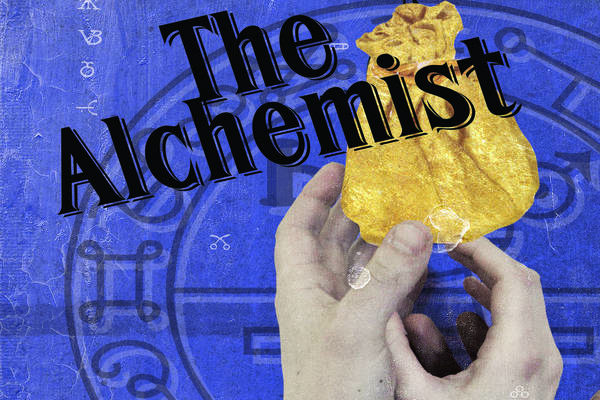
When butler Jeremy’s master goes out of town, he transforms himself into Captain Face and recruits his comrade in deceit, Subtle the Alchemist, to help him make a quick buck from gullible townsfolk. Aided by the local prozzie Doll Common, the three create bespoke schemes for each potential customer. Their plans spiral out of control and the risk of discovery becomes all too real in typical Jacobean comedy format, but also typical of the style, it all ends well – or as much as it can for the victims of their scams. With jokes that come quick and fast in this surprisingly straightforward story, it’s a fun, light-hearted play that needs clear direction to succeed.

Though The Alchemist can be considered Ben Jonson’s best play, it doesn’t get staged often. The slapstick comedy satirising a cross section of Jacobean society is swift, easy to follow and jolly so it deserves much more stage time than it receives. In Mercurius’ strongest of their last three productions, an energetic cast fully commit to the stock characters’ hijinks and trickery with clear staging and character doubling. Jenny Eastop’s direction is tight and precise, though altering the time period from the original is gratuitous and occasionally inconsistent with the text. This light production of a rarely staged play is a midsummer treat with few shortcomings.

The cast of eight are a generally tight ensemble with good chemistry. Peter Wicks as Jeremy/Captain Face has a commanding presence and wonderful speaking voice that is easily watchable. Benjamin Garrison as Subtle is a delightfully flamboyant foil but with the character having less to lose, he has less depth. Alec Bennie as Surly is the star of the supporting roles, playing the posh sceptic with a dry, steely wit. Charlie Ryall is strong as the feisty nun Ananias, but her disinterested Widow Pliant is harder to engage with.

Eastop’s choosing to set the play in the 1800s is justified in the programme notes, but with a play that is so undeniably Jacobean in its style, the costumes (that are in a poorly made/maintained state and betray a lack of time and/or budget) look out of place, particularly next to some set pieces that look much older. Nothing other than the characters’ dress indicate a change in time period, and as such, the adaptation contributes nothing to the understanding of the play. She also, nonsensically, reinvents two protestant characters as nuns who have derogatory dialogue about the Catholic Church. Despite the change in setting, this choice is painfully jarring. Otherwise, Eastop’s direction and choreography is well paced and takes advantage of the script’s inherent comedy.

This production suits the Rose Playhouse’s unique structure well, with the rear of the site being used occasionally for comic effect. Placing most of the action on the small stage in close proximity to the audience makes these larger than life characters all the more exaggerated, further emphasising the stereotypes that the play relies on for laughs. With a good cast and intuition for light comedy, The Alchemist makes for some excellent entertainment.

The Alchemist runs through 30 June.

The Play’s the Thing UK is committed to covering fringe and progressive theatre in London and beyond. It is run entirely voluntarily and needs regular support to ensure its survival. For more information and to help The Play’s the Thing UK provide coverage of the theatre that needs reviews the most, visit its patreon.
Karagula, Styx

Karagula at The Styx, courtesy of Lara Genovese @ Naiad Photography, Charmaine Wombwell

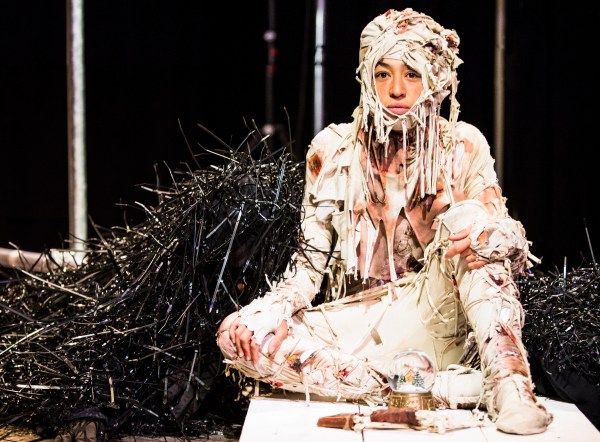
In a former ambulance depot in Tottenham Hale, Philip Ridley’s latest creation comes to life. This epic parallel world of wholly isolated nation states resembles the worst dystopias imaginable in contemporary fiction. Mareka is a 1950s America with laws enforced to the letter by the Grand Marshall, everyone wears pink, and milkshakes are consumed with religious zeal. Cotna is the future, where people are have numbers instead of names, and watching meteor showers without protective eyewear causes you to hear voices. Then, there’s a community of exiles in the mountains, living in caves, wearing skins, and praying to pre-Christian gods. A storyteller/historian in yet another time and place documents these people and their trials.

These kingdoms have a lot of detail, and a lot of emptiness. The story sprawls over three hours, zipping back and forth across time and place, leaving a swirl of slow understanding, further questions and obvious metaphor in its wake. The text is rich and beautiful, fragmentary and challenging, but it’s only partially reinforced by design. A scaffolding base reveals occasional moments of visual detail, but they generally pale against the language. Karagula is equally marvelous and horrible, an experience for all the senses with stories that enthrall and disturb in equal measure. But Ridley’s Tolkien-esque ambition never reaches its full structural potential.

Individual scenes are just as likely to delight as they are to be forgotten. If Karagula was a tapestry, it would be patchy and moth-eaten in some areas, others would have exquisite embroidery, and still others would be completely plain and ill-fitting. The gaping plot holes leave room for interpretation, but the better scenes feel all the more out of place. Ridley either needs to pare the script right back, or add another couple of hours to join up these worlds more fully. The whole experience is equally delightful and frustrating.

Nine actors play all roles in some exemplary multi-rolling. Producing company PigDog is committed to diversity in casting and audiences, and this cast is admirably so. Obi Abili is a terrifying brutal Grand Marshall in Mareka. Emily Forbes is the fiery leader of the mountain outcasts, initially motherly, then ruthless. Lynette Clarke is similarly versatile, as a flamboyant and vicious Marekan and a cold number in Cotna. None of the ensemble ever let their energy drop; their work is just as fantastic as Ridley’s best scenes.

Director Max Barton approaches the text with clear vision and choices that aid clarity, even in the muddiest sections of text. Designer Shawn Soh has moments of brilliance (beasts with coats of cable ties and a throne of gears and propellers for the narrator are fantastic surprises), but the shoestring budget is noticeable in the inconsistent application of detail.

Despite it’s issues, Karagula packs an emotional punch with social commentary and nihilistic fortune telling. Mareka foreshadows a Trump-led America, and Cotna is a land where technology has ushered in the loss of individualism. There are moments of wonder and horror, and sheer bafflement. Philip Ridley’s vision is commendable, but the execution isn’t quite there, leaving the audience partially sighted. It’s a wondrously alive and human production and like any given human being, it has it its faults and its virtues.

Karagula runs through 9 July.

The Play’s the Thing UK is committed to covering fringe and progressive theatre in London and beyond. It is run entirely voluntarily and needs regular support to ensure its survival. For more information and to help The Play’s the Thing UK provide coverage of the theatre that needs reviews the most, visit its patreon.
Gertrude – The Cry, Theatre N16

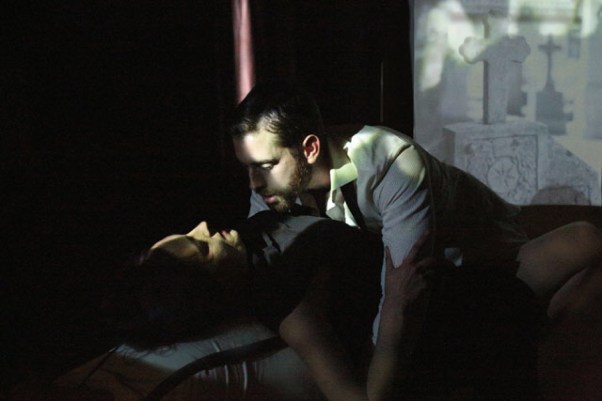
Shakespeare’s women never get the attention they deserve, even the more interesting ones. The deranged, damaged and dynamic are often maligned and infrequently on stage. Margaret, Lady Percy, La Pucelle, and so on have moments of brilliance, but are then hushed, relegated in favour of men. Howard Barker rescues Hamlet’s Gertrude from Shakespeare’s sidelining in his 2002 play, Gertrude – The Cry, but his depiction is hardly a favourable one. Though he places Hamlet’s mother at the forefront of his narrative, he paints her as an unfeeling, sex-crazed creature in a fetid nest of similarly awful people. Overt sexual acts and poetic, obscure language are plentiful, but this actually a rather dull and overly long script is hard to digest.

Director Chris Hislop utilises the irregularly-shaped Theatre N16 incredibly well with a small traverse stage, placing the action in the laps of the front row and evocative projections at one end. Felicity Reid’s set is white, with a minimalistic plinth functioning as various pieces of furniture and locations. Clean and stark, it suits the characters’ emotional detachment from everything other than their own ambition.

Liza Keast as Isola, Queen Mother to the dead King Hamlet and his brother Claudius (Alexander Hulme), and servant Cascan (Stephen Oswald) are supporting characters but give leading performances. Oswald in particular finds an honesty and depth not present in the desperation of the others. Isabella Urbanowicz as the titular Gertrude has a magnetic presence, but lacks chemistry with Hulme’s Claudius – though this is due to Barker’s script, not a lack of ability on the actors’ part.

The text is the production’s week point. At least half an hour too long, the dense, awkward language says little. Self-absorbed, maniacally driven characters who lack empathy and dimension rant and fuck, wash, rinse, repeat. Little actually happens, as if Barker didn’t really have a concrete idea on how to go about paralleling Shakespeare’s Hamlet from Gertrude’s perspective. Though Hislop’s choice to withhold an interval is the right one in terms of pace and energy, two hours with little linguistic variation and plot progression is an endurance test for both actors and audience.

Whilst Barker’s attempt to reconfigure Gertrude is admirable, this female-led play is hardly feminist. Her sexuality is her downfall rather than her freedom, and the men in her life entrap as much as they do in Shakespeare’s original story. Ragusa (LJ Reeves), the parallel to Ophelia, is essentially a sex slave purchased for Hamlet who is eventually driven mad by his infantile whinging and the abundance of malfunction in the household. Rather than presenting an alternative, progressive view on female sexuality, it comes across as crass and misunderstood.

This is a good production of a rarely-staged play, but it’s clear why it’s so obscure. Most interesting from an academic perspective, Barker’s Gertrude – The Cry isn’t a particularly good text.

Gertrude – The Cry runs through 30 June.

The Play’s the Thing UK is committed to covering fringe and progressive theatre in London and beyond. It is run entirely voluntarily and needs regular support to ensure its survival. For more information and to help The Play’s the Thing UK provide coverage of the theatre that needs reviews the most, visit its patreon.
Spill, Pleasance Theatre

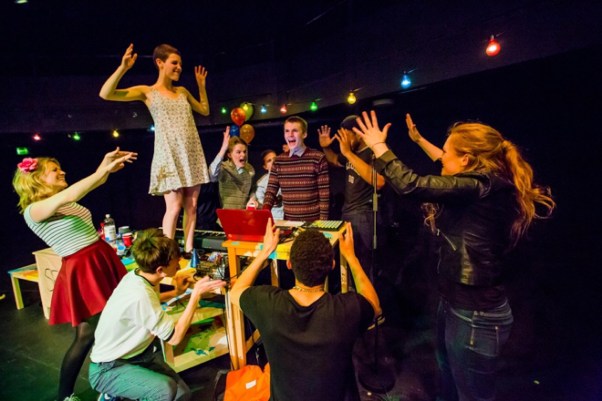
Discovering sex is probably one of the most definitive moments of a young life. Good, bad or indifferent, everyone remembers their sexual awakening. Masturbation, losing your virginity, rape, fantasies, dating, sexual identity and a handful of other topics come up in Propolis Theatre’s Spill, with a cast of eleven young theatre makers from Bristol. This verbatim piece is sweetly naive, but wittily blends music, song and a bit of delightful puppetry into the edited interview text, effectively breaking up the interweaving monologues. Though the material isn’t cutting edge or particularly interesting to more “experienced”, older audience members, Spill is well executed and full of heart.

Verbatim theatre created from the answers to interview questions can be tedious to sit through due to the first-person narratives and lack of dialogue between characters. Even chopped up and interspersed, engagement between performers often feels forced, if it’s there at all. Actors can stand there actively listening to each other as much as they like, but there’s still no getting away from the perceived self-involvement that comes from talking extensively about one’s own experiences. 

Propolis uses this format as the base, but they effectively utilise music, spoken word and song to emphasise particularly poignant moments and counter any potential monotony. Abstract movement sequences give the eye something engaging to take in, particularly when they’re as well executed as they are here. These devices make the piece much more interesting and able to hold audience attention for its duration. This fluid, changing form they have created is by far the most dynamic aspect of the production.

The eleven-strong ensemble never looks crowded; their choreography and staging is pleasingly slick. A simple set is colourful and striking, finding the balance between overly simple and excessive.

There is nothing innovative about the script though, particularly for an audience past their early twenties. Spill feels like it could be a TIE piece for 6th formers or freshers who are more likely to immediately relate to the stories of self-discovery. They otherwise come across as adorably nostalgic, even played by the young cast. There’s a good amount of humour and reflection in the language, and it’s admirably diverse and inclusive. 

Spill is certainly a polished piece of theatre that employs a some great devices, but the form and structure is more exciting than the content. It has clear potential as a touring show, though it will resonate much more with young people.

Spill runs at Edinburgh Fringe through August.

The Play’s the Thing UK is committed to covering fringe and progressive theatre in London and beyond. It is run entirely voluntarily and needs regular support to ensure its survival. For more information and to help The Play’s the Thing UK provide coverage of the theatre that needs reviews the most, visit its patreon.