Sea Life, Hope Theatre

I always think life in a British seaside town must be idyllic. Quaint and friendly, with the smell of chips, ice cream and salt in the air, the sun always shines and people share a friendly smile as they pass families playing in the sand and surf.

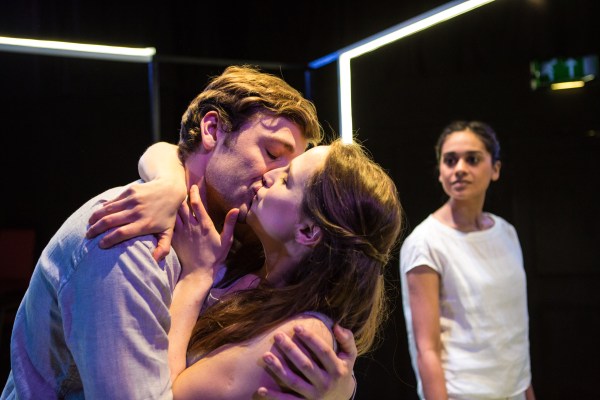
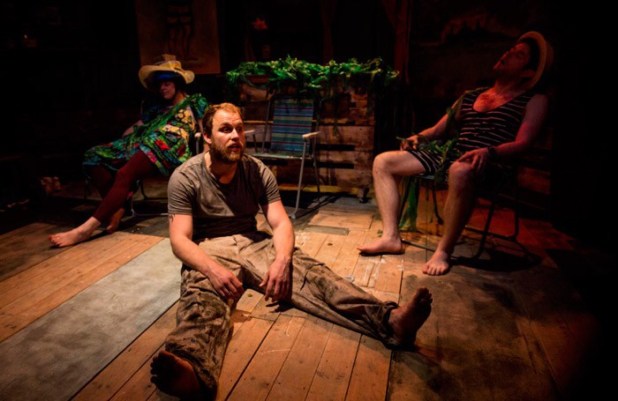
I know the reality is completely different. Broken economies are driving young people away, there are instances of racism and small mindedness, as there are everywhere else inland. Lucy Catherine’s Sea Life, set near Dover, captures this stark reality with three disfunctional, adult siblings in a town that’s literally and figuratively falling into the sea. Roberta is the agoraphobic fantasist who runs the family’s bar that never has customers. Her inappropriately clingy twin Bob builds coffins to inter the local cemetery’s residents that must be cremated before the cliffside where they rest crumbles into the channel. Their lone wolf brother Eddie, a failed artist, is one of a team tasked with digging up the dead. Their long-dead mother’s looming reappearance, constant rain and an anonymous American company that’s taken over the town’s economy has pushed these three to a breaking point that results in poetic, disturbing tragedy of classical proportions that’s also really rather funny. 

Catherine’s script is full of punchy, ferocious dialogue, constantly pulled taut by Matthew Parker’s direction. The three characters have radically different ways of coping (or not coping) with their dead-end lives, causing a natural undercurrent of tension that regularly erupts. The storyline is wonderfully unpredictable and increasingly macabre, though never implausible. Catherine’s gift here is showing a scenario that both feels like a work of fiction, and something that could totally happen under the perfect combination of circumstances and personalities. A couple of false endings detract from what could otherwise be a brilliant script, but the cathartic ending keeps things from being excessively dark.

The trio of actors have good chemistry, particularly twins Roberta and Bob (Vicky Gaskin and Chris Levens) who are uncomfortably close. Jack Harding as Eddie is an extraordinary pressure cooker who’s explosion is satisfyingly horrific to take in. 

Laura Harling’s set design is a fantastically detailed example of the possibilities able to be achieved in a tiny performance space. There is some slightly cheesy movement work that could otherwise be communicated with sound and lighting, but this is brief and the overall visual effect certainly adds to the play’s truthfulness.

Sea Life is a polished little gem of a play, and an excellent showcase for actors and designers alike. It’s not perfect, but Catherine’s script and Parker’s direction are a near-perfect example of contemporary naturalism.

Sea Life runs through 11 June.

The Play’s the Thing UK is committed to covering fringe and progressive theatre in London and beyond. It is run entirely voluntarily and needs regular support to ensure its survival. For more information and to help The Play’s the Thing UK provide coverage of the theatre that needs reviews the most, visit its patreon.

Leftovers, Theatre N16

What would you do if the country was as war and under attack? Would you join up and fight? Or would you run? If you left, where would you go? 

Protagonist Elizabeth lives in London with her husband Harry, who she met whilst feeding the residents of her local duck pond. Their romance is a proper fairytale, until the war starts. Writer Gabrielle Sheppard goes on to reveal the impact of the war on Elizabeth and Harry, and simultaneously shows Elizabeth’s ideal life that could have unfolded without the looming threat of attack. It’s a clever, Sliding Doors-esque device from Sheppard, though the understandable inclusion of Elizabeth’s mental trauma muddies the narrative – what is real? What are her delusions? These parallel worlds often overlap and blur, adding to the confusion. But maybe that’s the point. The refugee experience is hardly one of calm and clarity, and the disorientation of the narrative and dialogue has potential to foster empathy and understanding. It could also alienate, with the production being written off as unclear and poorly written, but hopefully this is a less likely interpretation. Leftovers is an intuitive, short piece of theatre with the ability to pluck at the heartstrings and present refugees as human beings who feel love, pain and want safety for those they love the most.

Sheppard also plays Elizabeth, showing her journey from a young woman in love to a damaged vessel who has lost everything, with great nuance and pathos. She has lovely chemistry with Christopher Adams (Harry) and Ella Cook, who plays her dog and her grown daughter. 

Director Dimitris Chimonas incorporates movement sequences mainly composed of running on the spot. There’s some nice abstract, gestural work to add variation but the running is the focus. The metaphor is clear, and effectively transitions between the episodic scenes. The set, mountains of clothing, are physically obstructive but a nice representation of everything refugees have to abandon in favour of safety.

At under an hour, Leftovers feels like it has a lot more to say, with the potential of becoming a fully formed, epic love/war story. The concept is a sound one, but further clarity and lengthening wouldn’t go amiss.  The two producing companies, Hounded and Ugly Collective, are certainly worth keeping an eye on. 

Leftovers is now closed at Theatre N16.

The Play’s the Thing UK is committed to covering fringe and progressive theatre in London and beyond. It is run entirely voluntarily and needs regular support to ensure its survival. For more information and to help The Play’s the Thing UK provide coverage of the theatre that needs reviews the most, visit its patreon.
Dea, Secombe Theatre

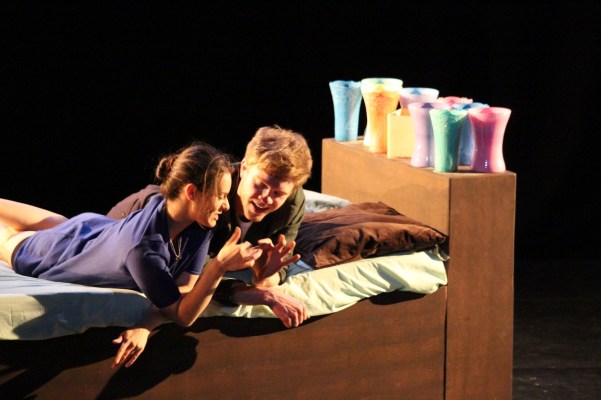
It can absolutely be said Edward Bond was a revolutionary of 1960s British theatre with his seminal play, Saved, that was a pivotal role in abolishing censorship. It can also not be doubted that he endured unspeakable horror as a child in WWII London. Still yet, it can be said that Bond’s work, that used to shock and appal, is now trite and bland despite his latest play’s copious obscene acts that are tenuously based on Medea. This production, bizarrely premiering at a theatre in Sutton, manages to be extremely violent and epic, whilst simultaneously terribly boring and pedestrian. Dea is also directed by Bond and, clocking in at over three hours with two intervals, is a self-indulgent, laughable affair desperately in need of an outside eye and feels more like three days. Though commendably anti-war and with some solid performances, Dea’s downfall is Bond’s dated aesthetic, self-importance, and lengthy, rambling scenes that are full of sound and fury, but say very little.

Five minutes into the first act, Dea (Helen Bang) commits a senseless act of infanticide that leads to her banishment, dooming her to wander the earth for the rest of the play. Though presumably aimed at her self-absorbed, army officer husband, her actions are entirely unjustified. Bringing destruction wherever she goes, Dea lacks the abilities to empathise or emotionally connect with others. Her husband (Edward Avison-Scott) is of similar ilk, though at least he manages to react to his children’s murder and send Dea away. Otherwise, this first scene is made rather uninteresting by flat, stilted dialogue. Neither character listens to the other, and the babies’ (cheap looking dolls) murder is badly staged. The rest of the act is about 16 years later and crowbars in incest, fellatio, rape and murder. Again, these are without justification, and again, the script lacks life. Bond seems to use his dialogue to frame the violence rather than communicating anything of any depth.

The subsequent acts are in the Middle East at a British army camp with less of a focus on Dea and more on the horrors of war. Bond chucks in necrophilia, more rape, a suicide bombing and cocks-out masturbation to pad Dea’s nonsensical quest to find a lost family member. With what’s on the news and the Internet these days, none of it shocks. Bond’s naivety in thinking it does is rather sweet. 

Bond’s ideas about the state of modern theatre are less sweet though. In fact, they’re blatantly offensive. He yearns for the good old days when people went to the theatre to be enlightened and educated, and theatre had something to say about the world. The programme notes laughably state, “I write of the rape of a corpse with a beer bottle to bring back some dignity to our theatre.” If Bond thinks our theatre lacks dignity and important messages, then he is out of touch with contemporary theatre, especially small scale and fringe work. This detachment from the real world is evident in Dea, what with the length and gratuitous violence that has absolutely no point.

Helen Bang does some great work at sustaining Dea’s fierce coldness, and her gradually loosening grip on reality is meticulously crafted. Despite awkward dialogue and some moments of unnatural delivery, she has a powerful presence and dominates the stage. Avison-Scott pales in comparison, though Joylon Price as her son Oliver isn’t far off measuring up to her. Oliver is the best written and most interesting character in the play, though is disposed of entirely too soon. The soldiers in the second act are mostly generic, though David Clayton as the PTSD-suffering Cliff in the final act does his best to make the character more well-rounded. Bond misses an opportunity to give the soldiers on the front line of modern desert warfare the depth that could move the audience to rage about their treatment and behaviour. 

Basically, Dea is a sad mess that thinks it’s radical and edgy but in trying so hard to shock, it comes across as absurd and pathetically out of touch. Bond thinks theatre lacks dignity? He needs to open his eyes to the vapid, grovelling dreck that he created.

Dea runs through 11 June.

The Play’s the Thing UK is committed to covering fringe and progressive theatre in London and beyond. It is run entirely voluntarily and needs regular support to ensure its survival. For more information and to help The Play’s the Thing UK provide coverage of the theatre that needs reviews the most, visit its patreon.
Human Animals, Royal Court

https://i0.wp.com/www.officiallondontheatre.co.uk/servlet/file/store5/item365300/version1/fileservice770/365300_770_preview.jpg

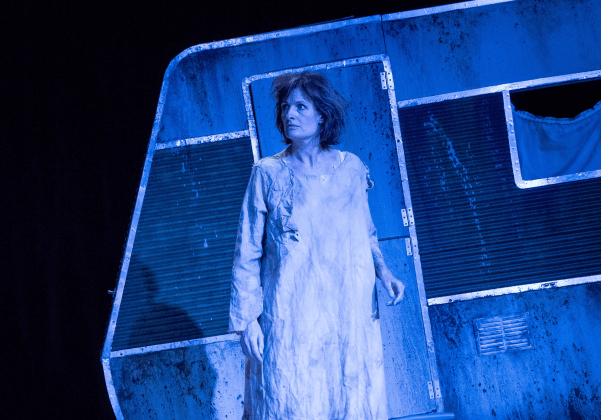
I adore animals, certainly more than I like humans, and I think I missed my calling to be a zookeeper or conservationist. I can’t bear any depiction of animals being harmed on stage or film; even mentions of animal abuse is hugely upsetting. So, I found Stef Smith’s Human Animals a pretty horrible ordeal. Smith’s frantic, apocalyptic story captures society’s instinctive, “Must. Destroy. Everything.” response to the natural world threatening contemporary human sovereignty. As the government wreaks havoc on the natural world in the name of security, half a dozen civilians have a range of reactions to the animal population’s invasion of their homes. This visceral, destabilising drama blasts the audience with 75 minutes of shocking, reactive action as the infection spreads across species, but with the fast pace and constant suspense, it’s difficult to relate to any of the characters. Canny design avoids much mess and graphic depictions of the described carnage, but the narrated horror is all too easy enough to imagine from most modern nations, and his highly disturbing on several levels.

Lisa (Lisa McGrills) and Jamie (Ashley Zhangazha) are a young couple supposedly very much in love, though lacking chemistry. Lisa doesn’t like animals much, so isn’t fazed when the government starts killing off the wild ones who are trying to invade people’s homes. She’s had enough of birds smashing into her windows and either dying or injuring themselves. Jamie can’t handle the ruthless killing; his collapse is well written and convincingly performed. Lisa’s boss Si (Sargon Yelda) is one of “them”, a vile, slimy little man profiting from the disaster. Young activist Alex (Natalie Dew) has just returned from travelling abroad, but mum Nancy (Stella Gonet) still tries to treat her as a child. There’s a lot of gorgeous intimacy and tension between them, often diffused by their genial family friend John (Ian Gelder), who clashes with Si regularly in the local boozer. Otherwise, there is little contact between these conflicting personalities, but the reactions from each character to the growing destruction are heartfelt and saddening.

Smith’s best writing is her conflict scenes between the characters. The rest certainly isn’t bad at all, but the storyline requires either depicting the violent extermination of animals or copious narration. Her choice is understandable and, though well incorporated into natural dialogue, there’s a lot of describing. The design team (Camilla Clarke, Lizzie Powell and Mark Melville) work with director Hamish Pirie to break up the text effectively, with sound, lighting, projection and jets of paint constantly interrupting and surprising/startling the audience. Being constantly kept on edge for over an hour is exhausting, with the story causing additional trauma. As horrible as it is, the whole effect is intricately constructed and totes a powerful message.

Also of note is the set design. The cast and audience are inside a zoo-style animal enclosure, disempowering the characters and trivialising their problems because the outside world is dominant and ever watching. Though the set does not literally indicate the characters’ world and gives no hints of the government-ordered extermination and arson that they describe, its tranquillity is calmly sinister.

The production elements and dialogue are excellent, through the relentlessness of Human Animals can alienate – but that’s the point. It’s terrible, clever commentary on contemporary environmentalism, fear of social disorder and individuals’ reactions to what is effectively a civil war and its strong effect will be long remembered by this animal lover.

Human Animals runs through 18 June.

The Play’s the Thing UK is committed to covering fringe and progressive theatre in London and beyond. It is run entirely voluntarily and needs regular support to ensure its survival. For more information and to help The Play’s the Thing UK provide coverage of the theatre that needs reviews the most, visit its patreon.


A Subject of Scandal and Concern, Finborough Theatre

George Jacob Holyoake, a pioneer in the British secularism movement, was the last man ever to be tried and sentenced for blasphemy in the UK. After an engagement in Cheltenham in 1842, the travelling lecturer and teacher found himself the subject of a damning newspaper article that caught authorities’ attention. John Osborne fictionalised the fiery young man’s story in a 1960 television drama, now largely forgotten in the wake of his popular plays. Production company Proud Haddock has resurrected the script, an hour-long tirade against religion and the establishment, in an excellently performed and staged production. A Subject of Scandal and Concern lacks finesse, though. It choppily covers a lengthy time period and all of the characters, save for Holyoake, are underwritten and underused. The story is engaging despite Osborne’s plot structure, and Jamie Muscato is a magnetic Holyoake that redeems this historical relic.

After a brief narrative monologue that is largely unnecessary, a moving scene between Holyoake and his wife indicates this is going to be a domestic poverty-drama. The story goes a completely different direction however, instead focusing solely on Holyoake’s subsequent speech, arrest, trial and imprisonment. With moving courtroom scenes and a tenacious spirit, the character is well-written and detailed. The rest of the characters frustratingly lack his depth and stage time, each only appearing a few times, if that. Multi-rolling gives the actors plenty to do, but this would be a far more interesting play if Holyoake had more substantial characters to engage with. There isn’t much in terms of a journey for any of the roles, instead Osborne uses the narrative to make a strong statement against organised religion and its death grip on Western society. This is agit-prop rather than effective storytelling, and a less able cast would make this a boring play indeed.

Jamie Muscato does a fantastic job with Holyoake, particularly in the courtroom scenes, and the rest of the cast are a smooth ensemble of devout resistance against him. Muscato’s flawless embodiment of his character’s tenacity and struggle is a masterclass in detailed characterisation. It’s a shame there isn’t enough opportunity for the other actors to showcase their ability in the same way, though there work is still very good. Their commitment to their characters is the saving grace of this production.

Philip Lindley’s set is a simple collection of slatted boxes of varying sizes and shapes that cleverly evoke a kitchen, a courtroom, a prison, and the club where Holyoake speaks. Their rearrangement is simply choreographed by director Jimmy Walters and choreographer Ste Clough, but there is missed potential for more poetic stylisation evoking Holyoake’s fight against the society that is threatened by his godlessness.

Though the generally unknown A Subject of Scandal and Concern disappointingly reinforced why it isn’t more frequently produced, Walters’ staging and the cast’s performances prevent this production from being flat and dull. It’s quite the opposite, and worth seeing for the excellent, intense performances in an intimate venue.

A Subject of Scandal and Concern runs through 11 June.

The Play’s the Thing UK is committed to covering fringe and progressive theatre in London and beyond. It is run entirely voluntarily and needs regular support to ensure its survival. For more information and to help The Play’s the Thing UK provide coverage of the theatre that needs reviews the most, visit its patreon.


Interview: Chris Hislop on Barker’s Gertrude

https://i0.wp.com/mytheatremates.com/wp-content/uploads/2016/05/600x425Izabella-Urbanowicz-as-Gertrude-Gertrude-The-Cry-at-Theatre-N16-c-Roy-Tan.jpg

“It is impossible – now, at this point in the long journey of human culture – to avoid the sense that pain is necessity…that it is integral to the human character both in its inflicting and in its suffering…” – Howard Barker

Howard Barker is no stranger to sex and violence. His 2002 reimagining of Shakespeare’s Hamlet places the prince’s mother and her sexuality centre stage in a divisive interpretation of the character who receives little attention in the original story. Rarely staged (most likely due to its relentless, sexually explicit subject matter), theatre PR Chris Hislop returns to directing with this upcoming production of Gertrude: The Cry at Theatre N16 in Balham. The play has fostered a huge range of opinions regarding its depiction of women, feminism and female sexuality and its director has a lot to say on the matter.

Why does this play need to be staged?

It’s a vital, powerful and fascinating piece that tackles feminism and sexuality from a very different angle. It’s also a wonderful dissection of Hamlet – considering the Shakespeare 400 celebrations, now is a great time to be giving the Prince of Denmark an overhaul. It’s also a largely forgotten and underperformed piece by a difficult and complex writer. We need more plays like this and writers like Barker, and if this production inspires anybody to think differently, I’ve done my job well.

Opposing views say Barker presents women in an empowering or negative light. What approach are you taking, and why?

Both – my favourite thing about this play is how it was written to empower an underwritten female character, and yet does such a piss-poor job of doing so. Or maybe it doesn’t – maybe Barker’s aggressive sexualising of Gertrude and blatant female nudity throughout is his attempt at female empowerment. Either way, he’s not a misogynist. Barker’s obsession with women has translated into some wonderful parts in his shows, and he’s always trying to write pieces that celebrate and empower them, just through a rather perverse lens. I don’t want to circumnavigate that entirely, just sand down some of the sharper corners.

What’s so appealing about the character of Gertrude in Shakespeare and Barker’s scripts?

She’s an utter mess. She doesn’t know what she wants, she doesn’t know how she’ll achieve it, and she’s governed by her wants and desires. She’s an incredibly human, rounded character. She’s a mother and a lover, neither of which are mutually exclusive.

Would you say this is a feminist play? Why/why not?

I struggle with the word “feminism”. Our world is defined by our language, and by defining an issue by a specific gender we’re generating responses that hinder as well as help. We talk about “racism” – defining someone by their race – so why don’t we call it “genderism”?

Anyway, I digress: I think this is a play about women, the role of women, and women’s sexuality – not exclusively, I think it has a lot to say about sex in general, but the fact that it does so from a female perspective is important. You could say that it’s not even really from a female perspective; it’s a script by a man, and it’s being directed by a man, but I find such comments painfully genderist. I wouldn’t expect only women to like Carol Churchill, or only men to like books by Ross Kemp.

So – is it a feminist play? Yes. Do I think that’s important? Not really. Do I think it tackles important issues around sex and gender? Yes. Is that important? 100%.

Gertrude: The Cry opens 12 June.

The Play’s the Thing UK is committed to covering fringe and progressive theatre in London and beyond. It is run entirely voluntarily and needs regular support to ensure its survival. For more information and to help The Play’s the Thing UK provide coverage of the theatre that needs reviews the most, visit its patreon.

Schism, Finborough Theatre

https://i0.wp.com/www.finboroughtheatre.co.uk/assets/images/press-images/schism/pre/Schism-3.jpg

Chicago, 1998. Harrison and Katherine are both struggling. Harrison’s wife recently left him and he gave up a challenging career choice for a safer one as a Math teacher. Fourteen-year-old Katherine’s school cannot see past her cerebral palsy, so she’s not allowed to take “normal” classes. Schism begins when both characters reach breaking point: Harrison is mid-suicide attempt when Katherine breaks into his home to appeal for his help to move into his Math class. This initial meeting spawns a twenty-year long relationship between the two, but not a healthy one. Harrison constantly tries to manipulate and control Katherine, who fights for her independence with progressively underhanded methods. Athena Stevens’ script choppily covers the huge time period in sections, addressing several important issues: autonomy within relationships, abuse, life/work balance, failure and aspiration. A play featuring disability that pushes other topics to the forefront, Schism needs more fleshing out but its messages are loud and clear.

Twenty years is a lot of material to fit into a play and at just over an hour, a lot of the plot is left out. There are about four years between each scene, nicely signposted by a current affairs talk radio show, but pivotal transitions are missing. How does their romantic relationship eventually come about? What are the immediate consequences of his awful behaviour? How does her career develop? How did he manage to keep his job after Katherine, in her final year of high school, hang out at his home regularly? These are unanswered, but easily could be by the addition of more scenes. This wouldn’t effect the episodic nature of the script, but would make the story more satisfying. Despite the clunky narrative arc, Stevens’ dialogue still manages to crackle and easily creates tension. There are some great one-liners that spark belly laughs, and moments that are equally horrifying. As set pieces, the scenes are excellent pieces of writing.

Stevens also plays Katherine and displays a clear sense of ownership over the role. Whether or not there are elements of Katherine in her own life, Stevens performance is emotionally genuine and wholly committed. Tim Beckmann gives a nuanced Harrison who transitions from teacher to lover easily, and maintains an undercurrent of desperation. Alex Marker’s domestic design with the ever-present huge, architectural drawings peeking through the windows is a good reflection of the passion that drives both characters, and director Alex Sims displays a good instinct for portraying the journey of a relationship.

Disability issues are ever present and dictate many of Katherine’s choices, but Schism isn’t about her overcoming adversity. It’s part of who she is, but she has other, more pressing problems – university admissions, bidding for work, whether or not to start a family, and civilian objection to her building projects. Harrison does as well, but they are more psychological and harder to resolve. His inability to cope with Katherine’s success in the field where he failed, his inability to have children with his ex-wife and his inability to let Katherine be an independent woman slowly devour him. It’s compelling to witness. In fact, Schism makes more of a statement about feminism within heterosexual relationships than it does about disability awareness, which is hugely refreshing and shows great progress in theatre equality – Katherine’s disability is a part of her, but only a small one compared to her aspirations.

Schism is a provocative relationship drama that certainly resonates despite the holes in the story. This dysfunctional couple can be both delightful and painful to watch, much like anyone in a modern relationship dealing with the other’s baggage. With some further development, Stevens’ play could pack an even heavier punch.

Schism ran through 14 May.

The Play’s the Thing UK is committed to covering fringe and progressive theatre in London and beyond. It is run entirely voluntarily and needs regular support to ensure its survival. For more information and to help The Play’s the Thing UK provide coverage of the theatre that needs reviews the most, visit its patreon.

Better Together, Brockley Jack Studio

Margaret and her husband Adam own a shipyard in Fife they built up to be the best in the area, after inheriting it from Margaret’s father. They lead a comfortable life in their small town and have two grown daughters. Though on the surface their life is idyllic, deep cracks are concealed under the family’s glossy veneer. Political conflict, local gossip and an unstable economy threaten the foundations of family life in Better Together, the winner of the Brockley Jack’s annual new writing competition and festival. This modern, Scottish kitchen sink drama, like an updated Death of a Salesman, has sibling rivalry, the collapse of an entrepreneurial father who’s stuck in the past and a thematically complex story that mirrors the real family life in modern Britain. Excellent performances and a script instinctively following a course of intimate conflict make this play a true winner.

It’s youngest daughter Arlene’s (Eleanor Morton) eighteenth, and she has just received her university offers. Determined to leave Scotland after the country failed to leave the UK, she breaks it to her parents that she’s off to Sweden. Mum (Kate Russell-Smith) is supportive, but dad Adam (Rikki Chamberlain) is most definitely not ok with the prospect of her leaving Scotland. Older sister Shona (Rosalind McAndrew) has enough of her own problems to deal with, what with being a single mum and having a new man every week. Her troubles eventually spread to the rest of the family, the local industry-driven economy collapses, and Adam’s determination to do business how he’s always done it creates a perfect storm of collapse. Personality differences become more pronounced and conflict naturally unfolds as their lives unravel. A climactic, irreparable end is fantastically dramatic but still plausible after the extremes the characters have undergone. No one comes out of it well. In this regard, the plot is much more like real life than its twentieth century predecessors – it’s messy, unresolved and the family has suffered permanent consequences. The linear structure is textbook, but the actual storyline manages several surprises. Structurally, the dramatic arc is watertight, though some of the plot elements are predictable, such as Arlene’s summer employment situation.

The four actors make a fantastically believable family unit and close ensemble, with no one coming across as a weak link or a dominant force. Morton and McAndrew even look alike, adding to the overall believability. Kate Bannister’s direction is commendably invisible save for a few overly-choreographed transitions, and her work is well supported by Moi Tran’s domestic set centreing around the dining table. 

There’s a heavy dose of Scottish working class life in the play, but the themes are abundant and universal, with something for everyone. Progression versus tradition, independence against safety, and old fashioned industry fighting corporate sterility are as present as political difference and familial struggles. It’s a rich tapestry of struggle that manages to avoid being overly dense.

Better Together is some of the best naturalism on the fringe at the moment. Though it follows a formula, it’s an effective and satisfying one. The play’s relevance and layers add depth and further resemblance to real life. Though inevitably tragic, the story’s events are exquisite in their unraveling. It’s a sparky, punchy story that leaves a long lasting glow.

Better Together runs through 28 May.

The Play’s the Thing UK is committed to covering fringe and progressive theatre in London and beyond. It is run entirely voluntarily and needs regular support to ensure its survival. For more information and to help The Play’s the Thing UK provide coverage of the theatre that needs reviews the most, visit its patreon.
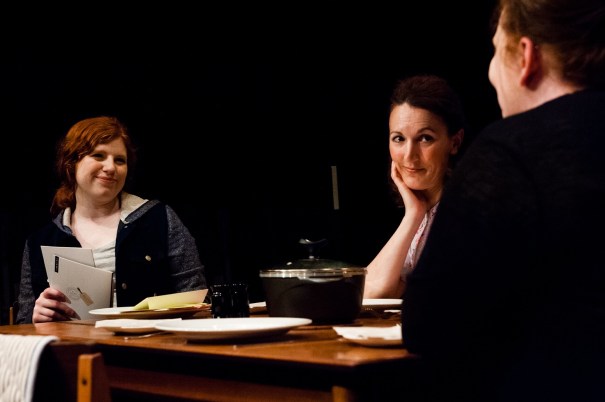
27, Battersea Arts Centre

Brian Jones. Jimi Hendrix. Amy Winehouse. Janis Joplin. Jim Morrison. Kurt Cobain. Peter McMaster? No, he didn’t join the “27 Club” but he celebrates the risks and excesses of the age that took so many legends. With co-performer Nick Anderson, they relay personal milestones from birth through the near future amongst displays of risk taking, celebration and sensual interaction with the audience and each other. This encroaching on personal space and copious amounts of dust creates a boundary-less, intimate world with surprising additions of pain and violence – an excellent depiction of the living life on the edge.

McMaster and Anderson’s start wearing skeleton morph suits and masks creates an otherworldly, animalistic effect. A joyful distribution of copious amounts of grey dust cleverly evokes death, subsequent cremation and the Judeo-Christian idea of “from dust you came and to dust you will return”.  This fine, grey powder lingers, soon kicked up into the air and covering both the performers (who are shortly out of their morph suits) and the audience. This isn’t a clean show, but neither are most people’s mid-20s. As glorious and invincible that age might be, death is inevitable and occasionally, not very far away. It’s a powerful metaphor.

The two performers have nothing on under their morph suits. The totally exposed bodies are vulnerable in their nudity, but simultaneously powerful as the two grapple and slam into each other. Sweaty bits of flesh slap into each other – this isn’t staged fighting, this is two blokes properly going for it. Trust falls become more and more risky even though repetitive and highly choreographed; the potential for harm is thrilling and visceral.

Two long scrolls document the 27 years of the performers’ lives and are read from intermittently. The lists of years and key events start out banal, but as they age, they become wonderfully anecdotal. The teen years are particularly amusing and expressed with a quiet nostalgia. The bodies on stage, what with all the flesh already exposed, seem to grow the more the audience learns about them.

The violence brings an accompanying suspense, but the vulnerability so blatantly on show is the defining feature of 27. The dust that’s kicked up into the air creates a harsh environment, but is a communal experience shared by actors and audience. Like the realities of feeling young and invincible, 27 is a wonderful, messy celebration of the age where we are not bound by societal expectations.

27 ran through 12 May.

The Play’s the Thing UK is committed to covering fringe and progressive theatre in London and beyond. It is run entirely voluntarily and needs regular support to ensure its survival. For more information and to help The Play’s the Thing UK provide coverage of the theatre that needs reviews the most, visit its patreon.
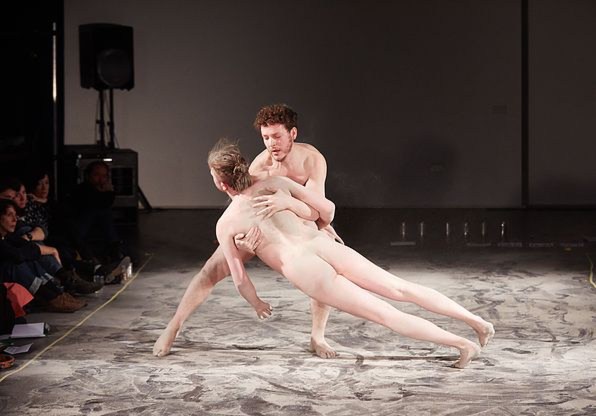
Nude, Hope Theatre

Nude- a play by Paul Hewitt - ©HelenMurray-156

A young couple meet, the relationship blooms, then goes through a rough patch and eventually ends when they are much older. Was it meant to be? Are the events in our lives accidental or controlled by outside forces? Within a standard love story, Nude boldly states that fate has the final word over life, death and love. Playwright Paul Hewitt relies on poetry and narration to tell this tiny, intimate tragedy that feels sadly familiar, like flicking through a dusty photo album of mostly forgotten family members whose memories thrive through stories. Poignant and competently executed, with gaps in the narrative that raise plenty of questions, Hewitt’s script skilfully uses language to depict this couple’s journey and the heavy hand that the personified Fate employs to convince us that we have free will.

Hewitt doesn’t rely on metaphors or overly flowery vocabulary in his rhyming poetry. His language is simple, almost pedestrian, but prettily structured and flows easily from the actors’ mouths. There are a lot of words though, and it’s delivered so quickly that there isn’t much time for in-depth processing. The narrative is a bit chunky with large sections missing and the length of time passing is consequently unclear. His characters are lovely and easy to relate to, though the heteronormative, white, middle class casting of the nameless everyman and woman, that are the focal point of this story, uncomfortably captures the lack of diversity theatre still struggles with. This is countered by a diverse production team and Fate, but romantic leads still lack diversity all to often.

Michelle Fahrenheim and Edward Nash are the charismatic couple controlled by Roshni Rathore as Fate. The three have a relaxed, watchable confidence and natural chemistry, though Fate clearly has the upper hand at all times, even when watching from the peripheral shadows. It creates a great dynamic that’s reminiscent of Prospero or a serious Puck.

Minglu Wang’s minimalist cube that contains the couple in the middle of the space is used well by director Ian Nicholson. Nicholson also incorporates some symbolic black thread, creating a sinister web that further traps the Woman and Man inside their box. This device could have been used more heavily to create a stronger sculptural effect, but was still a nice touch. Creating a space in the round emphasises the idea that the couple are constantly watched and controlled by outside forces – a canny choice.

Though Hewitt’s intention is to focus on a wider philosophical idea, his couple’s story steals the spotlight. Their timeless romance is achingly tragic and well executed textually and through Nicholson’s staging. Nude manages to move the heart even with its small faults, and taps into timeless truths about love, fear and loss.

The Play’s the Thing UK is committed to covering fringe and progressive theatre in London and beyond. It is run entirely voluntarily and needs regular support to ensure its survival. For more information and to help The Play’s the Thing UK provide coverage of the theatre that needs reviews the most, visit its patreon.