
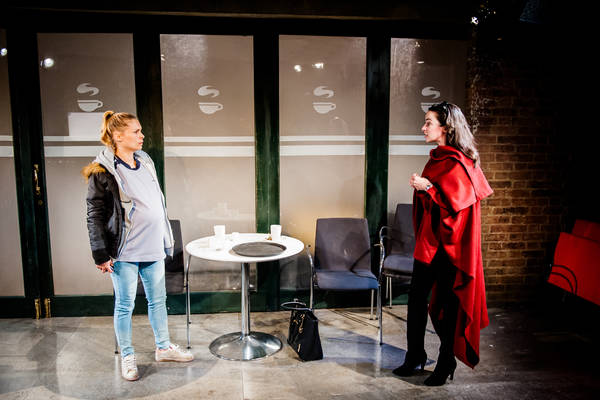
Hampstead Theatre does it again with another powerful, thought-provoking transfer after last month’s Four Minutes Twelve Seconds. Heather and Carla went to secondary school together about 20 years ago, live in the same town, but have little else in common. Heather comes from a stable, middle class family, is now married and lives quite comfortably. Carla is working poor, pregnant with her fifth child, and has a drunkard for a husband. Both had a terrible time in high school: Carla came from an abusive home, and Heather became one of a Carla’s targets after a brief friendship in year 7. They haven’t seen each other since school, but out of the blue, Heather asks Carla for coffee and makes her a surprising offer in Morgan Lloyd Malcolm’s both horrifying and enthralling The Wasp.
Myanna Buring as Carla and Laura Donnelly as Heather are an electric pair, as they should be in this relentless two-hander with sudden plot twists that keep the audience guessing. Their characters’ contrast naturally creates tension anyway, and the story generates even more. Most of the play is a hotbed of tension. The layers of lies and manipulation and abrupt reveals are surprising; there are audible gasps from the audience at certain key moments. The script has a fairly formulaic structure, but it’s the content that surprises. Albee’s Zoo Story, Miller’s The Crucible and most of LaBute’s work appear to influence. The characters’ behaviour is shocking, but the realisation that this could be anyone we know, or ourselves, uncomfortably resonates within.
Though there are a lot of big social and psychological issues presented: revenge, infidelity, class difference, abuse, rape and infertility. It doesn’t feel excessive to conflate them, but aids in creating complex characters that feel like genuine people backed up by Buring and Donnelly’s performances. This toxic cocktail of topics emphasises just how easy it is to cause lasting emotional damage in someone unintentionally, be it a family member, friend, partner or acquaintance. Kids especially: we all had tough times at school and treated each other badly but children are so self-absorbed (the ability to empathise is the last part of the human brain to develop) that they don’t often realize the consequences of their actions. And this is why each and every one of us is the hot mess we are, because of how we were treated by others when we were younger. It doesn’t take much more on top of all the baggage we already carry to send us over the edge, and that message resounds loud and clear through the women’s past and present actions that slowly unravel in the intimate Trafalgar 2.
David Woodhead’s set similarly beds in the horror of the characters’ actions. Benign, commonplace objects become aids for capture in his construction that emulates life. There’s an overly lengthy set change, but the transformation from outside a dingy café to Heather’s sitting room is as big a difference as the two women are to each other. The detail and naturalistic design make the story feel all the more like real life, an effective and powerful choice when simplicity and abstraction are the more common styles.
The Wasp presents the capacity for evil within each of us whilst challenging social stereotypes and making powerful comment on how we treat our fellow human beings. Outstandingly committed performances endowed with energy and high emotion and Lloyd Malcolm’s script create a disturbing landscape, disguised in the routine of day to day life, that can be revealed in a moment.
The Play’s the Thing UK is committed to covering fringe and progressive theatre in London and beyond. It is run entirely voluntarily and needs regular support to ensure its survival. For more information and to help The Play’s the Thing UK provide coverage of the theatre that needs reviews the most, visit its patreon.
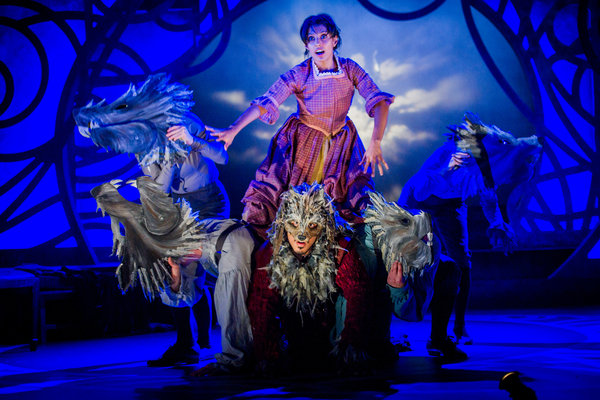
 There’s a mountain of inflatable sex dolls on the stage. Shiny, blank faces with gaping, toothless mouths, spherical tits and gargantuan cocks everywhere. The pile is so big that the actors have to wade through the dolls, a metaphor for the seedy Viennese streets where Shakespeare sets his Measure for Measure. Director Joe Hill-Gibbins wrenches this world into the present with a symbolism-laden, visually orgasmic production designed by Miriam Buether, and a great performance by Romola Garai as Isabella. Live video feeds, projection and pulsing beats marry a space that has ghosts of Elizabethan theatre structures, but some choices don’t sit well. Though the visuals are relevant and bold, there’s a disappointing tendency towards shouting, and a dubious (to the point of discomfort) characterization choice for infamous pimp Pompey. As the characters physically and emotionally wrestle through the heavily edited, relentless two hours of sex and religion, there is still a strong feeling that this production values style over substance.
 Nearly everyday we see news of refugees fleeing war torn lands in search of safety abroad. No matter how the press spins objective facts to suit their own agenda and their readers’ opinions, the perspective of these events unfailingly separates “them” from “us”. These people running for their lives are The Other that we must either keep out or allow in. It’s all very black and white, heavily doused with an air of superiority; we either look down on them as vermin that need controlling or as victims that need handling with kid gloves. We never really hear from these refugees, though. It’s all, “me, me, me” and a flamboyant display of either virtue or condemnation.
 There’s an abandoned island in the middle of Manchester. One gated and guarded road goes in and out. Zeppo owns it, like much of the land in Manchester, but he doesn’t like to get involved in the goings on at his properties. Too risky. After Ollie’s twin sister disappears, Zeppo tells her to try looking for her on his abandoned island, Pomona. So she does.
 Willem is 34. He moved from Amsterdam to New York City 12 years ago. After an inconveniently timed phone call from his mother on a cold New York morning, he goes home for his younger brother Pauli’s funeral. He is greeted by his father’s disappointment, his sister’s lectures and the disorientation of not knowing where “home” is anymore. Much has changed, yet so much has remained the same.
 The Play's The Thing UK