Songs For the End of the World, Battersea Arts Centre


https://i0.wp.com/www.domcoyote.com/wp-content/uploads/2015/12/millygraphic-2-e1469019899426.jpg

Jim Walters is the first person sent to colonise Mars. But when a global apocalypse occurs, trapping him in the Earth’s orbit and running out of oxygen, he and his guitar are left to broadcast music to the devastation below. Can anyone hear him? Are there any survivors? Will he ever know? Dom Coyote and his band the Bloodmoneys present a post-Brexit apocalypse in the gig-theatre Songs For the End of the World, a piece overly heavy on the ‘gig’ and reliant on a plot constructed of dystopian tropes. Though the story is thin, Dom Coyote’s songs are fantastically varied and plentiful, helping to gloss over any shortcomings in the script.

There’s rockabilly, 90s rock anthems, glam rock, and blues numbers with a touch of connecting story sprinkled in between. Set in Ashley Coombe, the village serves as a window into the attitudes of small, English towns of this dictatorial era – the elderly preacher woman who runs the place condemns foreigners, terrorists and space exploration whilst the rebels put on club nights in an underground bunker. The country is now called New Albion and rather than run by an individual, a corporation dictates all rules and procedures. These plot devices are predictable within a story of a dystopian future, but are simplistic enough to work within the gig-theatre format without needing much explanation. As these two tribes clash, Jim Walters is in space – a symbol of both human progress and arrogant dominion. It’s no surprise which side survives down on Earth, and that the future beyond the end of the show looks particularly bleak.

Though the story is overly familiar, the music is wonderfully varied. David Bowie’s promised influence is clear, but not limiting in style. All of the characters in this Little England kitsch/cold international corporation hybrid are suitably blown out of proportion, but feel eerily familiar in a fundamentalist-driven, isolationist Britain and a world where Donald Trump may become the next leader of its most powerful country. Staging is fairly static as per the usual gig-theatre approach, but there is some variation in movement and costume. The lighting design adds power and hope to the bleak, clinical setting.

A more substantial script and dynamic staging would lend more theatricality to the excellent set of tunes in of Songs For the End of the World; as is, it is overly driven by music and the narrative potential is neglected. That said, it would make a fantastic concept album, and the design is strong – an extra half hour of script would add polish to this fun, vibrant performance piece.

Songs For the End of the World is now closed.

The Play’s the Thing UK is committed to covering fringe and progressive theatre in London and beyond. It is run entirely voluntarily and needs regular support to ensure its survival. For more information and to help The Play’s the Thing UK provide coverage of the theatre that needs reviews the most, visit its patreon.

World Without Us, Edinburgh Festival Fringe

https://www.thestage.co.uk/wp-content/uploads/2016/08/World-Without-Us-700x455.jpg

Imagine the world if the entire human population disappeared suddenly, without a trace. What would it look like after a day, a month, a century, an era? A lone performer from Belgian company Ontroerend Goed methodically describes how the theatre space we sit in would change as a focal point within the wider world’s transformation. Delivered in a near monotone on a stage bare except for a grey obelisk, World Without Us is a meditative account of our solar system’s lifespan, and humanity’s inconsequence in the great scheme of planetary existence.

Karolien De Bleser quietly narrates this epoch-spanning journey of our planet with matter of fact coolness. What she describes really is remarkable in its compressed state, but the almost total lack of inflection makes the text pedestrian even in its most dramatic moments. Her movement around the space is relaxed and random, to look for meaning in it feels silly what with the story she tells.

With the ability to focus on the story without the mind drifting to topics such as what to have for lunch, the overall effect is a sense of calm acceptance that our lives, whilst impacting the planet immediately, really don’t matter. Our absence has little effect other than the gradual decay and burial of the artefacts we leave behind. Even in periods of environmental turmoil such as we see in the planet’s history, the impact is meaningless.

Even though the sun eventually swells and engulfs the Earth before it dies, all is not lost. Lightyears away, a single human artefact remains with a friendly but assumptive purpose. Its contents are, depending on one’s world view, absurd or incredibly beautiful. Perhaps they are both.The whimsy of human invention is particularly poignant at this moment.

World Without Us is a lovely, contemplative piece of performance and would work particularly well as an audio recording. As theatre, it could come across as flat, or upsetting or remarkable, depending each individual’s world view. Calmly provocative, it is wonderfully wide open to interpretation and effect.

World Without Us is now closed.

The Play’s the Thing UK is committed to covering fringe and progressive theatre in London and beyond. It is run entirely voluntarily and needs regular support to ensure its survival. For more information and to help The Play’s the Thing UK provide coverage of the theatre that needs reviews the most, visit its patreon.
 

In Fidelity, Edinburgh Festival Fringe

https://www.thestage.co.uk/wp-content/uploads/2016/08/In-Fidelity-Image-10-by-Rob-Drummond-at-Traverse-Photo-Credit-Sally-Jubb.jpg

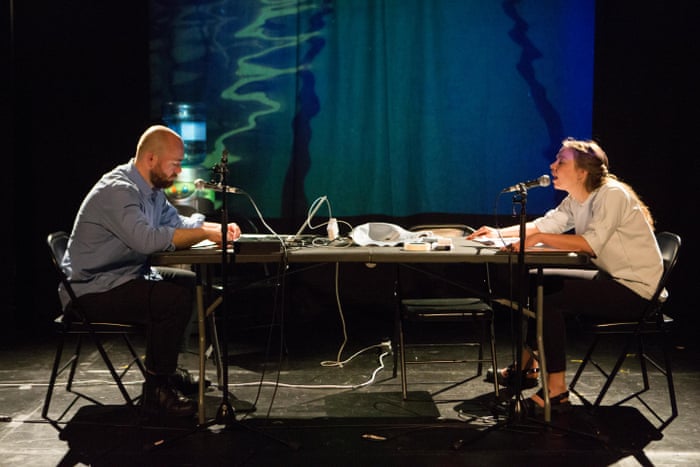
Rob Drummond and his wife Lucy are celebrating their fifteenth anniversary. As a gift to her, he made a show where two single audience members have the opportunity to go on a first date there and then in the hope of finding the sort of love he has with Lucy. Though the bulk of the production centres around the selected couple on stage, there is plenty of audience interaction as we guide them down the path of getting to know each other. Part TED talk, part talk show, part slumber party, In Fidelity is as informative as it is heartwarming and fun.

Drummond’s extensive research on brain activity, hormones and psychology drives the framework around the first date and is consistently present throughout the show. The pop-science is easy to understand and his presentation style makes this content all the more engaging. After a series of questions he selects the two audience members who will have their first date, the focus becomes on facilitating the introduction of these two people. Each performance will undoubtedly be different and have varying degrees of successful matchmaking, but this makes it all the more exciting.

There’s a gleeful voyeurism that In Fidelity satisfies and even though Drummond gives the audience and the pair on their date quite a lot of freedom, he keeps a tight grip on discussion and interaction so it never feels that he will lose control of the show’s progression. This restriction ensures that everyone in the room feels safe, and its remarkable how quickly people feel comfortable answering very personal questions about their love life. Drummond’s onstage persona is warm and strong, a great balance that encourages the audience to open up. His incorporation of personal anecdotes, adventures in the research process and his own relationship’s journey also help.

The show ends happily the day I see it, with the couple clearly having some degree of chemistry between them. Even if that doesn’t happen, Drummond ends with some fantastic news of his own, leaving the audience with a warm, fuzzy feeling as they leave the theatre. This theatrical experiment is a wonderful exploration of form and its benevolence is a wonderful thing to be a part of.

In Fidelity ends 28th August.

The Play’s the Thing UK is committed to covering fringe and progressive theatre in London and beyond. It is run entirely voluntarily and needs regular support to ensure its survival. For more information and to help The Play’s the Thing UK provide coverage of the theatre that needs reviews the most, visit its patreon.

Poena 5×1 and No Horizon, Edinburgh Festival Fringe

https://i0.wp.com/www.underbellyedinburgh.co.uk/images/made/images/uploads/POENA-5X1_1_%C2%A9RichardDavenport_750_500_60_c1.jpg

Science and Mathematics. Vaccinations, space travel, electricity. Nuclear weapons, lethal injections, pollution. Poena 5×1 and No Horizon. One is a new play showing the dark potential of science, the other a new musical celebrating overcoming disadvantage through maths. Radically different in style and story, both productions find inspiration in the potential of science, maths and technology, and both need further development.

Scientist Bryony Adams works for the Department of Justice in Poena 5×1. She’s a typical Tory suit who fully believes her horrifying work benefits the greater good – she invented Poena, a drug that reduces prison populations through humane punishment (whatever that is). Named after the minor goddess of punishment, Poena induces a state of despair and hopelessness that can lead to catastrophic mental consequences for the prisoners that are her voluntary test subjects. Bryony becomes emboldened by praise as she further develops the drug, deciding to test it on an unknowing volunteer.

Bryony is a despicable character that Cathy Conneff plays admirably, particularly as she begins to emotionally deteriorate. Considering this is a solo performance with little visual element, her ability to maintain audience focus through compelling embodiment of the character is excellent. The character presents her work to the audience until a twist reveals all is not what it seems. It’s at this point that Abbie Spallen’s script starts to lose its way. As Bryony’s story becomes more personal and less about her work, the narrative becomes knotty and unclear, having a knock-on effect on the script as a whole that until this point, terrifies through the government’s potential to commit heinous acts. Any themes and messages established about the horror of governmental capital punishment are unfortunately diluted. Reworking the ending to maintain character and plot continuity and clarifying the play’s message would take little work but have great effect.

In contrast to Poena 5×1, No Horizon has a solid, consistent script, but this new musical’s shortcomings are its music and the casting of this particular production. The true story of a remarkable young man in the 1680s looks at the power of mathematics to unite people across social class and ability. Nicholas Saunderson, blinded by Smallpox as an infant, learns to read through his friends’ support and tracing letters on gravestones. His envy and frustration grow as his parents enforce limitations on him because of his disability and his best friend in their tiny Yorkshire village goes to Cambridge. Through sheer determination and an innate aptitude for maths and physics, he eventually proves that in a pre-Braille era, disability is still no barrier to success.

It’s a wonderful, uplifting story with a generally good narrative arc, though most of the cast are gifted singers who struggle to match their acting ability to their voices. There is frustratingly little connection between characters, though George Griffiths as Joshua Dunn is a notable exception. The music is rather samey and repetitive without distinction, though there are some standout numbers amongst the Cambridge students. The music is pre-recorded, which makes it even harder to capture any nuance in tone and volume. There is minimal choreography, making the ensemble numbers more choric than musical theatre.

Theatre can be a powerful vehicle for maths and science, but in the cases of No Horizon and Poena 5×1, the subjects are let down a bit. Some tinkering is definitely needed to whip these productions into shape, but there is much potential in these character-driven stories.

Poena 5×1 runs through 29th August, No Horizon runs through 27th August.

The Play’s the Thing UK is committed to covering fringe and progressive theatre in London and beyond. It is run entirely voluntarily and needs regular support to ensure its survival. For more information and to help The Play’s the Thing UK provide coverage of the theatre that needs reviews the most, visit its patreon.

To Kill a Machine, King’s Head Theatre

To Kill a Machine: Scriptography Productions

How well can you condense Alan Turing’s life and work into one hour? Considering his technologically groundbreaking career, WWII code breaking and conviction for crimes of gross indecency, that’s a lot of source material for precious little time. Catrin Fflur Huws chooses to focus on the man behind the achievements at various pivotal points in his life for To Kill a Machine. From boarding school days to chemical castration shortly before his death, Huws shows the relationships rather than the events that shaped his life. Scenes of naturalism are interspersed with a surreal, presentational game show indicating the factors outside of Turing’s control that dictate his unfortunate fate at the hands of discrimination. Though stylistically dynamic, they are less compelling than the latter. Together, they make a good whole but with so much missing from Turing’s life, the highlights contained in To Kill a Machine shortchange the story of such an important man.

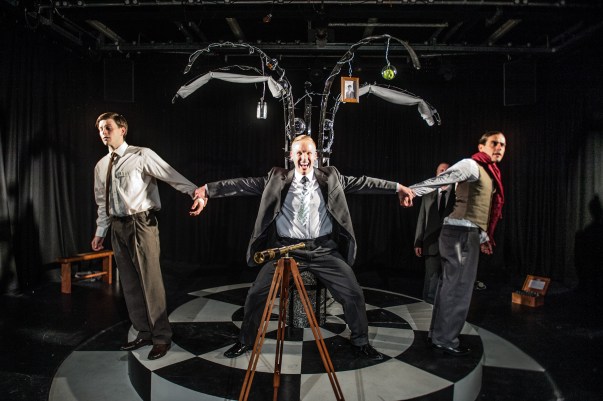
In the centre of a round platform, a wiry, mechanical tree by designer Cordielia Ashwell sprouts important mementos from Turing’s life: a photograph of Christopher, his first love at school, pages of indecipherable code, and the apple that he may or may not have used to kill himself. Its trunk is also a convenient place to store props and costume, but the visual aspect is the most dominant, and strikingly so. The symbol of life manifested in an everlasting, sculptural form against the items that were his downfall is powerful image.

The tree also dictates circular movements from the cast of four, most prominent in the game show scenes and Turing’s sex with his younger lover, Arnold Murray, who eventually betrays him – the moments where his life spirals irrevocably out of control. Alan’s eventual tethering to the tree via medical equipment during his “treatment” is a horrible,  effective reminder of history’s handing of people discovered to be gay and sapping their life force with discriminatory legislation.

Gwydion Rhys as Alan Turing is the anchor in the cast, with a nuanced and sensitive performance that leaves Benedict Cumberbatch’s generic interpretation in the dust. He is complimented well by intimate scenes with François Pandolfo as his school friend Christopher, and older brother John giving him advice in the run up the trial. This latter scene is by far the best in the play.

Though the script is good, it’s short length is unsatisfying and otherwise dwarfed by the performances and design. The structure works as does the lens with which it views Turing’s life, but surely there is more than an hour’s worth of material on the man behind the life-changing mathematician and inventor.

To Kill A Machine runs through 23 April.

The Play’s the Thing UK is committed to covering fringe and progressive theatre in London and beyond. It is run entirely voluntarily and needs regular support to ensure its survival. For more information and to help The Play’s the Thing UK provide coverage of the theatre that needs reviews the most, visit its patreon.