Scorched, Edinburgh Festival Fringe

rsz_cn0idouxgaazjdi

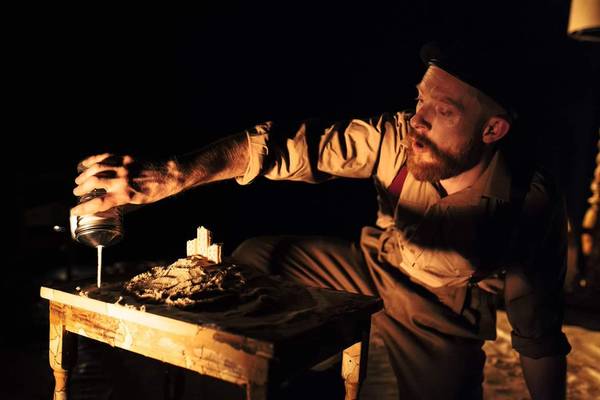
Jack, feeble in body and mind, wiles away the days watching news broadcasts from operation Desert Storm. The former WWII soldier, now safe and looked after in a care home, vividly recounts memories from his youth and on the front line. He may not be aware of the present, but his past is ever present and will not let me rest. Solo show Scorched is a moving and honest look at veterans’ experiences of combat and ageing, leaving the troubling feeling that society is not fulfilling its responsibility to this vulnerable demographic.

Lisle Turner’s script, inspired by her grandfather’s life, is an expressionistic snapshot of his thoughts at the twilight of his life. Stationed in Egypt during the war, we hear tales of heat, explosions, and beautiful women interspersed with memories from his childhood. The storyline is loosely constructed; it is episodic rather than wholly linear. This structure works well considering that these are Jack’s memories he plays out for himself rather than for an audience arbitrarily included in the action without being allocated any clear identity.

There are some beautiful design elements: Jack remembers tattooing himself and this is projected on his arm rather than shown with makeup. To see something normally considered permanent conveyed through an ephemeral form is a fitting reminder that nothing truly lasts forever and Jack is nearly at the end of his life. The loveliest of other whimsical projections is on a cascade of sand poured from a dinner tray. This sand is everywhere, like the memories that cling onto Jack’s deteriorating mind and are constantly discovered in unsuspecting places – a clever device either by Turner or director Claire Coache. A simple puppet is used well but not enough, as are mundane objects that transform into others more exciting – an umbrella becomes a fishing rod, a footstool is a motorbike. This object manipulation is a lovely surprise and suits Jack’s mental state well, so it could be utilised further to comment on the childhood of old age.

Robin Berry plays Jack with power and pathos, initially with a delicate frailty that gives way to a younger, more powerful man who enjoys boxing, horse riding, dancing and defending his country. Berry has a strong physical presence that is eminently watchable and a range that makes him believe both as the older and younger Jack.

Strengthening and streamlining the staging and theatrical devices will help make the script feel less like a random collection of memories, and reordering some of scenes would also have the same effect. Jack is a fantastic character and the play is a fitting tribute to elderly veterans, though also serves to pay homage to a generation that soon will no longer be with us.

Scorched runs through 29th August.

The Play’s the Thing UK is committed to covering fringe and progressive theatre in London and beyond. It is run entirely voluntarily and needs regular support to ensure its survival. For more information and to help The Play’s the Thing UK provide coverage of the theatre that needs reviews the most, visit its patreon.

Life According to Saki, Edinburgh Festival Fringe

CpVFTsMXYAA1jSg

Author Hector Hugh Munro, otherwise known as Saki, is in WWI’s trenches. He and his men been out there for nearly a year, and they are long fed up with life on the front. To entertain his fellow troops, he tells the stories that have already made him a well-known writer. Life According to Saki mixes biography and fiction as Saki tells the audience about his life, interspersed with silly and bizarre anecdotes. The cast of six play both soldiers and the character’s in Saki’s stories with fantastic energy and physical commitment, but the structure of the play and Saki’s pontificating soon grows repetitive. An excessively long ending and too many stories ushers in eventual tedium despite a polished show with high production values.

Anna Lewis’ design is excellent; it clearly indicates the trenches and is flexible for the imagined worlds elsewhere. Costumes are WWI uniforms that fit the cast of women and men smartly – they are not frumpy, unaltered hire costumes. The puppets by Claire Roi Harvey and Suzi Battersby are also very good, with the cock being particularly charming with a great range of realistic movement.

The script is where it begins to fall flat a few stories in. Each one is very short, some only a few minutes long. There are about eight or ten altogether, and the constant shift from tale to tale is exhausting. The are performed with great physical comedy, accents and verge on the fantastical; each one is lovely but there are way too many. Episodes from Saki’s life are bland and dry filler, and the two styles feel forced to miserably cohabit in the same structure. The tacked-on conclusion preaches about how to live one’s life, then drags on even longer into a song and a poem. Though it blatantly states its message of living life to its fullest, the connection to the hour of stories preceding it is tenuous.

Three or four longer stories with depth and detail, and less of Saki’s biography (if any at all) would make this a much more engaging play. The premise of a soldier entertaining his troops is a fine one, but The Life of Saki comes across as self-centred and lecture-y with some silly, disconnected interludes.

Life According to Saki runs through 29th August.

The Play’s the Thing UK is committed to covering fringe and progressive theatre in London and beyond. It is run entirely voluntarily and needs regular support to ensure its survival. For more information and to help The Play’s the Thing UK provide coverage of the theatre that needs reviews the most, visit its patreon.

The Inevitable Heartbreak of Gavin Plimsole, Edinburgh Festival Fringe

https://theplaysthethinguk.com/wp-content/uploads/2016/08/05b71-gavin2bplimsole2b252812529.jpg

Gavin Plimsole is a good enough guy. A bit geeky and nervous but well-meaning, maybe even a bit endearing if you like that sort of thing. After he receives a life-altering diagnosis from the cardiologist and realises his days are numbered, the audience (who have all strapped into heart monitors before the show begins), get to decide his fate. Part choose-your-own adventure, part poignant tale of grief morning people and times long lost, The Inevitable Heartbreak of Gavin Plimsole is a messy but touching reminder to make the most of every moment.

An ever-present projection of the audience members heartbeats overlays three energetic performers and a changing landscape of cardboard boxes. Gavin’s the sort that stores his life in tattered boxes labelled with masking tape, and these boxes now contain relics from his life. They aren’t particularly interesting, but a garden shed with a wonderful contraption that releases a large marble down a slide and into a box every 500 collective heartbeats, is ramshackle but dynamic. It cleverly represents our perpetual approach towards death with a drawn out clattering and eventual silence – a dying person’s last breaths.

Gavin monologues most of his thoughts; there are some interruptions by spunky, supporting actors that help break up the speeches but more of these would be welcome. A wiry (literally, as in made of wires) puppet makes one appearance and is similarly underused – a remarkable creature! The structure is understandable chaos that mirrors the the first couple of days after devastating news, though clearer transitions and a distinct style will help make sense of this emotional journey.

The use of the heart monitors and audience interaction unites the audience and performers, creating intimacy and empathy. It’s a sad story that manages to foster hope instead of gloom, and within the clutter there’s a lot of heart.

The Inevitable Heartbreak of Gavin Plimsole runs through 29th August.

The Play’s the Thing UK is committed to covering fringe and progressive theatre in London and beyond. It is run entirely voluntarily and needs regular support to ensure its survival. For more information and to help The Play’s the Thing UK provide coverage of the theatre that needs reviews the most, visit its patreon.

Leaper: A Fish Tale, Greenwich Theatre

unspecified

Our oceans are dying. Just yesterday, the news reported that 95% of the Great Barrier Reef has been bleached due to temperature rises. There are huge swathes of sea with high concentrations of microplastics that leach toxins into the water and the food chain. We are overfishing our oceans, causing a myriad of problems to human and sea life.

Tucked In is trying to change that through Leaper: A Fish Tale, an adventure story for families about a young girl’s discoveries in the world’s waterways. The unnamed daughter isn’t particularly interested in her dad’s fish farm and wreaks more havoc than anything else. But after falling into the stream in pursuit of a dropped crisp packet, she makes friends with Leaper the salmon on her journey from stream, to river, to ocean and back again. Good puppetry and movement keep younger ones engaged in this surprisingly complex story, though at times it feels a bit too convoluted and the lack of dialogue is unnaturally forced.

With an impressive array of animal puppets by Claire Harvey and Annie Brooks’ transformative set, there’s plenty to look at in the show’s recycled aesthetic. The larger puppets have an excellent range of movements, particularly the duck, seal and big fish. The rubbish monster is the most wonderfully inventive surprise, and the large jellyfish are poetry in motion. The smaller puppets are understandably simpler, but less dynamic with fewer moving parts. The baby fish, though sweet in the way the human characters treat them, are harder to see and not particularly interesting in and of themselves. The design really comes into its own in the middle of the ocean, with atmospheric lighting and sound to match.

Though the show wants to address both overfishing and ocean pollution, the littering is the primary focus. It makes sense as children may struggle with the concept of overfishing, but the plot points on the topic are consequently less engaging. There aren’t many of them though, and the focus is almost solely on the girl’s (Lizzie Franks) journey.

The performances by Franks, Philip Bosworth and Robert Welling are engaging and precise, though the reason for minimising speech is unclear. There are plenty of vocal effects, but character communication and actor impulses feel unnaturally limited. It doesn’t interfere with the story and the children in the audience aren’t bothered, but it doesn’t contribute to the production style.

Leaper: A Fish Tale is visually compelling with some great puppetry and an engaging story for children and adults alike. The performances are good and the story has all the necessary components of a satisfying adventure tale with a clear moral. Though there are some small issues, they don’t interfere with the overall enjoyment of the piece, and this show could play a powerful role in raising engaged, environmentally conscious young people.

Leaper: A Fish Tale is touring schools and theatres in April.

The Play’s the Thing UK is committed to covering fringe and progressive theatre in London and beyond. It is run entirely voluntarily and needs regular support to ensure its survival. For more information and to help The Play’s the Thing UK provide coverage of the theatre that needs reviews the most, visit its patreon.

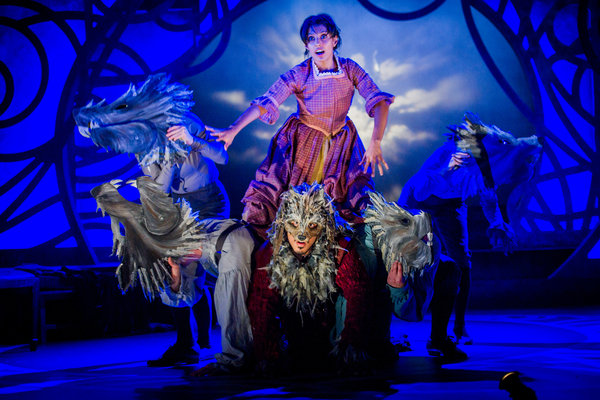
Red Riding Hood, Preston Continental

rsz_12299318_10153680692062789_6332526754861081608_n

What makes the story of Red Riding Hood so enduring? Is it the clever heroine? Is it the metaphor for growing up? Is it the violence and gore? Horse & Bamboo choose to focus on the colour red and its symbolism in their touring Red Riding Hood. Two actors, Nix Wood and Alex Kanefsky, are actor-storytellers-puppeteers who endow the story with a richness and life that appeals to their young audience as well as their families. The company’s lo-fi touring aesthetic uses a surprising amount of puppets at different sizes, masks and costume to keep the kids’ attention. It’s a bit hodgepodge on the surface but there’s a good amount of layers to this piece: meta theatre, storytelling, playing at the characters, and embodying them. Wood and Kanefsky fluidly switch between the styles that initially feel excessive in their quantity, but the children are so absorbed in the story that cannot be deemed as anything but highly effective and engaging.

The main focus of the story is the dynamic between Red and the Wolf. Mum and Grandma make appearances, but they don’t waste any time getting to the woods. The deeper Red gets, the larger the characters become – a great device. Initially, a tiny Red and mum are reading bedtime stories in a dolls’ house, eventually Wood plays Red in a full mask and the wolf is a nearly life-sized puppet with excellent movement and expression in the head and neck. Music and animated projections add additional detail to Wood’s controlled, emotional physicality communicating the unspeaking Red’s inner life. The wolf and Red focus results in a reinforcement of the “don’t trust strangers particularly if they seem nice” moral, which works for a children’s show but is quite a shallow interpretation in a production that has such depths of performance technique and style.

Red’s cloak is a dark, rich red that stands out beautifully against the rest of the set. Wood sets up red as her favourite colour as she chats with the entering audience pre-show; it’s lovely to watch. Kanefsky is goofy and warm, and loves cakes. This trait follows his characters through the rest of the story. The set is made of abstract blues and greens, inspired by Paul Klee’s art (my initial association was with Kandinsky’s work). Though the idea of starting with visual art for a way into a concept is a common one, the abstract set design clashes with the concrete realism of the puppets and mask, and the animation style was the starkness of shadow puppetry.

As children’s theatre goes, Horse & Bamboo’s Red Riding Hood is more sophisticated than it appears. Despite the moralizing, the craftsmanship and performance skill can be appreciated and enjoyed by all ages. Knowing that Horse & Bamboo are a touring company with just two actors makes their work all the more impressive. An excellent production for families at any time of year, too.


The Play’s the Thing UK is committed to covering fringe and progressive theatre in London and beyond. It is run entirely voluntarily and needs regular support to ensure its survival. For more information and to help The Play’s the Thing UK provide coverage of the theatre that needs reviews the most, visit its patreon.
Goodnight Mister Tom, Duke of York’s Theatre

rsz_5_alex_taylor-mcdowall_william_and_elisa_de_grey_puppeteer_for_sammy_the_dog_in_goodnight_mister_tom_2015_credit_dan_tsantilis

The WWII image of dejected, scrappy children with brown tags around their necks, clutching their most precious belongings as they are re-homed with strangers in the countryside is a powerful one. It’s one that inspired author Michelle Magorian to write Goodnight Mister Tom, adapted by David Wood for the stage, now in London after a successful run at Chichester and before heading off for a national tour. The audience meets little William, who is sent from Deptford to Dorset and assigned to live with the reclusive Tom Oakley. With a focus on Tom more so than the relocated children, this is a story about finding love again after a devastating loss. This part of the production is moving, but the story is slow to develop over a long time period and the flimsy, thin dialogue doesn’t support the large cast of characters, their development and the devastation of wartime.

David Troughton as Tom is a sad and sensitive widower, the complete opposite of the grump that his fellow villagers see. Three Williams, three Zachs (William’s precocious evacuee friend) and a gaggle of children make up half the cast; all are very much child actors. Alex Taylor-McDowall is today’s William, a lanky shy boy poisoned by his fundamentalist Christian single mother, Melle Stewart. We hear a lot about her, but only meet her in one scene. Stewart is unable to show just how evil (and mentally ill) the character is, though she does her best to live up to the previously discussed monster. Most of the other characters have similarly brief stage time, but plenty of multi-rolling and puppetry keeps the generally good ensemble performers busy.

But the first half takes its time to get going. It’s not from a lack of energy in individuals, but the overall pace is languid. It’s lovely and sweet, but flat. The war seems far away from this village, country life is slow, and day-to-day life is filled with routine and little errands. It’s in these small tasks that we see Tom’s affection for William grow: getting “new” clothes for him, teaching him to read and write and fending of bullies who pick on the “townies” and “vaccies” from London.

It’s no wonder the local kids pick on the Londoners. William can’t read or write, sleeps under the bed rather than on it, and his toxic mother skewed his worldview about, well, everything. Zach is well-spoken, attention seeking and flamboyant, the son of actors. It’s interesting that the London children the audience meets are either desperately camp or from the slums in this story; does this reflect Magorian’s preconceptions?

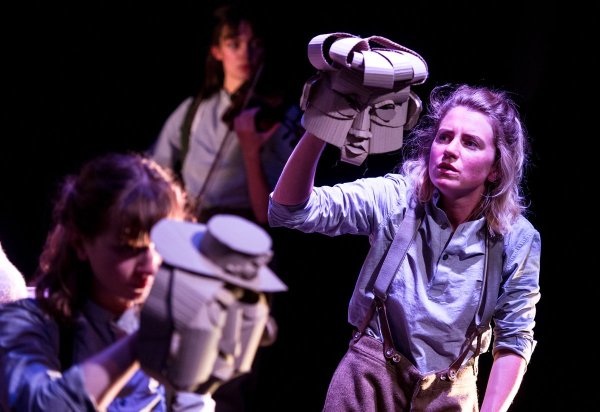
Along with Troughton’s performance, the puppets are outstanding. Tom’s dog, Sammy (Elisa de Grey) is gorgeously constructed, and full of movement and life from de Grey’s work. After the interval, there’s an increase in momentum after an unnecessary subplot involving William’s return to London and the effects of war creep closer, creating more tension and loss. The audience learns more about Tom’s past and the ending is a tearjerker and concise resolution.

For a family show however, the whole thing is too long and convoluted. Tom and William’s story could have easily had more focus with a reduction of other characters, more fleshed out scenes and additional detail about Tom’s life leading up to the point he takes in William. Fortunately, Troughton has enough stage time to keep this otherwise lovely, but flat, production going.

Press ticket for Goodnight Mister Tom is courtesy of theatrebloggers.co.uk.


The Play’s the Thing UK is committed to covering fringe and progressive theatre in London and beyond. It is run entirely voluntarily and needs regular support to ensure its survival. For more information and to help The Play’s the Thing UK provide coverage of the theatre that needs reviews the most, visit its patreon.
Beauty & the Beast, Polka Theatre

Beauty and the Beast - Polka Theatre - 20 November 2015 Writer - Charles Way Director - Roman Stefanski Designer - Laura McEwen Music - Julian Butler

Cold, dark days make me want to see feel-good theatre, especially in the run up to the holidays. Bonus points if it’s colourful, has some depth and at least some non-formulaic elements, even in a classic story. Polka Theatre’s Beauty & the Beast for ages 6-12 meets these criteria with a surprisingly complex storyline that keeps adult attention as well as kids’. Despite the target age range, there is some great humour and a touch of innuendo adults will appreciate (kids definitely won’t get it), sumptuous set and lighting and an adapted, relevant script. Some of the performances are wooden from the dated language and there are some dodgy movement-based transitions, but the school group audience was quiet and focused for most of the nearly two hours with interval.

Charles Way’s adaptation of the traditional story gives a much wider context than the Disney film and is more relatable to a modern, young audience. Belle is still the main character, but we get to know her father, Mr Godwin (Simon Holmes) and sister Cassandra (Géhane Strehler) well. Belle and Cassandra are complete opposites: Belle’s bookish, a visionary and frightened by most things; Cassandra loves boys, pretty dresses and adventures. The two bicker regularly and their money-driven merchant father is tired of it, a family dynamic that many children will recognize. Beginning in London and moving to the remote countryside when Mr Godwin loses his fortune, the girls also have to cope with big life changes and overcome adversity.

The women’s performances are consistently stronger than the men’s. Ritu Arya’s Belle is convincingly performed with a wonderfully dry sense of humour and an excellent character arc that isn’t overly saccharine. She carries the story and its energy well without being a stereotypical children’s performer, dealing with the old fashioned language brilliantly. Géhane Strehler is great contrast, giving young girls two opposite ideals to potentially relate to. Both have flaws, virtues and detail. Emma Cater is a sinister housekeeper for Jason Eddy’s Beast, a gentle man with stylized physicality and an imposing presence. Eddy doesn’t quite manage to carry that through after his transformation, but it’s so close to the end that it doesn’t matter much.

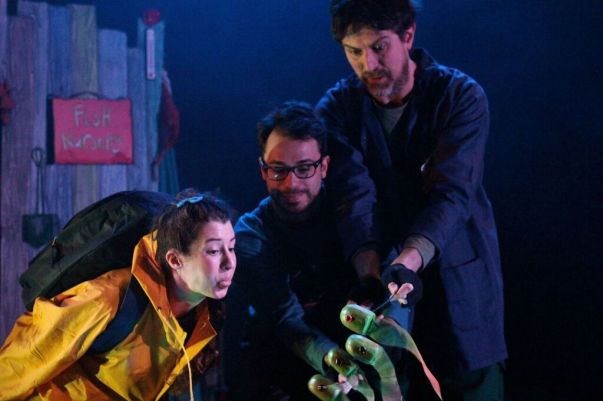
The set is layers of swirling panels that change colour and glow according to location, with the Beast’s castle the richest of them all. Laura McEwen’s set and Ian Scott’s lighting work together in wonderful harmony, with the occasional addition of puppets. Stage combat from RC Annie also adds a visual component, but the fights are slower that fight speed and brief. Some of the transitions lag and have abstract movement to fill the time, but this doesn’t contribute to the story and usually look pretty naff. Costumes, also by McEwen indicate the characters’ circumstances and changes in social class, but the highlight is the headdress and mask for the Beast.

Though there are still age and gender stereotypes, the adapted script empowers the young female characters. The detail and length will occupy adults as well as children and Way’s story is excellently constructed. With wonderfully visual design and a stirring score by Julian Butler, this is a lovely production harking back to the classical story without the glitz of Disney-fication or the panto cheese, and a solid option for a family holiday show.


The Play’s The Thing UK is an independent theatre criticism website maintained voluntarily. Whilst donations are never expected, they are hugely appreciated and will enable more time to be spent reviewing theatre productions of all sizes. Click here to make a donation with PayPal.

Bruce, Edinburgh Festival Fringe

Who knew a block of yellow foam could be such fun? Bruce is the not very bright, cop-turned-novelist-turned-astronaut, stuck in a time warp, lead character of Bruce. Created and controlled by Tim Watts and Wyatt Nixon-Lloyd, Bruce is a rectangular, Sponge Bob-like head with a white pair of hands. All of the other characters are played by the same head and hands, but Watts and Nixon-Lloyd use an array of voices to effectively distinguish them from each other.
The pace is relentless, perhaps too much so at the beginning as the audience starts to work out the story. When the time travel element is introduced at the end, it is similarly a lot to process at speed. The script is wonderfully funny, with a mix of humour styles and jokes catering to a wide variety of tastes. The puppetry is well rehearsed, with the two actors working in smooth tandem without any lag between the one controlling the head and the one playing the hands.

The entire concept is simple, but well executed and without self-referential flourish. The most complex aspect is the script, which has sufficient detail to keep audience interest. Laughs were widespread and regular. There isn’t a deeper level of social comment; Bruce is silly for the sake of it. I generally prefer my comedy with a heavy dose of social commentary, but after the serious shows I’ve seen over the past few days, this is a welcome break.


The Play’s The Thing UK is an independent theatre criticism website maintained voluntarily. Whilst donations are never expected, they are hugely appreciated and will enable more time to be spent reviewing theatre productions of all sizes. Click here to make a donation with PalPal.

Gorilla, Polka Theatre

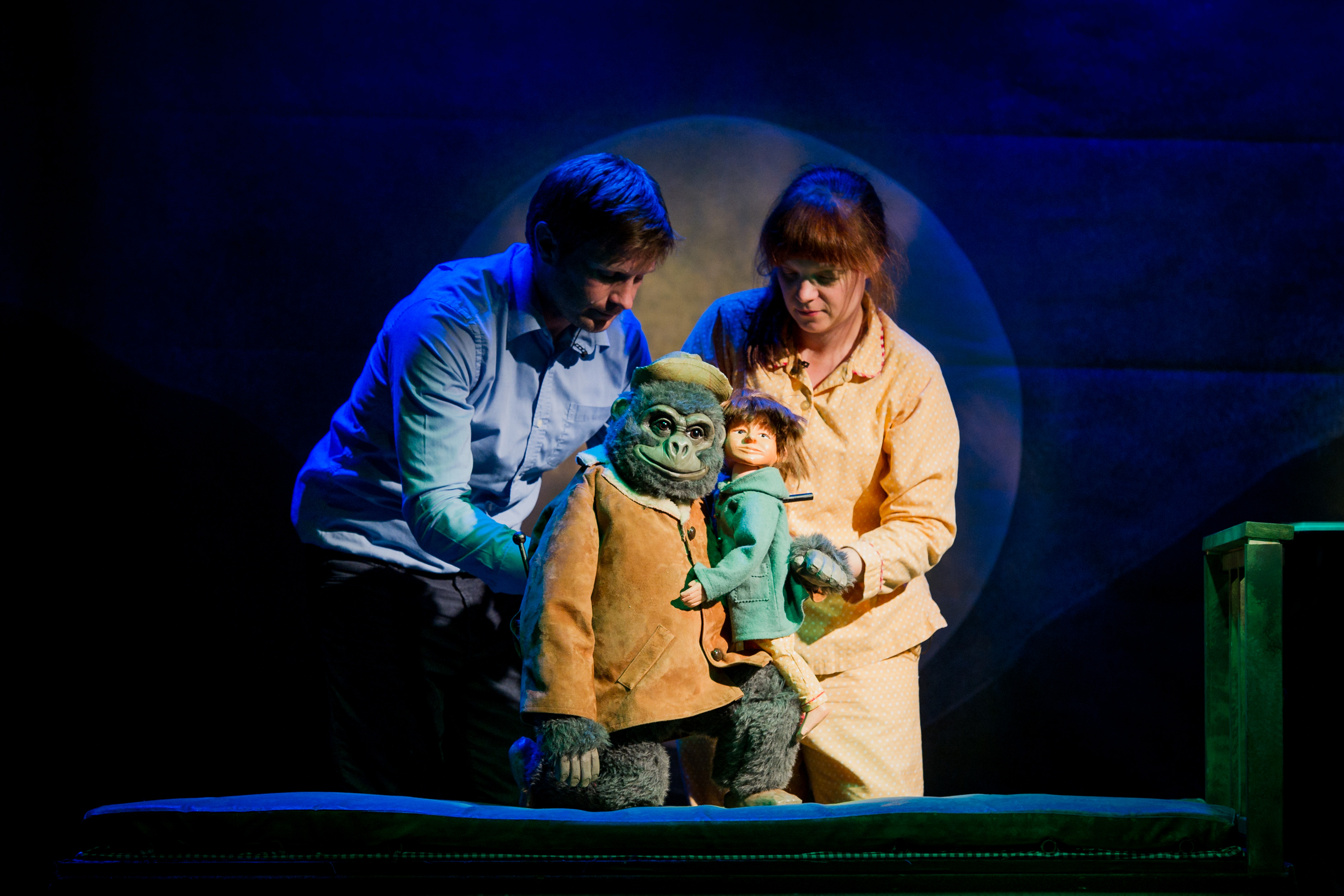
Gorilla Revival - Polka TheatreHannah is a little girl that loves gorillas. She spends all day drawing them, watching programmes about them, and talking about them. She tries to share her love for these wonderful animals with her dad, but he’s too busy. Then, on the night of her birthday she received a small toy gorilla that comes to life and takes her on an adventure, teaching her about kindness and gratitude, and her dad then gives her the best birthday ever. This classic children’s book, Gorilla, is charmingly brought to life with two actors, two puppets and a detailed but lo-tech set for children aged four to eight at Polka Theatre.

The story is a wonderful little adventure, executed quietly and calmly, without special effects and updating to reflect present day. Even the music sounds like it comes from a 1970s lounge bar. Initially I found it all terribly old fashioned, but considering the technology children are bombarded with today, it makes a refreshing change and reminds us that children don’t need an ipad and hi-tech toys to entertain them by the time they’re 3. After Hannah’s introduction, the sequence to establish her day-to-day routine and dad’s busyness is rather repetitive; the children in the audience became a bit fidgety and chatty. Once Hannah’s birthday arrives and the adventure begins through puppet versions of the characters, the audience of little ones becomes quiet and focused. Set changes tend towards the lengthy side, but the reveals that come from the set flips, rope tugs and lighting changes are choreographic in and of themselves.

The puppets suit the design of the set, old fashioned but still detailed and expressive. Actors Ceri Ashcroft and Phil Yarrow are good, with lovely chemistry, though at times it was hard to hear Ashcroft during the songs. The barometer for children’s theatre is the children in the audience though, and these maintained a steady focus once Hannah and her gorilla friend meet. They took some time to settle and weren’t grasped by the beginning exposition, but the rest of the play more than compensated.

There were some lovely staging choices by director Roman Stefanski. Particularly notable are the puppets coming into the audience as it transformed into a cinema and watching the audience as zoo animals from outside the bars of the cage. Transforming the human sized set into a puppet sized one also enchanted the audience, both adult and child. This is particularly praise-worthy as the transitions were quite lengthy and all changes (or most of them) looked operated solely by the performers.

This was my first visit to the Polka. What I found most disappointing was that the house was only half full. The theatre could certainly do with the revenue full houses generate, and this production makes a refreshing change from the fancy bells and whistles of West End family shows. The building emanates a warm sense of community that local families should enjoy more often, and it’s a break from fast and loud modern life. After all, people my age and older thrived in a childhood without the internet and handheld gadgets. Gorilla not only tells a sweet story with a strong female child as a lead, it proves that children today can enjoy live entertainment that quietly focuses on old fashioned adventure storytelling.


The Play’s The Thing UK is an independent theatre criticism website maintained voluntarily. Whilst donations are never expected, they are hugely appreciated and will enable more time to be spent reviewing theatre productions of all sizes. Click here to make a donation with PalPal.