Interview: Isley Lynn on Skin a Cat

rsz_skin-a-cat-main-image-digital

The upcoming opening of new venue The Bunker has certainly generated plenty of buzz, but what has excited me most about their debut season is that Rive Productions is bringing back Isley Lynn’s Skin a Cat for a three-week run. Hugely deserving winner of Vault Festival’s Pick of the Year, Skin a Cat is the coming-of-age story of Alana, a young woman who, like most young people, just wants to lose her virginity – but there’s something in the way. I spoke with writer Isley Lynn about the importance of Alana’s story, why stories like hers need to be told and how Lynn is working for more diversity in British theatre.

TPTTUK: Why does Alana’s story need telling?

IL: I’ve always been most interested in telling stories I haven’t heard before. I get so bored and frustrated when I see a show that’s beautifully produced/designed/directed/written/performed but tells me nothing I didn’t already know, or shows me nothing I haven’t seen so many times over. The bar really is so low for new stories – stories about differently abled people, women-centred stories, unconventional stories of anyone non-white, I could go on. Stories that give us new perspective are so important and exciting that I want to spend my time telling them. And the stories about sex – especially first sex – never matched up with my own experiences, so I figured I should tell mine. It really was as simple as that, but that’s also why it’s important.

TPTTUK: You use several dramatic forms and styles in Skin a Cat. Tell me a bit about these choices and the reasons behind them.

IL: To be honest, the play was so easy to write that it came out without too much thought. The stylistic qualities were organic to the material – and I had plenty of lived material to work with! I felt the direct address was important because it allows Alana to be honest and open with the audience in a way she isn’t able to be with the characters onstage with her. In a play about the pressures of how others see you and what effort it is to please, it felt crucial to keep this [play focused on] her story, her testimony, her voice.

So much of the action happens mid-coitus, and I had no idea how to put sex on stage. All credit to our wickedly brilliant director Blythe Stewart for its staging (this was definitely the most fun I’ve ever had in rehearsals, and I’m still impressed with how she managed to create a representational, physical language without resorting to silly hip thrusts).

TPTTUK: What would you like audiences to take away from Skin a Cat?

IL: We only had six performances at the Vault Festival, but after every one I had someone approach me and share their own embarrassing story, or their own experience of sexual shame or difference. That’s exactly the reaction I hope for at the Bunker – I want people to be able to see themselves in Alana’s story, and feel emboldened to talk about their experiences with strangers and friends and loved ones, because that’s the only way we can start to realise how we all “fall short” of the expectations placed on us – and not just with sex, but in so many other areas of our lives – and how unimportant and unhealthy those expectations can be.

TPTTUK: What are the biggest issues in the theatre industry today? Is your work combating them?

IL: I hope I am – I’m trying to. So many of the issues in our industry have their roots in the lack of representation. I’ve already talked about how important it is to have a diversity of stories and that’s a big part of it, but the responsibility for that is at the feet of everyone, not just writers – It’s important to create opportunities for underrepresented people on the stage, but it’s worthless if those individuals are not in a position to take opportunities available to them because they can’t afford to work for low or no pay, for example, or if they couldn’t afford the outrageous drama school audition [fee] in the first place. I have no idea how to fix that with unpaid work being the foundation for any career (certainly mine) and so much the norm.

Often, only people with strong financial support behind them can take full advantage of what’s out there. There are great one-off schemes, and great venues doing their part (like the Hope Theatre with their Equity house agreement on pay), but until the entire industry is a viable career option [for anyone], we won’t have a community that reflects the world we live in, and that’s the primary job of the arts.

TPTTUK: Isley Lynn fans are dying to know: what’s coming up next?

IL: I’ve been working with one of my absolute favourite actors on a one woman show that, if all goes well, should have a life at the 2017 Edinburgh Fringe and hopefully beyond. It’s about a English-Egyptian woman who takes up pole dancing when her husband leaves her for the revolution in Cairo. It’s going to be a unique perspective on the battle over women’s bodies and what that means when you have to navigate two very different worlds, when you’re not fully on one side or the other.

Skin a Cat runs 12 October – 5 November.

The Play’s the Thing UK is committed to covering fringe and progressive theatre in London and beyond. It is run entirely voluntarily and needs regular support to ensure its survival. For more information and to help The Play’s the Thing UK provide coverage of the theatre that needs reviews the most, visit its patreon.

Electric Eden, Edinburgh Festival Fringe

https://www.thestage.co.uk/wp-content/uploads/2016/08/Electric-Eden-700x455.jpg

Tommy Eden, a pensioner with a love for street performing since he retired, is dead. Local entrepreneur Alexander Sheldon’s security guards are responsible. Sheldon didn’t like Tommy performing outside his high end spa and leisure centre, but when the guards manhandled him off his patch, Tommy’s 87-year-old body couldn’t take it. Local young people, angry at the rapid gentrification of their town and the death of a local treasure, organise a protest/party in the abandoned club across the road, and everyone’s invited.

Not Too Tame’s Electric Eden doesn’t manage to deliver much of a party, though. Shouty political slogans and several under-developed subplots give a vague picture of a bigger problem, and staging choices fight against the attempted audience immersion. The concept promises a dynamic execution, but the delivery disappoints.

Seven characters at the party are featured, including organiser Greg (Andrew Butler) and Tommy Eden’s granddaughter, Grace (Louise Haggerty). Their stories, as well as those of the other five characters, are gradually presented through disconnected scenes in between dance numbers and party games. The audience are sometimes invited to join the dancing, other songs are tightly choreographed.

An exposition of protest rhetoric delivered down a mic, petition signing and ordering drinks from the bar is too long. Each of the characters’ individual stories only gets a couple of scenes, so they come across as generic snapshots of character types rather than real people.

The audience are provided with chairs so even though director Jimmy Fairhurst wants to create a party atmosphere, inevitably the majority of the audience end up sitting and watching for the entire performance. Choosing a club as a venue adds little with such a clear distinction between the actors and the audience, and the continuous reiteration that this is a party comes across as forced and false.

The performances are fine and there’s some tight choreography, though this also feels out of place with the attempts to create an anarchic/punk atmosphere. Electric Eden tries to be both a genuine party and a play, but the two aesthetics are so diametrically opposed that neither ends up working within the piece.

The whole experience is frustratingly flat, though it shows such promise on paper. With a script overhaul and a clear vision as to what Electric Eden wants to achieve, it would be a stronger piece. As is, it comes across as a confused and undeveloped piece.

Electric Eden runs through 29th August.

The Play’s the Thing UK is committed to covering fringe and progressive theatre in London and beyond. It is run entirely voluntarily and needs regular support to ensure its survival. For more information and to help The Play’s the Thing UK provide coverage of the theatre that needs reviews the most, visit its patreon.
Counting Sheep, Edinburgh Festival Fringe

https://i.guim.co.uk/img/media/23913cc392a98f67736cd3cdca806a6774c8940b/0_0_2048_1363/master/2048.jpg?w=620&q=55&auto=format&usm=12&fit=max&s=1feba80ccb7ff150a5842abd1e15ee76

Just over two years ago, a revolution in Kiev ushered in the downfall of the Ukranian government. Protests against the government’s refusal to sign pro-EU legislation lasting months had several violent outbursts that saw hundred of people injured and 780 killed. Toronto-based Ukrainian musician Marichka Kudriavtseva, in Kiev for work at the time, joined the protesters where she met Mark Marczyk, also based in Canada.

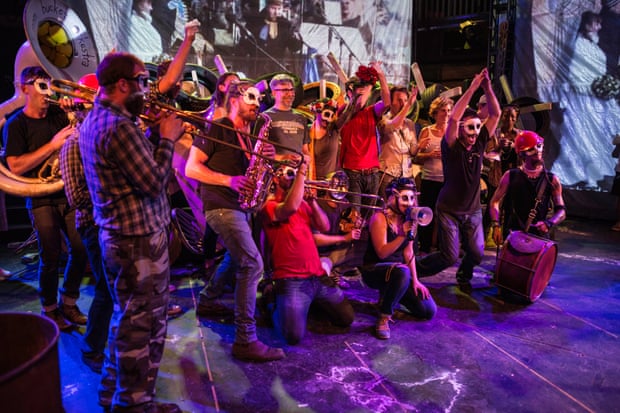
When the two returned from the Ukraine, they teamed up with Marczyk’s Lemon Bucket Orkestra to create Counting Sheep, an immersive “guerrilla folk opera”. A celebration of solidarity and the power of a collective voice, it also mourns those who died in the protests. Told from the perspective of the protesters, little is shared from the other side – but this rallying performance is fitting homage to not just the Ukrainian protesters, but those fighting government tyranny around the world.

Some audience sit around a huge table, whilst others sit on the sides of the space and still others up in a balcony. Klezmer or folk music is playing as the audience enters; there is a convivial atmosphere as the show formally starts. This is a party, or a wedding, or some other huge gathering, until the three screens display news reports of riots and police enter. The tone abruptly shifts, and the world that has been established is dismantled. It’s a wonderful, unsettling surprise.

The space is consistently reformed and redrawn using movement, and the audience is physically moved in the wake of the protesters’ gains and losses. They are willing and unquestioning, the sheep of the title. Though the numbers here obviously pale to those at the actual protest, incorporating the audience in acts such a building barricades and lobbing bricks at police fosters unity from disparate dozens. There is a hint of the solidarity and aggression found in protests, and joy and celebration from the audience who are keen to play. Being served food is also an important enabler that solidifies the unity the show aims to create.

Counting Sheep is hugely effective in its emotional manipulation, and also it’s storytelling through music, movement and projections. Choosing sheep as a metaphor is a curious choice, though. The benign but rather dumb livestock aren’t known for thinking for themselves and are susceptible to herding – otherwise, they wander around unproductively, getting lost and eaten by predators. Whilst the performers are the herders here, they are also in sheep masks, unempowered. Who then are the herders? The government? Unseen forces of political and social unrest? Whatever it is, us human beings are hugely susceptible to it when motivated enough, even if the metaphor isn’t totally clear.

Though sung completely in Ukrainian, there is a clear storyline conveyed through projections and movement. There is little nuance in this piece, but it a playground for the sweeping emotions of popular theatre. It provides at least a hint of the experience that the Ukrainian protesters endured, and powerfully unites the audience through the humanity of collective experience for a common goal. An excellent piece of theatre.

Counting Sheep runs through 29th August.

The Play’s the Thing UK is committed to covering fringe and progressive theatre in London and beyond. It is run entirely voluntarily and needs regular support to ensure its survival. For more information and to help The Play’s the Thing UK provide coverage of the theatre that needs reviews the most, visit its patreon.

Revolt. She Said. Revolt Again., Edinburgh Festival Fringe

https://cdn2.rsc.org.uk/sitefinity/images/productions/2016-shows/Making-Mischief/revolt-2016-production-photos/revolt-she-said-revolt-again-production-photos_-2016_2016_photo-by-richard-lakos-_c_-rsc_201024.tmb-gal-670.jpg?sfvrsn=1

Playwright Alice Birch wants to start a revolution. Revolt. She Said. Revolt Again. seeks to challenge the patriarchal language and social structures that hold woman second place to men. Being polite and socially acceptable isn’t going to achieve this, and the marketing material states that this play is not well behaved.The issue is that it is. The collection of scenarios with chaotic climax and resigned footnote of an ending starts out strong, but quickly loses sight of its goals through a lot of talking but few suggestions for effective action.

The first scene between a heterosexual couple is the most effective as he talks about all the things he wants to do to her body, and she corrects his language from one of his ownership to one of hers. The subject matter is provocative, funny and establishes a model that women can actually use. It’s not badly behaved, though – it’s polite, considerate and a bit uncomfortable, but not revolutionary. Subsequent scenes have less of a practical application; this isn’t a problem in and of itself, but these scenarios are much less of a catalyst in a show about taking action. There is some rejection of social convention, but little seen as radical. A culminating babble of voices largely indistinct from each other goes on entirely too long and due to the challenge of deciphering specific lines has little impact.

A cast of four, three women and one man, play a range of characters though disappointingly, the characters are middle class and English. Surely the issues that are presented – the language of sexual domination, consent, reproduction, family, flexible working – effect working class people as well.

Madeleine Girling keeps her set simple and efficient, using only items that are fully functional to each scene. Lighting designer Claire Gerrens creates angular, starkly delineated spaces that support the simple demand for equality and empowerment.

Birch certainly uses language well and constructs dynamic, interesting characters but the lack of much motivating material creates a lot of bluster with little change. The script also avoids any issues of intersectionality, particularly social class and race, even though one of the actors is black. Her goals are certainly admirable, but Revolt. She Said. Revolt Again.? More like have a chat and then carry on with your life.

Revolt. She Said. Revolt Again. runs through 28th August.

The Play’s the Thing UK is committed to covering fringe and progressive theatre in London and beyond. It is run entirely voluntarily and needs regular support to ensure its survival. For more information and to help The Play’s the Thing UK provide coverage of the theatre that needs reviews the most, visit its patreon.

Agent of Influence: The Secret Life of Pamela More, Edinburgh Festival Fringe

https://i0.wp.com/www.underbellyedinburgh.co.uk/images/made/images/uploads/pamela_more_750_500_60_c1.jpg

Lady Pamela More covers fashion and socialites for The Times and she has no interest in any other topic. As Britain’s involvement in the war becomes certain, her disinterest in politics and international affairs wanes, and her social circles are split into those who support Germany and those who believe the whispered stories coming across the channel. With newfound purpose and contacts, the use of her journalistic skills changes direction to a more practical use – she is recruited to spy on Britain’s elite.

Sarah Sigal reinvents Pamela from her 2014 Park Theatre play World Enough and Time, now making the character the primary subject of a solo performance. Reprised by Rebecca Dunn, Pamela recounts her wartime adventures through past-tense narration and dialogue between herself and impersonated peers. She meets and watches real people from British history, moulding a clear perspective of their wartime activities – this is the most interesting aspect of the narrative. Who the audience is, or why she is telling us her story is never made clear, though. Her tale is interesting enough, but what is it’s point?

The scenes Dunn enacts are more dynamic than the stretches of narration that span the years surrounding the war. She employs accents and an impressive vocal range to differentiate between herself and those she converses with, often with charm and humour. Her storytelling is good enough to maintain attention, but as no moral or message emerges from the text, the ambiguity of the script dwarfs Dunn’s ability.

Agent of Influence: The Secret Life of Pamela More suits a written format much more so than a staged one – it would make a lovely novella what with its detailed description of the setting and characters involved. Though its well performed and a good story in and of itself, theatricality gets in the way, making this solo performance piece fall flat.

Agent of Influence: The Secret Life of Pamela More runs through 28th August.

The Play’s the Thing UK is committed to covering fringe and progressive theatre in London and beyond. It is run entirely voluntarily and needs regular support to ensure its survival. For more information and to help The Play’s the Thing UK provide coverage of the theatre that needs reviews the most, visit its patreon.

Maggie and Pierre, Finborough Theatre

https://i0.wp.com/www.theartsdesk.com/sites/default/files/imagecache/mast_image_landscape/mastimages/KellyBurke5_PhotoByAshley%20Carter_REDUCED.jpg

It’s easy to see why Justin Trudeau is one of the darlings of world politics these days. This charming former teacher, actor and advocate, turning to politics after his father’s death, identifies as a feminist, wants to legalise marijuana, is pro-choice, gay friendly and committed to the rights of the First Nations and other minorities. Canada’s liberal prime minister attracts groups of screaming fans wherever he goes both nationally and internationally, like any pop star. But where did these attributes come from?

His parents. Maggie and Pierre Trudeau, who met whilst holidaying in Tahiti in the ‘60s when she was a mere 18 years old, were THE Canadian celebrity couple of the 1970s. Pierre was, like his son after him, the prime minister of Canada. Their relationship was flawed, though. Maggie, young, free-spirited and bipolar, soon felt trapped by family life as her intellectual husband busied himself with work. The press’s constant presence also took its toll on their relationship, which the public then poured over in microscopic detail. In 1979, Linda Griffiths’ and Paul Thompson’s Maggie and Pierre premiers, a solo performance tribute to this enigmatic couple. It runs off and on for many subsequent years, a testament to the pair’s appeal.

The script feels quite contemporary, but other than for the purpose of historical documentary, its purpose isn’t clear all these years later. Though the two meet, fall in love and navigate their relationship, life in the spotlight, and the press, there’s no overriding message. It’s unclear why this story needs to be told. It’s a solid narrative over many years with moving insight into these historical figures, but the social and political commentary are limited to brief reflection on their relationship with the press. Perhaps this play would be more satisfying to Canadians or those that already know of the Trudeaus, but for audiences that have never before heard of this couple, there is little impact. It reads like an autobiography. Outstandingly performed by Kelly Burke and worth seeing for her intricate work alone, there’s the feeling that without her, the play would be disappointing.

Burke plays Pierre, Maggie and journalist Henry whose career has hinged on his reporting of their every move. Even though director Eduard Lewis incorporates numerous costume changes to signify a character change, Burke’s physical and vocal mannerisms completely transform into each respective character. It’s a wholly compelling process, a masterclass in performance. Her energy and commitment never falters and her presence is magnetic.

Designer Sarah Booth’s set is simple, but a confusing mix of abstract and functional elements. A huge, bright red quilt with Pierre’s slogan takes up half the stage and is only referred to once, near the end. Its visual dominance is impossible to ignore but it has hardly any bearing on the story. However, Booth’s creation of a bed that’s revealed from a nondescript cupboard is a great device. Philip Matejtschuk’s composition and sound design adds further depth, emotion and context that the set avoids, giving the show a more rounded, polished feel.

As a documentary artefact, Maggie and Pierre is no doubt a learning experience. The couple’s history is an interesting one and the love story is universally relatable. Kelly Burke’s performance is a wondrous thing to experience though, and more than redeems any of the production’s inadequacies.

Maggie and Pierre runs through 5 July.

The Play’s the Thing UK is committed to covering fringe and progressive theatre in London and beyond. It is run entirely voluntarily and needs regular support to ensure its survival. For more information and to help The Play’s the Thing UK provide coverage of the theatre that needs reviews the most, visit its patreon.
Karagula, Styx

Karagula at The Styx, courtesy of Lara Genovese @ Naiad Photography, Charmaine Wombwell

In a former ambulance depot in Tottenham Hale, Philip Ridley’s latest creation comes to life. This epic parallel world of wholly isolated nation states resembles the worst dystopias imaginable in contemporary fiction. Mareka is a 1950s America with laws enforced to the letter by the Grand Marshall, everyone wears pink, and milkshakes are consumed with religious zeal. Cotna is the future, where people are have numbers instead of names, and watching meteor showers without protective eyewear causes you to hear voices. Then, there’s a community of exiles in the mountains, living in caves, wearing skins, and praying to pre-Christian gods. A storyteller/historian in yet another time and place documents these people and their trials.

These kingdoms have a lot of detail, and a lot of emptiness. The story sprawls over three hours, zipping back and forth across time and place, leaving a swirl of slow understanding, further questions and obvious metaphor in its wake. The text is rich and beautiful, fragmentary and challenging, but it’s only partially reinforced by design. A scaffolding base reveals occasional moments of visual detail, but they generally pale against the language. Karagula is equally marvelous and horrible, an experience for all the senses with stories that enthrall and disturb in equal measure. But Ridley’s Tolkien-esque ambition never reaches its full structural potential.

Individual scenes are just as likely to delight as they are to be forgotten. If Karagula was a tapestry, it would be patchy and moth-eaten in some areas, others would have exquisite embroidery, and still others would be completely plain and ill-fitting. The gaping plot holes leave room for interpretation, but the better scenes feel all the more out of place. Ridley either needs to pare the script right back, or add another couple of hours to join up these worlds more fully. The whole experience is equally delightful and frustrating.

Nine actors play all roles in some exemplary multi-rolling. Producing company PigDog is committed to diversity in casting and audiences, and this cast is admirably so. Obi Abili is a terrifying brutal Grand Marshall in Mareka. Emily Forbes is the fiery leader of the mountain outcasts, initially motherly, then ruthless. Lynette Clarke is similarly versatile, as a flamboyant and vicious Marekan and a cold number in Cotna. None of the ensemble ever let their energy drop; their work is just as fantastic as Ridley’s best scenes.

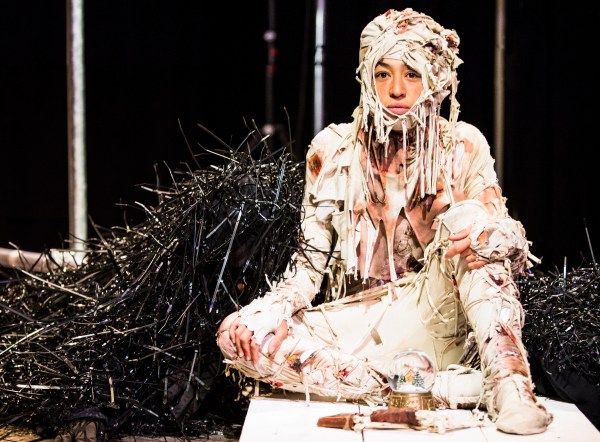
Director Max Barton approaches the text with clear vision and choices that aid clarity, even in the muddiest sections of text. Designer Shawn Soh has moments of brilliance (beasts with coats of cable ties and a throne of gears and propellers for the narrator are fantastic surprises), but the shoestring budget is noticeable in the inconsistent application of detail.

Despite it’s issues, Karagula packs an emotional punch with social commentary and nihilistic fortune telling. Mareka foreshadows a Trump-led America, and Cotna is a land where technology has ushered in the loss of individualism. There are moments of wonder and horror, and sheer bafflement. Philip Ridley’s vision is commendable, but the execution isn’t quite there, leaving the audience partially sighted. It’s a wondrously alive and human production and like any given human being, it has it its faults and its virtues.

Karagula runs through 9 July.

The Play’s the Thing UK is committed to covering fringe and progressive theatre in London and beyond. It is run entirely voluntarily and needs regular support to ensure its survival. For more information and to help The Play’s the Thing UK provide coverage of the theatre that needs reviews the most, visit its patreon.

A Nation’s Theatre: Wail and The Beanfield, Battersea Arts Centre

For two months, theatre makers from across the country are coming to London to celebrate the state of British theatre. One of the A Nation’s Theatre venues is Battersea Arts Centre, currently hosting the double bill of Little Bulb’s Wail and Breach Theatre’s The Beanfield. Wail is an exuberant cabaret about whales and human expression; The Beanfield uses multimedia to examine the impact of police violence on peaceful people and the need to fit in. Though different from each other in content and tone, both Little Bulb and Breach play with performance conventions to create innovative new structures that are at the forefront of theatre performance.

WAIL_Little Bulb Theatre

There’s a lot of science in Wail, and a lot of musical instruments. Actor-musicians Clare Beresford and Dominic Conway, performing as themselves, also have boundless enthusiasm and impressive music repertoires. With material ranging from folk to metal, they share their enthusiasm for whales through songs alternating with monologues of scientific facts. Their charisma and cheer keeps these sections engaging, particularly with the addition of audience interaction. Though the overall energy is light and positive, Beresford’s melancholy for never actually seeing a whale in the flesh provides a bit of contrast to the Male Whale Choir, a hilarious whole-audience exploration of whale songs that males use when on the pull in the coastal waters of Madagascar.

There isn’t as much material on the promised exploration of why humans wail, but a song about why they sing songs is a tender, poignant homage to feeling fragile. This fun, frivolous show is light on the gravitas that a bit more time on this topic could bring, but Wail is still a wonderful, joyful piece as is. The symphonic final number is a fantastic climax wrapping up an excellent contribution to A Nation’s Theatre.

The Beanfield_014_please credit Richard Davenport

The Beanfield by Warwick University’s Breach Theatre wowed audiences at Edinburgh last summer, and understandably so. Drawing on the historic clash between new age travelers heading to Stonehenge and police fresh from the miners’ strikes, they add the framing device of a uni reenactment group researching the event in order to recreate it, and a counter narrative of a group of students going to Solstice. It’s a sophisticated script with plenty of absurdity to lighten the bleak depiction of police violence against unarmed civilians, but still serves as a potent reminder that this happens today in the UK and abroad. Part documentary, interview footage with witnesses on both sides is broadcast liberally; even though the inclusion of police is sympathetic, The Beanfield firmly supports the travelers. Rightly so – pregnant women and children were among the 600 or so attacked with truncheons and projectiles by 1000-odd police.

There is no explicit link between the Beanfield story and that of the contemporary, skeptical students at Solstice, but the inclusion of the latter provides some necessary humour. It’s not a needed subplot though, and detracts from the power behind the political statement of the Beanfield standoff. The script is a great collage of experiences past and present, the sweet naivety of students juxtaposing the atrocities that happened at thirty years previously. The Beanfield, a bit less polished than Wail, is still an excellent piece of theatre with some important thoughts on police brutality.

With multimedia at its forefront, The Beanfield captures the rapid-fire sensory bombardment of present day youth and the desire to instigate change as well as fit in with our peers. Wail, mostly analogue and much less angry, implies the importance of conservation and sympathy for all creatures, human and not. Both shows excellently address concerns of people in this country and experiment with performance, fitting contributions to A Nation’s Theatre.

Wail runs until 23 April, The Beanfield until 21 April then touring.

The Play’s the Thing UK is committed to covering fringe and progressive theatre in London and beyond. It is run entirely voluntarily and needs regular support to ensure its survival. For more information and to help The Play’s the Thing UK provide coverage of the theatre that needs reviews the most, visit its patreon.
The Broke ‘N’ Beat Collective, Battersea Arts Centre

https://i0.wp.com/www.20storieshigh.org.uk/wp-content/uploads/2016/02/Jack-and-Lateefah-1280x853.jpg

Kids have it tough, especially if they’re poor. Decreasing social mobility, higher costs of education and living, and decreasing welfare are trapping our future generations in inescapable cycles of poverty. They are just as aspirational as young people from more privileged backgrounds and aware of the opportunities they don’t have. They are angry, frustrated and lack the opportunity to constructively express their feelings that often go completely disregarded by more comfortable members of society.

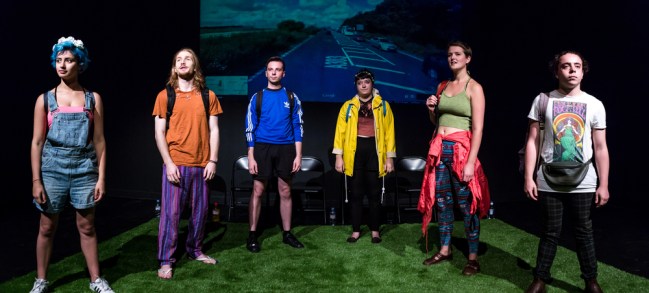
Theatre-Rites and 20 Stories High, seeing validity in their voices, worked with numerous young people in this demographic to devise a gig-theatre show that shares experiences of being a poor teenager in Britain today. The Broke ‘N’ Beat Collective is an empowering, important work that uses fantastic puppetry, mask and music to create a gloriously messy collage of young people’s concerns and issues. Structurally mirroring the rough and ready, fractured existence of urban youth culture, it rebels against theatrical and cultural preconceptions without apology for its flaws.

Elisha Howe’s (aka Elektric) soaring rhymes and Jack Hobbs (aka Hobbit) beatboxing energise the audience and establish a defiant, proud tone that carries through the show. They are not backing down, nor are B-boy Ryan Harson (aka LoGisTics) and puppeteer Mohsen Nouri. They literally zoom in on the tiny model tower blocks and street scenes of urban Britain, replicated in cardboard wonderfully extracted from the plain back wall, creating a landscape of alternating songs with monologues. These set pieces and puppets pass on the otherwise unknown life stories of young people they’ve met.

Omar is an insecure, confrontational grey hoodie that takes the whole show to find his voice. Jack’s a wannabe gangsta who knocks up Latifa (both with cartoonish, cardboard heads) and ditches her and the resulting child that reflects on how that’s shaped his life goals. Joanne is the Papergirl who cuts herself because her mum’s boyfriend abused her. There’s also the incredible Speaker Boy, a rotund, playful chap with a boombox for a head. Each puppet is as unique as the young person behind it, and just as inspiring. (Seriously, go look at the puppets’ photos in the gallery part way down the page; they are some of the most emotionally endowed bits of paper and foam I’ve ever encountered. All of these characters unashamedly demand attention with precise, evocative storytelling and a joyfully visualised presence. These stories are broadcast along side an ever-changing soundtrack with interjections of dance, banter and spoken word, simultaneously creating an atmosphere of celebration and seriousness. Though fun, it never loses the sense of the weight behind the work.

Despite the boldness in the work and the importance of its messages, there are some sloppy transitions that cause the piece to lose momentum. Elektric unnecessarily introduces each number by name, and there are some in-jokes between the performers that, whilst sweet, don’t carry energy with their small scale. This gives the whole piece a choppiness that makes it feel unfinished.

All four performers’ exemplary skillsets and vibrance are fantastic vehicles for the young people of this country seeking escape from the poverty that is so limiting to their ambition. Each moment connects to the next through a theme rather than a storyline, but the effect mirrors modern society: a bit messy, emotional and ambitious for a better life. The fun doesn’t override or trivialize the seriousness, and neither is it too weighty. The unpolished feel is very much ingrained in the gig-theatre style, and though it would be great to learn more about the characters presented, The Broke ‘N’ Beat Collective truly holds a mirror up to nature.

The Broke ‘N’ Beat Collective runs through 2 April.

The Play’s the Thing UK is committed to covering fringe and progressive theatre in London and beyond. It is run entirely voluntarily and needs regular support to ensure its survival. For more information and to help The Play’s the Thing UK provide coverage of the theatre that needs reviews the most, visit its patreon.

Gardens Speak, Battersea Arts Centre

5 Tania El Khoury _Gardens Speak_please credit James Allan for Fierce & Artsadmin

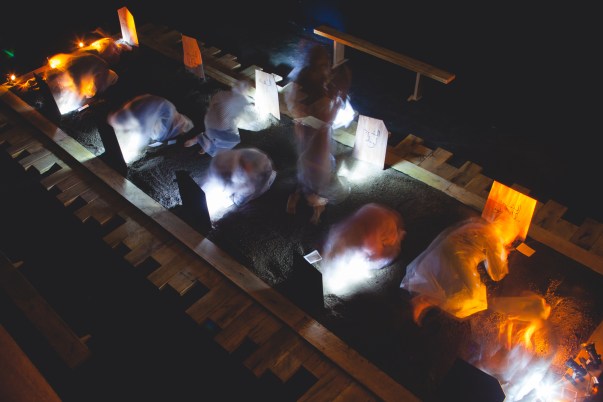
In Syria, Asad’s regime attacks the funeral services for rebel fighters. Rather than holding public burials, families bury dead martyrs in their gardens, usually with no tombstone. In tribute to these people, live artist Tania El Khoury has created an interactive sound installation with the stories of ten martyrs buried in gardens. An intimate audience of ten each hear the recorded monologue of an individual martyr who died fighting against Asad’s forces, but they have to experience some discomfort in the process. Gardens Speak lasts a mere 30 minutes but irrevocably alters the detached western view of Middle Eastern conflict, fostering empathy and despair for fellow man.

In a small room, we are asked to remove our shoes and socks, put our belongings to one side and don an over-sized raincoat. Once everyone is ready, the door is opened to a darkened room with ten tombstones lining the edge of a large wooden frame filled with soil. Each person is handed a postcard and a small torch. Following the instructions on the card, we each find the tombstone pictured. To hear the story of the person buried in that grave, we dig into the rich, peaty earth that scents the room. What with the competing sounds of other recordings, to hear properly we kneel or lie in the dirt.

The narration is a simple, unembellished tale of one man’s fight and fall at the hand of the tyrannical government. It’s neither overly graphic but neither does it hold back. The environment created by the set strongly influences the mood – there is a pronounced gravitas in the space. The whole effect doesn’t overwhelm, but imbeds itself internally, somewhere in the depths of the gut, along with the spirit of the young man who’s life spoke from the dirt I lie in.

We are lucky: the room is warm, and our clothes are protected from the soil. After the narrative of a man’s life, death and burial in his mother’s garden and a sound bath in Arabic singing, we can wash our feet (a reassuring ritual element that also adds to the aesthetic of the piece), collect our things and go home to our comfortable, little lives. Gardens Speak is both a little installation and one that encompasses the whole of humanity.

The Play’s the Thing UK is committed to covering fringe and progressive theatre in London and beyond. It is run entirely voluntarily and needs regular support to ensure its survival. For more information and to help The Play’s the Thing UK provide coverage of the theatre that needs reviews the most, visit its patreon.